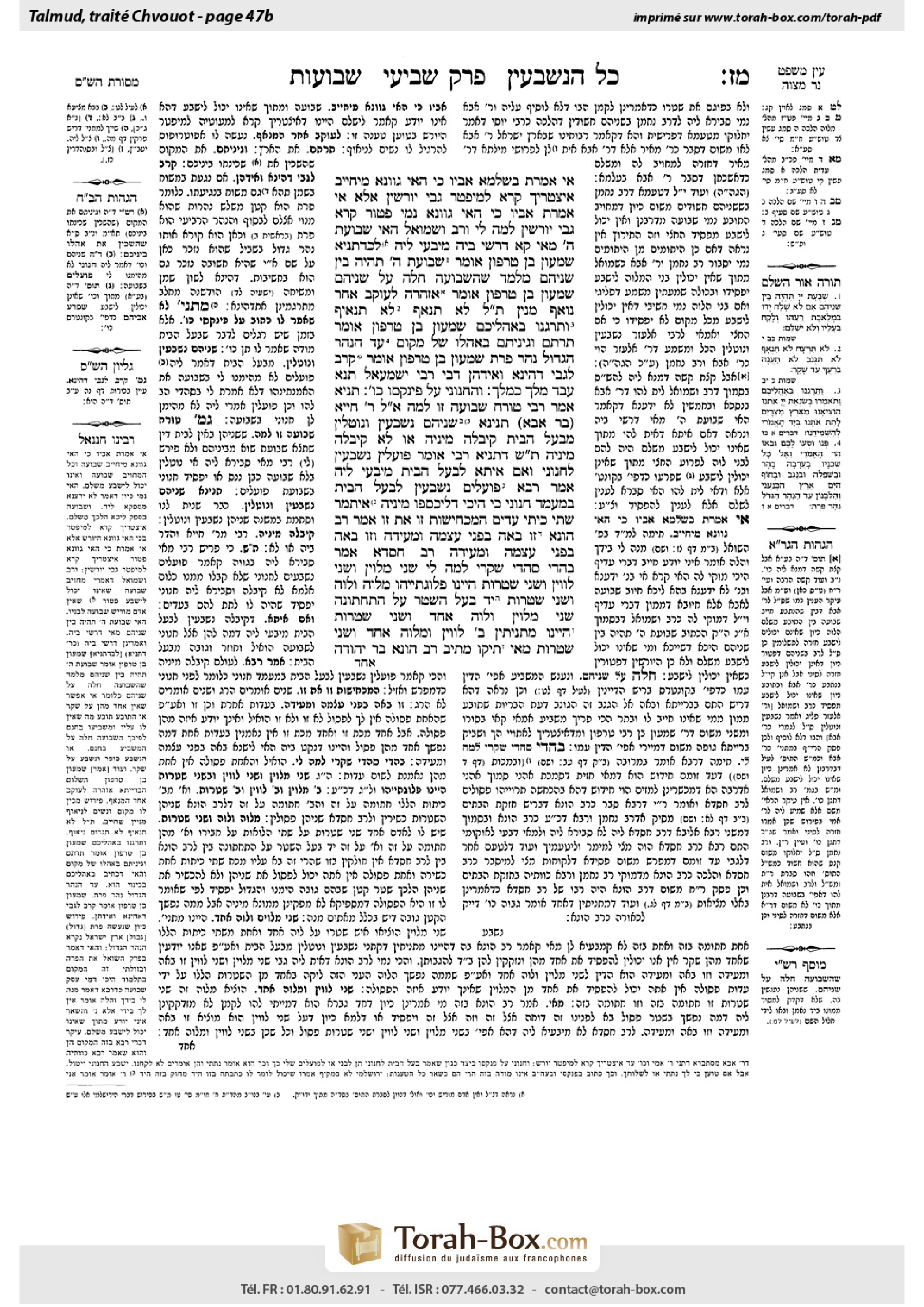
Shevuot 47b: Talmud study for Daf Yomi
Daf Yomi is the daily study of one Talmud folio. Explore 37 tractates with scans, Hebrew text, Sefaria English and AI-generated French translations where annotated.
Passage selection and English or AI-generated French translation are available where the scan has annotations. Daf Study is independent of Torah-Box and Sefaria.
Browse Shevuot · שבועות · All tractatesShevuot 47b text and translations
This page of Shevuot includes the Aramaic text, an English translation and an AI-generated French translation, alongside the scan above.
שבועות מ״ז ב · Aramaic and Hebrew text
אִי אָמְרַתְּ בִּשְׁלָמָא אָבִיו כִּי הַאי גַוְונָא מִיחַיַּיב, אִיצְטְרִיךְ קְרָא לְמִיפְטַר גַּבֵּי יוֹרְשִׁין; אֶלָּא אִי אָמְרַתְּ אָבִיו כִּי הַאי גַוְונָא נָמֵי פָּטוּר, קְרָא גַּבֵּי יוֹרְשִׁין לְמָה לִי?
וְרַב וּשְׁמוּאֵל – הַאי ״שְׁבֻעַת ה׳״ מַאי קָא דָּרְשִׁי בֵּיהּ?
מִיבְּעֵי לֵיהּ לְכִדְתַנְיָא, שִׁמְעוֹן בֶּן טַרְפוֹן אוֹמֵר: ״שְׁבֻעַת ה׳ תִּהְיֶה בֵּין שְׁנֵיהֶם״ – מְלַמֵּד שֶׁהַשְּׁבוּעָה חָלָה עַל שְׁנֵיהֶם.
שִׁמְעוֹן בֶּן טַרְפוֹן אוֹמֵר: אַזְהָרָה לָעוֹקֵב אַחֵר נוֹאֵף, מִנַּיִן? תַּלְמוּד לוֹמַר: ״לֹא תִּנְאָף״ – לֹא תַּנְאִיף.
״וַתֵּרָגְנוּ בְּאׇהֳלֵיכֶם״ – שִׁמְעוֹן בֶּן טַרְפוֹן אוֹמֵר: תַּרְתֶּם וְגִינִּיתֶם בְּאׇהֳלוֹ שֶׁל מָקוֹם.
״עַד הַנָּהָר הַגָּדוֹל נְהַר פְּרָת״ – שִׁמְעוֹן בֶּן טַרְפוֹן אוֹמֵר: קְרַב לְגַבֵּי דְהִינָא, וְאִידְּהַן. דְּבֵי רַבִּי יִשְׁמָעֵאל תָּנָא: עֶבֶד מֶלֶךְ – כְּמֶלֶךְ.
וְהַחֶנְוָנִי עַל פִּינְקָסוֹ כּוּ׳. תַּנְיָא, אָמַר רַבִּי: טוֹרַח שְׁבוּעָה זוֹ לָמָּה? אָמַר לוֹ רַבִּי חִיָּיא (בַּר אַבָּא), תְּנֵינָא: שְׁנֵיהֶם נִשְׁבָּעִין וְנוֹטְלִין מִבַּעַל הַבַּיִת.
קִיבְּלַהּ מִינֵּיהּ, אוֹ לָא קִיבְּלַהּ מִינֵּיהּ? תָּא שְׁמַע: דְּתַנְיָא, רַבִּי אוֹמֵר: פּוֹעֲלִין נִשְׁבָּעִין לַחֶנְוָנִי. וְאִם אִיתָא, לְבַעַל הַבַּיִת מִיבְּעֵי לֵיהּ!
אָמַר רָבָא: פּוֹעֲלִים נִשְׁבָּעִין לְבַעַל הַבַּיִת – בְּמַעֲמַד חֶנְוָנִי; כִּי הֵיכִי דְּלִיכַּסְפוּ מִינֵּיהּ.
אִיתְּמַר: שְׁתֵּי כִּיתֵּי עֵדִים הַמַּכְחִישׁוֹת זוֹ אֶת זוֹ – אָמַר רַב הוּנָא: זוֹ בָּאָה בִּפְנֵי עַצְמָהּ וּמְעִידָה, וְזוֹ בָּאָה בִּפְנֵי עַצְמָהּ וּמְעִידָה. רַב חִסְדָּא אָמַר: בַּהֲדֵי סָהֲדֵי שַׁקָּרֵי לְמָה לִי?
שְׁנֵי מַלְוִין וּשְׁנֵי לוֹוִין וּשְׁנֵי שְׁטָרוֹת – הַיְינוּ פְּלוּגְתַּיְיהוּ; מַלְוֶה וְלֹוֶה וּשְׁנֵי שְׁטָרוֹת – יַד בַּעַל הַשְּׁטָר עַל הַתַּחְתּוֹנָה;
שְׁנֵי מַלְוִין וְלֹוֶה אֶחָד וּשְׁנֵי שְׁטָרוֹת – הַיְינוּ מַתְנִיתִין; שְׁנֵי לוֹוִין וּמַלְוֶה אֶחָד וּשְׁנֵי שְׁטָרוֹת – מַאי? תֵּיקוּ.
מֵתִיב רַב הוּנָא בַּר יְהוּדָה:
Shevuot 47b · English translation
Rabba continues: Granted, if you say that his father, in a case like this, would be liable to take an oath, due to his partial admission, then the verse was necessary to exempt the heirs from taking the oath. But if you say that in a case like this, his father is also exempt from taking an oath, why do I need a verse about exempting the heirs? Evidently, an oath reverts to one who is liable to take it, and when he cannot take that oath he must pay the claim against him.
The Gemara asks: And as for Rav and Shmuel, who hold that one who cannot take an oath does not have to pay, and therefore there is no difference between the heirs and the father, what do they derive from this verse: “The oath of the Lord shall be between them both” (Exodus 22:10)?
The Gemara answers: It is necessary for that which is taught in a baraita: Shimon ben Tarfon says: The verse: “The oath of the Lord shall be between them both,” teaches that when one litigant imposes an oath on the other, and he takes a false oath, the oath applies to them both, i.e., they are both held responsible for the desecration of God’s name.
Since this Sage was mentioned, the Gemara cites some of his other statements. Shimon ben Tarfon says: With regard to the prohibition of following after an adulterer, i.e., providing him with assistance in carrying out adultery, from where is it derived? The verse states: “You shall not commit adultery [lo tinaf ]” (Exodus 20:13). If the verse is vocalized slightly differently, it may be read: You shall not cause adultery [lo tanif ].
Commenting on the verse describing the response of the Jewish people to the spies’ slander of Eretz Yisrael: “And you murmured [vatteragenu] in your tents and said: Because the Lord hated us, He has brought us forth out of the land of Egypt, to deliver us into the hand of the Amorites, to destroy us” (Deuteronomy 1:27), Shimon ben Tarfon says: “Teragenu” is interpreted as though it is composed of two Hebrew expressions: You explored [tartem] the land, and: You disparaged [ginnitem] it, in the tent of the Omnipresent.
With regard to the verse: “As far as the great river, the river Euphrates” (Deuteronomy 1:7), Shimon ben Tarfon says: Although it is not the largest river, the Euphrates is called great in accordance with the adage: Draw close to the one anointed with oil and become anointed as well. Because the Euphrates is close to Eretz Yisrael, it is called great. The school of Rabbi Yishmael taught a similar idea: The servant of a king is like a king.
§ The mishna teaches that the storekeeper relying on his ledger takes an oath and receives payment. If an employer tells a storekeeper to pay his laborers, and the storekeeper claims he paid them, while the laborers claim that they did not receive payment, both the storekeeper and the laborers take oaths and receive payment from the employer. It is taught in a baraita: Rabbi Yehuda HaNasi said: Why is there the bother with this oath, that it is imposed upon both of them? Rabbi Ḥiyya said to him: We learn in the mishna (see 45a) that both of them take an oath and receive payment of their claims from the employer.
The Gemara asks: Did Rabbi Yehuda HaNasi accept from him that this is the halakha, or did he not accept it from him? Come and hear as it is taught in a baraita: Rabbi Yehuda HaNasi says: The laborers take an oath to the storekeeper that he had not paid them. And if it is so that Rabbi Yehuda HaNasi accepted Rabbi Ḥiyya’s ruling, then Rabbi Yehuda HaNasi should have instead said that the laborers take an oath to the employer.
Rava said: Do not conclude that Rabbi Yehuda HaNasi did not accept Rabbi Ḥiyya’s ruling. Rather, interpret his statement as follows: The laborers take an oath to the employer in the presence of the storekeeper, so that they will feel ashamed to lie with him present, since he knows whether or not he paid them.
§ It was stated about a similar topic that if there were two sets of witnesses who contradict one another, and it is clear that one set must be testifying falsely, Rav Huna says: This set can come by itself and testify about other cases, and that set can come by itself and testify. Neither set of witnesses is disqualified for future testimony, since there is no way of knowing which was lying. Rav Ḥisda said: Why do I need to become involved with lying witnesses? Since each set of witnesses is possibly untrustworthy, both sets are disqualified.
The Gemara cites the circumstances relevant to this dispute. If, after contradicting each other, the two sets of witnesses testified about circumstances involving two distinct lenders, and two distinct borrowers, and therefore two separate promissory notes, each one signed by a different set of witnesses, this sort of scenario is the subject of their dispute. According to Rav Huna both promissory notes are valid, and according to Rav Ḥisda neither is valid. In the case of a single lender, and a single borrower, and two promissory notes, with each signed by a different one of the sets of witnesses, the holder of the promissory note is at a disadvantage and can collect only the lower sum. One of the promissory notes is necessarily not valid, as it is signed by witnesses who testified falsely.
In the case of two lenders, and a single borrower, and two promissory notes, this is the same as the mishna, where two claimants who contradict each other come to collect payment from a single person who must pay them both, as the evidence for both claims has a presumption of validity. In the case of two borrowers, and a single lender, and two promissory notes, what is the halakha? Can each of the borrowers claim that the promissory note supporting the claim against him is not valid, as it could have been signed by the untrustworthy set of witnesses; or does each of them have to pay unless he can prove that the promissory note against him was signed by the unfit set of witnesses? The Gemara states: The question shall stand unresolved.
Rav Huna bar Yehuda raises an objection from a baraita:
Shevuot 47b · Traduction française (IA)
Rabba poursuit : Certes, si tu dis que son père, dans un cas comme celui-ci, aurait été tenu de prêter serment en raison de son aveu partiel, alors le verset était nécessaire pour dispenser les héritiers du serment. Mais si tu dis que, dans un cas comme celui-ci, son père aurait lui aussi été dispensé du serment, pourquoi fallait-il un verset pour dispenser les héritiers ? Il en ressort qu’un serment incombe à celui qui est tenu de le prêter et que, lorsqu’il ne peut pas prêter ce serment, il doit payer la somme qui lui est réclamée.
La Guemara demande : Et qu’en est-il de Rav et Shmuel, qui soutiennent que celui qui ne peut pas prêter serment n’est pas tenu de payer, de sorte qu’il n’y a aucune différence entre les héritiers et le père ? Que déduisent-ils de ce verset : « Le serment de l’Éternel sera entre eux deux » (Exode 22, 10) ?
La Guemara répond : Ce verset est nécessaire pour enseigner ce qui est transmis dans une baraïta : Shimon ben Tarfon dit : Le verset « Le serment de l’Éternel sera entre eux deux » enseigne que, lorsqu’un plaideur impose un serment à l’autre et que celui-ci prête un faux serment, le serment les concerne tous deux, c’est-à-dire qu’ils sont tous deux tenus responsables de la profanation du nom de Dieu.
Puisque ce Sage a été mentionné, la Guemara cite certaines de ses autres déclarations. Shimon ben Tarfon dit : D’où déduit-on l’interdiction de prêter assistance à un adultère, c’est-à-dire de l’aider à commettre un adultère ? Le verset dit : « Tu ne commettras pas d’adultère [lo tinaf] » (Exode 20, 13). Si l’on vocalise le verset légèrement différemment, on peut le lire ainsi : « Tu ne feras pas commettre d’adultère [lo tanif]. »
À propos du verset qui décrit la réaction du peuple juif aux propos calomnieux des explorateurs sur Eretz Israël : « Vous avez murmuré [vatteragenu] dans vos tentes et vous avez dit : “C’est parce que l’Éternel nous haïssait qu’Il nous a fait sortir du pays d’Égypte, pour nous livrer aux mains des Amoréens et nous détruire” » (Deutéronome 1, 27), Shimon ben Tarfon dit : « Teragenu » s’interprète comme étant composé de deux expressions hébraïques : vous avez exploré [tartem] le pays et vous l’avez dénigré [ginnitem], dans la tente du Tout-Puissant.
À propos du verset « Jusqu’au grand fleuve, le fleuve Euphrate » (Deutéronome 1, 7), Shimon ben Tarfon dit : Bien qu’il ne soit pas le plus grand des fleuves, l’Euphrate est qualifié de grand, conformément au dicton : « Approche-toi de celui qui est oint d’huile, et toi aussi, tu seras oint. » Comme l’Euphrate est proche d’Eretz Israël, il est qualifié de grand. L’école de Rabbi Yishmael enseignait une idée semblable : le serviteur d’un roi est comme un roi.
§ La Michna enseigne que le commerçant qui s’appuie sur son registre prête serment et reçoit le paiement. Si un employeur demande à un commerçant de payer ses ouvriers, et que le commerçant affirme les avoir payés tandis que les ouvriers affirment ne pas avoir reçu leur salaire, le commerçant comme les ouvriers prêtent serment et reçoivent leur paiement de l’employeur. Il est enseigné dans une baraïta : Rabbi Yehuda HaNasi dit : Pourquoi leur imposer à tous deux la peine de prêter serment ? Rabbi Ḥiyya lui répond : Nous apprenons dans la Michna (voir 45a) qu’ils prêtent tous deux serment et reçoivent de l’employeur le paiement de leurs créances.
La Guemara demande : Rabbi Yehuda HaNasi a-t-il accepté de lui que telle était la halakha, ou ne l’a-t-il pas accepté ? Viens et entends ce qui est enseigné dans une baraïta : Rabbi Yehuda HaNasi dit : Les ouvriers prêtent serment devant le commerçant qu’il ne les a pas payés. Or, si Rabbi Yehuda HaNasi avait accepté la décision de Rabbi Ḥiyya, il aurait plutôt dû dire que les ouvriers prêtent serment devant l’employeur.
Rava dit : Ne conclus pas de là que Rabbi Yehuda HaNasi n’a pas accepté la décision de Rabbi Ḥiyya. Interprète plutôt sa déclaration ainsi : les ouvriers prêtent serment devant l’employeur, en présence du commerçant, afin qu’ils aient honte de mentir devant lui, puisqu’il sait s’il les a payés ou non.
§ À propos d’un sujet similaire, il a été rapporté que, si deux groupes de témoins se contredisent et qu’il est certain que l’un des groupes témoigne nécessairement faussement, Rav Huna dit : Ce groupe peut se présenter seul pour témoigner dans d’autres affaires, et l’autre groupe peut également se présenter seul pour témoigner. Aucun des deux groupes n’est disqualifié pour de futurs témoignages, puisqu’il est impossible de savoir lequel a menti. Rav Ḥisda dit : Pourquoi devrais-je m’occuper de témoins menteurs ? Puisque chacun des groupes de témoins est peut-être indigne de confiance, les deux groupes sont disqualifiés.
La Guemara expose les circonstances auxquelles se rapporte cette controverse. Si, après s’être contredits, les deux groupes de témoins ont témoigné au sujet d’affaires impliquant deux prêteurs distincts et deux emprunteurs distincts, et donc deux billets à ordre distincts, chacun signé par un groupe différent de témoins, c’est ce cas qui fait l’objet de leur controverse. Selon Rav Huna, les deux billets à ordre sont valides ; selon Rav Ḥisda, aucun des deux ne l’est. Dans le cas d’un seul prêteur, d’un seul emprunteur et de deux billets à ordre, chacun signé par un groupe différent de témoins, le détenteur des billets est désavantagé et ne peut recouvrer que la somme la plus faible. L’un des billets à ordre est nécessairement invalide, puisqu’il est signé par des témoins qui ont témoigné faussement.
Dans le cas de deux prêteurs, d’un seul emprunteur et de deux billets à ordre, la situation est identique à celle de la Michna : deux demandeurs qui se contredisent viennent réclamer le paiement à une seule personne, qui doit payer les deux, puisque les preuves à l’appui des deux créances sont présumées valides. Dans le cas de deux emprunteurs, d’un seul prêteur et de deux billets à ordre, quelle est la halakha ? Chacun des emprunteurs peut-il affirmer que le billet à ordre à l’appui de la créance dirigée contre lui est invalide, puisqu’il a pu être signé par le groupe de témoins indigne de confiance ? Ou bien chacun doit-il payer, à moins de pouvoir prouver que le billet à ordre dirigé contre lui a été signé par le groupe de témoins inaptes ? La Guemara conclut : la question reste sans réponse.
Rav Huna bar Yehuda soulève une objection à partir d’une baraïta :
Traduction française générée par IA à partir de l’édition anglaise de Sefaria. Vérifie toujours un passage avec le texte source.
Text from Sefaria: William Davidson Edition - Vocalized Aramaic (CC BY NC); William Davidson Edition - English (CC BY NC).