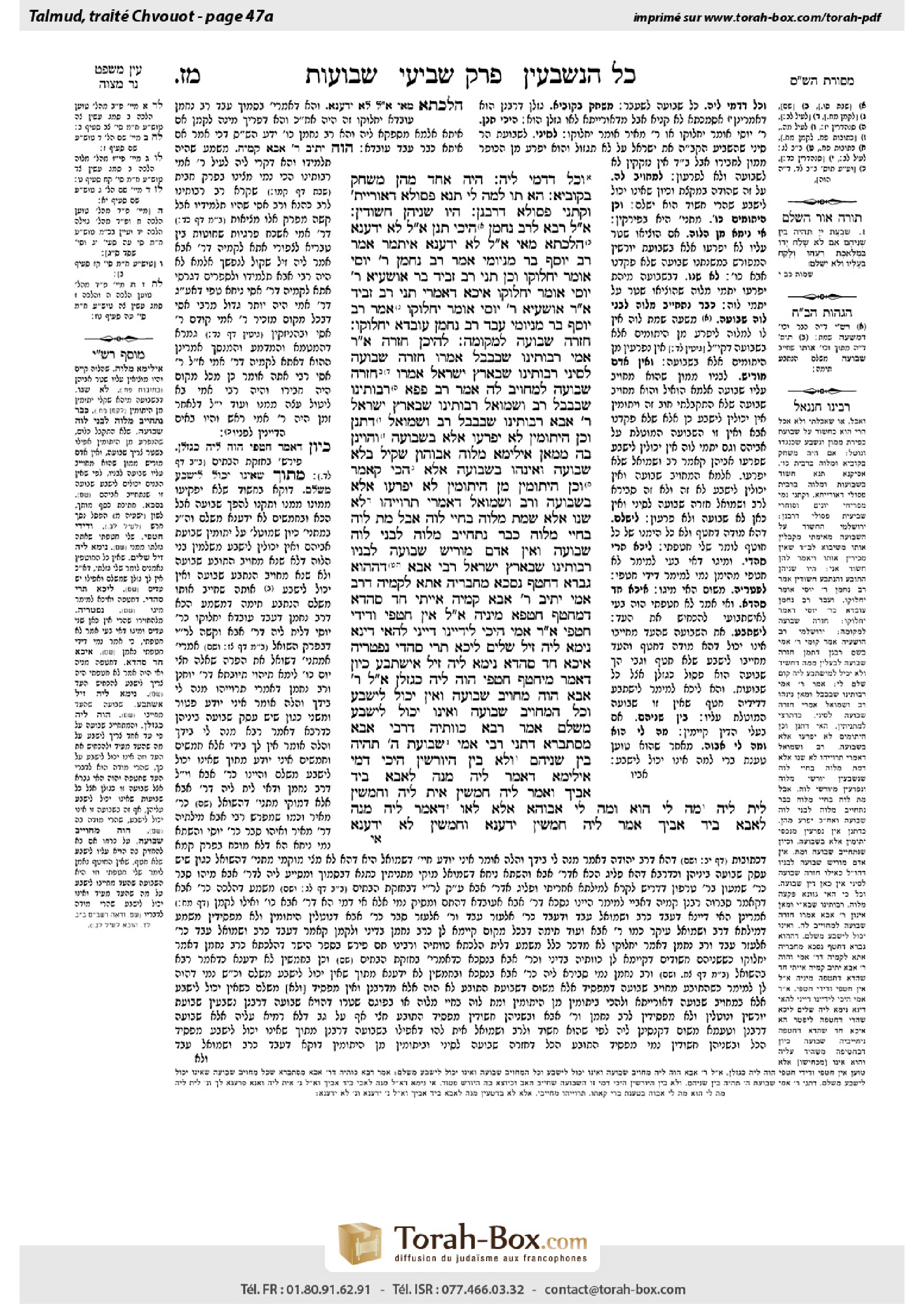
Shevuot 47a: Talmud study for Daf Yomi
Daf Yomi is the daily study of one Talmud folio. Explore 37 tractates with scans, Hebrew text, Sefaria English and AI-generated French translations where annotated.
Passage selection and English or AI-generated French translation are available where the scan has annotations. Daf Study is independent of Torah-Box and Sefaria.
Browse Shevuot · שבועות · All tractatesShevuot 47a text and translations
This page of Shevuot includes the Aramaic text, an English translation and an AI-generated French translation, alongside the scan above.
שבועות מ״ז א · Aramaic and Hebrew text
וְכֹל דְּדָמֵי לֵיהּ.
הָיָה אֶחָד מֵהֶן מְשַׂחֵק בְּקוּבְיָא. הָא תּוּ לְמָה לִי? תְּנָא פְּסוּלָא דְּאוֹרָיְיתָא, וְקָתָנֵי פְּסוּלָא דְּרַבָּנַן.
הָיוּ שְׁנֵיהֶן חֲשׁוּדִין. אֲמַר לֵיהּ רָבָא לְרַב נַחְמָן: הֵיכִי תְּנַן? אֲמַר לֵיהּ: לָא יָדַעְנָא. הִלְכְתָא מַאי? אֲמַר לֵיהּ: לָא יָדַעְנָא.
אִיתְּמַר: אָמַר רַב יוֹסֵף בַּר מִנְיוֹמֵי, אָמַר רַב נַחְמָן, רַבִּי יוֹסֵי אוֹמֵר: יַחְלוֹקוּ. וְכֵן תָּנֵי רַב זְבִיד בַּר אוֹשַׁעְיָא, רַבִּי יוֹסֵי אוֹמֵר: יַחְלוֹקוּ. אִיכָּא דְּאָמְרִי: תָּנֵי רַב זְבִיד אָמַר רַבִּי אוֹשַׁעְיָא, רַבִּי יוֹסֵי אוֹמֵר: יַחְלוֹקוּ. אָמַר רַב יוֹסֵף בַּר מִנְיוֹמֵי: עֲבַד רַב נַחְמָן עוֹבָדָא – יַחְלוֹקוּ.
חָזְרָה שְׁבוּעָה לִמְקוֹמָהּ. לְהֵיכָן חָזְרָה? אָמַר רַבִּי אַמֵּי, רַבּוֹתֵינוּ שֶׁבְּבָבֶל אָמְרוּ: חָזְרָה שְׁבוּעָה לְסִינַי, רַבּוֹתֵינוּ שֶׁבְּאֶרֶץ יִשְׂרָאֵל אָמְרוּ: חָזְרָה שְׁבוּעָה לַמְחוּיָּב לָהּ.
אָמַר רַב פָּפָּא: רַבּוֹתֵינוּ שֶׁבְּבָבֶל – רַב וּשְׁמוּאֵל, רַבּוֹתֵינוּ שֶׁבְּאֶרֶץ יִשְׂרָאֵל – רַבִּי אַבָּא. רַבּוֹתֵינוּ שֶׁבְּבָבֶל רַב וּשְׁמוּאֵל – דִּתְנַן: וְכֵן הַיְּתוֹמִין, לֹא יִפָּרְעוּ אֶלָּא בִּשְׁבוּעָה. וְהָוֵינַן בַּהּ: מִמַּאן? אִילֵּימָא מִלֹּוֶה – אֲבוּהוֹן שָׁקֵיל בְּלָא שְׁבוּעָה, וְאִינְהוּ בִּשְׁבוּעָה?! אֶלָּא הָכִי קָאָמַר: וְכֵן הַיְּתוֹמִין מִן הַיְּתוֹמִין – לֹא יִפָּרְעוּ אֶלָּא בִּשְׁבוּעָה.
וְרַב וּשְׁמוּאֵל דְּאָמְרִי תַּרְוַיְיהוּ: לֹא שָׁנוּ אֶלָּא שֶׁמֵּת מַלְוֶה בְּחַיֵּי לֹוֶה; אֲבָל מֵת לֹוֶה בְּחַיֵּי מַלְוֶה – כְּבָר נִתְחַיֵּיב מַלְוֶה לִבְנֵי לֹוֶה שְׁבוּעָה, וְאֵין אָדָם מוֹרִישׁ שְׁבוּעָה לְבָנָיו.
רַבּוֹתֵינוּ שֶׁבְּאֶרֶץ יִשְׂרָאֵל רַבִּי אַבָּא – דְּהָהוּא גַּבְרָא דַּחֲטַף נְסָכָא מֵחַבְרֵיהּ; אֲתָא לְקַמֵּיהּ דְּרַב אַמֵּי, יְתֵיב רַבִּי אַבָּא קַמֵּיהּ. אַיְיתִי חֲדָא סָהֲדָא דְּמִחְטָף חַטְפֵהּ מִינֵּיהּ, אֲמַר לֵיהּ: ״אִין, חֲטַפִי – וְדִידִי חֲטַפִי״.
אָמַר רַבִּי אַמֵּי: הֵיכִי לִידַיְּינוּ דַּיָּינֵי לְהַאי דִּינָא? נֵימָא לֵיהּ ״זִיל שַׁלֵּים״ – לֵיכָּא תְּרֵי סָהֲדִי. נִפְטְרֵיהּ – אִיכָּא חַד סָהֲדָא. נֵימָא לֵיהּ ״זִיל אִישְׁתְּבַע״ – כֵּיוָן דְּאָמַר ״מִיחְטָף חֲטַפִי״, הָוֵה לֵיהּ כְּגַזְלָן.
אֲמַר לֵיהּ רַבִּי אַבָּא: הָוֵה מְחוּיָּב שְׁבוּעָה וְאֵין יָכוֹל לִישָּׁבַע, וְכׇל הַמְחוּיָּב שְׁבוּעָה וְאֵינוֹ יָכוֹל לִישָּׁבַע – מְשַׁלֵּם.
אָמַר רָבָא: כְּוָותֵיהּ דְּרַבִּי אַבָּא מִסְתַּבְּרָא, דְּתָנֵי רַבִּי אַמֵּי: ״שְׁבֻעַת ה׳ תִּהְיֶה בֵּין שְׁנֵיהֶם״ – וְלֹא בֵּין הַיּוֹרְשִׁין. הֵיכִי דָּמֵי?
אִילֵימָא דְּאָמַר לֵיהּ: ״מָנֶה לְאַבָּא בְּיַד אָבִיךָ״, וְאָמַר לֵיהּ: ״חַמְשִׁין אִית לֵיהּ וְחַמְשִׁין לֵית לֵיהּ״ – מָה לִי הוּא וּמָה לִי אֲבוּהָא?
אֶלָּא לָאו דְּאָמַר לֵיהּ: ״מָנֶה לְאַבָּא בְּיַד אָבִיךָ״, אָמַר לֵיהּ: ״חַמְשִׁין יָדַעְנָא וְחַמְשִׁין לָא יָדַעְנָא״?
Shevuot 47a · English translation
and any oath that is similar to it, i.e., that is clearly a falsehood, disqualifies one from further oath taking.
§ The mishna teaches: If one of the litigants was a dice player, or one who lends with interest, or among those who fly pigeons, or among the vendors of produce that grew during the Sabbatical Year, then the litigant opposing him takes an oath and receives payment of his claim. The Gemara asks: Why do I need these additional examples of a person who is suspect with regard to oath taking? The Gemara explains: The mishna first teaches examples of people who are disqualified by Torah law, and then teaches examples of those who are disqualified by rabbinic law.
§ The mishna teaches: If both litigants were suspect, the oath returned to its place; this is the statement of Rabbi Yosei. Rabbi Meir says: Since neither can take an oath, they divide the disputed amount. Rava said to Rav Naḥman: How is it actually taught? What is Rabbi Yosei’s opinion and what is Rabbi Meir’s opinion? Rav Naḥman said to him: I do not know. Rava asked him: What is the halakha? Rav Naḥman said to him: I do not know.
It was stated that Rav Yosef bar Minyumi says that Rav Naḥman says that Rabbi Yosei says: They divide the disputed amount. And similarly, Rav Zevid bar Oshaya teaches that Rabbi Yosei says: They divide the disputed amount. The Gemara records a slightly different version of this tradition: There are those who say that Rav Zevid teaches that Rabbi Oshaya says that Rabbi Yosei says: They divide the disputed amount. Rav Yosef bar Minyumi said that Rav Naḥman ruled in an actual case that the litigants divide the disputed amount.
§ Rabbi Yosei rules in the mishna that in a case where both sides are suspect and cannot take an oath, the oath returned to its place. The Gemara asks: To where did it return? What is meant by the oath returning to its place? Rabbi Ami said that our Sages in Babylonia say: The oath returned to Sinai, where God administered an oath to the Jewish people that they would keep the mitzvot of the Torah, including the prohibition against robbery. The litigant who is robbing the other will be punished by God, not the court. Our Sages in Eretz Yisrael said: The oath returned to the one who was initially liable to take it, i.e., the defendant, and since he is disqualified from taking an oath, he must pay.
Rav Pappa said that the term: Our Sages in Babylonia, refers to Rav and Shmuel; and the term: Our Sages in Eretz Yisrael, refers to Rabbi Abba. The fact that the term: Our Sages in Babylonia, refers to Rav and Shmuel is as we learned in the mishna (45a): And likewise, orphans may collect a loan with a promissory note inherited from their father only by taking an oath; and we discussed it (see 48a), asking: From whom do they collect a debt by taking an oath? If we say that they collect this way from the borrower, i.e., those who borrowed from their fathers, that would not make sense. Their father would take payment with the promissory note without taking an oath, and they collect only by means of taking an oath? Don’t orphans have privileged status? Rather, this is what the mishna is saying: And even orphans do not collect with their father’s promissory note from the borrower’s orphans, except by means of taking an oath.
Rav Pappa continues: And Rav and Shmuel both say that the Sages taught that the lender’s orphans need to take an oath in order to be paid by the borrower’s orphans only when the lender died during the lifetime of the borrower, and the lender’s children had an opportunity to collect directly from the borrower without taking an oath. But if the borrower died during the lifetime of the lender, the lender has already become liable to take an oath to the children of the borrower, since one can collect from orphans only by means of an oath, and a person cannot bequeath an oath, i.e., a debt that requires the taking of an oath in order to be collected, to his children, and no payment is made. The lender’s children cannot take the oath that their father would have taken, that the promissory note has not been paid. The only oath they can take is that their father never told them that it had been paid, and that is insufficient once the father became liable to take an oath. From here it is clear that Rav and Shmuel hold that when no oath can be taken, the oath returns to Sinai, and the court takes no action.
The fact that the term: Our Sages in Eretz Yisrael, refers to Rabbi Abba is as the following story illustrates. As there was a certain man who snatched a piece of cast metal from another. The one from whom it was taken came before Rav Ami while Rabbi Abba was sitting before him, and he brought one witness who testified that the other man did, in fact, snatch it from him. The one who snatched it said to him: Yes, it is true that I snatched it, but I merely snatched that which was mine.
Rabbi Ami said: How should judges rule in this case? If they were to say to the one who snatched the metal: Go pay for it, that would not be the correct ruling, because there are not two witnesses who saw him snatch it, and the court does not force payment based on the testimony of one witness. If they were to accept his claim and exempt him entirely, that would not be the correct ruling, because there is one witness who testified against him. If they were to say to him: Go take an oath, which is the usual response to counter the testimony of one witness, once he said that he did in fact snatch it, and there is no proof that it is his, he is like a robber, and the court does not allow a robber to take an oath.
Rabbi Abba said to him: He is one who is liable to take an oath who is unable to take an oath, and anyone who is liable to take an oath who is unable to take an oath is liable to pay. This illustrates that Rabbi Abba holds that the oath returns to its place, i.e., to the defendant, who is disqualified from taking oaths, and that consequently he must pay.
Rava said: It stands to reason that the halakha is in accordance with the opinion of Rabbi Abba; as Rabbi Ami teaches this baraita: The verse states that “the oath of the Lord shall be between them both” (Exodus 22:10), but not between their heirs. What are the circumstances in which one would be liable to take an oath, but his heirs would be exempt?
If we say that it is where the lender’s son said to the borrower’s son: One hundred dinars that belonged to my father were in the possession of your father, as a loan, and you must repay me, and the borrower’s son said to him: He had a debt of fifty, and the other fifty he did not have to pay him, i.e., he did not owe it, that is difficult. Under these circumstances, what does it matter to me if it is he, the borrower’s heir, or his father, the original borrower? Since the son is admitting that he owes part of the money and denying the rest with certainty, he is liable to take an oath, just like his father would have been.
Rather, is it not that the lender’s son said to the borrower’s son: One hundred dinars that were my father’s were left in the possession of your father, and you must repay me, and the borrower’s son said to him: Concerning fifty dinars, I know that my father owed them, but I do not know anything about the other fifty dinars.
Shevuot 47a · Traduction française (IA)
et tout serment qui lui ressemble, c’est-à-dire qui est manifestement mensonger, disqualifie celui qui le prête de tout autre serment.
§ La Michna enseigne : Si l’un des plaideurs est joueur de dés, prêteur à intérêt, colombophile ou marchand de produits qui ont poussé pendant l’année sabbatique, le plaideur qui lui fait face prête serment et obtient le paiement de sa créance. La Guemara demande : Pourquoi faut-il ajouter ces exemples de personnes suspectes en matière de serment ? La Guemara explique : La Michna enseigne d’abord des exemples de personnes disqualifiées par la Torah, puis des exemples de personnes disqualifiées par décret rabbinique.
§ La Michna enseigne : Si les deux plaideurs sont suspects, le serment revient à son point de départ ; telle est l’opinion de Rabbi Yosei. Rabbi Meïr dit : Puisqu’aucun des deux ne peut prêter serment, ils se partagent la somme contestée. Rava dit à Rav Naḥman : Comment cela est-il enseigné en réalité ? Quelle est l’opinion de Rabbi Yosei et quelle est celle de Rabbi Meïr ? Rav Naḥman lui répondit : Je ne sais pas. Rava lui demanda : Quelle est la halakha ? Rav Naḥman lui répondit : Je ne sais pas.
Il a été rapporté que Rav Yosef bar Minyumi dit au nom de Rav Naḥman, qui dit au nom de Rabbi Yosei : Ils se partagent la somme contestée. De même, Rav Zevid bar Oshaya enseigne que Rabbi Yosei dit : Ils se partagent la somme contestée. La Guemara rapporte une version légèrement différente de cette tradition : Certains disent que Rav Zevid enseigne que Rabbi Oshaya dit au nom de Rabbi Yosei : Ils se partagent la somme contestée. Rav Yosef bar Minyumi dit que Rav Naḥman a statué, dans un cas concret, que les plaideurs se partagent la somme contestée.
§ Dans la Michna, Rabbi Yosei statue que, lorsque les deux parties sont suspectes et ne peuvent prêter serment, le serment revient à son point de départ. La Guemara demande : Où est-il retourné ? Que signifie l’expression « le serment revient à son point de départ » ? Rabbi Ami dit que nos Sages de Babylonie répondent : Le serment est retourné au Sinaï, où Dieu a fait jurer au peuple juif de respecter les mitsvot de la Torah, notamment l’interdiction du vol. Le plaideur qui vole l’autre sera puni par Dieu, et non par le tribunal. Nos Sages d’Eretz Israël disent : Le serment est retourné à celui qui était initialement tenu de le prêter, c’est-à-dire au défendeur ; puisqu’il est disqualifié pour prêter serment, il doit payer.
Rav Pappa dit que l’expression « nos Sages de Babylonie » désigne Rav et Shmuel, et que l’expression « nos Sages d’Eretz Israël » désigne Rabbi Abba. Le fait que l’expression « nos Sages de Babylonie » désigne Rav et Shmuel ressort de ce que nous avons appris dans la Michna (45a) : De même, des orphelins ne peuvent recouvrer un prêt au moyen d’une reconnaissance de dette héritée de leur père qu’en prêtant serment. Nous en avons discuté (voir 48a), en demandant : Auprès de qui recouvrent-ils une dette en prêtant serment ? Si l’on dit qu’ils la recouvrent ainsi auprès de l’emprunteur, c’est-à-dire de ceux qui ont emprunté à leur père, cela n’a pas de sens. Leur père aurait reçu le paiement sur présentation de la reconnaissance de dette sans prêter serment, tandis qu’eux ne peuvent recouvrer la dette qu’en prêtant serment ? Les orphelins ne jouissent-ils pas d’un statut privilégié ? Il faut plutôt comprendre que la Michna enseigne ceci : Même des orphelins ne peuvent recouvrer une dette au moyen de la reconnaissance de dette de leur père auprès des orphelins de l’emprunteur qu’en prêtant serment.
Rav Pappa poursuit : Rav et Shmuel disent tous deux que les Sages ont enseigné que les orphelins du prêteur doivent prêter serment pour être payés par les orphelins de l’emprunteur uniquement lorsque le prêteur est mort du vivant de l’emprunteur et que les enfants du prêteur ont eu la possibilité de recouvrer directement la dette auprès de l’emprunteur, sans prêter serment. Mais si l’emprunteur est mort du vivant du prêteur, celui-ci était déjà tenu de prêter serment aux enfants de l’emprunteur, car on ne peut recouvrer une dette auprès d’orphelins qu’en prêtant serment ; or, une personne ne peut léguer à ses enfants l’obligation de prêter serment, c’est-à-dire une dette dont le recouvrement exige un serment, et aucun paiement n’est donc effectué. Les enfants du prêteur ne peuvent pas prêter le serment que leur père aurait prêté, à savoir que la reconnaissance de dette n’a pas été payée. Le seul serment qu’ils puissent prêter est que leur père ne leur a jamais dit que la dette avait été payée, ce qui ne suffit pas dès lors que leur père était tenu de prêter serment. Il ressort de là que Rav et Shmuel considèrent que, lorsqu’aucun serment ne peut être prêté, le serment retourne au Sinaï et le tribunal n’intervient pas.
Le fait que l’expression « nos Sages d’Eretz Israël » désigne Rabbi Abba ressort de l’histoire suivante. Un homme avait arraché à un autre un morceau de métal coulé. Celui à qui on l’avait pris se présenta devant Rav Ami, tandis que Rabbi Abba siégeait devant lui, et amena un témoin qui attesta que l’autre homme le lui avait effectivement arraché. Celui qui l’avait arraché lui dit : Oui, il est vrai que je l’ai arraché, mais je n’ai fait que reprendre ce qui m’appartenait.
Rabbi Ami dit : Comment les juges doivent-ils statuer dans cette affaire ? S’ils disent à celui qui a arraché le métal : « Va le payer », ce ne serait pas la bonne décision, car il n’y a pas deux témoins qui l’aient vu l’arracher, et le tribunal n’impose pas de paiement sur la déposition d’un seul témoin. S’ils acceptent sa prétention et l’exonèrent entièrement, ce ne serait pas non plus la bonne décision, car un témoin a déposé contre lui. S’ils lui disent : « Va prêter serment » — ce qui est la réponse habituelle pour contredire le témoignage d’un seul témoin —, dès lors qu’il a reconnu l’avoir effectivement arraché et qu’aucune preuve n’établit que l’objet lui appartient, il est comme un voleur, et le tribunal ne permet pas à un voleur de prêter serment.
Rabbi Abba lui dit : C’est un homme tenu de prêter serment qui est incapable de le prêter ; or, quiconque est tenu de prêter serment et en est incapable est tenu de payer. Cela montre que Rabbi Abba considère que le serment revient à son point de départ, c’est-à-dire au défendeur, qui est disqualifié pour prêter serment et doit, par conséquent, payer.
Rava dit : Il est logique que la halakha soit conforme à l’opinion de Rabbi Abba, car Rabbi Ami enseigne cette baraïta : Le verset dit que « le serment du Seigneur sera entre les deux parties » (Exode 22:10), mais pas entre leurs héritiers. Dans quelles circonstances une personne serait-elle tenue de prêter serment alors que ses héritiers en seraient dispensés ?
Si l’on dit qu’il s’agit du cas où le fils du prêteur dit au fils de l’emprunteur : « Cent dinars appartenant à mon père se trouvaient en possession de ton père, à titre de prêt, et tu dois me les rembourser », et où le fils de l’emprunteur lui répond : « Il lui devait cinquante dinars, mais les cinquante autres, il n’avait pas à les lui payer », c’est-à-dire qu’il ne les lui devait pas, cela pose problème. Dans ces circonstances, qu’est-ce que cela change pour moi que ce soit lui, l’héritier de l’emprunteur, ou son père, l’emprunteur initial ? Puisque le fils reconnaît devoir une partie de la somme et nie avec certitude devoir le reste, il est tenu de prêter serment, tout comme son père l’aurait été.
Mais n’est-ce pas plutôt le cas où le fils du prêteur dit au fils de l’emprunteur : « Cent dinars appartenant à mon père ont été laissés en possession de ton père, et tu dois me les rembourser », et où le fils de l’emprunteur lui répond : « Pour cinquante dinars, je sais que mon père les devait, mais pour les cinquante autres, je ne sais rien » ?
Traduction française générée par IA à partir de l’édition anglaise de Sefaria. Vérifie toujours un passage avec le texte source.
Text from Sefaria: William Davidson Edition - Vocalized Aramaic (CC BY NC); William Davidson Edition - English (CC BY NC).