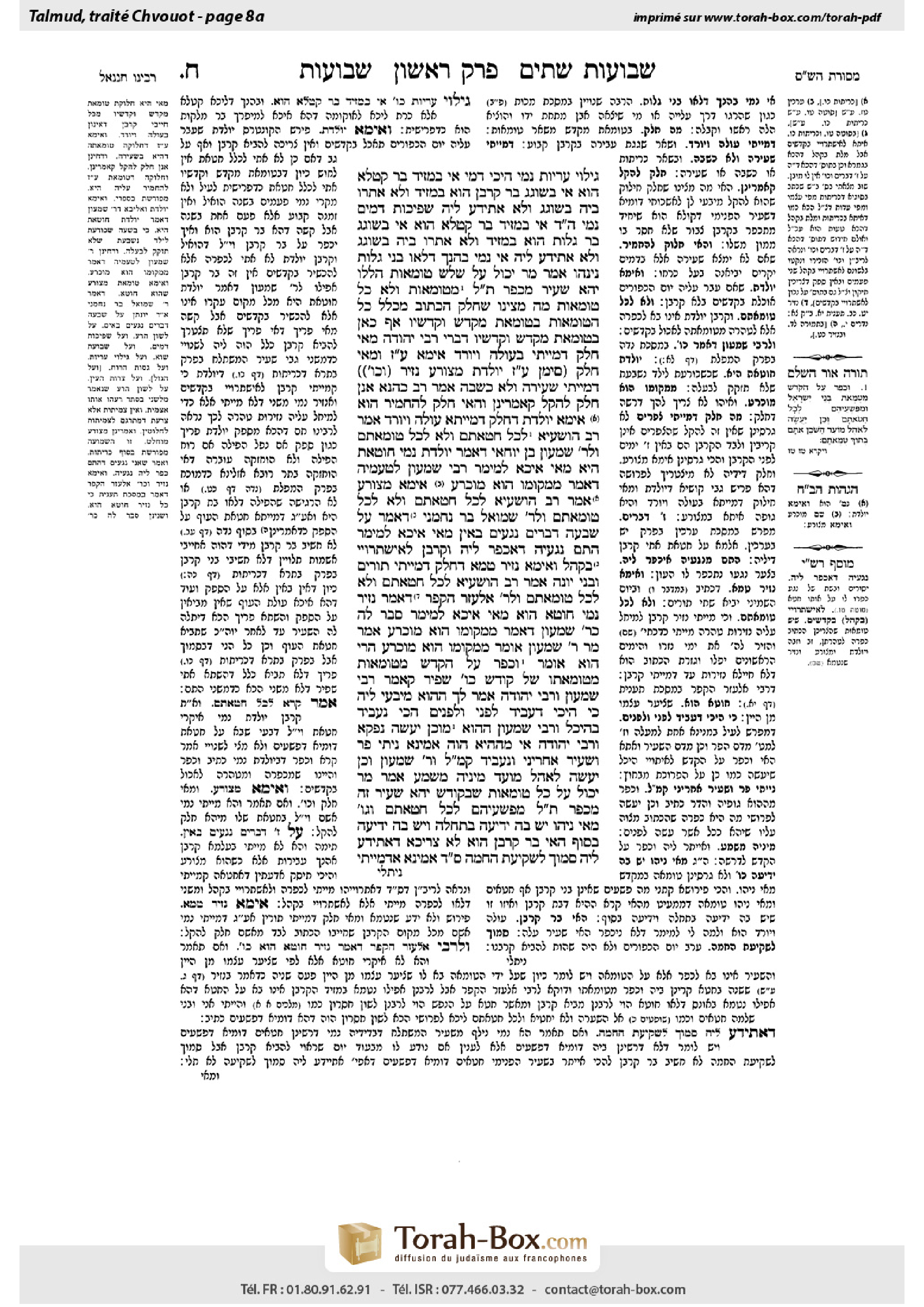
Shevuot 8a: Talmud study for Daf Yomi
Daf Yomi is the daily study of one Talmud folio. Explore 37 tractates with scans, Hebrew text, Sefaria English and AI-generated French translations where annotated.
Passage selection and English or AI-generated French translation are available where the scan has annotations. Daf Study is independent of Torah-Box and Sefaria.
Browse Shevuot · שבועות · All tractatesShevuot 8a text and translations
This page of Shevuot includes the Aramaic text, an English translation and an AI-generated French translation, alongside the scan above.
שבועות ח׳ א · Aramaic and Hebrew text
גִּילּוּי עֲרָיוֹת נָמֵי, הֵיכִי דָמֵי? אִי בְּמֵזִיד – בַּר קְטָלָא הוּא! אִי בְּשׁוֹגֵג – בַּר קׇרְבָּן הוּא!
בְּמֵזִיד – וְלָא אַתְרוֹ בֵּיהּ, בְּשׁוֹגֵג – וְלָא אִתְיְדַע לֵיהּ.
שְׁפִיכוּת דָּמִים נָמֵי, הֵיכִי דָּמֵי? אִי בְּמֵזִיד – בַּר קְטָלָא הוּא! אִי בְּשׁוֹגֵג – בַּר גָּלוּת הוּא!
בְּמֵזִיד – וְלָא אַתְרוֹ בֵּיהּ, בְּשׁוֹגֵג – וְלָא אִתְיְדַע לֵיהּ. אִי נָמֵי, בְּהָנָךְ דְּלָאו בְּנֵי גָלוּת נִינְהוּ.
אָמַר מָר: יָכוֹל עַל שָׁלֹשׁ טְומָאוֹת הַלָּלוּ יְהֵא שָׂעִיר מְכַפֵּר? תַּלְמוּד לוֹמַר: ״מִטֻּמְאוֹת״ – וְלֹא כׇּל טוּמְאוֹת; מָה מָצִינוּ שֶׁחָלַק הַכָּתוּב מִכְּלָל כׇּל הַטְּומָאוֹת – בְּטוּמְאַת מִקְדָּשׁ וְקָדָשָׁיו; אַף כָּאן – בְּטוּמְאַת מִקְדָּשׁ וְקָדָשָׁיו. דִּבְרֵי רַבִּי יְהוּדָה.
מַאי חָלַק? דְּמַיְיתֵי בְּעוֹלֶה וְיוֹרֵד. אֵימָא עֲבוֹדָה זָרָה, וּמַאי חָלַק –
(סִימַן: עֲבוֹדָה זָרָה, יוֹלֶדֶת, מְצוֹרָע, נָזִיר וְכוּ׳)
דְּמַיְיתֵי שְׂעִירָה וְלֹא כִּשְׂבָּה!
אָמַר רַב כָּהֲנָא: אֲנַן חָלַק לְהָקֵל קָאָמְרִינַן, וְהַאי חָלַק לְהַחְמִיר הוּא.
אֵימָא יוֹלֶדֶת – דְּחָלַק, דְּמַיְיתָא עוֹלֶה וְיוֹרֵד! אָמַר רַב הוֹשַׁעְיָא: ״לְכׇל חַטֹּאתָם״ – וְלֹא לְכׇל טוּמְאֹתָם.
וּלְרַבִּי שִׁמְעוֹן בֶּן יוֹחַאי דְּאָמַר יוֹלֶדֶת נָמֵי חוֹטֵאת הִיא, מַאי אִיכָּא לְמֵימַר? רַבִּי שִׁמְעוֹן לְטַעְמֵיהּ, דְּאָמַר: מִמְּקוֹמוֹ הוּא מוּכְרָע.
אֵימָא מְצוֹרָע! אָמַר רַב הוֹשַׁעְיָא: ״לְכׇל חַטֹּאתָם״ – וְלֹא לְכׇל טוּמְאֹתָם.
וּלְרַבִּי שְׁמוּאֵל בַּר נַחְמָנִי, דְּאָמַר: עַל שִׁבְעָה דְּבָרִים נְגָעִים בָּאִין – מַאי אִיכָּא לְמֵימַר? הָתָם נִגְעֵיהּ דְּאִכַּפַּר לֵיהּ, וְקׇרְבָּן לְאִישְׁתְּרוֹיֵי בַּקָּהָל.
וְאֵימָא נָזִיר טָמֵא – דְּחָלַק, דְּמַיְיתֵי תּוֹרִים וּבְנֵי יוֹנָה! אָמַר רַב הוֹשַׁעְיָא: ״לְכׇל חַטֹּאתָם״ – וְלֹא לְכׇל טוּמְאֹתָם.
וּלְרַבִּי אֶלְעָזָר הַקַּפָּר, דְּאָמַר נָזִיר נָמֵי חוֹטֵא הוּא, מַאי אִיכָּא לְמֵימַר? סָבַר לַהּ כְּרַבִּי שִׁמְעוֹן, דְּאָמַר: מִמְּקוֹמוֹ הוּא מוּכְרָע.
אָמַר מָר, רַבִּי שִׁמְעוֹן אוֹמֵר: מִמְּקוֹמוֹ הוּא מוּכְרָע; הֲרֵי הוּא אוֹמֵר: ״וְכִפֶּר עַל הַקֹּדֶשׁ מִטֻּמְאוֹת״ – מִטּוּמְאָתוֹ שֶׁל קוֹדֶשׁ כּוּ׳. שַׁפִּיר קָאָמַר רַבִּי שִׁמְעוֹן! וְרַבִּי יְהוּדָה אָמַר לָךְ: הַהוּא מִיבְּעֵי לֵיהּ – כִּי הֵיכִי דְּעָבֵיד לִפְנַי וְלִפְנִים, הָכִי נַעֲבֵיד בַּהֵיכָל.
וְרַבִּי שִׁמְעוֹן – הַהוּא מִ״וְּכֵן יַעֲשֶׂה״ נָפְקָא. וְרַבִּי יְהוּדָה – אִי מֵהַהִיא, הֲוָה אָמֵינָא נַיְתֵי פַּר וְשָׂעִיר אַחֲרִינֵי וְנַעֲבֵיד; קָא מַשְׁמַע לַן. וְרַבִּי שִׁמְעוֹן, ״וְכֵן יַעֲשֶׂה לְאֹהֶל מוֹעֵד״ – מִינֵּיהּ מַשְׁמַע.
אָמַר מָר: יָכוֹל עַל כׇּל טוּמְאוֹת שֶׁבַּקּוֹדֶשׁ יְהֵא שָׂעִיר זֶה מְכַפֵּר? תַּלְמוּד לוֹמַר: ״מִפִּשְׁעֵיהֶם לְכׇל חַטֹּאתָם וְגוֹ׳״. מַאי נִיהוּ – יֵשׁ בָּהּ יְדִיעָה בַּתְּחִלָּה וְיֵשׁ בָּהּ יְדִיעָה בַּסּוֹף; הַאי בַּר קׇרְבָּן הוּא!
לָא צְרִיכָא, דְּאִתְיְדַע לֵיהּ סָמוּךְ לִשְׁקִיעַת הַחַמָּה. סָלְקָא דַּעְתָּךְ אָמֵינָא: אַדְּמַיְיתֵי
Shevuot 8a · English translation
The Gemara asks further: With regard to forbidden sexual relations, for which one might have thought the goat offering would atone as well, what are the circumstances? If you say the reference is to a case where he transgressed intentionally, then one can counter that he is subject to the death penalty and so no offering will atone for his sin. And if you say the reference is to a case where he transgressed unwittingly, then one can counter that he is liable to bring his own sin-offering for his transgression, and so the goat will not atone for him.
The Gemara answers: The goat offering atones in a case where he transgressed intentionally but witnesses did not forewarn him about his transgression, so he is not liable to receive the death penalty. It also atones in a case where he transgressed unwittingly, but by the time Yom Kippur arrived he had still not become aware of his transgression, so he was not liable to bring an offering.
The Gemara asks further: Concerning the bloodshed for which one might have thought that the goat would atone as well, what are the circumstances? If you say the reference is to a case where he transgressed intentionally, then one can counter that he is subject to the death penalty, so no offering will atone for his sin. And if you say the reference is to a case where he transgressed unwittingly, then one can counter that he is subject to go into exile, so the goat offering will not atone for him.
The Gemara answers: The goat offering atones in a case where he transgressed intentionally but witnesses did not forewarn him about his transgression, and so he is not liable to receive the death penalty. It also atones in a case where he transgressed unwittingly, but by the time Yom Kippur arrived he had still not become aware of his transgression, so he was not liable to bring an offering. Alternatively, it is referring to those cases for which the perpetrator is not subject to exile, e.g., where the death was caused in a way that was almost unavoidable, or where it was very close to being considered intentional.
§ The Gemara continues to analyze the next part of the baraita: The Master said: One might have thought that the goat offering would atone for these three types of impurities. To counter this, the verse states: “From the impurities of the children of Israel” (Leviticus 16:16). The restrictive term “from” indicates that it atones for some impurities but not for all impurities. What do we find is the impurity that the verse differentiates from all other impurities? We find it with regard to the defiling of the Temple or its sacrificial foods. It is specifically for this transgression that the Torah provides one with the means of achieving atonement, i.e., by bringing a sliding-scale offering. So too here, since the verse limits the atonement of the goat offering to transgressions involving impurity, it is logical that it can also atone only for the defiling of the Temple or its sacrificial foods. This is the statement of Rabbi Yehuda.
The Gemara asks: In what way does the Torah differentiate the impurity of this transgression from other types of transgressions? It is differentiated in that one brings a sliding-scale offering to atone for it. But if that is a sufficient distinction, then say instead that the goat offering atones for idol worship, and in what way does the Torah differentiate it from other types of transgressions?
Before answering, the Gemara interjects with a mnemonic that summarizes which cases it will suggest the goat offering should atone for: Idol worship, a woman after childbirth, a leper, a nazirite, etc.
The Gemara returns to answer its question: It is differentiated in that he brings a she-goat as a sin-offering and not an ewe, which is the animal brought as a sin-offering for other transgressions.
Rav Kahana said: We said that the goat offering should atone for a transgression that the Torah differentiates in order to be lenient relative to other transgressions, but this case of idol worship is one that the Torah differentiates in order to be stringent relative to other transgressions. Accordingly, the verse cannot be referring to idol worship.
The Gemara asks: Why not say instead that the goat offering atones for a woman after childbirth, as the Torah differentiates her from other people who must bring a sin-offering following a period of impurity in that she brings a sliding-scale offering, whereas others bring a fixed sin-offering? Rav Hoshaya said: The verse states: “For all their sins” (Leviticus 16:16), and not: For all their impurities. Accordingly, since the offering brought by a woman after childbirth is not to atone for a sin, but due to the fact that she went through a period of ritual impurity, the goat offering will not atone for her.
The Gemara asks: But if so, according to Rabbi Shimon ben Yoḥai, who says: A woman after childbirth brings an offering because she is also a sinner, what is there to say? Under the intense pain of childbirth a woman is apt to take an oath not to engage in intercourse in order to avoid becoming pregnant again. This is regarded as a sin because she will certainly violate that oath. The Gemara answers: Rabbi Shimon conforms to his line of reasoning, as he said in the baraita: From its own place, i.e., from the verse about the atonement of the goat offering itself, it can be determined what the goat offering atones for.
The Gemara asks: Why not say that the goat offering atones for a leper, as the Torah differentiates him from other people who must bring a fixed offering following a period of impurity in that he brings a sliding-scale offering? Rav Hoshaya said: The verse states: “For all their sins” and not: For all their impurities. Accordingly, since the offering brought by a leper is not to atone for a sin, the goat offering will not atone for him.
The Gemara asks: But if so, according to Rabbi Shmuel bar Naḥmani, who says: Leprous marks come upon a person for seven matters, i.e., seven different sins, what is there to say? The Gemara answers: There, it is his leprous mark that atones for his sin, and the offering is brought in order to permit him to reenter the congregation, after having been ostracized while he was a leper.
The Gemara asks: But why not say that the goat offering atones for a nazirite who became ritually impure, as the Torah differentiates him from other people who must bring an offering following a period of impurity in that he brings doves or young pigeons? Rav Hoshaya said: The verse states: “For all their sins” and not: For all their impurities. Accordingly, since the offering brought by a nazirite is not to atone for a sin, the goat offering will not atone for him.
The Gemara asks: But if so, according to Rabbi Elazar HaKappar, who says: A nazirite is also a sinner because he unnecessarily abstained from wine, what is there to say? The Gemara answers: He holds in accordance with the opinion of Rabbi Shimon, who says in the baraita: From its own place, i.e., from the verse about the atonement of the goat itself, it can be determined what the goat offering atones for.
§ The Gemara continues to clarify the next part of the baraita: The Master said: Rabbi Shimon says: It is not necessary to derive which transgressions the goat offering atones for by comparing the verse written concerning it to a different verse. Rather, from its own place, i.e., from the verse about the atonement effected by the goat itself, it can be determined, as it states: “And he shall effect atonement upon the Sanctuary [hakodesh] from the impurities of the children of Israel,” which should be interpreted as saying that it atones for the defiling of anything sacred [kodesh], i.e., the Temple or its sacrificial foods. The Gemara explains Rabbi Yehuda’s opinion, asking: Rabbi Shimon is saying well; why does Rabbi Yehuda disagree? The Gemara answers: Rabbi Yehuda could have said to you: That verse is necessary to teach that in the same manner that he performs the blood presentation in the innermost sanctum, i.e., in the Holy of Holies, that is how he shall later perform them in the Sanctuary.
The Gemara asks: And how does Rabbi Shimon derive that halakha? That halakha is derived from the continuation of the verse: “And so shall he do to the Tent of Meeting,” i.e., the Sanctuary. The Gemara asks: And what does Rabbi Yehuda derive from that part of the verse? The Gemara explains: He holds that if this halakha would be derived only from that part of the verse, I would say that he should bring another bull and goat, slaughter them, and perform the blood presentations in the Sanctuary with their blood. Therefore, the first part of verse: “And he shall effect atonement upon the Sanctuary,” teaches us that all the presentations are made with blood from the same bull and goat. The Gemara asks: And why does Rabbi Shimon not need the first part of the verse to derive this? The Gemara explains that the verse: “And so shall he do to the Tent of Meeting,” itself indicates that the blood used in the Tent of Meeting, i.e., in the Sanctuary, is from the same bull and goat.
§ The Gemara cites the next part of the baraita: The Master said: One might have thought that this goat offering would atone for all cases of the defiling of the Temple, even where there was awareness at the beginning and at the end. To counter this, the verse states: “And from their acts of rebellion, for all their sins” (Leviticus 16:16), which indicates that the goat offering atones only for transgressions with regard to which the perpetrator is not subject to bring an offering brought by an individual to atone for himself. The Gemara asks: What is the case for which the goat offering does not atone? Where one had awareness at the beginning and had awareness at the end. The Gemara objects: But the person in that case is subject to atonement through an offering. If so, even without this verse it would be obvious that the goat offering would not atone for him and absolve him from his obligation to bring an offering.
The Gemara explains: No, the verse is necessary to teach that the goat does not atone for him in a case in which he became aware of his transgression close to sunset before the onset of Yom Kippur and was unable to bring his offering before Yom Kippur. In such a case it might enter your mind to say that until he brings his sliding-scale offering the day after Yom Kippur,
Shevuot 8a · Traduction française (IA)
La Guemara demande encore : En ce qui concerne les relations sexuelles interdites, pour lesquelles on aurait pu penser que le bouc expiatoire expie également, de quelles circonstances s’agit-il ? Si tu dis qu’il s’agit d’un cas où il a transgressé intentionnellement, on peut objecter qu’il est passible de la peine capitale et qu’aucune offrande n’expiera donc sa faute. Et si tu dis qu’il s’agit d’un cas où il a transgressé involontairement, on peut objecter qu’il est tenu d’apporter son propre sacrifice expiatoire pour sa transgression ; le bouc n’expiera donc pas pour lui.
La Guemara répond : Le bouc expiatoire expie dans le cas où il a transgressé intentionnellement, mais où les témoins ne l’ont pas averti de sa transgression ; il n’est donc pas passible de la peine capitale. Il expie également dans le cas où il a transgressé involontairement, mais où, à l’arrivée de Yom Kippour, il n’avait toujours pas pris conscience de sa transgression ; il n’était donc pas tenu d’apporter une offrande.
La Guemara demande encore : En ce qui concerne l’homicide, pour lequel on aurait pu penser que le bouc expie également, de quelles circonstances s’agit-il ? Si tu dis qu’il s’agit d’un cas où il a transgressé intentionnellement, on peut objecter qu’il est passible de la peine capitale et qu’aucune offrande n’expiera donc sa faute. Et si tu dis qu’il s’agit d’un cas où il a transgressé involontairement, on peut objecter qu’il est passible d’exil ; le bouc expiatoire n’expiera donc pas pour lui.
La Guemara répond : Le bouc expiatoire expie dans le cas où il a transgressé intentionnellement, mais où les témoins ne l’ont pas averti de sa transgression ; il n’est donc pas passible de la peine capitale. Il expie également dans le cas où il a transgressé involontairement, mais où, à l’arrivée de Yom Kippour, il n’avait toujours pas pris conscience de sa transgression ; il n’était donc pas tenu d’apporter une offrande. Autre possibilité : il s’agit des cas où l’auteur n’est pas passible d’exil, par exemple lorsque la mort a été causée d’une manière presque impossible à éviter, ou dans un cas où l’acte était très proche d’être considéré comme intentionnel.
§ La Guemara poursuit l’analyse de la partie suivante de la baraïta : Le Maître a dit : On aurait pu penser que le bouc expiatoire expie ces trois types d’impuretés. Pour écarter cette hypothèse, le verset dit : « Des impuretés des enfants d’Israël » (Lévitique 16:16). Le terme restrictif « des » indique qu’il expie certaines impuretés, mais pas toutes. Quelle impureté le verset distingue-t-il de toutes les autres ? On le constate à propos de la souillure du Temple ou de ses offrandes. C’est précisément pour cette transgression que la Torah prévoit un moyen d’obtenir l’expiation, à savoir l’apport d’un sacrifice à valeur variable. De même ici, puisque le verset limite l’expiation du bouc aux transgressions liées à l’impureté, il est logique qu’il ne puisse expier que la souillure du Temple ou de ses offrandes. Telle est la déclaration de Rabbi Yehuda.
La Guemara demande : En quoi la Torah distingue-t-elle l’impureté liée à cette transgression des autres types de transgressions ? Elle s’en distingue en ce qu’on apporte un sacrifice à valeur variable pour l’expier. Mais si cette distinction suffit, dis plutôt que le bouc expiatoire expie l’idolâtrie : en quoi la Torah distingue-t-elle celle-ci des autres types de transgressions ?
Avant de répondre, la Guemara intercale un moyen mnémotechnique qui résume les cas pour lesquels elle proposera que le bouc expiatoire expie : l’idolâtrie, une femme après l’accouchement, un lépreux, un nazir, etc.
La Guemara revient à la réponse à sa question : Elle s’en distingue en ce qu’il apporte une chèvre comme sacrifice expiatoire, et non une brebis, qui est l’animal apporté comme sacrifice expiatoire pour les autres transgressions.
Rav Kahana a dit : Nous avons dit que le bouc expiatoire devait expier une transgression que la Torah distingue afin d’être plus indulgente que pour les autres transgressions ; or, le cas de l’idolâtrie est un cas que la Torah distingue afin d’être plus rigoureuse que pour les autres transgressions. Par conséquent, le verset ne peut pas faire référence à l’idolâtrie.
La Guemara demande : Pourquoi ne pas dire plutôt que le bouc expiatoire expie pour une femme après l’accouchement, que la Torah distingue des autres personnes qui doivent apporter un sacrifice expiatoire après une période d’impureté en ce qu’elle apporte un sacrifice à valeur variable, alors que les autres apportent un sacrifice expiatoire de valeur fixe ? Rav Hoshaya a dit : Le verset dit : « Pour toutes leurs fautes » (Lévitique 16:16), et non : « Pour toutes leurs impuretés ». Par conséquent, puisque le sacrifice apporté par une femme après l’accouchement n’a pas pour but d’expier une faute, mais est dû au fait qu’elle a traversé une période d’impureté rituelle, le bouc expiatoire n’expiera pas pour elle.
La Guemara demande : Mais dans ce cas, selon Rabbi Shimon ben Yoḥai, qui dit qu’une femme après l’accouchement apporte un sacrifice parce qu’elle est elle aussi pécheresse, que peut-on dire ? Sous l’effet des intenses douleurs de l’accouchement, une femme est susceptible de faire le serment de ne pas avoir de relations sexuelles afin d’éviter une nouvelle grossesse. Cela est considéré comme une faute, car elle enfreindra certainement ce serment. La Guemara répond : Rabbi Shimon reste fidèle à son raisonnement, car il a dit dans la baraïta : C’est à partir de son propre passage, c’est-à-dire du verset concernant l’expiation par le bouc lui-même, que l’on peut déterminer ce que le bouc expie.
La Guemara demande : Pourquoi ne pas dire que le bouc expiatoire expie pour un lépreux, que la Torah distingue des autres personnes qui doivent apporter un sacrifice de valeur fixe après une période d’impureté en ce qu’il apporte un sacrifice à valeur variable ? Rav Hoshaya a dit : Le verset dit : « Pour toutes leurs fautes », et non : « Pour toutes leurs impuretés ». Par conséquent, puisque le sacrifice apporté par un lépreux n’a pas pour but d’expier une faute, le bouc expiatoire n’expiera pas pour lui.
La Guemara demande : Mais dans ce cas, selon Rabbi Shmuel bar Naḥmani, qui dit que les marques de lèpre apparaissent sur une personne pour sept raisons, c’est-à-dire en raison de sept fautes différentes, que peut-on dire ? La Guemara répond : Dans ce cas, c’est sa marque de lèpre qui expie sa faute ; le sacrifice est apporté afin de lui permettre de réintégrer la communauté, après en avoir été exclu pendant qu’il était lépreux.
La Guemara demande : Mais pourquoi ne pas dire que le bouc expiatoire expie pour un nazir devenu rituellement impur, que la Torah distingue des autres personnes qui doivent apporter un sacrifice après une période d’impureté en ce qu’il apporte des tourterelles ou de jeunes pigeons ? Rav Hoshaya a dit : Le verset dit : « Pour toutes leurs fautes », et non : « Pour toutes leurs impuretés ». Par conséquent, puisque le sacrifice apporté par un nazir n’a pas pour but d’expier une faute, le bouc expiatoire n’expiera pas pour lui.
La Guemara demande : Mais dans ce cas, selon Rabbi Elazar HaKappar, qui dit qu’un nazir est également pécheur parce qu’il s’est abstenu inutilement de vin, que peut-on dire ? La Guemara répond : Il suit l’opinion de Rabbi Shimon, qui dit dans la baraïta : C’est à partir de son propre passage, c’est-à-dire du verset concernant l’expiation par le bouc lui-même, que l’on peut déterminer ce que le bouc expie.
§ La Guemara poursuit l’éclaircissement de la partie suivante de la baraïta : Le Maître a dit : Rabbi Shimon dit : Il n’est pas nécessaire de déterminer quelles transgressions le bouc expiatoire expie en comparant le verset qui le concerne à un autre verset. On peut plutôt le déterminer à partir de son propre passage, c’est-à-dire du verset concernant l’expiation effectuée par le bouc lui-même, comme il est dit : « Et il expiera sur le Sanctuaire [hakodesh], des impuretés des enfants d’Israël » ; il faut interpréter cela comme signifiant qu’il expie la souillure de tout ce qui est sacré [kodesh], c’est-à-dire du Temple ou de ses offrandes. La Guemara examine l’opinion de Rabbi Yehuda et demande : Rabbi Shimon parle à juste titre ; pourquoi Rabbi Yehuda est-il en désaccord ? La Guemara répond : Rabbi Yehuda aurait pu te dire : Ce verset est nécessaire pour enseigner que, de même qu’il procède à la présentation du sang dans le sanctuaire intérieur, c’est-à-dire le Saint des Saints, il devra ensuite procéder de la même manière dans le Sanctuaire.
La Guemara demande : Et comment Rabbi Shimon déduit-il cette halakha ? Cette halakha se déduit de la suite du verset : « Et il fera de même dans la Tente d’assignation », c’est-à-dire le Sanctuaire. La Guemara demande : Et que déduit Rabbi Yehuda de cette partie du verset ? La Guemara explique : Il estime que, si cette halakha était déduite uniquement de cette partie du verset, je dirais qu’il doit apporter un autre taureau et un autre bouc, les égorger et procéder aux présentations du sang dans le Sanctuaire avec leur sang. C’est pourquoi la première partie du verset, « Et il expiera sur le Sanctuaire », nous enseigne que toutes les présentations sont faites avec le sang du même taureau et du même bouc. La Guemara demande : Et pourquoi Rabbi Shimon n’a-t-il pas besoin de la première partie du verset pour déduire cela ? La Guemara explique que le verset « Et il fera de même dans la Tente d’assignation » indique lui-même que le sang utilisé dans la Tente d’assignation, c’est-à-dire dans le Sanctuaire, provient du même taureau et du même bouc.
§ La Guemara cite la partie suivante de la baraïta : Le Maître a dit : On aurait pu penser que ce bouc expiatoire expie tous les cas de souillure du Temple, même lorsque l’on a eu connaissance de la faute au début et à la fin. Pour écarter cette hypothèse, le verset dit : « Et de leurs actes de rébellion, pour toutes leurs fautes » (Lévitique 16:16), ce qui indique que le bouc expiatoire n’expie que les transgressions pour lesquelles l’auteur n’est pas tenu d’apporter un sacrifice individuel afin d’obtenir l’expiation. La Guemara demande : Quel est le cas pour lequel le bouc expiatoire n’expie pas ? Celui où l’on a eu connaissance de la faute au début et où l’on en a eu connaissance à la fin. La Guemara objecte : Mais, dans ce cas, la personne est tenue d’obtenir l’expiation par une offrande. Si tel est le cas, même sans ce verset, il serait évident que le bouc expiatoire ne l’expierait pas et ne la dispenserait pas de son obligation d’apporter une offrande.
La Guemara explique : Non, le verset est nécessaire pour enseigner que le bouc n’expie pas pour lui dans le cas où il a pris conscience de sa transgression peu avant le coucher du soleil, avant le début de Yom Kippour, et où il n’a pas pu apporter son offrande avant Yom Kippour. Dans un tel cas, on pourrait être amené à penser que, jusqu’à ce qu’il apporte son sacrifice à valeur variable le lendemain de Yom Kippour,
Traduction française générée par IA à partir de l’édition anglaise de Sefaria. Vérifie toujours un passage avec le texte source.
Text from Sefaria: William Davidson Edition - Vocalized Aramaic (CC BY NC); William Davidson Edition - English (CC BY NC).