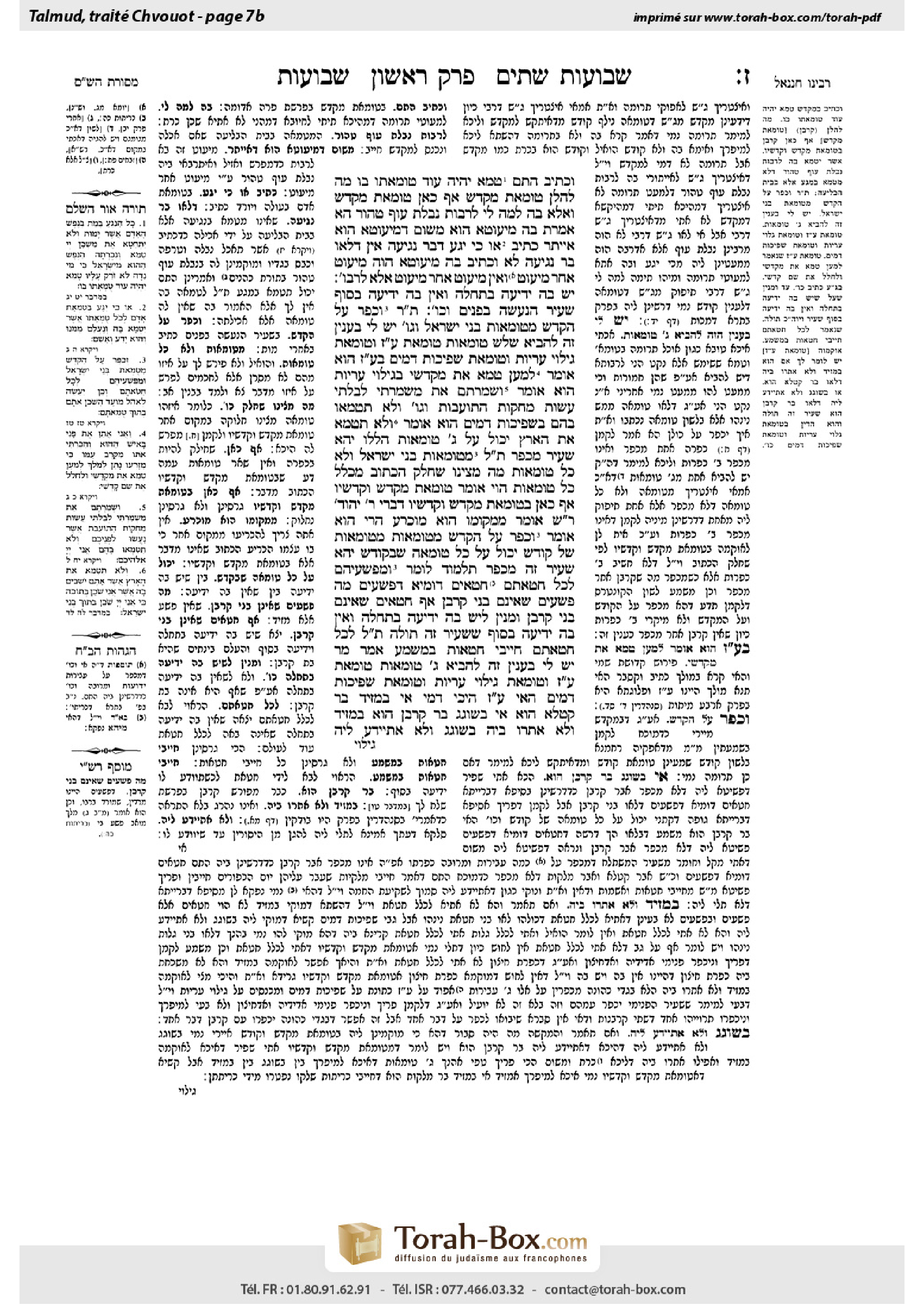
Shevuot 7b: Talmud study for Daf Yomi
Daf Yomi is the daily study of one Talmud folio. Explore 37 tractates with scans, Hebrew text, Sefaria English and AI-generated French translations where annotated.
Passage selection and English or AI-generated French translation are available where the scan has annotations. Daf Study is independent of Torah-Box and Sefaria.
Browse Shevuot · שבועות · All tractatesShevuot 7b text and translations
This page of Shevuot includes the Aramaic text, an English translation and an AI-generated French translation, alongside the scan above.
שבועות ז׳ ב · Aramaic and Hebrew text
וּכְתִיב הָתָם: ״טָמֵא יִהְיֶה עוֹד טֻמְאָתוֹ בּוֹ״; מָה לְהַלָּן טוּמְאַת מִקְדָּשׁ, אַף כָּאן טוּמְאַת מִקְדָּשׁ.
וְאֶלָּא ״בָּהּ״ לְמָה לִי?
לְרַבּוֹת נִבְלַת עוֹף טָהוֹר.
הָא אָמְרַתְּ: ״בָּהּ״ מִיעוּטָא הוּא! מִשּׁוּם דְּמִיעוּטָא הוּא – אִיַּיתַּר; כְּתִיב: ״אוֹ כִּי יִגַּע״ – דְּבַר נְגִיעָה אִין דְּלָאו בַּר נְגִיעָה לָא, וּכְתִיב ״בָּהּ״ – מִיעוּטָא; הָוֵי מִיעוּט אַחַר מִיעוּט, וְאֵין מִיעוּט אַחַר מִיעוּט אֶלָּא לְרַבּוֹת.
יֵשׁ בָּהּ יְדִיעָה בַּתְּחִלָּה וְאֵין בָּהּ יְדִיעָה בַּסּוֹף – שָׂעִיר הַנַּעֲשֶׂה בִּפְנִים וְכוּ׳. תָּנוּ רַבָּנַן: ״וְכִפֶּר עַל הַקֹּדֶשׁ מִטֻּמְאֹת בְּנֵי יִשְׂרָאֵל וְגוֹ׳״ –
יֵשׁ לִי בְּעִנְיָן זֶה לְהָבִיא שָׁלֹשׁ טְומָאוֹת: טוּמְאַת עֲבוֹדָה זָרָה, וְטוּמְאַת גִּילּוּי עֲרָיוֹת, וְטוּמְאַת שְׁפִיכוּת דָּמִים.
בַּעֲבוֹדָה זָרָה הוּא אוֹמֵר: ״לְמַעַן טַמֵּא אֶת מִקְדָּשִׁי״; בְּגִילּוּי עֲרָיוֹת הוּא אוֹמֵר: ״וּשְׁמַרְתֶּם אֶת מִשְׁמַרְתִּי לְבִלְתִּי עֲשׂוֹת מֵחֻקּוֹת הַתּוֹעֵבֹת וְגוֹ׳ וְלֹא תִטַּמְּאוּ בָּהֶם״; בִּשְׁפִיכוּת דָּמִים הוּא אוֹמֵר: ״וְלֹא תְטַמֵּא אֶת הָאָרֶץ״. יָכוֹל עַל שָׁלֹשׁ טְומָאוֹת הַלָּלוּ יְהֵא שָׂעִיר מְכַפֵּר? תַּלְמוּד לוֹמַר: ״מִטֻּמְאֹת בְּנֵי יִשְׂרָאֵל״ – וְלֹא כׇּל טוּמְאוֹת.
מָה מָצִינוּ שֶׁחִלֵּק הַכָּתוּב מִכְּלַל כׇּל טוּמְאוֹת – הֱוֵי אוֹמֵר טוּמְאַת מִקְדָּשׁ וְקָדָשָׁיו; אַף כָּאן – בְּטוּמְאַת מִקְדָּשׁ וְקָדָשָׁיו. דִּבְרֵי רַבִּי יְהוּדָה.
רַבִּי שִׁמְעוֹן אוֹמֵר: מִמְּקוֹמוֹ הוּא מוּכְרָע; הֲרֵי הוּא אוֹמֵר: ״וְכִפֶּר עַל הַקֹּדֶשׁ מִטֻּמְאֹת״ – מִטּוּמְאוֹת שֶׁל קוֹדֶשׁ.
יָכוֹל עַל כׇּל טוּמְאָה שֶׁבַּקּוֹדֶשׁ יְהֵא שָׂעִיר זֶה מְכַפֵּר? תַּלְמוּד לוֹמַר: ״וּמִפִּשְׁעֵיהֶם לְכׇל חַטֹּאתָם״ – חֲטָאִים דּוּמְיָא דִּפְשָׁעִים; מָה פְּשָׁעִים שֶׁאֵינָם בְּנֵי קׇרְבָּן, אַף חֲטָאִים שֶׁאֵינָם בְּנֵי קׇרְבָּן.
וּמִנַּיִן לְיֵשׁ בָּהּ יְדִיעָה בַּתְּחִלָּה וְאֵין בָּהּ יְדִיעָה בַּסּוֹף, שֶׁשָּׂעִיר זֶה תּוֹלֶה? תַּלְמוּד לוֹמַר: ״לְכׇל חַטֹּאתָם״ – חַיָּיבֵי חַטָּאוֹת בַּמַּשְׁמָע.
אָמַר מָר: יֵשׁ לִי בְּעִנְיָן זֶה לְהָבִיא שָׁלֹשׁ טוּמְאוֹת – טוּמְאַת עֲבוֹדָה זָרָה, וְטוּמְאַת גִּילּוּי עֲרָיוֹת, וְטוּמְאַת שְׁפִיכוּת דָּמִים.
הַאי עֲבוֹדָה זָרָה, הֵיכִי דָּמֵי? אִי בְּמֵזִיד – בַּר קְטָלָא הוּא! אִי בְּשׁוֹגֵג – בַּר קׇרְבָּן הוּא!
בְּמֵזִיד – וְלָא אַתְרוֹ בֵּיהּ, בְּשׁוֹגֵג – וְלָא אִתְיְידַע לֵיהּ.
Shevuot 7b · English translation
and it is written there with regard to the red heifer: “Whoever touches the corpse of a man who died and is not sprinkled, he will have contaminated the Tabernacle of God…he will be impure, his impurity is still upon him” (Numbers 19:13). This verbal analogy teaches that just as there the verse is referring to the defiling of the Temple, so too here, the sliding-scale offering is brought to atone for the defiling of the Temple.
The Gemara asks: But if so, why do I need the term “through which” (Leviticus 5:3)? The Gemara earlier derived from this term that one who is impure and unwittingly eats teruma is not liable to bring a sliding-scale offering. The Gemara has now derived that the sliding-scale offering atones specifically for the unwitting defiling of the Temple. If so, it is obvious that one is not liable for unwittingly eating teruma, and the phrase is superfluous.
The Gemara answers: The term “through which” serves to include one who was rendered impure by eating the unslaughtered carcass of a kosher bird. Unlike other impure items, which render impure any person who touches them, the carcass of a kosher bird renders a person impure only if he eats it. Therefore, one might have thought he would not be liable for entering the Temple if he was rendered impure by having eaten the carcass of a kosher bird. The extra term is therefore necessary to teach that one is liable.
The Gemara challenges: But didn’t you say above that the term “through which” is a restriction? How can you now use it to include additional cases? The Gemara explains: It is precisely because it is a restriction that it includes additional cases. As it is written at the beginning of that verse: “Or if he will touch an impurity of a man” (Leviticus 5:3), which indicates that one who is impure with a form of impurity that can impart impurity through touching, yes, he is liable for defiling the Temple by entering it in his impure state. But if one is impure with a form of impurity that cannot impart impurity through touching, then one would not be liable. Therefore, the verse opens with a restriction, and when the verse continues, and it is written “through which,” which is also a restriction, this constitutes a restriction after a restriction, and a restriction after a restriction serves only to amplify the halakha, applying it to additional cases.
§ The mishna continues: For cases in which one had awareness at the beginning, but then transgressed during a lapse of awareness and still had no awareness at the end, the goat whose blood presentation is performed inside the Sanctuary on Yom Kippur, and Yom Kippur itself, suspend any punishment that he deserves until he becomes aware of his transgression, at which point he must bring a sliding-scale offering. The Sages taught in a baraita: The verse states with regard to the internal goat offering: “And he shall effect atonement upon the Sanctuary from the impurities of the children of Israel and from their acts of rebellion, for all their sins” (Leviticus 16:16).
With regard to this matter, i.e., the atonement effected by the sacrifice of the goat, I can state that this verse serves to amplify the atonement by teaching that the goat offering atones for the following three sins, which the Torah is referring to as impurities: The impurity of the sin of idol worship, and the impurity of engaging in forbidden sexual relations, and the impurity of perpetrating bloodshed.
The baraita demonstrates that each of these sins is referred to as impurity: With regard to idol worship the verse states: “For he had given his offspring to Molekh in order to render impure My Sanctuary” (Leviticus 20:3). With regard to forbidden sexual relations the verse states: “You shall safeguard My charge not to do any of the abominable traditions that were done before you and not to render yourself impure through them” (Leviticus 18:30). With regard to bloodshed the verse states: “The land will not atone for the blood that was spilled on it except through the blood of the one who spilled it; you shall not render the land impure” (Numbers 35:34). One might have thought that the goat offering would atone for these three types of impurities. To counter this, the verse states: “From the impurities of the children of Israel” (Leviticus 16:16). The restrictive term “from” indicates that it atones for some impurities but not for all impurities.
The baraita derives the type of impurity for which the goat offering does atone: What do we find is the impurity that the verse differentiates from all other impurities? You must say that the verse is referring to the defiling of the Temple or its sacrificial foods. It is specifically for this transgression that the Torah provides one with the means of achieving atonement, i.e., by bringing a sliding-scale offering. So too here, since the verse limits the atonement of the goat offering to transgressions involving impurity, it is logical that it can also atone only for the defiling of the Temple or its sacrificial foods. This is the statement of Rabbi Yehuda.
Rabbi Shimon says: It is not necessary to derive which transgressions the goat offering atones for by comparing the verse written concerning it to a different verse. Rather, from its own place, i.e., from the verse about the atonement effected by the goat itself, it can be determined, as it states: “And he shall effect atonement upon the Sanctuary [hakodesh] from the impurities of the children of Israel,” which should be interpreted as saying that it atones for the defiling of anything sacred [kodesh], i.e., the Temple or its sacrificial foods.
The baraita continues: One might have thought that this goat offering would atone for all cases of the defiling of the Temple, even where there was awareness at the beginning and at the end. To counter this, the verse states: “And from their acts of rebellion, for all their sins” (Leviticus 16:16), which indicates that the goat offering atones only for sins that are similar to acts of rebellion. Just as it atones for acts of rebellion that are not subject to atonement through an offering, as sin-offerings brought by an individual are brought only for unwitting sins, so too, it atones only for sins that are not subject to atonement through an offering. As long as one does not become aware of his sin, it cannot be atoned for through the sliding-scale offering. Accordingly, the goat will atone for it.
The baraita continues. And from where is it derived for a case in which one had awareness at the beginning but did not have awareness at the end, that this goat suspends the punishment that he deserved until he becomes aware of his transgression? The verse states “for all their sins,” from which it is indicated that the goat offering atones only for those who are potentially liable to bring a sin-offering, i.e., the sliding-scale offering, should they become aware of their sin.
The Gemara clarifies some of the details of the baraita. The Master said: With regard to this matter, I can state that this verse serves to amplify the atonement by teaching that the goat offering atones for the following three sins, which the Torah is referring to as impurities: The impurity of the sin of idol worship, and the impurity of engaging in forbidden sexual relations, and the impurity of perpetrating bloodshed.
The Gemara asks: Concerning this sin of idol worship, for which one might have thought the goat would atone, what are the circumstances? If you say the reference is to a case where he transgressed intentionally, then one can counter that he is subject to the death penalty and no offering will atone for his sin. And if you say the reference is to a case where he transgressed unwittingly, then one can counter that he is liable to bring his own sin-offering for his transgression, and the goat will not atone for him.
The Gemara answers: The goat offering atones in a case where he transgressed intentionally but witnesses did not forewarn him about his transgression, and therefore he is not liable to receive the death penalty. It also atones in a case where he transgressed unwittingly, but by the time Yom Kippur arrived he had still not become aware of his transgression and therefore he was not liable to bring an offering.
Shevuot 7b · Traduction française (IA)
Et il est écrit à propos de la vache rousse : « Quiconque touche le cadavre d’un homme mort sans être aspergé, a rendu impur le Tabernacle de Dieu… il sera impur, son impureté restera sur lui » (Nombres 19:13). Cette analogie verbale enseigne que, de même qu’en cet endroit le verset parle de la souillure du Temple, de même ici, l’offrande à valeur variable est apportée pour expier la souillure du Temple.
La Guemara demande : Mais, dans ce cas, pourquoi l’expression « par laquelle » (Lévitique 5:3) est-elle nécessaire ? La Guemara avait précédemment déduit de cette expression qu’une personne impure qui mange involontairement de la terouma n’est pas tenue d’apporter une offrande à valeur variable. Or, la Guemara vient de déduire que l’offrande à valeur variable expie spécifiquement la souillure involontaire du Temple. Il est donc évident qu’on n’est pas tenu d’apporter une offrande pour avoir mangé involontairement de la terouma, et cette expression est superflue.
La Guemara répond : L’expression « par laquelle » inclut celui qui est devenu impur en mangeant la carcasse non abattue d’un oiseau casher. À la différence des autres sources d’impureté, qui rendent impur quiconque les touche, la carcasse d’un oiseau casher ne rend une personne impure que si elle la mange. On aurait donc pu penser qu’il ne serait pas tenu d’apporter une offrande pour être entré dans le Temple s’il était devenu impur en mangeant la carcasse d’un oiseau casher. L’expression supplémentaire est donc nécessaire pour enseigner qu’il en est tenu.
La Guemara objecte : Mais n’as-tu pas dit plus haut que l’expression « par laquelle » est restrictive ? Comment peux-tu maintenant t’en servir pour inclure des cas supplémentaires ? La Guemara explique : C’est précisément parce qu’elle est restrictive qu’elle inclut des cas supplémentaires. En effet, il est écrit au début de ce verset : « Ou s’il touche une impureté d’un homme » (Lévitique 5:3), ce qui indique que celui qui est impur d’une manière susceptible de transmettre l’impureté par contact est bien passible d’une peine pour avoir souillé le Temple en y entrant dans cet état d’impureté. Mais celui qui est impur d’une manière qui ne peut pas transmettre l’impureté par contact ne serait pas passible d’une peine. Le verset commence donc par une restriction ; puis, lorsqu’il poursuit par l’expression « par laquelle », qui est elle aussi restrictive, cela constitue une restriction après une restriction. Or, une restriction après une restriction ne sert qu’à élargir la halakha à des cas supplémentaires.
§ La Michna poursuit : Dans les cas où la personne avait conscience au début, puis a transgressé pendant une période d’inconscience et n’avait toujours pas conscience de sa transgression à la fin, le bouc dont le sang est appliqué à l’intérieur du Sanctuaire à Yom Kippour, ainsi que Yom Kippour lui-même, suspendent toute peine qu’elle encourt jusqu’à ce qu’elle prenne conscience de sa transgression ; à ce moment-là, elle doit apporter une offrande à valeur variable. Les Sages enseignent dans une baraïta : À propos du bouc offert à l’intérieur, le verset dit : « Il fera expiation sur le Sanctuaire pour les impuretés des enfants d’Israël et pour leurs actes de rébellion, pour tous leurs péchés » (Lévitique 16:16).
À propos de cette question, c’est-à-dire de l’expiation obtenue par le sacrifice du bouc, je peux dire que ce verset élargit la portée de l’expiation en enseignant que l’offrande du bouc expie les trois péchés suivants, que la Torah désigne comme des impuretés : l’impureté liée au péché d’idolâtrie, l’impureté liée aux relations sexuelles interdites et l’impureté liée au meurtre.
La baraïta montre que chacun de ces péchés est désigné comme une impureté. À propos de l’idolâtrie, le verset dit : « Car il a livré sa descendance à Molekh, afin de rendre impur Mon Sanctuaire » (Lévitique 20:3). À propos des relations sexuelles interdites, le verset dit : « Vous observerez Mes prescriptions : vous ne pratiquerez aucune de ces coutumes abominables qui ont été pratiquées avant vous et vous ne vous rendrez pas impurs par elles » (Lévitique 18:30). À propos du meurtre, le verset dit : « Le pays ne pourra être expié du sang qui y a été versé que par le sang de celui qui l’a versé ; vous ne rendrez pas le pays impur » (Nombres 35:34). On aurait pu penser que l’offrande du bouc expie ces trois types d’impureté. Pour l’exclure, le verset dit : « Des impuretés des enfants d’Israël » (Lévitique 16:16). Le terme restrictif « des » indique qu’elle expie certaines impuretés, mais pas toutes.
La baraïta déduit le type d’impureté pour lequel l’offrande du bouc expie effectivement : Quelle est l’impureté que le verset distingue de toutes les autres ? Il faut répondre que le verset parle de la souillure du Temple ou de ses aliments sacrificiels. C’est précisément pour cette transgression que la Torah prévoit un moyen d’obtenir l’expiation, à savoir l’apport d’une offrande à valeur variable. De même ici, puisque le verset limite l’expiation de l’offrande du bouc aux transgressions impliquant l’impureté, il est logique qu’elle ne puisse expier que la souillure du Temple ou de ses aliments sacrificiels. Telle est l’opinion de Rabbi Yehouda.
Rabbi Shimon dit : Il n’est pas nécessaire de déterminer les transgressions que l’offrande du bouc expie en comparant le verset qui la concerne à un autre verset. On peut plutôt le déterminer à partir du verset lui-même, c’est-à-dire de celui qui porte sur l’expiation obtenue par le bouc. Il est dit : « Il fera expiation sur le Sanctuaire [hakodesh] pour les impuretés des enfants d’Israël », ce qu’il faut interpréter comme signifiant qu’elle expie la souillure de tout ce qui est sacré [kodesh], c’est-à-dire du Temple ou de ses aliments sacrificiels.
La baraïta poursuit : On aurait pu penser que cette offrande du bouc expie tous les cas de souillure du Temple, même lorsque la personne avait conscience au début et à la fin. Pour l’exclure, le verset dit : « Et pour leurs actes de rébellion, pour tous leurs péchés » (Lévitique 16:16), ce qui indique que l’offrande du bouc n’expie que les péchés semblables à des actes de rébellion. De même qu’elle expie les actes de rébellion qui ne peuvent être expiés par une offrande — car les sacrifices expiatoires apportés par un particulier ne sont prescrits que pour les péchés involontaires —, de même elle n’expie que les péchés qui ne peuvent être expiés par une offrande. Tant que la personne n’a pas pris conscience de son péché, celui-ci ne peut pas être expié par l’offrande à valeur variable. Le bouc l’expiera donc.
La baraïta poursuit : Et d’où déduit-on que, dans le cas où la personne avait conscience au début mais pas à la fin, ce bouc suspend la peine qu’elle encourt jusqu’à ce qu’elle prenne conscience de sa transgression ? Le verset dit « pour tous leurs péchés », ce qui indique que l’offrande du bouc expie uniquement les péchés pour lesquels la personne pourrait être tenue d’apporter un sacrifice expiatoire, c’est-à-dire l’offrande à valeur variable, si elle prenait conscience de son péché.
La Guemara précise certains détails de la baraïta. Le Maître a dit : À propos de cette question, je peux dire que ce verset élargit la portée de l’expiation en enseignant que l’offrande du bouc expie les trois péchés suivants, que la Torah désigne comme des impuretés : l’impureté liée au péché d’idolâtrie, l’impureté liée aux relations sexuelles interdites et l’impureté liée au meurtre.
La Guemara demande : Concernant le péché d’idolâtrie, que l’on aurait pu penser que le bouc expie, dans quelles circonstances cela s’applique-t-il ? Si tu dis qu’il s’agit d’un cas où la personne a transgressé intentionnellement, on peut objecter qu’elle est passible de la peine de mort et qu’aucune offrande n’expie son péché. Et si tu dis qu’il s’agit d’un cas où elle a transgressé involontairement, on peut objecter qu’elle est tenue d’apporter son propre sacrifice expiatoire pour sa transgression et que le bouc n’expiera pas pour elle.
La Guemara répond : L’offrande du bouc expie dans un cas où la personne a transgressé intentionnellement, mais où les témoins ne l’avaient pas avertie de sa transgression ; elle n’est donc pas passible de la peine de mort. Elle expie également dans un cas où la personne a transgressé involontairement, mais où, à l’arrivée de Yom Kippour, elle n’avait toujours pas pris conscience de sa transgression et n’était donc pas tenue d’apporter une offrande.
Traduction française générée par IA à partir de l’édition anglaise de Sefaria. Vérifie toujours un passage avec le texte source.
Text from Sefaria: William Davidson Edition - Vocalized Aramaic (CC BY NC); William Davidson Edition - English (CC BY NC).