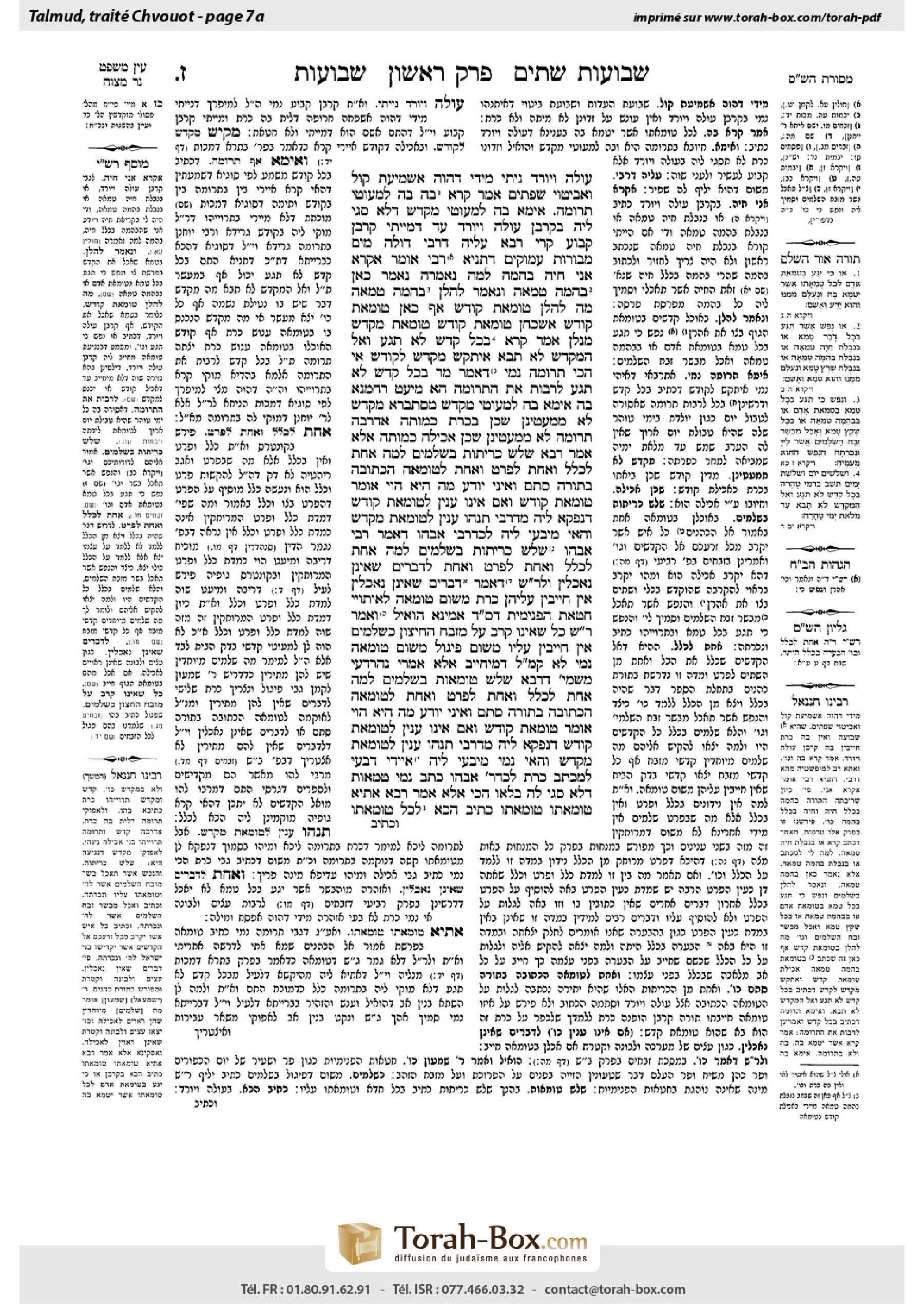
Shevuot 7a: Talmud study for Daf Yomi
Daf Yomi is the daily study of one Talmud folio. Explore 37 tractates with scans, Hebrew text, Sefaria English and AI-generated French translations where annotated.
Passage selection and English or AI-generated French translation are available where the scan has annotations. Daf Study is independent of Torah-Box and Sefaria.
Browse Shevuot · שבועות · All tractatesShevuot 7a text and translations
This page of Shevuot includes the Aramaic text, an English translation and an AI-generated French translation, alongside the scan above.
שבועות ז׳ א · Aramaic and Hebrew text
עוֹלֶה וְיוֹרֵד נַיְתֵי – מִידֵּי דְּהָוֵה אַשְּׁמִיעַת קוֹל וְאַבִּיטּוּי שְׂפָתַיִם!
אָמַר קְרָא: ״בָּהּ״; ״בָּהּ״ – לְמַעוֹטֵי תְּרוּמָה.
אֵימָא: ״בָּהּ״ – לְמַעוֹטֵי מִקְדָּשׁ; דְּלָא סַגִּי לֵיהּ בְּקׇרְבָּן עוֹלֶה וְיוֹרֵד עַד דְּמַיְיתֵי קׇרְבָּן קָבוּעַ!
קָרֵי רָבָא עֲלֵיהּ דְּרַבִּי: דּוֹלֶה מַיִם מִבּוֹרוֹת עֲמוּקִּים.
דְּתַנְיָא, רַבִּי אוֹמֵר: אֶקְרָא אֲנִי ״חַיָּה״; ״בְּהֵמָה״ לָמָּה נֶאֶמְרָה? נֶאֱמַר כָּאן ״בְּהֵמָה טְמֵאָה״, וְנֶאֱמַר לְהַלָּן ״בְּהֵמָה טְמֵאָה״; מָה לְהַלָּן טוּמְאַת קוֹדֶשׁ, אַף כָּאן טוּמְאַת קוֹדֶשׁ.
אַשְׁכְּחַן טוּמְאַת קוֹדֶשׁ, טוּמְאַת מִקְדָּשׁ מְנָלַן? אָמַר קְרָא: ״בְּכׇל קֹדֶשׁ לֹא תִגָּע וְאֶל הַמִּקְדָּשׁ לֹא תָבֹא״ – אִיתַּקַּשׁ מִקְדָּשׁ לְקוֹדֶשׁ.
אִי הָכִי, תְּרוּמָה נָמֵי – דְּאָמַר מָר: ״בְּכׇל קֹדֶשׁ לֹא תִגָּע״ – לְרַבּוֹת אֶת הַתְּרוּמָה!
הָא מִיעֵט רַחֲמָנָא ״בָּהּ״. אֵימָא ״בָּהּ״ – לְמַעוֹטֵי מִקְדָּשׁ! מִסְתַּבְּרָא מִקְדָּשׁ לָא מְמַעֲטִינַן, שֶׁכֵּן בְּכָרֵת כְּמוֹתָהּ.
אַדְּרַבָּה, תְּרוּמָה לָא מְמַעֲטִינַן – שֶׁכֵּן אֲכִילָה כְּמוֹתָהּ!
אֶלָּא אָמַר רָבָא: שָׁלֹשׁ כָּרֵיתוֹת בִּשְׁלָמִים לָמָּה? אַחַת לִכְלָל, וְאַחַת לִפְרָט, וְאַחַת לְטוּמְאָה הַכְּתוּבָה בַּתּוֹרָה סְתָם. וְאֵינִי יוֹדֵעַ מָה הִיא,
הֱוֵי אוֹמֵר: טוּמְאַת קוֹדֶשׁ. וְאִם אֵינוֹ עִנְיָן לְטוּמְאַת קוֹדֶשׁ – דְּנָפְקָא לֵיהּ מִדְּרַבִּי, תְּנֵהוּ עִנְיָן לְטוּמְאַת מִקְדָּשׁ.
וְהַאי מִיבְּעֵי לֵיהּ לְכִדְרַבִּי אֲבָהוּ! דְּאָמַר רַבִּי אֲבָהוּ: שָׁלֹשׁ כָּרֵיתוֹת בִּשְׁלָמִים לָמָּה? אַחַת לִכְלָל, וְאַחַת לִפְרָט, וְאַחַת לִדְבָרִים שֶׁאֵינָן נֶאֱכָלִין.
וּלְרַבִּי שִׁמְעוֹן דְּאָמַר: דְּבָרִים שֶׁאֵינָן נֶאֱכָלִין אֵין חַיָּיבִין עֲלֵיהֶן כָּרֵת מִשּׁוּם טוּמְאָה; לְאֵיתוֹיֵי חַטָּאת הַפְּנִימִית. דְּסָלְקָא דַּעְתָּךְ אָמֵינָא, הוֹאִיל וְאָמַר רַבִּי שִׁמְעוֹן: כֹּל שֶׁאֵינוֹ קָרֵב עַל מִזְבֵּחַ הַחִיצוֹן כִּשְׁלָמִים אֵין חַיָּיבִין עָלָיו מִשּׁוּם פִּיגּוּל, מִשּׁוּם טוּמְאָה נָמֵי לָא; קָא מַשְׁמַע לַן דְּמִיחַיַּיב.
אֶלָּא אָמְרִי נְהַרְדָּעֵי מִשְּׁמֵיהּ דְּרָבָא: שָׁלֹשׁ טוּמְאוֹת בִּשְׁלָמִים לָמָּה? אַחַת לִכְלָל, וְאַחַת לִפְרָט, וְאַחַת לְטוּמְאָה הַכְּתוּבָה בְּתוֹרָה סְתָם. וְאֵינִי יוֹדֵעַ מָה הִיא,
הֱוֵי אוֹמֵר טוּמְאַת קוֹדֶשׁ; וְאִם אֵינוֹ עִנְיָן לְטוּמְאַת קוֹדֶשׁ – דְּנָפְקָא לֵיהּ מִדְּרַבִּי, תְּנֵהוּ עִנְיָן לְטוּמְאַת מִקְדָּשׁ.
וְהַאי נָמֵי מִיבְּעֵי לֵיהּ – אַיְּידֵי דְּבָעֵי לְמִכְתַּב כָּרֵת לְכִדְרַבִּי אֲבָהוּ, כְּתַב נָמֵי טְמָאוֹת, דְּלָא סַגִּי לַהּ בְּלָאו הָכִי!
אֶלָּא אָמַר רָבָא: אָתְיָא ״טוּמְאָתוֹ״–״טוּמְאָתוֹ״; כְּתִיב הָכָא: ״לְכֹל טוּמְאָתוֹ״,
Shevuot 7a · English translation
one can bring a sliding-scale offering for the unwitting violation of a transgression whose intentional violation is not punishable by karet; just as is the case of a violation for “hearing the voice” (Leviticus 5:1), which is where a litigant asks a witness to testify about an event and he takes a false oath that he did not witness the event, and for taking a false oath with the “utterance of lips” (Leviticus 5:4). In both of these cases, an intentional violation is not punishable by karet, and nevertheless one is liable to bring a sliding-scale offering for an unwitting violation.
The Gemara answers: It cannot be referring to one who partakes of teruma while ritually impure, as the verse concerning a sliding-scale offering states: “Or if he will touch impurity of a man in any manner of his impurity through which he can become impure” (Leviticus 5:3). The verse states “through which” to exclude an impure person who partakes of teruma from liability to bring a sliding-scale offering.
The Gemara asks: But say the verse states “through which” to exclude one who defiles the Temple, and teaches that due to the severity of that transgression it is not sufficient for him to achieve atonement with a sliding-scale offering; rather, he will not achieve atonement until he brings a fixed sin-offering. Accordingly, no proof can be drawn from here.
Rava read the following verse about Rabbi Yehuda HaNasi: “One who draws water from deep wells” (see Proverbs 20:5); this verse describes Rabbi Yehuda HaNasi, because by delving deeply into the Bible he found a source that a sliding-scale offering atones for the unwitting defiling of sacrificial foods by partaking of them while ritually impure.
This is as it is taught in a baraita concerning the verse: “Or if a person will have touched any impure object, whether the carcass of an impure animal [ḥayya] or the carcass of an impure domesticated animal [behema]” (Leviticus 5:2). Rabbi Yehuda HaNasi says: Since a domesticated animal is also referred to as a ḥayya, it would be sufficient if I would read only the verse’s clause about a ḥayya. Why then is an explicit clause about a behema stated? It is in order to derive a verbal analogy. It is stated in the verse here: “An impure domesticated animal,” and it is stated in the verse below with regard to one who intentionally defiles an offering by partaking of it while he is impure: “An impure domesticated animal” (Leviticus 7:21). Just as below the reference is to the defiling of sacrificial foods, so too here, the reference is to the defiling of sacrificial foods.
The Gemara continues: We found a source for the halakha that the sliding-scale offering atones for the defiling of sacrificial foods; from where do we derive that it also atones for the defiling of the Temple by entering it while ritually impure? The verse states with regard to a woman after childbirth, who is impure due to having given birth: “She may not touch any sacred item and she may not enter the Temple” (Leviticus 12:4). The verse juxtaposes the Temple to sacred items to teach that the halakhot that apply to one apply to the other. Accordingly, the sliding-scale offering atones for both.
The Gemara asks: If so, that the liability to bring a sliding-scale offering is derived from this verse, then one should also be liable to bring the offering if he partakes of teruma while impure, as the Master said that the general term “sacred item,” in the verse: “She may not touch any sacred item,” serves to include teruma in the prohibition. Accordingly, it should also be included in the obligation to bring a sliding-scale offering.
The Gemara explains: The Merciful One excludes something with the term “through which” (Leviticus 5:3). Should we say that the term “through which” serves to exclude the defiling of the Temple? No, it is reasonable that we should not exclude the defiling of the Temple, as its intentional violation is punishable by karet, just like one who defiles sacrificial foods by partaking of them while he is impure. Rather, the term must serve to exclude one who partakes of teruma while impure.
The Gemara offers a counterargument: On the contrary, we should not exclude one who partakes of teruma while impure, as it is a violation done through eating, similar to one who eats sacrificial food while impure. Therefore, there is still no proof that one is liable to bring a sliding-scale offering for defiling the Temple.
Rather, Rava said it can be derived from the following: Why does the Torah mention three times the punishment of karet with regard to one who partakes of peace-offerings while he is impure? The three times are Leviticus 22:3, 7:20, and 7:21. One time is to apply the punishment to the general case of a ritually impure person who partakes of any type of offering, and one time is to apply it to the specific instance of a peace-offering, and one time is to apply it to another case of defiling something sacred that is written in the Torah without specifying what it is referring to, and I do not know from that passage what that case is.
Rava continues: The only passage that describes the defiling of something sacred without specifying the situation is the passage in the Torah that discusses a sliding-scale offering brought for the defiling of sacrificial foods. Therefore, you must say that the third mention of karet is referring to the defiling of sacrificial foods. But if it is not needed to teach the matter of defiling sacrificial foods, as that has been derived through the verbal analogy of Rabbi Yehuda HaNasi, apply it to the matter of defiling the Temple. Accordingly, one who intentionally defiles the Temple by entering it while impure is liable to receive karet, and it is reasonable that he should be liable to bring a sliding-scale offering for doing so unwittingly.
The Gemara asks: But that third mention is necessary in order to expound it in accordance with the statement of Rabbi Abbahu, as Rabbi Abbahu says: Why does the Torah mention three times the punishment of karet with regard to one who partakes of peace-offerings while he is ritually impure? One time is to apply the punishment to the general case of an impure person who partakes of any type of offering, and one time is to apply it to the specific instance of a peace-offering, and one time is to apply it to an impure person who eats items that are not generally eaten, such as frankincense.
The Gemara adds: And according to Rabbi Shimon, who says that for items that are not generally eaten one is not liable to be punished with karet for partaking of them while he is ritually impure, the third mention is necessary in order to include the case of an impure person who eats an internal sin-offering, as it could enter your mind to say that since Rabbi Shimon says: For any type of offering that is not sacrificed on and its blood applied to the external altar in the manner that peace-offerings are, one cannot be liable to be punished with karet for eating it if it is piggul, i.e., for eating such an offering if it was sacrificed with the intent to consume it after its appointed time. One might have thought that similarly, for such an offering, one is also not liable to be punished with karet for intentionally partaking of it while ritually impure; the third mention teaches us that one is indeed liable. Therefore, there is still no proof that one is liable to bring a sliding-scale offering for unwittingly entering the Temple while impure.
Rather, the Sages of Neharde’a said in the name of Rava that it can be derived from the following: Why does the Torah mention three times the ritually impure status with regard to one who partakes of peace-offerings while he is impure? That is, each of the three times that the Torah mentions the punishment of karet, it also mentions the fact that the person was impure at the time. One time is for the general case of an impure person who partakes of any type of offering, and one time is for the specific instance of one who partakes of a peace-offering, and one time is to apply it to another case of defiling something sacred that is written in the Torah without specifying what it is referring to, and I do not know from that passage what the case is.
Now, the only passage that describes the defiling of something sacred without specifying the situation is the passage in the Torah that discusses a sliding-scale offering that is brought for the defiling of sacrificial foods. Therefore, you must say that the third mention of karet is referring to the defiling of sacrificial foods. But if it is not needed to teach the matter of defiling sacrificial foods, as that has been derived through the verbal analogy of Rabbi Yehuda HaNasi, apply it to the matter of defiling the Temple.
The Gemara asks: But that third mention is also necessary, because since it is necessary for the Torah to write the karet punishment three times in order to expound it in accordance with the statement of Rabbi Abbahu, it also has to write that the person was ritually impure, as it is not sufficient to mention the punishment without mentioning for what the punishment is given. Accordingly, there is still no proof that one is liable to bring a sliding-scale offering for unwittingly defiling the Temple.
Rather, Rava said: It is derived from a verbal analogy between the terms “his impurity” and “his impurity,” as follows: It is written here, with regard to a sliding-scale offering: “Or if he will touch impurity of a man in any manner of his impurity through which he can become impure” (Leviticus 5:3),
Shevuot 7a · Traduction française (IA)
On peut apporter une offrande graduée pour la transgression involontaire d’une faute dont la transgression intentionnelle n’est pas passible de karet, comme dans le cas de la faute consistant à « entendre la voix » (Lévitique 5:1) : un plaideur demande à un témoin de témoigner au sujet d’un événement, et celui-ci prête un faux serment en affirmant qu’il n’a pas été témoin de cet événement. Il en va de même pour le faux serment prononcé par « les lèvres » (Lévitique 5:4). Dans ces deux cas, la transgression intentionnelle n’est pas passible de karet, et pourtant, une transgression involontaire oblige à apporter une offrande graduée.
La Guemara répond : Il ne peut pas s’agir de quelqu’un qui consomme de la terouma alors qu’il est rituellement impur, car le verset concernant l’offrande graduée dit : « Ou s’il touche l’impureté d’un homme, quelle que soit son impureté par laquelle il peut devenir impur » (Lévitique 5:3). L’expression « par laquelle » exclut de l’obligation d’apporter une offrande graduée une personne impure qui consomme de la terouma.
La Guemara demande : Mais ne pourrait-on pas dire que le verset emploie l’expression « par laquelle » afin d’exclure celui qui rend le Temple impur, et enseigne qu’en raison de la gravité de cette transgression, une offrande graduée ne suffit pas à expier sa faute ? Il n’obtiendra l’expiation qu’après avoir apporté un sacrifice expiatoire fixe. Par conséquent, on ne peut tirer aucune preuve de là.
Rava appliqua à Rabbi Yehouda HaNassi le verset suivant : « Celui qui puise de l’eau des puits profonds » (voir Proverbes 20:5). Ce verset décrit Rabbi Yehouda HaNassi, car, en scrutant profondément la Torah écrite, il a trouvé une source établissant qu’une offrande graduée expie le fait de rendre impurs des aliments sacrificiels en les consommant alors qu’on est rituellement impur.
C’est ce qui est enseigné dans une baraïta à propos du verset : « Ou si quelqu’un touche un objet impur, qu’il s’agisse de la carcasse d’un animal impur [ḥayya] ou de la carcasse d’un animal domestique impur [behema] » (Lévitique 5:2). Rabbi Yehouda HaNassi dit : Puisqu’un animal domestique est également appelé ḥayya, il aurait suffi que je lise uniquement la partie du verset qui parle d’une ḥayya. Pourquoi alors une clause explicite concernant une behema est-elle énoncée ? Pour établir une analogie verbale. Ici, le verset dit : « un animal domestique impur », et plus loin, à propos de celui qui rend intentionnellement une offrande impure en la consommant alors qu’il est impur, le verset dit : « un animal domestique impur » (Lévitique 7:21). De même que, dans le passage ultérieur, il s’agit de rendre impurs des aliments sacrificiels, de même ici, il s’agit de rendre impurs des aliments sacrificiels.
La Guemara poursuit : Nous avons trouvé une source établissant que l’offrande graduée expie le fait de rendre impurs des aliments sacrificiels ; d’où déduisons-nous qu’elle expie également le fait de rendre le Temple impur en y entrant alors qu’on est rituellement impur ? À propos d’une femme après un accouchement, impure parce qu’elle a accouché, le verset dit : « Elle ne touchera aucun objet sacré et elle n’entrera pas dans le Temple » (Lévitique 12:4). Le verset rapproche le Temple des objets sacrés pour enseigner que les règles qui s’appliquent à l’un s’appliquent aussi à l’autre. Par conséquent, l’offrande graduée expie les deux.
La Guemara demande : Si tel est le cas, si l’obligation d’apporter une offrande graduée est déduite de ce verset, on devrait également être obligé d’apporter cette offrande lorsqu’on consomme de la terouma en état d’impureté, car le Maître a dit que le terme général « objet sacré », dans le verset « Elle ne touchera aucun objet sacré », inclut la terouma dans l’interdit. Il faudrait donc aussi l’inclure dans l’obligation d’apporter une offrande graduée.
La Guemara explique : Le Miséricordieux exclut un cas au moyen de l’expression « par laquelle » (Lévitique 5:3). Faut-il dire que cette expression sert à exclure le fait de rendre le Temple impur ? Non, il est raisonnable de ne pas exclure le fait de rendre le Temple impur, car sa transgression intentionnelle est passible de karet, tout comme le fait de rendre impurs des aliments sacrificiels en les consommant alors qu’on est impur. L’expression doit donc servir à exclure celui qui consomme de la terouma en état d’impureté.
La Guemara oppose : Au contraire, nous ne devrions pas exclure celui qui consomme de la terouma en état d’impureté, car il s’agit d’une transgression commise en mangeant, comme lorsqu’on mange un aliment sacrificiel en état d’impureté. Par conséquent, il n’y a toujours pas de preuve qu’on soit obligé d’apporter une offrande graduée pour avoir rendu le Temple impur.
Rava dit plutôt qu’on peut le déduire de ce qui suit : Pourquoi la Torah mentionne-t-elle trois fois la peine de karet à propos de celui qui consomme des sacrifices de paix alors qu’il est impur ? Ces trois mentions se trouvent en Lévitique 22:3, 7:20 et 7:21. L’une s’applique au cas général d’une personne rituellement impure qui consomme n’importe quel type d’offrande ; une autre s’applique au cas particulier d’un sacrifice de paix ; et la troisième s’applique à un autre cas où l’on rend impur un objet sacré, mentionné dans la Torah sans qu’il soit précisé de quoi il s’agit, et je ne sais pas, à partir de ce passage, quel est ce cas.
Rava poursuit : Le seul passage qui décrit le fait de rendre impur un objet sacré sans préciser la situation est celui de la Torah qui traite de l’offrande graduée apportée pour avoir rendu impurs des aliments sacrificiels. Il faut donc dire que la troisième mention de karet se rapporte au fait de rendre impurs des aliments sacrificiels. Mais si elle n’est pas nécessaire pour enseigner la règle concernant le fait de rendre impurs des aliments sacrificiels, puisque cela a été déduit au moyen de l’analogie verbale de Rabbi Yehouda HaNassi, appliquons-la au cas où l’on rend le Temple impur. Par conséquent, celui qui rend intentionnellement le Temple impur en y entrant alors qu’il est impur est passible de karet, et il est raisonnable qu’il soit obligé d’apporter une offrande graduée s’il le fait involontairement.
La Guemara demande : Mais cette troisième mention est nécessaire pour l’interpréter conformément à l’enseignement de Rabbi Abbahou. Rabbi Abbahou dit : Pourquoi la Torah mentionne-t-elle trois fois la peine de karet à propos de celui qui consomme des sacrifices de paix alors qu’il est rituellement impur ? L’une s’applique au cas général d’une personne impure qui consomme n’importe quel type d’offrande ; une autre s’applique au cas particulier d’un sacrifice de paix ; et la troisième s’applique à une personne impure qui mange des éléments qui ne sont généralement pas consommés, comme l’encens.
La Guemara ajoute : Selon Rabbi Shimon, qui dit que la consommation, en état d’impureté rituelle, d’éléments qui ne sont généralement pas consommés n’est pas passible de karet, la troisième mention est nécessaire pour inclure le cas d’une personne impure qui mange un sacrifice expiatoire intérieur. On aurait pu penser que, puisque Rabbi Shimon dit que, pour tout type d’offrande qui n’est pas sacrifié sur l’autel extérieur et dont le sang n’est pas appliqué sur cet autel comme celui des sacrifices de paix, on ne peut pas être passible de karet pour l’avoir mangé s’il est piggoul, c’est-à-dire pour avoir mangé une telle offrande si elle a été sacrifiée avec l’intention d’en consommer la viande après le délai prescrit, on ne peut pas non plus être passible de karet pour l’avoir consommée intentionnellement en état d’impureté rituelle. La troisième mention nous enseigne qu’on en est effectivement passible. Par conséquent, il n’y a toujours pas de preuve qu’on soit obligé d’apporter une offrande graduée pour être entré involontairement dans le Temple en état d’impureté.
Les Sages de Nehardea ont plutôt dit au nom de Rava qu’on peut le déduire de ce qui suit : Pourquoi la Torah mentionne-t-elle trois fois l’état d’impureté rituelle à propos de celui qui consomme des sacrifices de paix alors qu’il est impur ? Autrement dit, chacune des trois fois où la Torah mentionne la peine de karet, elle mentionne également le fait que la personne était impure à ce moment-là. L’une s’applique au cas général d’une personne impure qui consomme n’importe quel type d’offrande ; une autre s’applique au cas particulier de celui qui consomme un sacrifice de paix ; et la troisième s’applique à un autre cas où l’on rend impur un objet sacré, mentionné dans la Torah sans qu’il soit précisé de quoi il s’agit, et je ne sais pas, à partir de ce passage, quel est ce cas.
Or, le seul passage qui décrit le fait de rendre impur un objet sacré sans préciser la situation est celui de la Torah qui traite de l’offrande graduée apportée pour avoir rendu impurs des aliments sacrificiels. Il faut donc dire que la troisième mention de karet se rapporte au fait de rendre impurs des aliments sacrificiels. Mais si elle n’est pas nécessaire pour enseigner la règle concernant le fait de rendre impurs des aliments sacrificiels, puisque cela a été déduit au moyen de l’analogie verbale de Rabbi Yehouda HaNassi, appliquons-la au cas où l’on rend le Temple impur.
La Guemara demande : Mais cette troisième mention est également nécessaire, car, puisqu’il est nécessaire que la Torah mentionne trois fois la peine de karet afin qu’on puisse l’interpréter conformément à l’enseignement de Rabbi Abbahou, elle doit aussi préciser que la personne était rituellement impure ; il ne suffit pas de mentionner la peine sans préciser à quelle faute elle s’applique. Par conséquent, il n’y a toujours pas de preuve qu’on soit obligé d’apporter une offrande graduée pour avoir rendu involontairement le Temple impur.
Rava dit plutôt qu’on le déduit d’une analogie verbale entre les expressions « son impureté » et « son impureté », comme suit : il est écrit ici, à propos de l’offrande graduée : « Ou s’il touche l’impureté d’un homme, quelle que soit son impureté par laquelle il peut devenir impur » (Lévitique 5:3),
Traduction française générée par IA à partir de l’édition anglaise de Sefaria. Vérifie toujours un passage avec le texte source.
Text from Sefaria: William Davidson Edition - Vocalized Aramaic (CC BY NC); William Davidson Edition - English (CC BY NC).