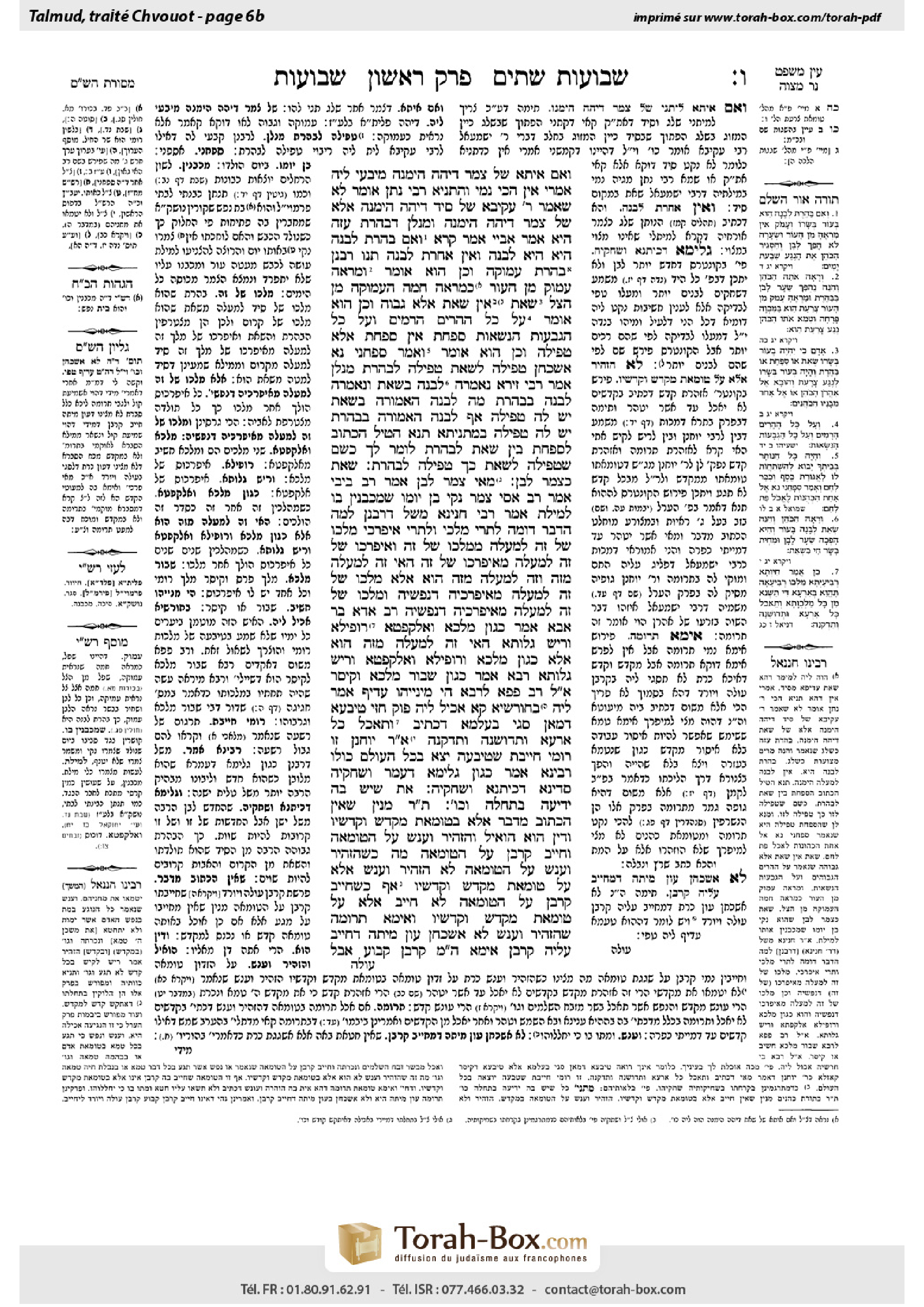
Shevuot 6b: Talmud study for Daf Yomi
Daf Yomi is the daily study of one Talmud folio. Explore 37 tractates with scans, Hebrew text, Sefaria English and AI-generated French translations where annotated.
Passage selection and English or AI-generated French translation are available where the scan has annotations. Daf Study is independent of Torah-Box and Sefaria.
Browse Shevuot · שבועות · All tractatesShevuot 6b text and translations
This page of Shevuot includes the Aramaic text, an English translation and an AI-generated French translation, alongside the scan above.
שבועות ו׳ ב · Aramaic and Hebrew text
וְאִם אִיתָא, ״שֶׁל צֶמֶר דֵּיהָה הֵימֶנָּה״ מִיבְּעֵי לֵיהּ!
אָמְרִי: אִין הָכִי נָמֵי, וְהָתַנְיָא: רַבִּי נָתָן אוֹמֵר, לֹא שֶׁאָמַר רַבִּי עֲקִיבָא ״שֶׁל סִיד דֵּיהָה הֵימֶנָּה״, אֶלָּא ״שֶׁל צֶמֶר דֵּיהָה הֵימֶנָּה״.
וּמְנָלַן דְּבַהֶרֶת עַזָּה הִיא? אָמַר אַבָּיֵי, אָמַר קְרָא: ״אִם בַּהֶרֶת לְבָנָה הִיא״ – הִיא לְבָנָה, וְאֵין אַחֶרֶת לְבָנָה.
תָּנוּ רַבָּנַן: ״בַּהֶרֶת״ – עֲמוּקָּה, וְכֵן הוּא אוֹמֵר: ״וּמַרְאֶהָ עָמֹק מִן הָעוֹר״; כְּמַרְאֵה חַמָּה הָעֲמוּקָּה מִן הַצֵּל. ״שְׂאֵת״ – אֵין שְׂאֵת אֶלָּא גָּבוֹהַּ, וְכֵן הוּא אוֹמֵר: ״עַל כׇּל הֶהָרִים הָרָמִים וְעַל כׇּל הַגְּבָעוֹת הַנִּשָּׂאוֹת״. ״סַפַּחַת״ – אֵין סַפַּחַת אֶלָּא טְפֵילָה, וְכֵן הוּא אוֹמֵר: ״וְאָמַר סְפָחֵנִי נָא״.
אַשְׁכְּחַן טְפֵילָה לַשְּׂאֵת; טְפֵילָה לַבַּהֶרֶת מְנָלַן? אָמַר רַבִּי זֵירָא: נֶאֶמְרָה ״לְבָנָה״ בַּשְּׂאֵת, וְנֶאֶמְרָה ״לְבָנָה״ בַּבַּהֶרֶת; מָה לְבָנָה הָאֲמוּרָה בַּשְּׂאֵת – יֵשׁ לָהּ טְפֵילָה, אַף לְבָנָה הָאֲמוּרָה בַּבַּהֶרֶת – יֵשׁ לָהּ טְפֵילָה.
בְּמַתְנִיתָא תָּנָא: הֵטִיל הַכָּתוּב לַסַּפַּחַת בֵּין שְׂאֵת לַבַּהֶרֶת, לוֹמַר לָךְ: כְּשֵׁם שֶׁטְּפֵילָה לַשְּׂאֵת, כָּךְ טְפֵילָה לַבַּהֶרֶת.
שְׂאֵת כְּצֶמֶר לָבָן. מַאי ״צֶמֶר לָבָן״? אָמַר רַב בִּיבִי אָמַר רַב אַסִּי: צֶמֶר נָקִי בֶּן יוֹמוֹ, שֶׁמְכַבְּנִין בּוֹ לְמֵילָת.
אָמַר רַבִּי חֲנִינָא: מָשָׁל דְּרַבָּנַן – לְמָה הַדָּבָר דּוֹמֶה? לִתְרֵי מַלְכֵי וְלִתְרֵי אִיפַּרְכֵי; מַלְכּוֹ שֶׁל זֶה לְמַעְלָה מִמַּלְכּוֹ שֶׁל זֶה, וְאִיפַּרְכוֹ שֶׁל זֶה לְמַעְלָה מֵאִיפַּרְכוֹ שֶׁל זֶה.
הַאי זֶה לְמַעְלָה מִזֶּה וְזֶה לְמַעְלָה מִזֶּה הוּא!
אֶלָּא מַלְכּוֹ שֶׁל זֶה לְמַעְלָה מֵאִיפַּרְכֵיהּ דְּנַפְשֵׁיהּ, וּמַלְכּוֹ שֶׁל זֶה לְמַעְלָה מֵאִיפַּרְכֵיהּ דְּנַפְשֵׁיהּ.
רַב אַדָּא בַּר אַבָּא אָמַר: כְּגוֹן מַלְכָּא וְאַלְקַפְטָא, רוּפִילָא וְרֵישׁ גָּלוּתָא. הַאי זֶה לְמַעְלָה מִזֶּה הוּא! אֶלָּא כְּגוֹן מַלְכָּא וְרוּפִילָא, וְאַלְקַפְטָא וְרֵישׁ גָּלוּתָא.
רָבָא אָמַר: כְּגוֹן שַׁבּוּר מַלְכָּא וְקֵיסָר.
אֲמַר לֵיהּ רַב פָּפָּא לְרָבָא: הֵי מִינַּיְיהוּ עֲדִיף? אֲמַר לֵיהּ: בְּחוּרְשַׁיָּא קָא אָכֵיל לֵיהּ. פּוֹק חֲזִי טִיבְעָא דְּמַאן סַגִּי בְּעָלְמָא – דִּכְתִיב: ״וְתֵאכֻל כׇּל אַרְעָא וּתְדוּשִׁנַּהּ וְתַדְּקִנַּהּ״. אָמַר רַבִּי יוֹחָנָן: זוֹ רוֹמִי חַיֶּיבֶת, שֶׁטִּיבְעָהּ יָצָא בְּכׇל הָעוֹלָם כּוּלּוֹ.
רָבִינָא אָמַר: כְּגוֹן גְּלִימָא דַּעֲמַר וְשַׁחְקֵיהּ, סְדִינָא דְּכִיתָּנָא וְשַׁחְקֵיהּ.
אֶת שֶׁיֵּשׁ בָּהּ יְדִיעָה בַּתְּחִלָּה וְכוּ׳. תָּנוּ רַבָּנַן: מִנַּיִן שֶׁאֵין הַכָּתוּב מְדַבֵּר אֶלָּא בְּטוּמְאַת מִקְדָּשׁ וְקָדָשָׁיו?
וְדִין הוּא – הוֹאִיל וְהִזְהִיר וְעָנַשׁ עַל הַטּוּמְאָה, וְחַיָּיב קׇרְבָּן עַל הַטּוּמְאָה; מָה כְּשֶׁהִזְהִיר וְעָנַשׁ עַל הַטּוּמְאָה – לֹא הִזְהִיר וְעָנַשׁ אֶלָּא עַל טוּמְאַת מִקְדָּשׁ וְקָדָשָׁיו, אַף כְּשֶׁחִיֵּיב קׇרְבָּן עַל הַטּוּמְאָה – לֹא חִיֵּיב אֶלָּא עַל טוּמְאַת מִקְדָּשׁ וְקָדָשָׁיו.
וְאֵימָא תְּרוּמָה – שֶׁהִזְהִיר וְעָנַשׁ! לָא אַשְׁכְּחַן עֲוֹן מִיתָה דְּחַיָּיב עָלֶיהָ קׇרְבָּן.
אֵימָא: הָנֵי מִילֵּי קׇרְבָּן קָבוּעַ, אֲבָל
Shevuot 6b · English translation
And if it is so that Rabbi Akiva lists the different shades in decreasing order of their degree of brightness, then after mentioning the reddish variation of baheret he should have next said: The reddish variation of a wool-white mark is darker than it, not that the reddish variation of lime is darker than it.
They said in response to this: Yes, it is indeed so that Rabbi Akiva continues by referring to the reddish variations of a wool-white mark, and it is taught likewise in a baraita that Rabbi Natan says, referring to that mishna: It is not correct that Rabbi Akiva said: The reddish variation of lime is darker than it; rather, he said that the reddish variation of a wool-white mark is darker than it.
§ The Gemara considers the source from which the different shades of marks are derived: And from where do we derive that baheret is an intense white color? Abaye said: The verse states: “And if it is a white baheret” (Leviticus 13:4), which indicates that it alone is a bright white and there is no other as white as it.
The Sages taught in a baraita: The bright shade of a baheret makes it appear deeper than the surrounding skin, and so the verse states: “And its appearance is deeper than the skin” (Leviticus 13:25). This is like the appearance of an area illuminated by the sun, which appears deeper than the area in the shade. The darker shade of a se’et makes it appear as though it is raised above the surrounding skin; this is indicated by the fact that the word se’et means nothing other than raised, and so the verse states: “Upon all the high mountains and upon all the raised up [hanissaot] hills” (Isaiah 2:14). The words hanissaot and se’et share the same Hebrew root and both refer to something raised up. In the verse: “For a se’et and for a sappaḥat” (Leviticus 14:56), the word sappaḥat means nothing other than secondary, and so the verse states: “And he will say: Append me [sefaḥeni] please to one of the priestly classes to eat a piece of bread” (I Samuel 2:36). This teaches that there is a leprous mark that is secondary and appended to a se’et. This is a mark that is the color of an egg membrane.
We found a source for a mark that is secondary to a se’et; from where do we derive that there is also a mark that is secondary to a baheret? Rabbi Zeira said: “White” (Leviticus 13:10) is stated with regard to a se’et and “white” (Leviticus 13:4) is stated with regard to a baheret. This teaches that just as the shade of white stated with regard to a se’et has a secondary mark, i.e., the mark that is the color of an egg membrane, so too, the shade of white stated with regard to a baheret has a secondary mark, i.e., the lime-colored mark.
A different source for this was taught in a baraita: The verse (see Leviticus 13:2) placed the word sappaḥat between se’et and baheret, to say to you: Just as there is a shade that is secondary to a se’et, so too, there is a shade that is secondary to a baheret.
The mishna in Nega’im cited above states: A se’et is like white wool. The Gemara asks: What is meant by white wool? Rav Beivai says that Rav Asi says: It is the color of clean wool from a lamb that is wrapped up [mekhabnin] in a cover when it is one day old in order to protect it from being sullied, so that the wool will be suitable for producing a fine wool garment.
§ In continuation of his statement cited above Rabbi Ḥanina says: The following is an analogy to illustrate the opinion of the Rabbis, i.e., the opinion expressed in the mishna in Nega’im (1:1) that both a baheret and a se’et have marks that are secondary to them. To what is this matter comparable? To two kings and to two governors [iparkhei] where, with regard to their supremacy, the king of this governor is above the king of that governor, and the governor of this king is above the governor of that king. The two kings are analogous to a baheret and a se’et and their two governors are, respectively, a lime-colored mark and an egg membrane–colored mark. Accordingly, the order of supremacy is: Baheret, se’et, lime-colored mark, egg membrane–colored mark.
The Gemara questions whether this is a suitable analogy for the opinion of the Rabbis: But this analogy suggests that the shades are ordered, this one above this one and that one above that one, i.e., according to their degrees of brightness. That is Rabbi Akiva’s opinion, not the opinion of the Rabbis.
Rather, a suitable analogy is where the king of this governor is above his own governor, and the king of that governor is above his own governor. So too, each secondary mark is subordinate only to its primary mark.
The Gemara presents a different analogy. Rav Adda bar Abba said: For example: A king, and a chief officer [alkafta], the vizier [rofila], and the Exilarch; each person in the list is more powerful than the subsequent one. The Gemara asks: But this analogy suggests that the shades are ordered, this one above that one, which is Rabbi Akiva’s opinion. Rather, a suitable analogy is, for example: A king and the vizier; and a chief officer and the Exilarch. This list splits the four into two groups, each group containing one person who is subordinate to the other.
The Gemara presents a different analogy. Rava said: The previous suggestion is not precise because all these positions, apart from the king, are subordinate to the king. A more precise analogy would be, for example: King Shapur, the king of Persia, with his subordinate; and the Roman emperor with his subordinate.
Rav Pappa said to Rava: Which of them is greater, King Shapur or the Roman emperor? Rava said to him: Does he eat in the forest, i.e., do you live disconnected and unaware of events in the world at large? Go out and see whose coin circulates throughout the world, which is an indicator of a government’s influence, as it is written with regard to the fourth empire described in Daniel’s dream of the future powers of the world: “It shall devour the whole earth and tread upon it and break it into pieces” (Daniel 7:23), and Rabbi Yoḥanan says: This is the guilty empire of Rome whose coin circulates throughout the entire world.
The Gemara presents a different analogy. Ravina said: For example, a new white woolen garment and a frayed one; a new linen sheet and a frayed one.
§ The mishna (2a) states: In cases of defiling the Temple or its sacrificial foods in which one had awareness at the beginning and awareness at the end, but had a lapse of awareness in between while he actually transgressed, this person is liable to bring a sliding-scale offering. The Sages taught in a baraita: From where is it derived that the verse that describes the liability for a sliding-scale offering (see Leviticus 5:2–4) speaks of nothing other than the defiling of the Temple or its sacrificial foods? While the verse mentions that a violation was committed due to a lapse of awareness of one’s state of impurity, it does not mention which transgression was violated.
The Gemara explains: And it is a logical inference: Since the Torah has explicitly prohibited and also prescribed punishment for the intentional defiling of something sacred and has rendered one liable to bring an offering for the unwitting defiling of something sacred, it follows that just as when it prohibited and also prescribed punishment for the defiling of something sacred it prohibited and also prescribed punishment only for the intentional defiling of the Temple or its sacrificial foods; so too, when it rendered one liable to bring an offering for the defiling of something sacred it rendered one liable to do so only for the unwitting defiling of the Temple or its sacrificial foods.
The Gemara asks: But say instead that the obligation to bring a sliding-scale offering is referring to a ritually impure person who partook of the sacred portion of produce grown in Eretz Yisrael that is designated to be given to a priest [teruma], as the Torah also has explicitly prohibited and prescribed punishment for this. One who partakes of teruma while ritually impure is liable to receive death at the hand of Heaven (see Leviticus 22:9). The Gemara answers: It cannot be referring to teruma, because we do not find a sin whose punishment for an intentional violation is death, with regard to which one is liable to bring an offering for its unwitting violation. Sin-offerings, of which the sliding-scale offering is one type, are brought only for transgressions whose intentional violation is punishable by karet.
The Gemara asks: But say that this statement applies only to a fixed sin-offering, but
Shevuot 6b · Traduction française (IA)
Et s’il en est ainsi, si Rabbi Akiva énumère les différentes nuances par ordre décroissant de luminosité, après avoir mentionné la nuance rougeâtre d’une baheret, il aurait dû dire ensuite : « La nuance rougeâtre d’une tache blanche comme la laine est plus sombre qu’elle », et non : « La nuance rougeâtre de la chaux est plus sombre qu’elle. »
On répondit à cette objection : Oui, Rabbi Akiva poursuit bien en parlant des nuances rougeâtres d’une tache blanche comme la laine. Une baraïta enseigne également que Rabbi Natan dit, à propos de cette Michna : « Rabbi Akiva n’a pas dit : “La nuance rougeâtre de la chaux est plus sombre qu’elle” ; il a plutôt dit que la nuance rougeâtre d’une tache blanche comme la laine est plus sombre qu’elle. »
§ La Guemara examine la source d’où sont déduites les différentes nuances des taches : d’où déduisons-nous que la baheret est d’un blanc intense ? Abayé dit : Le verset dit : « Et s’il y a une baheret blanche » (Lévitique 13:4), ce qui indique qu’elle seule est d’un blanc éclatant et qu’aucune autre n’est aussi blanche qu’elle.
Les Sages enseignent dans une baraïta : La nuance éclatante d’une baheret la fait paraître plus profonde que la peau environnante, comme le dit le verset : « Et son apparence est plus profonde que la peau » (Lévitique 13:25). Elle ressemble à une zone éclairée par le soleil, qui paraît plus profonde qu’une zone à l’ombre. La nuance plus sombre d’une se’et donne l’impression qu’elle est en relief par rapport à la peau environnante. Cela est indiqué par le fait que le mot se’et ne signifie rien d’autre que « relief » ; ainsi, le verset dit : « Sur toutes les hautes montagnes et sur toutes les collines élevées [hanissaot] » (Isaïe 2:14). Les mots hanissaot et se’et ont la même racine hébraïque et désignent tous deux quelque chose d’élevé. Dans le verset « Pour une se’et et une sappaḥat » (Lévitique 14:56), le mot sappaḥat ne signifie rien d’autre que « secondaire » ; ainsi, le verset dit : « Et il dira : Rattache-moi [sefaḥeni], je te prie, à l’une des classes sacerdotales, afin que je mange un morceau de pain » (I Samuel 2:36). Cela enseigne qu’il existe une tache lépreuse secondaire, rattachée à une se’et. C’est une tache de la couleur de la membrane d’un œuf.
Nous avons trouvé une source pour une tache secondaire à une se’et ; d’où déduisons-nous qu’il existe également une tache secondaire à une baheret ? Rabbi Zeira dit : Le mot « blanche » (Lévitique 13:10) est employé à propos d’une se’et, et le mot « blanche » (Lévitique 13:4) à propos d’une baheret. Cela enseigne que, de même que la nuance blanche mentionnée à propos d’une se’et a une tache secondaire, c’est-à-dire une tache de la couleur de la membrane d’un œuf, de même la nuance blanche mentionnée à propos d’une baheret a une tache secondaire, c’est-à-dire une tache de la couleur de la chaux.
Une autre source à ce sujet est enseignée dans une baraïta : le verset (voir Lévitique 13:2) a placé le mot sappaḥat entre se’et et baheret pour t’enseigner que, de même qu’il existe une nuance secondaire à une se’et, il existe également une nuance secondaire à une baheret.
La Michna de Negaïm citée plus haut dit : « Une se’et est comme de la laine blanche. » La Guemara demande : Qu’entend-on par « laine blanche » ? Rav Beivai rapporte au nom de Rav Asi : C’est la couleur de la laine propre d’un agneau que l’on enveloppe [mekhabnin] dans une couverture lorsqu’il n’a qu’un jour, afin de la protéger des salissures et de préserver ainsi la laine pour confectionner un vêtement de laine fine.
§ Poursuivant sa déclaration citée plus haut, Rabbi Ḥanina dit : Voici une analogie illustrant l’opinion des Rabbins, exprimée dans la Michna de Negaïm (1:1), selon laquelle une baheret et une se’et ont toutes deux des taches secondaires. À quoi cela ressemble-t-il ? À deux rois et à deux gouverneurs [iparkhei] : dans la hiérarchie, le roi de ce gouverneur est supérieur au roi de cet autre gouverneur, et le gouverneur de ce roi est supérieur au gouverneur de cet autre roi. Les deux rois correspondent respectivement à une baheret et à une se’et, et leurs deux gouverneurs à une tache de la couleur de la chaux et à une tache de la couleur de la membrane d’un œuf. L’ordre de préséance est donc le suivant : baheret, se’et, tache de la couleur de la chaux, tache de la couleur de la membrane d’un œuf.
La Guemara objecte que cette analogie ne convient pas à l’opinion des Rabbins : mais elle suggère que les nuances sont classées, l’une au-dessus de l’autre, c’est-à-dire selon leur degré de luminosité. Or, c’est l’opinion de Rabbi Akiva, et non celle des Rabbins.
Il faut plutôt proposer une analogie dans laquelle le roi de ce gouverneur est supérieur à son propre gouverneur, et le roi de cet autre gouverneur est supérieur au sien. De même, chaque tache secondaire n’est subordonnée qu’à sa propre tache principale.
La Guemara présente une autre analogie. Rav Adda bar Abba dit : Par exemple, un roi, un haut fonctionnaire [alkafta], le vizir [rofila] et l’Exilarque, chacun étant plus puissant que celui qui vient après lui. La Guemara demande : Mais cette analogie suggère que les nuances sont classées, l’une au-dessus de l’autre, ce qui correspond à l’opinion de Rabbi Akiva. Il faut plutôt proposer une analogie telle que celle-ci : un roi et le vizir, puis un haut fonctionnaire et l’Exilarque. Cette liste répartit les quatre personnes en deux groupes, chacun comprenant une personne subordonnée à l’autre.
La Guemara présente une autre analogie. Rava dit : La proposition précédente manque de précision, car toutes ces fonctions, à l’exception de celle du roi, sont subordonnées au roi. Une analogie plus précise serait, par exemple, le roi Shapour, roi de Perse, avec son subordonné, et l’empereur romain avec le sien.
Rav Pappa dit à Rava : Lequel des deux est le plus puissant, le roi Shapour ou l’empereur romain ? Rava lui dit : Est-ce qu’il mange dans la forêt, c’est-à-dire, vis-tu coupé du monde et ignorant ce qui se passe dans le monde ? Sors et regarde quelle monnaie circule dans le monde entier, car c’est un indicateur de l’influence d’un pouvoir. En effet, il est écrit au sujet du quatrième empire décrit dans le rêve de Daniel concernant les puissances futures du monde : « Il dévorera toute la terre, la foulera et la brisera en morceaux » (Daniel 7:23). Et Rabbi Yoḥanan dit : Il s’agit de l’empire coupable de Rome, dont la monnaie circule dans le monde entier.
La Guemara présente une autre analogie. Ravina dit : Par exemple, un vêtement neuf en laine blanche et un vêtement usé ; un drap de lin neuf et un drap usé.
§ La Michna (2a) dit : Dans les cas où l’on rend impur le Temple ou ses aliments sacrificiels, celui qui avait connaissance de son état d’impureté au début et à la fin, mais dont la connaissance a été interrompue entre-temps au moment où il a effectivement transgressé, est tenu d’apporter une offrande à valeur variable. Les Sages enseignent dans une baraïta : D’où déduit-on que le verset qui décrit l’obligation d’apporter une offrande à valeur variable (voir Lévitique 5:2–4) ne concerne que le fait de rendre impur le Temple ou ses aliments sacrificiels ? Le verset mentionne qu’une transgression a été commise en raison d’une perte de connaissance de son état d’impureté, mais il ne précise pas quelle transgression a été commise.
La Guemara explique : C’est une déduction logique. Puisque la Torah a explicitement interdit de rendre impur un objet consacré et a également prévu une sanction pour cet acte, et qu’elle a rendu obligatoire une offrande pour le fait de rendre impur par inadvertance un objet consacré, il s’ensuit que, de même que lorsqu’elle a interdit de rendre impur un objet consacré et prévu une sanction à cet égard, elle n’a interdit et sanctionné que le fait de rendre intentionnellement impurs le Temple ou ses aliments sacrificiels, de même, lorsqu’elle a rendu obligatoire une offrande pour le fait de rendre impur un objet consacré, elle ne l’a rendue obligatoire que pour le fait de rendre par inadvertance impurs le Temple ou ses aliments sacrificiels.
La Guemara demande : Mais ne pourrait-on pas plutôt dire que l’obligation d’apporter une offrande à valeur variable concerne une personne rituellement impure qui a consommé la part sacrée des produits cultivés en Eretz Israël destinée à être donnée à un prêtre [terouma], puisque la Torah a également explicitement interdit cet acte et prévu une sanction ? Celui qui consomme de la terouma alors qu’il est rituellement impur est passible de mort par la main du Ciel (voir Lévitique 22:9). La Guemara répond : Il ne peut s’agir de la terouma, car nous ne trouvons pas de faute dont la transgression intentionnelle est punie de mort et dont la transgression involontaire oblige à apporter une offrande. Les sacrifices expiatoires, dont l’offrande à valeur variable est un type, ne sont apportés que pour des transgressions dont la violation intentionnelle est passible de karet.
La Guemara demande : Mais ne pourrait-on pas dire que cette déclaration ne s’applique qu’à un sacrifice expiatoire fixe, mais
Traduction française générée par IA à partir de l’édition anglaise de Sefaria. Vérifie toujours un passage avec le texte source.
Text from Sefaria: William Davidson Edition - Vocalized Aramaic (CC BY NC); William Davidson Edition - English (CC BY NC).