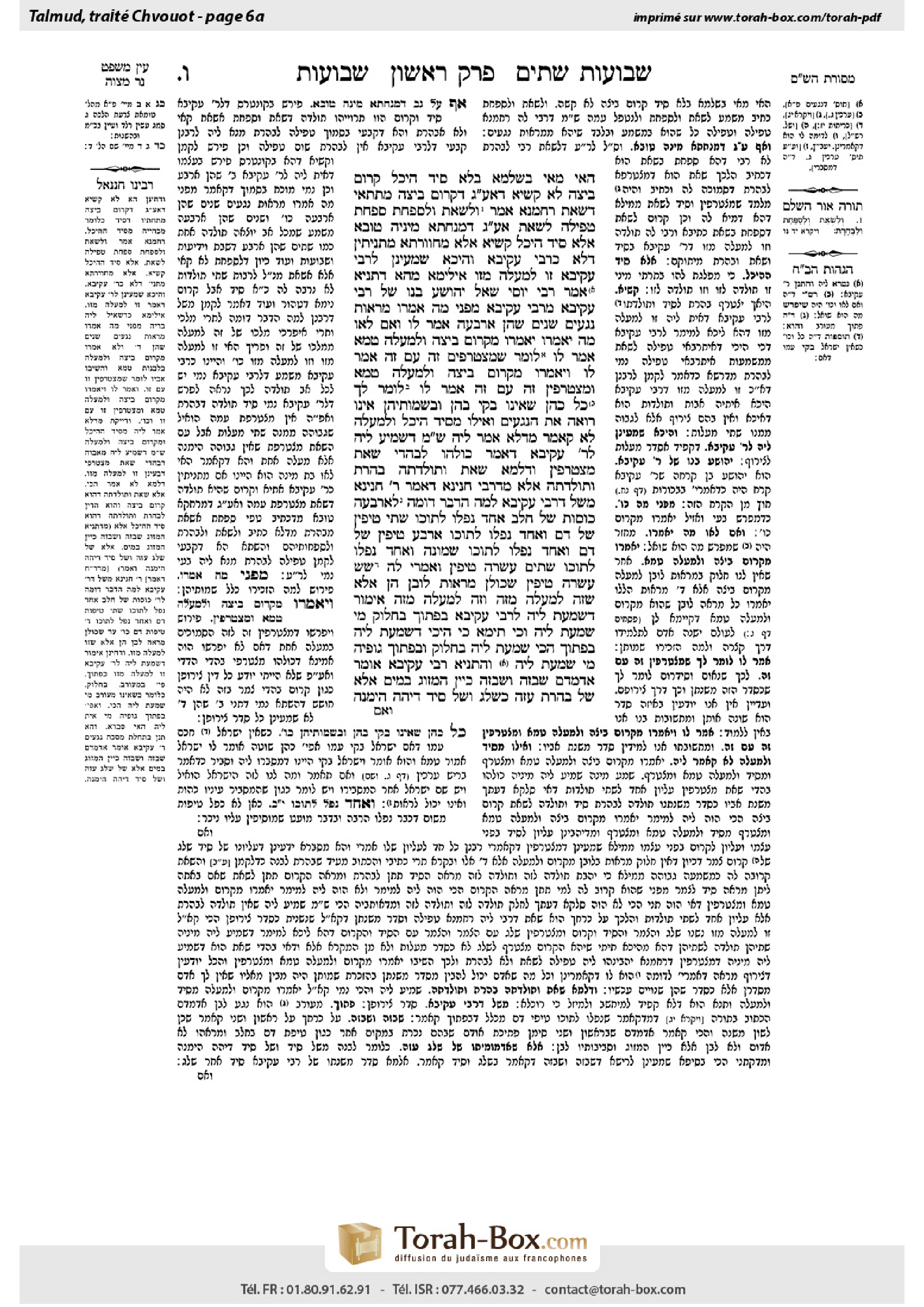
Shevuot 6a: Talmud study for Daf Yomi
Daf Yomi is the daily study of one Talmud folio. Explore 37 tractates with scans, Hebrew text, Sefaria English and AI-generated French translations where annotated.
Passage selection and English or AI-generated French translation are available where the scan has annotations. Daf Study is independent of Torah-Box and Sefaria.
Browse Shevuot · שבועות · All tractatesShevuot 6a text and translations
This page of Shevuot includes the Aramaic text, an English translation and an AI-generated French translation, alongside the scan above.
שבועות ו׳ א · Aramaic and Hebrew text
הַאי מַאי? בִּשְׁלָמָא בְּלָא סִיד הֵיכָל, קְרוּם בֵּיצָה לָא קַשְׁיָא – דְּאַף עַל גַּב דִּקְרוּם בֵּיצָה מִתַּתַּאי דִּשְׂאֵת, רַחֲמָנָא אָמַר ״וְלַשְׂאֵת וְלַסַּפַּחַת״ – סַפַּחַת טְפֵילָה לַשְּׂאֵת, אַף עַל גַּב דְּמִנַּחֲתָא מִינַּיהּ טוּבָא. אֶלָּא סִיד הֵיכָל – קַשְׁיָא, אֶלָּא מְחַוַּורְתָּא מַתְנִיתִין דְּלָא כְּרַבִּי עֲקִיבָא.
וְהֵיכָא שָׁמְעִינַן לְרַבִּי עֲקִיבָא זוֹ לְמַעְלָה מִזּוֹ?
אִילֵּימָא מֵהָא – דְּתַנְיָא: אָמַר רַבִּי יוֹסֵי, שָׁאַל יְהוֹשֻׁעַ בְּנוֹ שֶׁל רַבִּי עֲקִיבָא מֵרַבִּי עֲקִיבָא: מִפְּנֵי מָה אָמְרוּ מַרְאוֹת נְגָעִים שְׁנַיִם שֶׁהֵן אַרְבָּעָה? אָמַר לוֹ: וְאִם לָאו, מָה יֹאמְרוּ? יֹאמְרוּ מִקְּרוּם בֵּיצָה וּלְמַעְלָה טָמֵא!
אָמַר לוֹ: לוֹמַר שֶׁמִּצְטָרְפִים זֶה עִם זֶה. אָמַר לוֹ, וְיֹאמְרוּ: ״מִקְּרוּם בֵּיצָה וּלְמַעְלָה טָמֵא, וּמִצְטָרְפִין זֶה עִם זֶה״! אָמַר לוֹ: לוֹמַר לָךְ, כׇּל כֹּהֵן שֶׁאֵינוֹ בָּקִי בָּהֶן וּבִשְׁמוֹתֵיהֶן, אֵינוֹ רוֹאֶה אֶת הַנְּגָעִים.
וְאִילּוּ ״מִסִּיד הֵיכָל וּלְמַעְלָה״ – לָא קָאָמַר;
מִדְּלָא אֲמַר לֵיהּ, שְׁמַע מִינַּהּ דִּשְׁמִיעַ לֵיהּ לְרַבִּי עֲקִיבָא דְּאָמַר: כּוּלְּהוּ לְבַהֲדֵי שְׂאֵת מִצְטָרְפִין.
וְדִלְמָא ״שְׂאֵת וְתוֹלַדְתָּהּ״, ״בַּהֶרֶת וְתוֹלַדְתָּהּ״?
אֶלָּא מִדְּרַבִּי חֲנִינָא – דְּאָמַר רַבִּי חֲנִינָא: מָשָׁל דְּרַבִּי עֲקִיבָא לְמָה הַדָּבָר דּוֹמֶה? לְאַרְבָּעָה כּוֹסוֹת שֶׁל חָלָב, אֶחָד נָפְלוּ לְתוֹכוֹ שְׁתֵּי טִיפִּין שֶׁל דָּם, וְאֶחָד נָפְלוּ לְתוֹכוֹ אַרְבַּע טִיפִּין שֶׁל דָּם, וְאֶחָד נָפְלוּ לְתוֹכוֹ שְׁמוֹנֶה, וְאֶחָד נָפְלוּ לְתוֹכוֹ שְׁתֵּים עֶשְׂרֵה טִיפִּין – וְאָמְרִי לַהּ: שֵׁשׁ עֶשְׂרֵה טִיפִּין – שֶׁכּוּלָּן מַרְאוֹת לוֹבֶן הֵן, אֶלָּא שֶׁזֶּה לְמַעְלָה מִזֶּה וְזֶה לְמַעְלָה מִזֶּה.
אֵימוֹר דְּשָׁמְעַתְּ לֵיהּ לְרַבִּי עֲקִיבָא – בְּפָתוּךְ; בְּחָלוּק מִי שָׁמְעַתְּ לֵיהּ?
וְכִי תֵּימָא כִּי הֵיכִי דְּשָׁמְעַתְּ לֵיהּ בְּפָתוּךְ, הָכִי שָׁמְעַתְּ לֵיהּ בְּחָלוּק; וּבְפָתוּךְ גּוּפֵיהּ מִי שָׁמְעַתְּ לֵיהּ? וְהָתַנְיָא, רַבִּי עֲקִיבָא אוֹמֵר: אֲדַמְדַּם שֶׁבָּזֶה וְשֶׁבָּזֶה כְּיַיִן הַמָּזוּג בְּמַיִם; אֶלָּא שֶׁל בַּהֶרֶת עַזָּה כַּשֶּׁלֶג, וְשֶׁל סִיד דֵּיהָה הֵימֶנָּה.
Shevuot 6a · English translation
The Gemara answers: What is this comparison? Granted, it would all be well were it not for the difficulty with regard to a mark the color of the lime plaster of the Sanctuary walls, as the difficulty raised with regard to an egg membrane–colored mark is not difficult. As even though the shade of an egg membrane is two stages below that of a se’et, the Merciful One states: “And for a se’et and for a sappaḥat” (Leviticus 14:56), which indicates that a sappaḥat is secondary to a se’et and can combine with it even though a sappaḥat is of a much lower degree of brightness than it. Rabbi Akiva holds that both of the additional shades not explicitly mentioned in the Torah are derived from the word: Sappaḥat, and so both of them can combine with a se’et. But the difficulty raised with regard to a mark the color of the lime plaster of the Sanctuary walls is indeed difficult. Rather, it is clear that the mishna is not in accordance with the opinion of Rabbi Akiva.
§ The Gemara elaborates on Rabbi Akiva’s opinion: And where have we learned that according to Rabbi Akiva the different shades should be ordered this one above that one, i.e., according to their degrees of brightness, and only two adjacent shades can combine together?
If we say we learned it from that which is taught in the following baraita, it is difficult. The baraita teaches: Rabbi Yosei said that Yehoshua, son of Rabbi Akiva, asked of Rabbi Akiva: For what reason did the Sages say that the different shades of leprous marks are two types that are four, and proceed to specify their names? Rabbi Akiva said to him: But if not that, what else could they say? Rabbi Yehoshua answered him: Let them say that any mark of a degree of brightness from that of an egg membrane and above is ritually impure.
Rabbi Akiva said to him: They specified the four different shades in order to say that they combine with each other in that order, i.e., each one with its adjacent shade. Rabbi Yehoshua said to him: If so, let them simply say: Any mark of a degree of brightness from that of an egg membrane and above is ritually impure, and they combine with each other. Rabbi Akiva said to him: They specified their names in order to tell you: Any priest who is not an expert in distinguishing between them and in identifying their names is not authorized to inspect the leprous marks and make a decision regarding them.
The Gemara explains the difficulty: Rabbi Yehoshua suggested that according to Rabbi Akiva’s opinion it should be sufficient to say that any mark of a degree of brightness from that of an egg membrane and upward is impure, but he did not say that it would also be necessary to add: And any mark of a degree of brightness from that of the lime plaster of the Sanctuary walls and above is impure. If Rabbi Akiva agrees to the categorization of the mishna, then it would be necessary to state separately each category of marks, in a dual formulation, in order to indicate that only shades that are categorized together can combine.
The Gemara suggests: Conclude from the fact that he did not say this to Rabbi Akiva that Rabbi Yehoshua heard of Rabbi Akiva that he says: All the different shades combine with a se’et. Accordingly, both a snow-white baheret and a lime-colored mark will each combine with a se’et, as they are adjacent to it when listed in order of their degrees of brightness. An egg membrane–colored mark will also combine with a se’et, as it is derived from the word: Sappaḥat, and the Torah indicates that a sappaḥat is secondary to a se’et.
The Gemara rejects this proof: But perhaps Rabbi Akiva does hold that the only combinations possible are a se’et and its secondary mark, i.e., an egg membrane–colored mark; and a baheret and its secondary mark, i.e., a lime-colored mark. And perhaps Rabbi Yehoshua in fact proposed that the Sages should use a dual formulation, but the baraita cites only the first half of his suggestion.
Rather, Rabbi Akiva’s opinion can be inferred from that which Rabbi Ḥanina says, as Rabbi Ḥanina says: The following is an analogy to illustrate the opinion of Rabbi Akiva: To what is this matter comparable? It is comparable to four cups of milk, and two drops of blood fell into one of them, and four drops of blood fell into another one of them, and eight drops of blood fell into another one, and twelve drops of blood fell into the last one. And some say that sixteen drops fell into the last cup. This is a suitable analogy, as the milk in all of the cups still has a similar shade of white, but the cups can be ordered according to their degrees of brightness, as this one is above this one, and that one is above that one. Rabbi Ḥanina’s analogy would appear to portray Rabbi Akiva’s opinion in the same way it was cited earlier.
The Gemara rejects this. The Torah states that a “reddish-white affliction” (Leviticus 13:42), not just a flawless white one, renders a person ritually impure. Therefore, the Gemara suggests: Say that you heard Rabbi Akiva express this opinion with regard to combining different shades of a mark that is mixed [befatukh] with red, which is the case most similar to the analogy offered by Rabbi Ḥanina, but with regard to different shades of flawless white, have you heard Rabbi Akiva express this opinion?
And if you would say that just as you heard Rabbi Akiva express this opinion with regard to a mark that is mixed with red, so too, by logical extension, you have effectively heard Rabbi Akiva express this opinion with regard to different shades of flawless white, as what possible reason is there to differentiate between them, this is difficult. And this suggestion is problematic, as in the case of a mixed reddish-white mark itself, did you ever hear him express this opinion? But isn’t it taught otherwise in a mishna (Nega’im 1:2): With regard to the various shades of white that are mixed with red, Rabbi Akiva says the reddish variation of this one, i.e., of a baheret, and of that one, i.e., of a lime-colored mark, are like wine diluted in water, except for the following distinction: That the reddish variation of a baheret is still an intense white, like snow, albeit with a somewhat pinkish hue, but the reddish variation of lime is darker than it.
Shevuot 6a · Traduction française (IA)
La Guemara répond : En quoi consiste cette comparaison ? Tout irait bien s’il n’y avait pas de difficulté concernant une tache de la couleur du plâtre à la chaux des murs du Sanctuaire ; en revanche, la difficulté soulevée au sujet d’une tache de la couleur de la membrane d’un œuf ne pose pas problème. En effet, même si la teinte de la membrane d’un œuf est inférieure de deux degrés à celle d’une se’et, le Miséricordieux dit : « Et pour une se’et et pour une sappaḥat » (Lévitique 14,56), ce qui indique qu’une sappaḥat est secondaire par rapport à une se’et et peut s’y associer, même si son degré de blancheur est bien moindre. Rabbi Akiva considère que les deux teintes supplémentaires qui ne sont pas explicitement mentionnées dans la Torah sont toutes deux déduites du mot sappaḥat ; elles peuvent donc toutes deux s’associer à une se’et. Mais la difficulté soulevée au sujet d’une tache de la couleur du plâtre à la chaux des murs du Sanctuaire pose bel et bien problème. Il est donc clair que la Michna n’est pas conforme à l’opinion de Rabbi Akiva.
§ La Guemara développe l’opinion de Rabbi Akiva : Où avons-nous appris que, selon Rabbi Akiva, les différentes teintes doivent être classées les unes au-dessus des autres, c’est-à-dire selon leur degré de blancheur, et que seules deux teintes adjacentes peuvent s’associer ?
Si l’on dit que nous l’avons appris de la baraïta suivante, cela pose problème. La baraïta enseigne : Rabbi Yosei dit que Yehoshua, fils de Rabbi Akiva, demanda à Rabbi Akiva : Pour quelle raison les Sages ont-ils dit que les différentes teintes des marques de lèpre sont deux catégories comprenant quatre teintes, puis en ont précisé les noms ? Rabbi Akiva lui répondit : Sinon, que pourraient-ils dire d’autre ? Rabbi Yehoshua lui répondit : Qu’ils disent que toute marque dont le degré de blancheur est égal ou supérieur à celui de la membrane d’un œuf est rituellement impure.
Rabbi Akiva lui dit : Ils ont précisé les quatre teintes différentes pour enseigner qu’elles s’associent entre elles dans cet ordre, c’est-à-dire chacune avec la teinte qui lui est adjacente. Rabbi Yehoshua lui dit : Dans ce cas, qu’ils disent simplement : « Toute marque dont le degré de blancheur est égal ou supérieur à celui de la membrane d’un œuf est rituellement impure, et ces teintes s’associent entre elles. » Rabbi Akiva lui dit : Ils en ont précisé les noms pour t’enseigner que tout prêtre qui n’est pas expert dans leur distinction et dans l’identification de leurs noms n’est pas habilité à examiner les marques de lèpre ni à statuer à leur sujet.
La Guemara explique la difficulté : Rabbi Yehoshua suggéra que, selon l’opinion de Rabbi Akiva, il suffirait de dire que toute marque dont le degré de blancheur est égal ou supérieur à celui de la membrane d’un œuf est impure, mais il ne dit pas qu’il faudrait aussi ajouter : « Toute marque dont le degré de blancheur est égal ou supérieur à celui du plâtre à la chaux des murs du Sanctuaire est impure. » Si Rabbi Akiva adhère à la catégorisation de la Michna, il faudrait énoncer séparément chaque catégorie de marques, en formulant chacune de manière distincte, afin d’indiquer que seules les teintes classées dans une même catégorie peuvent s’associer.
La Guemara suggère : Déduis de ce qu’il ne lui a pas dit cela que Rabbi Yehoshua avait entendu Rabbi Akiva dire que toutes les différentes teintes s’associent à une se’et. Ainsi, une baheret blanche comme neige et une tache couleur de chaux s’associent chacune à une se’et, puisqu’elles lui sont adjacentes lorsqu’on les classe selon leur degré de blancheur. Une tache de la couleur de la membrane d’un œuf s’associe également à une se’et, car elle est déduite du mot sappaḥat, et la Torah indique qu’une sappaḥat est secondaire par rapport à une se’et.
La Guemara rejette cette preuve : Mais peut-être Rabbi Akiva considère-t-il que les seules associations possibles sont celle d’une se’et avec sa marque secondaire, c’est-à-dire une tache de la couleur de la membrane d’un œuf, et celle d’une baheret avec sa marque secondaire, c’est-à-dire une tache couleur de chaux. Et peut-être Rabbi Yehoshua a-t-il effectivement proposé que les Sages emploient une formulation double, mais la baraïta ne rapporte que la première partie de sa suggestion.
On peut plutôt déduire l’opinion de Rabbi Akiva de ce que dit Rabbi Ḥanina. Rabbi Ḥanina dit en effet : Voici une analogie qui illustre l’opinion de Rabbi Akiva : À quoi cette chose est-elle comparable ? À quatre coupes de lait, dans l’une desquelles tombèrent deux gouttes de sang, dans une autre quatre gouttes, dans une autre huit gouttes, et dans la dernière douze gouttes. Certains disent que seize gouttes tombèrent dans la dernière coupe. Cette analogie convient, car le lait de toutes les coupes conserve une teinte blanche semblable, mais les coupes peuvent être classées selon leur degré de blancheur : l’une est plus blanche que l’autre, et celle-ci plus blanche que celle-là. L’analogie de Rabbi Ḥanina semblerait présenter l’opinion de Rabbi Akiva de la même manière qu’elle a été citée précédemment.
La Guemara rejette cette preuve. La Torah dit qu’une « affection blanc rougeâtre » (Lévitique 13,42), et pas seulement une affection d’un blanc pur, rend une personne rituellement impure. La Guemara suggère donc : Dis que tu as entendu Rabbi Akiva exprimer cette opinion à propos de l’association de différentes teintes d’une marque mêlée de rouge [befatukh], ce qui correspond le mieux à l’analogie proposée par Rabbi Ḥanina ; mais, concernant les différentes teintes d’un blanc pur, l’as-tu entendu exprimer cette opinion ?
Et si tu dis que, de même que tu as entendu Rabbi Akiva exprimer cette opinion à propos d’une marque mêlée de rouge, tu l’as donc aussi entendue, par déduction logique, à propos des différentes teintes d’un blanc pur, puisqu’il n’y aurait aucune raison de faire une distinction entre elles, cela pose problème. Cette suggestion est problématique, car, à propos d’une marque blanc rougeâtre elle-même, l’as-tu jamais entendu exprimer cette opinion ? N’est-il pas enseigné autrement dans une Michna (Nega’im 1,2) : Concernant les différentes teintes blanches mêlées de rouge, Rabbi Akiva dit que la variante rougeâtre de l’une, c’est-à-dire d’une baheret, et celle de l’autre, c’est-à-dire d’une tache couleur de chaux, sont comme du vin dilué dans l’eau, à cette distinction près : la variante rougeâtre d’une baheret reste d’un blanc intense, comme la neige, quoique légèrement rosée, tandis que la variante rougeâtre de la chaux est plus foncée que celle-ci.
Traduction française générée par IA à partir de l’édition anglaise de Sefaria. Vérifie toujours un passage avec le texte source.
Text from Sefaria: William Davidson Edition - Vocalized Aramaic (CC BY NC); William Davidson Edition - English (CC BY NC).