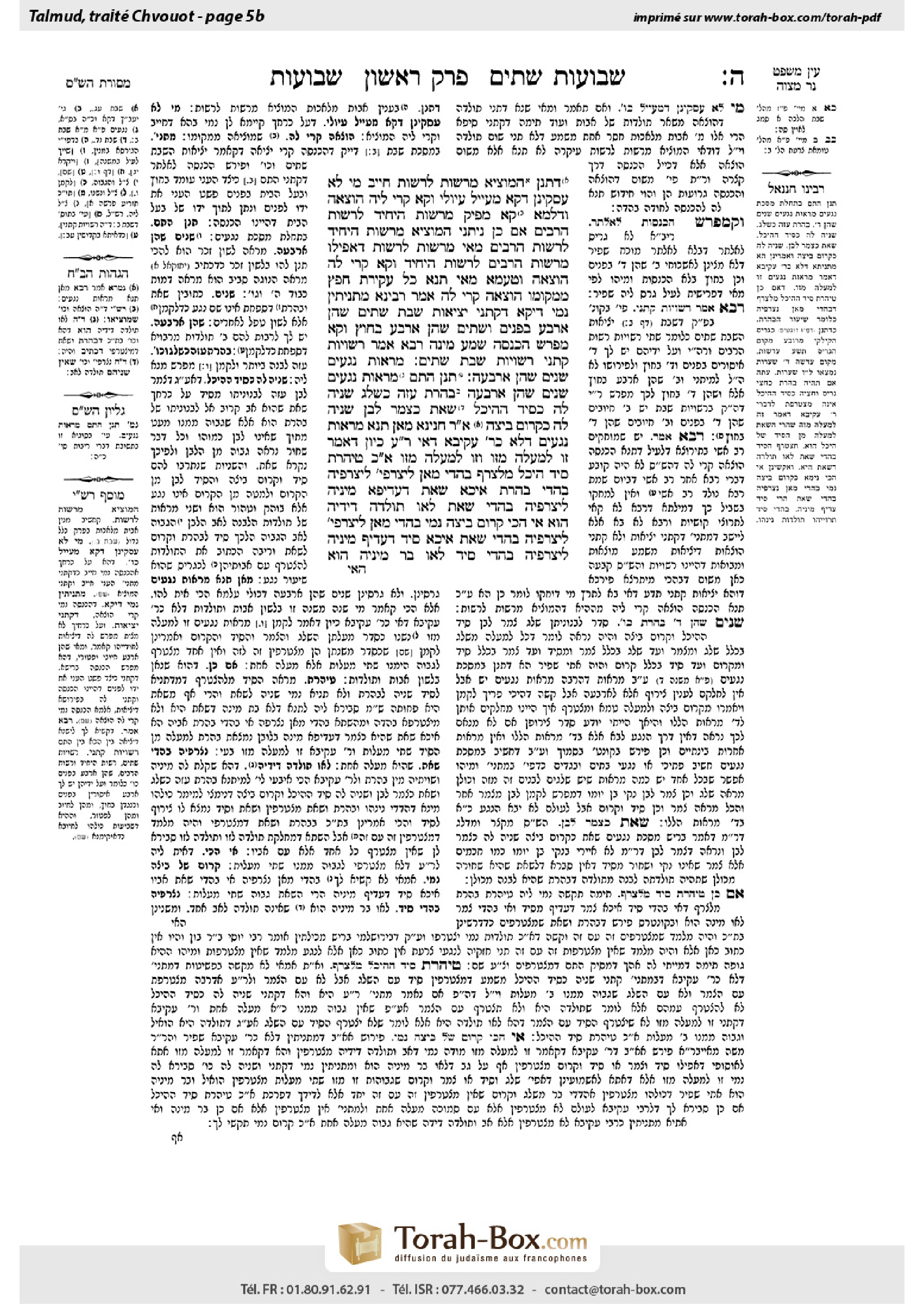
Shevuot 5b: Talmud study for Daf Yomi
Daf Yomi is the daily study of one Talmud folio. Explore 37 tractates with scans, Hebrew text, Sefaria English and AI-generated French translations where annotated.
Passage selection and English or AI-generated French translation are available where the scan has annotations. Daf Study is independent of Torah-Box and Sefaria.
Browse Shevuot · שבועות · All tractatesShevuot 5b text and translations
This page of Shevuot includes the Aramaic text, an English translation and an AI-generated French translation, alongside the scan above.
שבועות ה׳ ב · Aramaic and Hebrew text
דִּתְנַן: הַמּוֹצִיא מֵרְשׁוּת לִרְשׁוּת חַיָּיב. מִי לָא עָסְקִינַן דְּקָא מְעַיֵּיל עַיּוֹלֵי – וְקָא קָרֵי לֵיהּ ״הוֹצָאָה״?
וְדִלְמָא קָא מַפֵּיק מֵרְשׁוּת הַיָּחִיד לִרְשׁוּת הָרַבִּים? אִם כֵּן, נִיתְנֵי ״הַמּוֹצִיא מֵרְשׁוּת הַיָּחִיד לִרְשׁוּת הָרַבִּים״; מַאי ״מֵרְשׁוּת לִרְשׁוּת״? דַּאֲפִילּוּ מֵרְשׁוּת הָרַבִּים לִרְשׁוּת הַיָּחִיד,
וְקָא קָרֵי לַהּ ״הוֹצָאָה״. וְטַעְמָא מַאי? תַּנָּא, כׇּל עֲקִירַת חֵפֶץ מִמְּקוֹמוֹ – ״הוֹצָאָה״ קָרֵי לַהּ.
אָמַר רָבִינָא: מַתְנִיתִין נָמֵי דַּיְקָא, דְּקָתָנֵי: ״יְצִיאוֹת שַׁבָּת שְׁתַּיִם שֶׁהֵן אַרְבַּע בִּפְנִים וּשְׁתַּיִם שֶׁהֵן אַרְבַּע בַּחוּץ״, וְקָא מְפָרֵשׁ הַכְנָסָה. שְׁמַע מִינַּהּ.
רָבָא אָמַר: רְשׁוּיוֹת קָתָנֵי – רְשׁוּיוֹת שַׁבָּת שְׁתַּיִם.
מַרְאוֹת נְגָעִים שְׁנַיִם שֶׁהֵן אַרְבָּעָה. תְּנַן הָתָם: מַרְאוֹת נְגָעִים – שְׁנַיִם שֶׁהֵן אַרְבָּעָה: בַּהֶרֶת – עַזָּה כַּשֶּׁלֶג, שְׁנִיָּה לָהּ – כְּסִיד הַהֵיכָל,
שְׂאֵת – כְּצֶמֶר לָבָן, שְׁנִיָּה לָהּ – כִּקְרוּם בֵּיצָה.
אָמַר רַבִּי חֲנִינָא: מַאן תַּנָּא מַרְאוֹת נְגָעִים? דְּלָא כְּרַבִּי עֲקִיבָא. דְּאִי רַבִּי עֲקִיבָא, כֵּיוָן דְּאָמַר: זוֹ לְמַעְלָה מִזּוֹ וְזוֹ לְמַעְלָה מִזּוֹ, אִם כֵּן טִיהַרְתָּ סִיד הֵיכָל מִלְּצָרֵף.
בַּהֲדֵי מַאן לִיצָרְפֵיהּ? לִיצָרְפֵיהּ בַּהֲדֵי בַּהֶרֶת – אִיכָּא שְׂאֵת דַּעֲדִיפָא מִינֵּיהּ. לִיצָרְפֵיהּ בַּהֲדֵי שְׂאֵת – לָאו תּוֹלָדָה דִּידֵיהּ הוּא.
אִי הָכִי, קְרוּם בֵּיצָה נָמֵי – בַּהֲדֵי מַאן לִיצָרְפֵיהּ? לִיצָרְפֵיהּ בַּהֲדֵי שְׂאֵת – אִיכָּא סִיד דַּעֲדִיף מִינֵּיהּ, לִיצָרְפֵיהּ בַּהֲדֵי סִיד – לָאו בַּר מִינֵיהּ הוּא!
Shevuot 5b · English translation
It is as we learned in a mishna (Shabbat 73a): One who carries out an item from one domain to another domain is liable. The Gemara claims: Are we not also dealing with a case where he is bringing it in from a public domain to a private domain, and nevertheless the mishna refers to it as carrying out?
The Gemara questions this assertion: But perhaps the mishna is dealing with a case of carrying out an item from a private domain to a public domain. The Gemara defends its claim: If so, let it instead teach: One who carries out an item from a private domain to a public domain is liable. What is the reason it used the more generalized formulation: From one domain to another domain? To teach that one is liable even if one transfers an item from a public domain to a private domain.
The Gemara explains further: Even though the mishna addresses carrying an item in from a public domain to a private domain, it refers to it as carrying out. The Gemara explains: What is the reason for this? The tanna refers to any act that involves removal of an item from its place as carrying out. Accordingly, the term can appropriately be used even when an item is brought in to a private domain from a public domain.
Ravina said: The language of the mishna in tractate Shabbat is also precise in indicating this, as it teaches: With regard to acts of carrying out [yetziyyot] that are prohibited on Shabbat, there are primarily two basic actions that are four cases from the perspective of a person inside a private domain, and two basic actions that are four cases from the perspective of a person outside, in a public domain. And then, immediately, in the continuation of that mishna, it explicates the cases of bringing in an item. Conclude from it that the term: Carrying out, is also used to refer to bringing in an item.
Rava said: One cannot make any inference from the language of the mishna, as it is not referring to acts of carrying out. Rather, it teaches domains. In other words, it means: With regard to the domains of Shabbat there are two types, the existence of which leads to four types of prohibited transfers, two with regard to carrying out and two with regard to bringing in.
§ The mishna teaches: With regard to different shades of leprous marks, there are two types that are actually four. We learned in a mishna there (Nega’im 1:1): With regard to different shades of leprous marks, there are two types that are actually four: The baheret, mentioned in the Torah (see Leviticus 13:2), is considered a primary mark; it is an intense white, like snow. Secondary to it, i.e., a sub-category of it, is a mark that is white like the lime plaster of the Sanctuary walls.
That mishna continues: The se’et mentioned in the Torah is considered a primary mark; it is like white wool. Secondary to it is a mark that is white like the membrane of an egg. The ordering of different shades is relevant in determining which shades can be combined together. In order for a leprous mark to be halakhically significant, it must at least be the size of a split Cilician bean [geris]. If a mark is that size, but it is composed of different shades of white, none of which is alone the size of a geris, then if the different shades are compatible they can combine together and will thereby render the person ritually impure.
Rabbi Ḥanina said: Who is the tanna who taught this mishna, which delineates the different shades of leprous marks into two groups? It is not in accordance with the opinion of Rabbi Akiva. As if it were in accordance with the opinion of Rabbi Akiva one would be presented with a difficulty: Since with regard to which shades can combine together, Rabbi Akiva says: The different shades should be ordered this one above this one, and that one above that one, i.e., according to their degrees of brightness, from the most bright to the darkest shade, as follows: Snow white, i.e., baheret; wool white, i.e., se’et; lime; and egg membrane; and only two adjacent shades can combine together. But if so, you have rendered pure a mark that is white like the lime plaster of the Sanctuary walls and is smaller than a geris, as it cannot be combined with any other shade of white.
The Gemara explains: With which other shade could we combine the lime-colored mark? We cannot say: Let us combine it together with a snow-white baheret, which is the primary mark relative to a lime-colored mark, as there is a wool-white se’et, which is a more bright white than a lime-colored mark but less bright than snow white. Since baheret is not adjacent to lime it cannot combine with it. We cannot say: Let us combine it together with a se’et, as a lime-colored mark is not its secondary mark and a primary mark can combine only with its secondary mark. This is difficult because the mishna’s categorization of a lime-colored mark as a secondary mark indicates that it can be combined with another shade of white. Perforce, the mishna is not in accordance with the opinion of Rabbi Akiva.
The Gemara asks: If that is so, that Rabbi Akiva holds that only adjacent shades of white can combine together, why didn’t Rabbi Ḥanina also bring proof from a mark that is white like the membrane of an egg, as with which other shade could we combine it? We cannot say: Let us combine it together with a wool-white se’et, which is the primary mark relative to an egg membrane–colored mark, as there is a lime-colored mark, which is a more bright white than an egg membrane–colored mark but less bright that wool white. Since se’et is not adjacent to egg membrane it cannot combine with it. We cannot say: Let us combine it together with a lime-colored mark, as it is not its type, i.e., they are not of the same category, and so they cannot combine.
Shevuot 5b · Traduction française (IA)
C’est comme nous l’avons appris dans une Michna (Chabbat 73a) : Celui qui fait sortir un objet d’un domaine vers un autre est passible. La Guemara objecte : Ne s’agit-il pas également d’un cas où il le fait entrer d’un domaine public dans un domaine privé, et pourtant la Michna parle de le faire sortir ?
La Guemara remet cette affirmation en question : Mais peut-être la Michna traite-t-elle d’un cas où l’on fait sortir un objet d’un domaine privé vers un domaine public. La Guemara défend son affirmation : Si tel était le cas, qu’elle enseigne plutôt : « Celui qui fait sortir un objet d’un domaine privé vers un domaine public est passible. » Pourquoi emploie-t-elle cette formulation plus générale : « d’un domaine vers un autre domaine » ? Pour enseigner qu’on est passible même si l’on transfère un objet d’un domaine public vers un domaine privé.
La Guemara explique davantage : Bien que la Michna traite du fait de faire entrer un objet d’un domaine public dans un domaine privé, elle parle de le faire sortir. La Guemara explique : Pour quelle raison ? Le tanna désigne comme une sortie toute action qui consiste à retirer un objet de son emplacement. Le terme convient donc également lorsqu’on fait entrer un objet dans un domaine privé depuis un domaine public.
Ravina dit : La formulation de la Michna du traité Chabbat indique elle aussi précisément cela, puisqu’elle enseigne : « Concernant les actes de sortie [yetziyyot] interdits pendant Chabbat, il y a principalement deux actions de base qui correspondent à quatre cas du point de vue d’une personne se trouvant dans un domaine privé, et deux actions de base qui correspondent à quatre cas du point de vue d’une personne se trouvant à l’extérieur, dans un domaine public. » Puis, immédiatement après, dans la suite de cette Michna, elle détaille les cas où l’on fait entrer un objet. Il faut en conclure que le terme « sortie » désigne aussi le fait de faire entrer un objet.
Rava dit : On ne peut tirer aucune conclusion de la formulation de la Michna, car elle ne parle pas des actes de sortie. Elle enseigne plutôt les domaines. Autrement dit, elle signifie : « Il existe deux types de domaines pour Chabbat, dont l’existence entraîne quatre types de transferts interdits : deux concernant la sortie et deux concernant l’entrée. »
§ La Michna enseigne : Concernant les différentes nuances des lésions lépreuses, il y a deux catégories qui en constituent en réalité quatre. Nous avons appris dans une Michna de ce traité (Nega’im 1:1) : « Concernant les différentes nuances des lésions lépreuses, il y a deux catégories qui en constituent en réalité quatre. » La baheret, mentionnée dans la Torah (voir Lévitique 13:2), est considérée comme une lésion principale ; elle est d’un blanc intense, comme la neige. Lui est subordonnée, c’est-à-dire qu’elle constitue une sous-catégorie, une lésion blanche comme le plâtre des murs du Sanctuaire.
Cette Michna poursuit : La se’et mentionnée dans la Torah est considérée comme une lésion principale ; elle est blanche comme la laine. Lui est subordonnée une lésion blanche comme la membrane d’un œuf. Le classement des différentes nuances est pertinent pour déterminer lesquelles peuvent être réunies. Pour qu’une lésion lépreuse ait une portée halakhique, elle doit au moins avoir la taille d’un haricot de Cilicie fendu [geris]. Si une lésion atteint cette taille, mais se compose de différentes nuances de blanc, dont aucune n’atteint à elle seule la taille d’un geris, alors, si ces nuances sont compatibles, elles peuvent être réunies et rendent ainsi la personne rituellement impure.
Rabbi Ḥanina dit : Quel est le tanna qui a enseigné cette Michna, qui répartit les différentes nuances des lésions lépreuses en deux groupes ? Elle ne suit pas l’opinion de Rabbi Akiva. Car si elle suivait son opinion, une difficulté se poserait : au sujet des nuances qui peuvent être réunies, Rabbi Akiva dit qu’il faut les classer les unes par rapport aux autres, selon leur degré de blancheur, de la plus éclatante à la plus sombre, comme suit : blanc comme la neige, c’est-à-dire baheret ; blanc comme la laine, c’est-à-dire se’et ; plâtre ; et membrane d’œuf. Seules deux nuances adjacentes peuvent être réunies. Mais alors, tu déclarerais pure une lésion blanche comme le plâtre des murs du Sanctuaire et plus petite qu’un geris, puisqu’elle ne peut être réunie à aucune autre nuance de blanc.
La Guemara explique : À quelle autre nuance pourrions-nous réunir la lésion de couleur plâtre ? Nous ne pouvons pas dire : « Réunissons-la à une baheret blanche comme la neige », qui est la lésion principale par rapport à une lésion de couleur plâtre, car il existe une se’et blanche comme la laine, dont le blanc est plus éclatant que celui d’une lésion de couleur plâtre, mais moins éclatant que le blanc neige. Puisque la baheret n’est pas adjacente au plâtre, elle ne peut pas être réunie à celui-ci. Nous ne pouvons pas non plus dire : « Réunissons-la à une se’et », car une lésion de couleur plâtre n’est pas sa lésion subordonnée, et une lésion principale ne peut être réunie qu’à sa lésion subordonnée. Cela pose problème, car le classement par la Michna d’une lésion de couleur plâtre comme lésion subordonnée indique qu’elle peut être réunie à une autre nuance de blanc. Il faut donc conclure que la Michna ne suit pas l’opinion de Rabbi Akiva.
La Guemara demande : Si tel est le cas, si Rabbi Akiva estime que seules les nuances de blanc adjacentes peuvent être réunies, pourquoi Rabbi Ḥanina n’a-t-il pas également apporté une preuve à partir d’une lésion blanche comme la membrane d’un œuf ? À quelle autre nuance pourrait-on la réunir ? Nous ne pouvons pas dire : « Réunissons-la à une se’et blanche comme la laine », qui est la lésion principale par rapport à une lésion de couleur membrane d’œuf, car il existe une lésion de couleur plâtre, dont le blanc est plus éclatant que celui d’une lésion de couleur membrane d’œuf, mais moins éclatant que le blanc laine. Puisque la se’et n’est pas adjacente à la membrane d’œuf, elle ne peut pas être réunie à celle-ci. Nous ne pouvons pas non plus dire : « Réunissons-la à une lésion de couleur plâtre », car elle n’est pas de la même catégorie ; elles ne peuvent donc pas être réunies.
Traduction française générée par IA à partir de l’édition anglaise de Sefaria. Vérifie toujours un passage avec le texte source.
Text from Sefaria: William Davidson Edition - Vocalized Aramaic (CC BY NC); William Davidson Edition - English (CC BY NC).