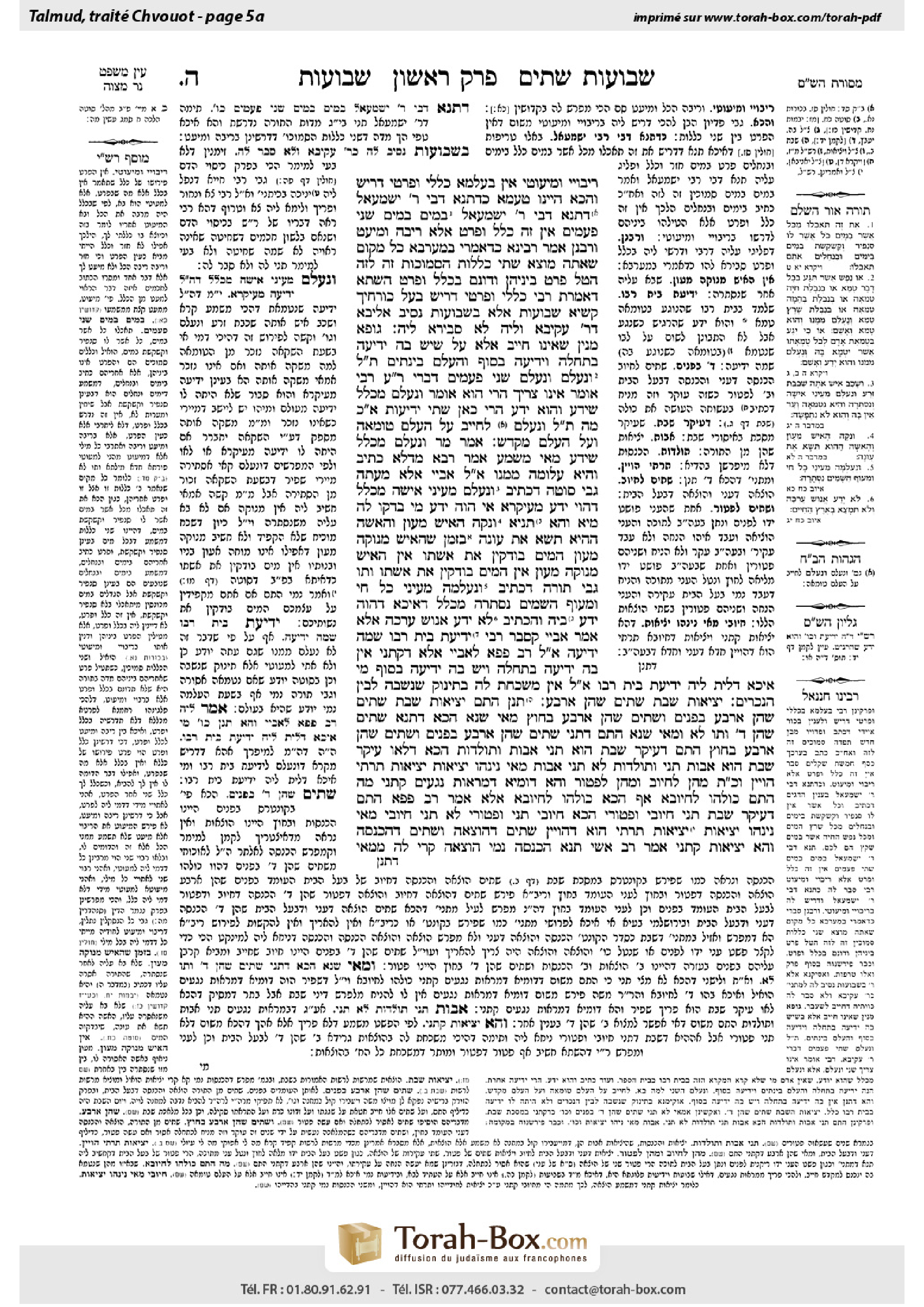
Shevuot 5a: Talmud study for Daf Yomi
Daf Yomi is the daily study of one Talmud folio. Explore 37 tractates with scans, Hebrew text, Sefaria English and AI-generated French translations where annotated.
Passage selection and English or AI-generated French translation are available where the scan has annotations. Daf Study is independent of Torah-Box and Sefaria.
Browse Shevuot · שבועות · All tractatesShevuot 5a text and translations
This page of Shevuot includes the Aramaic text, an English translation and an AI-generated French translation, alongside the scan above.
שבועות ה׳ א · Aramaic and Hebrew text
רִיבּוּיֵי וּמִיעוּטֵי.
אִין, בְּעָלְמָא כְּלָלֵי וּפְרָטֵי דָּרֵישׁ; וְהָכָא הַיְינוּ טַעְמָא – כִּדְתָנָא דְּבֵי רַבִּי יִשְׁמָעֵאל.
דְּתָנָא דְּבֵי רַבִּי יִשְׁמָעֵאל: ״בְּמַיִם״ ״בַּמַּיִם״ שְׁנֵי פְּעָמִים – אֵין זֶה כְּלָל וּפְרָט, אֶלָּא רִיבָּה וּמִיעֵט.
וְרַבָּנַן – אָמַר רָבִינָא, כִּדְאָמְרִי בְּמַעְרְבָא: כׇּל מָקוֹם שֶׁאַתָּה מוֹצֵא שְׁתֵּי כְלָלוֹת הַסְּמוּכוֹת זֶה לָזֶה, הַטֵּל פְּרָט בֵּינֵיהֶן, וְדוּנֵם בִּכְלָל וּפְרָט.
הַשְׁתָּא דְּאָמְרַתְּ רַבִּי כְּלָלֵי וּפְרָטֵי דָּרֵישׁ, בְּעַל כּוּרְחֵיךְ קַשְׁיָא שָׁבוּעוֹת! אֶלָּא בִּשְׁבוּעוֹת נָסֵיב אַלִּיבָּא דְּרַבִּי עֲקִיבָא, וְלֵיהּ לָא סְבִירָא לֵיהּ.
גּוּפָא – מִנַּיִן שֶׁאֵינוֹ חַיָּיב אֶלָּא עַל שֶׁיֵּשׁ בָּהּ יְדִיעָה בַּתְּחִלָּה וִידִיעָה בַּסּוֹף וְהֶעְלֵם בֵּינָתַיִם? תַּלְמוּד לוֹמַר: ״וְנֶעְלַם״ ״וְנֶעְלַם״ שְׁנֵי פְּעָמִים. דִּבְרֵי רַבִּי עֲקִיבָא.
רַבִּי אוֹמֵר: אֵינוֹ צָרִיךְ, הֲרֵי הוּא אוֹמֵר ״וְנֶעְלַם״ – מִכְּלָל שֶׁיָּדַע, ״וְהוּא יָדַע״ – הֲרֵי כָּאן שְׁתֵּי יְדִיעוֹת. אִם כֵּן, מָה תַּלְמוּד לוֹמַר: ״וְנֶעְלַם״? לְחַיֵּיב עַל הֶעְלֵם טוּמְאָה וְעַל הֶעְלֵם מִקְדָּשׁ.
אָמַר מָר: ״וְנֶעְלַם״ – מִכְּלָל שֶׁיָּדַע. מַאי מַשְׁמַע? אָמַר רָבָא: מִדְּלָא כְּתִיב ״וְהִיא עֲלוּמָה מִמֶּנּוּ״.
אֲמַר לֵיהּ אַבָּיֵי: אֶלָּא מֵעַתָּה, גַּבֵּי סוֹטָה דִּכְתִיב: ״וְנֶעְלַם מֵעֵינֵי אִישָׁהּ״ – מִכְּלַל דְּהָוֵי יָדַע מֵעִיקָּרָא?! אִי הֲוָה יָדַע, מִי בָּדְקוּ לַהּ מַיָּא?
וְהָא תַּנְיָא: ״וְנִקָּה הָאִישׁ מֵעָוֹן וְהָאִשָּׁה הַהִוא תִּשָּׂא אֶת עֲוֹנָהּ״ – בִּזְמַן שֶׁהָאִישׁ מְנוּקֶּה מֵעָוֹן, הַמַּיִם בּוֹדְקִין אֶת אִשְׁתּוֹ; אֵין הָאִישׁ מְנוּקֶּה מֵעָוֹן, אֵין הַמַּיִם בּוֹדְקִין אֶת אִשְׁתּוֹ!
וְתוּ, גַּבֵּי תוֹרָה דִּכְתִיב: ״וְנֶעֶלְמָה מֵעֵינֵי כׇל חָי וּמֵעוֹף הַשָּׁמַיִם נִסְתָּרָה״ – מִכְּלָל דְּאִיכָּא דַּהֲוָה יָדַע בֵּיהּ? וְהָכְתִיב: ״לֹא יָדַע אֱנוֹשׁ עֶרְכָּהּ״!
אֶלָּא אָמַר אַבָּיֵי: קָסָבַר רַבִּי, יְדִיעַת בֵּית רַבּוֹ שְׁמָהּ יְדִיעָה.
אֲמַר לֵיהּ רַב פָּפָּא לְאַבָּיֵי: אֶלָּא דְּקָתָנֵי ״אֵין בָּהּ יְדִיעָה בַּתְּחִלָּה וְיֵשׁ בָּהּ יְדִיעָה בַּסּוֹף״ – מִי אִיכָּא דְּלֵית לֵיהּ יְדִיעַת בֵּית רַבּוֹ? אָמַר לֵיהּ: אִין, מַשְׁכַּחַתְּ לַהּ בְּתִינוֹק שֶׁנִּשְׁבָּה לְבֵין הַגּוֹיִם.
יְצִיאוֹת שַׁבָּת שְׁתַּיִם שֶׁהֵן אַרְבַּע. תְּנַן הָתָם: יְצִיאוֹת שַׁבָּת – שְׁתַּיִם שֶׁהֵן אַרְבַּע בִּפְנִים, וּשְׁתַּיִם שֶׁהֵן אַרְבַּע בַּחוּץ. מַאי שְׁנָא הָכָא דִּתְנָא ״שְׁתַּיִם שֶׁהֵן אַרְבַּע״ וְתוּ לָא, וּמַאי שְׁנָא הָתָם דְּתָנֵי ״שְׁתַּיִם שֶׁהֵן אַרְבַּע בִּפְנִים וּשְׁתַּיִם שֶׁהֵן אַרְבַּע בַּחוּץ״?
הָתָם דְּעִיקַּר שַׁבָּת הוּא, תָּנֵי אָבוֹת וְתוֹלָדוֹת. הָכָא דְּלָאו עִיקַּר שַׁבָּת הוּא – אָבוֹת תָּנֵי, וְתוֹלָדוֹת לָא תָּנֵי.
אָבוֹת מַאי נִינְהוּ – יְצִיאוֹת; יְצִיאוֹת תַּרְתֵּי הָוְיָין!
וְכִי תֵּימָא: מֵהֶן לְחִיּוּב וּמֵהֶן לִפְטוּר; וְהָא דּוּמְיָא דְּמַרְאוֹת נְגָעִים קָתָנֵי – מָה הָתָם כּוּלְּהוּ לְחִיּוּבָא, אַף הָכָא כּוּלְּהוּ לְחִיּוּבָא!
אֶלָּא אָמַר רַב פָּפָּא: הָתָם דְּעִיקַּר שַׁבָּת, תָּנֵי חִיּוּבֵי וּפְטוּרֵי; הָכָא, חִיּוּבֵי תָּנֵי וּפְטוּרֵי לָא תָּנֵי.
חִיּוּבֵי מַאי נִינְהוּ – יְצִיאוֹת; יְצִיאוֹת תַּרְתֵּי הוּא דְּהָוְיָין! שְׁתַּיִם דְּהוֹצָאָה וּשְׁתַּיִם דְּהַכְנָסָה.
וְהָא ״יְצִיאוֹת״ קָתָנֵי! אָמַר רַב אָשֵׁי: תַּנָּא, הַכְנָסָה נָמֵי ״הוֹצָאָה״ קָרֵי לַהּ. מִמַּאי?
Shevuot 5a · English translation
using the method of amplifications and restrictions.
Ameimar answers: Yes, generally Rabbi Yehuda HaNasi expounds verses using the method of generalizations and details, but here, with regard to the redemption of the firstborn, this is the reason that he expounds the verses using the method of amplifications and restrictions: He holds in accordance with that which the school of Rabbi Yishmael taught.
As the school of Rabbi Yishmael taught: When defining which fish it is permitted to eat, the verse states: “This you may eat, from whatever is in the water, anything that has fins and scales in the water, in the seas and in the streams” (Leviticus 11:9). The verse first states the general term: “In the water,” “in the water,” mentioning it twice, and only afterward mentions the details, i.e., “in the seas and in the streams.” When the general and detailed phrases are ordered in this way, they are not expounded as a generalization and a detail, but rather as an amplification and a restriction. Similarly, although Rabbi Yehuda HaNasi generally expounds verses using the method of generalizations and details, with regard to the redemption of the firstborn, since the verse mentions the two general terms first and mentions the specific detail only afterward, he expounds it using the method of amplifications and restrictions.
The Gemara asks: And the Rabbis, why do they expound the verse about the redemption of a firstborn as a generalization and a detail? Ravina said: Like they say in the West, Eretz Yisrael: Wherever you find two generalizations juxtaposed to each other, followed by a specific detail, place the detail between the two generalizations and thereby expound them as a generalization and a detail followed by another generalization.
The Gemara concludes the question it asked earlier: Now that you said that Rabbi Yehuda HaNasi expounds verses using the method of generalizations and details, perforce the mishna’s ruling in the case of oaths is difficult, as it is derived by expounding the verse as an amplification and a restriction, and Rabbi Yehuda HaNasi does not generally expound verses in that manner. This contradicts Rav Kahana’s explanation that the mishna expresses Rabbi Yehuda HaNasi’s own opinion. Rather, one must say that with regard to oaths, Rabbi Yehuda HaNasi formulated the mishna in accordance with the opinion of Rabbi Akiva, but he himself does not hold accordingly.
§ Above (4a), the Gemara cited a baraita. Now the Gemara analyzes the matter itself. The baraita states: From where is it derived that one is liable to bring a sliding-scale offering only for cases in which he had awareness at the beginning and awareness at the end, but had a lapse of awareness in between, when he actually transgressed? The verse states with regard to a person’s awareness of the fact that he was impure: “And it was concealed,” “and it was concealed,” mentioning it twice (Leviticus 5:2–3). The first mention teaches that one is liable only if during the transgression he was unaware of his status, and the second mention teaches that one is liable only if he had awareness of his status before the transgression. This is the statement of Rabbi Akiva.
The baraita continues: Rabbi Yehuda HaNasi says: This proof is not necessary, as it states in the same verse: “And it was concealed,” which indicates, by inference, that initially he had been aware; and nevertheless the verse continues to state: “And he was aware.” It emerges, then, that the verse refers here to two different periods of awareness, one before the transgression and one afterward. But if so, why must the verse state: “And it was concealed,” a second time? It is in order to render one liable both for a violation due to a lapse of awareness of the fact that he was ritually impure and for a violation due to a lapse of awareness of the fact that the place he entered was actually the Temple.
The Master said in that baraita: The verse states: “And it was concealed,” which indicates, by inference, that initially he had been aware. The Gemara asks: From where is this inferred? Rava said: From the fact that it is not written: And it is concealed from him, which would have been the appropriate formulation had he never been aware of the matter at all. Accordingly, the phrase “and it was concealed” is to be understood as referring to a case in which he had been initially aware.
Abaye said to him: If that is so, then you should also make a similar inference with regard to a suspected adulteress [sota], as it is written that she is liable to undergo the ordeal of drinking the bitter waters when “a man lay with her carnally, and it was concealed from the eyes of her husband” (Numbers 5:13). This would indicate, by inference, that initially he had been aware of the fact that his wife committed adultery. Abaye explains the difficulty: If he was actually aware that his wife had committed adultery, would the bitter waters have the power to examine her?
But isn’t it taught in a baraita: The verse states with regard to a case in which she is found guilty: “And the husband will be free of sin and the wife shall bear her sin” (Numbers 5:31). This verse teaches that only when the husband is free of sin, the water examines his wife, but if the husband is not free of sin, the water does not examine his wife. If the husband had been aware that his wife had committed adultery, then she is forbidden to him and he is required to divorce her. The fact he did not divorce her is considered a sin; consequently, the waters cannot examine his wife.
Abaye presents another difficulty to Rava: And furthermore, according to your understanding, you should also make a similar inference with regard to Torah, as it is written: “And it was concealed from the eyes of all living creatures, and from those that soar in the heavens it was hidden” (Job 28:21), which would indicate, by inference, that initially there was someone who was aware of the Torah. But isn’t it written: “No man knew its value, and it is not known in the land of the living” (Job 28:13)?
Rather, Abaye said: The formulation of the verse does not indicate that he actually realized he was impure; it indicates only that he was initially aware of the fact that he had come into contact with a source of impurity, but he failed to reach the obvious conclusion that he was thereby rendered impure. And Rabbi Yehuda HaNasi holds that the elementary knowledge of the halakhot of ritual impurity that a person gained in his childhood from his school is sufficient, in light of his awareness of the fact he came into contact with a source of impurity, to be considered awareness of the fact that he was impure, and thereby render him liable to bring a sliding-scale offering.
Rav Pappa said to Abaye: But how can you explain the halakha that is taught in the mishna: For cases in which he did not have awareness at the beginning but had awareness at the end? According to your explanation, is there anyone who does not have the elementary knowledge of the halakhot of ritual impurity that he gained from his school? Abaye said to him: Yes, you find it in the case of a child who was taken captive among gentiles, who never received even the most elementary level of knowledge.
§ The mishna states (2a): With regard to acts of carrying out that are prohibited on Shabbat, there are two types that are four. We learned in a mishna there (Shabbat 2a): With regard to acts of carrying out that are prohibited on Shabbat, there are primarily two basic actions that are four cases with regard to transferring an item inside, to a private domain; and two basic actions that are four cases with regard to transferring an item outside, to a public domain. The Gemara asks: What is different here that the mishna teaches: There are two types that are four, and nothing more; and what is different there, in tractate Shabbat, that the mishna teaches: There are two actions that are four cases with regard to transferring an item inside, to a private domain, and two actions that are four cases with regard to transferring an item outside, to a public domain?
The Gemara answers: There, in tractate Shabbat, which is where the main discussion of the halakhot of Shabbat is found, the mishna teaches both the primary categories and the subcategories of labor prohibited on Shabbat. But here, in tractate Shevuot, which does not contain the main discussion of the halakhot of Shabbat, the mishna teaches the primary categories of labor prohibited on Shabbat but does not teach the subcategories of labor.
The Gemara asks: What are the primary categories of transferring an item on Shabbat? They are acts of carrying out from the private domain to the public domain. The Gemara objects: But the acts of carrying out are only two in number, i.e., where the carrying out is done by someone standing in the private domain and when it is done by someone in the public domain. Why then does the mishna state that there are four cases?
And if you would say that the mishna enumerates four types of carrying out, among them those for which there is liability and among them those for which there is exemption, that is not feasible, as doesn’t the mishna teach this case as similar to the different shades of leprous marks? This would indicate that just as there, all four of them are types for which there is liability, so too here, with regard to carrying out on Shabbat, all four of them are types for which there is liability.
Rather, Rav Pappa said that the difference between the manner in which the halakha is cited in tractates Shevuot and Shabbat must be understood as follows: There, in tractate Shabbat, which contains the main discussion of the halakhot of Shabbat, the mishna teaches both cases of liability and cases of exemption. But here, in tractate Shevuot, which does not contain the main discussion of the halakhot of Shabbat, the mishna teaches only cases of liability but does not teach cases of exemption.
The Gemara asks: What are the cases of liability? They are acts of carrying out from the private domain to the public domain. The Gemara objects: But the acts of carrying out are only two in number. Why then does the mishna state that there are four cases? The Gemara explains: There are two cases of carrying out an item from a private domain to a public domain and two more cases of bringing in an item from a public domain to a private domain.
The Gemara objects: But the mishna teaches: Acts of carrying out. It does not appear to mention acts of bringing in at all. Rav Ashi said: The tanna also refers to an act of bringing in an item as an act of carrying out an item. The Gemara asks: From where do we know this?
Shevuot 5a · Traduction française (IA)
selon la méthode des amplifications et des restrictions.
Ameimar répond : Oui, en règle générale, Rabbi Yehouda HaNassi interprète les versets selon la méthode des généralités et des détails. Mais ici, concernant le rachat du premier-né, voici pourquoi il interprète les versets selon la méthode des amplifications et des restrictions : il suit l’enseignement de l’école de Rabbi Yichmaël.
En effet, l’école de Rabbi Yichmaël a enseigné : Pour déterminer quels poissons il est permis de manger, le verset dit : « Voici ce que vous pourrez manger parmi tout ce qui se trouve dans l’eau : tout ce qui, dans les eaux, dans les mers et dans les cours d’eau, a des nageoires et des écailles » (Lévitique 11, 9). Le verset énonce d’abord le terme général « dans l’eau », qu’il mentionne deux fois, puis seulement ensuite les détails, à savoir « dans les mers et dans les cours d’eau ». Lorsque les termes généraux et les détails sont ordonnés ainsi, on ne les interprète pas selon la méthode des généralités et des détails, mais selon celle des amplifications et des restrictions. De même, bien que Rabbi Yehouda HaNassi interprète généralement les versets selon la méthode des généralités et des détails, concernant le rachat du premier-né, puisque le verset énonce d’abord les deux termes généraux et ne mentionne le détail précis qu’ensuite, il l’interprète selon la méthode des amplifications et des restrictions.
La Guemara demande : Et les Rabbins, pourquoi interprètent-ils le verset concernant le rachat du premier-né selon la méthode des généralités et des détails ? Ravina a dit : Comme on dit en Occident, en Terre d’Israël : partout où l’on trouve deux termes généraux juxtaposés, suivis d’un détail précis, on place ce détail entre les deux termes généraux et on les interprète ainsi : une généralité, un détail, puis une autre généralité.
La Guemara conclut la question posée précédemment : À présent que tu as dit que Rabbi Yehouda HaNassi interprète les versets selon la méthode des généralités et des détails, il faut nécessairement conclure que l’arrêt de la Michna concernant les serments pose problème, puisqu’il est déduit en interprétant le verset selon la méthode des amplifications et des restrictions, alors que Rabbi Yehouda HaNassi n’interprète généralement pas les versets de cette manière. Cela contredit l’explication de Rav Kahana, selon laquelle la Michna exprime l’opinion propre de Rabbi Yehouda HaNassi. Il faut donc plutôt dire que, concernant les serments, Rabbi Yehouda HaNassi a formulé la Michna conformément à l’opinion de Rabbi Akiva, mais que lui-même ne partage pas cette opinion.
§ Plus haut (4a), la Guemara a cité une baraïta. À présent, la Guemara examine le sujet lui-même. La baraïta enseigne : D’où déduit-on qu’on n’est tenu d’apporter un sacrifice à valeur variable que dans les cas où l’on avait conscience de son état au départ et à la fin, mais où l’on a connu un oubli de conscience entre les deux, au moment où l’on a effectivement transgressé ? Le verset dit au sujet de la conscience qu’une personne avait de son impureté : « Et cela lui fut caché », « et cela lui fut caché », mentionnant cette expression deux fois (Lévitique 5, 2-3). La première mention enseigne qu’on n’est tenu d’apporter ce sacrifice que si, au moment de la transgression, on ignorait son état ; la seconde enseigne qu’on n’en est tenu que si l’on avait conscience de son état avant la transgression. Telle est la déclaration de Rabbi Akiva.
La baraïta poursuit : Rabbi Yehouda HaNassi dit : Cette preuve n’est pas nécessaire, car le même verset dit : « Et cela lui fut caché », ce qui implique qu’au départ, il en avait conscience ; pourtant, le verset poursuit : « Et il en eut connaissance ». Il s’ensuit que le verset évoque ici deux périodes distinctes de conscience : l’une avant la transgression et l’autre après. Mais, dans ce cas, pourquoi le verset doit-il dire une seconde fois : « Et cela lui fut caché » ? C’est afin de rendre une personne passible aussi bien pour une transgression due à l’oubli de son impureté rituelle que pour une transgression due à l’oubli du fait que le lieu où elle est entrée était le Temple.
Le Maître a dit dans cette baraïta : Le verset dit : « Et cela lui fut caché », ce qui implique qu’au départ, il en avait conscience. La Guemara demande : Qu’est-ce qui permet de le déduire ? Rava a dit : Du fait qu’il n’est pas écrit : « Et cela lui est caché », formulation qui aurait convenu s’il n’avait jamais eu connaissance de la chose. Par conséquent, l’expression « et cela lui fut caché » doit s’entendre d’un cas où il en avait initialement conscience.
Abayé lui dit : Si c’est ainsi, il faudrait également tirer une déduction semblable concernant une femme soupçonnée d’adultère [sota], car il est écrit qu’elle doit subir l’épreuve de l’eau amère lorsqu’« un homme a couché charnellement avec elle, et cela a été caché aux yeux de son mari » (Nombres 5, 13). Cela impliquerait qu’au départ, le mari avait eu connaissance de l’adultère de sa femme. Abayé explique la difficulté : s’il savait effectivement que sa femme avait commis un adultère, l’eau amère aurait-elle le pouvoir de l’éprouver ?
Mais n’est-il pas enseigné dans une baraïta : Le verset dit, au sujet du cas où elle est reconnue coupable : « Le mari sera quitte de faute, et la femme portera sa faute » (Nombres 5, 31). Ce verset enseigne que l’eau n’éprouve sa femme que si le mari est quitte de faute ; mais si le mari ne l’est pas, l’eau n’éprouve pas sa femme. Si le mari avait su que sa femme avait commis un adultère, elle lui serait interdite et il serait tenu de divorcer d’elle. Le fait de ne pas l’avoir répudiée est considéré comme une faute ; par conséquent, l’eau ne peut pas éprouver sa femme.
Abayé présente une autre difficulté à Rava : En outre, selon ton raisonnement, il faudrait également tirer une déduction semblable au sujet de la Torah, car il est écrit : « Elle a été cachée aux yeux de tout être vivant, et elle a été dissimulée aux oiseaux du ciel » (Job 28, 21), ce qui impliquerait qu’au départ, quelqu’un avait connaissance de la Torah. Mais n’est-il pas écrit : « L’homme n’en connaît pas la valeur, et elle ne se trouve pas dans le pays des vivants » (Job 28, 13) ?
Abayé a plutôt dit : La formulation du verset n’indique pas qu’il a effectivement pris conscience de son impureté ; elle indique seulement qu’au départ, il savait avoir été en contact avec une source d’impureté, mais qu’il n’en a pas tiré la conclusion évidente, à savoir qu’il était dès lors devenu impur. Rabbi Yehouda HaNassi considère que la connaissance élémentaire des halakhot de l’impureté rituelle acquise dans son enfance à l’école suffit, compte tenu du fait qu’il savait avoir été en contact avec une source d’impureté, pour être considérée comme une conscience de son impureté et le rendre ainsi passible d’apporter un sacrifice à valeur variable.
Rav Pappa dit à Abayé : Mais comment peux-tu expliquer la halakha enseignée dans la Michna : les cas où l’on n’avait pas conscience de son état au départ, mais où l’on en a eu conscience à la fin ? Selon ton explication, existe-t-il quelqu’un qui ne possède pas la connaissance élémentaire des halakhot de l’impureté rituelle acquise à l’école ? Abayé lui dit : Oui, on trouve ce cas chez un enfant capturé par des non-Juifs, qui n’a jamais reçu même les connaissances les plus élémentaires.
§ La Michna dit (2a) : Concernant les actes de sortie interdits pendant Chabbat, il y a deux catégories qui en comprennent quatre. Nous avons appris dans une Michna de là-bas (Chabbat 2a) : Concernant les actes de sortie interdits pendant Chabbat, il y a principalement deux actes de base qui en comprennent quatre pour le transfert d’un objet vers l’intérieur, dans un domaine privé, et deux actes de base qui en comprennent quatre pour le transfert d’un objet vers l’extérieur, dans un domaine public. La Guemara demande : Pourquoi la Michna dit-elle ici : « deux catégories qui en comprennent quatre », sans rien ajouter, tandis que là, dans le traité Chabbat, la Michna dit : « deux actes qui en comprennent quatre pour le transfert d’un objet vers l’intérieur, dans un domaine privé, et deux actes qui en comprennent quatre pour le transfert d’un objet vers l’extérieur, dans un domaine public » ?
La Guemara répond : Là, dans le traité Chabbat, où se trouve l’exposé principal des halakhot de Chabbat, la Michna enseigne à la fois les catégories principales et les catégories secondaires des travaux interdits pendant Chabbat. Mais ici, dans le traité Shevuot, qui ne contient pas l’exposé principal des halakhot de Chabbat, la Michna enseigne les catégories principales des travaux interdits pendant Chabbat, mais n’enseigne pas leurs catégories secondaires.
La Guemara demande : Quelles sont les catégories principales du transfert d’un objet pendant Chabbat ? Ce sont les actes consistant à sortir un objet d’un domaine privé vers un domaine public. La Guemara objecte : Mais les actes de sortie ne sont qu’au nombre de deux, à savoir lorsque celui qui sort l’objet se tient dans le domaine privé et lorsqu’il se tient dans le domaine public. Pourquoi, dès lors, la Michna dit-elle qu’il y a quatre cas ?
Et si tu dis que la Michna énumère quatre types d’actes de sortie, dont certains entraînent une obligation et d’autres une exemption, cela n’est pas possible, car la Michna ne présente-t-elle pas ce cas comme analogue aux différentes nuances des marques de lèpre ? Cela indique que, de même que là-bas, les quatre types entraînent tous une obligation, de même ici, concernant la sortie d’un objet pendant Chabbat, les quatre types entraînent tous une obligation.
Rav Pappa a plutôt dit que la différence entre la manière dont la halakha est citée dans les traités Shevuot et Chabbat doit se comprendre ainsi : là, dans le traité Chabbat, qui contient l’exposé principal des halakhot de Chabbat, la Michna enseigne à la fois les cas qui entraînent une obligation et ceux qui entraînent une exemption. Mais ici, dans le traité Shevuot, qui ne contient pas l’exposé principal des halakhot de Chabbat, la Michna n’enseigne que les cas qui entraînent une obligation, sans enseigner les cas qui entraînent une exemption.
La Guemara demande : Quels sont les cas qui entraînent une obligation ? Ce sont les actes consistant à sortir un objet d’un domaine privé vers un domaine public. La Guemara objecte : Mais les actes de sortie ne sont qu’au nombre de deux. Pourquoi, dès lors, la Michna dit-elle qu’il y a quatre cas ? La Guemara explique : Il y a deux cas où l’on sort un objet d’un domaine privé vers un domaine public, et deux autres cas où l’on fait entrer un objet d’un domaine public vers un domaine privé.
La Guemara objecte : Mais la Michna enseigne : « les actes de sortie ». Elle ne semble pas mentionner du tout les actes d’entrée. Rav Achi a dit : Le tanna désigne également l’acte consistant à faire entrer un objet comme un acte de sortie. La Guemara demande : D’où le savons-nous ?
Traduction française générée par IA à partir de l’édition anglaise de Sefaria. Vérifie toujours un passage avec le texte source.
Text from Sefaria: William Davidson Edition - Vocalized Aramaic (CC BY NC); William Davidson Edition - English (CC BY NC).