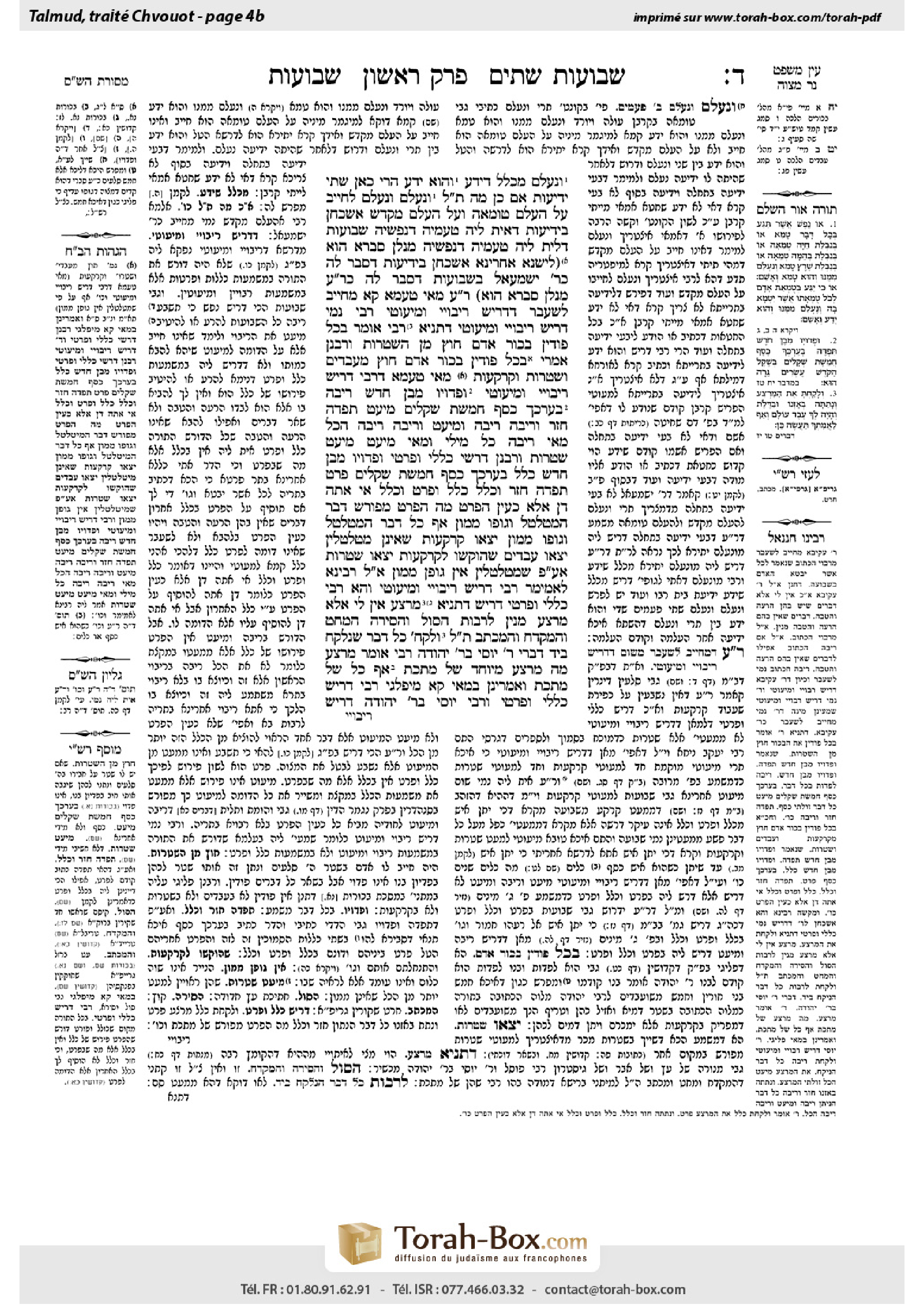
Shevuot 4b: Talmud study for Daf Yomi
Daf Yomi is the daily study of one Talmud folio. Explore 37 tractates with scans, Hebrew text, Sefaria English and AI-generated French translations where annotated.
Passage selection and English or AI-generated French translation are available where the scan has annotations. Daf Study is independent of Torah-Box and Sefaria.
Browse Shevuot · שבועות · All tractatesShevuot 4b text and translations
This page of Shevuot includes the Aramaic text, an English translation and an AI-generated French translation, alongside the scan above.
שבועות ד׳ ב · Aramaic and Hebrew text
״וְנֶעְלַם״ – מִכְּלָל דְּיָדַע, ״וְהוּא יָדַע״ – הֲרֵי כָּאן שְׁתֵּי יְדִיעוֹת. אִם כֵּן, מָה תַּלְמוּד לוֹמַר: ״וְנֶעְלַם״ ״וְנֶעְלַם״? לְחַיֵּיב עַל הֶעְלֵם טוּמְאָה וְעַל הֶעְלֵם מִקְדָּשׁ.
אַשְׁכְּחַן בִּידִיעוֹת דְּאִית לֵיהּ טַעְמֵיהּ דְּנַפְשֵׁיהּ, שְׁבוּעוֹת דְּלֵית לֵיהּ טַעְמֵיהּ דְּנַפְשֵׁיהּ מְנָלַן? סְבָרָא הוּא.
לִישָּׁנָא אַחֲרִינָא: אַשְׁכְּחַן בִּידִיעוֹת דְּסָבַר לַהּ כְּרַבִּי יִשְׁמָעֵאל, בִּשְׁבוּעוֹת דְּסָבַר לַהּ כְּרַבִּי עֲקִיבָא מְנָלַן? סְבָרָא הוּא,
רַבִּי עֲקִיבָא מַאי טַעְמָא קָא מְחַיֵּיב לְשֶׁעָבַר – דְּדָרֵישׁ רִיבּוּיֵי וּמִיעוּטֵי; רַבִּי נָמֵי דָּרֵישׁ רִיבּוּיֵי וּמִיעוּטֵי.
דְּתַנְיָא, רַבִּי אוֹמֵר: בַּכֹּל פּוֹדִין בְּכוֹר אָדָם, חוּץ מִן הַשְּׁטָרוֹת. וְרַבָּנַן אָמְרִי: בַּכֹּל פּוֹדִין בְּכוֹר אָדָם, חוּץ מֵעֲבָדִים וּשְׁטָרוֹת וְקַרְקָעוֹת.
מַאי טַעְמָא דְּרַבִּי? דָּרֵישׁ רִיבּוּיֵי וּמִיעוּטֵי: ״וּפְדוּיָו מִבֶּן חֹדֶשׁ״ – רִיבָּה, ״בְּעֶרְכְּךָ כֶּסֶף חֲמֵשֶׁת שְׁקָלִים״ – מִיעֵט, ״תִּפְדֶּה״ – חָזַר וְרִיבָּה.
רִיבָּה וּמִיעֵט וְרִיבָּה – רִיבָּה הַכֹּל; מַאי רִיבָּה – כׇּל מִילֵּי, וּמַאי מִיעֵט – מִיעֵט שְׁטָרוֹת.
וְרַבָּנַן דָּרְשִׁי כְּלָלֵי וּפְרָטֵי: ״וּפְדוּיָו מִבֶּן חֹדֶשׁ״ – כָּלַל, ״בְּעֶרְכְּךָ כֶּסֶף חֲמֵשֶׁת שְׁקָלִים״ – פָּרַט, ״תִּפְדֶּה״ – חָזַר וְכָלַל.
כְּלָל וּפְרָט וּכְלָל – אִי אַתָּה דָן אֶלָּא כְּעֵין הַפְּרָט; מָה הַפְּרָט מְפוֹרָשׁ – דָּבָר הַמִּטַּלְטֵל וְגוּפוֹ מָמוֹן, אַף כׇּל דָּבָר הַמִּטַּלְטֵל וְגוּפוֹ מָמוֹן. יָצְאוּ קַרְקָעוֹת – שֶׁאֵינָן מִטַּלְטְלִין; יָצְאוּ עֲבָדִים – שֶׁהוּקְּשׁוּ לְקַרְקָעוֹת; יָצְאוּ שְׁטָרוֹת – אַף עַל פִּי שֶׁמִּטַּלְטְלִין, אֵין גּוּפָן מָמוֹן.
אֲמַר לֵיהּ רָבִינָא לְאַמֵּימָר: רַבִּי דָּרֵישׁ רִיבּוּיֵי וּמִיעוּטֵי?! וְהָא רַבִּי כְּלָלֵי וּפְרָטֵי דָּרֵישׁ!
דְּתַנְיָא: ״מַרְצֵעַ״ – אֵין לִי אֶלָּא מַרְצֵעַ, מִנַּיִן לְרַבּוֹת הַסּוֹל וְהַסִּירָה, הַמַּחַט וְהַמַּקְדֵּחַ וְהַמַּכְתֵּב? תַּלְמוּד לוֹמַר: ״וְלָקַחְתָּ״ – כׇּל דָּבָר שֶׁנִּלְקָח בַּיָּד, דִּבְרֵי רַבִּי יוֹסֵי בְּרַבִּי יְהוּדָה. רַבִּי אוֹמֵר: ״מַרְצֵעַ״ – מָה מַרְצֵעַ מְיוּחָד, שֶׁל מַתֶּכֶת; אַף כֹּל שֶׁל מַתֶּכֶת.
וְאָמְרִינַן: בְּמַאי קָא מִיפַּלְגִי? רַבִּי דָּרֵישׁ כְּלָלֵי וּפְרָטֵי, וְרַבִּי יוֹסֵי בְּרַבִּי יְהוּדָה דָּרֵישׁ
Shevuot 4b · English translation
“And it was concealed,” which indicates, by inference, that initially he had been aware, and nevertheless the verse continues to state: “And he was aware” (Leviticus 5:3). It emerges that the verse refers here to two different periods of awareness, one before the transgression and one afterward. But if so, why must the verses state: “And it was concealed,” “and it was concealed,” mentioning it twice? It is in order to render one liable both for a violation due to a lapse of awareness of the fact he was ritually impure and for a violation due to a lapse of awareness of the fact that the place he entered was actually the Temple. From this baraita it is apparent that Rabbi Yehuda HaNasi agrees with Rabbi Yishmael’s opinion concerning which types of lapses of awareness render one liable to bring a sliding-scale offering.
The Gemara asks: We have found with regard to cases of one’s awareness of the defiling of the Temple or its sacrificial foods that Rabbi Yehuda HaNasi has explained his own reasoning and it accords with the opinion of Rabbi Yishmael. With regard to oaths, where he has not explained his own reasoning, from where do we derive that he holds in accordance with the opinion of Rabbi Akiva? The Gemara answers: It is based on logical reasoning.
The Gemara presents another formulation of the preceding comment: The Gemara asks: We have found an explicit statement of Rabbi Yehuda HaNasi with regard to cases of one’s awareness of the defiling of the Temple or its sacrificial foods indicating that he holds in accordance with the opinion of Rabbi Yishmael. With regard to oaths, from where do we derive that he holds in accordance with the opinion of Rabbi Akiva? The Gemara answers: It is based on logical reasoning.
The Gemara explains the logical reasoning: What is the reason that Rabbi Akiva deems one liable for oaths pertaining to the past? The reason is that he expounds verses using the method of amplifications and restrictions (see 26a). Rabbi Yehuda HaNasi also expounds verses using the method of amplifications and restrictions, and consequently he arrives at the same opinion as Rabbi Akiva.
The Gemara demonstrates its point: As it is taught in a baraita: Rabbi Yehuda HaNasi says that one can redeem a woman’s firstborn son with any item worth five shekels, except for promissory notes. And the Rabbis say that one can redeem a woman’s firstborn son with any item worth five shekels, except for Canaanite slaves, promissory notes, and land.
The Gemara explains: What is the reasoning of Rabbi Yehuda HaNasi? He expounds verses using the method of amplifications and restrictions. Accordingly, he expounds the verse: “And its redemption from one month shall you redeem, according to the valuation of five silver shekels by the sacred shekel” (Numbers 18:16), as follows: Concerning the phrase: “And its redemption from one month,” since it does not specify that only certain items can be used for the redemption, the verse amplified the category of items that can be used to redeem the firstborn, intimating that many different items can be used. Then, with the phrase: “According to the valuation of five silver shekels,” the verse restricted the category to items that are similar to silver shekels. Then, with the term: “Shall you redeem,” the verse again amplified the category.
According to the hermeneutical principle that when a verse amplified and then restricted and then amplified, it amplified the relevant category to include everything except for the specific matter excluded in the restriction. The Gemara elaborates: What is included by the fact it amplified? Almost everything. And what is excluded by the fact it restricted? It restricted only promissory notes, which are the most fundamentally dissimilar to silver shekels.
The Gemara explains the reasoning of the Rabbis: And the Rabbis expound verses through the method of generalizations and details. Accordingly, they expound the verse as follows: The phrase: “And its redemption from one month,” is a generalization which suggests that many different items can be used to redeem the firstborn. Then, the phrase: “According to the valuation of five silver shekels,” is a detail, which suggests that only items that are similar to silver shekels can be used. Then, with the term: “Shall you redeem,” the verse again makes a generalization.
Based on this exegetical method, whenever a verse has a generalization and then a detail and then a generalization, the principle is that you may deduce that the verse is referring only to items similar to the detail; in this case, just as the detail, i.e., silver shekels, is explicitly something that is movable and has intrinsic monetary value, so too, anything that is movable and has intrinsic monetary value can be used. This excludes land, which is not movable property; it excludes Canaanite slaves, who are halakhically compared to land; and it excludes promissory notes, because even though they are movable property, they do not have intrinsic monetary value.
Ravina said to Ameimar: Does Rabbi Yehuda HaNasi really expound verses through the method of amplifications and restrictions? But doesn’t Rabbi Yehuda HaNasi expound verses through the method of generalizations and details?
This is as it is taught in a baraita: The Torah provides the process by which a Hebrew slave who has already completed his six years of servitude may continue on as a slave of his master: “And you shall take the awl and put it through his ear and in the door” (Deuteronomy 15:17). From this verse, I have derived only that an awl can be used; from where do I know to include the thorn of a palm [hasol], and a thorn, a needle, and a gimlet, and a stylus for writing on wax, as valid tools for piercing his ear? The verse states: “And you shall take,” which indicates that anything that can be taken by hand is a valid tool. This is the statement of Rabbi Yosei, son of Rabbi Yehuda. Rabbi Yehuda HaNasi says: Not all these items can be used. Rather, since the verse specifies an “awl,” only items similar to an awl can be used; just as an awl is distinct in that it is fashioned of metal, so too, anything fashioned of metal can be used.
And we say with regard to this dispute: About what do they disagree? Rabbi Yehuda HaNasi expounds verses using the method of generalizations and details, and Rabbi Yosei, son of Rabbi Yehuda, expounds verses
Shevuot 4b · Traduction française (IA)
« Et cela lui fut caché » indique, par déduction, qu’il en avait eu connaissance auparavant ; pourtant, le verset poursuit en disant : « Et il en eut connaissance » (Lévitique 5,3). Il s’ensuit que le verset parle ici de deux périodes distinctes de connaissance, l’une avant la transgression et l’autre après. Mais, dans ce cas, pourquoi les versets disent-ils deux fois : « Et cela lui fut caché » ? C’est afin de rendre une personne passible à la fois pour une transgression due à l’oubli de son état d’impureté rituelle et pour une transgression due à l’oubli du fait que le lieu où elle était entrée était le Temple. Cette baraïta montre que Rabbi Yehouda HaNassi partage l’opinion de Rabbi Yichmaël quant aux types d’oublis qui rendent passible d’apporter une offrande à valeur variable.
La Guemara demande : Nous avons établi, au sujet des cas où une personne sait qu’elle a rendu impur le Temple ou ses aliments sacrificiels, que Rabbi Yehouda HaNassi a exposé son propre raisonnement, lequel concorde avec l’opinion de Rabbi Yichmaël. Mais, au sujet des serments, puisqu’il n’a pas exposé son propre raisonnement, d’où déduisons-nous qu’il partage l’opinion de Rabbi Akiva ? La Guemara répond : Cela découle d’un raisonnement logique.
La Guemara présente une autre formulation de la remarque précédente. Elle demande : Nous avons trouvé une déclaration explicite de Rabbi Yehouda HaNassi concernant les cas où une personne sait qu’elle a rendu impur le Temple ou ses aliments sacrificiels, qui indique qu’il partage l’opinion de Rabbi Yichmaël. Mais, au sujet des serments, d’où déduisons-nous qu’il partage l’opinion de Rabbi Akiva ? La Guemara répond : Cela découle d’un raisonnement logique.
La Guemara expose le raisonnement logique : Pour quelle raison Rabbi Akiva rend-il une personne passible pour des serments portant sur le passé ? Parce qu’il interprète les versets selon la méthode des amplifications et des restrictions (voir 26a). Rabbi Yehouda HaNassi interprète lui aussi les versets selon cette méthode ; il parvient donc à la même opinion que Rabbi Akiva.
La Guemara étaye son propos : Il est enseigné dans une baraïta que Rabbi Yehouda HaNassi dit qu’on peut racheter un premier-né avec tout objet valant cinq sicles, à l’exception des reconnaissances de dette. Les Sages disent qu’on peut racheter un premier-né avec tout objet valant cinq sicles, à l’exception des esclaves cananéens, des reconnaissances de dette et des biens fonciers.
La Guemara explique : Quel est le raisonnement de Rabbi Yehouda HaNassi ? Il interprète les versets selon la méthode des amplifications et des restrictions. En conséquence, il interprète ainsi le verset : « Et son rachat, à partir d’un mois, tu le rachèteras selon l’évaluation de cinq sicles d’argent, au sicle sacré » (Nombres 18,16) : l’expression « Et son rachat, à partir d’un mois » ne précisant pas que seuls certains objets peuvent servir au rachat, le verset élargit la catégorie des objets utilisables pour racheter le premier-né, indiquant qu’un grand nombre d’objets différents peuvent convenir. Puis, par l’expression « selon l’évaluation de cinq sicles d’argent », le verset restreint cette catégorie aux objets semblables à des sicles d’argent. Enfin, par les mots « tu le rachèteras », le verset élargit de nouveau la catégorie.
Selon le principe d’interprétation suivant : lorsqu’un verset élargit, puis restreint, puis élargit de nouveau, il étend la catégorie concernée à presque tout, à l’exception de l’élément précis exclu par la restriction. La Guemara précise : Qu’est-ce que l’élargissement inclut ? Presque tout. Et qu’est-ce que la restriction exclut ? Seulement les reconnaissances de dette, qui sont ce qui diffère le plus fondamentalement des sicles d’argent.
La Guemara explique le raisonnement des Sages : ils interprètent les versets selon la méthode des termes généraux et des détails. Ils interprètent donc le verset ainsi : l’expression « Et son rachat, à partir d’un mois » est un terme général, qui laisse entendre que de nombreux objets différents peuvent servir à racheter le premier-né. Puis, l’expression « selon l’évaluation de cinq sicles d’argent » est un détail, qui indique que seuls les objets semblables à des sicles d’argent peuvent convenir. Enfin, par les mots « tu le rachèteras », le verset formule de nouveau un terme général.
Selon cette méthode exégétique, chaque fois qu’un verset comporte un terme général, puis un détail, puis un terme général, on déduit qu’il ne vise que les objets semblables à ceux du détail. Dans ce cas, de même que le détail, c’est-à-dire les sicles d’argent, désigne explicitement un bien meuble ayant une valeur monétaire intrinsèque, de même tout bien meuble ayant une valeur monétaire intrinsèque peut être utilisé. Cela exclut les biens fonciers, qui ne sont pas des biens meubles ; les esclaves cananéens, qui sont assimilés halakhiquement aux biens fonciers ; et les reconnaissances de dette, car, bien qu’elles soient des biens meubles, elles n’ont pas de valeur monétaire intrinsèque.
Ravina dit à Ameimar : Rabbi Yehouda HaNassi interprète-t-il réellement les versets selon la méthode des amplifications et des restrictions ? Pourtant, Rabbi Yehouda HaNassi n’interprète-t-il pas les versets selon la méthode des termes généraux et des détails ?
C’est ce qui est enseigné dans une baraïta : la Torah indique la procédure par laquelle un esclave hébreu ayant déjà achevé ses six années de servitude peut continuer à servir son maître : « Tu prendras le poinçon, tu le passeras à travers son oreille et la porte » (Deutéronome 15,17). De ce verset, je n’ai déduit que l’emploi d’un poinçon ; d’où sais-je qu’il faut également inclure l’épine d’un palmier [hasol], une épine, une aiguille, une vrille et un stylet servant à écrire sur la cire comme outils valides pour lui percer l’oreille ? Le verset dit : « Tu prendras », ce qui indique que tout objet pouvant être pris à la main est un outil valide. Telle est la déclaration de Rabbi Yossi, fils de Rabbi Yehouda. Rabbi Yehouda HaNassi dit : Tous ces objets ne peuvent pas être utilisés. En effet, puisque le verset précise « un poinçon », seuls des objets semblables à un poinçon peuvent être utilisés ; de même que le poinçon se distingue par le fait qu’il est en métal, de même tout objet en métal peut être utilisé.
Et nous disons à propos de cette controverse : sur quoi portent leurs divergences ? Rabbi Yehouda HaNassi interprète les versets selon la méthode des termes généraux et des détails, tandis que Rabbi Yossi, fils de Rabbi Yehouda, interprète les versets
Traduction française générée par IA à partir de l’édition anglaise de Sefaria. Vérifie toujours un passage avec le texte source.
Text from Sefaria: William Davidson Edition - Vocalized Aramaic (CC BY NC); William Davidson Edition - English (CC BY NC).