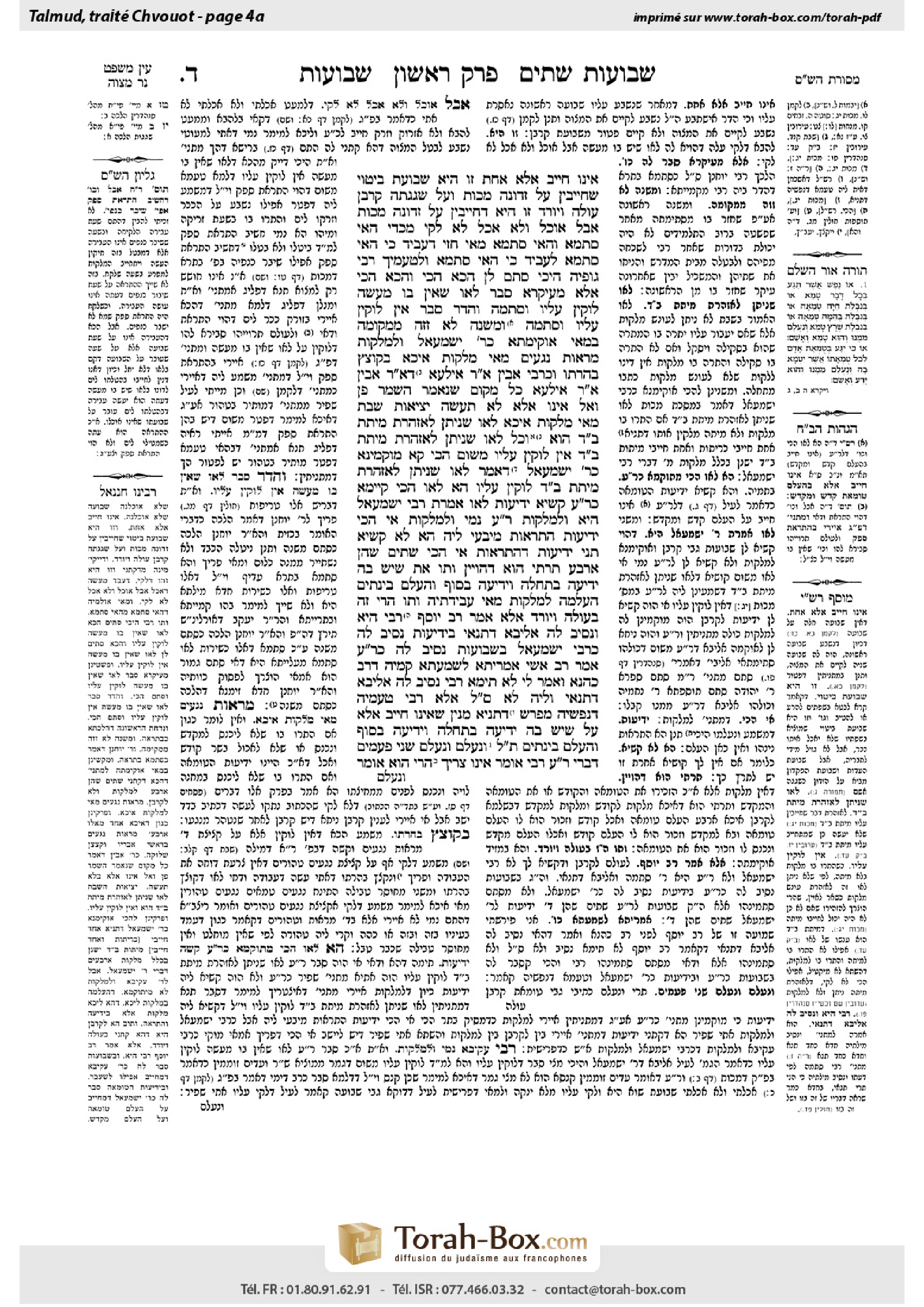
Shevuot 4a: Talmud study for Daf Yomi
Daf Yomi is the daily study of one Talmud folio. Explore 37 tractates with scans, Hebrew text, Sefaria English and AI-generated French translations where annotated.
Passage selection and English or AI-generated French translation are available where the scan has annotations. Daf Study is independent of Torah-Box and Sefaria.
Browse Shevuot · שבועות · All tractatesShevuot 4a text and translations
This page of Shevuot includes the Aramaic text, an English translation and an AI-generated French translation, alongside the scan above.
שבועות ד׳ א · Aramaic and Hebrew text
אֵינוֹ חַיָּיב אֶלָּא אַחַת. זוֹ הִיא שְׁבוּעַת בִּיטּוּי, שֶׁחַיָּיבִין עַל זְדוֹנָהּ מַכּוֹת, וְעַל שִׁגְגָתָהּ קׇרְבַּן עוֹלֶה וְיוֹרֵד.
״זוֹ הִיא דְּחַיָּיבִין עַל זְדוֹנָהּ מַכּוֹת״ – אֲבָל ״אוֹכַל״ וְלֹא אָכַל, לָא לָקֵי!
מִכְּדִי הַאי סְתָמָא וְהַאי סְתָמָא; מַאי חָזֵי דְּעָבֵיד כִּי הַאי סְתָמָא? לֶעְבֵּיד כִּי הַאי סְתָמָא!
וּלְטַעְמָיךְ – רַבִּי גּוּפֵיהּ, הֵיכִי סְתַם לַן הָכָא הָכִי וְהָכָא הָכִי?
אֶלָּא מֵעִיקָּרָא סָבַר לָאו שֶׁאֵין בּוֹ מַעֲשֶׂה לוֹקִין עָלָיו, וְסַתְמַהּ, וַהֲדַר סָבַר אֵין לוֹקִין עָלָיו, וְסַתְמַהּ; וּמִשְׁנָה לֹא זָזָה מִמְּקוֹמָהּ.
בְּמַאי אוֹקֵימְתָּא – כְּרַבִּי יִשְׁמָעֵאל, וּלְמַלְקוֹת; מַרְאוֹת נְגָעִים – מַאי מַלְקוֹת אִיכָּא? בְּקוֹצֵץ בַּהַרְתּוֹ, וּכְרַבִּי אָבִין אָמַר רַבִּי אִילְעָא; דְּאָמַר רַבִּי אָבִין אָמַר רַבִּי אִילְעָא: כׇּל מָקוֹם שֶׁנֶּאֱמַר ״הִשָּׁמֶר״, ״פֶּן״ וְ״אַל״ – אֵינוֹ אֶלָּא לֹא תַעֲשֶׂה.
יְצִיאוֹת שַׁבָּת, מַאי מַלְקוֹת אִיכָּא? לָאו שֶׁנִּיתַּן לְאַזְהָרַת מִיתַת בֵּית דִּין הוּא – וְכׇל לָאו שֶׁנִּיתַּן לְאַזְהָרַת מִיתַת בֵּית דִּין, אֵין לוֹקִין עָלָיו! מִשּׁוּם הָכִי קָא מוֹקֵימְנָא כְּרַבִּי יִשְׁמָעֵאל, דְּאָמַר: לָאו שֶׁנִּיתַּן לְאַזְהָרַת מִיתַת בֵּית דִין – לוֹקִין עָלָיו.
הָא לָאו הָכִי, קָיְימָא כְּרַבִּי עֲקִיבָא?! קַשְׁיָא יְדִיעוֹת! לָאו אָמְרַתְּ: רַבִּי יִשְׁמָעֵאל הִיא – וּלְמַלְקוּת? רַבִּי עֲקִיבָא נָמֵי – וּלְמַלְקוּת.
אִי הָכִי, ״יְדִיעוֹת״?! ״הַתְרָאוֹת״ מִיבְּעֵי לֵיהּ! הָא לָא קַשְׁיָא, תְּנִי ״יְדִיעוֹת דְּהַתְרָאוֹת״.
אִי הָכִי, ״שְׁתַּיִם שֶׁהֵן אַרְבַּע״?! תַּרְתֵּי הוּא דְּהָוְיָין! וְתוּ, ״אֶת שֶׁיֵּשׁ בָּהּ יְדִיעָה בַּתְּחִלָּה וִידִיעָה בַּסּוֹף וְהֶעְלֵם בֵּינָתַיִם״ – הַעֲלָמָה לְמַלְקוּת מַאי עֲבִידְתֵּיהּ? וְתוּ, ״הֲרֵי זֶה בְּעוֹלֶה וְיוֹרֵד״!
אֶלָּא אָמַר רַב יוֹסֵף: רַבִּי הִיא, וְנָסֵיב לַהּ אַלִּיבָּא דְתַנָּאֵי. בִּידִיעוֹת – נָסֵיב לַהּ כְּרַבִּי יִשְׁמָעֵאל, בִּשְׁבוּעוֹת – נָסֵיב לַהּ כְּרַבִּי עֲקִיבָא.
אָמַר רַב אָשֵׁי: אַמְרִיתָא לִשְׁמַעְתָּא קַמֵּיהּ דְּרַב כָּהֲנָא, וְאָמַר לִי: לָא תֵּימָא רַבִּי נָסֵיב לַהּ אַלִּיבָּא דְתַנָּאֵי – וְלֵיהּ לָא סְבִירָא לֵיהּ;
אֶלָּא רַבִּי טַעְמֵיהּ דְּנַפְשֵׁיהּ מְפָרֵשׁ, דְּתַנְיָא: מִנַּיִן שֶׁאֵינוֹ חַיָּיב אֶלָּא עַל שֶׁיֵּשׁ בָּהּ יְדִיעָה בַּתְּחִלָּה וִידִיעָה בַּסּוֹף וְהֶעְלֵם בֵּינָתַיִם? תַּלְמוּד לוֹמַר: ״וְנֶעְלַם״ ״וְנֶעְלַם״ שְׁנֵי פְּעָמִים, דִּבְרֵי רַבִּי עֲקִיבָא.
רַבִּי אוֹמֵר: אֵינוֹ צָרִיךְ, הֲרֵי הוּא אוֹמֵר:
Shevuot 4a · English translation
he is liable for only one violation. Since the second oath did not prohibit any act in addition to the first oath, he is not liable for violating it. The mishna concludes: This is an oath on an utterance for which one is liable to receive lashes for its intentional violation, and to bring a sliding-scale offering for its unwitting violation.
The Gemara infers from the formulation of the mishna: It is specifically this case of an oath on an utterance for which one is liable to receive lashes for its intentional violation. But if a person stated: On my oath I will eat, and then he did not eat, he is not flogged. Presumably this is because the violation does not involve any action. This mishna, then, can provide a basis for Rabbi Yoḥanan’s ruling.
The Gemara asks: Now, this mishna (27b) is unattributed and that mishna (2a) is unattributed. What did Rabbi Yoḥanan see that he practiced in accordance with this unattributed mishna? Let him instead practice in accordance with that unattributed mishna.
The Gemara adds another question: And according to your reasoning that both mishnayot carry equal weight, then with regard to Rabbi Yehuda HaNasi himself, when he redacted the Mishna, how could he teach us as unattributed both this opinion in the mishna here and that opinion in the mishna there? This would result in a contradiction.
Rather, it is apparent that initially Rabbi Yehuda HaNasi held that for a violation of a prohibition that does not involve an action one is flogged, and so he taught it as an unattributed mishna, and later he retracted his opinion and held that one is not flogged for a violation of such a prohibition, and so he taught that opinion as an unattributed mishna. And he left the first mishna (2a) as it was because a mishna does not move from its place, i.e., since the students had already learned that mishna it was deemed inappropriate to remove it. Based on this logic, Rabbi Yoḥanan ruled in accordance with the later mishna (27b).
The Gemara clarifies: In accordance with which opinion did you interpret the mishna? In accordance with the opinion of Rabbi Yishmael, and it is referring to liability to receive lashes. The Gemara questions this: But in the parallel case of shades of leprous marks, what punishment of lashes is there? The Gemara answers: There is a punishment of lashes in a case where one cuts off his snow-white leprous mark [baheret], and in accordance with the principle that Rabbi Avin says that Rabbi Ile’a says, as Rabbi Avin says that Rabbi Ile’a says: Wherever it is stated: Observe, or: Lest, or: Do not, it is nothing other than a prohibition. So too, with regard to leprosy, the verse states: “Observe the leprous mark” (Deuteronomy 24:8), which according to Rabbi Ile’a’s principle teaches a prohibition, namely that it is prohibited to remove the mark. Accordingly, one who violates this prohibition is liable to receive lashes.
The Gemara asks further: But in the parallel clause of acts of carrying out that are prohibited on Shabbat, what punishment of lashes is there? The prohibition against doing so is a prohibition in the Torah that potentially serves as a mandate for court-imposed capital punishment, and the generally accepted principle is that with regard to a violation of any prohibition in the Torah that potentially serves as a mandate for court-imposed capital punishment, one is not flogged for its violation even if no death penalty is imposed, as that prohibition is punishable only by death. The Gemara answers: It is due to that reason that we interpreted the mishna to be in accordance with the opinion of Rabbi Yishmael, as he says that with regard to a prohibition in the Torah that potentially serves as a mandate for court-imposed capital punishment, one is flogged for its violation in a case where there is no actual death penalty.
The Gemara asks: Is that to say that were it not for this reason, the mishna could be interpreted in accordance with the opinion of Rabbi Akiva, who holds that one is not flogged for violating such prohibitions? But then the question raised above with regard to the mishna’s detailing of the cases of one’s awareness of the defiling of the Temple or its sacrificial foods poses a difficulty, as Rabbi Akiva holds that one is not liable if he entered the Temple during a lapse of awareness of the fact that the place he entered was actually the Temple, whereas the mishna indicates one is liable in such a case. The Gemara answers: Didn’t you say above that it is possible to conclude that the mishna is in accordance with the opinion of Rabbi Yishmael and the liability referred to in the mishna is for liability to receive lashes? Similarly, it is also possible to say that the mishna is in accordance with the opinion of Rabbi Akiva and the liability referred to in the mishna is for liability to receive lashes.
The Gemara asks: If so, why did the tanna use the term: Cases of awareness, which is generally used for cases in which the transgression was performed during a lack of awareness and then subsequent awareness is necessary in order for the person to be liable to bring an offering? The tanna should have instead said: Forewarnings, as the forewarning is a necessary condition to be able to give lashes for an intentional transgression. The Gemara answers: This is not difficult; emend and teach the mishna as saying: Cases of awareness of forewarnings.
The Gemara rejects the suggestion that the mishna is referring to liability to receive lashes: If so, if the mishna is referring to liability to receive lashes, why does it state that there are two types that are four? There are only two types. Since the person was forewarned he is certainly fully aware of all aspects of his transgression. Accordingly, there are only two cases of liability: For a ritually impure person who enters the Temple and for a ritually impure person who partakes of sacrificial foods. And furthermore, the continuation of the mishna states the case: In which one had awareness at the beginning and awareness at the end, but had a lapse of awareness in between, when he actually transgressed. The Gemara asks: What is the relevance of lapses of awareness to one’s liability to receive lashes? And furthermore, that clause explicitly concludes: This person is liable to bring a sliding-scale offering. Clearly then, the mishna is not referring to liability to receive lashes.
Having rejected the suggestion that the mishna is referring to liability to be punished with lashes, it addresses the difficulty raised above that the mishna’s ruling with regard to oaths does not accord with Rabbi Yishmael’s opinion and its ruling with regard to cases of one’s awareness of the defiling of the Temple or its sacrificial foods does not accord with Rabbi Akiva’s opinion. If so, whose opinion is expressed in the mishna? Rather, Rav Yosef said: The mishna is in accordance with the opinion of Rabbi Yehuda HaNasi, and he formulates the mishna according to different tanna’im, as follows: With regard to cases of one’s awareness of the defiling of the Temple or its sacrificial foods, he formulates it in accordance with the opinion of Rabbi Yishmael, and with regard to oaths, he formulates it in accordance with the opinion of Rabbi Akiva.
Rav Ashi said: I said this statement of Rav Yosef before Rav Kahana, and he said to me: Do not say that Rabbi Yehuda HaNasi formulates the mishna according to different tanna’im but he himself does not hold accordingly.
Rav Kahana continued: Rather, Rabbi Yehuda HaNasi is explicating his own reasoning, as it is taught in a baraita: From where is it derived that one is liable to bring a sliding-scale offering only for cases in which one had awareness at the beginning and awareness at the end and had a lapse of awareness only in between, when he actually transgressed? The verses state with regard to a person’s awareness of the fact that he was impure: “And it was concealed,” “and it was concealed” (Leviticus 5:2–3), mentioning concealment twice. The first mention is necessary to teach that one is liable to bring an offering only where he was unaware of his status at the time of the transgression. The second mention is superfluous and serves to teach an additional condition for liability, that one must have had awareness of his status before the transgression. This is the statement of Rabbi Akiva.
The baraita continues: Rabbi Yehuda HaNasi says: This proof is not necessary, as it says in the verse:
Shevuot 4a · Traduction française (IA)
Il n’est passible que d’une seule infraction. Puisque le second serment n’interdisait aucun acte que le premier n’interdisait déjà, il n’est pas passible pour sa transgression. La Michna conclut : C’est un serment portant sur une déclaration, dont la transgression intentionnelle rend passible de coups de fouet et dont la transgression involontaire oblige à apporter un sacrifice à valeur variable.
La Guemara déduit de la formulation de la Michna que c’est précisément dans ce cas — celui d’un serment portant sur une déclaration — que la transgression intentionnelle rend passible de coups de fouet. Mais si quelqu’un a déclaré : « Par serment, je mangerai », puis n’a pas mangé, il ne reçoit pas de coups de fouet. C’est apparemment parce que la transgression ne comporte aucun acte. Cette Michna peut donc servir de fondement à la décision de Rabbi Yoḥanan.
La Guemara demande : Or, cette Michna (27b) n’est attribuée à aucun tanna, pas plus que cette Michna (2a). Qu’a donc vu Rabbi Yoḥanan pour agir conformément à cette Michna non attribuée ? Qu’il agisse plutôt conformément à l’autre Michna non attribuée.
La Guemara ajoute une question : Et selon ton raisonnement, si les deux Michnayot ont la même autorité, comment Rabbi Yehuda HaNassi lui-même, lorsqu’il a compilé la Michna, a-t-il pu enseigner sans attribution à la fois cette opinion, dans la Michna ici, et cette autre opinion, dans la Michna là-bas ? Cela aboutirait à une contradiction.
Il apparaît plutôt qu’au départ, Rabbi Yehuda HaNassi pensait que celui qui transgresse une interdiction qui ne comporte pas d’acte reçoit des coups de fouet ; c’est pourquoi il a enseigné cette opinion dans une Michna non attribuée. Par la suite, il s’est rétracté et a estimé que celui qui transgresse une telle interdiction ne reçoit pas de coups de fouet ; c’est pourquoi il a enseigné cette opinion dans une Michna non attribuée. Il a laissé la première Michna (2a) telle quelle, car une Michna ne quitte pas sa place, c’est-à-dire qu’il était jugé inapproprié de la supprimer puisque les élèves l’avaient déjà apprise. Selon ce raisonnement, Rabbi Yoḥanan a statué conformément à la Michna enseignée plus tard (27b).
La Guemara précise : Selon quelle opinion as-tu interprété la Michna ? Selon celle de Rabbi Yishmael, et elle concerne la responsabilité de recevoir des coups de fouet. La Guemara objecte : Mais, dans le cas parallèle des nuances des marques de lèpre, quelle peine de coups de fouet y a-t-il ? La Guemara répond : Il y a une peine de coups de fouet dans le cas où quelqu’un arrache sa marque de lèpre blanc éclatant [baheret], conformément au principe énoncé par Rabbi Avin au nom de Rabbi Ile’a. En effet, Rabbi Avin a dit au nom de Rabbi Ile’a : Partout où il est dit « observe », « de peur que » ou « ne… pas », il s’agit d’une interdiction. De même, au sujet de la lèpre, le verset dit : « Observe la marque de lèpre » (Deutéronome 24:8), ce qui, selon le principe de Rabbi Ile’a, enseigne une interdiction, à savoir qu’il est interdit de retirer la marque. Par conséquent, celui qui transgresse cette interdiction est passible de coups de fouet.
La Guemara demande encore : Mais, dans la clause parallèle concernant les actes de transfert interdits le Chabbat, quelle peine de coups de fouet y a-t-il ? L’interdiction de procéder ainsi est une interdiction de la Torah qui peut servir de fondement à une peine capitale prononcée par le tribunal. Or, le principe généralement admis est que celui qui transgresse une interdiction de la Torah pouvant servir de fondement à une peine capitale prononcée par le tribunal ne reçoit pas de coups de fouet, même si la peine de mort n’est pas infligée, car cette interdiction n’est sanctionnée que par la mort. La Guemara répond : C’est précisément pour cette raison que nous avons interprété la Michna conformément à l’opinion de Rabbi Yishmael, car celui-ci enseigne que, lorsqu’une interdiction de la Torah peut servir de fondement à une peine capitale prononcée par le tribunal, celui qui la transgresse reçoit des coups de fouet si aucune peine de mort n’est effectivement infligée.
La Guemara demande : Cela signifie-t-il que, sans cette raison, on pourrait interpréter la Michna conformément à l’opinion de Rabbi Akiva, selon laquelle celui qui transgresse de telles interdictions ne reçoit pas de coups de fouet ? Mais alors se pose la difficulté soulevée plus haut au sujet des cas que la Michna énumère concernant la connaissance de l’impureté du Temple ou de ses aliments sacrificiels : Rabbi Akiva estime qu’une personne n’est pas passible si elle est entrée dans le Temple sans savoir que le lieu où elle entrait était bien le Temple, alors que la Michna indique qu’elle est passible dans un tel cas. La Guemara répond : N’as-tu pas dit plus haut qu’on peut conclure que la Michna suit l’opinion de Rabbi Yishmael et que la responsabilité mentionnée dans la Michna est celle de recevoir des coups de fouet ? De même, on peut aussi dire que la Michna suit l’opinion de Rabbi Akiva et que la responsabilité mentionnée dans la Michna est celle de recevoir des coups de fouet.
La Guemara demande : Si tel est le cas, pourquoi le tanna a-t-il employé l’expression « cas de connaissance », généralement utilisée pour désigner les cas où la transgression a été commise alors que la personne n’avait pas conscience de son état, et où une prise de conscience ultérieure est nécessaire pour qu’elle soit tenue d’apporter un sacrifice ? Le tanna aurait plutôt dû dire : « cas d’avertissement préalable », puisque cet avertissement est une condition nécessaire pour pouvoir infliger des coups de fouet pour une transgression intentionnelle. La Guemara répond : Ce n’est pas difficile ; corrige et enseigne la Michna ainsi : « cas de connaissance de l’avertissement préalable ».
La Guemara rejette l’hypothèse selon laquelle la Michna concerne la responsabilité de recevoir des coups de fouet : si tel était le cas, pourquoi la Michna dit-elle qu’il y a deux catégories qui en font quatre ? Il n’y aurait que deux catégories. Puisque la personne a reçu un avertissement préalable, elle a nécessairement pleinement conscience de tous les aspects de sa transgression. Il n’y aurait donc que deux cas où elle est passible : celui d’une personne rituellement impure qui entre dans le Temple et celui d’une personne rituellement impure qui consomme des aliments sacrificiels. En outre, la suite de la Michna mentionne le cas où la personne avait conscience de son état au début et à la fin, mais a connu une période d’inconscience entre les deux, au moment où elle a effectivement transgressé. La Guemara demande : Quel rapport les périodes d’inconscience ont-elles avec la responsabilité de recevoir des coups de fouet ? De plus, cette clause conclut explicitement : « Cette personne est tenue d’apporter un sacrifice à valeur variable. » Il est donc clair que la Michna ne concerne pas la responsabilité de recevoir des coups de fouet.
Après avoir rejeté l’hypothèse selon laquelle la Michna concerne la responsabilité de recevoir des coups de fouet, la Guemara revient sur la difficulté soulevée plus haut : la décision de la Michna au sujet des serments ne correspond pas à l’opinion de Rabbi Yishmael, et sa décision au sujet des cas de connaissance de l’impureté du Temple ou de ses aliments sacrificiels ne correspond pas à l’opinion de Rabbi Akiva. Si tel est le cas, quelle opinion la Michna exprime-t-elle ? Rav Yosef dit plutôt : La Michna suit l’opinion de Rabbi Yehuda HaNassi, qui la formule en s’appuyant sur différents tannaïm, comme suit : pour les cas de connaissance de l’impureté du Temple ou de ses aliments sacrificiels, il la formule conformément à l’opinion de Rabbi Yishmael ; pour les serments, il la formule conformément à l’opinion de Rabbi Akiva.
Rav Ashi dit : J’ai rapporté cette déclaration de Rav Yosef devant Rav Kahana, qui m’a dit : Ne dis pas que Rabbi Yehuda HaNassi formule la Michna selon différents tannaïm sans adhérer lui-même à leurs opinions.
Rav Kahana poursuivit : Au contraire, Rabbi Yehuda HaNassi expose son propre raisonnement, comme il est enseigné dans une baraïta : D’où déduit-on qu’une personne n’est tenue d’apporter un sacrifice à valeur variable que dans les cas où elle avait conscience de son état au début et à la fin, et où elle n’en a pas eu conscience uniquement entre les deux, au moment où elle a effectivement transgressé ? Les versets disent, au sujet de la conscience qu’une personne a de son état d’impureté : « Et cela lui fut caché », « et cela lui fut caché » (Lévitique 5:2–3), mentionnant deux fois cette dissimulation. La première mention est nécessaire pour enseigner qu’une personne n’est tenue d’apporter un sacrifice que si elle ignorait son état au moment de la transgression. La seconde mention est superflue et enseigne une condition supplémentaire : la personne doit avoir eu conscience de son état avant la transgression. Telle est l’opinion de Rabbi Akiva.
La baraïta poursuit : Rabbi Yehuda HaNassi dit : Cette déduction n’est pas nécessaire, car le verset dit :
Traduction française générée par IA à partir de l’édition anglaise de Sefaria. Vérifie toujours un passage avec le texte source.
Text from Sefaria: William Davidson Edition - Vocalized Aramaic (CC BY NC); William Davidson Edition - English (CC BY NC).