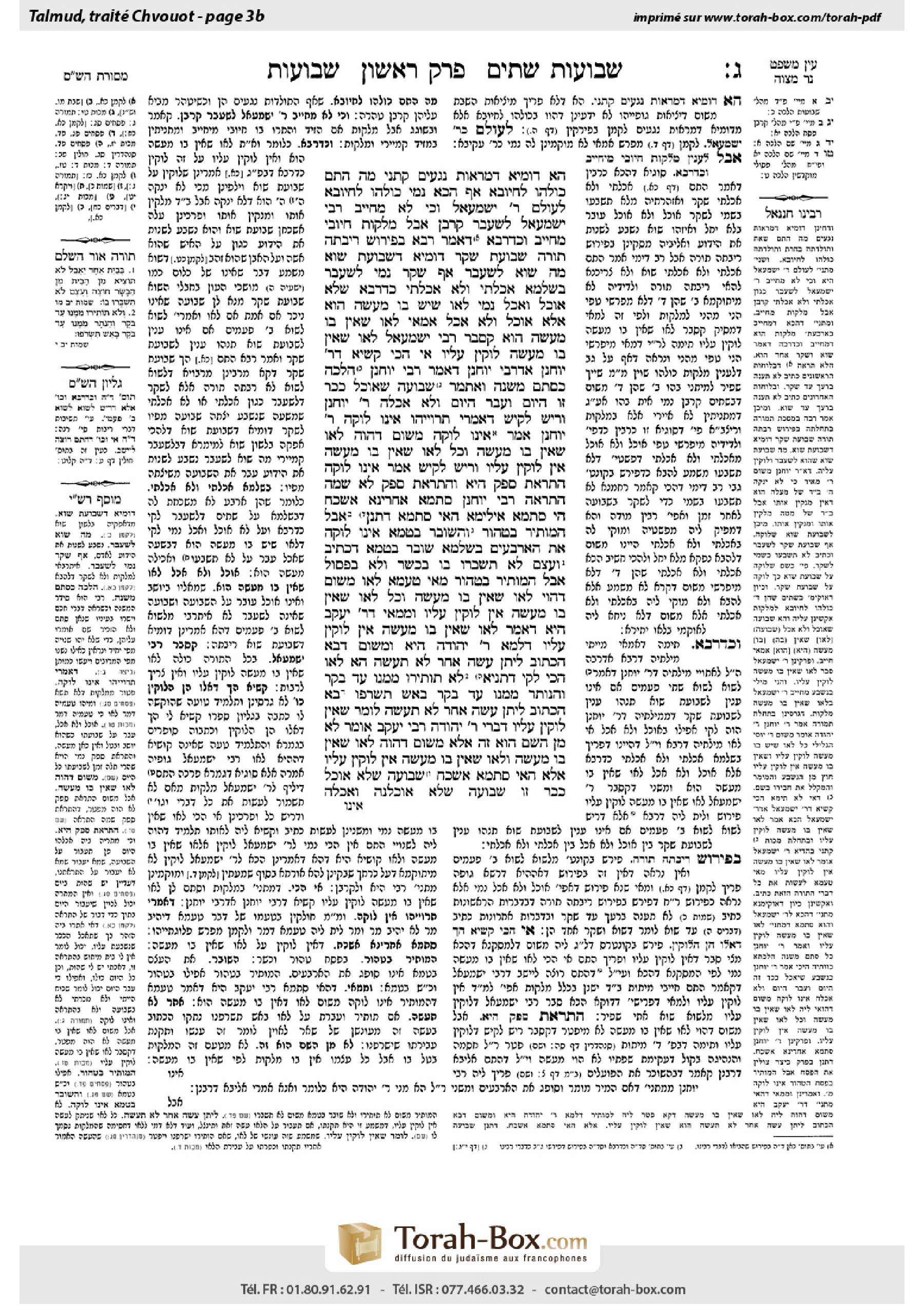
Shevuot 3b: Talmud study for Daf Yomi
Daf Yomi is the daily study of one Talmud folio. Explore 37 tractates with scans, Hebrew text, Sefaria English and AI-generated French translations where annotated.
Passage selection and English or AI-generated French translation are available where the scan has annotations. Daf Study is independent of Torah-Box and Sefaria.
Browse Shevuot · שבועות · All tractatesShevuot 3b text and translations
This page of Shevuot includes the Aramaic text, an English translation and an AI-generated French translation, alongside the scan above.
שבועות ג׳ ב · Aramaic and Hebrew text
הָא דּוּמְיָא דְּמַרְאוֹת נְגָעִים קָתָנֵי – מָה הָתָם כּוּלְּהוּ לְחִיּוּבָא, אַף הָכָא נָמֵי כּוּלְּהוּ לְחִיּוּבָא!
לְעוֹלָם רַבִּי יִשְׁמָעֵאל; וְכִי לָא מְחַיֵּיב רַבִּי יִשְׁמָעֵאל לְשֶׁעָבַר – קׇרְבָּן; אֲבָל מַלְקוֹת חַיּוֹבֵי מְחַיֵּיב.
וְכִדְרָבָא – דְּאָמַר רָבָא: בְּפֵירוּשׁ רִיבְּתָה תּוֹרָה שְׁבוּעַת שֶׁקֶר דּוּמְיָא דִּשְׁבוּעַת שָׁוְא; מָה שָׁוְא לְשֶׁעָבַר, אַף שֶׁקֶר נָמֵי לְשֶׁעָבַר.
בִּשְׁלָמָא ״אָכַלְתִּי״ וְ״לֹא אָכַלְתִּי״ – כִּדְרָבָא; ״שֶׁלֹּא אוֹכַל״ וְאָכַל נָמֵי – לָאו שֶׁיֵּשׁ בּוֹ מַעֲשֶׂה הוּא; אֶלָּא ״אוֹכַל״ וְלֹא אָכַל – אַמַּאי? לָאו שֶׁאֵין בּוֹ מַעֲשֶׂה הוּא!
קָסָבַר רַבִּי יִשְׁמָעֵאל: לָאו שֶׁאֵין בּוֹ מַעֲשֶׂה – לוֹקִין עָלָיו.
אִי הָכִי, קַשְׁיָא דְּרַבִּי יוֹחָנָן אַדְּרַבִּי יוֹחָנָן!
דְּאָמַר רַבִּי יוֹחָנָן: הֲלָכָה כִּסְתַם מִשְׁנָה;
וְאִתְּמַר: ״שְׁבוּעָה שֶׁאוֹכַל כִּכָּר זוֹ הַיּוֹם״, וְעָבַר הַיּוֹם וְלֹא אֲכָלָהּ – רַבִּי יוֹחָנָן וְרֵישׁ לָקִישׁ דְּאָמְרִי תַּרְוַיְיהוּ: אֵינוֹ לוֹקֶה. רַבִּי יוֹחָנָן אָמַר אֵינוֹ לוֹקֶה – מִשּׁוּם דְּהָוֵה לָאו שֶׁאֵין בּוֹ מַעֲשֶׂה, וְכׇל לָאו שֶׁאֵין בּוֹ מַעֲשֶׂה אֵין לוֹקִין עָלָיו. וְרֵישׁ לָקִישׁ אָמַר אֵינוֹ לוֹקֶה – הַתְרָאַת סָפֵק הִיא, וְהַתְרָאַת סָפֵק לֹא שְׁמָהּ הַתְרָאָה.
רַבִּי יוֹחָנָן סְתָמָא אַחֲרִינָא אַשְׁכַּח.
הֵי סְתָמָא? אִילֵּימָא הַאי סְתָמָא – דִּתְנַן: אֲבָל הַמּוֹתִיר בַּטָּהוֹר וְהַשּׁוֹבֵר בַּטָּמֵא – אֵינוֹ לוֹקֶה אֶת הָאַרְבָּעִים;
בִּשְׁלָמָא שׁוֹבֵר בַּטָּמֵא, דִּכְתִיב ״וְעֶצֶם לֹא תִשְׁבְּרוּ בּוֹ״ – בְּכָשֵׁר וְלֹא בְּפָסוּל. אֲבָל הַמּוֹתִיר בַּטָּהוֹר, מַאי טַעְמָא? לָאו מִשּׁוּם דְּהָוֵי לָאו שֶׁאֵין בּוֹ מַעֲשֶׂה, וְכׇל לָאו שֶׁאֵין בּוֹ מַעֲשֶׂה אֵין לוֹקִים עָלָיו?
וּמִמַּאי דְּרַבִּי יַעֲקֹב הִיא – דְּאָמַר לָאו שֶׁאֵין בּוֹ מַעֲשֶׂה אֵין לוֹקִין עָלָיו? דִּלְמָא רַבִּי יְהוּדָה הִיא – וּמִשּׁוּם דְּבָא הַכָּתוּב לִיתֵּן עֲשֵׂה אַחַר לֹא תַעֲשֶׂה; הָא לָאו הָכִי, לָקֵי!
דְּתַנְיָא: ״לֹא תוֹתִירוּ מִמֶּנּוּ עַד בֹּקֶר, וְהַנֹּתָר מִמֶּנּוּ עַד בֹּקֶר בָּאֵשׁ תִּשְׂרֹפוּ״ – בָּא הַכָּתוּב לִיתֵּן עֲשֵׂה אַחַר לֹא תַּעֲשֶׂה, לוֹמַר שֶׁאֵין לוֹקִין עָלָיו; דִּבְרֵי רַבִּי יְהוּדָה. רַבִּי יַעֲקֹב אוֹמֵר: לֹא מִן הַשֵּׁם הוּא זֶה, אֶלָּא מִשּׁוּם דְּהָוֵה לָאו שֶׁאֵין בּוֹ מַעֲשֶׂה, וְלָאו שֶׁאֵין בּוֹ מַעֲשֶׂה אֵין לוֹקִים עָלָיו.
אֶלָּא הַאי סְתָמָא אַשְׁכַּח: ״שְׁבוּעָה שֶׁלֹּא אוֹכַל כִּכָּר זוֹ״, ״שְׁבוּעָה שֶׁלֹּא אוֹכְלֶנָּה״, וַאֲכָלָהּ –
Shevuot 3b · English translation
But the mishna teaches these cases similar to the different shades of leprous marks, which indicates that just as there, all four of them are shades for which there is liability to bring an offering, so too here, with regard to oaths and the cases of one’s awareness of the defiling of the Temple or its sacrificial foods, all four of them are cases for which there is liability to bring an offering.
The Gemara suggests a different resolution: Actually, the mishna expresses the opinion of Rabbi Yishmael. And while Rabbi Yishmael does not deem one liable for oaths pertaining to the past, that is only with regard to liability to bring an offering; but he does deem one liable to be administered lashes.
And this is in accordance with the statement of Rava, as Rava says: The Torah explicitly amplifies the prohibition of taking a false oath to be similar to the prohibition of an oath taken in vain, to teach that one is flogged for its violation. It follows that just as an oath taken in vain pertains to the past and renders one liable to receive lashes, so too, taking a false oath that pertains to the past renders one liable to receive lashes.
The Gemara asks: Granted that one who stated: On my oath I ate, but in fact he did not eat, or one who stated: On my oath I did not eat, but in fact he ate, is liable to receive lashes, as this is in accordance with the statement of Rava. And also if one stated: On my oath I will not eat, and he ate in violation of his oath, he is liable to receive lashes, as it is a prohibition that involves an action, and, in general, such prohibitions are punishable by flogging. But if one stated: On my oath I will eat, and in violation of his oath he did not eat, why should he be liable to receive lashes? It is a prohibition that does not involve an action. The generally accepted principle is that one is not liable to receive lashes for violating a prohibition without performing an action.
The Gemara answers: Rabbi Yishmael disagrees with the generally accepted principle and holds that one is flogged for the violation of a prohibition that does not involve an action.
The Gemara challenges: If so, then a difficulty arises between one statement of Rabbi Yoḥanan and another statement of Rabbi Yoḥanan.
As Rabbi Yoḥanan says: The halakha is always in accordance with the ruling of an unattributed mishna. Since the mishna here is unattributed and assumes that one is flogged for taking a false oath, Rabbi Yoḥanan should rule that this is the halakha.
And an amoraic dispute was stated with regard to one who said: On my oath I will eat this loaf today, and the day passed and he did not eat it. Rabbi Yoḥanan and Reish Lakish both say: He is not flogged for taking a false oath. They disagree with regard to the reason that he is not flogged. Rabbi Yoḥanan says: He is not flogged due to the fact that it is a prohibition that does not involve an action, as he violates the oath by failing to perform an action rather than by performing an action, and the principle is: With regard to any prohibition that does not involve an action, one is not flogged for its violation. And Reish Lakish says: He is not flogged because it is an uncertain forewarning, as one cannot forewarn him before he fails to fulfill the oath because as long as time remains in the day he can still later eat the loaf and fulfill the oath; and an uncertain forewarning is not characterized as forewarning. Evidently, Rabbi Yoḥanan does not rule in accordance with the mishna here.
The Gemara resolves the difficulty: Rabbi Yoḥanan found another unattributed mishna which holds that one is not flogged for a prohibition that does not involve an action, and he rules in accordance with that mishna.
The Gemara asks: Which other unattributed mishna did he find? If we say he found this unattributed mishna, as we learned (Pesaḥim 84a): But one who leaves over some of the meat of a ritually pure Paschal offering until the morning of the fifteenth of Nisan and one who breaks a bone of a ritually impure Paschal offering are not flogged with the forty lashes, that is difficult.
First, the Gemara explains how this mishna demonstrates Rabbi Yoḥanan’s opinion: Granted that breaking a bone of an impure Paschal offering does not incur lashes, as it is written: “Nor shall you break a bone in it” (Exodus 12:46). The term “in it” indicates that the verse refers only to a valid Paschal offering, but not to a disqualified one, such as one that is impure. But in the case of one who leaves over some of the meat of a pure Paschal offering, what is the reason he is not flogged? Is it not because it is a violation of a prohibition that does not involve an action, and for a violation of any prohibition that does not involve an action one is not flogged?
The Gemara now questions this explanation of the mishna: But from where is it apparent that this mishna is in accordance with the opinion of Rabbi Ya’akov, who says that for a violation of a prohibition that does not involve an action, one is not flogged? Perhaps the mishna is in accordance with the opinion of Rabbi Yehuda, and he holds that the reason the mishna rules that one is not flogged is due to the fact that the verse comes to position the positive mitzva of burning the leftover meat after the prohibition of leaving over the meat, and one is not flogged for a prohibition whose violation obligates one in a positive mitzva. But were it not for this, one would be flogged, despite the fact it is a prohibition that does not involve an action. Since the unattributed mishna is not necessarily in accordance with Rabbi Yaakov’s opinion, it cannot be the basis of Rabbi Yoḥanan’s ruling.
The Gemara cites the source of Rabbi Yaakov’s and Rabbi Yehuda’s opinions: As it is taught in a baraita: “And you shall let nothing of it remain until the morning, and that which remains of it until the morning you shall burn in fire” (Exodus 12:10). The verse comes to position the positive mitzva of burning the leftover meat after the prohibition against leaving over the meat, to say that one is not flogged for its violation; this is the statement of Rabbi Yehuda. Rabbi Ya’akov says: This is not for that reason; rather, it is due to the fact that it is a prohibition that does not involve an action, and for a violation of a prohibition that does not involve an action one is not flogged.
Rather, Rabbi Yoḥanan found this unattributed mishna, which teaches (27b): If one states: On my oath I will not eat this loaf, and immediately states: On my oath I will not eat it, and then he ate it,
Shevuot 3b · Traduction française (IA)
Mais la Michna présente ces cas comme analogues aux différentes nuances des lésions lépreuses, ce qui indique que, de même que là-bas, les quatre nuances entraînent toutes l’obligation d’apporter un sacrifice, de même ici, en ce qui concerne les serments et les cas où l’on prend conscience de l’impureté du Temple ou de ses aliments sacrificiels, les quatre cas entraînent l’obligation d’apporter un sacrifice.
La Guemara propose une autre résolution : en réalité, la Michna exprime l’opinion de Rabbi Yishmael. Rabbi Yishmael ne rend certes pas passible d’un sacrifice celui qui prête un serment portant sur le passé, mais cela ne concerne que l’obligation d’apporter un sacrifice ; en revanche, il le rend passible de flagellation.
Et cela est conforme à la déclaration de Rava, qui dit : La Torah étend explicitement l’interdiction de prêter un faux serment pour la rapprocher de celle de prêter un serment vain, afin d’enseigner que sa transgression est passible de flagellation. Il s’ensuit que, de même qu’un serment vain porte sur le passé et rend passible de flagellation, de même un faux serment portant sur le passé rend passible de flagellation.
La Guemara demande : Il est compréhensible que celui qui a déclaré : « Par serment, j’ai mangé », alors qu’en réalité il n’a pas mangé, ou celui qui a déclaré : « Par serment, je n’ai pas mangé », alors qu’en réalité il a mangé, soit passible de flagellation, conformément à la déclaration de Rava. De même, celui qui a déclaré : « Par serment, je ne mangerai pas », puis a mangé en violation de son serment, est passible de flagellation, car il s’agit d’une interdiction impliquant un acte et, en règle générale, la transgression de telles interdictions est punie de flagellation. Mais si quelqu’un a déclaré : « Par serment, je mangerai », puis n’a pas mangé, en violation de son serment, pourquoi serait-il passible de flagellation ? Il s’agit d’une interdiction qui n’implique pas d’acte. Le principe généralement admis est que l’on n’est pas passible de flagellation pour la transgression d’une interdiction sans accomplir d’acte.
La Guemara répond : Rabbi Yishmael conteste le principe généralement admis et considère que l’on est passible de flagellation pour la transgression d’une interdiction qui n’implique pas d’acte.
La Guemara objecte : Si tel est le cas, il y a contradiction entre une déclaration de Rabbi Yoḥanan et une autre déclaration de Rabbi Yoḥanan.
En effet, Rabbi Yoḥanan dit : La halakha suit toujours la décision d’une Michna anonyme. Puisque la Michna ici est anonyme et implique que l’on est passible de flagellation pour avoir prêté un faux serment, Rabbi Yoḥanan devrait statuer que telle est la halakha.
Un différend entre amoraïm a été rapporté au sujet de celui qui a dit : « Par serment, je mangerai cette miche aujourd’hui », puis a laissé passer la journée sans la manger. Rabbi Yoḥanan et Reish Lakish disent tous deux qu’il n’est pas passible de flagellation pour avoir prêté un faux serment. Ils divergent quant à la raison pour laquelle il n’est pas passible de flagellation. Rabbi Yoḥanan dit qu’il n’est pas passible de flagellation parce qu’il s’agit d’une interdiction qui n’implique pas d’acte : il transgresse le serment en omettant d’accomplir un acte, et non en accomplissant un acte ; or le principe est que l’on n’est pas passible de flagellation pour la transgression d’une interdiction qui n’implique pas d’acte. Reish Lakish dit qu’il n’est pas passible de flagellation parce que l’avertissement est incertain : on ne peut pas l’avertir avant qu’il ne manque à son serment, car tant qu’il reste du temps dans la journée, il peut encore manger la miche et respecter son serment ; or un avertissement incertain n’est pas considéré comme un avertissement. Il apparaît donc que Rabbi Yoḥanan ne statue pas conformément à la Michna ici.
La Guemara résout la difficulté : Rabbi Yoḥanan a trouvé une autre Michna anonyme qui considère que l’on n’est pas passible de flagellation pour la transgression d’une interdiction qui n’implique pas d’acte, et il statue conformément à cette Michna.
La Guemara demande : Quelle autre Michna anonyme a-t-il trouvée ? Si l’on dit qu’il s’agit de cette Michna, comme nous l’avons appris (Pessaḥim 84a) : celui qui laisse une partie de la viande d’un sacrifice pascal pur jusqu’au matin du quinze Nissan, ainsi que celui qui brise un os d’un sacrifice pascal impur, ne sont pas passibles des quarante coups de flagellation, cela pose une difficulté.
La Guemara explique d’abord en quoi cette Michna démontre l’opinion de Rabbi Yoḥanan : il est compréhensible que celui qui brise un os d’un sacrifice pascal impur ne soit pas passible de flagellation, car il est écrit : « Vous n’en briserez aucun os » (Exode 12:46). L’expression « en lui » indique que le verset ne concerne qu’un sacrifice pascal valide, et non un sacrifice disqualifié, tel qu’un sacrifice impur. Mais, dans le cas de celui qui laisse une partie de la viande d’un sacrifice pascal pur, pour quelle raison n’est-il pas passible de flagellation ? N’est-ce pas parce qu’il transgresse une interdiction qui n’implique pas d’acte, et que l’on n’est pas passible de flagellation pour la transgression d’une telle interdiction ?
La Guemara remet maintenant en question cette explication de la Michna : D’où sait-on que cette Michna est conforme à l’opinion de Rabbi Ya’akov, selon laquelle on n’est pas passible de flagellation pour la transgression d’une interdiction qui n’implique pas d’acte ? Peut-être la Michna est-elle conforme à l’opinion de Rabbi Yehuda, qui considère qu’elle statue que l’on n’est pas passible de flagellation parce que le verset place la mitsva positive de brûler la viande restante après l’interdiction de laisser de la viande, et que l’on n’est pas passible de flagellation pour une interdiction dont la transgression oblige à accomplir une mitsva positive. Mais, sans cela, on serait passible de flagellation, bien qu’il s’agisse d’une interdiction qui n’implique pas d’acte. Puisque la Michna anonyme n’est pas nécessairement conforme à l’opinion de Rabbi Ya’akov, elle ne peut servir de fondement à la décision de Rabbi Yoḥanan.
La Guemara cite la source des opinions de Rabbi Ya’akov et de Rabbi Yehuda, car il est enseigné dans une baraïta : « Vous ne laisserez rien de ce sacrifice jusqu’au matin, et ce qui en restera jusqu’au matin, vous le brûlerez au feu » (Exode 12:10). Le verset place la mitsva positive de brûler la viande restante après l’interdiction de laisser de la viande, pour enseigner que l’on n’est pas passible de flagellation pour cette transgression ; telle est l’opinion de Rabbi Yehuda. Rabbi Ya’akov dit : Ce n’est pas pour cette raison, mais parce qu’il s’agit d’une interdiction qui n’implique pas d’acte, et que l’on n’est pas passible de flagellation pour la transgression d’une telle interdiction.
Au contraire, Rabbi Yoḥanan a trouvé cette Michna anonyme, qui enseigne (27b) : si quelqu’un déclare : « Par serment, je ne mangerai pas cette miche », puis déclare aussitôt : « Par serment, je ne la mangerai pas », et qu’ensuite il la mange,
Traduction française générée par IA à partir de l’édition anglaise de Sefaria. Vérifie toujours un passage avec le texte source.
Text from Sefaria: William Davidson Edition - Vocalized Aramaic (CC BY NC); William Davidson Edition - English (CC BY NC).