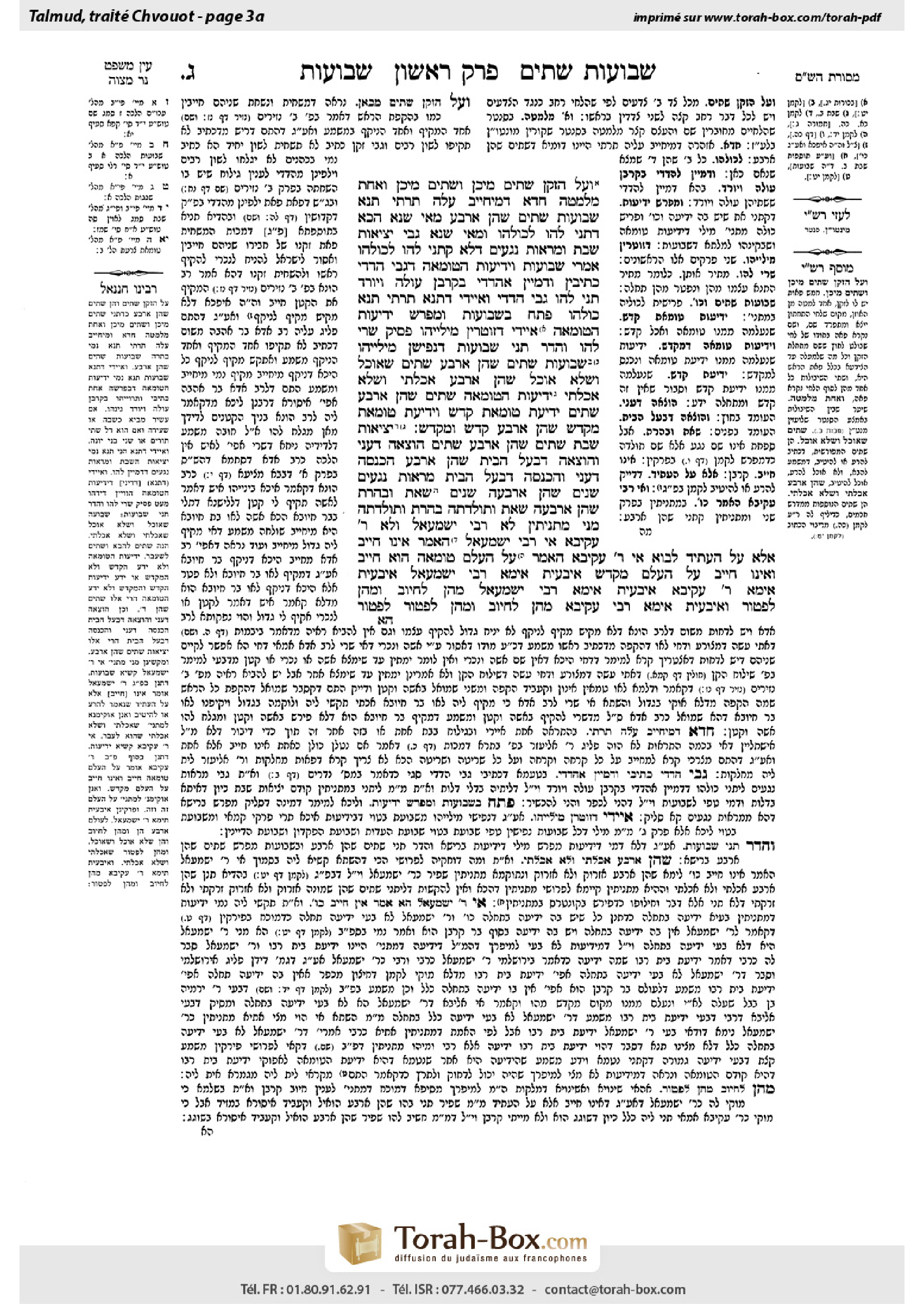
Shevuot 3a: Talmud study for Daf Yomi
Daf Yomi is the daily study of one Talmud folio. Explore 37 tractates with scans, Hebrew text, Sefaria English and AI-generated French translations where annotated.
Passage selection and English or AI-generated French translation are available where the scan has annotations. Daf Study is independent of Torah-Box and Sefaria.
Browse Shevuot · שבועות · All tractatesShevuot 3a text and translations
This page of Shevuot includes the Aramaic text, an English translation and an AI-generated French translation, alongside the scan above.
שבועות ג׳ א · Aramaic and Hebrew text
וְעַל הַזָּקָן שְׁתַּיִם מִיכָּן וּשְׁתַּיִם מִיכָּן וְאַחַת מִלְּמַטָּה;
חֲדָא דְּמִיחַיַּיב עֲלַהּ תַּרְתֵּי; תָּנֵא שְׁבוּעוֹת שְׁתַּיִם שֶׁהֵן אַרְבַּע.
מַאי שְׁנָא הָכָא דְּתָנֵי לְהוּ לְכוּלְּהוּ, וּמַאי שְׁנָא גַּבֵּי יְצִיאוֹת שַׁבָּת וּמַרְאוֹת נְגָעִים, דְּלָא קָתָנֵי לְהוּ לְכוּלְּהוּ?
אָמְרִי: שְׁבוּעוֹת וִידִיעוֹת הַטּוּמְאָה דְּגַבֵּי הֲדָדֵי כְּתִיבָן, וְדָמְיָין אַהֲדָדֵי בְּקׇרְבַּן עוֹלֶה וְיוֹרֵד – תָּנֵי לְהוּ גַּבֵּי הֲדָדֵי; וְאַיְּידֵי דִּתְנָא תַּרְתֵּי – תְּנָא כּוּלְּהוּ.
פְּתַח בִּשְׁבוּעוֹת, וּמְפָרֵשׁ יְדִיעוֹת הַטּוּמְאָה! אַיְּידֵי דְּזוּטְרָן מִילַּיְיהוּ, פָּסֵיק שָׁרֵי לְהוּ; וַהֲדַר תָּנֵי שְׁבוּעוֹת דִּנְפִישָׁן מִילַּיְיהוּ.
שְׁבוּעוֹת שְׁתַּיִם שֶׁהֵן אַרְבַּע: שְׁתַּיִם – ״שֶׁאוֹכַל״ וְ״שֶׁלֹּא אוֹכַל״; שֶׁהֵן אַרְבַּע – ״אָכַלְתִּי״ וְ״שֶׁלֹּא אָכַלְתִּי״.
יְדִיעוֹת הַטּוּמְאָה שְׁתַּיִם שֶׁהֵן אַרְבַּע: שְׁתַּיִם – יְדִיעַת טוּמְאַת קֹדֶשׁ וִידִיעַת טוּמְאַת מִקְדָּשׁ; שֶׁהֵן אַרְבַּע – קֹדֶשׁ וּמִקְדָּשׁ.
יְצִיאוֹת שַׁבָּת שְׁתַּיִם שֶׁהֵן אַרְבַּע: שְׁתַּיִם – הוֹצָאָה דְעָנִי וְהוֹצָאָה דְּבַעַל הַבַּיִת; שֶׁהֵן אַרְבַּע – הַכְנָסָה דְעָנִי וְהַכְנָסָה דְּבַעַל הַבַּיִת.
מַרְאוֹת נְגָעִים שְׁנַיִם שֶׁהֵן אַרְבָּעָה: שְׁנַיִם – שְׂאֵת וּבַהֶרֶת; שֶׁהֵן אַרְבָּעָה – שְׂאֵת וְתוֹלַדְתָּהּ, בַּהֶרֶת וְתוֹלַדְתָּהּ.
מַנִּי מַתְנִיתִין? לֹא רַבִּי יִשְׁמָעֵאל וְלָא רַבִּי עֲקִיבָא! אִי רַבִּי יִשְׁמָעֵאל – הָאָמַר: אֵינוֹ חַיָּיב אֶלָּא עַל הֶעָתִיד לָבוֹא. אִי רַבִּי עֲקִיבָא – הָאָמַר: עַל הֶעְלֵם טוּמְאָה הוּא חַיָּיב, וְאֵינוֹ חַיָּיב עַל הֶעְלֵם מִקְדָּשׁ.
אִיבָּעֵית אֵימָא רַבִּי יִשְׁמָעֵאל, אִיבָּעֵית אֵימָא רַבִּי עֲקִיבָא. אִיבָּעֵית אֵימָא רַבִּי יִשְׁמָעֵאל – מֵהֶן לְחִיּוּב וּמֵהֶן לִפְטוּר. וְאִיבָּעֵית אֵימָא רַבִּי עֲקִיבָא – מֵהֶן לְחִיּוּב וּמֵהֶן לִפְטוּר.
לִפְטוּר?!
Shevuot 3a · English translation
And for marring the edges of his beard there are two edges from here, on one side of his face, and two from there, on the other side, and one from below.
The Gemara explains: As apparent from the mishna in Makkot, this is a case where there is one prohibition for which one is liable to receive two punishments. Continuing on this theme, the tanna taught in the beginning of tractate Shevuot examples of other sets of halakhot that can be formulated similarly, beginning with: With regard to oaths on an utterance, there are two types that are actually four types.
The Gemara inquires: What is different here, in tractate Shevuot, that the mishna teaches all the sets of halakhot that can be formulated as: Two that are four, and what is different with regard to the chapter beginning: The acts of carrying out that are prohibited on Shabbat, i.e., the first chapter of tractate Shabbat, and the chapter beginning: And the shades of leprous marks, i.e., the first chapter of tractate Nega’im, where the mishna does not teach all of them, rather only the specific set of halakhot relevant to that tractate?
The Sages say in explanation: Since the passages of oaths and of liability based on one’s awareness of the defiling of the Temple or its sacrificial foods are written together in the Torah (see Leviticus 5:2–4), and they are also similar to each other in that they can both incur liability to bring a sliding-scale offering, the mishna therefore taught both of them together here. And once it already taught two sets, it continued and taught all of them.
The Gemara inquires further: Tractate Shevuot opens with a reference to oaths, but then proceeds to explain the cases of one’s awareness of the defiling of the Temple or its sacrificial foods, returning to discuss oaths only in the third chapter. Why? The Gemara explains: Since the cases of one’s awareness of the defiling of the Temple or its sacrificial foods are relatively few, the tanna addressed them directly and dispensed with them, and then afterward returned to teach the halakhot of oaths, which have numerous details.
§ The mishna teaches: With regard to oaths on an utterance, there are two types that are actually four types. The Gemara explains: The two types are where one states: On my oath I will eat, and where he states: On my oath I will not eat. If he violates either oath he is liable to bring a sliding-scale offering. These two types are actually four types because they also include the cases where a person falsely states: On my oath I ate, and where he falsely states: On my oath I did not eat.
The mishna continues: With regard to cases of one’s awareness of the defiling of the Temple or its sacrificial foods, for which one is liable to bring a sliding-scale offering, there are two cases that are actually four. The Gemara explains: The two cases are where one’s lack of awareness of the fact that he was ritually impure led him to eat sacrificial food, and where one’s lack of awareness of the fact that he was ritually impure led him to enter the Temple. These two types are actually four types, because one is also liable where he was aware that he was impure, but had a lapse of awareness about the status of the sacrificial food or the identity of the Temple.
The mishna continues: With regard to acts of carrying out that are prohibited on Shabbat, there are two types that are four. The Gemara explains the cases by using the analogy of a poor person who remains in the public domain and a homeowner who remains in the private domain and one passes an item to the other: The two types are the carrying out by a poor person of an item from the private domain to the public domain and the carrying out by a homeowner of an item from the private domain to the public domain. These two types are actually four types because they also include the bringing in by a poor person of an item from the public domain to the private domain and the bringing in by a homeowner of an item from the public domain to the private domain.
The mishna’s final example: With regard to shades of leprous marks, there are two shades that are actually four. The Gemara explains: The two shades are of a wool-white leprous mark [se’et] and of a snow-white leprous mark [baheret]. These two are actually four because they also include a se’et and its secondary mark, i.e., one similar to it, and a baheret and its secondary mark, i.e., one similar to it.
§ The Gemara asks: Whose opinion is expressed in the mishna? It is neither the opinion of Rabbi Yishmael nor the opinion of Rabbi Akiva. The Gemara elaborates: If one suggests that it is the opinion of Rabbi Yishmael, that suggestion can be refuted, as doesn’t he say with regard to oaths: One is liable only for oaths pertaining to the future, but not for those pertaining to the past? The mishna states that one is liable also for oaths pertaining to the past. And if one suggests it is the opinion of Rabbi Akiva, that suggestion can be refuted, as doesn’t he say: For having defiled the Temple or its sacrificial foods during a lapse of awareness of the fact that one is ritually impure one is liable to bring a sliding-scale offering, but one is not liable for having done so during a lapse of awareness of the fact that the place he entered was actually the Temple? The mishna states that one is liable also in such a case.
The Gemara answers: If you wish, say that the mishna expresses the opinion of Rabbi Yishmael, and if you wish, say that the mishna expresses the opinion of Rabbi Akiva. The Gemara elaborates: If you wish, say that the mishna expresses the opinion of Rabbi Yishmael, and the intent of the mishna is that while there are four types of oaths, among them are types for which there is liability to bring an offering for one who violates them and among them are types for which there is exemption from liability for one who violates them. And if you wish, say that the mishna expresses the opinion of Rabbi Akiva, and the intent of the mishna is that while there are four cases defined by one’s awareness of the defiling of the Temple or its sacrificial foods, among them are cases for which there is liability to bring an offering and among them are cases for which there is exemption from liability.
The Gemara asks: How can one say that the mishna teaches types for which there is exemption from liability?
Shevuot 3a · Traduction française (IA)
Et pour le rasage des bords de sa barbe, il y a deux bords de ce côté, sur un côté de son visage, deux de l’autre côté, et un en dessous.
La Guemara explique : comme le montre la Michna de Makot, il s’agit d’un cas où une seule interdiction est passible de deux peines. Dans le prolongement de ce thème, le tanna a enseigné, au début du traité Chevouot, des exemples d’autres ensembles de halakhot qui peuvent être formulés de façon semblable, en commençant par : Pour les serments portant sur une déclaration, il y en a deux qui sont en réalité quatre.
La Guemara demande : Qu’est-ce qui distingue le traité Chevouot, où la Michna enseigne tous les ensembles de halakhot qui peuvent être formulés ainsi : « deux qui sont quatre », des chapitres qui commencent par « Les actes de sortie interdits le Chabbat », c’est-à-dire le premier chapitre du traité Chabbat, et par « Et les nuances des marques de lèpre », c’est-à-dire le premier chapitre du traité Negaim, où la Michna n’enseigne pas tous ces ensembles, mais seulement celui qui concerne précisément le traité en question ?
Les Sages expliquent : Puisque les passages relatifs aux serments et à la responsabilité découlant de la prise de conscience de la profanation du Temple ou de ses aliments sacrificiels sont écrits ensemble dans la Torah (voir Lévitique 5, 2–4), et qu’ils se ressemblent également en ce qu’ils peuvent tous deux entraîner l’obligation d’apporter une offrande à valeur graduée, la Michna les a donc enseignés ensemble ici. Et puisqu’elle avait déjà enseigné deux ensembles, elle a poursuivi en enseignant tous les autres.
La Guemara demande encore : Le traité Chevouot s’ouvre sur une référence aux serments, mais traite ensuite des cas où l’on prend conscience de la profanation du Temple ou de ses aliments sacrificiels, pour ne revenir aux serments qu’au troisième chapitre. Pourquoi ? La Guemara explique : Comme les cas où l’on prend conscience de la profanation du Temple ou de ses aliments sacrificiels sont relativement peu nombreux, le tanna les a traités directement et s’en est acquitté ; ensuite, il est revenu enseigner les halakhot des serments, qui comportent de nombreux détails.
§ La Michna enseigne : Pour les serments portant sur une déclaration, il y en a deux qui sont en réalité quatre. La Guemara explique : Les deux types sont le cas où l’on déclare : « Je jure que je mangerai », et celui où l’on déclare : « Je jure que je ne mangerai pas ». S’il enfreint l’un ou l’autre de ces serments, il est tenu d’apporter une offrande à valeur graduée. Ces deux types sont en réalité quatre, car ils comprennent également les cas où quelqu’un déclare faussement : « Je jure que j’ai mangé », et : « Je jure que je n’ai pas mangé ».
La Michna poursuit : Pour les cas de profanation du Temple ou de ses aliments sacrificiels, qui entraînent l’obligation d’apporter une offrande à valeur graduée, il y a deux cas qui sont en réalité quatre. La Guemara explique : Les deux cas sont celui où, parce qu’il ignorait qu’il était en état d’impureté rituelle, il a mangé un aliment sacrificiel, et celui où, pour la même raison, il est entré dans le Temple. Ces deux types sont en réalité quatre, car on est également passible si l’on savait être impur, mais que l’on avait oublié le statut de l’aliment sacrificiel ou l’identité du lieu où l’on était entré, à savoir le Temple.
La Michna poursuit : Pour les actes de sortie interdits le Chabbat, il y en a deux qui sont quatre. La Guemara explique les cas à l’aide de l’analogie d’un pauvre qui reste dans le domaine public et d’un maître de maison qui reste dans le domaine privé, l’un faisant passer un objet à l’autre : les deux types sont la sortie par le pauvre d’un objet du domaine privé vers le domaine public, et la sortie par le maître de maison d’un objet du domaine privé vers le domaine public. Ces deux types sont en réalité quatre, car ils comprennent également l’introduction par le pauvre d’un objet du domaine public vers le domaine privé, et l’introduction par le maître de maison d’un objet du domaine public vers le domaine privé.
Dernier exemple de la Michna : Pour les nuances des marques de lèpre, il y en a deux qui sont en réalité quatre. La Guemara explique : Les deux nuances sont une marque de lèpre blanche comme la laine [se’et] et une marque de lèpre blanche comme la neige [baheret]. Ces deux nuances sont en réalité quatre, car elles comprennent également une se’et et sa nuance secondaire, c’est-à-dire une nuance qui lui ressemble, ainsi qu’une baheret et sa nuance secondaire, c’est-à-dire une nuance qui lui ressemble.
§ La Guemara demande : De qui la Michna exprime-t-elle l’opinion ? Elle ne suit ni Rabbi Yichmaël ni Rabbi Akiva. La Guemara précise : Si l’on suggère qu’il s’agit de l’opinion de Rabbi Yichmaël, cette suggestion peut être réfutée : ne dit-il pas, à propos des serments, que l’on n’est passible que pour les serments portant sur l’avenir, et non pour ceux portant sur le passé ? Or, la Michna affirme que l’on est également passible pour les serments portant sur le passé. Et si l’on suggère qu’il s’agit de l’opinion de Rabbi Akiva, cette suggestion peut être réfutée : ne dit-il pas que, si l’on a profané le Temple ou ses aliments sacrificiels en ignorant que l’on était en état d’impureté rituelle, on est tenu d’apporter une offrande à valeur graduée, mais que l’on n’est pas passible si l’on a agi ainsi en ignorant que le lieu où l’on était entré était le Temple ? Or, la Michna affirme que l’on est également passible dans un tel cas.
La Guemara répond : On peut dire que la Michna exprime l’opinion de Rabbi Yichmaël, ou bien celle de Rabbi Akiva. La Guemara précise : On peut dire que la Michna exprime l’opinion de Rabbi Yichmaël, et qu’elle signifie qu’il existe quatre types de serments, parmi lesquels certains entraînent l’obligation d’apporter une offrande pour celui qui les enfreint, tandis que d’autres ne rendent pas celui qui les enfreint passible d’une offrande. Ou bien, on peut dire que la Michna exprime l’opinion de Rabbi Akiva, et qu’elle signifie qu’il existe quatre cas de profanation du Temple ou de ses aliments sacrificiels liés à la prise de conscience, parmi lesquels certains entraînent l’obligation d’apporter une offrande, tandis que d’autres ne rendent pas passible d’une offrande.
La Guemara demande : Comment peut-on dire que la Michna enseigne des types de cas qui n’entraînent pas d’obligation ?
Traduction française générée par IA à partir de l’édition anglaise de Sefaria. Vérifie toujours un passage avec le texte source.
Text from Sefaria: William Davidson Edition - Vocalized Aramaic (CC BY NC); William Davidson Edition - English (CC BY NC).