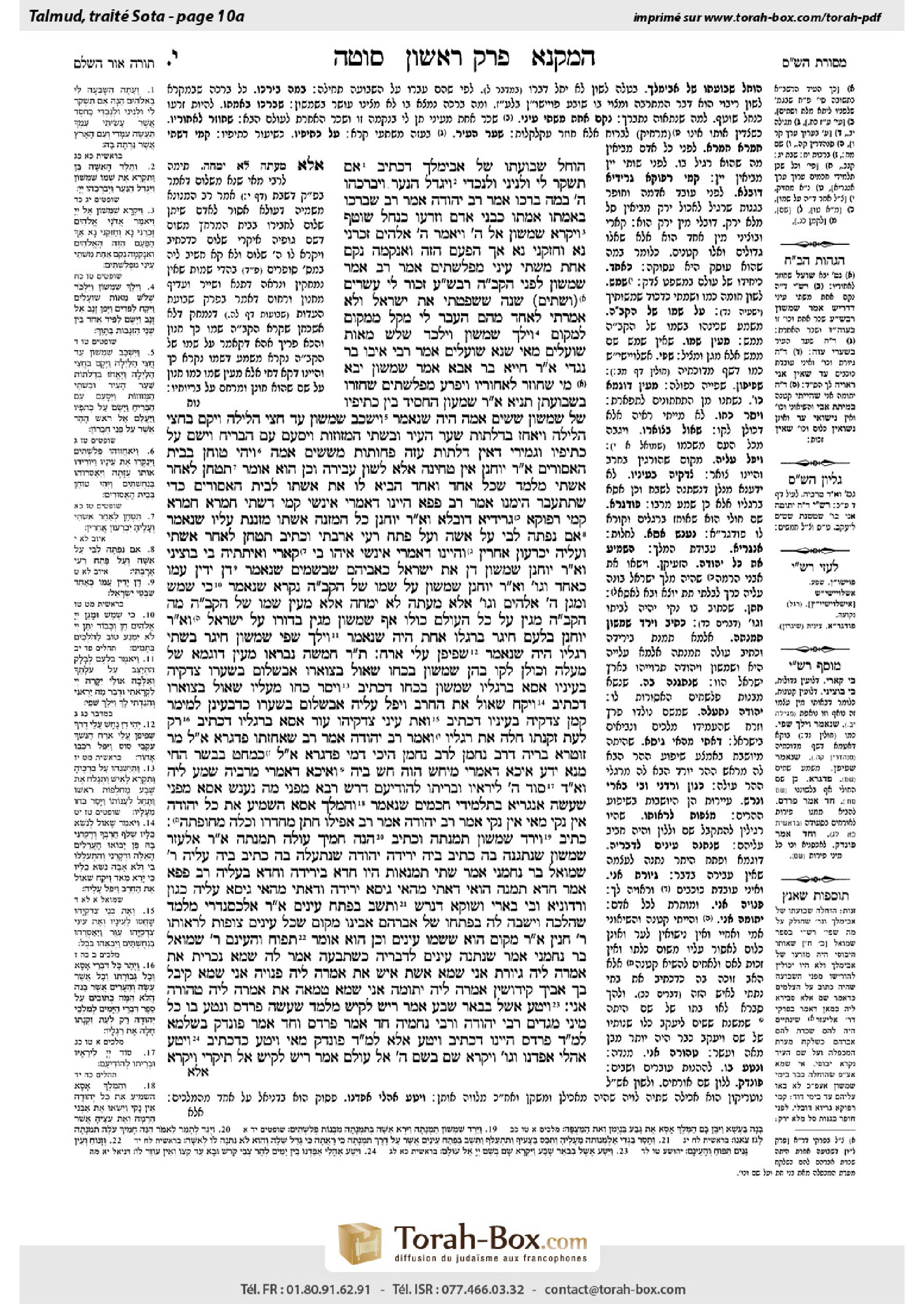
Sotah 10a: Talmud study for Daf Yomi
Daf Yomi is the daily study of one Talmud folio. Explore 37 tractates with scans, Hebrew text, Sefaria English and AI-generated French translations where annotated.
Passage selection and English or AI-generated French translation are available where the scan has annotations. Daf Study is independent of Torah-Box and Sefaria.
Browse Sotah · סוטה · All tractatesSotah 10a text and translations
This page of Sotah includes the Aramaic text, an English translation and an AI-generated French translation, alongside the scan above.
סוטה י׳ א · Aramaic and Hebrew text
הוּחַל שְׁבוּעָתוֹ שֶׁל אֲבִימֶלֶךְ, דִּכְתִיב: ״אִם תִּשְׁקֹר לִי וּלְנִינִי וּלְנֶכְדִּי״.
״וַיִּגְדַּל הַנַּעַר וַיְבָרְכֵהוּ ה׳״. בַּמֶּה בֵּרְכוֹ? אָמַר רַב יְהוּדָה אָמַר רַב, שֶׁבֵּרְכוֹ בְּאַמָּתוֹ: אַמָּתוֹ כִּבְנֵי אָדָם, וְזַרְעוֹ כְּנַחַל שׁוֹטֵף.
״וַיִּקְרָא שִׁמְשׁוֹן אֶל ה׳ וַיֹּאמֶר ה׳ אֱלֹהִים זׇכְרֵנִי נָא וְחַזְּקֵנִי נָא אַךְ הַפַּעַם הַזֶּה וְאִנָּקְמָה נְקַם אַחַת מִשְּׁתֵי עֵינַי מִפְּלִשְׁתִּים״. אָמַר רַב: אָמַר שִׁמְשׁוֹן לִפְנֵי הַקָּדוֹשׁ בָּרוּךְ הוּא: רִבּוֹנוֹ שֶׁל עוֹלָם, זְכוֹר לִי עֶשְׂרִים וּשְׁתַּיִם שָׁנָה שֶׁשָּׁפַטְתִּי אֶת יִשְׂרָאֵל, וְלֹא אָמַרְתִּי לְאֶחָד מֵהֶם הַעֲבֵר לִי מַקֵּל מִמָּקוֹם לְמָקוֹם.
״וַיֵּלֶךְ שִׁמְשׁוֹן וַיִּלְכֹּד שְׁלֹשׁ מֵאוֹת שׁוּעָלִים״. מַאי שְׁנָא שׁוּעָלִים? אָמַר רַבִּי אַיְּבוּ בַּר נַגְדִּי אָמַר רַבִּי חִיָּיא בַּר אַבָּא: אָמַר שִׁמְשׁוֹן, יָבֹא מִי שֶׁחוֹזֵר לַאֲחוֹרָיו, וְיִפָּרַע מִפְּלִשְׁתִּים שֶׁחָזְרוּ בִּשְׁבוּעָתָן.
תַּנְיָא, אָמַר רַבִּי שִׁמְעוֹן הֶחָסִיד: בֵּין כְּתֵיפָיו שֶׁל שִׁמְשׁוֹן שִׁשִּׁים אַמָּה הָיָה, שֶׁנֶּאֱמַר: ״וַיִּשְׁכַּב שִׁמְשׁוֹן עַד חֲצִי הַלַּיְלָה וַיָּקׇם בַּחֲצִי הַלַּיְלָה וַיֶּאֱחֹז בְּדַלְתוֹת שַׁעַר הָעִיר וּבִשְׁתֵּי הַמְּזוּזוֹת וַיִּסָּעֵם עִם הַבְּרִיחַ וַיָּשֶׂם עַל כְּתֵיפָיו״, וּגְמִירִי דְּאֵין דַּלְתוֹת עַזָּה פְּחוּתוֹת מִשִּׁשִּׁים אַמָּה.
״וַיְהִי טוֹחֵן בְּבֵית הָאֲסוּרִים״. אָמַר רַבִּי יוֹחָנָן: אֵין טְחִינָה אֶלָּא לְשׁוֹן עֲבֵירָה, וְכֵן הוּא אוֹמֵר: ״תִּטְחַן לְאַחֵר אִשְׁתִּי״. מְלַמֵּד שֶׁכׇּל אֶחָד וְאֶחָד הֵבִיא לוֹ אֶת אִשְׁתּוֹ לְבֵית הָאֲסוּרִים כְּדֵי שֶׁתִּתְעַבֵּר הֵימֶנּוּ. אָמַר רַב פָּפָּא: הַיְינוּ דְּאָמְרִי אִינָשֵׁי: קַמֵּי דְּשָׁתֵי חַמְרָא — חַמְרָא, קַמֵּי רָפוֹקָא (גְּרִידְיָא — דּוּבְלָא).
וְאָמַר רַבִּי יוֹחָנָן: כׇּל הַמְזַנֶּה — אִשְׁתּוֹ (מְזַנֶּנֶת) [מְזַנָּה] עָלָיו, שֶׁנֶּאֱמַר: ״אִם נִפְתָּה לִבִּי עַל אִשָּׁה וְעַל פֶּתַח רֵעִי אָרָבְתִּי״, וּכְתִיב: ״תִּטְחַן לְאַחֵר אִשְׁתִּי וְעָלֶיהָ יִכְרְעוּן אֲחֵרִין״, וְהַיְינוּ דְּאָמְרִי אִינָשֵׁי: אִיהוּ בֵּי קָארֵי, וְאִיתְּתֵיהּ בֵּי בוּצִינֵי.
וְאָמַר רַבִּי יוֹחָנָן: שִׁמְשׁוֹן דָּן אֶת יִשְׂרָאֵל כַּאֲבִיהֶם שֶׁבַּשָּׁמַיִם, שֶׁנֶּאֱמַר: ״דָּן יָדִין עַמּוֹ כְּאַחַד וְגוֹ׳״. וְאָמַר רַבִּי יוֹחָנָן: שִׁמְשׁוֹן עַל שְׁמוֹ שֶׁל הַקָּדוֹשׁ בָּרוּךְ הוּא נִקְרָא, שֶׁנֶּאֱמַר: ״כִּי שֶׁמֶשׁ וּמָגֵן ה׳ אֱלֹהִים וְגוֹ׳״. אֶלָּא מֵעַתָּה, לֹא יִמָּחֶה! אֶלָּא: מֵעֵין שְׁמוֹ שֶׁל הַקָּדוֹשׁ בָּרוּךְ הוּא: מָה הַקָּדוֹשׁ בָּרוּךְ הוּא מֵגֵין עַל כׇּל הָעוֹלָם כּוּלּוֹ — אַף שִׁמְשׁוֹן מֵגֵין בְּדוֹרוֹ עַל יִשְׂרָאֵל.
וְאָמַר רַבִּי יוֹחָנָן: בִּלְעָם חִיגֵּר בְּרַגְלוֹ אַחַת הָיָה, שֶׁנֶּאֱמַר ״וַיֵּלֶךְ שֶׁפִי״. שִׁמְשׁוֹן חִיגֵּר בִּשְׁתֵּי רַגְלָיו הָיָה, שֶׁנֶּאֱמַר: ״שְׁפִיפֹן עֲלֵי אֹרַח״.
תָּנוּ רַבָּנַן: חֲמִשָּׁה נִבְרְאוּ מֵעֵין דּוּגְמָא שֶׁל מַעְלָה, וְכוּלָּן לָקוּ בָּהֶן. שִׁמְשׁוֹן בְּכֹחוֹ, שָׁאוּל בְּצַוָּארוֹ, אַבְשָׁלוֹם בִּשְׂעָרוֹ, צִדְקִיָּה בְּעֵינָיו, אָסָא בְּרַגְלָיו.
שִׁמְשׁוֹן בְּכֹחוֹ, דִּכְתִיב: ״וַיָּסַר כֹּחוֹ מֵעָלָיו״.
שָׁאוּל בְּצַוָּארוֹ, דִּכְתִיב: ״וַיִּקַּח שָׁאוּל אֶת הַחֶרֶב וַיִּפֹּל עָלֶיהָ״.
אַבְשָׁלוֹם בִּשְׂעָרוֹ, כִּדְבָעֵינַן לְמֵימַר קַמַּן. צִדְקִיָּה בְּעֵינָיו, דִּכְתִיב: ״וְאֶת עֵינֵי צִדְקִיָּהוּ עִוֵּר״.
אָסָא בְּרַגְלָיו, דִּכְתִיב: ״רַק לְעֵת זִקְנָתוֹ חָלָה אֶת רַגְלָיו״, וְאָמַר רַב יְהוּדָה אָמַר רַב: שֶׁאֲחָזַתּוּ פָּדַגְרָא. אֲמַר לֵיהּ מָר זוּטְרָא בְּרֵיהּ דְּרַב נַחְמָן לְרַב נַחְמָן: הֵיכִי דָּמֵי פָּדַגְרָא? אֲמַר לֵיהּ: כְּמַחַט בִּבְשַׂר הַחַי. מְנָא יָדַע? אִיכָּא דְּאָמְרִי: מֵיחַשׁ הֲוָה חָשׁ בֵּיהּ. וְאִיכָּא דְּאָמְרִי: מֵרַבֵּיהּ שְׁמַע לֵיהּ. וְאִיכָּא דְּאָמְרִי: ״סוֹד ה׳ לִירֵאָיו וּבְרִיתוֹ לְהוֹדִיעָם״.
דָּרֵשׁ רָבָא: מִפְּנֵי מָה נֶעֱנַשׁ אָסָא — מִפְּנֵי שֶׁעָשָׂה אַנְגַּרְיָא בְּתַלְמִידֵי חֲכָמִים, שֶׁנֶּאֱמַר: ״וְהַמֶּלֶךְ אָסָא הִשְׁמִיעַ אֶת כׇּל יְהוּדָה אֵין נָקִי״. מַאי ״אֵין נָקִי״? אָמַר רַב יְהוּדָה אָמַר רַב: אֲפִילּוּ חָתָן מֵחֶדְרוֹ וְכַלָּה מֵחוּפָּתָהּ.
כְּתִיב: ״וַיֵּרֶד שִׁמְשׁוֹן תִּמְנָתָה״, וּכְתִיב: ״הִנֵּה חָמִיךְ עֹלֶה תִמְנָתָה״. אָמַר רַבִּי אֶלְעָזָר: שִׁמְשׁוֹן שֶׁנִּתְגַּנָּה בָּהּ — כְּתִיב בֵּיהּ יְרִידָה. יְהוּדָה שֶׁנִּתְעַלָּה בָּהּ — כְּתִיב בֵּיהּ עֲלִיָּה.
רַבִּי שְׁמוּאֵל בַּר נַחְמָנִי אָמַר: שְׁתֵּי תִּמְנָאוֹת הָיוּ, חֲדָא בִּירִידָה, וַחֲדָא בַּעֲלִיָּה.
רַב פָּפָּא אָמַר: חֲדָא תִּמְנָה הֲוַאי, דְּאָתֵי מֵהַאי גִּיסָא — יְרִידָה, וּדְאָתֵי מֵהַאי גִּיסָא — עֲלִיָּה. כְּגוֹן וַרְדּוֹנְיָא וּבֵי בָארֵי וְשׁוּקָא דְנַרֶשׁ.
״וַתֵּשֶׁב בְּפֶתַח עֵינַיִם״. אָמַר רַבִּי אֲלֶכְּסַנְדְּרִי: מְלַמֵּד שֶׁהָלְכָה וְיָשְׁבָה לָהּ בְּפִתְחוֹ שֶׁל אַבְרָהָם אָבִינוּ, מָקוֹם שֶׁכׇּל עֵינַיִם צוֹפוֹת לִרְאוֹתוֹ. רַבִּי חָנִין אָמַר רַב: מָקוֹם הוּא שֶׁשְּׁמוֹ עֵינַיִם, וְכֵן הוּא אוֹמֵר: ״תַּפּוּחַ וְהָעֵינָם״.
רַבִּי שְׁמוּאֵל בַּר נַחְמָנִי אָמַר: שֶׁנָּתְנָה עֵינַיִם לִדְבָרֶיהָ. כְּשֶׁתְּבָעָהּ אָמַר לָהּ: שֶׁמָּא נׇכְרִית אַתְּ? אָמְרָה לֵיהּ: גִּיּוֹרֶת אֲנִי. שֶׁמָּא אֵשֶׁת אִישׁ אַתְּ? אָמְרָה לֵיהּ: פְּנוּיָה אֲנִי. שֶׁמָּא קִיבֵּל בִּךְ אָבִיךָ קִידּוּשִׁין? אָמְרָה לֵיהּ: יְתוֹמָה אֲנִי. שֶׁמָּא טְמֵאָה אַתְּ? אָמְרָה לֵיהּ: טְהוֹרָה אֲנִי.
״וַיִּטַּע אֶשֶׁל בִּבְאֵר שָׁבַע״, אָמַר רֵישׁ לָקִישׁ: מְלַמֵּד שֶׁעָשָׂה פַּרְדֵּס, וְנָטַע בּוֹ כׇּל מִינֵי מְגָדִים.
רַבִּי יְהוּדָה וְרַבִּי נְחֶמְיָה, חַד אָמַר: פַּרְדֵּס, וְחַד אָמַר: פּוּנְדָּק. בִּשְׁלָמָא לְמַאן דְּאָמַר פַּרְדֵּס, הַיְינוּ דִּכְתִיב ״וַיִּטַּע״. אֶלָּא לְמַאן דְּאָמַר פּוּנְדָּק, מַאי ״וַיִּטַּע״? כְּדִכְתִיב: ״וַיִּטַּע אׇהֳלֵי אַפַּדְנוֹ וְגוֹ׳״.
״וַיִּקְרָא שָׁם בְּשֵׁם ה׳ אֵל עוֹלָם״. אָמַר רֵישׁ לָקִישׁ: אַל תִּיקְרֵי ״וַיִּקְרָא״,
Sotah 10a · English translation
Samson’s parents were being told that the oath of Abimelech, king of the Philistines, was negated, as it is written that Abimelech said to our forefather Abraham: “Now therefore swear unto me here by God that you will not deal falsely with me, nor with my son, nor with my son’s son; but according to the kindness that I have done unto you, you shall do to me, and to the land wherein you have sojourned” (Genesis 21:23). The oath of the descendants of Abraham was no longer binding since the Philistines broke their oath by subjugating the Jewish people.
The verse states: “And the woman bore a son, and called his name Samson; and the child grew, and the Lord blessed him” (Judges 13:24). The Gemara asks: With what did He bless him? Rav Yehuda says that Rav says: It means that He blessed him with regard to his penis, that despite his youth his penis should function like that of physically mature men, and that his seed should be like an overflowing river.
Prior to Samson’s death, the verse states: “And Samson called unto the Lord, and said: Lord God, remember me, I pray to You, and strengthen me, I pray to You, only this once, O God, that I may be this once avenged of the Philistines for my two eyes” (Judges 16:28). Rav said that Samson said before the Holy One, Blessed be He: Master of the Universe, remember on my behalf the twenty-two years that I judged the Jewish people without receiving any reward, and I did not even say to any one of them: Move a stick for me from one place to another place.
The verse states earlier: “And Samson went and caught three hundred foxes, and took torches, and turned tail to tail, and put a torch in the midst between every two tails” (Judges 15:4). The Gemara asks: What is different about foxes than any other animal, that he chose them for this purpose? Rabbi Aivu bar Nagdi says that Rabbi Ḥiyya bar Abba says: Samson said: Let the animal that goes in reverse when it tries to escape, i.e., the fox, come and exact punishment from the Philistines, who reneged on their oath that Abimelech swore to Abraham.
It is taught in a baraita that Rabbi Shimon the Pious said: The width between the shoulders of Samson was sixty cubits, as it is stated: “And Samson lay till midnight, and arose at midnight, and grabbed hold of the doors of the gate of the city, and the two posts, and plucked them up, bar and all, and put them upon his shoulders, and carried them up to the top of the mountain that is before Hebron” (Judges 16:3). The verse indicates that the width of the gate of the city of Gaza was equal to the width of Samson’s shoulders, and it is learned as a tradition that doors of the gate of Gaza were no less than sixty cubits wide.
With regard to Samson’s capture, the verse states: “And the Philistines laid hold on him, and put out his eyes; and they brought him down to Gaza, and bound him with fetters of brass; and he did grind in the prison-house” (Judges 16:21). Rabbi Yoḥanan says: Grinding is nothing other than a language of a transgression of sexual intercourse, and so the verse says: “Then let my wife grind unto another man” (Job 31:10). This teaches that each and every Philistine man brought his wife to the prison in order that she should be impregnated by Samson. Rav Pappa said: This is an example of the folk saying that people say: Before a wine drinker, bring wine; before one who digs in the ground, bring figs. So too, Samson, who married Philistine women, was brought more Philistine women while in prison.
And Rabbi Yoḥanan says: With regard to anyone who commits adultery, his wife commits adultery against him, as it is stated: “If my heart has been enticed unto a woman, and I have lain in wait at my neighbor’s door” (Job 31:9), and it is written: “Then let my wife grind unto another man and may strangers kneel over her” (Job 31:10). And this explains the folk saying that people say: He is found among the pumpkins [karei] and his wife among the zucchinis [butzinei], which are similar types of vegetables. In other words, she acts the same way that he does.
And Rabbi Yoḥanan says: Samson judged the Jewish people as their Father in Heaven does, with complete justice, as it is stated: “Dan shall judge his people, as one of the tribes of Israel” (Genesis 49:16), which is interpreted to mean that Samson, from the tribe of Dan, judges his people just as God, Who is “One.” And Rabbi Yoḥanan says: Samson [Shimshon] is called by the name of the Holy One, Blessed be He, as it is stated: “For the Lord God is a sun [shemesh] and a shield” (Psalms 84:12). The Gemara comments: If that is so, then his name should not be erased just like other sanctified names are not erased. Rather, he is not called by the name of God but his name is akin to the name of the Holy One, Blessed be He, for just as the Holy One, Blessed be He, protects the entire world, so too Samson, in his generation, protected all the Jewish people.
And Rabbi Yoḥanan says: Balaam was lame in one of his legs, as it is stated with regard to him: “And he went, limping [shefi]” (Numbers 23:3). Samson was lame in both of his two legs, as it is stated that when Jacob mentioned the tribe of Dan in the prophecy that pertained to Samson, he referred to him as: “Dan shall be a serpent in the way, a horned snake [shefifon] in the path” (Genesis 49:17), which is double shefi, i.e., doubly lame.
§ The Sages taught in a baraita: Five individuals were created with a characteristic that is akin to a representation of the One on High, and they were all stricken by that characteristic. Samson was glorified in his strength, Saul in his neck (see I Samuel 9:2), Absalom in his hair, Zedekiah in his eyes, and Asa in his feet.
The Gemara clarifies: Samson was stricken by his strength, which led to his demise, as it is written: “And she made him sleep upon her knees; and she called for a man and had the seven locks of his head shaved off; and she began to afflict him, and his strength went from him” (Judges 16:19).
Saul was smitten in his neck, as it is written: “Then said Saul to his armor-bearer: Draw your sword, and thrust me through with it; lest these uncircumcised come and thrust me through, and make a mock of me. But his armor-bearer would not; for he was sore afraid. Therefore, Saul took his sword and fell upon it” (I Samuel 31:4); he fell with his neck upon the sword.
Absalom was stricken in his hair, as we will state later. Zedekiah was stricken in his eyes, as it is written: “And they slew the sons of Zedekiah before his eyes, and put out the eyes of Zedekiah, and bound him in fetters, and carried him to Babylon” (II Kings 25:7).
Asa was stricken in his feet, as it is written: “Now the rest of all the acts of Asa, and all his might, and all that he did, and the cities that he built, are they not written in the book of the chronicles of the kings of Judah? But in the time of his old age he was diseased in his feet” (I Kings 15:23). And Rav Yehuda says that Rav says: This indicates that gout [padagra] grabbed hold of him. Mar Zutra, son of Rav Naḥman, said to Rav Naḥman: What are the circumstances of gout? What pain does it involve? He said to him: It feels like a needle inserted into living flesh. The Gemara asks: From where did he know this? The Gemara answers: Some say that he himself suffered from this condition, and some say that he heard it from his teacher, and some say that he knew it through divine inspiration, as it stated: “The secret of the Lord is with them that fear Him; and His covenant, to make them know it” (Psalms 25:14).
Rava taught: For what reason was Asa punished in his feet? Because he made Torah scholars perform forced labor [angarya], as it is stated: “Then King Asa made a proclamation unto all Judah; none was exempted; and they carried away the stones of Ramah and the timber thereof, with which Baasa had built, and King Asa built with them Geba of Benjamin and Mizpah” (I Kings 15:22). The superfluous expression “unto all” indicates that the proclamation was issued to everyone, including Torah scholars. The Gemara asks: What is the meaning of the next phrase in the verse: “None was exempted [ein naki]”? Rav Yehuda says that Rav says: This includes even a bridegroom from his chamber and a bride from her canopy, as the verse states with regard to a bridegroom: “He shall be free [naki] for his house one year” (Deuteronomy 24:5).
§ It is written with regard to Samson: “And Samson went down to Timnah, and saw a woman in Timnah of the daughters of the Philistines” (Judges 14:1), and it is written in the Torah passage concerning the incident of Judah and Tamar: “And it was told to Tamar, saying: Behold, your father-in-law is going up to Timnah to sheer his sheep” (Genesis 38:13). The verses contain an apparent contradiction as to whether Timnah was a place to which one must descend or a place to which one must ascend. Rabbi Elazar says: These terms do not refer to the manner of traveling to Timnah but are used figuratively. Concerning Samson, who was disgraced there in Timnah, the term indicating descent is written with regard to his journey. Concerning Judah, who was elevated there, the term indicating ascent is written with regard to his journey.
Rabbi Shmuel bar Naḥmani says differently: There were two cities named Timnah, one was reached by descent into a valley, and one was reached by ascent.
Rav Pappa said differently: There was one Timnah, and it was located on the slope of a mountain. One who came from this side reached it by descent, and one who came from that side reached it by ascent. The Gemara presents examples of such cities: For example: Vardonia, and Bei Varei, and the market of Neresh.
The verse states with regard to Tamar: “And she put off from her the garments of her widowhood, and covered herself with her veil, and wrapped herself, and sat in the entrance of Enaim [befetaḥ einayim], which is by the way to Timnah; for she saw that Shelah was grown up, and she was not given unto him to wife” (Genesis 38:14). The amora’im dispute the meaning of the word einayim. Rabbi Alexandri says: This teaches that she went and she sat at the entrance of the home of Abraham our forefather, a place that all eyes hope to see it, as she was certain that Judah would pass there. Rabbi Ḥanin says that Rav says: It is a place called Enaim, and similarly the verse states in the list of cities in Eretz Yisrael in the portion of Judah: “Tappuah and Enam” (Joshua 15:34).
Rabbi Shmuel bar Naḥmani says: She provided eyes [einayim] for her statements, i.e., with her words she provided an opening [petaḥ] for Judah to solicit her. When Judah solicited her to engage in sexual intercourse with him, he first attempted to verify her status and said to her: Are you perhaps are a gentile? She said to him: I am a convert. He asked: Perhaps you are a married woman? She said to him: I am an unmarried woman. He asked: Perhaps your father accepted betrothal for you and you are unaware of it? She said to him: I am an orphan. He asked: Maybe you are impure? She said to him: I am pure.
The Gemara discusses Abraham’s house: It is written: “And he planted an eshel in Beersheba, and called there on the name of the Lord, the Everlasting God” (Genesis 21:33). Reish Lakish says: This teaches that Abraham made an orchard and planted in it all kinds of sweet things.
The tanna’im Rabbi Yehuda and Rabbi Neḥemya disagree as to the meaning of the word “eshel.” One said that it means an orchard [pardes], and one said that it means an inn [pundak]. The Gemara continues: Granted, according to the one who said that it means an orchard, this is what is written: “And he planted,” and this is suitable language for an orchard. But according to the one who said that he opened an inn, what is the meaning of the phrase “and he planted”? The Gemara answers: As it is written: “And he shall plant [vayitta] the tents of his palace between the seas and the beauteous holy mountain; and he shall come to his end, and none shall help him” (Daniel 11:45), indicating that the word vayitta, and he planted, is also used to indicate pitching tents.
The verse there states: “And he planted an eshel in Beersheba, and called there [vayyikra] on the name of the Lord, the Everlasting God” (Genesis 21:33). Reish Lakish said: Do not read this word literally as “vayyikra,” and he called,
Sotah 10a · Traduction française (IA)
On annonçait aux parents de Samson que le serment d’Abimélech, roi des Philistins, était devenu caduc, comme il est écrit qu’Abimélech dit à notre ancêtre Abraham : « Maintenant donc, jure-moi ici par Dieu que tu ne me tromperas pas, ni moi, ni mon fils, ni le fils de mon fils ; mais tu agiras envers moi et envers le pays où tu as séjourné avec la même bonté que celle dont j’ai usé envers toi » (Genèse 21:23). Le serment imposé aux descendants d’Abraham n’était plus contraignant, puisque les Philistins l’avaient rompu en asservissant le peuple juif.
Le verset dit : « La femme enfanta un fils et lui donna le nom de Samson ; l’enfant grandit et le Seigneur le bénit » (Juges 13:24). La Guemara demande : En quoi le bénit-il ? Rav Yehouda rapporte au nom de Rav : Il le bénit en ce qui concerne son pénis, afin que, malgré son jeune âge, celui-ci fonctionne comme celui d’hommes physiquement mûrs et que sa semence soit comme un fleuve débordant.
Avant la mort de Samson, le verset dit : « Samson invoqua le Seigneur et dit : Seigneur Dieu, je T’en prie, souviens-Toi de moi et, je T’en prie, fortifie-moi, ne serait-ce que cette fois, ô Dieu, afin que je me venge cette fois des Philistins pour mes deux yeux » (Juges 16:28). Rav dit que Samson déclara devant le Saint, béni soit-Il : « Maître de l’Univers, souviens-Toi en ma faveur des vingt-deux années durant lesquelles j’ai jugé le peuple juif sans recevoir aucune récompense, et sans même demander à l’un d’eux de déplacer pour moi un bâton d’un endroit à un autre. »
Un verset antérieur dit : « Samson alla capturer trois cents renards, prit des torches, attacha les renards queue contre queue et plaça une torche entre chaque paire de queues » (Juges 15:4). La Guemara demande : En quoi les renards se distinguent-ils des autres animaux, pour qu’il les choisisse à cette fin ? Rabbi Aïvou bar Nagdi rapporte au nom de Rabbi Ḥiyya bar Abba : Samson dit : « Que l’animal qui recule lorsqu’il tente de fuir, c’est-à-dire le renard, vienne punir les Philistins, qui ont renié le serment qu’Abimélech avait prêté à Abraham. »
Il est enseigné dans une baraïta que Rabbi Shimon le Pieux disait : La largeur des épaules de Samson était de soixante coudées, comme il est dit : « Samson resta couché jusqu’à minuit, puis se leva à minuit, saisit les portes de la porte de la ville et les deux montants, les arracha avec la barre, les posa sur ses épaules et les porta au sommet de la montagne qui fait face à Hébron » (Juges 16:3). Le verset indique que la largeur de la porte de la ville de Gaza était égale à celle des épaules de Samson ; or, la tradition enseigne que les portes de la porte de Gaza mesuraient au moins soixante coudées de large.
Au sujet de la capture de Samson, le verset dit : « Les Philistins se saisirent de lui, lui crevèrent les yeux, le firent descendre à Gaza, l’attachèrent avec des chaînes de bronze et le firent tourner la meule dans la prison » (Juges 16:21). Rabbi Yoḥanan dit : L’expression « tourner la meule » désigne une transgression liée aux relations sexuelles ; ainsi, le verset dit : « Que ma femme tourne la meule pour un autre homme » (Job 31:10). Cela enseigne que chacun des hommes philistins amenait sa femme à la prison afin qu’elle soit fécondée par Samson. Rav Pappa dit : C’est un exemple du proverbe populaire : « Devant un buveur de vin, apporte du vin ; devant celui qui creuse la terre, apporte des figues. » De même, Samson, qui avait épousé des femmes philistines, se vit amener d’autres femmes philistines en prison.
Rabbi Yoḥanan dit également : Quiconque commet l’adultère, sa femme commet l’adultère à son tour, comme il est dit : « Si mon cœur s’est laissé séduire par une femme, si j’ai guetté à la porte de mon prochain » (Job 31:9), et il est écrit : « Que ma femme tourne la meule pour un autre homme, et que des étrangers s’agenouillent sur elle » (Job 31:10). Cela explique le proverbe populaire : « Lui se trouve parmi les citrouilles [karei], et sa femme parmi les courgettes [butzinei] », légumes de même espèce. Autrement dit, elle agit comme lui.
Rabbi Yoḥanan dit également : Samson jugeait le peuple juif comme le fait son Père céleste, avec une justice parfaite, comme il est dit : « Dan jugera son peuple comme l’une des tribus d’Israël » (Genèse 49:16). Cela s’interprète ainsi : Samson, de la tribu de Dan, juge son peuple comme Dieu, qui est « Un ». Rabbi Yoḥanan dit également : Samson [Shimshon] porte un nom semblable à celui du Saint, béni soit-Il, comme il est dit : « Car le Seigneur Dieu est un soleil [shemesh] et un bouclier » (Psaumes 84:12). La Guemara fait remarquer : Si tel était le cas, son nom ne devrait pas pouvoir être effacé, à l’instar des autres noms sacrés. Mais Samson ne porte pas le nom de Dieu ; son nom est seulement apparenté à celui du Saint, béni soit-Il. En effet, de même que le Saint, béni soit-Il, protège le monde entier, Samson protégea lui aussi tout le peuple juif à son époque.
Rabbi Yoḥanan dit également : Balaam boitait d’une jambe, comme il est dit à son sujet : « Et il s’en alla en boitant [shefi] » (Nombres 23:3). Samson boitait des deux jambes, comme il est dit que, lorsque Jacob mentionna la tribu de Dan dans la prophétie concernant Samson, il le désigna ainsi : « Dan sera un serpent sur le chemin, une vipère [shefifon] sur le sentier » (Genèse 49:17). Le terme [shefifon] correspond à un double shefi, c’est-à-dire qu’il boitait des deux jambes.
§ Les Sages enseignèrent dans une baraïta : Cinq personnes furent créées avec une caractéristique évoquant une représentation de Celui qui est là-haut, et toutes furent frappées dans cette caractéristique. Samson se distinguait par sa force, Saül par son cou (voir I Samuel 9:2), Absalom par ses cheveux, Sédécias par ses yeux et Asa par ses pieds.
La Guemara précise : Samson fut frappé dans ce qui faisait sa force, ce qui entraîna sa perte, comme il est écrit : « Elle le fit dormir sur ses genoux, appela un homme et lui fit raser les sept tresses de sa tête ; elle commença à le tourmenter, et sa force le quitta » (Juges 16:19).
Saül fut frappé au cou, comme il est écrit : « Saül dit à son écuyer : Tire ton épée et transperce-moi, de peur que ces incirconcis ne viennent me transpercer et me bafouer. Mais son écuyer refusa, car il était saisi d’une grande peur. Alors Saül prit son épée et se jeta dessus » (I Samuel 31:4) : il tomba, le cou sur l’épée.
Absalom fut frappé dans ses cheveux, comme nous le dirons plus loin. Sédécias fut frappé aux yeux, comme il est écrit : « Ils tuèrent les fils de Sédécias sous ses yeux, puis crevèrent les yeux de Sédécias, le chargèrent de chaînes et l’emmenèrent à Babylone » (II Rois 25:7).
Asa fut frappé aux pieds, comme il est écrit : « Le reste des actes d’Asa, toute sa vaillance, tout ce qu’il fit et les villes qu’il bâtit, cela n’est-il pas écrit dans le livre des Chroniques des rois de Juda ? Mais, au temps de sa vieillesse, il eut une maladie aux pieds » (I Rois 15:23). Rav Yehouda rapporte au nom de Rav : Cela indique que la goutte [padagra] s’empara de lui. Mar Zutra, fils de Rav Naḥman, demanda à Rav Naḥman : Quels sont les symptômes de la goutte ? Quelle douleur provoque-t-elle ? Il lui répondit : On a l’impression qu’une aiguille est enfoncée dans la chair vive. La Guemara demande : Comment le savait-il ? La Guemara répond : Certains disent qu’il souffrait lui-même de cette maladie ; d’autres disent qu’il l’avait apprise de son maître ; d’autres encore disent qu’il la connaissait par inspiration divine, comme il est dit : « Le secret du Seigneur est pour ceux qui Le craignent, et Il leur fait connaître Son alliance » (Psaumes 25:14).
Rava enseigna : Pourquoi Asa fut-il puni aux pieds ? Parce qu’il imposa des travaux forcés [angarya] aux érudits de la Torah, comme il est écrit : « Le roi Asa convoqua tout Juda ; nul ne fut exempté. Ils emportèrent les pierres de Rama et son bois, avec lesquels Baasha avait construit ; le roi Asa s’en servit pour bâtir Guéba de Benjamin et Mitspa » (I Rois 15:22). L’expression superflue « tout Juda » indique que la convocation s’adressait à tous, y compris aux érudits de la Torah. La Guemara demande : Que signifie la phrase suivante du verset : « Nul ne fut exempté [ein naki] » ? Rav Yehouda rapporte au nom de Rav : Cela inclut même un fiancé dans sa chambre et une mariée sous son dais, comme le verset dit au sujet du fiancé : « Il sera libre [naki] pour sa maison pendant un an » (Deutéronome 24:5).
§ Au sujet de Samson, il est écrit : « Samson descendit à Timna et vit à Timna une femme parmi les filles des Philistins » (Juges 14:1). Et, dans le récit de Juda et Tamar, il est écrit : « On annonça à Tamar : Voici que ton beau-père monte à Timna pour tondre ses brebis » (Genèse 38:13). Ces versets semblent se contredire quant à savoir si Timna était un lieu où l’on descendait ou où l’on montait. Rabbi Elazar dit : Ces termes ne décrivent pas la manière de se rendre à Timna ; ils sont employés au sens figuré. Pour Samson, qui y fut humilié, le texte emploie le terme indiquant une descente. Pour Juda, qui y fut élevé, le texte emploie le terme indiquant une montée.
Rabbi Shmuel bar Naḥmani donne une autre explication : Il y avait deux villes nommées Timna ; on accédait à l’une en descendant dans une vallée, et à l’autre en montant.
Rav Pappa donne une autre explication : Il n’y avait qu’une seule Timna, située sur le versant d’une montagne. Celui qui venait d’un côté y accédait en descendant, et celui qui venait de l’autre côté y accédait en montant. La Guemara donne des exemples de villes de ce genre : Vardonia, Bei Varei et le marché de Neresh.
Au sujet de Tamar, le verset dit : « Elle ôta ses vêtements de veuve, se couvrit d’un voile, s’enveloppa et s’assit à l’entrée d’Énaïm [befetaḥ einayim], qui est sur le chemin de Timna ; car elle avait vu que Shéla avait grandi et qu’elle ne lui avait pas été donnée pour épouse » (Genèse 38:14). Les amoraïm sont en désaccord sur le sens du mot einayim. Rabbi Alexandri dit : Cela enseigne qu’elle alla s’asseoir à l’entrée de la maison de notre ancêtre Abraham, un endroit que tous espèrent voir, car elle était certaine que Juda passerait par là. Rabbi Ḥanin rapporte au nom de Rav : C’est un lieu appelé Énaïm, comme le mentionne également le verset dans la liste des villes situées dans le territoire de Juda, en Eretz Yisrael : « Tappouaḥ et Énam » (Josué 15:34).
Rabbi Shmuel bar Naḥmani dit : Elle donna des « yeux » [einayim] à ses paroles, c’est-à-dire qu’avec ses propos elle offrit une ouverture [petaḥ] à Juda pour qu’il la sollicite. Lorsque Juda la sollicita pour avoir des relations sexuelles avec elle, il tenta d’abord de vérifier son statut et lui demanda : « Serais-tu peut-être une non-Juive ? » Elle lui répondit : « Je suis convertie. » Il demanda : « Serais-tu peut-être une femme mariée ? » Elle répondit : « Je ne suis pas mariée. » Il demanda : « Ton père aurait-il peut-être accepté des fiançailles en ton nom, à ton insu ? » Elle répondit : « Je suis orpheline. » Il demanda : « Serais-tu peut-être impure ? » Elle répondit : « Je suis pure. »
La Guemara parle de la maison d’Abraham. Il est écrit : « Il planta un eshel à Beersheba et invoqua là le nom du Seigneur, Dieu éternel » (Genèse 21:33). Reish Lakish dit : Cela enseigne qu’Abraham aménagea un verger et y planta toutes sortes de plantes agréables.
Les tannaïm Rabbi Yehouda et Rabbi Neḥemya sont en désaccord sur le sens du mot « eshel ». L’un dit qu’il signifie un verger [pardes], et l’autre qu’il signifie une auberge [pundak]. La Guemara poursuit : Il est compréhensible que, selon celui qui dit qu’il signifie un verger, le verset emploie le terme « planta », qui convient à un verger. Mais, selon celui qui dit qu’il ouvrit une auberge, que signifie l’expression « et il planta » ? La Guemara répond : Comme il est écrit : « Il plantera [vayitta] les tentes de son palais entre les mers et la montagne sainte et magnifique ; puis il arrivera à sa fin, et personne ne lui viendra en aide » (Daniel 11:45). Cela indique que le mot vayitta, « il planta », sert également à désigner le fait de dresser des tentes.
Le verset dit là : « Il planta un eshel à Beersheba et invoqua [vayyikra] là le nom du Seigneur, Dieu éternel » (Genèse 21:33). Reish Lakish dit : Ne lis pas ce mot littéralement comme « vayyikra », « et il invoqua ».
Traduction française générée par IA à partir de l’édition anglaise de Sefaria. Vérifie toujours un passage avec le texte source.
Text from Sefaria: William Davidson Edition - Vocalized Aramaic (CC BY NC); William Davidson Edition - English (CC BY NC).