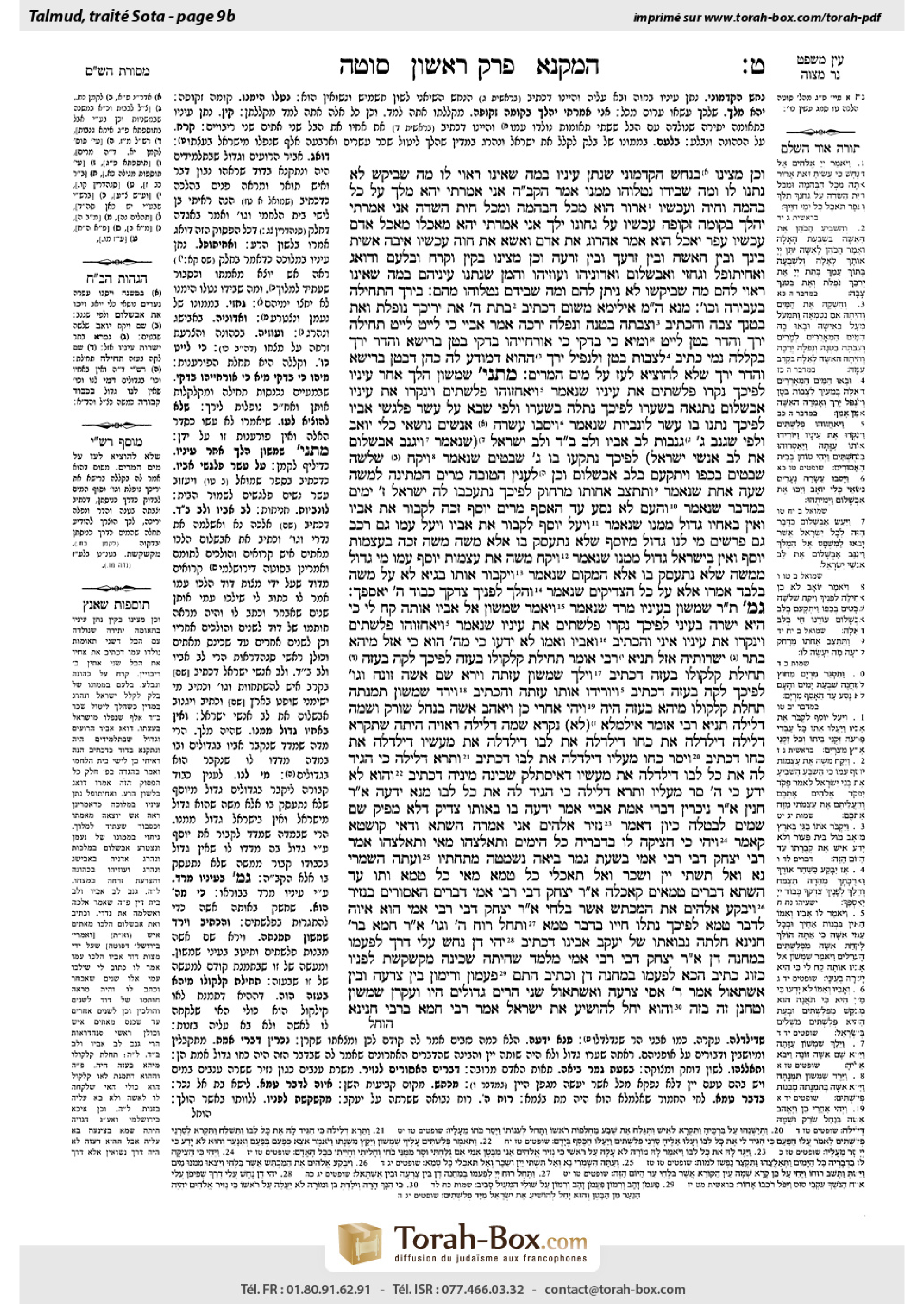
Sotah 9b: Talmud study for Daf Yomi
Daf Yomi is the daily study of one Talmud folio. Explore 37 tractates with scans, Hebrew text, Sefaria English and AI-generated French translations where annotated.
Passage selection and English or AI-generated French translation are available where the scan has annotations. Daf Study is independent of Torah-Box and Sefaria.
Browse Sotah · סוטה · All tractatesSotah 9b text and translations
This page of Sotah includes the Aramaic text, an English translation and an AI-generated French translation, alongside the scan above.
סוטה ט׳ ב · Aramaic and Hebrew text
וְכֵן מָצִינוּ בְּנָחָשׁ הַקַּדְמוֹנִי, שֶׁנָּתַן עֵינָיו בְּמַה שֶּׁאֵינוֹ רָאוּי לוֹ — מַה שֶּׁבִּיקֵּשׁ לֹא נָתְנוּ לוֹ, וּמַה שֶּׁבְּיָדוֹ נְטָלוּהוּ מִמֶּנּוּ. אָמַר הַקָּדוֹשׁ בָּרוּךְ הוּא: אֲנִי אָמַרְתִּי יְהֵא מֶלֶךְ עַל כׇּל בְּהֵמָה וְחַיָּה, וְעַכְשָׁיו ״אָרוּר הוּא מִכׇּל הַבְּהֵמָה וּמִכֹּל חַיַּת הַשָּׂדֶה״.
אֲנִי אָמַרְתִּי יְהַלֵּךְ בְּקוֹמָה זְקוּפָה, עַכְשָׁיו — ״עַל גְּחוֹנוֹ יֵלֵךְ״. אֲנִי אָמַרְתִּי יְהֵא מַאֲכָלוֹ מַאֲכַל אָדָם, עַכְשָׁיו — ״עָפָר יֹאכַל״. הוּא אָמַר אֶהֱרוֹג אֶת אָדָם וְאֶשָּׂא אֶת חַוָּה, עַכְשָׁיו — ״אֵיבָה אָשִׁית בֵּינְךָ וּבֵין הָאִשָּׁה וּבֵין זַרְעֲךָ וּבֵין זַרְעָהּ״.
וְכֵן מָצִינוּ בְּקַיִן וְקֹרַח וּבִלְעָם וְדוֹאֵג וַאֲחִיתוֹפֶל וְגֵחֲזִי וְאַבְשָׁלוֹם וַאֲדוֹנִיָּהוּ וְעוּזִּיָּהוּ וְהָמָן — שֶׁנָּתְנוּ עֵינֵיהֶם בְּמַה שֶּׁאֵינוֹ רָאוּי לָהֶם. מַה שֶּׁבִּיקְּשׁוּ — לֹא נִיתַּן לָהֶם, וּמַה שֶּׁבְּיָדָם — נְטָלוּהוּ מֵהֶם.
בַּיָּרֵךְ הִתְחִילָּה בַּעֲבֵירָה וְכוּ׳. מְנָא הָנֵי מִילֵּי? אִילֵּימָא מִשּׁוּם דִּכְתִיב: ״בְּתֵת ה׳ אֶת יְרֵכֵךְ נוֹפֶלֶת וְאֶת בִּטְנֵךְ צָבָה״ — וְהָכְתִיב: ״וְצָבְתָה בִטְנָהּ וְנָפְלָה יְרֵכָהּ״?
אֲמַר אַבָּיֵי: כִּי לָיֵיט — לָיֵיט תְּחִילָּה יָרֵךְ, וַהֲדַר בֶּטֶן לָיֵיט, וּמַיָּא כִּי בָּדְקִי — כִּי אוֹרְחַיְיהוּ בָּדְקִי, בֶּטֶן בְּרֵישָׁא וַהֲדַר יָרֵךְ. בִּקְלָלָה נָמֵי כְּתִיב: ״לַצְבּוֹת בֶּטֶן וְלַנְפִּל יָרֵךְ״! הָהוּא דְּמוֹדַע לַהּ כֹּהֵן דְּבֶטֶן בְּרֵישָׁא וַהֲדַר יָרֵךְ, שֶׁלֹּא לְהוֹצִיא לַעַז עַל מַיִם הַמָּרִים.
מַתְנִי׳ שִׁמְשׁוֹן הָלַךְ אַחַר עֵינָיו — לְפִיכָךְ נִקְּרוּ פְּלִשְׁתִּים אֶת עֵינָיו, שֶׁנֶּאֱמַר: ״וַיֹּאחֲזוּהוּ פְלִשְׁתִּים וַיְנַקְּרוּ אֶת עֵינָיו״.
אַבְשָׁלוֹם נִתְגָּאָה בִּשְׂעָרוֹ — לְפִיכָךְ נִתְלָה בִּשְׂעָרוֹ. וּלְפִי שֶׁבָּא עַל עֶשֶׂר פִּלַגְשֵׁי אָבִיו — לְפִיכָךְ נִתְּנוּ בּוֹ עֶשֶׂר לוֹנְבִיּוֹת, שֶׁנֶּאֱמַר: ״וַיָּסֹבּוּ עֲשָׂרָה אֲנָשִׁים נוֹשְׂאֵי כְּלֵי יוֹאָב״. וּלְפִי שֶׁגָּנַב שָׁלֹשׁ גְּנֵבוֹת: לֵב אָבִיו, וְלֵב בֵּית דִּין, וְלֵב יִשְׂרָאֵל, שֶׁנֶּאֱמַר: ״וַיְגַנֵּב אַבְשָׁלוֹם אֶת לֵב אַנְשֵׁי יִשְׂרָאֵל״ — לְפִיכָךְ נִתְקְעוּ בּוֹ שְׁלֹשָׁה שְׁבָטִים, שֶׁנֶּאֱמַר: ״וַיִּקַּח שְׁלֹשָׁה שְׁבָטִים בְּכַפּוֹ וַיִּתְקָעֵם בְּלֵב אַבְשָׁלוֹם״.
וְכֵן לְעִנְיַן הַטּוֹבָה: מִרְיָם הִמְתִּינָה לְמֹשֶׁה שָׁעָה אַחַת, שֶׁנֶּאֱמַר: ״וַתֵּתַצַּב אֲחוֹתוֹ מֵרָחוֹק״ — לְפִיכָךְ נִתְעַכְּבוּ לָהּ יִשְׂרָאֵל שִׁבְעָה יָמִים בַּמִּדְבָּר, שֶׁנֶּאֱמַר: ״וְהָעָם לֹא נָסַע עַד הֵאָסֵף מִרְיָם״.
יוֹסֵף זָכָה לִקְבּוֹר אֶת אָבִיו, וְאֵין בְּאֶחָיו גָּדוֹל מִמֶּנּוּ, שֶׁנֶּאֱמַר: ״וַיַּעַל יוֹסֵף לִקְבֹּר אֶת אָבִיו וַיַּעֲלוּ עִמּוֹ גַּם רֶכֶב גַּם פָּרָשִׁים״. מִי לָנוּ גָּדוֹל מִיּוֹסֵף, שֶׁלֹּא נִתְעַסֵּק בּוֹ אֶלָּא מֹשֶׁה.
מֹשֶׁה זָכָה בְּעַצְמוֹת יוֹסֵף, וְאֵין בְּיִשְׂרָאֵל גָּדוֹל מִמֶּנּוּ, שֶׁנֶּאֱמַר: ״וַיִּקַּח מֹשֶׁה אֶת עַצְמוֹת יוֹסֵף עִמּוֹ״ — מִי גָּדוֹל מִמֹּשֶׁה שֶׁלֹּא נִתְעַסֵּק בּוֹ אֶלָּא הַמָּקוֹם, שֶׁנֶּאֱמַר: ״וַיִּקְבֹּר אוֹתוֹ בַּגַּי״. לֹא עַל מֹשֶׁה בִּלְבַד אָמְרוּ, אֶלָּא עַל כׇּל הַצַּדִּיקִים, שֶׁנֶּאֱמַר: ״וְהָלַךְ לְפָנֶיךָ צִדְקֶךָ כְּבוֹד ה׳ יַאַסְפֶךָ״.
גְּמָ׳ תָּנוּ רַבָּנַן: שִׁמְשׁוֹן בְּעֵינָיו מָרַד, שֶׁנֶּאֱמַר: ״וַיֹּאמֶר שִׁמְשׁוֹן אֶל אָבִיו אוֹתָהּ קַח לִי כִּי הִיא יָשְׁרָה בְעֵינָי״ — לְפִיכָךְ נִקְּרוּ פְּלִשְׁתִּים אֶת עֵינָיו, שֶׁנֶּאֱמַר: ״וַיֹּאחֲזוּהוּ פְלִשְׁתִּים וַיְנַקְּרוּ אֶת עֵינָיו״.
אִינִי? וְהָכְתִיב: ״וְאָבִיו וְאִמּוֹ לֹא יָדְעוּ כִּי מֵה׳ הִיא״. כִּי אֲזַל מִיהָא — בָּתַר יַשְׁרוּתֵיהּ אֲזַל.
תַּנְיָא, רַבִּי אוֹמֵר: תְּחִילַּת קִלְקוּלוֹ בְּעַזָּה, לְפִיכָךְ לָקָה בְּעַזָּה. תְּחִילַּת קִלְקוּלוֹ בְּעַזָּה, דִּכְתִיב: ״וַיֵּלֶךְ שִׁמְשׁוֹן עַזָּתָה וַיַּרְא שָׁם אִשָּׁה זוֹנָה וְגוֹ׳״, לְפִיכָךְ לָקָה בְּעַזָּה דִּכְתִיב: ״וַיּוֹרִידוּ אוֹתוֹ עַזָּתָהּ״.
וְהָכְתִיב: ״וַיֵּרֶד שִׁמְשׁוֹן תִּמְנָתָה״? תְּחִלַּת קִלְקוּלוֹ מִיהָא בְּעַזָּה הֲוָה.
״וַיְהִי אַחֲרֵי כֵן וַיֶּאֱהַב אִשָּׁה בְּנַחַל שֹׂרֵק וּשְׁמָהּ דְּלִילָה״. תַּנְיָא, רַבִּי אוֹמֵר: אִילְמָלֵא לֹא נִקְרָא שְׁמָהּ ״דְּלִילָה״ — רְאוּיָה הָיְתָה שֶׁתִּקָּרֵא דְּלִילָה: דִּילְדְּלָה אֶת כֹּחוֹ, דִּילְדְּלָה אֶת לִבּוֹ, דִּילְדְּלָה אֶת מַעֲשָׂיו.
דִּילְדְּלָה אֶת כֹּחוֹ — דִּכְתִיב: ״וַיָּסַר כֹּחוֹ מֵעָלָיו״. דִּילְדְּלָה אֶת לִבּוֹ — דִּכְתִיב: ״וַתֵּרֶא דְּלִילָה כִּי הִגִּיד לָהּ אֶת כׇּל לִבּוֹ״. דִּילְדְּלָה אֶת מַעֲשָׂיו — דְּאִיסְתַּלַּק שְׁכִינָה מִינֵּיהּ, דִּכְתִיב: ״וְהוּא לֹא יָדַע כִּי ה׳ סָר מֵעָלָיו״.
״וַתֵּרֶא דְּלִילָה כִּי הִגִּיד לָהּ אֶת כׇּל לִבּוֹ״. מְנָא יָדְעָה? אָמַר רַבִּי חָנִין אָמַר רַב: נִיכָּרִין דִּבְרֵי אֱמֶת. אַבָּיֵי אָמַר: יָדְעָה בּוֹ בְּאוֹתוֹ צַדִּיק דְּלָא מַפֵּיק שֵׁם שָׁמַיִם לְבַטָּלָה. כֵּיוָן דַּאֲמַר ״נְזִיר אֱלֹהִים אֲנִי״, אֲמַרָה: הַשְׁתָּא וַדַּאי קוּשְׁטָא קָאָמַר.
״וַיְהִי כִּי הֵצִיקָה לּוֹ בִדְבָרֶיהָ כׇּל הַיָּמִים וַתְּאַלְצֵהוּ״. מַאי ״וַתְּאַלְצֵהוּ״? אָמַר רַבִּי יִצְחָק דְּבֵי רַבִּי אַמֵּי: בִּשְׁעַת גְּמַר בִּיאָה נִשְׁמְטָה מִתַּחְתָּיו.
״וְעַתָּה הִשָּׁמְרִי נָא וְאַל תִּשְׁתִּי יַיִן וְשֵׁכָר וְאַל תֹּאכְלִי כׇּל טָמֵא״. מַאי ״כׇּל טָמֵא״? וְתוּ: עַד הַשְׁתָּא דְּבָרִים טְמֵאִים קָאָכְלָה?! אָמַר רַבִּי יִצְחָק דְּבֵי רַבִּי אַמֵּי: דְּבָרִים הָאֲסוּרִים בְּנָזִיר.
״וַיִּבְקַע אֱלֹהִים אֶת הַמַּכְתֵּשׁ אֲשֶׁר בַּלֶּחִי״. אָמַר רַבִּי יִצְחָק דְּבֵי רַבִּי אַמֵּי: הוּא אִיוָּה לְדָבָר טָמֵא — לְפִיכָךְ נִתְלוּ חַיָּיו בְּדָבָר טָמֵא.
״וַתָּחֵל רוּחַ ה׳ וְגוֹ׳״. אָמַר רַבִּי חָמָא בְּרַבִּי חֲנִינָא: חָלְתָה נְבוּאָתוֹ שֶׁל יַעֲקֹב אָבִינוּ, דִּכְתִיב: ״יְהִי דָן נָחָשׁ עֲלֵי דֶרֶךְ״.
״לְפַעֲמוֹ בְּמַחֲנֵה דָן״, אָמַר רַבִּי יִצְחָק דְּבֵי רַבִּי אַמֵּי: מְלַמֵּד שֶׁהָיְתָה שְׁכִינָה מְקַשְׁקֶשֶׁת לְפָנָיו כְּזוֹג. כְּתִיב הָכָא: ״לְפַעֲמוֹ בְּמַחֲנֵה דָן״, וּכְתִיב הָתָם: ״פַּעֲמֹן וְרִמֹּן״.
״בֵּין צׇרְעָה וּבֵין אֶשְׁתָּאוֹל״, אָמַר רַבִּי אַסִּי: צׇרְעָה וְאֶשְׁתָּאוֹל שְׁנֵי הָרִים גְּדוֹלִים הָיוּ, וַעֲקָרָן שִׁמְשׁוֹן וּטְחָנָן זֶה בָּזֶה.
״וְהוּא יָחֵל לְהוֹשִׁיעַ אֶת יִשְׂרָאֵל״, אָמַר רַבִּי חָמָא בְּרַבִּי חֲנִינָא:
Sotah 9b · English translation
And, so too, we found with regard to the primeval snake who seduced Eve, for he placed his eyes on that which was unfit for him, as he wanted to marry Eve. Consequently, that which he desired was not given to him, and that which was in his possession was taken from him. The Holy One, Blessed be He, said: I initially said that the snake will be king over every domesticated animal and non-domesticated animal, but now he is cursed more than all the domesticated animals and all the non-domesticated animals of the field, as it is stated: “And the Lord God said unto the serpent: Because you have done this, you are cursed from among all cattle, and from among all beasts of the field; upon your belly shall you go, and dust shall you eat all the days of your life” (Genesis 3:14).
The baraita explains the elements of this curse. I said that the snake will walk upright, but now he shall go on his belly; I said that his food will be the same as the food eaten by a person, but now he shall eat dust. The snake said: I will kill Adam and marry Eve, but now: “I will put enmity between you and the woman and between your seed and her seed” (Genesis 3:15).
The baraita continues: And so we found with regard to Cain, who desired to inherit the whole world alone (see Genesis 4); and Korah, who desired the priesthood (see Numbers 16); and Balaam, who desired Balak’s money (see Numbers 22); and Doeg, who was jealous of David (see I Samuel 21–22); and Ahithophel, who was also jealous of David (see II Samuel 16); and Gehazi, who took Naaman’s money (see II Kings 5); and Absalom, who wanted the kingdom (see II Samuel 15); and Adonijah, who also wanted the kingdom (see I Kings 1); and Uzziah, who wanted to be the High Priest (see II Chronicles 26); and Haman, who wanted to kill all the Jews (see Esther 3:13). All of these were people who placed their eyes on that which is unfit for them, and consequently what they desired was not given to them, and what they had was taken from them.
§ The mishna teaches: She began her transgression with her thigh and afterward with her stomach, therefore the thigh is smitten first and then the stomach. The Gemara asks: From where are these matters derived, i.e., that this is the order of her punishment? If we say it is because it is written in the verse detailing the priest’s curse: “Then the priest shall cause the woman to swear with the oath of cursing, and the priest shall say unto the woman: The Lord make you a curse and an oath among your people, when the Lord does make your thigh to fall away, and your belly to swell” (Numbers 5:21), which indicates the sequence of her punishment; but isn’t the opposite written in the verse describing what actually occurs to a guilty sota: “And her belly shall swell, and her thigh shall fall away” (Numbers 5:27), indicating that the punishment begins with her stomach and then her thigh?
Abaye said in explanation: When the priest curses the woman, he first curses the thigh and then he curses the stomach, but when the bitter water evaluates her, it evaluates her along its way through the body. The water first enters the stomach and then reaches the thigh. The Gemara asks: But in the verse detailing the curse it is also written: “And this water that causes the curse shall go into your bowels, and will cause your belly to swell, and your thigh to fall away” (Numbers 5:22). The Gemara answers: That verse teaches that the priest notifies her that the stomach will be affected first and then the thigh, so that one not cast aspersions on the bitter water.
MISHNA: The mishna provides additional examples of people who were treated by Heaven commensurate with their actions. Samson followed his eyes, therefore he was punished measure for measure, as the Philistines gouged out his eyes, as it is stated: “And the Philistines laid hold on him, and put out his eyes” (Judges 16:21).
Absalom was excessively proud of his hair, and therefore he was hanged by his hair. And furthermore, because he engaged in sexual intercourse with ten of his father’s concubines (see II Samuel 15:16 and 16:22), therefore ten spears [loneviyyot] were put, i.e., thrust, into him, as it is stated: “And ten young men that bore Joab’s armor compassed about and smote Absalom, and slew him” (II Samuel 18:15). And because he stole three times, committing three thefts of people’s hearts: The heart of his father, as he tricked him by saying that he was going to sacrifice offerings; the heart of the court, as he tricked them into following him; and the heart of the Jewish people, as it is stated: “So Absalom stole the hearts of the men of Israel” (II Samuel 15:6), therefore three spears were embedded into his heart, as it is stated: “Then said Joab: I may not tarry like this with you. And he took three spears in his hand, and thrust them through the heart of Absalom, while he was yet alive” (II Samuel 18:14).
The mishna continues: And the same is so with regard to the reward of good deeds; a person is rewarded measure for measure. Miriam waited for the baby Moses for one hour at the shore of the Nile, as it is stated: “And his sister stood afar off, to know what would be done to him” (Exodus 2:4). Therefore the Jewish people delayed their travels in the desert for seven days to wait for her when she was smitten with leprosy, as it is stated: “And Miriam was confined outside of the camp seven days; and the people journeyed not until Miriam was brought in again” (Numbers 12:15).
Joseph merited to bury his father, resulting in a display of great honor to his father, and there was none among his brothers greater than he in importance, for he was viceroy of Egypt, as it is stated: “And Joseph went up to bury his father; and with him went up all the servants of Pharaoh, the Elders of his house, and all the Elders of the land of Egypt, and all the house of Joseph, and his brethren, and his father’s house; only their little ones, and their flocks, and their herds, they left in the land of Goshen. And there went up with him both chariots and horsemen; and it was a very great company” (Genesis 50:7–9). Who, to us, had a greater burial than Joseph, as it was none other than Moses who involved himself in transporting his coffin.
Moses merited to be the only person involved in the transportation of Joseph’s bones to be buried in Eretz Yisrael, and there was none among the Jewish people greater than he, as it is stated: “And Moses took the bones of Joseph with him” (Exodus 13:19). Who had a greater burial than Moses, as no one involved himself in his burial other than the Omnipresent Himself, as it is stated: “And He buried him in the valley in the land of Moab over against Beth Peor; and no man knows of his sepulcher unto this day” (Deuteronomy 34:6). The mishna comments: Not only with regard to Moses did the Sages say that God takes part in his burial, but also with regard to all the righteous individuals, as it is stated: “Your righteousness shall go before you and the glory of the Lord shall gather you in” (Isaiah 58:8).
GEMARA: The Sages taught (Tosefta 3:15): Samson rebelled with his eyes, as it is stated: “Then his father and his mother said to him: Is there never a woman among the daughters of your brethren, or among all my people, that you go out to take a wife of the uncircumcised Philistines? And Samson said to his father: Get her for me; for she is pleasant in my eyes” (Judges 14:3). Therefore, the Philistines gouged out his eyes, as it is stated: “And the Philistines laid hold on him, and put out his eyes” (Judges 16:21).
The Gemara asks: Is that so? But isn’t it written: “But his father and his mother knew not that it was from the Lord; as he sought a subterfuge against the Philistines” (Judges 14:4), indicating that Samson’s searching for a Philistine wife was due to a Divine mission? The Gemara answers: Although God did plan the punishment of the Philistines, in any event when he went, he followed his inclination and did not act for the sake of Heaven.
It is taught in a baraita in the Tosefta (3:15): Rabbi Yehuda HaNasi says: His initial wrongdoing was in Gaza, and therefore he was smitten in Gaza. The Gemara explains: His initial wrongdoing was in Gaza, as it is written: “And Samson went to Gaza, and saw there a harlot, and went in unto her” (Judges 16:1). Therefore, he was smitten in Gaza, as it is written: “And the Philistines laid hold on him, and put out his eyes; and they brought him down to Gaza, and bound him with fetters of brass; and he did grind in the prison-house” (Judges 16:21).
The Gemara asks: But isn’t it written earlier: “And Samson went down to Timnah, and saw a woman in Timnah of the daughters of the Philistines” (Judges 14:1), indicating that his initial wrongdoing was in Timnah? The Gemara answers: In any event, his initial wrongdoing was in Gaza, for at least he had married the woman in Timnah; in Gaza, Samson never wed the woman but only engaged in sexual intercourse with her.
The Gemara continues its discussion of Samson. The verse states: “And it came to pass afterward, that he loved a woman in the valley of Sorek, whose name was Delilah” (Judges 16:4). It is taught in a baraita that Rabbi Yehuda HaNasi says: Even if she had not been called by the name Delilah, it would have been fitting that she be called Delilah, for she weakened [dildela] his strength, she weakened his heart, and she weakened his deeds, thereby decreasing his merits.
The Gemara explains: She weakened his strength, as it is written: “And she made him sleep upon her knees; and she called for a man and had the seven locks of his head shaved off; and she began to afflict him, and his strength went from him” (Judges 16:19). She weakened his heart, as it is written: “And when Delilah saw that he had told her all his heart, she sent and called for the lords of the Philistines, saying: Come up this once, for he has told me all his heart” (Judges 16:18). She weakened his deeds, thereby decreasing his merits, as the Divine Presence left him, as it is written: “And she said: The Philistines are upon you, Samson. And he awoke out of his sleep, and said: I will go out as at other times, and shake myself. But he knew not that the Lord was departed from him” (Judges 16:20).
The verse states: “And when Delilah saw that he had told her all his heart” (Judges 16:18). The Gemara asks: From where did she know that this time he had told her the truth about the source of his strength, as he had lied about it previously? Rabbi Ḥanin says that Rav says: Words of truth are recognizable, and she felt that this time he was telling the truth. Abaye says differently: She knew about Samson being a righteous individual, that he would not express the name of Heaven in vain. Once he said: “And he told her all his heart, and said to her: There has not come a razor upon my head; for I have been a nazirite unto God from my mother’s womb” (Judges 16:17), she said: Now he is certainly saying the truth.
The verse states: “And it came to pass, when she pressed him daily with her words, and urged him, that his soul was vexed unto death” (Judges 16:16). The Gemara asks: What is the meaning of “and urged him”? How did she do so? Rabbi Yitzḥak of the school of Rabbi Ami says: At the moment immediately before his completion of the act of intercourse, she slipped away from beneath him. By doing this, she urged him to reveal his secret.
When the angel spoke to Samson’s mother, he said: “Now therefore beware, I pray of you, and drink no wine nor strong drink, and eat not any unclean thing” (Judges 13:4). The Gemara asks, what is the meaning of “any unclean thing”? That term usually means non-kosher foods, but obviously she would not eat them anyway. And what’s more, until now was she eating unclean things, that she should have to be warned not to continue doing so? Rabbi Yitzḥak of the school of Rabbi Ami says: The angel was not referring to foods that are actually unclean, but rather items that are forbidden to a nazirite.
After Samson smote one thousand Philistines with the jawbone of a donkey, he called the place Lehi, and God miraculously granted him to drink, as he was dying of thirst. The verse states: “But God cleaved the hollow place that is in Lehi, and out of there came water; and when he had drunk, his spirit came back, and he revived” (Judges 15:19). Rabbi Yitzḥak of the school of Rabbi Ami says: He desired something unclean, as he was driven by lust to Philistine women. Therefore, the saving of his life was dependent on something unclean, the jawbone of a donkey.
The verse states with regard to Samson: “And the spirit of the Lord began [vataḥel] to move him in Mahaneh Dan, between Zorah and Eshtaol” (Judges 13:25). Rabbi Ḥama, son of Rabbi Ḥanina, says: The prophecy of Jacob our forefather concerning the tribe of Dan took effect [ḥaleta] through Samson, a member of the tribe of Dan, as it is written: “Dan shall be a serpent in the way, a horned snake in the path, that bites the horse’s heels, so that his rider falls backward” (Genesis 49:17).
The verse continues: “To move him [lefa’amo] in Mahaneh Dan.” Rabbi Yitzḥak of the school of Rabbi Ami says: This teaches that the Divine Presence jangled before him, inspiring him, like a bell [zog], as it is written here: “To move him [lefa’amo] in Mahaneh Dan,” and it is written there with regard to the clothing of the High Priest: “A bell [pa’amon] and a pomegranate” (Exodus 39:26).
The verse concludes: “Between Zorah and Eshtaol.” Rabbi Asi says: Zorah and Eshtaol were two large mountains, and Samson uprooted them and ground them one against the other.
Samson’s parents were told: “For behold, you shall conceive, and bear a son; and no razor shall come upon his head; for the child shall be a nazirite unto God from the womb; and he shall begin to save Israel out of the hand of the Philistines” (Judges 13:5). Rabbi Ḥama, son of Rabbi Ḥanina, says:
Sotah 9b · Traduction française (IA)
De même, nous trouvons le cas du serpent primordial qui séduisit Ève : il avait porté son regard sur ce qui ne lui était pas destiné, car il voulait épouser Ève. En conséquence, ce qu’il désirait ne lui fut pas accordé, et ce qu’il possédait lui fut retiré. Le Saint, béni soit-Il, dit : « J’avais d’abord dit que le serpent régnerait sur tous les animaux domestiques et toutes les bêtes sauvages, mais à présent, il est maudit plus que tous les animaux domestiques et toutes les bêtes sauvages des champs », ainsi qu’il est dit : « L’Éternel Dieu dit au serpent : Puisque tu as fait cela, tu es maudit entre tous les animaux domestiques et toutes les bêtes sauvages des champs ; tu marcheras sur ton ventre et tu mangeras de la poussière tous les jours de ta vie » (Genèse 3:14).
La baraïta explique les différents éléments de cette malédiction. J’avais dit que le serpent marcherait debout, mais à présent il ira sur son ventre ; j’avais dit que sa nourriture serait la même que celle des êtres humains, mais à présent il mangera de la poussière. Le serpent avait dit : « Je tuerai Adam et j’épouserai Ève », mais à présent : « Je mettrai une inimitié entre toi et la femme, entre ta descendance et sa descendance » (Genèse 3:15).
La baraïta poursuit : De même, nous trouvons le cas de Caïn, qui désirait hériter seul du monde entier (voir Genèse 4) ; de Koré, qui désirait la prêtrise (voir Nombres 16) ; de Balaam, qui désirait l’argent de Balak (voir Nombres 22) ; de Doëg, qui était jaloux de David (voir I Samuel 21–22) ; d’Ahitophel, qui était lui aussi jaloux de David (voir II Samuel 16) ; de Guéhazi, qui prit l’argent de Naaman (voir II Rois 5) ; d’Absalom, qui voulait le royaume (voir II Samuel 15) ; d’Adonias, qui voulait lui aussi le royaume (voir I Rois 1) ; d’Ozias, qui voulait être grand prêtre (voir II Chroniques 26) ; et d’Haman, qui voulait tuer tous les Juifs (voir Esther 3:13). Tous avaient porté leur regard sur ce qui ne leur était pas destiné ; en conséquence, ce qu’ils désiraient ne leur fut pas accordé, et ce qu’ils possédaient leur fut retiré.
§ La Michna enseigne : Elle a commencé sa faute par sa cuisse, puis par son ventre ; c’est pourquoi la cuisse est frappée la première, puis le ventre. La Guemara demande : D’où déduit-on cet ordre dans son châtiment ? Si l’on dit que c’est parce qu’il est écrit dans le verset détaillant la malédiction du prêtre : « Alors le prêtre fera jurer à la femme le serment de malédiction, et le prêtre dira à la femme : Que l’Éternel fasse de toi une malédiction et un serment au milieu de ton peuple, lorsque l’Éternel fera tomber ta cuisse et enfler ton ventre » (Nombres 5:21), ce qui indique l’ordre de son châtiment, le verset décrivant ce qui arrive effectivement à une sota coupable ne dit-il pas l’inverse : « Son ventre enflera et sa cuisse tombera » (Nombres 5:27), indiquant que le châtiment commence par le ventre, puis atteint la cuisse ?
Abayé explique : Lorsque le prêtre maudit la femme, il maudit d’abord la cuisse, puis le ventre ; mais lorsque l’eau amère l’éprouve, elle suit son parcours dans le corps. L’eau pénètre d’abord dans le ventre, puis atteint la cuisse. La Guemara demande : Pourtant, dans le verset détaillant la malédiction, il est également écrit : « Cette eau qui apporte la malédiction pénétrera dans tes entrailles, fera enfler ton ventre et tomber ta cuisse » (Nombres 5:22). La Guemara répond : Ce verset enseigne que le prêtre l’informe que le ventre sera atteint en premier, puis la cuisse, afin que personne ne jette le discrédit sur l’eau amère.
MICHNA : La Michna donne d’autres exemples de personnes qui furent traitées par le Ciel à la mesure de leurs actes. Samson suivait ses yeux ; il fut donc puni mesure pour mesure, lorsque les Philistins lui crevèrent les yeux, ainsi qu’il est dit : « Les Philistins se saisirent de lui et lui crevèrent les yeux » (Juges 16:21).
Absalom était excessivement fier de sa chevelure ; il fut donc pendu par les cheveux. En outre, parce qu’il avait eu des relations sexuelles avec les dix concubines de son père (voir II Samuel 15:16 et 16:22), dix lances [loneviyyot] furent plantées, c’est-à-dire enfoncées, en lui, ainsi qu’il est dit : « Dix jeunes gens qui portaient l’armure de Joab entourèrent Absalom, le frappèrent et le tuèrent » (II Samuel 18:15). Et parce qu’il avait volé à trois reprises, en dérobant le cœur de trois personnes — celui de son père, qu’il trompa en lui disant qu’il allait offrir des sacrifices ; celui de la cour, qu’il trompa pour qu’elle le suive ; et celui du peuple juif, ainsi qu’il est dit : « Absalom dérobait le cœur des hommes d’Israël » (II Samuel 15:6) —, trois lances furent donc enfoncées dans son cœur, ainsi qu’il est dit : « Joab dit : Je ne peux pas m’attarder ainsi avec toi. Il prit trois lances dans sa main et les enfonça dans le cœur d’Absalom, alors qu’il était encore vivant » (II Samuel 18:14).
La Michna poursuit : Il en va de même pour la récompense des bonnes actions : une personne est récompensée mesure pour mesure. Myriam attendit le jeune Moïse pendant une heure sur la rive du Nil, ainsi qu’il est dit : « Sa sœur se tint à distance pour savoir ce qui lui arriverait » (Exode 2:4). C’est pourquoi le peuple juif retarda de sept jours son départ dans le désert pour l’attendre lorsqu’elle fut frappée de lèpre, ainsi qu’il est dit : « Myriam fut retenue à l’extérieur du camp pendant sept jours ; le peuple ne partit pas avant que Myriam ne fût de nouveau admise » (Nombres 12:15).
Joseph eut le mérite d’enterrer son père, lui rendant ainsi de grands honneurs, et nul parmi ses frères n’était plus important que lui, car il était vice-roi d’Égypte, ainsi qu’il est dit : « Joseph monta pour enterrer son père ; avec lui montèrent tous les serviteurs de Pharaon, les anciens de sa maison et tous les anciens du pays d’Égypte, toute la maison de Joseph, ses frères et la maison de son père ; seuls leurs petits enfants, leurs troupeaux et leurs bœufs restèrent au pays de Goshen. Des chars et des cavaliers montèrent aussi avec lui ; c’était une très grande caravane » (Genèse 50:7–9). Qui, parmi nous, eut des funérailles plus grandioses que Joseph ? Ce fut nul autre que Moïse qui s’occupa de transporter son cercueil.
Moïse eut le mérite d’être le seul à s’occuper du transport des ossements de Joseph pour qu’ils soient ensevelis en Eretz Israël, et nul parmi le peuple juif n’était plus grand que lui, ainsi qu’il est dit : « Moïse prit avec lui les ossements de Joseph » (Exode 13:19). Qui eut des funérailles plus grandioses que Moïse ? Nul autre que le Tout-Puissant Lui-même ne s’occupa de son ensevelissement, ainsi qu’il est dit : « Il l’enterra dans la vallée, au pays de Moab, en face de Beth-Péor ; nul ne connaît son tombeau jusqu’à ce jour » (Deutéronome 34:6). La Michna commente : Les Sages n’ont pas dit que Dieu prend part à l’ensevelissement uniquement à propos de Moïse, mais aussi à propos de tous les justes, ainsi qu’il est dit : « Ta justice marchera devant toi, et la gloire de l’Éternel sera ton arrière-garde » (Isaïe 58:8).
GUEMARA : Les Sages ont enseigné (Tosefta 3:15) : Samson se rebella par ses yeux, ainsi qu’il est dit : « Son père et sa mère lui dirent : N’y a-t-il donc pas de femme parmi les filles de tes frères ou parmi tout mon peuple, pour que tu ailles prendre une femme chez les Philistins incirconcis ? Samson dit à son père : Prends-la pour moi, car elle plaît à mes yeux » (Juges 14:3). Les Philistins lui crevèrent donc les yeux, ainsi qu’il est dit : « Les Philistins se saisirent de lui et lui crevèrent les yeux » (Juges 16:21).
La Guemara demande : Est-ce bien le cas ? N’est-il pas écrit : « Mais son père et sa mère ne savaient pas que cela venait de l’Éternel, car Il cherchait une occasion contre les Philistins » (Juges 14:4), ce qui indique que la recherche par Samson d’une femme philistine répondait à une mission divine ? La Guemara répond : Bien que Dieu ait effectivement préparé le châtiment des Philistins, lorsqu’il partit, Samson suivit ses inclinations et n’agit pas pour la gloire du Ciel.
Il est enseigné dans une baraïta de la Tosefta (3:15) : Rabbi Yehouda HaNassi dit : Sa première faute eut lieu à Gaza ; il fut donc frappé à Gaza. La Guemara explique : Sa première faute eut lieu à Gaza, ainsi qu’il est écrit : « Samson se rendit à Gaza, y vit une prostituée et entra chez elle » (Juges 16:1). Il fut donc frappé à Gaza, ainsi qu’il est écrit : « Les Philistins se saisirent de lui, lui crevèrent les yeux, le firent descendre à Gaza, le lièrent avec des chaînes de bronze et le firent tourner la meule dans la prison » (Juges 16:21).
La Guemara demande : Pourtant, il est écrit plus tôt : « Samson descendit à Timna et vit à Timna une femme parmi les filles des Philistins » (Juges 14:1), ce qui indique que sa première faute eut lieu à Timna. La Guemara répond : Quoi qu’il en soit, sa première faute eut lieu à Gaza, car à Timna, il avait au moins épousé la femme ; à Gaza, Samson n’épousa pas la femme, mais eut seulement des relations sexuelles avec elle.
La Guemara poursuit son examen de Samson. Le verset dit : « Après cela, il aima une femme dans la vallée de Sorek, dont le nom était Dalila » (Juges 16:4). Une baraïta enseigne que Rabbi Yehouda HaNassi dit : Même si elle ne s’était pas appelée Dalila, il aurait convenu de l’appeler Dalila, car elle avait affaibli [dildela] sa force et son cœur, et amoindri ses actes, diminuant ainsi ses mérites.
La Guemara explique : Elle affaiblit sa force, ainsi qu’il est écrit : « Elle le fit dormir sur ses genoux ; elle appela un homme et lui fit raser les sept tresses de sa tête. Elle commença alors à le tourmenter, et sa force l’abandonna » (Juges 16:19). Elle affaiblit son cœur, ainsi qu’il est écrit : « Quand Dalila vit qu’il lui avait confié tout son cœur, elle envoya appeler les princes des Philistins et leur dit : Montez cette fois, car il m’a confié tout son cœur » (Juges 16:18). Elle amoindrit ses actes et diminua ainsi ses mérites, car la Présence divine le quitta, ainsi qu’il est écrit : « Elle dit : Les Philistins sont sur toi, Samson ! Il se réveilla de son sommeil et dit : J’en sortirai comme les autres fois et je me dégagerai. Mais il ne savait pas que l’Éternel s’était retiré de lui » (Juges 16:20).
Le verset dit : « Quand Dalila vit qu’il lui avait confié tout son cœur » (Juges 16:18). La Guemara demande : Comment sut-elle que cette fois, il lui avait dit la vérité sur la source de sa force, alors qu’il lui avait menti auparavant ? Rabbi Ḥanin dit au nom de Rav : Les paroles de vérité se reconnaissent, et elle sentit que cette fois il disait la vérité. Abayé donne une autre explication : Elle savait que Samson était un homme juste et qu’il ne prononcerait pas le nom du Ciel en vain. Lorsqu’il lui dit : « Il lui confia tout son cœur et lui dit : Le rasoir n’a jamais touché ma tête, car je suis nazir depuis le sein de ma mère, consacré à Dieu » (Juges 16:17), elle se dit : « Cette fois, il dit certainement la vérité. »
Le verset dit : « Comme elle le pressait chaque jour par ses paroles et le harcelait, son âme fut excédée jusqu’à la mort » (Juges 16:16). La Guemara demande : Que signifie « le harcelait » ? Comment s’y prenait-elle ? Rabbi Yitzḥak, de l’école de Rabbi Ami, dit : Juste avant qu’il n’achève l’acte sexuel, elle se dégageait de dessous lui. Ainsi, elle le poussait à révéler son secret.
Lorsque l’ange s’adressa à la mère de Samson, il dit : « Maintenant donc, prends garde, je t’en prie : ne bois ni vin ni boisson forte et ne mange rien d’impur » (Juges 13:4). La Guemara demande : Que signifie « rien d’impur » ? Ce terme désigne habituellement des aliments non cachers, mais, de toute évidence, elle n’en aurait pas mangé de toute façon. Et, de plus, jusqu’à présent, mangeait-elle donc des aliments impurs, au point qu’il faille lui ordonner de ne pas continuer ? Rabbi Yitzḥak, de l’école de Rabbi Ami, dit : L’ange ne parlait pas d’aliments réellement impurs, mais de choses interdites à un nazir.
Après que Samson eut frappé mille Philistins avec la mâchoire d’un âne, il appela l’endroit Léḥi, et Dieu lui fit miraculeusement jaillir de l’eau alors qu’il mourait de soif. Le verset dit : « Dieu fendit le creux qui est à Léḥi, et il en sortit de l’eau. Il but, son esprit revint et il reprit vie » (Juges 15:19). Rabbi Yitzḥak, de l’école de Rabbi Ami, dit : Il avait désiré quelque chose d’impur, car la convoitise le poussait vers les femmes philistines. C’est pourquoi le salut de sa vie dépendit d’une chose impure : la mâchoire d’un âne.
À propos de Samson, le verset dit : « L’esprit de l’Éternel commença [vataḥel] à le pousser dans le camp de Dan, entre Tsora et Eshtaol » (Juges 13:25). Rabbi Ḥama, fils de Rabbi Ḥanina, dit : La prophétie de Jacob notre ancêtre au sujet de la tribu de Dan se réalisa [ḥaleta] par Samson, membre de la tribu de Dan, ainsi qu’il est écrit : « Dan sera un serpent sur le chemin, une vipère cornue sur le sentier, qui mord les talons du cheval, et son cavalier tombe à la renverse » (Genèse 49:17).
Le verset poursuit : « Pour le pousser [lefa’amo] dans le camp de Dan. » Rabbi Yitzḥak, de l’école de Rabbi Ami, dit : Cela enseigne que la Présence divine tint devant lui le rôle d’une clochette [zog], le mettant en mouvement, ainsi qu’il est écrit ici : « Pour le pousser [lefa’amo] dans le camp de Dan », et qu’il est écrit ailleurs, au sujet des vêtements du grand prêtre : « Une clochette [pa’amon] et une grenade » (Exode 39:26).
Le verset conclut : « Entre Tsora et Eshtaol. » Rabbi Assi dit : Tsora et Eshtaol étaient deux grandes montagnes ; Samson les déracina et les broya l’une contre l’autre.
On avait dit aux parents de Samson : « Voici, tu vas concevoir et enfanter un fils ; aucun rasoir ne passera sur sa tête, car l’enfant sera nazir, consacré à Dieu dès le sein maternel ; et il commencera à sauver Israël de la main des Philistins » (Juges 13:5). Rabbi Ḥama, fils de Rabbi Ḥanina, dit :
Traduction française générée par IA à partir de l’édition anglaise de Sefaria. Vérifie toujours un passage avec le texte source.
Text from Sefaria: William Davidson Edition - Vocalized Aramaic (CC BY NC); William Davidson Edition - English (CC BY NC).