Sotah 9a: Talmud study for Daf Yomi
Daf Yomi is the daily study of one Talmud folio. Explore 37 tractates with scans, Hebrew text, Sefaria English and AI-generated French translations where annotated.
Passage selection and English or AI-generated French translation are available where the scan has annotations. Daf Study is independent of Torah-Box and Sefaria.
Browse Sotah · סוטה · All tractatesSotah 9a text and translations
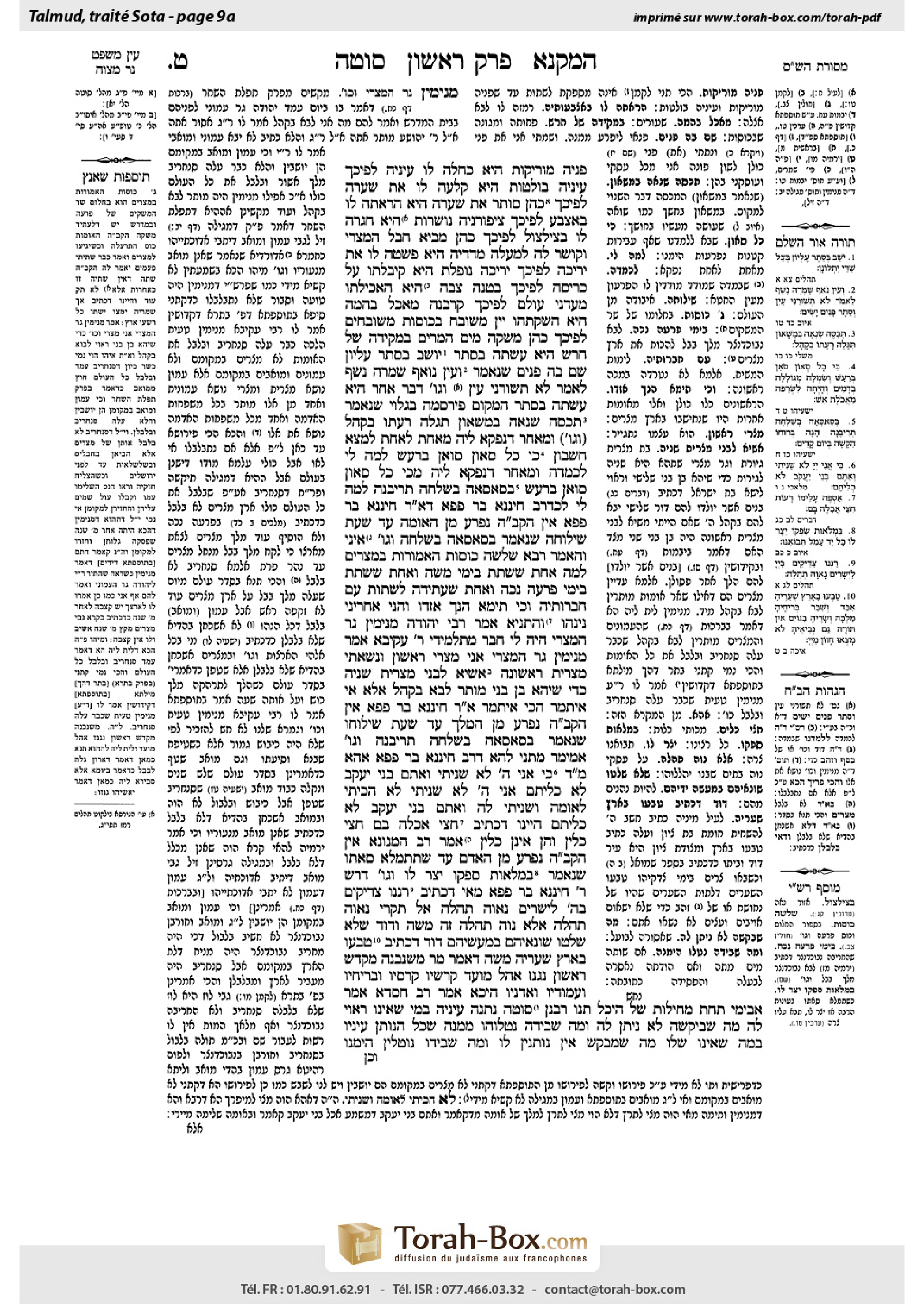
This page of Sotah includes the Aramaic text, an English translation and an AI-generated French translation, alongside the scan above.
סוטה ט׳ א · Aramaic and Hebrew text
פָּנֶיהָ מוֹרִיקוֹת. הִיא כָּחֲלָה לוֹ עֵינֶיהָ — לְפִיכָךְ עֵינֶיהָ בּוֹלְטוֹת. הִיא קָלְעָה לוֹ אֶת שְׂעָרָהּ — לְפִיכָךְ כֹּהֵן סוֹתֵר אֶת שְׂעָרָהּ. הִיא הֶרְאֲתָה לוֹ בְּאֶצְבַּע — לְפִיכָךְ צִיפּוֹרְנֶיהָ נוֹשְׁרוֹת. הִיא חָגְרָה לוֹ בְּצִילְצוֹל — לְפִיכָךְ כֹּהֵן מֵבִיא חֶבֶל הַמִּצְרִי וְקוֹשֵׁר לָהּ לְמַעְלָה מִדַּדֶּיהָ. הִיא פָּשְׁטָה לוֹ אֶת יְרֵיכָהּ — לְפִיכָךְ יְרֵיכָהּ נוֹפֶלֶת.
הִיא קִיבְּלַתּוּ עַל כְּרֵיסָהּ — לְפִיכָךְ בִּטְנָהּ צָבָה. הִיא הֶאֱכִילַתּוּ מַעֲדַנֵּי עוֹלָם — לְפִיכָךְ קׇרְבָּנָהּ מַאֲכַל בְּהֵמָה. הִיא הִשְׁקַתְהוּ יַיִן מְשׁוּבָּח בְּכוֹסוֹת מְשׁוּבָּחִים — לְפִיכָךְ כֹּהֵן מַשְׁקֶה מַיִם הַמָּרִים בִּמְקִידָּה שֶׁל חֶרֶשׂ.
הִיא עָשְׂתָה בַּסֵּתֶר — ״יוֹשֵׁב בְּסֵתֶר עֶלְיוֹן״ שָׂם בָּהּ פָּנִים, שֶׁנֶּאֱמַר: ״וְעֵין נֹאֵף שָׁמְרָה נֶשֶׁף לֵאמֹר לֹא תְשׁוּרֵנִי עָיִן וְגוֹ׳״.
דָּבָר אַחֵר: הִיא עָשְׂתָה בַּסֵּתֶר — הַמָּקוֹם פִּירְסְמָה בַּגָּלוּי, שֶׁנֶּאֱמַר: ״תִּכַּסֶּה שִׂנְאָה בְּמַשָּׁאוֹן תִּגָּלֶה רָעָתוֹ בְקָהָל (וְגוֹ׳)״.
וּמֵאַחַר דְּנָפְקָא לֵיהּ מֵ״אַחַת לְאַחַת לִמְצֹא חֶשְׁבּוֹן״, ״כִּי כׇל סְאוֹן סֹאֵן בְּרַעַשׁ״ לְמָה לִי? לְכַמִּדָּה.
וּמֵאַחַר דְּנָפְקָא לֵיהּ מִ״כִּי כׇל סְאוֹן סֹאֵן בְּרַעַשׁ״, ״בְּסַאסְּאָה בְּשַׁלְּחָהּ תְּרִיבֶנָּה״ לְמָה לִי?
לְכִדְרַב חִינָּנָא בַּר פָּפָּא. דְּאָמַר רַב חִינָּנָא בַּר פָּפָּא: אֵין הַקָּדוֹשׁ בָּרוּךְ הוּא נִפְרָע מִן הָאוּמָּה עַד שְׁעַת שִׁילּוּחָהּ, שֶׁנֶּאֱמַר: ״בְּסַאסְּאָה בְּשַׁלְּחָהּ וְגוֹ׳״.
אִינִי? וְהָאָמַר רָבָא: שָׁלֹשׁ(ה) כּוֹסוֹת הָאֲמוּרוֹת בְּמִצְרַיִם, לָמָּה? אַחַת שֶׁשָּׁתָת בִּימֵי מֹשֶׁה, וְאַחַת שֶׁשָּׁתָת בִּימֵי פַּרְעֹה נְכֹה, וְאַחַת שֶׁעֲתִידָה לִשְׁתּוֹת עִם חַבְרוֹתֶיהָ!
וְכִי תֵּימָא הָנָךְ אֲזַדוּ וְהָנֵי אַחֲרִינֵי נִינְהוּ — וְהָתַנְיָא, אָמַר רַבִּי יְהוּדָה: מִנְיָמִין גֵּר הַמִּצְרִי הָיָה לִי חָבֵר מִתַּלְמִידֵי רַבִּי עֲקִיבָא. אָמַר מִנְיָמִין גֵּר הַמִּצְרִי: אֲנִי מִצְרִי רִאשׁוֹן, וְנָשָׂאתִי מִצְרִית רִאשׁוֹנָה, אַשִּׂיא לִבְנֵי מִצְרִית שְׁנִיָּה כְּדֵי שֶׁיְּהֵא בֶּן בְּנִי מוּתָּר לָבֹא בַּקָּהָל!
אֶלָּא אִי אִיתְּמַר הָכִי אִיתְּמַר: אָמַר רַב חִינָּנָא בַּר פָּפָּא: אֵין הַקָּדוֹשׁ בָּרוּךְ הוּא נִפְרָע מִן הַמֶּלֶךְ עַד שְׁעַת שִׁילּוּחוֹ, שֶׁנֶּאֱמַר: ״בְּסַאסְּאָה בְּשַׁלְּחָהּ תְּרִיבֶנָּה וְגוֹ׳״.
אַמֵּימָר מַתְנֵי לְהָא דְּרַב חִינָּנָא בַּר פָּפָּא אַהָא, מַאי דִּכְתִיב: ״כִּי אֲנִי ה׳ לֹא שָׁנִיתִי וְאַתֶּם בְּנֵי יַעֲקֹב לֹא כְלִיתֶם״? ״אֲנִי ה׳ לֹא שָׁנִיתִי״ — לֹא הִכֵּיתִי לְאוּמָּהּ וְשָׁנִיתִי לָהּ. ״וְאַתֶּם בְּנֵי יַעֲקֹב לֹא כְלִיתֶם״ — הַיְינוּ דִּכְתִיב: ״חִצַּי אֲכַלֶּה בָּם״. חִצַּי כָּלִין, וְהֵן אֵינָן כָּלִין.
אָמַר רַב הַמְנוּנָא: אֵין הַקָּדוֹשׁ בָּרוּךְ הוּא נִפְרָע מִן הָאָדָם עַד שֶׁתִּתְמַלֵּא סְאָתוֹ, שֶׁנֶּאֱמַר: ״בִּמְלֹאות שִׂפְקוֹ יֵצֶר לוֹ וְגוֹ׳״.
דָּרֵשׁ רַב חִינָּנָא בַּר פָּפָּא, מַאי דִּכְתִיב: ״רַנְּנוּ צַדִּיקִים בַּה׳ לַיְשָׁרִים נָאוָה תְהִלָּה״? אַל תִּקְרֵי ״נָאוָה תְהִלָּה״, אֶלָּא ״נָוֶה תְהִלָּה״, זֶה מֹשֶׁה וְדָוִד, שֶׁלֹּא שָׁלְטוּ שׂוֹנְאֵיהֶם בְּמַעֲשֵׂיהֶם.
דָּוִד — דִּכְתִיב: ״טָבְעוּ בָאָרֶץ שְׁעָרֶיהָ״. מֹשֶׁה — דְּאָמַר מָר: מִשֶּׁנִּבְנָה מִקְדָּשׁ רִאשׁוֹן נִגְנַז אֹהֶל מוֹעֵד, קְרָשָׁיו קְרָסָיו וּבְרִיחָיו וְעַמּוּדָיו וַאֲדָנָיו. הֵיכָא? אָמַר רַב חִסְדָּא אָמַר אֲבִימִי: תַּחַת מְחִילּוֹת שֶׁל הֵיכָל.
תָּנוּ רַבָּנַן: סוֹטָה נָתְנָה עֵינֶיהָ בְּמִי שֶׁאֵינוֹ רָאוּי לָהּ, מַה שֶּׁבִּיקְּשָׁה — לֹא נִיתַּן לָהּ, וּמַה שֶּׁבְּיָדָהּ — נְטָלוּהוּ מִמֶּנָּה. שֶׁכׇּל הַנּוֹתֵן עֵינָיו בְּמַה שֶּׁאֵינוֹ שֶׁלּוֹ — מַה שֶּׁמְבַקֵּשׁ אֵין נוֹתְנִין לוֹ, וּמַה שֶּׁבְּיָדוֹ — נוֹטְלִין הֵימֶנּוּ.
Sotah 9a · English translation
her face becomes sallow after drinking the bitter water; she painted her eyes for her paramour, therefore her eyes bulge after she drinks; she braided her hair for her paramour, therefore a priest unbraids her hair and makes it disheveled; she indicated to her paramour with a finger that he should come to her, therefore her fingernails fall off; she girded herself for her paramour with a ribbon as a belt, therefore a priest brings an Egyptian rope and ties it for her above her breasts; she extended her thigh for her paramour, therefore her thigh falls away after drinking.
She received her paramour upon her stomach, therefore her stomach swells; she fed him delicacies of the world, therefore her offering is animal food, as it is from oats; she gave him fine wine to drink in fine cups, therefore a priest gives her bitter water in an earthenware mekeida, a simple clay vessel, to drink.
She acted in secret; therefore, God, referred to in the verse “Who dwell in secret, with the Most High” (Psalms 91:1), turns His face to her, as it is stated: “The eye of the adulterer waits for the twilight, saying: No eye shall see me; and the Hidden Face will turn” (Job 24:15). The adulterer acts in the twilight of the night to act in secrecy, and therefore God, Who is concealed, arranges that the matter is revealed in public.
Alternatively, she acted in secret, and therefore the Omnipresent revealed it in the open, as it is stated: “Though his hatred be concealed with deceit, his wickedness shall be revealed before the congregation” (Proverbs 26:26), i.e., concealed acts of sin are ultimately revealed in public.
§ The Gemara questions the need for two verses to indicate that small transgressions are addressed through one significant punishment. And since Rabbi Yehuda HaNasi derives that small transgressions are combined and punished together from: “Behold, this have I found, says Koheleth, adding one thing to another, to find out the account” (Ecclesiastes 7:27), why do I need the verse: “For every boot stamped with fierceness” (Isaiah 9:4)? The Gemara answers: This verse serves to teach that even small transgressions are punished by the measure, i.e., with a punishment appropriate to the transgression.
The Gemara asks: And since he derives it from “for every boot stamped with fierceness,” why do I need “in full measure, when you send her away, you contend with her” (Isaiah 27:8)?
The Gemara answers: This verse serves to teach the statement as taught by Rav Ḥinnana bar Pappa, for Rav Ḥinnana bar Pappa says: The Holy One, Blessed be He, does not punish a nation deserving of punishment until its time to be banished, i.e., until the time of its final eradication from the world, as it is stated: “In full measure, when you send her away, you contend with her” (Isaiah 27:8).
Is that so? But didn’t Rava say: Why are there specifically three cups of misfortune that are stated with regard to Egypt in the dream of its chief butler (see Genesis 40:11–13)? They are an allusion to three cups of misfortune that would later befall Egypt: One that it drank in the days of Moses during the ten plagues and the Exodus; one that it drank in the days of Pharaoh Neco, the king of Egypt who was defeated by Nebuchadnezzar; and one that it will drink in the future with its companions, i.e., the other nations, when they are punished during the days of the Messiah. This indicates that nations can be punished several times, not only when they are eradicated.
And if you would say that those ancient Egyptians, have gone, and these later Egyptians are different ones, but isn’t it taught in a baraita in the Tosefta (Kiddushin 4:3): Rabbi Yehuda said: Minyamin, an Egyptian convert, was a friend of mine from among the students of Rabbi Akiva, and Minyamin the Egyptian convert said: After I converted I was a first-generation Egyptian convert, and so I married another first-generation Egyptian convert. I will marry off my son, who is a second-generation Egyptian convert, to another second-generation Egyptian convert, in order that my son’s son will be permitted to enter into the congregation. The Torah prohibits Egyptian converts before the third generation to enter into the congregation (see Deuteronomy 23:8–9). By Minyamin’s observance of this prohibition even during the time of Rabbi Akiva, it indicates that Egypt during the tannaitic period was still viewed as biblical Egypt.
Rather, if anything was stated with regard to the delay of punishment, it was stated like this: Rav Ḥinnana bar Pappa says: The Holy One, Blessed be He, does not punish a sinful king until his time to be banished, as it is stated: “In full measure, when you send her away, you contend with her” (Isaiah 27:8).
Ameimar teaches that statement of Rav Ḥinnana bar Pappa with regard to this: What is the meaning of that which is written: “For I the Lord change not; and you, sons of Jacob, are not consumed” (Malachi 3:6)? “For I the Lord change [shaniti] not” is interpreted to mean: I did not strike a nation and repeat [shaniti] striking it, as a stricken nation never recovers from the initial strike. “And you, sons of Jacob, are not consumed,” is interpreted to mean: Despite the fact that I strike you many times for your sins, I do not let you perish. This is the same as that which is written: “I will heap evils upon them; I will consume My arrows upon them” (Deuteronomy 32:23), which is interpreted to mean: My arrows are consumed and used up, and they, the Jewish people, are not consumed but will continue to endure despite the many calamities that will befall them.
Rav Hamnuna says: The Holy One, Blessed be He, does not punish a person until his se’a, the measure that is suitable for him, is filled, as it is stated: “In the fullness of his sufficiency he shall be in straits; the hand of every one that is in misery shall come upon him” (Job 20:22). In other words, when the sufficient measure of sin has been reached, then the trouble will overtake him.
Having mentioned Rav Ḥinnana bar Pappa, the Gemara quotes another of his interpretations. Rav Ḥinnana bar Pappa interpreted a verse homiletically: What is the meaning of that which is written: “Rejoice in the Lord, you righteous, praise is comely for the upright [nava tehilla]” (Psalms 33:1)? Do not read the conclusion of the verse as: Praise is comely [nava]; rather, read it as: A house [naveh] of praise. This is referring to Moses and David, whose enemies did not rule over their achievements, as they each built a naveh, a house for the Lord, and this house remained in existence.
With regard to David, the citadel that housed his home and city, was not destroyed, as it is written: “Her gates are sunk into the ground” (Lamentations 2:9), as the gates of Jerusalem built by David were not destroyed by enemies, but sunk into the ground and were buried there. This is also so with regard to Moses, as the Master said: When the first Temple was built, the Tent of Meeting was sequestered, including its boards, its clasps, and its bars, and its pillars, and its sockets. The Gemara asks: Where is it sequestered? Rav Ḥisda says that Avimi says: Beneath the tunnels of the Sanctuary.
§ The Sages taught in a baraita in the Tosefta (4:16–19): The sota placed her eyes, fixed her gaze, on one who is unfit for her, i.e., another man, so this is her punishment: That which she desired, i.e., to be with her paramour, is not given to her, as she becomes forbidden to him forever. And that which she had, i.e., her husband, was taken away from her, as she is now forbidden to him as well. This teaches that anyone who places his eyes on that which is not his is not given what he desires, and that which he had is taken from him.
Sotah 9a · Traduction française (IA)
Son visage devient livide après qu’elle a bu l’eau amère ; elle s’est maquillé les yeux pour son amant, aussi ses yeux sortent-ils de leurs orbites après qu’elle a bu ; elle s’est tressé les cheveux pour son amant, aussi un prêtre défait-il sa tresse et ébouriffe-t-il ses cheveux ; elle a fait signe à son amant du doigt de venir vers elle, aussi ses ongles tombent-ils ; elle s’est ceinturée d’un ruban pour son amant, aussi un prêtre apporte-t-il une corde égyptienne et la lui attache-t-il au-dessus des seins ; elle a tendu sa cuisse à son amant, aussi sa cuisse se détache-t-elle après qu’elle a bu.
Elle a accueilli son amant sur son ventre, aussi son ventre enfle-t-il ; elle lui a servi les mets délicats de ce monde, aussi son offrande est-elle une nourriture animale, puisqu’elle est faite d’avoine ; elle lui a donné à boire du vin fin dans de belles coupes, aussi un prêtre lui donne-t-il à boire l’eau amère dans une mekeida en terre cuite, un simple récipient d’argile.
Elle a agi en secret ; c’est pourquoi Dieu, désigné dans le verset « Celui qui demeure à l’abri du Très-Haut » (Psaumes 91, 1), tourne son visage vers elle, comme il est dit : « L’œil de l’adultère guette le crépuscule, en disant : Aucun œil ne me verra ; et le Visage caché se tournera » (Job 24, 15). L’adultère agit au crépuscule, dans l’obscurité de la nuit, pour agir en secret ; c’est pourquoi Dieu, qui est caché, fait en sorte que l’affaire soit révélée au grand jour.
Autre explication : elle a agi en secret, et c’est pourquoi le Tout-Puissant l’a révélé au grand jour, comme il est dit : « Même si sa haine se dissimule sous la tromperie, sa méchanceté sera révélée devant l’assemblée » (Proverbes 26, 26), c’est-à-dire que les actes de péché commis en secret finissent par être révélés en public.
§ La Guemara s’interroge sur la nécessité de deux versets pour indiquer que de petites transgressions sont sanctionnées par un seul châtiment important. Puisque Rabbi Yehouda HaNassi déduit du verset « Voici ce que j’ai trouvé, dit Kohelet, en ajoutant une chose à une autre pour découvrir le compte » (Ecclésiaste 7, 27) que les petites transgressions sont cumulées et punies ensemble, pourquoi faut-il le verset « Car toute chaussure qui piétine avec fracas » (Isaïe 9, 4) ? La Guemara répond : Ce verset enseigne que même les petites transgressions sont punies à la mesure de la faute, c’est-à-dire par un châtiment approprié à la transgression.
La Guemara demande : Puisqu’il le déduit du verset « Car toute chaussure qui piétine avec fracas », pourquoi faut-il le verset « Avec mesure, quand tu la renvoies, tu luttes contre elle » (Isaïe 27, 8) ?
La Guemara répond : Ce verset enseigne ce que Rav Ḥinnana bar Pappa a enseigné. En effet, Rav Ḥinnana bar Pappa dit : Le Saint, béni soit-Il, ne punit pas une nation méritant un châtiment avant le moment où elle doit être bannie, c’est-à-dire jusqu’à son éradication définitive du monde, comme il est dit : « Avec mesure, quand tu la renvoies, tu luttes contre elle » (Isaïe 27, 8).
En est-il ainsi ? Rava n’a-t-il pas dit : Pourquoi est-il précisément question de trois coupes de malheur concernant l’Égypte dans le rêve de son grand échanson (voir Genèse 40, 11–13) ? Elles font allusion à trois coupes de malheur qui s’abattront ensuite sur l’Égypte : l’une qu’elle a bue à l’époque de Moïse, lors des dix plaies et de l’Exode ; une autre à l’époque de Pharaon Nékao, roi d’Égypte vaincu par Nabuchodonosor ; et une troisième qu’elle boira à l’avenir avec ses compagnes, c’est-à-dire les autres nations, lorsqu’elles seront punies à l’époque du Messie. Cela indique que les nations peuvent être punies plusieurs fois, et pas seulement au moment de leur éradication.
Et si tu dis que ces anciens Égyptiens ont disparu et que ceux d’une époque ultérieure sont différents, n’est-il pas pourtant enseigné dans une baraïta de la Tosefta (Kiddouchine 4, 3) : Rabbi Yehouda a dit : « Minyamin, un converti égyptien, était un ami à moi parmi les élèves de Rabbi Akiva. Minyamin, le converti égyptien, a dit : “Après ma conversion, j’étais un converti égyptien de première génération, et j’ai donc épousé une autre convertie égyptienne de première génération. Je marierai mon fils, qui est un converti égyptien de deuxième génération, à une autre convertie égyptienne de deuxième génération, afin que le fils de mon fils soit autorisé à entrer dans l’assemblée.” » La Torah interdit aux convertis égyptiens d’entrer dans l’assemblée avant la troisième génération (voir Deutéronome 23, 8–9). Le fait que Minyamin ait observé cette interdiction même à l’époque de Rabbi Akiva indique que l’Égypte de l’époque des tanaïm était encore considérée comme l’Égypte biblique.
Mais, si quelque chose a été dit au sujet du report du châtiment, cela a été formulé ainsi : Rav Ḥinnana bar Pappa dit : Le Saint, béni soit-Il, ne punit pas un roi pécheur avant le moment où il doit être banni, comme il est dit : « Avec mesure, quand tu la renvoies, tu luttes contre elle » (Isaïe 27, 8).
Ameimar enseigne cette déclaration de Rav Ḥinnana bar Pappa à propos du verset suivant : Que signifie ce qui est écrit : « Car moi, l’Éternel, je ne change pas ; et vous, fils de Jacob, vous n’êtes pas anéantis » (Malachie 3, 6) ? « Car moi, l’Éternel, je ne change [shaniti] pas » s’interprète ainsi : Je n’ai pas frappé une nation puis répété [shaniti] le coup, car une nation frappée ne se remet jamais du coup initial. « Et vous, fils de Jacob, vous n’êtes pas anéantis » s’interprète ainsi : bien que je vous frappe maintes fois pour vos péchés, je ne vous laisse pas périr. Cela correspond à ce qui est écrit : « J’accumulerai sur eux des malheurs, j’épuiserai mes flèches contre eux » (Deutéronome 32, 23), ce qui s’interprète ainsi : mes flèches s’épuisent et sont consommées, mais eux, le peuple juif, ne sont pas anéantis et continueront à subsister malgré les nombreuses calamités qui s’abattront sur eux.
Rav Hamnouna dit : Le Saint, béni soit-Il, ne punit pas une personne avant que son séa, la mesure qui lui convient, soit rempli, comme il est dit : « Au comble de son abondance, il sera dans la détresse ; la main de tous ceux qui sont dans le malheur s’abattra sur lui » (Job 20, 22). Autrement dit, lorsque la mesure de péché qui lui revient est atteinte, le malheur le rattrape.
Après avoir mentionné Rav Ḥinnana bar Pappa, la Guemara cite une autre de ses interprétations. Rav Ḥinnana bar Pappa a interprété un verset de manière homilétique : Que signifie ce qui est écrit : « Réjouissez-vous dans l’Éternel, vous les justes ; la louange sied aux hommes droits [nava tehilla] » (Psaumes 33, 1) ? Ne lis pas la fin du verset comme « la louange sied [nava] », mais plutôt comme « une demeure [naveh] de louange ». Cela fait référence à Moïse et à David, dont les ennemis n’ont pas régné sur les réalisations, car chacun a bâti un naveh, une demeure pour l’Éternel, et cette demeure a subsisté.
En ce qui concerne David, la citadelle où se trouvaient sa demeure et sa ville n’a pas été détruite, comme il est écrit : « Ses portes sont enfoncées dans la terre » (Lamentations 2, 9) : les portes de Jérusalem bâties par David n’ont pas été détruites par les ennemis ; elles se sont enfoncées dans la terre et y ont été ensevelies. Il en va de même pour Moïse, car le Maître a dit : Lorsque le premier Temple fut construit, la Tente d’assignation fut mise en réserve, avec ses planches, ses agrafes, ses barres, ses piliers et ses socles. La Guemara demande : Où fut-elle mise en réserve ? Rav Ḥisda dit au nom d’Avimi : sous les tunnels du Sanctuaire.
§ Les Sages ont enseigné dans une baraïta de la Tosefta (4, 16–19) : La sota a fixé son regard sur quelqu’un qui ne lui convenait pas, c’est-à-dire un autre homme ; voici donc son châtiment : ce qu’elle désirait, c’est-à-dire être avec son amant, ne lui est pas accordé, car elle lui est interdite à jamais. Et ce qu’elle avait, c’est-à-dire son mari, lui a été retiré, car elle lui est désormais interdite également. Cela enseigne que quiconque fixe son regard sur ce qui ne lui appartient pas n’obtient pas ce qu’il désire et se voit retirer ce qu’il possédait.
Traduction française générée par IA à partir de l’édition anglaise de Sefaria. Vérifie toujours un passage avec le texte source.
Text from Sefaria: William Davidson Edition - Vocalized Aramaic (CC BY NC); William Davidson Edition - English (CC BY NC).