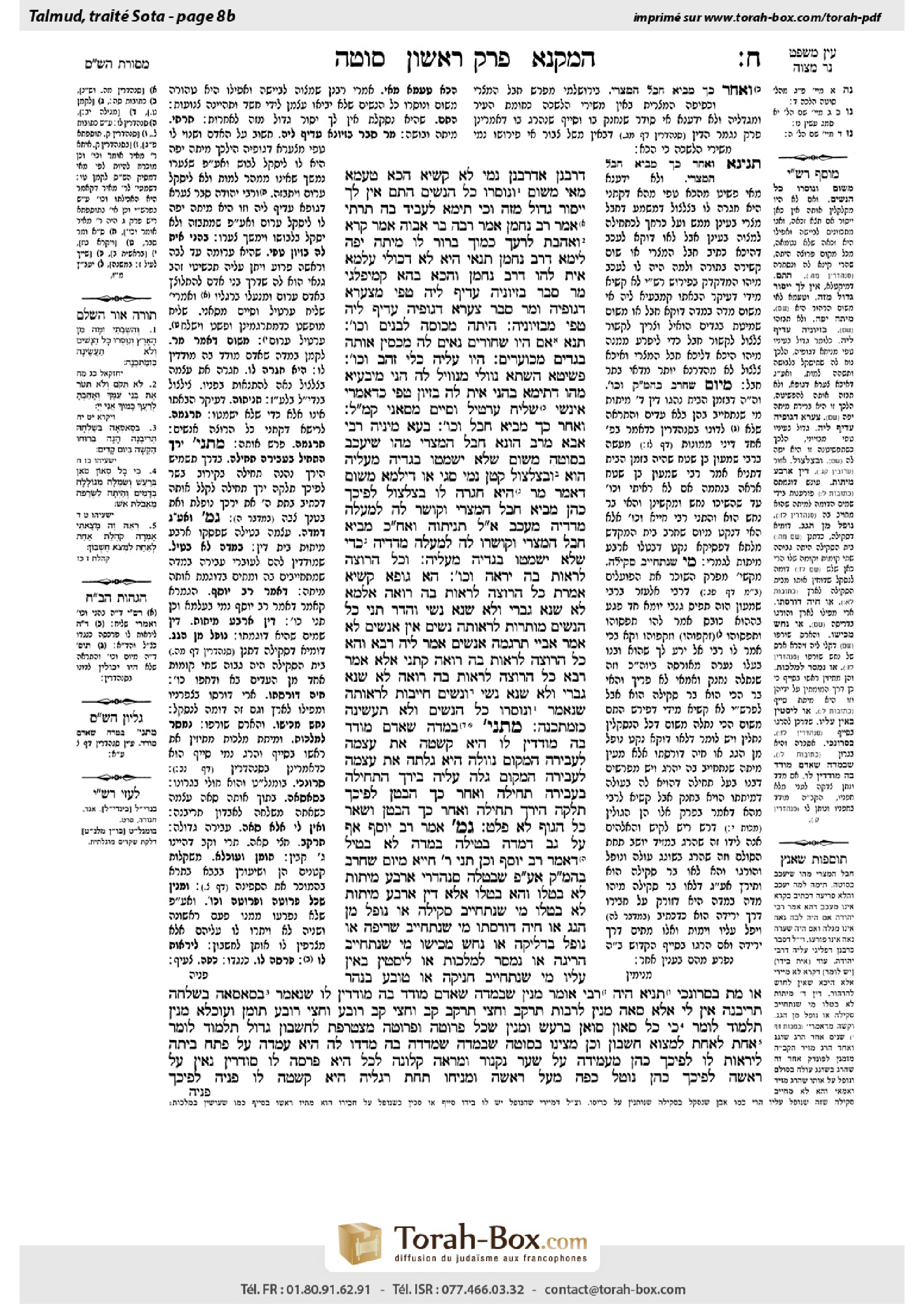
Sotah 8b: Talmud study for Daf Yomi
Daf Yomi is the daily study of one Talmud folio. Explore 37 tractates with scans, Hebrew text, Sefaria English and AI-generated French translations where annotated.
Passage selection and English or AI-generated French translation are available where the scan has annotations. Daf Study is independent of Torah-Box and Sefaria.
Browse Sotah · סוטה · All tractatesSotah 8b text and translations
This page of Sotah includes the Aramaic text, an English translation and an AI-generated French translation, alongside the scan above.
סוטה ח׳ ב · Aramaic and Hebrew text
דְּרַבָּנַן אַדְּרַבָּנַן נָמֵי לָא קַשְׁיָא. הָכָא טַעְמָא מַאי? מִשּׁוּם ״וְנִוַּסְּרוּ כׇּל הַנָּשִׁים״. הָתָם — אֵין לְךָ יִיסּוּר גָּדוֹל מִזֶּה.
וְכִי תֵּימָא לַעֲבֵיד בַּהּ תַּרְתֵּי — אָמַר רַב נַחְמָן אָמַר רַבָּה בַּר אֲבוּהּ, אָמַר קְרָא: ״וְאָהַבְתָּ לְרֵעֲךָ כָּמוֹךָ״ — בְּרוֹר לוֹ מִיתָה יָפָה.
לֵימָא דְּרַב נַחְמָן תַּנָּאֵי הִיא? לָא, דְּכוּלֵּי עָלְמָא אִית לְהוּ דְּרַב נַחְמָן. וְהָכָא בְּהָא קָמִיפַּלְגִי, מָר סָבַר: בִּזְיוֹנֵיהּ עֲדִיף לֵיהּ טְפֵי מִצַּעְרָא דְגוּפֵיהּ, וּמָר סָבַר: צַעְרָא דְגוּפֵיהּ עֲדִיף לֵיהּ טְפֵי מִבִּזְיוֹנֵיהּ.
הָיְתָה מְכוּסָּה לְבָנִים וְכוּ׳. תָּנָא, אִם הָיוּ שְׁחוֹרִים נָאִים לָהּ — מְכַסִּין אוֹתָהּ בְּגָדִים מְכוֹעָרִים.
הָיוּ עָלֶיהָ כְּלֵי זָהָב וְכוּ׳. פְּשִׁיטָא, הַשְׁתָּא נַוּוֹלֵי מְנַוֵּויל לַהּ, הָנֵי מִיבַּעְיָא? מַהוּ דְּתֵימָא: בְּהָנֵי אִית לַהּ בִּזָּיוֹן טְפֵי, כִּדְאָמְרִי אִינָשֵׁי: שָׁלִיחַ עַרְטִיל וְסָיֵים מְסָאנֵי. קָא מַשְׁמַע לַן.
וְאַחַר כָּךְ מֵבִיא חֶבֶל וְכוּ׳. בְּעָא מִינֵּיהּ רַבִּי אַבָּא מֵרַב הוּנָא: חֶבֶל הַמִּצְרִי מַהוּ שֶׁיְּעַכֵּב בְּסוֹטָה? מִשּׁוּם שֶׁלֹּא יִשָּׁמְטוּ בְּגָדֶיהָ מֵעָלֶיהָ הוּא, וּבְצִלְצוֹל קָטָן נָמֵי סַגִּי, אוֹ דִילְמָא מִשּׁוּם דְּאָמַר מָר ״הִיא חָגְרָה לוֹ בְּצִלְצוֹל, לְפִיכָךְ כֹּהֵן מֵבִיא חֶבֶל הַמִּצְרִי וְקוֹשֵׁר לָהּ לְמַעְלָה מִדַּדֶּיהָ״ — מְעַכֵּב?
אֲמַר לֵיהּ, תְּנֵיתוּהָ: וְאַחַר כָּךְ מֵבִיא חֶבֶל הַמִּצְרִי וְקוֹשְׁרוֹ לָהּ לְמַעְלָה מִדַּדֶּיהָ, כְּדֵי שֶׁלֹּא יִשָּׁמְטוּ בְּגָדֶיהָ מֵעָלֶיהָ.
וְכׇל הָרוֹצֶה לִרְאוֹת בָּהּ יִרְאֶה וְכוּ׳. הָא גוּפָא קַשְׁיָא. אָמְרַתְּ: כָּל הָרוֹצֶה לִרְאוֹת בָּהּ רוֹאֶה, אַלְמָא לָא שְׁנָא גַּבְרֵי וְלָא שְׁנָא נְשֵׁי, וַהֲדַר תָּנֵי: כׇּל הַנָּשִׁים מוּתָּרוֹת לִרְאוֹתָהּ: נָשִׁים — אִין, אֲנָשִׁים — לָא.
אָמַר אַבָּיֵי: תַּרְגְּמַהּ אֲנָשִׁים. אָמַר לֵיהּ רָבָא: וְהָא ״כָּל הָרוֹצֶה לִרְאוֹת בָּהּ רוֹאֶה״ קָתָנֵי!
אֶלָּא אָמַר רָבָא: כׇּל הָרוֹצֶה לִרְאוֹת בָּהּ רוֹאֶה, לָא שְׁנָא גַּבְרֵי וְלָא שְׁנָא נְשֵׁי. וְנָשִׁים חַיָּיבוֹת לִרְאוֹתָהּ, שֶׁנֶּאֱמַר: ״וְנִוַּסְּרוּ כׇּל הַנָּשִׁים וְלֹא תַעֲשֶׂינָה כְּזִמַּתְכֶנָה״.
מַתְנִי׳ בְּמִדָּה שֶׁאָדָם מוֹדֵד — בָּהּ מוֹדְדִין לוֹ. הִיא קִשְּׁטָה אֶת עַצְמָהּ לַעֲבֵירָה — הַמָּקוֹם נִוְּולָהּ. הִיא גִּלְּתָה אֶת עַצְמָהּ לַעֲבֵירָה — הַמָּקוֹם גִּלָּה עָלֶיהָ. בַּיָּרֵךְ הִתְחִילָּה בַּעֲבֵירָה תְּחִילָּה וְאַחַר כָּךְ הַבֶּטֶן — לְפִיכָךְ תִּלְקֶה הַיָּרֵךְ תְּחִילָּה וְאַחַר כָּךְ הַבֶּטֶן, וּשְׁאָר כָּל הַגּוּף לֹא פָּלַט.
גְּמָ׳ אָמַר רַב יוֹסֵף: אַף עַל גַּב דְּמִדָּה בְּטֵילָה, בַּמִּדָּה לֹא בָּטֵיל.
דְּאָמַר רַב יוֹסֵף, וְכֵן תָּנֵי רַבִּי חִיָּיא: מִיּוֹם שֶׁחָרַב בֵּית הַמִּקְדָּשׁ, אַף עַל פִּי שֶׁבָּטְלָה סַנְהֶדְרִי — אַרְבַּע מִיתוֹת לֹא בָּטְלוּ. וְהָא בָּטְלוּ?! אֶלָּא: דִּין אַרְבַּע מִיתוֹת לֹא בָּטְלוּ.
מִי שֶׁנִּתְחַיֵּיב סְקִילָה — אוֹ נוֹפֵל מִן הַגָּג, אוֹ חַיָּה דּוֹרַסְתּוֹ. מִי שֶׁנִּתְחַיֵּיב שְׂרֵיפָה — אוֹ נוֹפֵל בִּדְלֵיקָה, אוֹ נָחָשׁ מַכִּישׁוֹ. מִי שֶׁנִּתְחַיֵּיב הֲרִיגָה — אוֹ נִמְסָר לַמַּלְכוּת, אוֹ לִיסְטִין בָּאִין עָלָיו. מִי שֶׁנִּתְחַיֵּיב חֲנִיקָה — אוֹ טוֹבֵעַ בַּנָּהָר, אוֹ מֵת בִּסְרוֹנְכֵי.
תַּנְיָא, הָיָה רַבִּי אוֹמֵר: מִנַּיִן שֶׁבְּמִדָּה שֶׁאָדָם מוֹדֵד בָּהּ מוֹדְדִין לוֹ — שֶׁנֶּאֱמַר: ״בְּסַאסְּאָה בְּשַׁלְּחָהּ תְּרִיבֶנָּה״.
אֵין לִי אֶלָּא סְאָה, מִנַּיִן לְרַבּוֹת תַּרְקַב וַחֲצִי תַּרְקַב, קַב וַחֲצִי קַב, רוֹבַע וַחֲצִי רוֹבַע, תּוֹמֶן וְעוּכְלָא, מִנַּיִן — תַּלְמוּד לוֹמַר: ״כִּי כׇּל סְאוֹן סֹאֵן בְּרַעַשׁ״.
וּמִנַּיִן שֶׁכׇּל פְּרוּטָה וּפְרוּטָה מִצְטָרֶפֶת לְחֶשְׁבּוֹן גָּדוֹל — תַּלְמוּד לוֹמַר: ״אַחַת לְאַחַת לִמְצֹא חֶשְׁבּוֹן״.
וְכֵן מָצִינוּ בַּסּוֹטָה, שֶׁבַּמִּדָּה שֶׁמָּדְדָה — בָּהּ מָדְדוּ לָהּ: הִיא עָמְדָה עַל פֶּתַח בֵּיתָהּ לֵירָאוֹת לוֹ — לְפִיכָךְ כֹּהֵן מַעֲמִידָהּ עַל שַׁעַר נִקָּנוֹר וּמַרְאֶה קְלוֹנָהּ לַכֹּל. הִיא פָּרְסָה לוֹ סוּדָרִין נָאִין עַל רֹאשָׁהּ — לְפִיכָךְ כֹּהֵן נוֹטֵל כִּפָּה מֵעַל רֹאשָׁהּ וּמַנִּיחוֹ תַּחַת רַגְלֶיהָ. הִיא קִשְּׁטָה לוֹ פָּנֶיהָ — לְפִיכָךְ
Sotah 8b · English translation
The contradiction between one ruling of the Rabbis and the other ruling of the Rabbis is not difficult as well. Here, with regard to a sota, what is the reason that her hair and body are uncovered? Because of what is stated in the verse, that other women should be warned: “Thus will I cause lewdness to cease out of the land, that all women may be chastened not to do after your lewdness” (Ezekiel 23:48). There, with regard to stoning, you have no greater chastening than seeing this stoning itself.
And if you would say that two forms of chastening, both stoning and humiliation, should be done with her, Rav Naḥman said that Rabba bar Avuh said: The verse states: “You shall love your neighbor as yourself” (Leviticus 19:18), teaching that even with regard to a condemned prisoner, select a good, i.e., a compassionate, death for him. Therefore, when putting a woman to death by stoning, she should not be humiliated in the process.
The Gemara suggests: Let us say that the statement of Rav Naḥman is a dispute between tanna’im, and according to Rabbi Yehuda there is no mitzva to select a compassionate death. The Gemara refutes this: No, it may be that everyone agrees with the opinion of Rav Naḥman, and here they disagree about this: One Sage, i.e., the Rabbis, holds: Minimizing one’s degradation is preferable to him than minimizing his physical pain. Therefore, the Rabbis view the more compassionate death as one without degradation, even if wearing clothes will increase the pain of the one being executed, as the clothes will absorb the blow and prolong death. And one Sage, Rabbi Yehuda, holds that minimizing physical pain is preferable to a person than minimizing his degradation, and therefore the one being executed prefers to be stoned unclothed, without any chance of the clothing prolonging the death, although this adds to the degradation.
§ The mishna teaches: If she was dressed in white garments, he would cover her with black garments. A Sage taught: If black garments are becoming to her, then she is covered in unsightly garments.
The mishna teaches: If she was wearing gold adornments or other jewelry, they are removed from her. The Gemara asks: Isn’t this obvious? Now that the priest renders her unattractive by uncovering her and dressing her in unsightly garments, is it necessary to teach that they remove these adornments from her? The Gemara answers: Lest you say that with these adornments on her, she has more degradation, as people say in a known aphorism: Undressed, naked, and wearing shoes. This means that a naked person who wears shoes emphasizes the fact that he is naked. Perhaps one would think that by a sota wearing jewelry, her nakedness is emphasized and her degradation is amplified. Therefore, the mishna teaches us that this is not so.
The mishna continues: And afterward the priest would bring an Egyptian rope, and he would tie it above her breasts. Rabbi Abba raised a dilemma before Rav Huna: What is the halakha as to whether the lack of an Egyptian rope will preclude the performance of the rite with regard to a sota? Does any means of tying suffice? Perhaps the primary function of the rope is so that her clothes will not fall off her, and therefore even a small ribbon [tziltzul] would also suffice. Or, perhaps the rope is used because of what the Master said: She girded herself with a comely ribbon when she committed her transgression, and therefore the priest brings specifically an Egyptian rope, which is coarse, and ties it above her breasts. If that is the case, then the Egyptian rope should be indispensable.
Rav Huna said to him: You learned the answer to this dilemma in a baraita that teaches: And afterward the priest would bring an Egyptian rope and he would tie it above her breasts, so that her clothes would not fall off her. The baraita states that the use of an Egyptian rope is primarily for holding up her clothing, and therefore use of specifically Egyptian rope is not essential.
§ The mishna teaches: And anyone who desires to watch her may watch, except for her slaves and maidservants, who are not permitted to watch because her heart is emboldened by them. And all of the women are permitted to watch her. The Gemara comments: This matter is itself difficult, as there is an internal contradiction in the mishna. First you say: And anyone who desires to watch her may watch. Apparently, there is no difference whether the onlookers are men and there is no difference whether they are women; all are permitted to observe the rite. And then the mishna teaches: And all of the women are permitted to watch her, which indicates women, yes, they may watch her, but men, no, they may not.
Abaye said: Interpret the first statement, which permits all people to observe the sota, as pertaining to women, but men may not be onlookers. Rava said to him: But it teaches in that first statement that anyone who desires to watch her may watch, and one cannot limit this to women.
Rather, Rava said: Anyone who desires to watch her may watch, there is no difference whether the onlookers are men and there is no difference whether they are women. And the next clause of the mishna teaches that women are obligated to watch her, as is stated: “Thus will I cause lewdness to cease out of the land, that all women may be chastened not to do after your lewdness” (Ezekiel 23:48).
MISHNA: The mishna teaches lessons that can be derived from the actions and treatment of a sota. With the measure that a person measures, he is measured with it. For example, she, the sota, adorned herself to violate a transgression, the Omnipresent therefore decreed that she be rendered unattractive; she exposed herself for the purpose of violating a transgression, as she stood in places where she would be noticed by potential adulterers, so the Omnipresent therefore decreed that her body be exposed publicly; she began her transgression with her thigh and afterward with her stomach, therefore the thigh is smitten first and then the stomach, and the rest of all her body does not escape punishment.
GEMARA: Rav Yosef says: Although the measure with regard to court-imposed capital punishment has ceased, as there is no court today empowered to adjudicate and apply corporal punishment, punishment that is suitable to be applied with a measure by God has not ceased, as a person is punished by Heaven in accordance with his sin.
As Rav Yosef says, and Rabbi Ḥiyya similarly teaches: From the day that the Temple was destroyed, although the Sanhedrin ceased, the four types of court-imposed capital punishment have not ceased. The Gemara asks: But they have ceased; court-imposed capital punishment is no longer given. Rather, the intention is: The law of the four types of court-imposed capital punishment has not ceased.
The Gemara explains: How so? One who is liable to be executed by stoning either falls from a roof or an animal mauls him and breaks his bones. This death is similar to the experience of stoning, in which the one liable to be executed is pushed from a platform and his bones break from the impact of the fall. One who is liable to be executed by burning either falls into a fire and is burned or a snake bites him, as a snakebite causes a burning sensation. One who is liable to be executed by slaying of the sword either is turned over to the authorities and they execute him with a sword, or robbers come upon him and murder him. One who is liable to be executed by strangling either drowns in a river and is choked by the water or dies of diphtheria [seronekhi], which causes his throat to become clogged, and he dies.
It is taught in a baraita in the Tosefta (3:1–5) that Rabbi Yehuda HaNasi would say: From where is it derived that with the measure that a person measures, he is measured with it? As it is stated: “In full measure [besase’a], when you send her away, you contend with her” (Isaiah 27:8). In other words, in the measure, bese’a, that one used in one’s sin, God will contend with, i.e., punish, him.
The baraita continues: I have derived only the relatively large measurement of a se’a, which alludes to a significant sin. From where do I know to include even lesser sins that are comparable to smaller measurements, e.g., a half-se’a [tarkav] and a half-tarkav; a kav and a half-kav; a quarter-kav and half of a quarter-kav; an eighth-kav [toman] and an ukla, which is one-thirty-second of a kav. From where is it derived that all these lesser sins are also dealt with in accordance with the measure of the sin? The verse states: “For every boot [sa’on] stamped with fierceness, and every cloak rolled in blood, shall even be for burning, for fuel of fire” (Isaiah 9:4), indicating that every sa’on, which Rabbi Yehuda HaNasi interprets as a small se’a, is “stamped with fierceness” and doesn’t go unpunished.
And from where is it derived that each and every peruta combine to add up to a great sum, alluding to the notion that even if one is not immediately punished for a small transgression, in the final accounting all misdeeds will combine together and be addressed by the imposition of a large punishment? The verse states: “Behold, this have I found, says Koheleth, adding one thing to another, to find out the account” (Ecclesiastes 7:27).
The baraita continues: And we found this with regard to a sota, that with the measure with which she measured, she is measured with it: She stood by the opening of her house to exhibit herself to her paramour, therefore a priest has her stand at the Gate of Nicanor and exhibits her disgrace to all; she spread beautiful shawls [sudarin] on her head for her paramour, therefore a priest removes her kerchief from her head and places it under her feet; she adorned her face for her paramour, therefore
Sotah 8b · Traduction française (IA)
La contradiction entre deux décisions des rabbins n’est pas difficile non plus. Ici, à propos d’une sota, pourquoi lui découvre-t-on les cheveux et le corps ? Parce que le verset dit qu’il faut avertir les autres femmes : « Je ferai ainsi cesser la débauche dans le pays, afin que toutes les femmes soient averties de ne pas imiter votre débauche » (Ézéchiel 23,48). Là, à propos de la lapidation, rien ne peut mieux servir d’avertissement que d’assister à cette lapidation elle-même.
Et si tu dis qu’il faudrait lui infliger les deux formes d’avertissement, la lapidation et l’humiliation, Rav Naḥman a dit au nom de Rabba bar Avuh : le verset dit : « Tu aimeras ton prochain comme toi-même » (Lévitique 19,18), enseignant que même pour un condamné à mort, il faut choisir pour lui une mort clémente. Par conséquent, lorsqu’on met une femme à mort par lapidation, il ne faut pas l’humilier dans le même temps.
La Guemara propose : Ne pourrait-on pas dire que la déclaration de Rav Naḥman fait l’objet d’une controverse entre tannaïm, et que, selon Rabbi Yehuda, il n’y a pas de mitsva de choisir une mort clémente ? La Guemara réfute cette idée : Non, il se peut que tous soient d’accord avec Rav Naḥman, et que leur désaccord porte sur ceci : un Sage, c’est-à-dire les rabbins, estime qu’il vaut mieux réduire l’humiliation d’une personne que sa douleur physique. Les rabbins considèrent donc que la mort la plus clémente est celle qui n’entraîne pas d’humiliation, même si le fait de porter des vêtements accroît la douleur de la personne exécutée, car les vêtements amortissent le coup et prolongent la mort. L’autre Sage, Rabbi Yehuda, estime qu’il vaut mieux réduire la douleur physique d’une personne que son humiliation ; la personne exécutée préfère donc être lapidée sans vêtements, sans risquer que ceux-ci prolongent sa mort, bien que cela accroisse son humiliation.
§ La Michna enseigne : Si elle était vêtue de blanc, on la couvrait de vêtements noirs. Un Sage a enseigné : si les vêtements noirs lui vont bien, on la couvre de vêtements peu seyants.
La Michna enseigne : Si elle portait des ornements en or ou d’autres bijoux, on les lui retirait. La Guemara demande : N’est-ce pas évident ? Puisque le prêtre la rend peu attrayante en la découvrant et en la vêtant de vêtements peu seyants, faut-il encore enseigner qu’on lui retire ces ornements ? La Guemara répond : On pourrait penser que ces ornements accentuent son humiliation, comme le dit un aphorisme connu : dévêtu, nu et chaussé. Cela signifie que des chaussures aux pieds d’une personne nue soulignent le fait qu’elle est nue. On pourrait penser que les bijoux portés par une sota soulignent sa nudité et accroissent son humiliation. La Michna nous enseigne donc que ce n’est pas le cas.
La Michna poursuit : Ensuite, le prêtre apportait une corde égyptienne et la lui attachait au-dessus des seins. Rabbi Abba soumit à Rav Huna la question suivante : Quelle est la halakha si l’on ne dispose pas d’une corde égyptienne ? Cela empêche-t-il d’accomplir le rite de la sota ? N’importe quel moyen de l’attacher convient-il ? Peut-être la corde sert-elle essentiellement à empêcher ses vêtements de tomber, auquel cas même un petit ruban [tziltzul] conviendrait. Ou peut-être la corde est-elle utilisée en raison de ce que le Maître a dit : elle s’était ceinte d’un joli ruban lorsqu’elle commit sa transgression ; le prêtre apporte donc précisément une corde égyptienne, qui est grossière, et la lui attache au-dessus des seins. Si tel est le cas, la corde égyptienne serait indispensable.
Rav Huna lui dit : Tu as appris la réponse à cette question dans une baraïta qui enseigne : Ensuite, le prêtre apportait une corde égyptienne et la lui attachait au-dessus des seins, afin que ses vêtements ne tombent pas. La baraïta indique que la corde égyptienne sert principalement à maintenir ses vêtements ; l’emploi d’une corde spécifiquement égyptienne n’est donc pas indispensable.
§ La Michna enseigne : Toute personne qui désire la regarder peut le faire, à l’exception de ses esclaves et de ses servantes, qui n’y sont pas autorisés, car leur présence lui donne de l’assurance. Toutes les femmes sont autorisées à la regarder. La Guemara fait remarquer : Cette question présente une contradiction interne dans la Michna. D’abord, on dit : toute personne qui désire la regarder peut le faire. Il semblerait donc qu’il n’y ait pas de différence entre les spectateurs hommes et femmes : tous sont autorisés à assister au rite. Puis la Michna enseigne : toutes les femmes sont autorisées à la regarder, ce qui indique que les femmes, oui, peuvent la regarder, mais que les hommes, non, ne le peuvent pas.
Abaye dit : Interprète la première déclaration, qui autorise tous à assister à l’épreuve de la sota, comme se rapportant aux femmes ; les hommes ne peuvent pas être spectateurs. Rava lui dit : Mais la première déclaration enseigne que toute personne qui désire la regarder peut le faire ; on ne peut pas limiter cela aux femmes.
Rava dit plutôt : Toute personne qui désire la regarder peut le faire, qu’il s’agisse d’hommes ou de femmes, sans distinction. La clause suivante de la Michna enseigne que les femmes sont tenues de la regarder, comme il est dit : « Je ferai ainsi cesser la débauche dans le pays, afin que toutes les femmes soient averties de ne pas imiter votre débauche » (Ézéchiel 23,48).
MICHNA : La Michna enseigne des leçons que l’on peut tirer des actes et du traitement infligé à une sota. On est traité selon la mesure dont on s’est servi. Ainsi, elle, la sota, s’était parée pour commettre une transgression ; le Tout-Puissant décréta donc qu’elle soit rendue peu attrayante. Elle s’était exposée afin de commettre une transgression, puisqu’elle se tenait dans des lieux où des hommes susceptibles de commettre l’adultère pouvaient la remarquer ; le Tout-Puissant décréta donc que son corps soit exposé publiquement. Elle avait commencé sa transgression par la cuisse, puis par le ventre ; la cuisse est donc frappée en premier, puis le ventre, et le reste de son corps ne peut échapper au châtiment.
GUEMARA : Rav Yosef dit : Bien que la mesure du châtiment capital infligé par le tribunal ait cessé, puisqu’il n’existe aujourd’hui aucun tribunal habilité à juger et à appliquer des châtiments corporels, le châtiment que Dieu peut infliger selon la mesure n’a pas cessé : une personne est punie par le Ciel conformément à sa faute.
Comme le dit Rav Yosef, Rabbi Ḥiyya enseigne de même : depuis la destruction du Temple, bien que le Sanhédrin ait cessé d’exister, les quatre modes d’exécution judiciaire n’ont pas cessé. La Guemara demande : Mais ils ont cessé ; on n’inflige plus de peine capitale par décision d’un tribunal. Il faut plutôt comprendre que la loi relative aux quatre modes d’exécution judiciaire n’a pas cessé.
La Guemara explique : Comment cela ? Celui qui est passible de la lapidation tombe d’un toit, ou bien un animal le piétine et lui brise les os. Cette mort ressemble à la lapidation, au cours de laquelle le condamné est poussé d’une estrade et se brise les os en heurtant le sol. Celui qui est passible du bûcher tombe dans le feu et brûle, ou bien un serpent le mord, car une morsure de serpent provoque une sensation de brûlure. Celui qui est passible de l’exécution par l’épée est livré aux autorités, qui l’exécutent à l’épée, ou bien des brigands le surprennent et le tuent. Celui qui est passible de l’étranglement se noie dans une rivière et suffoque sous l’eau, ou meurt de diphtérie [seronekhi], qui obstrue sa gorge et entraîne sa mort.
Il est enseigné dans une baraïta de la Tosefta (3,1-5) que Rabbi Yehuda HaNasi disait : D’où apprend-on qu’on est traité selon la mesure dont on s’est servi ? Comme il est dit : « En pleine mesure [besase’a], lorsque tu la renvoies, tu la combats » (Isaïe 27,8). Autrement dit, selon la mesure, bese’a, dont une personne s’est servie dans sa faute, Dieu la combat, c’est-à-dire la punit.
La baraïta poursuit : Je n’ai déduit cela que pour la mesure relativement grande d’un séa, qui évoque une faute importante. D’où sais-je qu’il faut inclure même les fautes moindres, comparables à des mesures plus petites, par exemple un demi-séa [tarkav] et un demi-tarkav, un kav et un demi-kav, un quart de kav et la moitié d’un quart de kav, un huitième de kav [toman] et une ukla, qui correspond à un trente-deuxième de kav ? D’où apprend-on que toutes ces fautes moindres sont elles aussi traitées selon la mesure de la faute ? Le verset dit : « Car toute chaussure [sa’on] piétinant avec fracas, et tout manteau roulé dans le sang, seront livrés au feu, serviront de combustible aux flammes » (Isaïe 9,4), indiquant que chaque sa’on, que Rabbi Yehuda HaNasi interprète comme un petit séa, est « piétiné avec fracas » et ne demeure pas impuni.
Et d’où apprend-on que chaque perouta s’ajoute aux autres pour former une grande somme, ce qui évoque l’idée que même si une petite transgression n’entraîne pas immédiatement de châtiment, dans le décompte final, toutes les fautes s’additionneront et donneront lieu à un grand châtiment ? Le verset dit : « Voici ce que j’ai trouvé, dit Kohélet, en ajoutant une chose à une autre pour trouver le compte » (Ecclésiaste 7,27).
La baraïta poursuit : Nous trouvons aussi cela à propos d’une sota : elle est traitée selon la mesure dont elle s’est servie. Elle se tenait à l’entrée de sa maison pour se montrer à son amant ; un prêtre la fait donc se tenir à la porte de Nicanor et expose son déshonneur aux yeux de tous. Elle avait étalé sur sa tête de beaux châles [sudarin] pour son amant ; un prêtre lui retire donc son voile et le place sous ses pieds. Elle avait paré son visage pour son amant ;
Traduction française générée par IA à partir de l’édition anglaise de Sefaria. Vérifie toujours un passage avec le texte source.
Text from Sefaria: William Davidson Edition - Vocalized Aramaic (CC BY NC); William Davidson Edition - English (CC BY NC).