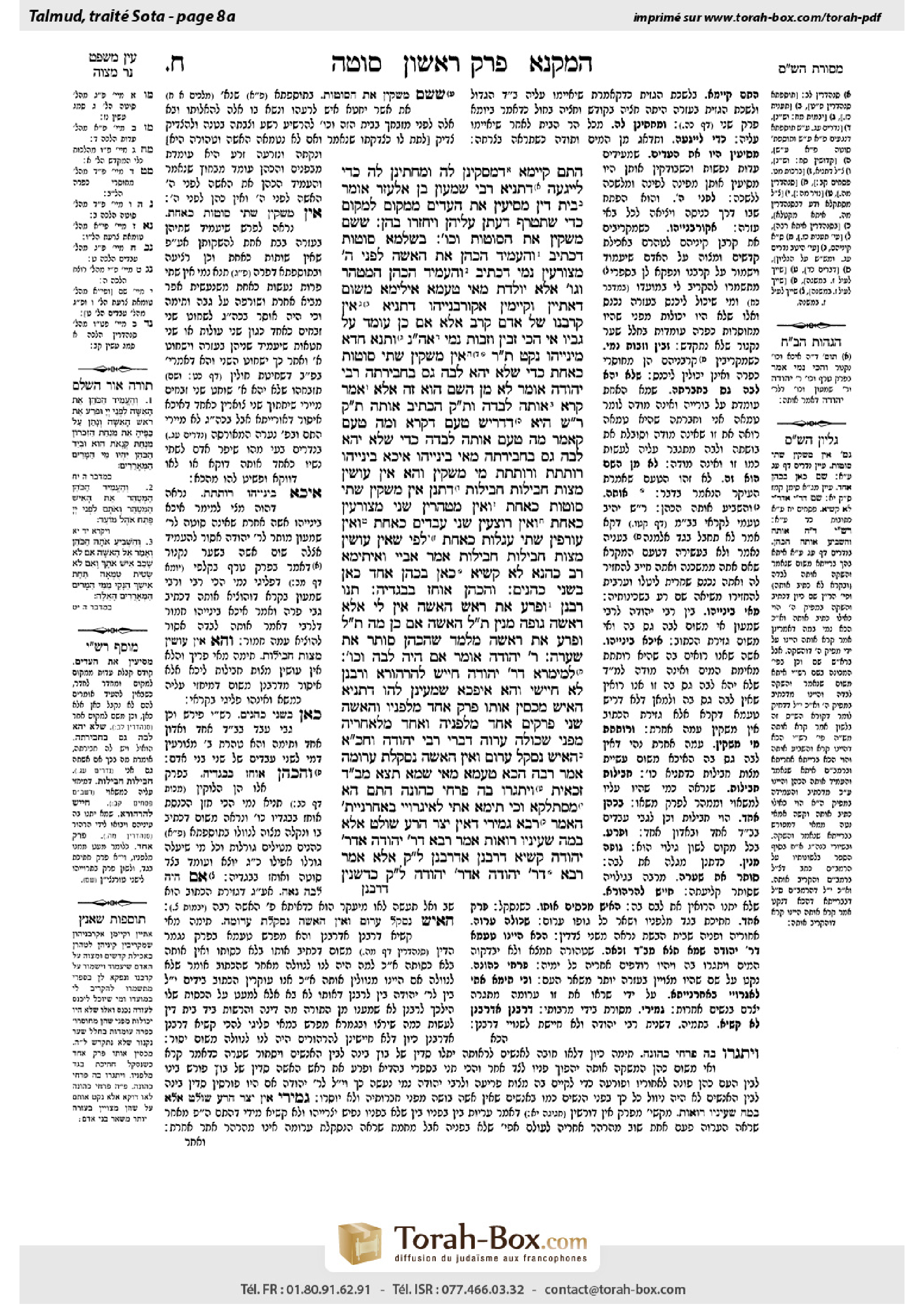
Sotah 8a: Talmud study for Daf Yomi
Daf Yomi is the daily study of one Talmud folio. Explore 37 tractates with scans, Hebrew text, Sefaria English and AI-generated French translations where annotated.
Passage selection and English or AI-generated French translation are available where the scan has annotations. Daf Study is independent of Torah-Box and Sefaria.
Browse Sotah · סוטה · All tractatesSotah 8a text and translations
This page of Sotah includes the Aramaic text, an English translation and an AI-generated French translation, alongside the scan above.
סוטה ח׳ א · Aramaic and Hebrew text
הָתָם קָיְימָא! דְּמַסְּקִינַן לַהּ וּמַחֲתִינַן לַהּ כְּדֵי לְיַיגְּעָהּ. דְּתַנְיָא רַבִּי שִׁמְעוֹן בֶּן אֶלְעָזָר אוֹמֵר: בֵּית דִּין מַסִּיעִין אֶת הָעֵדִים מִמָּקוֹם לְמָקוֹם, כְּדֵי שֶׁתִּטָּרֵף דַּעְתָּן עֲלֵיהֶן וְיַחְזְרוּ בָּהֶן.
שֶׁשָּׁם מַשְׁקִין אֶת הַסּוֹטוֹת וְכוּ׳. בִּשְׁלָמָא סוֹטוֹת, דִּכְתִיב: ״וְהֶעֱמִיד הַכֹּהֵן אֶת הָאִשָּׁה לִפְנֵי ה׳״, מְצוֹרָעִין נָמֵי, דִּכְתִיב: ״וְהֶעֱמִיד הַכֹּהֵן הַמְטַהֵר וְגוֹ׳״, אֶלָּא יוֹלֶדֶת מַאי טַעְמָא?
אִילֵּימָא מִשּׁוּם דְּאָתְיָין וְקָיְימָין אַקּוּרְבָּנַיְיהוּ, דְּתַנְיָא: אֵין קׇרְבָּנוֹ שֶׁל אָדָם קָרֵב אֶלָּא אִם כֵּן עוֹמֵד עַל גַּבָּיו. אִי הָכִי — זָבִין וְזָבוֹת נָמֵי! אִין הָכִי נָמֵי, וְתַנָּא חֲדָא מִינַּיְיהוּ נְקַט.
תָּנוּ רַבָּנַן: אֵין מַשְׁקִין שְׁתֵּי סוֹטוֹת כְּאַחַת, כְּדֵי שֶׁלֹּא יְהֵא לִבָּהּ גַּס בַּחֲבֶירְתָּהּ. רַבִּי יְהוּדָה אוֹמֵר: לֹא מִן הַשֵּׁם הוּא זֶה, אֶלָּא אָמַר קְרָא: ״אֹתָהּ״ — לְבַדָּהּ.
וְתַנָּא קַמָּא, הָכְתִיב ״אֹתָהּ״? תַּנָּא קַמָּא — רַבִּי שִׁמְעוֹן הִיא, דְּדָרֵישׁ טַעַם דִּקְרָא, וּמָה טַעַם קָאָמַר: מָה טַעַם ״אוֹתָהּ״ לְבַדָּהּ — כְּדֵי שֶׁלֹּא יְהֵא לִבָּהּ גַּס בַּחֲבֶירְתָּהּ.
מַאי בֵּינַיְיהוּ? אִיכָּא בֵּינַיְיהוּ רוֹתֶתֶת.
וְרוֹתֶתֶת מִי מַשְׁקִין? וְהָא אֵין עוֹשִׂין מִצְוֹת חֲבִילוֹת חֲבִילוֹת.
דִּתְנַן: אֵין מַשְׁקִין שְׁתֵּי סוֹטוֹת כְּאַחַת, וְאֵין מְטַהֲרִין שְׁנֵי מְצוֹרָעִין כְּאַחַת, וְאֵין רוֹצְעִין שְׁנֵי עֲבָדִים כְּאַחַת, וְאֵין עוֹרְפִין שְׁתֵּי עֲגָלוֹת כְּאַחַת, לְפִי שֶׁאֵין עוֹשִׂין מִצְוֹת חֲבִילוֹת חֲבִילוֹת.
אָמַר אַבָּיֵי, וְאִיתֵּימָא רַב כָּהֲנָא, לָא קַשְׁיָא: כָּאן בְּכֹהֵן אֶחָד, כָּאן בִּשְׁנֵי כֹּהֲנִים.
וְהַכֹּהֵן אוֹחֵז בִּבְגָדֶיהָ. תָּנוּ רַבָּנַן: ״וּפָרַע אֶת רֹאשׁ הָאִשָּׁה״, אֵין לִי אֶלָּא רֹאשָׁהּ. גּוּפָהּ מִנַּיִן — תַּלְמוּד לוֹמַר: ״הָאִשָּׁה״. אִם כֵּן מָה תַּלְמוּד לוֹמַר ״וּפָרַע אֶת רֹאשָׁהּ״ — מְלַמֵּד שֶׁהַכֹּהֵן סוֹתֵר אֶת שְׂעָרָהּ.
רַבִּי יְהוּדָה אוֹמֵר: אִם הָיָה לִבָּהּ וְכוּ׳. לְמֵימְרָא דְּרַבִּי יְהוּדָה חָיֵישׁ לְהִרְהוּרָא, וְרַבָּנַן לָא חָיְישִׁי?
וְהָא אִיפְּכָא שָׁמְעִינַן לְהוּ, דְּתַנְיָא: הָאִישׁ, מְכַסִּין אוֹתוֹ פֶּרֶק אֶחָד מִלְּפָנָיו, וְהָאִשָּׁה, שְׁנֵי פְּרָקִים — אֶחָד מִלְּפָנֶיהָ וְאֶחָד מִלְּאַחֲרֶיהָ, מִפְּנֵי שֶׁכּוּלָּהּ עֶרְוָה, דִּבְרֵי רַבִּי יְהוּדָה. וַחֲכָמִים אוֹמְרִים: הָאִישׁ נִסְקָל עָרוֹם, וְאֵין הָאִשָּׁה נִסְקֶלֶת עֲרוּמָּה!
אָמַר רַבָּה: הָכָא טַעְמָא מַאי — שֶׁמָּא תֵּצֵא מִבֵּית דִּין זַכָּאִית, וְיִתְגָּרוּ בָּהּ פִּרְחֵי כְהוּנָּה. הָתָם — הָא מִסְתַּלְּקָא. וְכִי תֵּימָא: אָתֵי לְאִיגָּרוֹיֵי בְּאַחְרָנְיָיתָא — הָאָמַר רָבָא: גְּמִירִי דְּאֵין יֵצֶר הָרָע שׁוֹלֵט אֶלָּא בְּמַה שֶּׁעֵינָיו רוֹאוֹת.
אָמַר רָבָא: דְּרַבִּי יְהוּדָה אַדְּרַבִּי יְהוּדָה קַשְׁיָא, דְּרַבָּנַן אַדְּרַבָּנַן לָא קַשְׁיָא? אֶלָּא אָמַר רָבָא: דְּרַבִּי יְהוּדָה אַדְּרַבִּי יְהוּדָה לָא קַשְׁיָא, כִּדְשַׁנִּין.
Sotah 8a · English translation
She is already standing there in the Temple courtyard, as that is where the Sanhedrin sits. The Gemara answers: This teaches that they would bring her up and would bring her down repeatedly in order to fatigue her, with the hope that her worn-down mental state will lead to her confession. This was also done with witnesses testifying in cases of capital law, as it is taught in the Tosefta (Sanhedrin 9:1): Rabbi Shimon ben Elazar says: In cases of capital law, the court brings the witnesses from one place to another place in order to confuse them so that they will retract their testimony if they are lying.
§ The mishna teaches: Because there, at the Eastern Gate, they give the sota women the bitter water to drink, and there the lepers and women who have given birth are purified. The Gemara asks: Granted, the sota women are given the bitter water to drink there, as it is written: “And the priest shall stand the woman before the Lord” (Numbers 5:18), and the Eastern Gate is directly opposite the Sanctuary, which is the area referred to as “before the Lord.” Similarly, with regard to lepers as well, this is as it is written: “And the priest that cleans him shall set the man that is to be cleansed, and those things, before the Lord” (Leviticus 14:11). But what is the reason that a woman who has given birth must also be purified there?
The Gemara suggests: If we say it is because of the requirement for the women who have given birth to come and stand over their offerings, as it is taught in a baraita: The offering of a person is brought only if he stands over it while it is being sacrificed, and that is why they stand at this gate, which is as close to the sacrifice as they are permitted to be while they are ritually impure. If that is so, then the same halakha should apply to men who experience a gonorrhea-like discharge [zavim] and women who experience a discharge of uterine blood after their menstrual period [zavot] as well. They are also ritually impure while their offerings are sacrificed. Why would the mishna then specify women who have given birth? The Gemara answers: Yes, it is indeed so, and the tanna cited one of them, and the same halakha applies to all others in that category.
§ The Sages taught in a baraita in the Tosefta (1:6): Two sota women are not given to drink simultaneously, in order that the heart of each one not be emboldened by the other, as there is a concern that when one sees that the other woman is not confessing, she will maintain her innocence even if she is guilty. Rabbi Yehuda says: This is not for that reason. Rather, it is because the verse states: “And the priest shall bring her [ota] near and stand her before the Lord” (Numbers 5:16). Rabbi Yehuda explains his inference: The word “ota” indicates her alone, and therefore there is a Torah edict not to have two women drink the bitter water simultaneously.
The Gemara asks: And as for the first tanna, isn’t it written “ota”? The Gemara answers: The first tanna is actually Rabbi Shimon, who interprets the reasons of halakhot written in verses, and he is saying: What is the reason? What is the reason the Torah requires her alone, that each sota drink individually? In order that the heart of each woman not be emboldened by the other.
The Gemara asks: What is the difference between them? Why should it matter if this halakha is due to a logical reasoning or due to a Torah edict? The Gemara answers: The difference between them is in a case where one of the women is trembling from fear. Since she has obviously not been emboldened by the presence of the other, Rabbi Shimon would allow her to be given to drink at the same time as the other.
The Gemara asks: And if she is trembling, can the court give her to drink at the same time as the other? But there is a general principle that one does not perform mitzvot in bundles, as one who does so appears as if the mitzvot are a burden upon him, and he is trying to finish with them as soon as possible.
As we learned in a baraita: Two sota women are not given to drink simultaneously, and two lepers are not purified simultaneously, and two slaves are not pierced simultaneously, and two heifers do not have their necks broken simultaneously, because one does not perform mitzvot in bundles. Accordingly, even Rabbi Shimon would agree that under no circumstances can a priest give two sota women to drink simultaneously. How, then, can the Gemara say that a trembling woman can be given to drink together with another sota?
Abaye said, and some say it was Rav Kahana who said: This is not difficult. Here, the second baraita, which says that it is prohibited to give two sota women to drink simultaneously because one does not perform mitzvot in bundles, is speaking with regard to one priest. There, Rabbi Shimon in the first baraita, who permits a trembling sota to be given to drink together with another sota, is speaking with regard to two priests. Since no individual priest is giving two women to drink simultaneously, mitzvot are not being performed in bundles.
§ The mishna teaches: And the priest grabs hold of her clothing and pulls them until he reveals her heart, and he unbraids her hair. The Gemara cites the source for these acts. The Sages taught: The verse states: “And the priest shall stand the woman before the Lord and uncover the woman’s head” (Numbers 5:18). From this verse I have derived only that he uncovers her head; from where do I derive that he uncovers her body? The verse states: “The woman,” rather than just stating: And uncovers her head. This indicates that the woman’s body should be uncovered as well. If so, what is the meaning when the verse states specifically: “And uncover her head”? Once it has stated that he uncovers the woman, it is already apparent that she, including her hair, is uncovered. It teaches that the priest not only uncovers her hair but also unbraids her hair.
The mishna continues by citing that Rabbi Yehuda says: If her heart was attractive he would not reveal it, and if her hair was attractive he would not unbraid it. The Gemara asks: Is this to say that Rabbi Yehuda, who maintains that it is prohibited to uncover an attractive woman, is concerned about onlookers having sexual thoughts, and the Rabbis, who permit it, are not concerned about this?
But we have heard the opposite from them, as it is taught in the Tosefta (Sanhedrin 9:6): Although a man condemned to stoning is stoned unclothed, the court covers him with one small piece of material in front of him, to obscure his genitals, and they cover a woman with two small pieces of material, one in front of her and one behind her, because all of her loins are nakedness, as her genitals are visible both from the front and from the back. This is the statement of Rabbi Yehuda. And the Rabbis say: A man is stoned while naked, but a woman is not stoned while naked, but fully clothed. Apparently, Rabbi Yehuda is not concerned that the onlookers seeing the woman unclothed will lead to sexual thoughts, but the Rabbis are concerned about this.
Rabba said: What is the reason here, with regard to a sota, that Rabbi Yehuda is concerned? Perhaps the sota will leave the court having been proven innocent, and the young priests in the Temple who saw her partially naked will become provoked by the sight of her. There, in the case of a woman who is stoned, she departs from this world by being stoned and there is no concern for sexual thoughts. The Gemara comments: And if you would say that the fact that she is killed is irrelevant to their sexual thoughts, as the onlookers will be provoked with regard to other women, this is not a concern. As didn’t Rava say: It is learned as a tradition that the evil inclination controls only that which a person’s eyes see.
Rava said: Is the contradiction between one statement of Rabbi Yehuda and the other statement of Rabbi Yehuda difficult, while the contradiction between one statement of the Rabbis and the other statement of the Rabbis is not difficult? There is also an apparent contradiction between the two rulings of the Rabbis, as with regard to a sota, they are not concerned about sexual thoughts, but with regard to a woman who is stoned they are. Rather, Rava said: The contradiction between one statement of Rabbi Yehuda and the other statement of Rabbi Yehuda is not difficult, as we answered above.
Sotah 8a · Traduction française (IA)
Elle se tient déjà là, dans la cour du Temple, puisque c’est là que siège le Sanhédrin. La Guemara répond : Cela enseigne qu’on la faisait monter puis descendre à plusieurs reprises afin de la fatiguer, dans l’espoir que son état mental affaibli l’amène à avouer. On procédait également ainsi avec les témoins qui déposaient dans les affaires criminelles, comme l’enseigne la Tossefta (Sanhédrin 9:1) : Rabbi Shimon ben Elazar dit : Dans les affaires criminelles, le tribunal fait passer les témoins d’un endroit à un autre afin de les troubler, pour qu’ils rétractent leur témoignage s’ils mentent.
§ La Michna enseigne : Car c’est là, à la Porte orientale, qu’on fait boire l’eau amère aux femmes sota et que les lépreux ainsi que les femmes ayant accouché sont purifiés. La Guemara demande : Il est compréhensible qu’on fasse boire là l’eau amère aux femmes sota, car il est écrit : « Le prêtre placera la femme devant le Seigneur » (Nombres 5:18), et la Porte orientale fait directement face au Sanctuaire, qui est l’endroit désigné par les mots « devant le Seigneur ». De même, pour les lépreux, il est écrit : « Le prêtre qui le purifie placera l’homme à purifier, ainsi que ces objets, devant le Seigneur » (Lévitique 14:11). Mais pourquoi une femme ayant accouché doit-elle également être purifiée là ?
La Guemara suggère : Si l’on dit que c’est parce que les femmes ayant accouché doivent venir se tenir auprès de leurs offrandes, comme l’enseigne une baraïta : l’offrande d’une personne n’est apportée que si celle-ci se tient auprès d’elle pendant qu’elle est sacrifiée ; c’est pourquoi elles se tiennent à cette porte, aussi près du sacrifice que leur impureté rituelle le leur permet. Si tel est le cas, la même halakha devrait également s’appliquer aux hommes qui souffrent d’un écoulement semblable à la gonorrhée [zavim] et aux femmes qui ont un écoulement de sang utérin après leurs règles [zavot]. Eux aussi sont rituellement impurs pendant le sacrifice de leurs offrandes. Pourquoi la Michna mentionnerait-elle alors précisément les femmes ayant accouché ? La Guemara répond : Oui, c’est bien ainsi ; le tanna en a cité une, mais la même halakha s’applique à tous les autres de cette catégorie.
§ Les Sages ont enseigné dans une baraïta de la Tossefta (1:6) : On ne fait pas boire simultanément l’eau amère à deux femmes sota, afin que le cœur de chacune ne soit pas enhardi par l’autre ; on craint en effet que, voyant l’autre femme ne pas avouer, elle ne persiste à proclamer son innocence, même si elle est coupable. Rabbi Yehuda dit : Ce n’est pas pour cette raison. C’est plutôt parce que le verset dit : « Le prêtre la [ota] fera approcher et la placera devant le Seigneur » (Nombres 5:16). Rabbi Yehuda explique son raisonnement : Le mot « ota » indique qu’il s’agit d’elle seule ; il y a donc un décret de la Torah interdisant de faire boire simultanément l’eau amère à deux femmes.
La Guemara demande : Mais, pour le premier tanna, n’est-il pas écrit « ota » ? La Guemara répond : Le premier tanna est en réalité Rabbi Shimon, qui interprète les raisons des halakhot énoncées dans les versets, et il demande : Quelle en est la raison ? Pourquoi la Torah exige-t-elle qu’elle soit seule, que chaque femme sota boive individuellement ? Afin que le cœur de chacune ne soit pas enhardi par l’autre.
La Guemara demande : Quelle différence y a-t-il entre eux ? Pourquoi importe-t-il que cette halakha découle d’un raisonnement logique ou d’un décret de la Torah ? La Guemara répond : La différence apparaît dans le cas où l’une des femmes tremble de peur. Puisqu’il est évident que la présence de l’autre ne l’a pas enhardie, Rabbi Shimon permettrait qu’on lui fasse boire l’eau en même temps qu’à l’autre.
La Guemara demande : Et si elle tremble, le tribunal peut-il lui faire boire l’eau en même temps qu’à l’autre ? Pourtant, il existe un principe général selon lequel on n’accomplit pas les mitsvot en série, car celui qui agit ainsi donne l’impression que les mitsvot lui sont une charge et qu’il cherche à en finir avec elles le plus vite possible.
Comme nous l’avons appris dans une baraïta : On ne fait pas boire simultanément l’eau amère à deux femmes sota, on ne purifie pas simultanément deux lépreux, on ne perce pas simultanément les oreilles de deux esclaves et on ne brise pas simultanément la nuque de deux génisses, car on n’accomplit pas les mitsvot en série. Par conséquent, même Rabbi Shimon conviendrait qu’en aucun cas un prêtre ne peut faire boire simultanément l’eau amère à deux femmes sota. Comment la Guemara peut-elle alors dire qu’une femme qui tremble peut boire en même temps qu’une autre sota ?
Abaye a dit, et certains disent que c’est Rav Kahana qui l’a dit : Il n’y a pas de difficulté. Ici, la deuxième baraïta, qui dit qu’il est interdit de faire boire simultanément l’eau amère à deux femmes sota parce qu’on n’accomplit pas les mitsvot en série, parle du cas d’un seul prêtre. Là, Rabbi Shimon, dans la première baraïta, qui permet de faire boire l’eau à une femme sota qui tremble en même temps qu’à une autre sota, parle du cas de deux prêtres. Puisqu’aucun prêtre, à lui seul, ne fait boire simultanément l’eau à deux femmes, les mitsvot ne sont pas accomplies en série.
§ La Michna enseigne : Le prêtre saisit ses vêtements et les tire jusqu’à dévoiler sa poitrine, puis défait ses cheveux. La Guemara cite la source de ces gestes. Les Sages ont enseigné : Le verset dit : « Le prêtre placera la femme devant le Seigneur et découvrira la tête de la femme » (Nombres 5:18). De ce verset, j’ai seulement déduit qu’il découvre sa tête ; d’où déduis-je qu’il découvre son corps ? Le verset dit « la femme », au lieu de dire simplement : « et découvrira sa tête ». Cela indique que le corps de la femme doit lui aussi être découvert. Si tel est le cas, que signifie la mention précise « et découvrira sa tête » ? Dès lors qu’il est dit qu’il découvre la femme, il est déjà évident que celle-ci, cheveux compris, est découverte. Cela enseigne que le prêtre ne se contente pas de découvrir ses cheveux : il les défait également.
La Michna poursuit en citant Rabbi Yehuda, qui dit : Si sa poitrine était belle, il ne la dévoilait pas ; et si ses cheveux étaient beaux, il ne les défaisait pas. La Guemara demande : Faut-il en conclure que Rabbi Yehuda, qui estime qu’il est interdit de découvrir une femme belle, se soucie des pensées sexuelles des spectateurs, tandis que les Sages, qui le permettent, ne s’en soucient pas ?
Pourtant, nous avons entendu le contraire de leur part, comme l’enseigne la Tossefta (Sanhédrin 9:6) : Bien qu’un homme condamné à la lapidation soit lapidé sans vêtements, le tribunal le couvre à l’avant d’un petit morceau de tissu pour dissimuler ses organes génitaux ; une femme est couverte de deux petits morceaux de tissu, l’un devant elle et l’autre derrière elle, car toute sa région lombaire est nudité, ses organes génitaux étant visibles aussi bien de devant que de derrière. Telle est la déclaration de Rabbi Yehuda. Les Sages disent : Un homme est lapidé nu, mais une femme n’est pas lapidée nue ; elle est entièrement vêtue. Apparemment, Rabbi Yehuda ne craint pas que les spectateurs, en voyant une femme dénudée, aient des pensées sexuelles, tandis que les Sages le craignent.
Rabba a dit : Pour quelle raison Rabbi Yehuda s’en soucie-t-il ici, dans le cas d’une sota ? Peut-être la sota quittera-t-elle le tribunal après avoir été reconnue innocente, et les jeunes prêtres du Temple qui l’auront vue partiellement dénudée seront-ils excités par sa vue. Là, dans le cas d’une femme lapidée, elle quitte ce monde par la lapidation et l’on ne craint pas les pensées sexuelles. La Guemara fait remarquer : Et si tu dis que le fait qu’elle soit tuée est sans importance pour leurs pensées sexuelles, puisque les spectateurs seront excités à l’égard d’autres femmes, ce n’est pas une inquiétude. Rava n’a-t-il pas dit : Une tradition enseigne que le mauvais penchant ne domine que ce que les yeux d’une personne voient ?
Rava a dit : La contradiction entre une déclaration de Rabbi Yehuda et une autre déclaration de Rabbi Yehuda pose-t-elle problème, alors que celle entre une déclaration des Sages et une autre déclaration des Sages n’en pose pas ? Il y a également une contradiction apparente entre les deux décisions des Sages : dans le cas d’une sota, ils ne se soucient pas des pensées sexuelles, alors que dans le cas d’une femme lapidée, ils s’en soucient. Rava a plutôt dit : La contradiction entre une déclaration de Rabbi Yehuda et une autre déclaration de Rabbi Yehuda ne pose pas problème, car nous y avons répondu plus haut.
Traduction française générée par IA à partir de l’édition anglaise de Sefaria. Vérifie toujours un passage avec le texte source.
Text from Sefaria: William Davidson Edition - Vocalized Aramaic (CC BY NC); William Davidson Edition - English (CC BY NC).