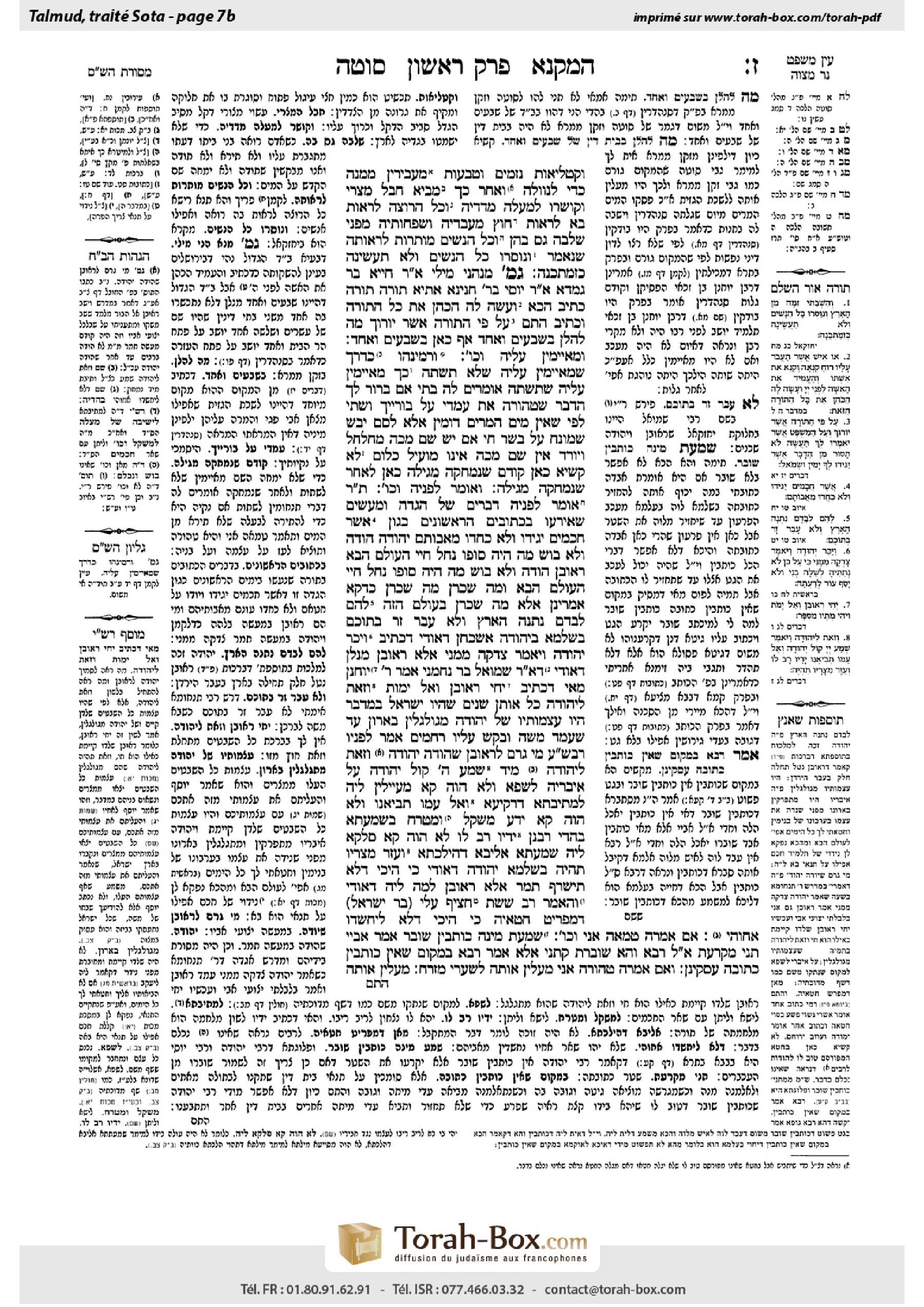
Sotah 7b: Talmud study for Daf Yomi
Daf Yomi is the daily study of one Talmud folio. Explore 37 tractates with scans, Hebrew text, Sefaria English and AI-generated French translations where annotated.
Passage selection and English or AI-generated French translation are available where the scan has annotations. Daf Study is independent of Torah-Box and Sefaria.
Browse Sotah · סוטה · All tractatesSotah 7b text and translations
This page of Sotah includes the Aramaic text, an English translation and an AI-generated French translation, alongside the scan above.
סוטה ז׳ ב · Aramaic and Hebrew text
וְקַטְלֵיאוֹת, נְזָמִים וְטַבָּעוֹת — מַעֲבִירִין מִמֶּנָּה, כְּדֵי לְנַוְּולָהּ. וְאַחַר כָּךְ מֵבִיא חֶבֶל מִצְרִי וְקוֹשְׁרוֹ לְמַעְלָה מִדַּדֶּיהָ,
וְכׇל הָרוֹצֶה לִרְאוֹת בָּא לִרְאוֹת, חוּץ מֵעֲבָדֶיהָ וְשִׁפְחוֹתֶיהָ, מִפְּנֵי שֶׁלִּבָּהּ גַּס בָּהֶן. וְכׇל הַנָּשִׁים מוּתָּרוֹת לִרְאוֹתָהּ, שֶׁנֶּאֱמַר: ״וְנִוַּסְּרוּ כׇּל הַנָּשִׁים וְלֹא תַעֲשֶׂינָה כְּזִמַּתְכֶנָה״.
גְּמָ׳ מְנָהָנֵי מִילֵּי? אָמַר רַבִּי חִיָּיא בַּר גַּמָּדָא אָמַר רַבִּי יוֹסֵי בְּרַבִּי חֲנִינָא: אָתְיָא ״תּוֹרָה״ ״תּוֹרָה״. כְּתִיב הָכָא: ״וְעָשָׂה לָהּ הַכֹּהֵן אֵת כׇּל הַתּוֹרָה״, וּכְתִיב הָתָם: ״עַל פִּי הַתּוֹרָה אֲשֶׁר יוֹרוּךָ״, מָה לְהַלָּן בְּשִׁבְעִים וְאֶחָד — אַף כָּאן בְּשִׁבְעִים וְאֶחָד.
וּמְאַיְּימִין עָלֶיהָ וְכוּ׳. וּרְמִינְהוּ: כְּדֶרֶךְ שֶׁמְּאַיְּימִין עָלֶיהָ שֶׁלֹּא תִּשְׁתֶּה כָּךְ מְאַיְּימִין עָלֶיהָ שֶׁתִּשְׁתֶּה. אוֹמְרִים לָהּ: בִּתִּי, אִם בָּרוּר לָךְ הַדָּבָר שֶׁטְּהוֹרָה אַתְּ עִמְדִי עַל בּוּרְיִיךְ, וּשְׁתִי. לְפִי שֶׁאֵין מַיִם הַמָּרִים דּוֹמִין אֶלָּא לְסַם יָבֵשׁ שֶׁמּוּנָּח עַל בָּשָׂר חַי. אִם יֵשׁ שָׁם מַכָּה — מְחַלְחֵל וְיוֹרֵד, אֵין שָׁם מַכָּה — אֵינוֹ מוֹעִיל כְּלוּם.
לָא קַשְׁיָא: כָּאן — קוֹדֶם שֶׁנִּמְחֲקָה מְגִילָּה. כָּאן — לְאַחַר שֶׁנִּמְחֲקָה מְגִילָּה.
וְאוֹמֵר לְפָנֶיהָ וְכוּ׳. תָּנוּ רַבָּנַן: אוֹמֵר לְפָנֶיהָ דְּבָרִים שֶׁל הַגָּדָה, וּמַעֲשִׂים שֶׁאֵירְעוּ בִּכְתוּבִים הָרִאשׁוֹנִים, כְּגוֹן: ״אֲשֶׁר חֲכָמִים יַגִּידוּ וְלֹא כִחֲדוּ מֵאֲבוֹתָם״.
יְהוּדָה הוֹדָה וְלֹא בּוֹשׁ, מֶה הָיָה סוֹפוֹ — נָחַל חַיֵּי הָעוֹלָם הַבָּא. רְאוּבֵן הוֹדָה וְלֹא בּוֹשׁ, מֶה הָיָה סוֹפוֹ — נָחַל חַיֵּי הָעוֹלָם הַבָּא. וּמָה שְׂכָרָן? מָה שְׂכָרָן?! כִּדְקָא אָמְרִינַן! אֶלָּא: מָה שְׂכָרָן בָּעוֹלָם הַזֶּה, ״לָהֶם לְבַדָּם נִתְּנָה הָאָרֶץ וְלֹא עָבַר זָר בְּתוֹכָם״.
בִּשְׁלָמָא בִּיהוּדָה אַשְׁכְּחַן דְּאוֹדִי, דִּכְתִיב: ״וַיַּכֵּר יְהוּדָה וַיֹּאמֶר צָדְקָה מִמֶּנִּי״, אֶלָּא רְאוּבֵן מְנָלַן דְּאוֹדִי?
דְּאָמַר רַבִּי שְׁמוּאֵל בַּר נַחְמָנִי אָמַר רַבִּי יוֹחָנָן: מַאי דִּכְתִיב ״יְחִי רְאוּבֵן וְאַל יָמֹת״, ״וְזֹאת לִיהוּדָה״?
כׇּל אוֹתָן שָׁנִים שֶׁהָיוּ יִשְׂרָאֵל בַּמִּדְבָּר, הָיוּ עַצְמוֹתָיו שֶׁל יְהוּדָה מְגוּלְגָּלִין בָּאָרוֹן, עַד שֶׁעָמַד מֹשֶׁה וּבִקֵּשׁ עָלָיו רַחֲמִים. אָמַר לְפָנָיו: רִבּוֹנוֹ שֶׁל עוֹלָם, מִי גָּרַם לִרְאוּבֵן שֶׁהוֹדָה — יְהוּדָה: ״וְזֹאת לִיהוּדָה״?!
מִיָּד: ״שְׁמַע ה׳ קוֹל יְהוּדָה״, עָל אֵיבְרֵיהּ לְשָׁפָא. וְלָא הֲוָה קָא מְעַיְּילִין לֵיהּ לִמְתִיבְתָּא דִרְקִיעָא, ״וְאֶל עַמּוֹ תְּבִיאֶנּוּ״. וְלָא הֲוָה קָא יָדַע מִשְׁקַל וּמִטְרַח בִּשְׁמַעְתָּא בַּהֲדֵי רַבָּנַן, ״יָדָיו רָב לוֹ״. לָא הֲוָה קָא סָלְקָא לֵיהּ שְׁמַעְתָּא אַלִּיבָּא דְהִילְכְתָא, ״וְעֵזֶר מִצָּרָיו תִּהְיֶה״.
בִּשְׁלָמָא יְהוּדָה דְּאוֹדִי, כִּי הֵיכִי דְּלֹא תִּישָּׂרֵף תָּמָר. אֶלָּא רְאוּבֵן, לְמָה לֵיהּ דְּאוֹדִי? וְהָאָמַר רַב שֵׁשֶׁת: חֲצִיף עֲלַי דִּמְפָרֵיט חֶטְאֵיהּ? כִּי הֵיכִי דְּלָא לִיחַשְׁדוּ אֲחוֹהִי.
אִם אָמְרָה ״טְמֵאָה אֲנִי״ וְכוּ׳. שָׁמְעַתְּ מִינַּהּ כּוֹתְבִין שׁוֹבָר.
אָמַר אַבָּיֵי, תְּנִי: ״מְקָרַעַת״. אֲמַר לֵיהּ רָבָא: וְהָא ״שׁוֹבֶרֶת״ קָתָנֵי! אֶלָּא אָמַר רָבָא: בִּמְקוֹם שֶׁאֵין כּוֹתְבִין כְּתוּבָּה עָסְקִינַן.
וְאִם אָמְרָה ״טְהוֹרָה אֲנִי״ מַעֲלִין אוֹתָהּ לְשַׁעֲרֵי מִזְרָח. מַעֲלִין אוֹתָהּ?!
Sotah 7b · English translation
or chokers [katliyot], or nose rings, or finger rings, they removed them from her in order to render her unattractive. And afterward the priest would bring an Egyptian rope fashioned from palm fibers, and he would tie it above her breasts.
And anyone who desires to watch her may come to watch, except for her slaves and maidservants, who are not permitted to watch because her heart is emboldened by them, as seeing one’s slaves reinforces one’s feeling of pride, and their presence may cause her to maintain her innocence. And all of the women are permitted to watch her, as it is stated: “Thus will I cause lewdness to cease out of the land, that all women may be taught not to do after your lewdness” (Ezekiel 23:48).
GEMARA: The Gemara asks concerning the halakha that the sota is brought before the Sanhedrin: From where are these matters derived? Rabbi Ḥiyya bar Gamda says that Rabbi Yosei, son of Rabbi Ḥanina, says: This is derived by means of a verbal analogy between the words “tora” and “tora.” It is written here, with regard to a sota: “And the priest shall execute upon her all this law [tora]” (Numbers 5:30), and it is written there, with regard to a rebellious Elder, who must go to the place chosen by God and follow the ruling of the Sanhedrin: “According to the law [tora] that they shall teach you” (Deuteronomy 17:11). Just as there the verse is referring to what occurs in the presence of the Sanhedrin of seventy-one judges, so too here, with regard to a sota, the verse is referring to what occurs in the presence of the Sanhedrin of seventy-one judges.
§ The mishna teaches: And they threaten her in order that she admit her sin, to obviate the need to erase God’s name. And the Gemara raises a contradiction from that which was taught in a baraita in the Tosefta (1:6): In the same manner that they threaten her so that she will not drink, so too, they threaten her so that she will drink, as they say to her: My daughter, if the matter is clear to you that you are pure, arise for the sake of your clear position and drink. If you are innocent you have nothing to fear, because the bitter water is similar only to a dry poison placed on the flesh. If there is a wound there, the poison will penetrate and enter the blood stream, but if there is no wound there, it does not have any effect. This teaches that the woman is warned not to drink if she is guilty, but if she is not guilty she is encouraged to drink. There is no mention of the latter in the mishna.
The Gemara answers: This is not difficult. Here the mishna is referring to before the scroll was erased, and at that point the woman is warned only not to drink if she is guilty, so that the name of God will not be erased. There the baraita is referring to after the scroll was erased. Then she is warned that if she is innocent she should drink because if she now refuses to drink, it will turn out that the scroll was erased for no purpose.
§ The mishna teaches: And the judge says in her presence matters that are not worthy of being heard by her and all her father’s family in order to encourage her to admit her sin. The Gemara cites a baraita that details what was said. The Sages taught in a baraita: The judge says in her presence words of homiletical interpretation and mentions incidents that happened to previous generations that are recorded in the early prophetic writings. For example, they expound the following verse: “That wise men told and did not hide from their fathers” (Job 15:18); this teaches that even during the time of the forefathers, there were people who admitted their sins despite the shame they incurred.
For example, Judah admitted that he sinned with Tamar and was not embarrassed to do so, and what was his end? He inherited the life of the World-to-Come. Reuben admitted that he lay with his father’s concubine Bilhah and was not embarrassed, and what was his end? He too inherited the life of the World-to-Come. The Gemara asks: And what is their reward? The Gemara interjects: What is their reward? Their reward was clearly as we say, that they inherited the life of the World-to-Come. The Gemara clarifies: Rather, the second question was: What is their reward in this world? The Gemara answers by citing the next verse in the book of Job: “To them alone the land was given, and no stranger passed among them” (Job 15:19). Judah was given the kingship, and Reuben inherited a portion of land in the Transjordan before the other tribes.
The Gemara questions the source for Reuben’s admission. Granted, with regard to Judah we have found a source that he admitted his sin with Tamar, as it is written: “And Judah acknowledged them and said: She is more righteous than I” (Genesis 38:26). Judah admitted that he was the one who had impregnated Tamar. But from where do we derive that Reuben admitted his sin?
The Gemara answers: It is as Rabbi Shmuel bar Naḥmani says that Rabbi Yoḥanan says: What is the meaning of that which is written concerning Reuben and Judah in Moses’ blessing of the tribes at the end of his life: “Let Reuben live and not die in that his men become few” (Deuteronomy 33:6), and immediately afterward, in the following verse, it is stated: “And this for Judah, and he said: Hear, Lord, the voice of Judah, and bring him in unto his people; his hands shall contend for him, and You shall be a help against his adversaries” (Deuteronomy 33:7). What is the connection between the blessing of Reuben and that of Judah, juxtaposed with the conjunction “and”?
Rabbi Yoḥanan says: All those years that the Jewish people were in the desert, the bones of Judah, which the Jewish people took with them from Egypt along with the bones of his brothers, were rolling around in the coffin, until Moses arose and asked for compassion on Judah’s behalf. Moses said before God: Master of the Universe, who served as the impetus for Reuben that he admit his sin, through which he merited a blessing and was not excluded from the count of the twelve sons of Jacob (see Genesis 35:22)? It was Judah, as Reuben saw him confess his sin, and thereby did the same. Moses continues in the next verse: “And this for Judah,” as if to say: Is this Judah’s reward for serving as an example of confessing to one’s sins, that his bones roll around?
Immediately after Moses prayed, the verse states: “Hear, Lord, the voice of Judah” (Deuteronomy 33:7). His bones then entered their sockets [shafa], and his skeleton was reassembled. But the angels still did not elevate him into the heavenly study hall. Moses then prayed: “And bring him in unto his people” (Deuteronomy 33:7), i.e., those in the heavenly study hall. This prayer was accepted, but he still did not know how to deliberate in Torah matters with the heavenly sages. Moses then prayed: “His hands shall contend for him” (Deuteronomy 33:7), meaning that he should have the ability to contend with them in study. But still he was unable to draw conclusions from his discussion in accordance with the halakha. Moses then prayed: “And You shall be a help against his adversaries” (Deuteronomy 33:7).
The Gemara discusses the propriety of admitting one’s sins in public. Granted, with regard to Judah, it was proper that he admitted his sin in public, as he did so in order that Tamar not be burned innocently. But why did Reuben admit his sin in public? But didn’t Rav Sheshet say: I consider one who specifies his sins in public to be brazen, as one who does so indicates that he is not embarrassed by his actions? The Gemara answers: The reason he admitted his sin in public was in order that his brothers should not be suspected of having committed the deed.
§ The mishna teaches: If after the judge’s warning she says: I am defiled, she writes a receipt for her marriage contract. The Gemara comments: You can learn from this mishna that one writes a receipt to serve as proof that a debt has been paid rather than tearing the promissory note. This matter is the subject of a dispute between the tanna’im in tractate Bava Batra (170b).
Abaye said: Teach in the mishna differently. Rather than understanding that she writes a receipt, explain it to mean: She tears her marriage contract. Rava said to him: But the mishna teaches explicitly that she writes a receipt. Rather, to explain the mishna, Rava said: We are dealing with a place in which they do not write a marriage contract, as they rely on the rabbinical ordinance that all wives are entitled to the sum of a standard marriage contract upon divorce or being widowed, even if no marriage contract has been written. Because there is no marriage contract to tear, a receipt is written so that the man can prove that he no longer has a monetary obligation. However, generally, it is possible that the document would be torn, and no proof can be adduced from this mishna.
§ The mishna teaches: But if after the warning she maintains her innocence and says: I am pure, they would bring her up to the Eastern Gate. The Gemara asks: Would they bring her up?
Sotah 7b · Traduction française (IA)
ou ses colliers [katliyot], ou ses anneaux de nez, ou ses bagues ; on les lui retirait afin de la rendre disgracieuse. Ensuite, le prêtre apportait une corde égyptienne faite de fibres de palmier et la lui nouait au-dessus des seins.
Quiconque souhaitait la regarder pouvait venir le faire, à l’exception de ses esclaves et de ses servantes, qui n’étaient pas autorisés à la regarder, car leur présence l’enhardissait : voir ses esclaves renforçait son sentiment de fierté, et leur présence pouvait l’amener à persister à proclamer son innocence. Toutes les femmes, en revanche, étaient autorisées à la regarder, comme il est dit : « Ainsi, je ferai cesser la débauche dans le pays, afin que toutes les femmes soient instruites et ne fassent pas comme vous dans votre débauche » (Ézéchiel 23,48).
GUEMARA : La Guemara demande, au sujet de la halakha selon laquelle la sota est amenée devant le Sanhédrin : d’où ces règles sont-elles déduites ? Rabbi Ḥiyya bar Gamda rapporte au nom de Rabbi Yosei, fils de Rabbi Ḥanina : on les déduit au moyen d’une analogie verbale entre les termes « tora » et « tora ». Il est écrit ici, à propos de la sota : « Le prêtre exécutera à son égard toute cette loi [tora] » (Nombres 5,30), et il est écrit là, à propos d’un Ancien rebelle, qui doit se rendre au lieu choisi par Dieu et se conformer à la décision du Sanhédrin : « Selon la loi [tora] qu’ils t’enseigneront » (Deutéronome 17,11). De même que là le verset fait référence à ce qui se déroule en présence du Sanhédrin composé de soixante et onze juges, de même ici, à propos de la sota, il fait référence à ce qui se déroule en présence du Sanhédrin composé de soixante et onze juges.
§ La Michna enseigne : On l’admoneste afin qu’elle avoue son péché, pour éviter d’avoir à effacer le nom de Dieu. La Guemara soulève une contradiction à partir de ce qui est enseigné dans une baraïta de la Tosefta (1,6) : de même qu’on l’admoneste pour qu’elle ne boive pas, on l’admoneste également pour qu’elle boive, en lui disant : « Ma fille, si tu es certaine d’être pure, lève-toi et bois, pour défendre ta cause. Si tu es innocente, tu n’as rien à craindre, car l’eau amère n’est comparable qu’à un poison sec placé sur la chair. S’il y a une plaie à cet endroit, le poison y pénétrera et entrera dans le sang ; mais s’il n’y a pas de plaie, il n’aura aucun effet. » Cela enseigne qu’on avertit la femme de ne pas boire si elle est coupable, mais que, si elle est innocente, on l’encourage à boire. La Michna ne mentionne pas ce dernier point.
La Guemara répond : Il n’y a pas de difficulté. Ici, la Michna parle d’avant l’effacement du rouleau ; à ce stade, on avertit la femme de ne pas boire si elle est coupable, afin que le nom de Dieu ne soit pas effacé. Là, la baraïta parle d’après l’effacement du rouleau. À ce moment-là, on l’avertit que, si elle est innocente, elle doit boire, car si elle refuse maintenant de boire, il s’avérera que le rouleau a été effacé en vain.
§ La Michna enseigne : Le juge dit en sa présence des choses qu’elle et toute la famille de son père ne devraient pas entendre, afin de l’inciter à avouer son péché. La Guemara cite une baraïta qui précise ce qui était dit. Les Sages ont enseigné dans une baraïta : Le juge dit en sa présence des paroles d’interprétation homilétique et évoque des événements survenus aux générations précédentes, consignés dans les premiers écrits prophétiques. Par exemple, ils interprètent le verset suivant : « Ce que des sages ont raconté, sans le cacher à leurs pères » (Job 15,18). Cela enseigne qu’à l’époque même des patriarches, des gens avouaient leurs péchés malgré la honte qu’ils en éprouvaient.
Ainsi, Juda reconnut avoir péché avec Tamar et n’eut pas honte de le faire. Quelle fut sa fin ? Il hérita de la vie du monde à venir. Ruben reconnut avoir couché avec Bilha, la concubine de son père, et n’eut pas honte. Quelle fut sa fin ? Lui aussi hérita de la vie du monde à venir. La Guemara demande : Et quelle est leur récompense ? La Guemara s’interrompt : « Quelle est leur récompense ? » Leur récompense est évidemment celle que nous venons de dire : ils héritèrent de la vie du monde à venir. La Guemara précise : La seconde question était plutôt : quelle est leur récompense dans ce monde-ci ? La Guemara répond en citant le verset suivant du livre de Job : « Le pays leur fut donné à eux seuls, et aucun étranger ne passa parmi eux » (Job 15,19). Juda reçut la royauté, et Ruben hérita d’une part de terre en Transjordanie avant les autres tribus.
La Guemara s’interroge sur la source de l’aveu de Ruben. Pour Juda, nous avons certes trouvé une source attestant qu’il avoua son péché avec Tamar, puisqu’il est écrit : « Juda les reconnut et dit : Elle est plus juste que moi » (Genèse 38,26). Juda reconnut qu’il était celui qui avait mis Tamar enceinte. Mais d’où déduit-on que Ruben avoua son péché ?
La Guemara répond : C’est comme l’enseigne Rabbi Shmuel bar Naḥmani au nom de Rabbi Yoḥanan : quel est le sens de ce qui est écrit au sujet de Ruben et de Juda dans la bénédiction que Moïse accorda aux tribus à la fin de sa vie : « Que Ruben vive et ne meure pas, et que ses hommes soient en petit nombre » (Deutéronome 33,6), puis, immédiatement après, au verset suivant : « Et ceci pour Juda : il dit : Éternel, écoute la voix de Juda, ramène-le auprès de son peuple ; que ses mains combattent pour lui, et sois son secours contre ses adversaires » (Deutéronome 33,7) ? Quel est le lien entre la bénédiction de Ruben et celle de Juda, rapprochées par la conjonction « et » ?
Rabbi Yoḥanan dit : Pendant toutes ces années où le peuple juif séjourna dans le désert, les os de Juda, que le peuple avait emportés d’Égypte avec ceux de ses frères, roulaient dans le cercueil, jusqu’à ce que Moïse se lève et implore la miséricorde en faveur de Juda. Moïse dit devant Dieu : « Maître de l’Univers, qui a incité Ruben à avouer son péché, grâce à quoi il mérita une bénédiction et ne fut pas exclu du décompte des douze fils de Jacob (voir Genèse 35,22) ? Ce fut Juda, car Ruben le vit confesser son péché et fit de même. » Moïse poursuit dans le verset suivant : « Et ceci pour Juda », comme pour dire : est-ce là la récompense de Juda pour avoir donné l’exemple en confessant ses péchés, que ses os roulent ainsi ?
Immédiatement après la prière de Moïse, le verset dit : « Éternel, écoute la voix de Juda » (Deutéronome 33,7). Ses os réintégrèrent alors leurs articulations [shafa], et son squelette fut reconstitué. Mais les anges ne le firent toujours pas monter dans l’académie céleste. Moïse pria alors : « Ramène-le auprès de son peuple » (Deutéronome 33,7), c’est-à-dire auprès de ceux qui se trouvent dans l’académie céleste. Cette prière fut exaucée, mais Juda ne savait toujours pas délibérer sur des questions de Torah avec les sages célestes. Moïse pria alors : « Que ses mains combattent pour lui » (Deutéronome 33,7), c’est-à-dire qu’il soit capable de débattre avec eux dans l’étude. Mais il était encore incapable de tirer de sa discussion des conclusions conformes à la halakha. Moïse pria alors : « Et sois son secours contre ses adversaires » (Deutéronome 33,7).
La Guemara examine s’il convient d’avouer ses péchés en public. Pour Juda, il convenait certes qu’il avoue son péché en public, car il le fit afin que Tamar ne soit pas brûlée alors qu’elle était innocente. Mais pourquoi Ruben avoua-t-il son péché en public ? Rav Sheshet n’a-t-il pas dit : « Je considère comme effronté celui qui détaille publiquement ses péchés », car celui qui agit ainsi montre qu’il n’a pas honte de ses actes ? La Guemara répond : Il avoua son péché en public afin que ses frères ne soient pas soupçonnés d’avoir commis cet acte.
§ La Michna enseigne : Si, après l’avertissement du juge, elle dit : « Je suis souillée », elle rédige un reçu pour sa ketouba. La Guemara fait remarquer : On peut déduire de cette Michna qu’on rédige un reçu pour prouver qu’une dette a été payée, au lieu de déchirer le billet à ordre. Cette question fait l’objet d’une controverse entre les tannaïm dans le traité Baba Batra (170b).
Abaye dit : Enseigne la Michna autrement. Au lieu de comprendre qu’elle rédige un reçu, explique qu’elle déchire sa ketouba. Rava lui dit : Mais la Michna enseigne explicitement qu’elle rédige un reçu. Rava propose plutôt l’explication suivante : nous avons affaire à un endroit où l’on ne rédige pas de ketouba, car on s’appuie sur l’ordonnance rabbinique selon laquelle toutes les épouses ont droit, en cas de divorce ou de veuvage, au montant d’une ketouba standard, même si aucune ketouba n’a été rédigée. Puisqu’il n’y a pas de ketouba à déchirer, on rédige un reçu afin que l’homme puisse prouver qu’il n’a plus d’obligation financière. Toutefois, en règle générale, il est possible que le document soit déchiré, et l’on ne peut rien déduire de cette Michna.
§ La Michna enseigne : Mais si, après l’avertissement, elle maintient son innocence et dit : « Je suis pure », on la faisait monter à la porte orientale. La Guemara demande : On la faisait monter ?
Traduction française générée par IA à partir de l’édition anglaise de Sefaria. Vérifie toujours un passage avec le texte source.
Text from Sefaria: William Davidson Edition - Vocalized Aramaic (CC BY NC); William Davidson Edition - English (CC BY NC).