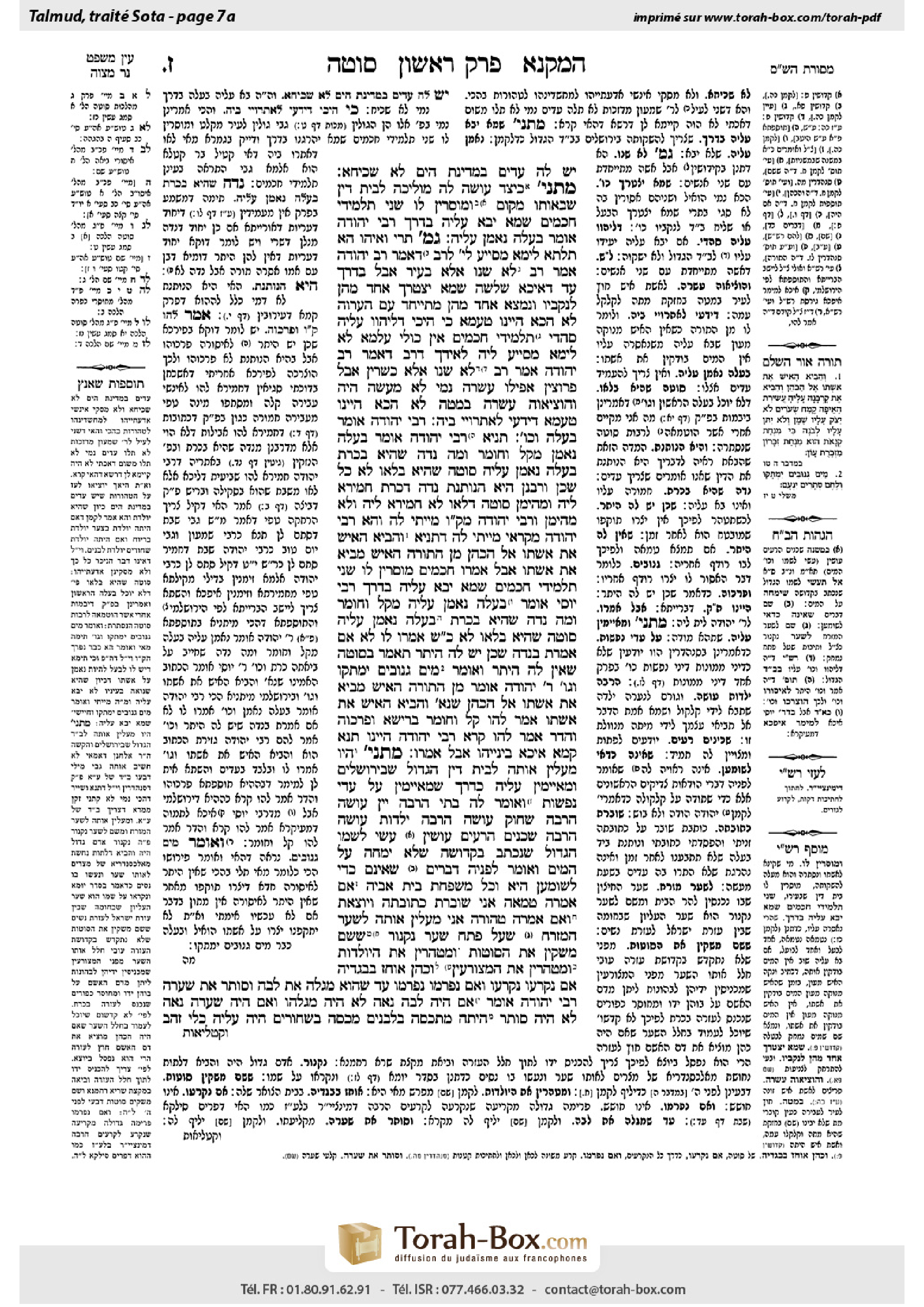
Sotah 7a: Talmud study for Daf Yomi
Daf Yomi is the daily study of one Talmud folio. Explore 37 tractates with scans, Hebrew text, Sefaria English and AI-generated French translations where annotated.
Passage selection and English or AI-generated French translation are available where the scan has annotations. Daf Study is independent of Torah-Box and Sefaria.
Browse Sotah · סוטה · All tractatesSotah 7a text and translations
This page of Sotah includes the Aramaic text, an English translation and an AI-generated French translation, alongside the scan above.
סוטה ז׳ א · Aramaic and Hebrew text
יֵשׁ לָהּ עֵדִים בִּמְדִינַת הַיָּם!
לָא שְׁכִיחָא.
מַתְנִי׳ כֵּיצַד עוֹשֶׂה לָהּ? מוֹלִיכָהּ לְבֵית דִּין שֶׁבְּאוֹתוֹ מָקוֹם, וּמוֹסְרִין לוֹ שְׁנֵי תַּלְמִידֵי חֲכָמִים, שֶׁמָּא יָבֹא עָלֶיהָ בַּדֶּרֶךְ. רַבִּי יְהוּדָה אוֹמֵר: בַּעְלָהּ נֶאֱמָן עָלֶיהָ.
גְּמָ׳ תְּרֵי וְאִיהוּ — הָא תְּלָתָא. לֵימָא מְסַיַּיע לֵיהּ לְרַב. דְּאָמַר רַב יְהוּדָה אָמַר רַב: לֹא שָׁנוּ אֶלָּא בָּעִיר, אֲבָל בַּדֶּרֶךְ — עַד דְּאִיכָּא שְׁלֹשָׁה, שֶׁמָּא יִצְטָרֵךְ אֶחָד מֵהֶן לִנְקָבָיו, וְנִמְצָא אֶחָד מֵהֶן מִתְיַיחֵד עִם הָעֶרְוָה.
לָא: הָכָא הַיְינוּ טַעְמָא כִּי הֵיכִי דְּלִיהְווֹ עֲלֵיהּ סָהֲדִי.
תַּלְמִידֵי חֲכָמִים — אִין, כּוּלֵּי עָלְמָא — לָא. לֵימָא מְסַיַּיע לֵיהּ לְאִידַּךְ דְּרַב, דְּאָמַר רַב יְהוּדָה אָמַר רַב: לֹא שָׁנוּ אֶלָּא כְּשֵׁרִין, אֲבָל פְּרוּצִין, אֲפִילּוּ עֲשָׂרָה נָמֵי לָא. מַעֲשֶׂה הָיָה וְהוֹצִיאוּהָ עֲשָׂרָה בְּמִטָּה.
לָא, הָכָא הַיְינוּ טַעְמָא — דְּיָדְעִי לְאַתְרוֹיֵי בֵּיהּ.
רַבִּי יְהוּדָה אוֹמֵר: בַּעְלָהּ וְכוּ׳. תַּנְיָא, רַבִּי יְהוּדָה אוֹמֵר, בַּעְלָהּ נֶאֱמָן מִקַּל וָחוֹמֶר: וּמָה נִדָּה שֶׁהִיא בְּכָרֵת — בַּעְלָהּ נֶאֱמָן עָלֶיהָ, סוֹטָה שֶׁהִיא בְּלָאו — לֹא כׇּל שֶׁכֵּן?!
וְרַבָּנַן, הִיא הַנּוֹתֶנֶת: נִדָּה דְּכָרֵת — חֲמִירָא לֵיהּ וּמְהֵימַן. סוֹטָה דְּלָאו — לָא חֲמִירָא לֵיהּ, וְלָא מְהֵימַן.
וְרַבִּי יְהוּדָה מִקַּל וָחוֹמֶר מַיְיתֵי לַהּ? וְהָא רַבִּי יְהוּדָה מִקְּרָאֵי מַיְיתֵי לַהּ! דְּתַנְיָא: ״וְהֵבִיא הָאִישׁ אֶת אִשְׁתּוֹ אֶל הַכֹּהֵן״. מִן הַתּוֹרָה הָאִישׁ מֵבִיא אֶת אִשְׁתּוֹ, אֲבָל אָמְרוּ חֲכָמִים: מוֹסְרִין לוֹ שְׁנֵי תַּלְמִידֵי חֲכָמִים, שֶׁמָּא יָבֹא עָלֶיהָ בַּדֶּרֶךְ.
רַבִּי יוֹסֵי אוֹמֵר, בַּעְלָהּ נֶאֱמָן עָלֶיהָ מִקַּל וָחוֹמֶר: וּמָה נִדָּה שֶׁהִיא בְּכָרֵת — בַּעְלָהּ נֶאֱמָן עָלֶיהָ, סוֹטָה שֶׁהִיא בְּלָאו — לֹא כׇּל שֶׁכֵּן?!
אָמְרוּ לוֹ: לֹא, אִם אָמַרְתָּ בְּנִדָּה — שֶׁכֵּן יֵשׁ לָהּ הֶיתֵּר, תֹּאמַר בְּסוֹטָה — שֶׁאֵין לָהּ הֶיתֵּר, וְאוֹמֵר: ״מַיִם גְּנוּבִים יִמְתָּקוּ וְגוֹ׳״.
רַבִּי יְהוּדָה אוֹמֵר: מִן הַתּוֹרָה הָאִישׁ מֵבִיא אֶת אִשְׁתּוֹ אֶל הַכֹּהֵן, שֶׁנֶּאֱמַר: ״וְהֵבִיא הָאִישׁ אֶת אִשְׁתּוֹ״!
אֲמַר לְהוּ קַל וָחוֹמֶר בְּרֵישָׁא וּפַרְכוּהּ, וַהֲדַר אָמַר לְהוּ קְרָא.
רַבִּי יְהוּדָה הַיְינוּ תַּנָּא קַמָּא! אִיכָּא בֵּינַיְיהוּ ״אֲבָל אָמְרוּ״.
מַתְנִי׳ הָיוּ מַעֲלִין אוֹתָהּ לְבֵית דִּין הַגָּדוֹל שֶׁבִּירוּשָׁלַיִם, וּמְאַיְּימִין עָלֶיהָ כְּדֶרֶךְ שֶׁמְּאַיְּימִין עַל עֵדֵי נְפָשׁוֹת.
וְאוֹמֵר לָהּ: בִּתִּי, הַרְבֵּה יַיִן עוֹשֶׂה, הַרְבֵּה שְׂחוֹק עוֹשֶׂה, הַרְבֵּה יַלְדוּת עוֹשָׂה, הַרְבֵּה שְׁכֵנִים הָרָעִים עוֹשִׂין.
עֲשִׂי לִשְׁמוֹ הַגָּדוֹל שֶׁנִּכְתַּב בִּקְדוּשָּׁה שֶׁלֹּא יִמָּחֶה עַל הַמַּיִם. וְאוֹמֵר לְפָנֶיהָ דְּבָרִים שֶׁאֵינָם כְּדַי לְשׁוֹמְעָן, הִיא וְכׇל מִשְׁפַּחַת בֵּית אָבִיהָ.
אִם אָמְרָה ״טְמֵאָה אֲנִי״ — שׁוֹבֶרֶת כְּתוּבָּתָהּ וְיוֹצֵאת.
וְאִם אָמְרָה ״טְהוֹרָה אֲנִי״ — מַעֲלִין אוֹתָהּ לְשַׁעַר הַמִּזְרָח שֶׁעַל פֶּתַח שַׁעַר נִקָּנוֹר, שֶׁשָּׁם מַשְׁקִין אֶת הַסּוֹטוֹת, וּמְטַהֲרִין אֶת הַיּוֹלְדוֹת, וּמְטַהֲרִין אֶת הַמְצוֹרָעִין.
וְכֹהֵן אוֹחֵז בִּבְגָדֶיהָ. אִם נִקְרְעוּ — נִקְרְעוּ. וְאִם נִפְרְמוּ — נִפְרְמוּ. עַד שֶׁהוּא מְגַלֶּה אֶת לִבָּהּ. וְסוֹתֵר אֶת שְׂעָרָהּ. רַבִּי יְהוּדָה אוֹמֵר: אִם הָיָה לִבָּהּ נָאֶה — לֹא הָיָה מְגַלֵּהוּ, וְאִם הָיָה שְׂעָרָהּ נָאֶה — לֹא הָיָה סוֹתֵר.
הָיְתָה מִתְכַּסָּה בִּלְבָנִים — מְכַסֶּהָ בִּשְׁחוֹרִים. הָיָה עָלֶיהָ כְּלֵי זָהָב
Sotah 7a · English translation
the case where there are witnesses for her in a country overseas who can testify that she engaged in sexual intercourse, when the bitter water will not evaluate her faithfulness. Therefore, Rabbi Shimon should be concerned that such a dispensation will result in the defamation of the untainted women who drank and were unaffected, as people will view them as guilty women who were not affected because there were witnesses overseas.
The Gemara answers: The case of witnesses in a country overseas is not common, and therefore no one will assume that that is the reason why the woman was not affected. By contrast, a woman having merit is common.
MISHNA: The mishna details the procedure for administering the drinking of the bitter water of a sota. What does her husband do with her after she secluded herself with the man about whom she had been warned? He brings her to the court that is found in that location, and the court provides him with two Torah scholars to accompany him, lest he engage in sexual intercourse with her on the way to the Temple, which is not only prohibited but will also prevent the bitter water from evaluating her. Rabbi Yehuda says: Her husband is trusted with regard to her, so there is no need to provide scholars to accompany him.
GEMARA: The Gemara assumes that the requirement for there to be two Torah scholars is to avoid the prohibition against a woman being alone with a man. The Gemara notes: Two additional men and he, the husband, are three people altogether. Let us say that this mishna supports the opinion of Rav, as Rav Yehuda says that Rav says: When they taught that it is permitted for a woman to be secluded with two men, they taught that this is permitted only in the town (see Kiddushin 80b). But on the way, when traveling, this is not permitted unless there are three men with the woman. The reason for this stringency is that if there are only two men with her, perhaps one will need to relieve himself and will seek privacy, and it will be found that one of them is in seclusion with a woman forbidden to him.
The Gemara refutes this assumption: No, here, in the case of a sota, this is the reason why there is a requirement for two scholars, so that there are two witnesses with regard to her, i.e., there will be two witnesses to testify in the event that the husband engages in sexual intercourse with her on the way to the Temple. The reason is not to avoid the prohibition against her being alone with a man, as one scholar would suffice for that.
The mishna teaches that the husband is provided with Torah scholars. The Gemara further comments: Torah scholars, yes; anyone else, no. It is specifically Torah scholars who are provided to accompany the husband and wife. Let us say that this mishna supports another statement of Rav, as Rav Yehuda says that Rav says: When they taught that it is permitted for a woman to be secluded with two men, they taught that this is permitted only with regard to men of fit morals. But with regard to those of loose morals, she may not be secluded even with ten men. The Gemara adds: There was an incident and ten men carried out a woman on a bier, as if she were dead, and engaged in sexual intercourse with her.
The Gemara refutes this assumption: No, here, in the case of a sota, this is the reason why there is a requirement for two scholars, that they know how to properly warn him not to engage in sexual intercourse with her. Therefore, this mishna does not support the opinion of Rav.
§ The Gemara now discusses Rabbi Yehuda’s statement in the mishna. Rabbi Yehuda says: Her husband is trusted with regard to her. It is taught in a baraita in the Tosefta (1:2): Rabbi Yehuda says: Her husband is trusted due to an a fortiori inference: And just as in the case of a menstruating woman, who is prohibited from engaging in sexual intercourse with her husband by penalty of karet, her husband is nevertheless trusted with regard to her, as he is permitted to seclude himself with her, so too, with regard to a sota, who is prohibited from engaging in sexual intercourse with her husband only by penalty of a prohibition, is it not all the more so that he should be trusted?
And the Rabbis say: That provides support for the contrary opinion, as these considerations lead to the opposite conclusion. A menstruating woman is forbidden by penalty of karet. This is a stringent prohibition for him, and this is why he is trusted not to engage in sexual intercourse with her. By contrast, a sota is forbidden to him only by a prohibition. This is not a stringent prohibition to him, and he is therefore not trusted with her.
The Gemara asks: And does Rabbi Yehuda in fact derive this halakha from an a fortiori inference? But Rabbi Yehuda derives it from a verse, as it is taught in a baraita: The verse: “Then shall the man bring his wife to the priest” (Numbers 5:15), teaches that by Torah law the man alone brings his wife to the Temple, but the Sages said: The court provides him with two Torah scholars to accompany him, lest he engage in sexual intercourse with her on the way to the Temple.
The baraita records a second opinion. Rabbi Yosei says: Her husband is trusted with regard to her based on an a fortiori inference: And just as a menstruating woman, who is prohibited from engaging in sexual intercourse with her husband by penalty of karet, and her husband is nevertheless trusted with regard to her, then with regard to a sota, who is prohibited from engaging in sexual intercourse with her husband by penalty of only a prohibition, should he not all the more so be trusted?
The Sages said to him: No, if you say that this is true with regard to a menstruating woman, the reason he is trusted is not due to the severity of the prohibition. Rather, he is trusted because she has the ability to become permitted to her husband after her menstrual flow has ceased and she has immersed in a ritual bath. Shall you also say that this is the case with regard to a sota, who potentially does not have the ability to become permitted to her husband due to her suspected adultery? And proof to the notion that people will more readily commit illicit acts that are permanently prohibited comes from the verse that states: “Stolen waters are sweet and bread eaten in secret is pleasing” (Proverbs 9:17). Consequently, there is a concern that the husband will engage in sexual intercourse with his sota wife if not accompanied by scholars.
The baraita quotes a third opinion. Rabbi Yehuda says: By Torah law, the man alone brings his wife to the Temple, as is stated: “Then shall the man bring his wife to the priest.” This baraita states explicitly that Rabbi Yehuda derives this halakha from the verse itself, not from an a fortiori inference.
The Gemara answers: Rabbi Yehuda first said to them the a fortiori inference, and they refuted it as mentioned above, and he then said to them the derivation from the verse.
The Gemara clarifies: Apparently, the opinion of Rabbi Yehuda is the same as that of the first tanna in the baraita, who also cites the verse as proof that by Torah law the husband alone brings his wife to the priest. The Gemara explains: The difference between them concerns the following clause: But the Sages said that the court provides him with two Torah scholars to accompany him. The first tanna holds that the Sages require two scholars to accompany the husband and wife, while Rabbi Yehuda holds that they do not.
MISHNA: The mishna details the next stage of the process. They would bring her up to the Sanhedrin that was in Jerusalem, and the judges would threaten her in order that she admit her sin. And this was done in the manner that they would threaten witnesses testifying in cases of capital law. In those cases, the judges would explain to the witnesses the gravity of their testimony by stressing the value of human life. Here too, the judges would attempt to convince the woman to admit her sin, to avoid the loss of her life.
And additionally, the judge would say to her: My daughter, wine causes a great deal of immoral behavior, levity causes a great deal of immoral behavior, immaturity causes a great deal of immoral behavior, and bad neighbors cause a great deal of immoral behavior. The judge encouraged her to admit her sin by explaining to her that he understands that there may have been mitigating factors.
The judge then continues: Act for the sake of His great name, so that God’s name, which is written in sanctity, shall not be erased on the water. If the woman admits to having committed adultery, the scroll upon which the name of God is written will not be erased. And additionally, the judge says in her presence matters that are not worthy of being heard by her and all her father’s family, in order to encourage her to admit her sin, as the Gemara will explain.
If after the judge’s warning she says: I am defiled, she writes a receipt for her marriage contract. That is, she writes a receipt indicating that she has no claims on her husband with regard to the sum written in her marriage contract, as a woman who admits to adultery forfeits her right to this payment. And she is then divorced from her husband.
But if after the warning she maintains her innocence and says: I am pure, they bring her up to the Eastern Gate, which is at the opening of the Gate of Nicanor, because three rites were performed there: They give the sota women the bitter water to drink, and they purify women who have given birth (see Leviticus 12:6–8), and they purify the lepers (see Leviticus 14:10–20).
The mishna continues describing the sota rite. And the priest grabs hold of her clothing and pulls them, unconcerned about what happens to the clothing. If the clothes are torn, so they are torn; if the stitches come apart, so they come apart. And he pulls her clothing until he reveals her heart, i.e., her chest. And then he unbraids her hair. Rabbi Yehuda says: If her heart was attractive he would not reveal it, and if her hair was attractive he would not unbraid it.
If she was dressed in white garments, he would now cover her with black garments. If she was wearing gold adornments,
Sotah 7a · Traduction française (IA)
le cas où des témoins se trouvent dans un pays d’outre-mer et peuvent témoigner qu’elle a eu des relations sexuelles : l’eau amère ne pourra alors pas évaluer sa fidélité. Rabbi Shimon devrait donc craindre qu’une telle dérogation n’entraîne la diffamation des femmes innocentes qui ont bu et n’ont subi aucun effet, car les gens les considéreront comme des femmes coupables que l’eau n’a pas affectées parce qu’il y avait des témoins outre-mer.
La Guemara répond : Le cas de témoins se trouvant dans un pays d’outre-mer est rare ; personne ne supposera donc que c’est la raison pour laquelle la femme n’a subi aucun effet. En revanche, il est fréquent qu’une femme ait un mérite.
MICHNA : La Michna détaille la procédure d’administration de l’eau amère à une sota. Que fait son mari avec elle après qu’elle s’est isolée avec l’homme au sujet duquel il l’avait mise en garde ? Il l’amène devant le tribunal qui se trouve à cet endroit, et le tribunal lui adjoint deux érudits en Torah pour l’accompagner, de peur qu’il n’ait des relations sexuelles avec elle en chemin vers le Temple ; cela est non seulement interdit, mais empêcherait aussi l’eau amère d’évaluer sa fidélité. Rabbi Yehouda dit : Son mari est digne de confiance à son égard ; il n’est donc pas nécessaire de lui adjoindre des érudits.
GUEMARA : La Guemara suppose que l’exigence de deux érudits vise à éviter l’interdiction pour une femme de se retrouver seule avec un homme. La Guemara fait remarquer : Il y a deux hommes supplémentaires et lui, le mari, soit trois personnes en tout. Disons que cette Michna étaye l’opinion de Rav, car Rav Yehouda rapporte au nom de Rav : Lorsqu’on a enseigné qu’il est permis à une femme de s’isoler avec deux hommes, on a enseigné que cela n’est permis qu’en ville (voir Kiddoushin 80b). En chemin, lorsqu’on voyage, cela n’est permis que si trois hommes accompagnent la femme. Cette rigueur s’explique ainsi : s’il n’y a que deux hommes avec elle, peut-être l’un d’eux devra-t-il se soulager et chercher un endroit à l’écart ; il se trouvera alors que l’autre est seul avec une femme qui lui est interdite.
La Guemara réfute cette hypothèse : Non, ici, dans le cas d’une sota, deux érudits sont requis afin qu’il y ait deux témoins à son sujet, c’est-à-dire deux témoins qui pourront témoigner si le mari a des relations sexuelles avec elle en chemin vers le Temple. Il ne s’agit pas d’éviter l’interdiction pour elle de se retrouver seule avec un homme, car un seul érudit suffirait à cette fin.
La Michna enseigne que des érudits en Torah sont adjoints au mari. La Guemara ajoute : Des érudits en Torah, oui ; toute autre personne, non. Ce sont spécifiquement des érudits en Torah qui sont chargés d’accompagner le mari et sa femme. Disons que cette Michna étaye une autre déclaration de Rav, car Rav Yehouda rapporte au nom de Rav : Lorsqu’on a enseigné qu’il est permis à une femme de s’isoler avec deux hommes, on a enseigné que cela n’est permis qu’avec des hommes de bonne moralité. Mais avec des hommes de mœurs légères, elle ne peut s’isoler même avec dix hommes. La Guemara ajoute : Il est arrivé que dix hommes transportent une femme sur une civière, comme si elle était morte, et aient des relations sexuelles avec elle.
La Guemara réfute cette hypothèse : Non, ici, dans le cas d’une sota, deux érudits sont requis parce qu’ils savent comment le mettre correctement en garde contre le fait d’avoir des relations sexuelles avec elle. Cette Michna n’étaye donc pas l’opinion de Rav.
§ La Guemara examine maintenant la déclaration de Rabbi Yehouda dans la Michna. Rabbi Yehouda dit : Son mari est digne de confiance à son égard. Une baraïta est enseignée dans la Tosefta (1:2) : Rabbi Yehouda dit : Son mari est digne de confiance en vertu d’un raisonnement a fortiori : de même que, dans le cas d’une femme menstruée, avec laquelle les relations sexuelles sont interdites à son mari sous peine de karet, son mari est néanmoins digne de confiance à son égard, puisqu’il lui est permis de s’isoler avec elle, à plus forte raison devrait-il être digne de confiance à l’égard d’une sota, avec laquelle les relations sexuelles sont interdites à son mari uniquement sous peine d’une interdiction.
Les Rabbins disent : Cela étaye l’opinion contraire, car ces considérations conduisent à la conclusion opposée. Les relations sexuelles avec une femme menstruée sont interdites sous peine de karet. Cette interdiction est grave pour lui, et c’est pourquoi on lui fait confiance pour ne pas avoir de relations sexuelles avec elle. En revanche, les relations sexuelles avec une sota ne lui sont interdites que par une simple interdiction. Cette interdiction n’est pas grave pour lui ; on ne lui fait donc pas confiance lorsqu’il est avec elle.
La Guemara demande : Rabbi Yehouda déduit-il réellement cette halakha d’un raisonnement a fortiori ? Pourtant, Rabbi Yehouda la déduit d’un verset, comme l’enseigne une baraïta : Le verset « Alors l’homme amènera sa femme au prêtre » (Nombres 5:15) enseigne que, selon la Torah écrite, l’homme seul amène sa femme au Temple ; mais les Sages ont dit que le tribunal lui adjoigne deux érudits en Torah pour l’accompagner, de peur qu’il n’ait des relations sexuelles avec elle en chemin vers le Temple.
La baraïta rapporte une deuxième opinion. Rabbi Yossi dit : Son mari est digne de confiance à son égard en vertu d’un raisonnement a fortiori : de même qu’une femme menstruée, avec laquelle les relations sexuelles sont interdites à son mari sous peine de karet, ne l’empêche pas d’être digne de confiance à son égard, qu’en est-il d’une sota, avec laquelle les relations sexuelles sont interdites à son mari sous peine d’une simple interdiction ? Ne devrait-il pas, à plus forte raison, être digne de confiance ?
Les Sages lui répondirent : Non. Si tu dis que cela est vrai pour une femme menstruée, ce n’est pas en raison de la gravité de l’interdiction qu’on lui fait confiance. C’est plutôt parce qu’elle peut redevenir permise à son mari une fois son flux menstruel terminé et après s’être immergée dans un bain rituel. Dirais-tu la même chose d’une sota, qui pourrait ne pas avoir la possibilité de redevenir permise à son mari en raison de l’adultère dont elle est soupçonnée ? La preuve que les gens commettent plus facilement des actes illicites lorsqu’ils sont interdits de façon permanente se trouve dans le verset : « Les eaux dérobées sont douces, et le pain mangé en secret est agréable » (Proverbes 9:17). On craint donc que le mari ait des relations sexuelles avec sa femme sota s’il n’est pas accompagné d’érudits.
La baraïta rapporte une troisième opinion. Rabbi Yehouda dit : Selon la Torah écrite, l’homme seul amène sa femme au Temple, comme il est dit : « Alors l’homme amènera sa femme au prêtre. » Cette baraïta affirme explicitement que Rabbi Yehouda déduit cette halakha du verset lui-même, et non d’un raisonnement a fortiori.
La Guemara répond : Rabbi Yehouda leur a d’abord présenté le raisonnement a fortiori ; ils l’ont réfuté, comme indiqué plus haut, puis il leur a présenté la déduction tirée du verset.
La Guemara précise : Apparemment, l’opinion de Rabbi Yehouda est la même que celle du premier tanna de la baraïta, qui cite lui aussi le verset comme preuve que, selon la Torah écrite, le mari seul amène sa femme au prêtre. La Guemara explique : Leur divergence porte sur la clause suivante : « Mais les Sages ont dit que le tribunal lui adjoigne deux érudits en Torah pour l’accompagner. » Le premier tanna estime que les Sages exigent que deux érudits accompagnent le mari et sa femme, tandis que Rabbi Yehouda estime que ce n’est pas le cas.
MICHNA : La Michna détaille l’étape suivante de la procédure. On la faisait monter devant le Sanhédrin qui se trouvait à Jérusalem, et les juges l’intimidaient afin qu’elle avoue sa faute. Cela se faisait de la même manière qu’on intimidait les témoins qui déposaient dans les affaires de droit pénal. Dans ces affaires, les juges expliquaient aux témoins la gravité de leur déposition en insistant sur la valeur de la vie humaine. Ici aussi, les juges tentaient de convaincre la femme d’avouer sa faute afin d’éviter qu’elle ne perde la vie.
De plus, le juge lui disait : Ma fille, le vin entraîne beaucoup de comportements immoraux ; la légèreté entraîne beaucoup de comportements immoraux ; l’immaturité entraîne beaucoup de comportements immoraux ; et de mauvais voisins entraînent beaucoup de comportements immoraux. Le juge l’encourageait à avouer sa faute en lui expliquant qu’il comprenait qu’il pouvait y avoir des circonstances atténuantes.
Le juge poursuivait : Agis pour la gloire de Son grand Nom, afin que le Nom de Dieu, écrit avec sainteté, ne soit pas effacé dans l’eau. Si la femme avoue avoir commis un adultère, le rouleau sur lequel le Nom de Dieu est écrit ne sera pas effacé. De plus, le juge dit en sa présence des choses qu’elle et toute la famille de son père ne devraient pas entendre, afin de l’encourager à avouer sa faute, comme la Guemara l’expliquera.
Si, après l’avertissement du juge, elle dit : « Je suis souillée », elle rédige une quittance relative à son contrat de mariage. Autrement dit, elle rédige une quittance indiquant qu’elle ne réclame rien à son mari au titre de la somme inscrite dans son contrat de mariage, car une femme qui avoue un adultère perd son droit à ce paiement. Elle est alors divorcée de son mari.
Mais si, après l’avertissement, elle maintient qu’elle est innocente et dit : « Je suis pure », on la fait monter à la Porte orientale, située à l’entrée de la Porte de Nicanor, car trois rites y étaient accomplis : on y faisait boire l’eau amère aux femmes sota, on y purifiait les femmes qui avaient accouché (voir Lévitique 12:6–8), et on y purifiait les lépreux (voir Lévitique 14:10–20).
La Michna poursuit la description du rite de la sota. Le prêtre saisit ses vêtements et les tire, sans se soucier de ce qu’il leur advient. S’ils se déchirent, qu’ils se déchirent ; si les coutures se défont, qu’elles se défont. Il tire ses vêtements jusqu’à dévoiler son cœur, c’est-à-dire sa poitrine. Puis il défait ses cheveux. Rabbi Yehouda dit : Si sa poitrine était belle, il ne la dévoilait pas ; et si ses cheveux étaient beaux, il ne les défaisait pas.
Si elle était vêtue de vêtements blancs, il la couvrait alors de vêtements noirs. Si elle portait des ornements en or,
Traduction française générée par IA à partir de l’édition anglaise de Sefaria. Vérifie toujours un passage avec le texte source.
Text from Sefaria: William Davidson Edition - Vocalized Aramaic (CC BY NC); William Davidson Edition - English (CC BY NC).