Sotah 11a: Talmud study for Daf Yomi
Daf Yomi is the daily study of one Talmud folio. Explore 37 tractates with scans, Hebrew text, Sefaria English and AI-generated French translations where annotated.
Passage selection and English or AI-generated French translation are available where the scan has annotations. Daf Study is independent of Torah-Box and Sefaria.
Browse Sotah · סוטה · All tractatesSotah 11a text and translations
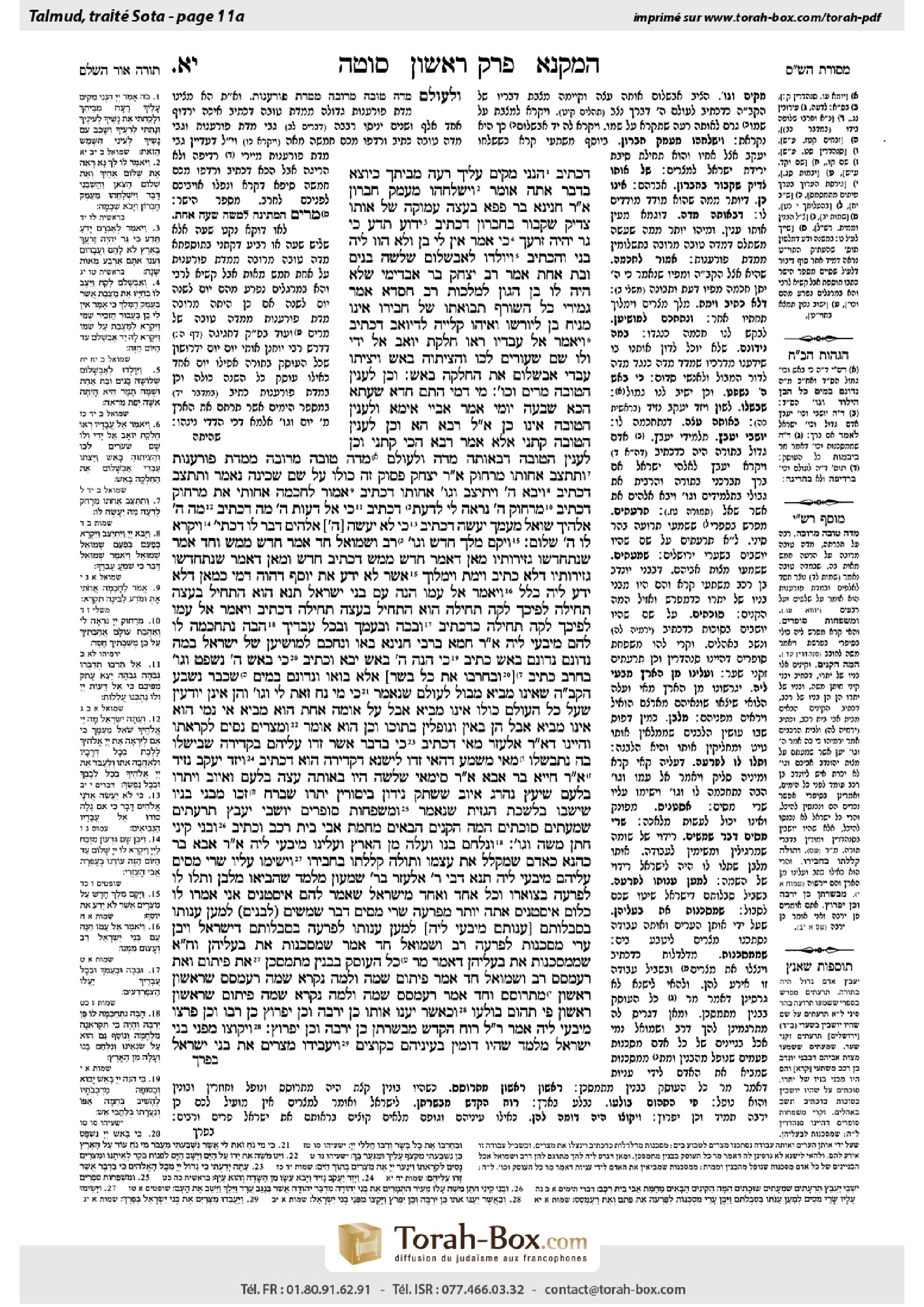
This page of Sotah includes the Aramaic text, an English translation and an AI-generated French translation, alongside the scan above.
סוטה י״א א · Aramaic and Hebrew text
דִּכְתִיב: ״הִנְנִי מֵקִים עָלֶיךָ רָעָה מִבֵּיתֶךָ״. כַּיּוֹצֵא בַּדָּבָר אַתָּה אוֹמֵר: ״וַיִּשְׁלָחֵהוּ מֵעֵמֶק חֶבְרוֹן״, אָמַר רַבִּי חֲנִינָא בַּר פָּפָּא: בְּעֵצָה עֲמוּקָּה שֶׁל אוֹתוֹ צַדִּיק שֶׁקָּבוּר בְּחֶבְרוֹן, דִּכְתִיב: ״יָדֹעַ תֵּדַע כִּי גֵר יִהְיֶה זַרְעֲךָ״.
״כִּי אָמַר אֵין לִי בֵן״. וְלָא הֲווֹ לֵיהּ בְּנֵי? וְהָכְתִיב: ״וַיִּוָּלְדוּ לְאַבְשָׁלוֹם שְׁלֹשָׁה בָּנִים וּבַת אַחַת״! אָמַר רַב יִצְחָק בַּר אַבְדִּימִי: שֶׁלֹּא הָיָה לוֹ בֵּן הָגוּן לַמַּלְכוּת. רַב חִסְדָּא אָמַר, גְּמִירִי: כׇּל הַשּׂוֹרֵף תְּבוּאָתוֹ שֶׁל חֲבֵירוֹ, אֵינוֹ מַנִּיחַ בֵּן לְיוֹרְשׁוֹ. וְאִיהוּ קַלְיַיהּ לִדְיוֹאָב, דִּכְתִיב: ״וַיֹּאמֶר אֶל עֲבָדָיו רְאוּ חֶלְקַת יוֹאָב אֶל יָדִי וְלוֹ שָׁם שְׂעֹרִים לְכוּ וְהַצִּיתוּהָ בָאֵשׁ וַיַּצִּיתוּ עַבְדֵי אַבְשָׁלוֹם אֶת הַחֶלְקָה בָּאֵשׁ״.
וְכֵן לְעִנְיַן הַטּוֹבָה מִרְיָם וְכוּ׳. מִי דָּמֵי? הָתָם — חֲדָא שַׁעְתָּא, הָכָא — שִׁבְעָה יוֹמֵי! אָמַר אַבָּיֵי, אֵימָא: וּלְעִנְיַן הַטּוֹבָה אֵינוֹ כֵּן.
אֲמַר לֵיהּ רָבָא: הָא ״וְכֵן לְעִנְיַן הַטּוֹבָה״ קָתָנֵי! אֶלָּא אָמַר רָבָא, הָכִי קָתָנֵי: וְכֵן לְעִנְיַן הַטּוֹבָה, דִּבְאוֹתָהּ מִדָּה, וּלְעוֹלָם מִדָּה טוֹבָה מְרוּבָּה מִמִּדַּת פּוּרְעָנוּת.
״וַתֵּתַצַּב אֲחוֹתוֹ מֵרָחוֹק״, אָמַר רַבִּי יִצְחָק: פָּסוּק זֶה כּוּלּוֹ עַל שֵׁם שְׁכִינָה נֶאֱמַר: ״וַתֵּתַצַּב״ — דִּכְתִיב: ״וַיָּבֹא ה׳ וַיִּתְיַצַּב וְגוֹ׳״. ״אֲחוֹתוֹ״ — דִּכְתִיב: ״אֱמֹר לַחׇכְמָה אֲחוֹתִי אָתְּ״. ״מֵרָחוֹק״ — דִּכְתִיב: ״מֵרָחוֹק ה׳ נִרְאָה לִי״. ״לָדַעַת״ — דִּכְתִיב: ״כִּי אֵל דֵּעוֹת ה׳״. ״מָה״ — דִּכְתִיב: ״מַה ה׳ אֱלֹהֶיךָ שֹׁאֵל מֵעִמָּךְ״. ״יֵּעָשֶׂה״ — דִּכְתִיב: ״כִּי לֹא יַעֲשֶׂה ה׳ אֱלֹהִים דָּבָר״. ״לוֹ״ — דִּכְתִיב: ״וַיֹּאמֶר לוֹ ה׳ שָׁלוֹם״.
״וַיָּקׇם מֶלֶךְ חָדָשׁ וְגוֹ׳״. רַב וּשְׁמוּאֵל, חַד אָמַר: חָדָשׁ מַמָּשׁ, וְחַד אָמַר: שֶׁנִּתְחַדְּשׁוּ גְּזֵירוֹתָיו. מַאן דְּאָמַר חָדָשׁ מַמָּשׁ — דִּכְתִיב ״חָדָשׁ״, וּמַאן דְּאָמַר שֶׁנִּתְחַדְּשׁוּ גְּזֵירוֹתָיו, דְּלָא כְּתִיב ״וַיָּמׇת וַיִּמְלוֹךְ״. ״אֲשֶׁר לֹא יָדַע אֶת יוֹסֵף״, דַּהֲוָה דָּמֵי כְּמַאן דְּלָא יָדַע לֵיהּ כְּלָל.
״וַיֹּאמֶר אֶל עַמּוֹ הִנֵּה עַם בְּנֵי יִשְׂרָאֵל״. תָּנָא: הוּא הִתְחִיל בְּעֵצָה תְּחִילָּה לְפִיכָךְ לָקָה תְּחִילָּה. הוּא הִתְחִיל בְּעֵצָה תְּחִילָּה — דִּכְתִיב: ״וַיֹּאמֶר אֶל עַמּוֹ״, לְפִיכָךְ לָקָה תְּחִילָּה — כְּדִכְתִיב: ״וּבְכָה וּבְעַמְּךָ וּבְכׇל עֲבָדֶיךָ״.
״הָבָה נִתְחַכְּמָה לוֹ״. ״לָהֶם״ מִיבְּעֵי לֵיהּ! אָמַר רַבִּי חָמָא בְּרַבִּי חֲנִינָא: בֹּאוּ וְנֶחְכַּם לְמוֹשִׁיעָן שֶׁל יִשְׂרָאֵל —
בַּמֶּה נְדוּנֵם? נְדוּנֵם בָּאֵשׁ — כְּתִיב: ״כִּי הִנֵּה ה׳ בָּאֵשׁ יָבֹא״, וּכְתִיב: ״כִּי בָאֵשׁ ה׳ נִשְׁפָּט וְגוֹ׳״. בְּחֶרֶב — כְּתִיב: [״וּבְחַרְבּוֹ אֶת כׇּל בָּשָׂר״].
אֶלָּא בּוֹאוּ וּנְדוּנֵם בַּמַּיִם, שֶׁכְּבָר נִשְׁבַּע הַקָּדוֹשׁ בָּרוּךְ הוּא שֶׁאֵינוֹ מֵבִיא מַבּוּל לָעוֹלָם, שֶׁנֶּאֱמַר: ״כִּי מֵי נֹחַ זֹאת לִי וְגוֹ׳״. וְהֵן אֵינָן יוֹדְעִין שֶׁעַל כׇּל הָעוֹלָם כּוּלּוֹ אֵינוֹ מֵבִיא, אֲבָל עַל אוּמָּה אַחַת הוּא מֵבִיא.
אִי נָמֵי: הוּא אֵינוֹ מֵבִיא, אֲבָל הֵן בָּאִין וְנוֹפְלִין בְּתוֹכוֹ. וְכֵן הוּא אוֹמֵר: ״וּמִצְרַיִם נָסִים לִקְרָאתוֹ״. וְהַיְינוּ דְּאָמַר רַבִּי אֶלְעָזָר: מַאי דִּכְתִיב ״כִּי בַדָּבָר אֲשֶׁר זָדוּ עֲלֵיהֶם״ — בִּקְדֵירָה שֶׁבִּישְּׁלוּ, בָּהּ נִתְבַּשְּׁלוּ. מַאי מַשְׁמַע דְּהַאי ״זָדוּ״ לִישָּׁנָא דִקְדֵירָה הוּא — דִּכְתִיב: ״וַיָּזֶד יַעֲקֹב נָזִיד״.
אָמַר רַבִּי חִיָּיא בַּר אַבָּא אָמַר רַבִּי סִימַאי: שְׁלֹשָׁה הָיוּ בְּאוֹתָהּ עֵצָה: בִּלְעָם, וְאִיּוֹב, וְיִתְרוֹ.
בִּלְעָם שֶׁיָּעַץ — נֶהֱרַג, אִיּוֹב שֶׁשָּׁתַק — נִידּוֹן בְּיִסּוּרִין. יִתְרוֹ שֶׁבָּרַח — זָכוּ מִבְּנֵי בָנָיו שֶׁיָּשְׁבוּ בְּלִשְׁכַּת הַגָּזִית, שֶׁנֶּאֱמַר: ״וּמִשְׁפְּחוֹת סוֹפְרִים יוֹשְׁבֵי יַעְבֵּץ תִּרְעָתִים שִׁמְעָתִים שׂוּכָתִים הֵמָּה הַקִּינִים הַבָּאִים מֵחַמַּת אֲבִי בֵית רֵכָב״, וּכְתִיב: ״וּבְנֵי קֵינִי חֹתֵן מֹשֶׁה וְגוֹ׳״.
״וְנִלְחַם בָּנוּ וְעָלָה מִן הָאָרֶץ״, ״וְעָלִינוּ״ מִיבְּעֵי לֵיהּ! אָמַר רַבִּי אַבָּא בַּר כָּהֲנָא: כְּאָדָם שֶׁמְּקַלֵּל אֶת עַצְמוֹ, וְתוֹלֶה קִלְלָתוֹ בַּחֲבֵירוֹ.
״וַיָּשִׂימוּ עָלָיו שָׂרֵי מִסִּים״, ״עֲלֵיהֶם״ מִיבְּעֵי לֵיהּ! תָּנָא דְּבֵי רַבִּי אֶלְעָזָר בְּרַבִּי שִׁמְעוֹן: מְלַמֵּד שֶׁהֵבִיאוּ מַלְבֵּן וְתָלוּ לוֹ לְפַרְעֹה בְּצַוָּארוֹ, וְכׇל אֶחָד וְאֶחָד מִיִּשְׂרָאֵל שֶׁאָמַר לָהֶם אִיסְטְנִיס אֲנִי, אָמְרוּ לוֹ: כְּלוּם אִיסְטְנִיס אַתָּה יוֹתֵר מִפַּרְעֹה?
״שָׂרֵי מִסִּים״, דָּבָר שֶׁמֵּשִׂים (לְבֵנִים).
״לְמַעַן עַנּוֹתוֹ בְּסִבְלוֹתָם״, [״עַנּוֹתָם״ מִיבְּעֵי לֵיהּ]! לְמַעַן עַנּוֹתוֹ לְפַרְעֹה בְּסִבְלוֹתָם דְּיִשְׂרָאֵל.
״וַיִּבֶן עָרֵי מִסְכְּנוֹת לְפַרְעֹה״, רַב וּשְׁמוּאֵל, חַד אָמַר: שֶׁמְּסַכְּנוֹת אֶת בַּעְלֵיהֶן. וְחַד אָמַר: שֶׁמְּמַסְכְּנוֹת אֶת בַּעְלֵיהֶן, דְּאָמַר מָר: כׇּל הָעוֹסֵק בְּבִנְיָן מִתְמַסְכֵּן.
״אֶת פִּיתוֹם וְאֶת רַעַמְסֵס״. רַב וּשְׁמוּאֵל, חַד אָמַר: פִּיתוֹם שְׁמָהּ, וְלָמָּה נִקְרָא שְׁמָהּ רַעַמְסֵס — שֶׁרִאשׁוֹן רִאשׁוֹן מִתְרוֹסֵס. וְחַד אָמַר: רַעַמְסֵס שְׁמָהּ, וְלָמָּה נִקְרָא שְׁמָהּ פִּיתוֹם — שֶׁרִאשׁוֹן רִאשׁוֹן פִּי תְהוֹם בּוֹלְעוֹ.
״וְכַאֲשֶׁר יְעַנּוּ אוֹתוֹ כֵּן יִרְבֶּה וְכֵן יִפְרוֹץ״. ״כֵּן רַבּוּ וְכֵן פָּרְצוּ״ מִיבְּעֵי לֵיהּ! אָמַר רֵישׁ לָקִישׁ: רוּחַ הַקֹּדֶשׁ מְבַשַּׂרְתָּן: ״כֵּן יִרְבֶּה וְכֵן יִפְרוֹץ״. ״וַיָּקֻצוּ מִפְּנֵי בְּנֵי יִשְׂרָאֵל״, מְלַמֵּד שֶׁהָיוּ דּוֹמִין בְּעֵינֵיהֶם כְּקוֹצִים.
״וַיַּעֲבִדוּ מִצְרַיִם אֶת בְּנֵי יִשְׂרָאֵל
Sotah 11a · English translation
This is as it is written there: “Thus said the Lord: Behold, I will raise up evil against you out of your own house” (II Samuel 12:11), and this prophecy was fulfilled through Absalom. Similarly, you can say about Joseph, who was sent by his father to inquire as to the well-being of his brothers, where the verse states: “And he sent him from the valley [emek] of Hebron” (Genesis 37:14). Rabbi Ḥanina bar Pappa says: From the deep [amukka] counsel of that righteous individual who is interred in Hebron, i.e., Abraham, as it is written: “And He said unto Abram: Know that your seed shall be a stranger in a land that is not theirs, and shall serve them; and they shall afflict them four hundred years” (Genesis 15:13). The journey Joseph took to his brothers set in motion the descent of the Jewish people to Egypt.
The Gemara continues its discussion of Absalom. The verse states concerning Absalom: “For he said: I have no son to keep my name in remembrance; and he called the pillar after his own name; and it is called Absalom’s monument to this day” (II Samuel 18:18). The Gemara asks: And did Absalom not have sons? But isn’t it written: “And to Absalom there were born three sons, and one daughter” (II Samuel 14:27)? Rav Yitzḥak bar Avdimi says: He meant that he did not have a son worthy for royalty. Rav Ḥisda said: It is learned as a tradition: Anyone who burns the produce of another does not leave a son to inherit from him, and he, Absalom, burned the produce of Joab, as it is written: “Therefore he said to his servants: See, Joab’s field is near mine, and he has barley there; go and set it on fire. And Absalom’s servants set the field on fire” (II Samuel 14:30).
§ The mishna teaches: And the same is so with regard to the reward for good deeds. Miriam waited for the baby Moses for one hour at the shore of the Nile; therefore, the Jewish people delayed their travels in the desert for seven days to wait for her when she was smitten with leprosy. The Gemara asks: Are these matters comparable? There, Miriam waited one hour, while here, the Jewish people waited for her for seven days. Abaye said: Say this with a slight change: And with regard to the repaying of good it is not so, as a person is not rewarded precisely measure for measure, as the reward may be greater than the good deed.
Rava said to him: But the tanna taught in the mishna: And the same is so with regard to the reward of good deeds. Rather, Rava said: This is what the mishna is teaching: And the same is so with regard to the reward of good deeds. It is rewarded with the same measure, i.e., a person is rewarded in the same manner as the good deed, but the measure of good is always greater than the measure of punishment. Therefore, Miriam was rewarded in the same manner as, but in a greater measure than, her deed.
With regard to Miriam’s deed the verse states: “And his sister stood afar off, to know what would be done to him” (Exodus 2:4). Rabbi Yitzḥak says: This entire verse is stated in reference to the Divine Presence, i.e., each phrase alludes to the Divine Presence watching over Moses. “And his sister stood”; as it is written: “And the Lord came, and stood” (I Samuel 3:10). “His sister”; as it is written: “Say to wisdom: You are my sister” (Proverbs 7:4). “Afar off”; as it is written: “From afar the Lord appeared to me” (Jeremiah 31:2). “To know”; as it is written: “For the Lord is a God of knowledge” (I Samuel 2:3). “What”; as it is written: “What does the Lord God require of you” (Deuteronomy 10:12). “Would be done”; as it is written: “For the Lord God will do nothing” (Amos 3:7). “To him”; as it is written: “And the Lord said to him: Peace be with you” (Judges 6:23).
§ The Gemara proceeds to discuss the sojourn of the Jewish people in Egypt. The verse states: “And there arose a new king over Egypt, who knew not Joseph” (Exodus 1:8). Rav and Shmuel disagree about the interpretation of this verse. One says that this means he was actually a new king, and one says that this means that his decrees were transformed as if he were a new king. The one who says that he was actually a new king holds that it is because it is written “new.” And the one who says that his decrees were transformed holds that it is because it is not written: “And the previous king of Egypt died and a new king reigned.” This indicates that the same king remained. According to this interpretation, the words: “Who knew not Joseph” (Exodus 1:8), mean that he was like someone who did not know him at all. Although he certainly knew Joseph and his accomplishments, he acted as if he didn’t.
The next verse states: “And he said to his people: Behold, the people of the children of Israel are too many and too mighty for us” (Exodus 1:9). It was taught (Tosefta 4:11): He, Pharaoh, initiated the proposal. Therefore, of his people, he was stricken first. He initiated the proposal, as it is written: “And he said to his people.” Therefore, he was stricken first, as it is written: “And the frogs shall come up both upon you, and upon your people, and upon all your servants” (Exodus 7:29).
The next verse states that Pharaoh said: “Come, let us deal wisely with him [lo], lest he multiply, and it come to pass that when there befalls us any war, he will also join our enemies, and fight against us” (Exodus 1:10). The Gemara comments: He should have said in plural: With them [lahem], rather than the singular: “With him.” Rabbi Ḥama, son of Rabbi Ḥanina, says that Pharaoh was saying: Come, let us deal wisely with regard to the savior of Israel, referring to God.
His advisors asked: With what form of death shall we judge and decree upon them? If we shall judge them with fire, perhaps we will be punished measure for measure by fire, as it is written: “For behold, the Lord will come in fire” (Isaiah 66:15), and it is written in the verse that follows it: “For by fire will the Lord contend” (Isaiah 66:16). Similarly, we cannot judge them with the sword, as it is written in the continuation of that verse: “And by His sword with all flesh” (Isaiah 66:16).
Rather, let us come and judge them with water, by drowning the Jewish babies. God will not punish us with water, for the Holy One, Blessed be He, already took an oath that He will not bring a flood upon the world, as it is stated: “For this is as the waters of Noah unto Me; for as I have sworn that the waters of Noah should no more go over the earth” (Isaiah 54:9). The Gemara comments: And Pharaoh’s advisors did not know that He will not bring a flood upon all the world, but He may bring destruction by water upon one nation.
Alternatively, there is an additional way to punish the Egyptians with water: He does not bring a flood upon them, but they may come and fall into water, and so it says: “And the sea returned to its strength when the morning appeared; and the Egyptians fled toward it; and the Lord overthrew the Egyptians in the midst of the sea” (Exodus 14:27), indicating that the Egyptians fell into the water. And this is what Rabbi Elazar says: What is the meaning of that which is written: “Now I know that the Lord is greater than all gods, for in that which they conspired [zadu] against them” (Exodus 18:11)? The phrase means: In the pot in which they cooked, they themselves were cooked, as they were punished through drowning, measure for measure, for drowning the Jewish babies. The Gemara asks: From where may it be inferred that this word “zadu” is a term meaning a pot? The Gemara answers: As it is written: “And Jacob simmered a pot [vayyazed Ya’akov nazid]” (Genesis 25:29).
Rabbi Ḥiyya bar Abba says that Rabbi Simai says: Three noteworthy people were consulted by Pharaoh in that counsel where Pharaoh questioned what should be done with the Jewish people. They were Balaam, and Job, and Yitro.
Rabbi Ḥiyya bar Abba teaches what occurred to each of them: Balaam, who advised Pharaoh to kill all sons born to the Jewish people, was punished by being killed in the war with Midian (see Numbers 31:8). Job, who was silent and neither advised nor protested, was punished by suffering, as detailed in the eponymous book in the Bible. Yitro, who ran away as a sign of protest, merited that some of his children’s children sat in the Sanhedrin in the Chamber of Hewn Stone, as it is stated: “And the families of scribes who dwelt at Jabez, Tirathites, Shimeathites, and Sucathites, these were the Kenites who descended from Hammath, the father of the house of Rechab” (I Chronicles 2:55). And it is written: “The children of the Kenite, Moses’ father-in-law” (Judges 1:16). This teaches that the Kenites, descendants of Yitro, the father-in-law of Moses, dwelt at Jabez [Yabetz], referring to the place where the Jewish people go for advice [eitza], i.e., the Chamber of Hewn Stone.
The verse states: “Come, let us deal wisely with him, lest he multiply, and it come to pass that when there befalls us any war, he will also join our enemies, and fight against us, and get him up out of the land” (Exodus 1:10). The Gemara comments: He should have said: And get us up, as Pharaoh’s fear was that the Jewish people would join the enemies of Egypt and drive Pharaoh and the Egyptians out of Egypt. Rabbi Abba bar Kahana says: By stating this, Pharaoh is like a person who curses himself but applies his curse to another.
The next verse states: “Therefore they did set over him taskmasters in order to afflict him with their burdens” (Exodus 1:11). The Gemara comments: It should have stated: Over them, in the plural. The school of Rabbi Elazar, son of Rabbi Shimon, taught: This teaches that at first they brought a brick mold and they hung it on the neck of Pharaoh to create the appearance that he was also participating in the labor. And with regard to each and every Jew who said to the Egyptians: I am a delicate person [istenis] and I cannot participate in the labor, they said to him: Are you at all more of a delicate person than Pharaoh, and he is participating. Therefore, the verse states: “They did set over him,” as they first placed the burden on Pharaoh as an artifice to enslave the Jewish people.
The term “Taskmasters [sarei missim]” is formed from the term: A matter that compels [shemesim] the manufacture of bricks, as the Jewish people were forced into labor when these taskmasters were assigned to them.
The verse continues: “In order to afflict him with their burdens” (Exodus1:11). The Gemara comments: It should have stated: “In order to afflict them,” in the plural. Rather, the intention is, as mentioned previously, in order to afflict Pharaoh, with the result of causing the burdens of the Jewish people.
The verse concludes: “And they built for Pharaoh storage cities [miskenot], Pithom and Raamses” (Exodus 1:11). Rav and Shmuel disagree as to the precise interpretation of the word miskenot. One says that they are called this because they were the type of structures that endanger [mesakenot] their owners, as it is dangerous to work in cities with tall buildings. And one says that they are called this because this is the type of property that impoverishes [memaskenot] their owners, as the Master said: All who engage in construction become poor.
The verse states that the names of the cities they built were “Pithom and Raamses” (Exodus 1:11). Rav and Shmuel disagree as to the precise interpretation of this verse, both assuming that only one city was built, which had primary and secondary names. One says that Pithom was its real name, and why was it called Raamses? It is an appellation indicating that as the buildings were constructed they collapsed [mitroses] one by one and needed to be rebuilt. And one says that Raamses was its real name, and why was it called Pithom? Because the opening of the abyss [pi tehom] swallowed each building they constructed one by one, and it sunk into the ground.
The next verse states: “But the more they afflicted him, the more he would multiply and the more he would spread about” (Exodus 1:12). The Gemara comments: It should have stated: The more they multiplied and the more they spread about, in the past tense. Reish Lakish says: Divine inspiration proclaimed to the Egyptians: As long as this nation is afflicted, the more he will multiply and the more he will spread about. As the verse states: “And they became disgusted [vayyakutzu] due to the children of Israel.” The Gemara explains: This teaches that the Jewish people appeared in their eyes like thorns [kotzim].
The next verse states: “And the Egyptians made the children of Israel work
Sotah 11a · Traduction française (IA)
C’est ce qui est écrit là-bas : « Ainsi parle le Seigneur : Voici, je vais faire surgir contre toi le malheur de ta propre maison » (II Samuel 12:11), et cette prophétie s’accomplit par l’intermédiaire d’Absalom. De même, on peut dire au sujet de Joseph, que son père envoya prendre des nouvelles de ses frères, au sujet duquel le verset dit : « Il l’envoya de la vallée [emek] de Hébron » (Genèse 37:14). Rabbi Ḥanina bar Pappa dit : Cela vient du profond [amukka] dessein de ce juste enseveli à Hébron, c’est-à-dire Abraham, comme il est écrit : « Il dit à Abram : Sache que ta descendance sera étrangère dans un pays qui ne sera pas le sien ; elle les servira, et ils l’opprimeront pendant quatre cents ans » (Genèse 15:13). Le voyage de Joseph vers ses frères mit en branle la descente du peuple juif en Égypte.
La Guemara poursuit son étude au sujet d’Absalom. Le verset dit à son propos : « Car il disait : Je n’ai pas de fils pour perpétuer mon nom ; il donna son nom à la stèle, et on l’appelle encore aujourd’hui le monument d’Absalom » (II Samuel 18:18). La Guemara demande : Absalom n’avait-il donc pas de fils ? Pourtant, n’est-il pas écrit : « Absalom eut trois fils et une fille » (II Samuel 14:27) ? Rav Yitzḥak bar Avdimi dit : Il voulait dire qu’il n’avait pas de fils digne de la royauté. Rav Ḥisda dit : La tradition enseigne que quiconque brûle les récoltes d’autrui ne laisse pas de fils pour hériter de lui ; or Absalom brûla les récoltes de Joab, comme il est écrit : « Il dit donc à ses serviteurs : Voyez, le champ de Joab est près du mien, et il y a de l’orge ; allez-y mettre le feu. Et les serviteurs d’Absalom mirent le feu au champ » (II Samuel 14:30).
§ La Michna enseigne : Il en va de même pour la récompense des bonnes actions. Miriam attendit une heure le bébé Moïse sur la rive du Nil ; c’est pourquoi le peuple juif interrompit ses déplacements dans le désert pendant sept jours afin de l’attendre lorsqu’elle fut frappée de lèpre. La Guemara demande : Ces deux cas sont-ils comparables ? Dans le premier, Miriam attendit une heure, tandis que dans le second, le peuple juif l’attendit sept jours. Abaye dit : Il faut légèrement reformuler : En ce qui concerne la rétribution du bien, il n’en va pas ainsi, car une personne n’est pas récompensée exactement mesure pour mesure ; la récompense peut être supérieure à la bonne action.
Rava lui dit : Pourtant, le tanna a enseigné dans la Michna : « Il en va de même pour la récompense des bonnes actions. » Rava dit plutôt : Voici ce qu’enseigne la Michna : Il en va de même pour la récompense des bonnes actions. La récompense correspond à la même mesure, c’est-à-dire qu’une personne est récompensée de la même manière que sa bonne action, mais la mesure du bien est toujours supérieure à celle du châtiment. Miriam fut donc récompensée de la même manière que pour son action, mais dans une mesure supérieure.
Au sujet de l’action de Miriam, le verset dit : « Sa sœur se tint à distance pour savoir ce qu’on lui ferait » (Exode 2:4). Rabbi Yitzḥak dit : Tout ce verset fait référence à la Présence divine, c’est-à-dire que chaque expression évoque la Présence divine veillant sur Moïse. « Sa sœur se tint » : comme il est écrit : « Le Seigneur vint et se tint là » (I Samuel 3:10). « Sa sœur » : comme il est écrit : « Dis à la sagesse : Tu es ma sœur » (Proverbes 7:4). « À distance » : comme il est écrit : « De loin, le Seigneur m’est apparu » (Jérémie 31:2). « Pour savoir » : comme il est écrit : « Car le Seigneur est un Dieu de connaissance » (I Samuel 2:3). « Ce que » : comme il est écrit : « Ce que le Seigneur ton Dieu demande de toi » (Deutéronome 10:12). « On lui ferait » : comme il est écrit : « Car le Seigneur Dieu ne fait rien » (Amos 3:7). « À lui » : comme il est écrit : « Le Seigneur lui dit : Que la paix soit avec toi » (Juges 6:23).
§ La Guemara poursuit son étude du séjour du peuple juif en Égypte. Le verset dit : « Un nouveau roi s’éleva sur l’Égypte, qui ne connaissait pas Joseph » (Exode 1:8). Rav et Shmuel sont en désaccord sur l’interprétation de ce verset. Selon l’un, il s’agissait réellement d’un nouveau roi ; selon l’autre, ses décrets avaient changé, comme s’il s’agissait d’un nouveau roi. Celui qui dit qu’il s’agissait réellement d’un nouveau roi s’appuie sur le fait que le texte dit « nouveau ». Celui qui dit que ses décrets avaient changé s’appuie sur le fait que le texte ne dit pas : « L’ancien roi d’Égypte mourut et un nouveau roi régna. » Cela indique que le même roi resta en place. Selon cette interprétation, les mots « qui ne connaissait pas Joseph » (Exode 1:8) signifient qu’il se comportait comme quelqu’un qui ne l’avait jamais connu. Bien qu’il connût certainement Joseph et ses réalisations, il agit comme s’il ne le connaissait pas.
Le verset suivant dit : « Il dit à son peuple : Voici, le peuple des enfants d’Israël est trop nombreux et trop puissant pour nous » (Exode 1:9). Il a été enseigné (Tossefta 4:11) : C’est lui, Pharaon, qui lança la proposition. C’est pourquoi il fut le premier de son peuple à être frappé. Il lança la proposition, comme il est écrit : « Il dit à son peuple. » Il fut donc le premier à être frappé, comme il est écrit : « Les grenouilles monteront sur toi, sur ton peuple et sur tous tes serviteurs » (Exode 7:29).
Le verset suivant rapporte que Pharaon dit : « Allons, agissons avec ruse à son égard [lo], de peur qu’il ne se multiplie et que, si une guerre nous survient, il ne se joigne aussi à nos ennemis, ne combatte contre nous et ne quitte le pays » (Exode 1:10). La Guemara fait remarquer qu’il aurait dû employer le pluriel et dire : « à leur égard [lahem] », plutôt que le singulier : « à son égard ». Rabbi Ḥama, fils de Rabbi Ḥanina, dit que Pharaon voulait dire : « Allons, agissons avec ruse à l’égard du sauveur d’Israël », faisant allusion à Dieu.
Ses conseillers demandèrent : De quelle manière allons-nous décider de les mettre à mort ? Si nous décidons de les tuer par le feu, nous risquons d’être punis mesure pour mesure par le feu, comme il est écrit : « Car voici, le Seigneur viendra dans le feu » (Isaïe 66:15), et le verset suivant dit : « Car c’est par le feu que le Seigneur exercera son jugement » (Isaïe 66:16). De même, nous ne pouvons pas décider de les tuer par l’épée, comme le poursuit ce verset : « Et par son épée, contre toute chair » (Isaïe 66:16).
Décidons plutôt de venir à bout d’eux par l’eau, en noyant les bébés juifs. Dieu ne nous punira pas par l’eau, car le Saint, béni soit-Il, a déjà juré qu’Il ne ferait pas venir de déluge sur le monde, comme il est dit : « Car cela est pour moi comme les eaux de Noé ; de même que j’ai juré que les eaux de Noé ne submergeraient plus la terre » (Isaïe 54:9). La Guemara fait remarquer que les conseillers de Pharaon ne savaient pas qu’Il ne ferait pas venir de déluge sur le monde entier, mais qu’Il pouvait détruire une seule nation par l’eau.
On peut aussi faire périr les Égyptiens par l’eau d’une autre manière : Il ne fait pas venir de déluge sur eux, mais ils peuvent tomber dans l’eau. C’est pourquoi il est dit : « La mer revint à sa force lorsque le matin parut ; les Égyptiens s’enfuirent vers elle, et le Seigneur précipita les Égyptiens au milieu de la mer » (Exode 14:27), ce qui indique que les Égyptiens tombèrent dans l’eau. C’est ce que dit Rabbi Elazar : Quel est le sens de ce qui est écrit : « Maintenant, je sais que le Seigneur est plus grand que tous les dieux, car dans la chose même où ils avaient agi avec arrogance [zadu] contre eux » (Exode 18:11) ? Cela signifie que dans la marmite où ils avaient fait cuire, ils furent eux-mêmes cuits, car ils furent punis par noyade, mesure pour mesure, pour avoir noyé les bébés juifs. La Guemara demande : D’où déduit-on que le mot « zadu » désigne une marmite ? La Guemara répond : Comme il est écrit : « Jacob fit cuire un ragoût [vayyazed Ya’akov nazid] » (Genèse 25:29).
Rabbi Ḥiyya bar Abba dit au nom de Rabbi Simai : Trois personnages remarquables furent consultés par Pharaon lors de la délibération où il demanda ce qu’il fallait faire du peuple juif. Il s’agissait de Balaam, de Job et de Yitro.
Rabbi Ḥiyya bar Abba enseigne ce qui advint à chacun d’eux : Balaam, qui conseilla à Pharaon de tuer tous les garçons nés au sein du peuple juif, fut puni en étant tué lors de la guerre contre Midian (voir Nombres 31:8). Job, qui garda le silence et ne conseilla ni ne protesta, fut puni par la souffrance, comme le relate le livre biblique qui porte son nom. Yitro, qui s’enfuit en signe de protestation, mérita que certains de ses descendants siègent au Sanhédrin, dans la Chambre des pierres de taille, comme il est dit : « Les familles de scribes qui habitaient à Yabetz, les Tiratites, les Shiméatites et les Soukatites, ce sont les Qénites qui descendaient de Hammath, père de la maison de Rékab » (I Chroniques 2:55). Et il est écrit : « Les fils du Qénien, beau-père de Moïse » (Juges 1:16). Cela enseigne que les Qénites, descendants de Yitro, le beau-père de Moïse, habitaient à Yabetz [Yabetz], désignant le lieu où le peuple juif vient demander conseil [eitza], c’est-à-dire la Chambre des pierres de taille.
Le verset dit : « Allons, agissons avec ruse à son égard, de peur qu’il ne se multiplie et que, si une guerre nous survient, il ne se joigne aussi à nos ennemis, ne combatte contre nous et ne nous fasse quitter le pays » (Exode 1:10). La Guemara fait remarquer qu’il aurait dû dire : « Et nous faire quitter le pays », car Pharaon craignait que le peuple juif ne se joigne aux ennemis de l’Égypte et ne chasse Pharaon et les Égyptiens d’Égypte. Rabbi Abba bar Kahana dit : En parlant ainsi, Pharaon ressemble à quelqu’un qui se maudit lui-même, mais applique sa malédiction à un autre.
Le verset suivant dit : « Ils établirent donc sur lui des chefs de corvée afin de l’accabler de leurs fardeaux » (Exode 1:11). La Guemara fait remarquer qu’il aurait dû dire : « sur eux », au pluriel. L’école de Rabbi Elazar, fils de Rabbi Shimon, enseigna : Cela enseigne qu’au début, ils apportèrent un moule à briques et le suspendirent au cou de Pharaon, pour donner l’impression qu’il participait lui aussi au travail. À chaque Juif qui disait aux Égyptiens : « Je suis délicat [istenis] et je ne peux pas participer au travail », ils répondaient : « Es-tu donc plus délicat que Pharaon, qui y participe ? » Le verset dit donc : « Ils établirent sur lui », car ils placèrent d’abord le fardeau sur Pharaon, afin d’asservir le peuple juif.
Le terme « chefs de corvée [sarei missim] » est formé à partir du terme désignant une tâche qui contraint [shemesim] à fabriquer des briques, car le peuple juif fut forcé au travail lorsque ces chefs de corvée lui furent assignés.
Le verset poursuit : « Afin de l’accabler de leurs fardeaux » (Exode 1:11). La Guemara fait remarquer qu’il aurait dû dire : « afin de les accabler », au pluriel. L’intention est plutôt, comme indiqué précédemment, d’accabler Pharaon, ce qui eut pour conséquence d’imposer des fardeaux au peuple juif.
Le verset conclut : « Ils bâtirent pour Pharaon des villes-entrepôts [miskenot], Pitom et Ramsès » (Exode 1:11). Rav et Shmuel sont en désaccord sur le sens précis du mot miskenot. Selon l’un, ces villes sont ainsi appelées parce qu’elles sont du type de constructions qui mettent en danger [mesakenot] leurs propriétaires, car il est dangereux de travailler dans des villes aux bâtiments élevés. Selon l’autre, elles sont ainsi appelées parce que ce type de propriété appauvrit [memaskenot] ses propriétaires, comme l’a dit le maître : Tous ceux qui se consacrent à la construction deviennent pauvres.
Le verset indique que les villes qu’ils bâtirent s’appelaient « Pitom et Ramsès » (Exode 1:11). Rav et Shmuel sont en désaccord sur l’interprétation précise de ce verset, tous deux supposant qu’une seule ville fut bâtie et qu’elle avait un nom principal et un nom secondaire. Selon l’un, Pitom était son vrai nom. Pourquoi l’appelait-on Ramsès ? Ce nom indiquait que les bâtiments s’effondraient [mitroses] les uns après les autres à mesure qu’on les construisait et qu’il fallait les rebâtir. Selon l’autre, Ramsès était son vrai nom. Pourquoi l’appelait-on Pitom ? Parce que l’ouverture de l’abîme [pi tehom] engloutissait chaque bâtiment qu’ils construisaient, l’un après l’autre, et que celui-ci s’enfonçait dans le sol.
Le verset suivant dit : « Mais plus on l’accablait, plus il se multipliait et plus il s’étendait » (Exode 1:12). La Guemara fait remarquer qu’il aurait dû dire : « Plus ils se multipliaient et plus ils s’étendaient », au passé. Reish Lakish dit : L’inspiration divine annonça aux Égyptiens : Tant que cette nation sera accablée, elle se multipliera et s’étendra davantage. Comme le verset dit : « Ils furent dégoûtés [vayyakutzu] à cause des enfants d’Israël. » La Guemara explique : Cela enseigne que les enfants d’Israël leur semblaient être des épines [kotzim].
Le verset suivant dit : « Et les Égyptiens firent travailler les enfants d’Israël
Traduction française générée par IA à partir de l’édition anglaise de Sefaria. Vérifie toujours un passage avec le texte source.
Text from Sefaria: William Davidson Edition - Vocalized Aramaic (CC BY NC); William Davidson Edition - English (CC BY NC).