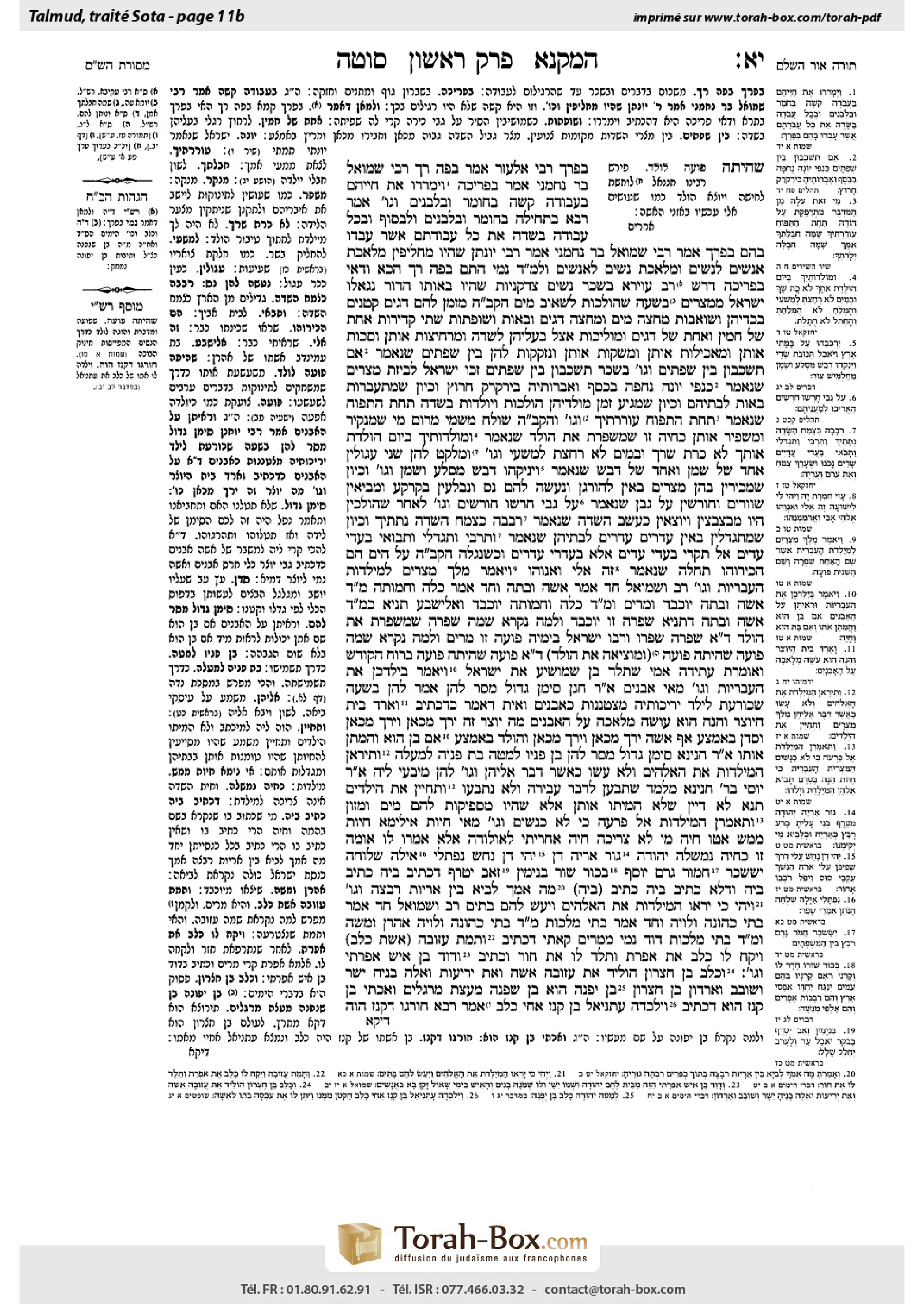
Sotah 11b: Talmud study for Daf Yomi
Daf Yomi is the daily study of one Talmud folio. Explore 37 tractates with scans, Hebrew text, Sefaria English and AI-generated French translations where annotated.
Passage selection and English or AI-generated French translation are available where the scan has annotations. Daf Study is independent of Torah-Box and Sefaria.
Browse Sotah · סוטה · All tractatesSotah 11b text and translations
This page of Sotah includes the Aramaic text, an English translation and an AI-generated French translation, alongside the scan above.
סוטה י״א ב · Aramaic and Hebrew text
בְּפָרֶךְ״, רַבִּי אֶלְעָזָר אָמַר: בְּפֶה רַךְ. רַבִּי שְׁמוּאֵל בַּר נַחְמָנִי אָמַר: בִּפְרִיכָה.
״וַיְמָרְרוּ אֶת חַיֵּיהֶם בַּעֲבֹדָה קָשָׁה בְּחֹמֶר וּבִלְבֵנִים וְגוֹ׳״, אָמַר רָבָא: בַּתְּחִילָּה ״בְּחוֹמֶר וּבִלְבֵנִים״, וּלְבַסּוֹף ״וּבְכׇל עֲבוֹדָה בַּשָּׂדֶה״.
״אֵת כׇּל עֲבֹדָתָם אֲשֶׁר עָבְדוּ בָהֶם בְּפָרֶךְ״, אָמַר רַבִּי שְׁמוּאֵל בַּר נַחְמָנִי אָמַר רַבִּי יוֹנָתָן: שֶׁהָיוּ מַחְלִיפִין מְלֶאכֶת אֲנָשִׁים לְנָשִׁים וּמְלֶאכֶת נָשִׁים לַאֲנָשִׁים. וּלְמַאן דְּאָמַר נָמֵי הָתָם בְּפֶה רַךְ, הָכָא וַדַּאי בִּפְרִיכָה.
דָּרֵשׁ רַב עַוִּירָא: בִּשְׂכַר נָשִׁים צִדְקָנִיּוֹת שֶׁהָיוּ בְּאוֹתוֹ הַדּוֹר נִגְאֲלוּ יִשְׂרָאֵל מִמִּצְרַיִם. בְּשָׁעָה שֶׁהוֹלְכוֹת לִשְׁאוֹב מַיִם, הַקָּדוֹשׁ בָּרוּךְ הוּא מְזַמֵּן לָהֶם דָּגִים קְטַנִּים בְּכַדֵּיהֶן, וְשׁוֹאֲבוֹת מֶחֱצָה מַיִם וּמֶחֱצָה דָּגִים, וּבָאוֹת וְשׁוֹפְתוֹת שְׁתֵּי קְדֵירוֹת, אַחַת שֶׁל חַמִּין וְאַחַת שֶׁל דָּגִים.
וּמוֹלִיכוֹת אֵצֶל בַּעְלֵיהֶן לַשָּׂדֶה, וּמַרְחִיצוֹת אוֹתָן, וְסָכוֹת אוֹתָן, וּמַאֲכִילוֹת אוֹתָן, וּמַשְׁקוֹת אוֹתָן, וְנִזְקָקוֹת לָהֶן בֵּין שְׁפַתַּיִם, שֶׁנֶּאֱמַר: ״אִם תִּשְׁכְּבוּן בֵּין שְׁפַתָּיִם וְגוֹ׳״, בִּשְׂכַר ״תִּשְׁכְּבוּן בֵּין שְׁפַתָּיִם״ זָכוּ יִשְׂרָאֵל לְבִיזַּת מִצְרַיִם, שֶׁנֶּאֱמַר: ״כַּנְפֵי יוֹנָה נֶחְפָּה בַכֶּסֶף וְאֶבְרוֹתֶיהָ בִּירַקְרַק חָרוּץ״.
וְכֵיוָן שֶׁמִּתְעַבְּרוֹת בָּאוֹת לְבָתֵּיהֶם, וְכֵיוָן שֶׁמַּגִּיעַ זְמַן מוֹלְדֵיהֶן הוֹלְכוֹת וְיוֹלְדוֹת בַּשָּׂדֶה תַּחַת הַתַּפּוּחַ, שֶׁנֶּאֱמַר: ״תַּחַת הַתַּפּוּחַ עוֹרַרְתִּיךָ וְגוֹ׳״.
וְהַקָּדוֹשׁ בָּרוּךְ הוּא שׁוֹלֵחַ מִשְּׁמֵי מָרוֹם מִי שֶׁמְּנַקֵּיר וּמְשַׁפֵּיר אוֹתָן, כְּחַיָּה זוֹ שֶׁמְּשַׁפֶּרֶת אֶת הַוָּלָד, שֶׁנֶּאֱמַר: ״וּמוֹלְדוֹתַיִךְ בְּיוֹם הוּלֶּדֶת אוֹתָךְ לֹא כׇרַּת שׇׁרֵּךְ וּבְמַיִם לֹא רֻחַצְתְּ לְמִשְׁעִי וְגוֹ׳״. וּמְלַקֵּט לָהֶן שְׁנֵי עִגּוּלִין, אֶחָד שֶׁל שֶׁמֶן וְאֶחָד שֶׁל דְּבַשׁ, שֶׁנֶּאֱמַר: ״וַיֵּנִקֵהוּ דְבַשׁ מִסֶּלַע וְשֶׁמֶן וְגוֹ׳״.
וְכֵיוָן שֶׁמַּכִּירִין בָּהֶן מִצְרִים בָּאִין לְהוֹרְגָן, וְנַעֲשָׂה לָהֶם נֵס וְנִבְלָעִין בַּקַּרְקַע, וּמְבִיאִין שְׁוָורִים וְחוֹרְשִׁין עַל גַּבָּן, שֶׁנֶּאֱמַר: ״עַל גַּבִּי חָרְשׁוּ חֹרְשִׁים וְגוֹ׳״. לְאַחַר שֶׁהוֹלְכִין הָיוּ מְבַצְבְּצִין וְיוֹצְאִין כְּעֵשֶׂב הַשָּׂדֶה, שֶׁנֶּאֱמַר: ״רְבָבָה כְּצֶמַח הַשָּׂדֶה נְתַתִּיךְ״.
וְכֵיוָן שֶׁמִּתְגַּדְּלִין בָּאִין עֲדָרִים עֲדָרִים לְבָתֵּיהֶן, שֶׁנֶּאֱמַר: ״וַתִּרְבִּי וַתִּגְדְּלִי וַתָּבֹאִי בַּעֲדִי עֲדָיִים״, אַל תִּקְרֵי ״בַּעֲדִי עֲדָיִים״, אֶלָּא ״בְּעֶדְרֵי עֲדָרִים״.
וּכְשֶׁנִּגְלָה הַקָּדוֹשׁ בָּרוּךְ הוּא עַל הַיָּם, הֵם הִכִּירוּהוּ תְּחִלָּה, שֶׁנֶּאֱמַר: ״זֶה אֵלִי וְאַנְוֵהוּ״.
״וַיֹּאמֶר מֶלֶךְ מִצְרַיִם לַמְיַלְּדוֹת הָעִבְרִיּוֹת וְגוֹ׳״. רַב וּשְׁמוּאֵל, חַד אָמַר: אִשָּׁה וּבִתָּהּ, וְחַד אָמַר: כַּלָּה וַחֲמוֹתָהּ. מַאן דְּאָמַר אִשָּׁה וּבִתָּהּ — יוֹכֶבֶד וּמִרְיָם, וּמַאן דְּאָמַר כַּלָּה וַחֲמוֹתָהּ — יוֹכֶבֶד וֶאֱלִישֶׁבַע.
תַּנְיָא כְּמַאן דְּאָמַר אִשָּׁה וּבִתָּהּ, דְּתַנְיָא: שִׁפְרָה זוֹ יוֹכֶבֶד, וְלָמָּה נִקְרָא שְׁמָהּ שִׁפְרָה — שֶׁמְּשַׁפֶּרֶת אֶת הַוָּלָד. דָּבָר אַחֵר: ״שִׁפְרָה״ — שֶׁפָּרוּ וְרָבוּ יִשְׂרָאֵל בְּיָמֶיהָ.
״פּוּעָה״ — זוֹ מִרְיָם. וְלָמָּה נִקְרָא שְׁמָהּ ״פּוּעָה״ שֶׁהָיְתָה פּוֹעָה וּמוֹצִיאָה אֶת הַוָּלָד. דָּבָר אַחֵר: ״פּוּעָה״ — שֶׁהָיְתָה פּוֹעָה בְּרוּחַ הַקּוֹדֶשׁ וְאוֹמֶרֶת: עֲתִידָה אִמִּי שֶׁתֵּלֵד בֵּן שֶׁמּוֹשִׁיעַ אֶת יִשְׂרָאֵל.
״וַיֹּאמֶר בְּיַלֶּדְכֶן אֶת הָעִבְרִיּוֹת וְגוֹ׳״. מַאי ״אׇבְנָיִם״ — אָמַר רַבִּי חָנָן: סִימָן גָּדוֹל מָסַר לָהֶן. אָמַר לָהֶן: בְּשָׁעָה שֶׁכּוֹרַעַת לֵילֵד יַרְכוֹתֶיהָ מִצְטַנְּנוֹת כַּאֲבָנִים.
וְאִית דְּאָמַר, כְּדִכְתִיב: ״וָאֵרֵד בֵּית הַיּוֹצֵר וְהִנֵּה הוּא עוֹשֶׂה מְלָאכָה עַל הָאׇבְנָיִם״, מָה יוֹצֵר זֶה — יָרֵךְ מִכָּאן וְיָרֵךְ מִכָּאן וְסַדָּן בָּאֶמְצַע, אַף אִשָּׁה — יָרֵךְ מִכָּאן וְיָרֵךְ מִכָּאן וְהַוָּלָד בָּאֶמְצַע.
״אִם בֵּן הוּא וַהֲמִתֶּן אוֹתוֹ״. אָמַר רַבִּי חֲנִינָא, סִימָן גָּדוֹל מָסַר לָהֶן: בֵּן פָּנָיו לְמַטָּה, בַּת פָּנֶיהָ לְמַעְלָה.
״וַתִּירֶאןָ הַמְיַלְּדוֹת אֶת הָאֱלֹהִים וְלֹא עָשׂוּ כַּאֲשֶׁר דִּבֶּר אֲלֵיהֶן וְגוֹ׳״. ״לָהֶן״ מִיבְּעֵי לֵיהּ! אָמַר רַבִּי יוֹסֵי בְּרַבִּי חֲנִינָא: מְלַמֵּד שֶׁתְּבָעָן לִדְבַר עֲבֵירָה וְלֹא נִתְבְּעוּ.
״וַתְּחַיֶּיןָ אֶת הַיְּלָדִים״. תָּנָא: לֹא דַּיָּין שֶׁלֹּא הֵמִיתוּ אוֹתָן, אֶלָּא שֶׁהָיוּ מַסְפִּיקוֹת לָהֶם מַיִם וּמָזוֹן.
״וַתֹּאמַרְןָ הַמְיַלְּדוֹת אֶל פַּרְעֹה כִּי לֹא כַנָּשִׁים וְגוֹ׳״. מַאי ״חָיוֹת״? אִילֵימָא חַיּוֹת מַמָּשׁ, אַטּוּ חַיָּה מִי לָא צְרִיכָה חַיָּה אַחֲרִיתִי לְאוֹלוֹדַהּ?
אֶלָּא אָמְרוּ לוֹ, אוּמָּה זוֹ כְּחַיָּה נִמְשְׁלָה: יְהוּדָה — ״גּוּר אַרְיֵה״, דָּן — ״יְהִי דָן נָחָשׁ״, ״נַפְתָּלִי אַיָּלָה שְׁלֻחָה״, ״יִשָּׂשכָר חֲמוֹר גָּרֶם״, יוֹסֵף — ״בְּכוֹר שׁוֹר״, ״בִּנְיָמִין זְאֵב יִטְרָף״.
דִּכְתִיב בֵּיהּ — כְּתִיב בֵּיהּ. וּדְלָא כְּתִיב בֵּיהּ — כְּתִיב בֵּיהּ: ״מַה אִמְּךָ לְבִיָּא בֵּין אֲרָיוֹת רָבָצָה וְגוֹ׳״.
״וַיְהִי כִּי יָרְאוּ הַמְיַלְּדוֹת אֶת הָאֱלֹהִים וַיַּעַשׂ לָהֶם בָּתִּים״. רַב וּשְׁמוּאֵל, חַד אָמַר: בָּתֵּי כְהוּנָּה וּלְוִיָּה, וְחַד אָמַר: בָּתֵּי מַלְכוּת. מַאן דְּאָמַר בָּתֵּי כְהוּנָּה וּלְוִיָּה — אַהֲרֹן וּמֹשֶׁה. וּמַאן דְּאָמַר בָּתֵּי מַלְכוּת — דָּוִד נָמֵי מִמִּרְיָם קָאָתֵי, דִּכְתִיב: ״וַתָּמׇת עֲזוּבָה אֵשֶׁת כָּלֵב וַיִּקַּח לוֹ כָלֵב אֶת אֶפְרָת וַתֵּלֶד לוֹ אֶת חוּר״. וּכְתִיב: ״וְדָוִד בֶּן אִישׁ אֶפְרָתִי וְגוֹ׳״.
״וְכָלֵב בֶּן חֶצְרוֹן הוֹלִיד אֶת עֲזוּבָה אִשָּׁה וְאֶת יְרִיעוֹת וְאֵלֶּה בָנֶיהָ יֵשֶׁר וְשׁוֹבָב וְאַרְדּוֹן״. בֶּן חֶצְרוֹן? בֶּן יְפֻנֶּה הוּא! בֵּן שֶׁפָּנָה מֵעֲצַת מְרַגְּלִים.
וְאַכַּתִּי: בֶּן קְנַז הוּא, דִּכְתִיב: ״וַיִּלְכְּדָהּ עׇתְנִיאֵל בֶּן קְנַז אֲחִי כָלֵב״! אָמַר רָבָא: חוֹרְגוֹ דִּקְנַז הֲוָה.
Sotah 11b · English translation
with rigor [befarekh]” (Exodus 1:13). Rabbi Elazar says: The word befarekh is a conjugation of the words: With a soft mouth [bifeh rakh], as the Egyptians enticed the Jewish people into slavery, gradually subjugating them until they had lost their freedom completely. Rabbi Shmuel bar Naḥmani says: The word befarekh should be understood as: With crushing [bifrikha], as the Egyptians subjugated Israel with backbreaking labor.
The next verse states: “And they made their lives bitter through hard service, with mortar and brick, and with every laborious service in the field” (Exodus 1:14). Rava says: The verse mentions specifically mortar and brick and then all forms of labor, as initially the Egyptians had them work with mortar and bricks, and ultimately they subjugated them “and with every laborious service in the field.”
The verse concludes: “In all their service, wherein they made them serve with rigor” (Exodus 1:14). Rabbi Shmuel bar Naḥmani says that Rabbi Yonatan says: The meaning of befarekh is that the Egyptians would exchange the responsibilities of men and women, giving men’s work to women and women’s work to men, requiring everyone to do work to which they were unaccustomed. And even according to the one who says that there, in the previous verse, bifarekh indicates that the Egyptians enslaved the Jews with a soft mouth, here, in this verse, which describes the physical hardship of the labor, the word befarekh certainly means with crushing labor.
§ Rav Avira taught: In the merit of the righteous women that were in that generation, the Jewish people were redeemed from Egypt. He tells of their righteous actions: At the time when these women would go to the river to draw water, the Holy One, Blessed be He, would materialize for them small fish that would enter into their pitchers, and they would therefore draw pitchers that were half filled with water and half filled with fish. And they would then come and place two pots on the fire, one pot of hot water for washing their husbands and one pot of fish with which to feed them.
And they would then take what they prepared to their husbands, to the field, and would bathe their husbands and anoint them with oil and feed them the fish and give them to drink and bond with them in sexual intercourse between the sheepfolds, i.e., between the borders and fences of the fields, as it is stated: “When you lie among the sheepfolds, the wings of the dove are covered with silver, and her pinions with the shimmer of gold” (Psalms 68:14), which is interpreted to mean that as a reward for “when you lie among the sheepfolds,” the Jewish people merited to receive the plunder of Egypt, as it is stated in the continuation of the verse, as a reference to the Jewish people: “The wings of the dove are covered with silver, and her pinions with the shimmer of gold” (Psalms 68:14).
And when these women would become pregnant, they would come back to their homes, and when the time for them to give birth would arrive they would go and give birth in the field under the apple tree, as it is stated: “Under the apple tree I awakened you; there your mother was in travail with you; there was she in travail and brought you forth” (Song of Songs 8:5).
And the Holy One, Blessed be He, would send from the heavens above an angel who would clean and prepare the newborns, just as a midwife prepares the newborn, as it is stated: “And as for your birth, on the day you were born, your navel was not cut nor were you washed with water for cleansing; you were not salted at all, nor swaddled at all” (Ezekiel 16:4). This indicates that there were no midwives to take care of the Jews born in Egypt. And then, the angel would gather for them two round stones from the field and the babies would nurse from that which would flow out of them. One of the stones flowed with oil and one of the stones flowed with honey, as it is stated: “And He would suckle them with honey from a crag and oil from a flinty rock” (Deuteronomy 32:13).
And once the Egyptians would notice them, realizing that they were Jewish babies, they would come to kill them. But a miracle would occur for them and they would be absorbed by the earth. And the Egyptians would then bring oxen and would plow upon them, as it is stated: “The plowers plowed upon my back; they made long their furrows” (Psalms 129:3). After the Egyptians would leave, the babies would emerge and exit the ground like grass of the field, as it is stated: “I caused you to increase even as the growth of the field” (Ezekiel 16:7).
And once the babies would grow, they would come like many flocks of sheep to their homes, as it is stated in the continuation of the verse: “And you did increase and grow up and you came with excellent beauty [ba’adi adayim]” (Ezekiel 16:7). Do not read the verse as: “Ba’adi adayim,” “with excellent beauty.” Rather, read it as: Be’edrei adarim, meaning: As many flocks.
And when the Holy One, Blessed be He, revealed Himself at the Red Sea, these children recognized Him first, as it is stated: “This is my God, and I will glorify Him” (Exodus 15:2). They recognized Him from the previous time that He revealed Himself to them in their infancy, enabling them to say: “This is my God.”
§ The verse states: “And the king of Egypt spoke to the Hebrew midwives, of whom the name of the one was Shiphrah, and the name of the other Puah” (Exodus 1:15). Rav and Shmuel disagree as to the proper interpretation of this verse. One says that these midwives were a woman and her daughter, and one says that they were a daughter-in-law and her mother-in-law. According to the one who says that they were a woman and her daughter, the women were Jochebed, the mother of Moses and Aaron, and her daughter, Miriam. And according to the one who says that they were a daughter-in-law and her mother-in-law, the verse is referring to Jochebed and her daughter-in-law Elisheba, the wife of Aaron.
It is taught in a baraita according to the one who says that they were a woman and her daughter, because it is taught in a baraita: With regard to Shiphrah, who is referred to in the verse, this is really a reference to Jochebed. And why was she called Shiphrah? Because she would prepare [mishapperet] the newborn. Alternatively, she is referred to as Shiphrah because the Jewish people increased and multiplied [shepparu verabbu] in her days, due to her assistance.
The baraita continues: With regard to Puah, who is referred to in the verse, this is really a reference to Miriam. And why was she called Puah? Because she would make a comforting sound [po’a] as she would remove the child from the womb of the mother. Alternatively, the word Puah is related to one of the verbs that describe speaking, as she would speak [po’a] through divine inspiration and say: In the future, my mother will give birth to a son who will save the Jewish people.
The next verse relates the instructions of Pharaoh to the midwives: “And he said: When you deliver the Hebrew women, and you look upon the stones [ovnayim], if it be a son, then you shall kill him; but if it be a daughter, then she shall live” (Exodus 1:16). The Gemara asks: What is the meaning of “stones”? Rabbi Ḥanan says: Pharaoh transmitted a great sign to them. He said to them: At the time when a woman crouches to give birth, her thighs become as cold as stones, and, therefore, this shall be for you a sign that the woman is about to give birth.
And there are those who say an alternative explanation for ovnayim: As it is written: “So I went down to the potter’s shop, and behold, he was at his work on the wheels [ovnayim]” (Jeremiah 18:3). Just as this potter sits so that one thigh is here and one thigh is there and the block upon which he works is in the middle, so too, a woman giving birth also has one thigh here and one thigh there and the newborn is in the middle.
The verse continues: “If it be a son, then you shall kill him; but if it be a daughter, then she shall live” (Exodus 1:16). Rabbi Ḥanina says: Pharaoh transmitted to them a great sign to enable them to know the gender of the infant from the beginning of the birth process: A boy is born with his face downward; a girl is born with her face upward. Pharaoh provided them with this sign so that they could kill the boys secretly even before the mother realized what was happening.
The next verse states: “But the midwives feared God, and did not as the king of Egypt spoke about them [aleihen], but they kept the male children alive” (Exodus 1:17). The Gemara comments: It should have stated: “Spoke to them [lahen].” Rabbi Yosei, son of Rabbi Ḥanina, says: This teaches that Pharaoh proposed to them to engage in a sinful act, i.e., sexual intercourse, with him, but they did not accept his overtures. The word aleihen is often used in reference to sexual intercourse, for example: “And brought her to him; and he consorted with her [eileha]” (Genesis 29:23), and that is its connotation here as well.
The verse concludes: “But they kept the male children alive” (Exodus 1:17). A Sage teaches: It is not only that they did not kill the children as Pharaoh had commanded them, but that they would even provide for them water and food, as the phrase “But they kept the male children alive” indicates.
After being questioned by Pharaoh concerning their failure to obey his command, the midwives responded, as it is written: “And the midwives said to Pharaoh: Because the Hebrew women are not as the Egyptian women, for they are lively [ḥayot], and are delivered before the midwife comes to them” (Exodus 1:19). The Gemara asks: What is the meaning of “ḥayot”? If we say that the Hebrew women are like ḥayot, meaning actual midwives for themselves, and therefore they do not need assistance from others, is that to say that a midwife does not need the assistance of another midwife in order to help her give birth?
Rather, the midwives said to Pharaoh: This nation is compared to an animal [ḥayya], and animals give birth without a midwife. For example, with regard to Judah it is written: “Judah is a lion’s whelp” (Genesis 49:9); with regard to Dan it is written: “Dan shall be a serpent in the way” (Genesis 49:17); with regard to Naphtali it is written: “A hind let loose” (Genesis 49:21); with regard to Issachar it is written: “A large-boned donkey” (Genesis 49:14); with regard to Joseph it is written: “His first bullock” (Deuteronomy 33:17); with regard to Benjamin it is written: “A ravenous wolf” (Genesis 49:27).
The Gemara comments: Concerning those individuals where a comparison to an animal is written with regard to him, it is already written with regard to him. And concerning those where no specific metaphor comparing them to an animal is written with regard to him explicitly, in any case a general comparison is written about the Jewish people: “How your mother was a lioness; among lions she crouched, in the midst of the young lions she reared her whelps” (Ezekiel 19:2), indicating that all the Jewish people are compared to animals.
The verse relates the midwives’ reward: “And it came to pass, because the midwives feared God, that He made them houses” (Exodus 1:21). Rav and Shmuel disagree as to the precise interpretation of these houses: One says that God made the houses of the priesthood and the Levites descend from the midwives, and one says that God made the houses of royalty descend from them. The one who says that it is referring to the houses of the priesthood and the Levites is referring to Aaron and Moses, who were sons of Jochebed. And the one who says that it is referring to houses of royalty is referring to David, who also comes from Miriam, as it is written: “And Azubah,” the wife of Caleb, “died, and Caleb took to him Ephrath, who bore him Hur” (I Chronicles 2:19) and, as will be explained further, Ephrath is Miriam. And it is written: “David was the son of that Ephrathite of Bethlehem in Judah” (I Samuel 17:12). Therefore, he was a descendant of Miriam.
The Gemara discusses the family of Caleb: In Chronicles it says: “And Caleb, the son of Hezron, begot children of Azubah his wife, and of Jerioth, and these were her sons: Jesher, and Shobab, and Ardon” (I Chronicles 2:18). The Gemara asks: Was Caleb actually the son of Hezron? Wasn’t he the son of Jephunneh, as the verse states in Numbers 13:6? The Gemara answers: He was the son of Hezron, but he is called “son of Jephunneh” as an appellation indicating that he was a son who turned away [sheppana] from the counsel of the spies.
The Gemara asks: But it is still difficult. Hezron could not be his father, as Caleb was the son of Kenaz, as it is written: “And Othniel, the son of Kenaz, Caleb’s younger brother, took it” (Judges 1:13). This would mean that Caleb was also a son of Kenaz. Rava said: Caleb was the stepson of Kenaz, as he and Othniel shared a mother but had different fathers.
Sotah 11b · Traduction française (IA)
« avec rigueur [befarekh] » (Exode 1,13). Rabbi Elazar dit : Le mot befarekh est une contraction de l’expression « avec une bouche douce [bifeh rakh] », car les Égyptiens attirèrent les enfants d’Israël vers l’esclavage, les asservissant progressivement jusqu’à les priver entièrement de leur liberté. Rabbi Shmuel bar Naḥmani dit : Le mot befarekh doit être compris comme signifiant « en les écrasant [bifrikha] », car les Égyptiens asservirent Israël en lui imposant un travail éreintant.
Le verset suivant dit : « Ils leur rendirent la vie amère par un dur labeur, avec le mortier et les briques, et par toutes sortes de travaux pénibles dans les champs » (Exode 1,14). Rava dit : Le verset mentionne précisément le mortier et les briques, puis toutes sortes de travaux, car, au début, les Égyptiens les faisaient travailler avec du mortier et des briques, puis finirent par les asservir « par toutes sortes de travaux pénibles dans les champs ».
Le verset conclut : « Dans tous leurs travaux, ils les faisaient travailler avec rigueur » (Exode 1,14). Rabbi Shmuel bar Naḥmani dit au nom de Rabbi Yonatan : Le mot befarekh signifie que les Égyptiens échangeaient les tâches des hommes et des femmes, donnant aux femmes les travaux des hommes et aux hommes ceux des femmes, et obligeaient chacun à accomplir des travaux auxquels il n’était pas habitué. Et même selon celui qui dit que, dans le verset précédent, bifarekh indique que les Égyptiens asservissaient les Juifs avec une bouche douce, ici, dans ce verset qui décrit la pénibilité physique du travail, le mot befarekh signifie certainement qu’ils les écrasaient sous le labeur.
§ Rav Avira enseigna : C’est grâce au mérite des femmes justes de cette génération que les enfants d’Israël furent délivrés d’Égypte. Il rapporte leurs actes méritoires : lorsque ces femmes allaient au fleuve puiser de l’eau, le Saint, béni soit-Il, faisait apparaître pour elles de petits poissons, qui entraient dans leurs cruches. Elles puisaient donc des cruches à moitié remplies d’eau et à moitié remplies de poissons. Elles rentraient ensuite et plaçaient deux marmites sur le feu : l’une remplie d’eau chaude pour laver leurs maris, l’autre de poissons pour les nourrir.
Elles apportaient ensuite ce qu’elles avaient préparé à leurs maris, dans les champs, les baignaient, les oignaient d’huile, leur donnaient les poissons à manger et à boire, puis s’unissaient à eux entre les bergeries, c’est-à-dire entre les limites et les clôtures des champs, comme il est dit : « Quand vous reposez parmi les bergeries, les ailes de la colombe sont couvertes d’argent, et ses plumes, de l’éclat de l’or » (Psaumes 68,14). Ce verset est interprété ainsi : en récompense de « quand vous reposez parmi les bergeries », les enfants d’Israël méritèrent de recevoir le butin d’Égypte, auquel fait référence la suite du verset, qui parle des enfants d’Israël : « Les ailes de la colombe sont couvertes d’argent, et ses plumes, de l’éclat de l’or » (Psaumes 68,14).
Lorsque ces femmes tombaient enceintes, elles rentraient chez elles ; au moment d’accoucher, elles allaient mettre leur enfant au monde dans les champs, sous le pommier, comme il est dit : « Sous le pommier, je t’ai éveillée ; là, ta mère est entrée en travail pour toi ; là, elle est entrée en travail et t’a enfantée » (Cantique des Cantiques 8,5).
Le Saint, béni soit-Il, envoyait alors des cieux un ange qui nettoyait et préparait les nouveau-nés, comme le fait une sage-femme, ainsi qu’il est dit : « Quant à ta naissance, le jour où tu naquis, ton cordon ombilical ne fut pas coupé ; tu ne fus pas lavée à l’eau pour être purifiée, tu ne fus pas salée du tout et tu ne fus pas emmaillotée du tout » (Ézéchiel 16,4). Cela indique qu’il n’y avait pas de sages-femmes pour s’occuper des Juifs nés en Égypte. Puis l’ange leur ramassait deux pierres rondes dans les champs, et les bébés tétaient ce qui en coulait. L’une des pierres donnait de l’huile et l’autre, du miel, comme il est dit : « Il les fit téter le miel du rocher et l’huile du roc le plus dur » (Deutéronome 32,13).
Lorsque les Égyptiens les remarquaient et comprenaient qu’il s’agissait de bébés juifs, ils venaient pour les tuer. Mais un miracle se produisait : les bébés étaient absorbés par la terre. Les Égyptiens amenaient alors des bœufs et labouraient au-dessus d’eux, comme il est dit : « Les laboureurs ont labouré mon dos, ils y ont tracé de longs sillons » (Psaumes 129,3). Après le départ des Égyptiens, les bébés émergeaient du sol et en sortaient comme l’herbe des champs, ainsi qu’il est dit : « Je t’ai fait croître comme la végétation des champs » (Ézéchiel 16,7).
Lorsque les bébés grandissaient, ils rentraient chez eux comme de nombreux troupeaux de moutons, ainsi que le dit la suite du verset : « Tu as grandi, tu t’es développée et tu es venue dans toute ta beauté [ba’adi adayim] » (Ézéchiel 16,7). Ne lis pas le verset ainsi : « Ba’adi adayim », « dans toute ta beauté ». Lis plutôt : Be’edrei adarim, c’est-à-dire « comme de nombreux troupeaux ».
Lorsque le Saint, béni soit-Il, se révéla à la mer Rouge, ces enfants furent les premiers à Le reconnaître, ainsi qu’il est dit : « Voici mon Dieu, et je Le glorifierai » (Exode 15,2). Ils Le reconnurent parce qu’Il s’était déjà révélé à eux lorsqu’ils étaient tout petits, ce qui leur permit de dire : « Voici mon Dieu. »
§ Le verset dit : « Le roi d’Égypte parla aux sages-femmes hébreues, dont l’une s’appelait Shiphra et l’autre Puah » (Exode 1,15). Rav et Shmuel sont en désaccord sur l’interprétation de ce verset. Selon l’un, ces sages-femmes étaient une femme et sa fille ; selon l’autre, une belle-fille et sa belle-mère. Selon celui qui dit qu’il s’agissait d’une femme et de sa fille, ces femmes étaient Yokhéved, la mère de Moïse et d’Aaron, et sa fille Myriam. Selon celui qui dit qu’il s’agissait d’une belle-fille et de sa belle-mère, le verset parle de Yokhéved et de sa belle-fille Élishéva, l’épouse d’Aaron.
Une baraïta est enseignée conformément à l’avis selon lequel il s’agissait d’une femme et de sa fille, car une baraïta enseigne : Dans le verset, Shiphra désigne en réalité Yokhéved. Pourquoi l’appelait-on Shiphra ? Parce qu’elle préparait [mishapperet] le nouveau-né. Autre explication : on l’appelait Shiphra parce qu’à son époque, les enfants d’Israël se multiplièrent et s’accrurent [shepparu verabbu], grâce à son aide.
La baraïta poursuit : Dans le verset, Puah désigne en réalité Myriam. Pourquoi l’appelait-on Puah ? Parce qu’elle émettait un son apaisant [po’a] lorsqu’elle faisait sortir l’enfant du ventre de sa mère. Autre explication : le mot Puah est apparenté à l’un des verbes qui signifient parler, car elle parlait [po’a] par inspiration divine et disait : À l’avenir, ma mère donnera naissance à un fils qui sauvera les enfants d’Israël.
Le verset suivant rapporte les instructions de Pharaon aux sages-femmes : « Il dit : Quand vous accoucherez les femmes hébreues et que vous regarderez les pierres [ovnayim], si c’est un garçon, faites-le mourir ; si c’est une fille, qu’elle vive » (Exode 1,16). La Guemara demande : Que signifie « pierres » ? Rabbi Ḥanan dit : Pharaon leur donna un signe important. Il leur dit : Au moment où une femme s’accroupit pour accoucher, ses cuisses deviennent froides comme des pierres ; ce sera donc pour vous le signe qu’elle est sur le point d’accoucher.
D’autres donnent une autre explication de ovnayim, d’après ce qui est écrit : « Je descendis à l’atelier du potier, et voici qu’il travaillait sur les roues [ovnayim] » (Jérémie 18,3). De même que le potier s’assied avec une cuisse de chaque côté et le bloc sur lequel il travaille au milieu, de même, une femme qui accouche a une cuisse de chaque côté et le nouveau-né au milieu.
Le verset poursuit : « Si c’est un garçon, faites-le mourir ; si c’est une fille, qu’elle vive » (Exode 1,16). Rabbi Ḥanina dit : Pharaon leur donna un signe important pour leur permettre de connaître le sexe du nourrisson dès le début de l’accouchement : un garçon naît le visage tourné vers le bas, une fille naît le visage tourné vers le haut. Pharaon leur fournit ce signe afin qu’elles puissent tuer les garçons en secret, avant même que leur mère ne comprenne ce qui se passait.
Le verset suivant dit : « Mais les sages-femmes craignaient Dieu et n’agirent pas comme le roi d’Égypte leur avait dit [aleihen] ; elles laissèrent vivre les garçons » (Exode 1,17). La Guemara fait remarquer : Il aurait dû être écrit : « leur avait dit [lahen] ». Rabbi Yosei, fils de Rabbi Ḥanina, dit : Cela enseigne que Pharaon leur proposa de commettre une faute, c’est-à-dire d’avoir des relations sexuelles avec lui, mais qu’elles refusèrent ses avances. Le mot aleihen est souvent employé pour désigner les relations sexuelles, par exemple : « Il l’amena auprès de lui et s’unit à elle [eileha] » (Genèse 29,23) ; c’est aussi son sens ici.
Le verset conclut : « Elles laissèrent vivre les garçons » (Exode 1,17). Un Sage enseigne : Non seulement elles ne tuèrent pas les enfants comme Pharaon le leur avait ordonné, mais elles leur fournissaient aussi de l’eau et de la nourriture, comme l’indique l’expression « elles laissèrent vivre les garçons ».
Après que Pharaon les eut interrogées sur leur désobéissance à son ordre, les sages-femmes lui répondirent, comme il est écrit : « Les sages-femmes dirent à Pharaon : Les femmes hébreues ne sont pas comme les femmes égyptiennes, car elles sont vigoureuses [ḥayot] et accouchent avant que la sage-femme n’arrive auprès d’elles » (Exode 1,19). La Guemara demande : Que signifie « ḥayot » ? Si l’on dit que les femmes hébreues sont comme des ḥayot, c’est-à-dire qu’elles sont elles-mêmes de véritables sages-femmes et n’ont donc pas besoin de l’aide d’autrui, faudrait-il en conclure qu’une sage-femme n’a pas besoin de l’aide d’une autre sage-femme pour l’assister lors de son propre accouchement ?
Les sages-femmes dirent plutôt à Pharaon : Ce peuple est comparé à un animal [ḥayya], et les animaux mettent bas sans sage-femme. Ainsi, au sujet de Juda, il est écrit : « Juda est un jeune lion » (Genèse 49,9) ; au sujet de Dan, il est écrit : « Dan sera un serpent sur le chemin » (Genèse 49,17) ; au sujet de Nephtali, il est écrit : « Une biche en liberté » (Genèse 49,21) ; au sujet d’Issachar, il est écrit : « Un âne robuste » (Genèse 49,14) ; au sujet de Joseph, il est écrit : « Son premier-né est un taureau » (Deutéronome 33,17) ; au sujet de Benjamin, il est écrit : « Un loup ravisseur » (Genèse 49,27).
La Guemara fait remarquer : Pour ceux au sujet desquels une comparaison avec un animal est écrite, cette comparaison est déjà explicitement mentionnée. Quant à ceux au sujet desquels aucune métaphore précise les comparant à un animal n’est explicitement écrite, une comparaison générale concernant le peuple juif est néanmoins formulée : « Ta mère était comme une lionne ; elle était couchée parmi les lions, elle élevait ses petits au milieu des lionceaux » (Ézéchiel 19,2), ce qui indique que tout le peuple juif est comparé à des animaux.
Le verset rapporte la récompense des sages-femmes : « Parce que les sages-femmes craignaient Dieu, Il leur fit des maisons » (Exode 1,21). Rav et Shmuel sont en désaccord sur l’interprétation précise de ces maisons : selon l’un, Dieu fit descendre des sages-femmes les maisons de la prêtrise et des Lévites ; selon l’autre, Il fit descendre d’elles les maisons de la royauté. Celui qui dit qu’il s’agit des maisons de la prêtrise et des Lévites parle d’Aaron et de Moïse, qui étaient les fils de Yokhéved. Celui qui dit qu’il s’agit des maisons de la royauté parle de David, qui descend également de Myriam, comme il est écrit : « Azouva », l’épouse de Caleb, « mourut, et Caleb prit Éphrata, qui lui donna Hour » (I Chroniques 2,19) ; comme on l’expliquera plus loin, Éphrata est Myriam. Il est également écrit : « David était le fils de cet Éphrathite de Bethléem en Juda » (I Samuel 17,12). David était donc un descendant de Myriam.
La Guemara examine la famille de Caleb : dans les Chroniques, il est écrit : « Caleb, fils de Ḥetsron, eut des enfants de sa femme Azouva et de Yeriot ; voici ses fils : Yéser, Shovav et Ardon » (I Chroniques 2,18). La Guemara demande : Caleb était-il réellement fils de Ḥetsron ? N’était-il pas fils de Yefounné, comme le dit le verset dans les Nombres 13,6 ? La Guemara répond : Il était fils de Ḥetsron, mais il est appelé « fils de Yefounné » comme une appellation indiquant qu’il était un fils qui s’était détourné [sheppana] du conseil des explorateurs.
La Guemara demande : Mais la difficulté demeure. Ḥetsron ne pouvait pas être son père, puisque Caleb était fils de Kenaz, comme il est écrit : « Otniel, fils de Kenaz, frère cadet de Caleb, s’en empara » (Juges 1,13). Cela signifierait que Caleb était lui aussi fils de Kenaz. Rava dit : Caleb était le beau-fils de Kenaz, car lui et Otniel avaient la même mère, mais des pères différents.
Traduction française générée par IA à partir de l’édition anglaise de Sefaria. Vérifie toujours un passage avec le texte source.
Text from Sefaria: William Davidson Edition - Vocalized Aramaic (CC BY NC); William Davidson Edition - English (CC BY NC).