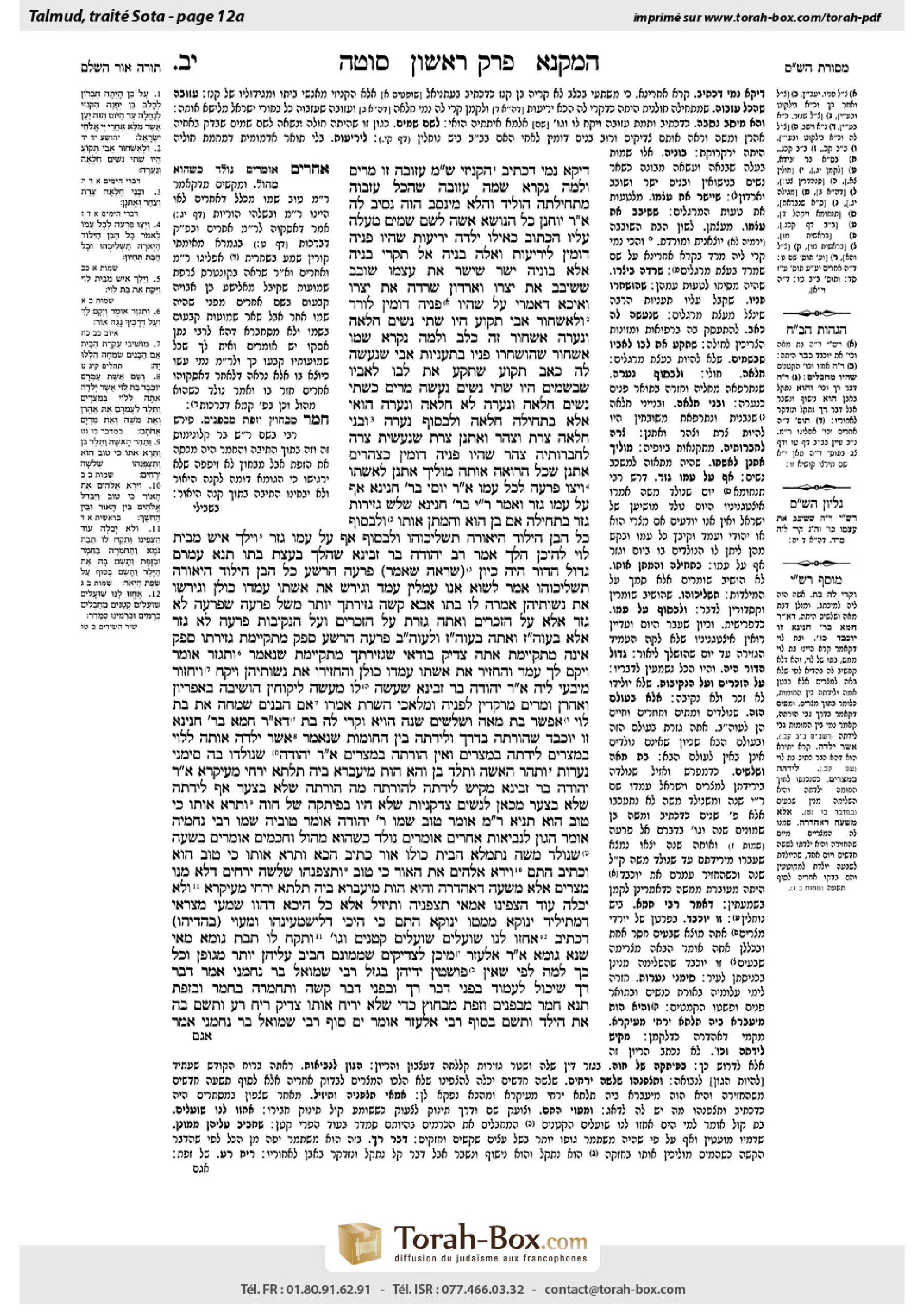
Sotah 12a: Talmud study for Daf Yomi
Daf Yomi is the daily study of one Talmud folio. Explore 37 tractates with scans, Hebrew text, Sefaria English and AI-generated French translations where annotated.
Passage selection and English or AI-generated French translation are available where the scan has annotations. Daf Study is independent of Torah-Box and Sefaria.
Browse Sotah · סוטה · All tractatesSotah 12a text and translations
This page of Sotah includes the Aramaic text, an English translation and an AI-generated French translation, alongside the scan above.
סוטה י״ב א · Aramaic and Hebrew text
דַּיְקָא נָמֵי דִּכְתִיב ״הַקְּנִזִּי״. שְׁמַע מִינַּהּ.
״עֲזוּבָה״ — זוֹ מִרְיָם, וְלָמָּה נִקְרָא שְׁמָהּ עֲזוּבָה — שֶׁהַכֹּל עֲזָבוּהָ מִתְּחִילָּתָהּ. ״הוֹלִיד״ — וַהֲלֹא מִינְסָב הֲוָה נָסֵיב לַהּ! אָמַר רַבִּי יוֹחָנָן: כׇּל הַנּוֹשֵׂא אִשָּׁה לְשֵׁם שָׁמַיִם — מַעֲלֶה עָלָיו הַכָּתוּב כְּאִילּוּ יְלָדָהּ.
״יְרִיעוֹת״ — שֶׁהָיוּ פָּנֶיהָ דּוֹמִין לִירִיעוֹת.
״וְאֵלֶּה בָּנֶיהָ״ — אַל תִּקְרֵי בָּנֶיהָ אֶלָּא ״בּוֹנֶיהָ״, ״יֵשֶׁר״ — שֶׁיִּשֵּׁר אֶת עַצְמוֹ. ״שׁוֹבָב״ — שֶׁשִּׁיבֵּב אֶת יִצְרוֹ, ״וְאַרְדּוֹן״ — שֶׁרָדָה אֶת יִצְרוֹ, וְאִיכָּא דְּאָמְרִי: עַל שֶׁהָיוּ פָּנֶיהָ דּוֹמִין לְוֶרֶד.
״וּלְאַשְׁחוּר אֲבִי תְקוֹעַ הָיוּ שְׁתֵּי נָשִׁים חֶלְאָה וְנַעֲרָה״. ״אַשְׁחוּר״ — זֶה כָּלֵב, וְלָמָּה נִקְרָא שְׁמוֹ ״אַשְׁחוּר״ — שֶׁהוּשְׁחֲרוּ פָּנָיו בְּתַעֲנִיּוֹת. ״אֲבִי״ — שֶׁנַּעֲשָׂה לָהּ כְּאָב, ״תְּקוֹעַ״ — שֶׁתָּקַע אֶת לִבּוֹ לְאָבִיו שֶׁבַּשָּׁמַיִם.
״הָיוּ שְׁתֵּי נָשִׁים״ — נַעֲשָׂה מִרְיָם כִּשְׁתֵּי נָשִׁים. ״חֶלְאָה וְנַעֲרָה״ — לָא חֶלְאָה וְנַעֲרָה הֲוַאי, אֶלָּא בַּתְּחִילָּה חֶלְאָה, וּלְבַסּוֹף נַעֲרָה.
״וּבְנֵי חֶלְאָה צֶרֶת וְצֹהַר וְאֶתְנָן״. ״צֶרֶת״ — שֶׁנַּעֲשֵׂית צָרָה לְחַבְרוֹתֶיהָ. ״צֹהַר״ — שֶׁהָיוּ פָּנֶיהָ דּוֹמִין כַּצׇּהֳרַיִם, ״אֶתְנָן״ — שֶׁכׇּל הָרוֹאֶה אוֹתָהּ מוֹלִיךְ אֶתְנָן לְאִשְׁתּוֹ.
״וַיְצַו פַּרְעֹה לְכׇל עַמּוֹ״, אָמַר רַבִּי יוֹסֵי בְּרַבִּי חֲנִינָא: אַף עַל עַמּוֹ גָּזַר. וְאָמַר רַבִּי יוֹסֵי בְּרַבִּי חֲנִינָא: שָׁלֹשׁ גְּזֵירוֹת גָּזַר: בַּתְּחִילָּה ״אִם בֵּן הוּא וַהֲמִתֶּן אוֹתוֹ״, וּלְבַסּוֹף ״כׇּל הַבֵּן הַיִּלּוֹד הַיְאֹרָה תַּשְׁלִיכֻהוּ״, וּלְבַסּוֹף אַף עַל עַמּוֹ גָּזַר.
״וַיֵּלֶךְ אִישׁ מִבֵּית לֵוִי״. לְהֵיכָן הָלַךְ? אָמַר רַב יְהוּדָה בַּר זְבִינָא: שֶׁהָלַךְ בַּעֲצַת בִּתּוֹ.
תָּנָא: עַמְרָם גְּדוֹל הַדּוֹר הָיָה. כֵּיוָן שֶׁרָאָה שֶׁאָמַר פַּרְעֹה הָרָשָׁע ״כׇּל הַבֵּן הַיִּלּוֹד הַיְאֹרָה תַּשְׁלִיכֻהוּ״, אָמַר: לַשָּׁוְא אָנוּ עֲמֵלִין, עָמַד וְגֵירַשׁ אֶת אִשְׁתּוֹ. עָמְדוּ כּוּלָּן וְגֵירְשׁוּ אֶת נְשׁוֹתֵיהֶן.
אָמְרָה לוֹ בִּתּוֹ: אַבָּא, קָשָׁה גְּזֵירָתְךָ יוֹתֵר מִשֶּׁל פַּרְעֹה. שֶׁפַּרְעֹה לֹא גָּזַר אֶלָּא עַל הַזְּכָרִים, וְאַתָּה גָּזַרְתָּ עַל הַזְּכָרִים וְעַל הַנְּקֵיבוֹת. פַּרְעֹה לָא גָּזַר אֶלָּא בָּעוֹלָם הַזֶּה, וְאַתָּה בָּעוֹלָם הַזֶּה וּלְעוֹלָם הַבָּא.
פַּרְעֹה הָרָשָׁע — סָפֵק מִתְקַיֶּימֶת גְּזֵירָתוֹ, סָפֵק אֵינָהּ מִתְקַיֶּימֶת. אַתָּה צַדִּיק, בְּוַדַּאי שֶׁגְּזֵירָתְךָ מִתְקַיֶּימֶת, שֶׁנֶּאֱמַר: ״וְתִגְזַר אוֹמֶר וְיָקׇם לָךְ״. עָמַד וְהֶחְזִיר אֶת אִשְׁתּוֹ, עָמְדוּ כּוּלָּן וְהֶחְזִירוּ אֶת נְשׁוֹתֵיהֶן.
״וַיִּקַּח״. ״וַיַּחְזִיר״ מִיבְּעֵי לֵיהּ! אָמַר רַב יְהוּדָה בַּר זְבִינָא: שֶׁעָשָׂה לוֹ מַעֲשֵׂה לִיקּוּחִין — הוֹשִׁיבָהּ בְּאַפִּרְיוֹן, וְאַהֲרֹן וּמִרְיָם מְרַקְּדִין לְפָנֶיהָ, וּמַלְאֲכֵי הַשָּׁרֵת אָמְרוּ ״אֵם הַבָּנִים שְׂמֵחָה״.
״אֶת בַּת לֵוִי״. אֶפְשָׁר בַּת מֵאָה וּשְׁלֹשִׁים שָׁנָה הָוְיָא וְקָרֵי לַהּ ״בַּת״, דְּאָמַר רַבִּי חָמָא בְּרַבִּי חֲנִינָא: זוֹ יוֹכֶבֶד, שֶׁהוֹרָתָהּ בַּדֶּרֶךְ וְלֵידָתָהּ בֵּין הַחוֹמוֹת, שֶׁנֶּאֱמַר: ״אֲשֶׁר יָלְדָה אוֹתָהּ לְלֵוִי בְּמִצְרָיִם״ —
לֵידָתָהּ בְּמִצְרַיִם, וְאֵין הוֹרָתָה בְּמִצְרַיִם. אָמַר רַבִּי יְהוּדָה: שֶׁנּוֹלְדוּ בָּהּ סִימָנֵי נַעֲרוּת.
״וַתַּהַר הָאִשָּׁה וַתֵּלֶד בֵּן״. וְהָא הֲוָת מִיעַבְּרָא בֵּיהּ תְּלָתָא יַרְחֵי מֵעִיקָּרָא! אָמַר רַב יְהוּדָה בַּר זְבִינָא: מַקִּישׁ לֵידָתָהּ לְהוֹרָתָהּ: מָה הוֹרָתָהּ שֶׁלֹּא בְּצַעַר — אַף לֵידָתָהּ שֶׁלֹּא בְּצַעַר. מִכָּאן לְנָשִׁים צִדְקָנִיּוֹת שֶׁלֹּא הָיוּ בְּפִיתְקָהּ שֶׁל חַוָּה.
״וַתֵּרֶא אוֹתוֹ כִּי טוֹב הוּא״. תַּנְיָא, רַבִּי מֵאִיר אוֹמֵר: ״טוֹב״ שְׁמוֹ. רַבִּי יְהוּדָה אוֹמֵר: ״טוֹבִיָּה״ שְׁמוֹ. רַבִּי נְחֶמְיָה אוֹמֵר: הָגוּן לִנְבִיאוּת. אֲחֵרִים אוֹמְרִים: נוֹלַד כְּשֶׁהוּא מָהוּל. וַחֲכָמִים אוֹמְרִים: בְּשָׁעָה שֶׁנּוֹלַד מֹשֶׁה, נִתְמַלֵּא הַבַּיִת כּוּלּוֹ אוֹר. כְּתִיב הָכָא: ״וַתֵּרֶא אוֹתוֹ כִּי טוֹב הוּא״, וּכְתִיב הָתָם: ״וַיַּרְא אֱלֹהִים אֶת הָאוֹר כִּי טוֹב״.
״וַתִּצְפְּנֵהוּ שְׁלֹשָׁה יְרָחִים״ — דְּלָא מְנוֹ מִצְרִיִּם אֶלָּא מִשָּׁעָה דְּאַהְדְּרַהּ, וְהִיא הֲוָת מִיעַבְּרָא בֵּיהּ תְּלָתָא יַרְחֵי מֵעִיקָּרָא.
״וְלֹא יָכְלָה עוֹד הַצְּפִינוֹ״. אַמַּאי? תִּצְפְּנֵיהּ וְתֵיזִיל! אֶלָּא, כֹּל הֵיכָא דַּהֲווֹ שָׁמְעִי מִצְרָאֵי דְּמִתְיְלִיד יָנוֹקָא, מַמְטוּ יָנוֹקֵי הָתָם כִּי הֵיכִי דְּלִישְׁמְעִינְהוּ וּמְעַוֵּי בַּהֲדַיְהוּ, דִּכְתִיב: ״אֶחֱזוּ לָנוּ שׁוּעָלִים שׁוּעָלִים קְטַנִּים וְגוֹ׳״.
״וַתִּקַּח לוֹ תֵּבַת גֹּמֶא״. מַאי שְׁנָא גּוֹמֶא? אָמַר רַבִּי אֶלְעָזָר: מִיכָּן לְצַדִּיקִים שֶׁמָּמוֹנָם חָבִיב עֲלֵיהֶן יוֹתֵר מִגּוּפָן. וְכׇל כָּךְ לָמָּה — לְפִי שֶׁאֵין פּוֹשְׁטִין יְדֵיהֶן בְּגָזֵל.
רַבִּי שְׁמוּאֵל בַּר נַחְמָנִי אָמַר: דָּבָר רַךְ, שֶׁיָּכוֹל לַעֲמוֹד בִּפְנֵי דָּבָר רַךְ וּבִפְנֵי דָּבָר קָשֶׁה.
״וַתַּחְמְרָה בַחֵמָר וּבַזָּפֶת״, תָּנָא: חֵמָר מִבִּפְנִים וְזֶפֶת מִבַּחוּץ, כְּדֵי שֶׁלֹּא יָרִיחַ אוֹתוֹ צַדִּיק רֵיחַ רַע.
״וַתָּשֶׂם בָּהּ אֶת הַיֶּלֶד וַתָּשֶׂם בַּסּוּף״, רַבִּי אֶלְעָזָר אוֹמֵר: יַם סוּף. רַבִּי שְׁמוּאֵל בַּר נַחְמָנִי אָמַר:
Sotah 12a · English translation
The Gemara comments: The language of another verse is also precise based on this explanation, as it is written: “And Caleb the son of Jephunneh the Kenizzite said unto him” (Joshua 14:6). Although his father was Jephunneh, he is known as “the Kenizzite,” although he was not actually a son of Kenaz. The Gemara accepts this proof and states: Conclude from it that Rava’s explanation is correct.
The verse states: “And Caleb, the son of Hezron, begot children of Azubah his wife, and of Jerioth, and these were her sons: Jesher, and Shobab, and Ardon” (I Chronicles 2:18). The Gemara analyzes the verse: The verse refers to the wife of Caleb by the name Azubah. The Sages teach that this is Miriam. And why is she called Azubah? As everyone initially abandoned her [azavuha] and did not want to marry her because she was sickly and unattractive. The verse additionally states: “And Caleb, the son of Hezron, begot children [holid] of Azubah his wife” (I Chronicles 2:18). The Gemara asks: Why use the term “holid,” begot children? But doesn’t this verse state that he married her? Rabbi Yoḥanan says: This teaches us that with regard to anyone who marries a woman for the sake of Heaven, as he married her due to her righteousness without concern for her appearance, the verse ascribes him credit as if he gave birth to her.
The same verse refers to Miriam additionally as Jerioth, which the Gemara explains was appropriate, for her face was like extremely pallid curtains [yeriot].
The verse continues: “And these were her sons [vaneha].” The Gemara explains: Do not read it as vaneha, her sons; rather, read it as boneha, her builders. In other words, the rest of the names in the verse are not the names of her children, but rather appellations for her husband, whose marriage to her built her, as it were. The first appellation for Caleb, “Jesher,” is referring to his actions, as he set himself straight [yisher] and did not join in the counsel of the spies. The second appellation, “Shobab,” is referring to the fact that he broke [sibbev] his evil inclination by rebelling against the other spies. The third appellation, “and Ardon [veArdon],” is referring to the fact that he ruled [rada] over his evil inclination. And some say: Because the face of his wife Miriam became beautiful like a rose [vered] after they were married, she was also called Vardon, due to her rose-like complexion.
The Gemara interprets an additional verse as referring to Caleb. It is stated: “And Ashhur the father of Tekoa had two wives, Helah and Naarah” (I Chronicles 4:5). Ashhur is Caleb. And why was he called Ashhur? Because his face became blackened [husheḥaru] from the extensive fasts that he accepted upon himself so that he would not be entrapped by the counsel of the spies. “The father of” is also referring to Caleb, as he became like a father to his wife. The next word in the verse, “Tekoa,” is an additional reference to Caleb, as he attached [taka] his heart to his Father in Heaven.
The phrase in the verse “had two wives” actually means it is as if Miriam became like two wives, because she changed over the course of time. And therefore the two names written in the verse: “Helah and Naarah,” were not two separate women, Helah and Naarah. Rather, initially Miriam was sickly [ḥela] and forlorn, and ultimately she was healthy and beautiful like a young woman [na’ara].
The Gemara expounds the following verse as referring to Miriam: “And the children of Helah were Zereth [Tzeret] and Zohar and Ethnan” (I Chronicles 4:7). She was now called “Tzeret,” for she became so beautiful that she was like a rival [tzara] to other women, as they were jealous of her beauty. She is called “Zohar,” as her face shined like the sun does at noon [tzohorayim]. She is called “Ethnan,” as any man that saw her would be aroused so much that he would bring a gift [etnan] to his wife to entice her.
§ The Gemara returns to the discussion of the bondage in Egypt. “And Pharaoh charged all his people, saying: Every son that is born you shall cast into the river, and every daughter you shall save alive” (Exodus 1:22). Rabbi Yosei, son of Rabbi Ḥanina, says: The use of the phrase “every son that is born” indicates that he decreed even on his own nation that all their male babies must be killed. And Rabbi Yosei, son of Rabbi Ḥanina, says further: He decreed three decrees. Initially, he commanded the midwives only with regard to Jewish infants: “You shall look upon the stones. If it be a son, then you shall kill him; but if it be a daughter, then she shall live” (Exodus 1:16). And afterward, he decreed with regard to the Jewish infants: “Every son that is born you shall cast into the river” (Exodus 1:22). And ultimately, he decreed even on his own nation that Egyptian infant boys should be cast into the river as well.
The verse states: “And there went a man of the house of Levi, and took for a wife a daughter of Levi” (Exodus 2:1). The Gemara asks: To where did he go? Rav Yehuda bar Zevina says: He went according to the advice of his daughter Miriam, as the Gemara will proceed to explain.
A Sage teaches: Amram, the father of Moses, was the great man of his generation. Once he saw that the wicked Pharaoh said: “Every son that is born you shall cast into the river, and every daughter you shall save alive” (Exodus 1:22), he said: We are laboring for nothing by bringing children into the world to be killed. Therefore, he arose and divorced his wife. All others who saw this followed his example and arose and divorced their wives.
His daughter, Miriam, said to him: Father, your decree is more harsh for the Jewish people than that of Pharaoh, as Pharaoh decreed only with regard to the males, but you decreed both on the males and on the females. And now no children will be born. Additionally, Pharaoh decreed to kill them only in this world, but you decreed in this world and in the World-to-Come, as those not born will not enter the World-to-Come.
Miriam continued: Additionally, concerning Pharaoh the wicked, it is uncertain whether his decree will be fulfilled, and it is uncertain if his decree will not be fulfilled. You are a righteous person, and as such, your decrees will certainly be fulfilled, as it is stated with regard to the righteous: “You shall also decree a thing, and it shall be established unto you” (Job 22:28). Amram accepted his daughter’s words and arose and brought back, i.e., remarried, his wife, and all others who saw this followed his example and arose and brought back their wives.
The Gemara asks: If Amram remarried Jochebed, rather than say: “And took for a wife a daughter of Levi” (Exodus 2:1), it should have stated: “And returned for a wife the daughter of Levi.” Rav Yehuda bar Zevina says: He performed an act of marriage just as one would do for a first marriage. He sat her on a palanquin [appiryon], and Aaron and Miriam danced before her, and the ministering angels said: “A joyful mother of children” (Psalms 113:9).
The verse is referring to Jochebed as “a daughter of Levi” (Exodus 2:1). The Gemara asks: Is it possible that this is Jochebed? Jochebed was then 130 years old and the verse still calls her a daughter? Jochebed’s age is established based on a tradition concerning the number of the descendants of Jacob who came to Egypt, as follows: While the verse states that Leah had thirty-three descendants (Genesis 46:15), only thirty-two were enumerated. This was explained as Rabbi Ḥama, son of Rabbi Ḥanina, says: The “daughter of Levi” is Jochebed, whose conception was on the road, as the family of Jacob descended to Egypt, and she was born between the walls, i.e., in Egypt, as it is stated: “And the name of Amram’s wife was Jochebed, the daughter of Levi, who was born to Levi in Egypt” (Numbers 26:59).
This interpolation concerning her birth is interpreted: Her birth was in Egypt, but her conception was not in Egypt. Since the Jewish people were in Egypt for two hundred ten years and Moses was eighty years old at the time of the exodus, Jochebed was one hundred thirty years old when Moses was born. In light of this, the Gemara is asking how the verse can refer to her as a daughter. Rabbi Yehuda says: The signs of a young woman were born in her when her husband remarried her, and she became like a young girl again.
§ The verse states concerning Moses: “And the woman conceived, and bore a son; and when she saw him that he was a goodly child, she hid him three months” (Exodus 2:2). The Gemara asks: But Jochebed was pregnant with Moses for three months at the outset, before Amram remarried her, as will be explained further. Rav Yehuda bar Zevina said: The intention of the verse is to juxtapose her giving birth to her becoming pregnant. Just as her becoming pregnant was without pain, so too, her giving birth was without pain. From here it is derived concerning righteous women that they were not included in the verdict [pitkah] of Eve that a woman will suffer pain during childbirth (see Genesis 3:16).
The verse states with regard to the birth of Moses: “And the woman conceived, and bore a son; and when she saw him that he was a goodly [tov] child, she hid him three months” (Exodus 2:2). It is taught in a baraita that Rabbi Meir says: “Tov” is his, Moses’, real name, as it was given to him by his parents when he was born. Rabbi Yehuda says: His name was Toviya. Rabbi Neḥemya says: They said he was good because they saw that he was fit for prophecy. Others say: They said he was good because he was born when he was already circumcised. And the Rabbis say: At the time when Moses was born, the entire house was filled with light, as it is written here: “And when she saw him that he was a goodly [tov] child,” and it is written there: “And God saw the light, that it was good [tov]” (Genesis 1:4).
The verse continues: “And she hid him three months” (Exodus 2:2). The Gemara explains that she was able to hide him for three months because the Egyptians counted the nine months of her pregnancy only from the time her husband took her back, but she was pregnant with Moses for three months from the outset of her remarriage.
The next verse states: “And when she could no longer hide him” (Exodus 2:3). The Gemara asks: Why couldn’t she hide him any longer? Let her continue to hide him. Rather, anywhere that the Egyptians heard that a baby was born and they wanted to locate the baby, they would bring another baby there in order that it could be heard crying, and the two babies would cry together, as it is written: “Take us the foxes, the little foxes, that spoil the vineyards; for our vineyards are in blossom” (Song of Songs 2:15). The infants who were used to uncover the hidden babies are referred to as little foxes.
The verse states: “And when she could no longer hide him, she took for him an ark of bulrushes, and daubed it with bitumen and with pitch; and she put the child therein, and laid it in the willows by the river’s bank” (Exodus 2:3). The Gemara asks: What is different about bulrushes that she decided to use them? Rabbi Elazar says: From here it is derived concerning righteous people that their money is more precious to them than their bodies, as she took an inexpensive material to build the ark. And why do they care so much about their money? Because they do not stretch out their hands to partake of stolen property. Therefore, their own property is very precious to them.
Rabbi Shmuel bar Naḥmani says an alternative reason for her taking bulrushes for the ark: She took a soft material like bulrush, which is able to withstand an impact both before a soft item and before a hard item. She feared that if she would have made the box from a hard material like wood, if it were to collide with a hard item in the water it might break.
The verse continues: “And daubed it with bitumen and with pitch” (Exodus 2:3). A Sage teaches: She daubed bitumen on the interior and pitch on the exterior, so that righteous person, i.e., Moses, would not smell a foul odor, such as that of pitch.
The verse continues: “And she put the child therein, and laid it in the willows [bassuf]” (Exodus 2:3). Rabbi Elazar says: This means she placed him in the Suf Sea, i.e., the Red Sea. Rabbi Shmuel bar Naḥmani says:
Sotah 12a · Traduction française (IA)
La Guemara fait remarquer que, selon cette explication, la formulation d’un autre verset est également précise, comme il est écrit : « Caleb, fils de Yephounné le Qenizzite, lui dit » (Josué 14:6). Bien que son père fût Yephounné, il est appelé « le Qenizzite », alors qu’il n’était pas réellement fils de Qenaz. La Guemara accepte cette preuve et conclut : On peut en déduire que l’explication de Rava est correcte.
Le verset dit : « Caleb, fils de Hetsron, engendra des enfants d’Azouva, sa femme, et de Yeriot ; et voici ses fils : Yécher, Chovav et Ardon » (I Chroniques 2:18). La Guemara analyse le verset : il désigne la femme de Caleb sous le nom d’Azouva. Les Sages enseignent qu’il s’agit de Myriam. Et pourquoi l’appelle-t-on Azouva ? Parce qu’au début, tout le monde l’avait abandonnée [azavuha] et ne voulait pas l’épouser, car elle était maladive et peu attrayante. Le verset dit également : « Caleb, fils de Hetsron, engendra [holid] des enfants d’Azouva, sa femme » (I Chroniques 2:18). La Guemara demande : Pourquoi employer le terme « holid », « engendra » ? Le verset ne dit-il pas qu’il l’épousa ? Rabbi Yoḥanan dit : Cela nous enseigne que, lorsqu’un homme épouse une femme pour l’amour du Ciel, comme Caleb l’épousa en raison de sa piété, sans se soucier de son apparence, le verset lui en attribue le mérite comme s’il l’avait mise au monde.
Le même verset désigne également Myriam sous le nom de Yeriot, ce que la Guemara explique ainsi : ce nom lui convenait, car son visage était pâle comme des rideaux [yeriot].
Le verset poursuit : « Et voici ses fils [vaneha]. » La Guemara explique : ne lis pas vaneha, « ses fils », mais boneha, « ceux qui l’ont bâtie ». Autrement dit, les autres noms du verset ne sont pas ceux de ses enfants, mais des appellations de son mari, dont le mariage avec elle l’a, pour ainsi dire, édifiée. La première appellation de Caleb, « Yécher », renvoie à ses actes, car il s’est redressé [yisher] et ne s’est pas joint au conseil des espions. La deuxième appellation, « Chovav », renvoie au fait qu’il a brisé [sibbev] son mauvais penchant en se rebellant contre les autres espions. La troisième appellation, « et Ardon [veArdon] », renvoie au fait qu’il a dominé [rada] son mauvais penchant. Certains disent aussi que, comme le visage de sa femme Myriam devint beau comme une rose [vered] après leur mariage, elle fut également appelée Vardon, en raison de son teint semblable à celui d’une rose.
La Guemara interprète un autre verset comme se rapportant à Caleb. Il est dit : « Ashhour, père de Téqoa, avait deux femmes, Hela et Naara » (I Chroniques 4:5). Ashhour, c’est Caleb. Et pourquoi était-il appelé Ashhour ? Parce que son visage était devenu noir [husheḥaru] à la suite des nombreux jeûnes qu’il s’était imposés afin de ne pas se laisser prendre au piège du conseil des espions. « Père de » se rapporte également à Caleb, car il était devenu comme un père pour sa femme. Le mot suivant du verset, « Téqoa », désigne encore Caleb, car il attacha [taka] son cœur à son Père céleste.
L’expression du verset « avait deux femmes » signifie en réalité que Myriam devint comme deux femmes, car elle changea au fil du temps. Ainsi, les deux noms mentionnés dans le verset, « Hela et Naara », ne désignent pas deux femmes distinctes. Au début, Myriam était malade [ḥela] et délaissée, puis elle devint en bonne santé et belle comme une jeune fille [na’ara].
La Guemara interprète le verset suivant comme se rapportant à Myriam : « Les enfants de Hela étaient Tseret [Tzeret], Tsohar et Etnan » (I Chroniques 4:7). On l’appelait désormais « Tseret », car elle était devenue si belle qu’elle était comme une rivale [tzara] pour les autres femmes, jalouses de sa beauté. On l’appelle « Tsohar », car son visage brillait comme le soleil à midi [tzohorayim]. On l’appelle « Etnan », car tout homme qui la voyait était si excité qu’il apportait un cadeau [etnan] à sa femme pour la séduire.
§ La Guemara revient à la discussion de l’esclavage en Égypte. « Pharaon ordonna à tout son peuple en disant : Tout garçon qui naîtra, vous le jetterez dans le fleuve, et toute fille, vous la laisserez vivre » (Exode 1:22). Rabbi Yosei, fils de Rabbi Ḥanina, dit : L’emploi de l’expression « tout garçon qui naîtra » indique qu’il décréta que même les garçons nouveau-nés de son propre peuple devaient être tués. Rabbi Yosei, fils de Rabbi Ḥanina, dit encore : Il prononça trois décrets. Au début, il ordonna aux sages-femmes de ne s’occuper que des nourrissons juifs : « Vous regarderez les pierres. Si c’est un garçon, vous le tuerez ; si c’est une fille, elle vivra » (Exode 1:16). Ensuite, il décréta, au sujet des nourrissons juifs : « Tout garçon qui naîtra, vous le jetterez dans le fleuve » (Exode 1:22). Enfin, il décréta que même les garçons nouveau-nés de son propre peuple égyptien seraient jetés dans le fleuve.
Le verset dit : « Un homme de la maison de Lévi alla et prit pour femme une fille de Lévi » (Exode 2:1). La Guemara demande : Où alla-t-il ? Rav Yehuda bar Zevina dit : Il suivit le conseil de sa fille Myriam, comme la Guemara va l’expliquer.
Un Sage enseigne : Amram, le père de Moïse, était le grand homme de sa génération. Lorsqu’il vit que le méchant Pharaon avait dit : « Tout garçon qui naîtra, vous le jetterez dans le fleuve, et toute fille, vous la laisserez vivre » (Exode 1:22), il dit : Nous nous donnons de la peine pour rien en mettant au monde des enfants destinés à être tués. Il se leva donc et répudia sa femme. Tous les autres, voyant cela, suivirent son exemple et se levèrent pour répudier leurs femmes.
Sa fille Myriam lui dit : Père, ton décret est plus sévère pour le peuple juif que celui de Pharaon, car Pharaon n’a décrété que contre les garçons, tandis que toi, tu as décrété contre les garçons comme contre les filles. Désormais, aucun enfant ne naîtra. De plus, Pharaon a décrété de les tuer uniquement dans ce monde-ci, tandis que toi, tu l’as décrété dans ce monde-ci et dans le Monde à venir, car ceux qui ne naîtront pas n’entreront pas dans le Monde à venir.
Myriam poursuivit : De plus, pour ce qui est du méchant Pharaon, on ne sait pas si son décret se réalisera ou non. Mais toi, tu es un juste et, par conséquent, tes décrets se réaliseront certainement, comme il est dit au sujet des justes : « Tu décréteras une chose, et elle s’accomplira pour toi » (Job 22:28). Amram accepta les paroles de sa fille, se leva et reprit sa femme, c’est-à-dire qu’il l’épousa de nouveau. Tous les autres, voyant cela, suivirent son exemple et se levèrent pour reprendre leurs femmes.
La Guemara demande : Si Amram épousa de nouveau Yokhéved, au lieu de dire : « Et prit pour femme une fille de Lévi » (Exode 2:1), le verset aurait dû dire : « Et reprit pour femme la fille de Lévi. » Rav Yehuda bar Zevina dit : Il célébra le mariage comme on le ferait pour un premier mariage. Il l’installa dans un palanquin [appiryon], et Aaron et Myriam dansèrent devant elle ; les anges du service divin dirent : « Une mère joyeuse de fils » (Psaumes 113:9).
Le verset désigne Yokhéved comme « une fille de Lévi » (Exode 2:1). La Guemara demande : Est-il possible qu’il s’agisse de Yokhéved ? Elle avait alors 130 ans, et le verset l’appelle encore une fille ? L’âge de Yokhéved est établi à partir d’une tradition concernant le nombre des descendants de Jacob qui vinrent en Égypte, comme suit : le verset dit que Léa eut trente-trois descendants (Genèse 46:15), mais seulement trente-deux sont énumérés. Rabbi Ḥama, fils de Rabbi Ḥanina, explique cette différence ainsi : la « fille de Lévi » est Yokhéved, dont la conception eut lieu en chemin, alors que la famille de Jacob descendait en Égypte, et qui naquit entre les murailles, c’est-à-dire en Égypte, comme il est dit : « Le nom de la femme d’Amram était Yokhéved, fille de Lévi, qui naquit à Lévi en Égypte » (Nombres 26:59).
Cette précision concernant sa naissance s’interprète ainsi : elle naquit en Égypte, mais ne fut pas conçue en Égypte. Puisque le peuple juif séjourna en Égypte pendant deux cent dix ans et que Moïse avait quatre-vingts ans au moment de l’Exode, Yokhéved avait cent trente ans lorsque Moïse naquit. À la lumière de cela, la Guemara demande comment le verset peut la désigner comme une fille. Rabbi Yehuda dit : Les signes de la jeunesse apparurent en elle lorsque son mari l’épousa de nouveau, et elle redevint comme une jeune fille.
§ Le verset dit au sujet de Moïse : « La femme conçut et enfanta un fils ; elle vit qu’il était un bel enfant et le cacha pendant trois mois » (Exode 2:2). La Guemara demande : Mais Yokhéved était déjà enceinte de Moïse depuis trois mois au début, avant qu’Amram ne l’épouse de nouveau, comme on l’expliquera plus loin. Rav Yehuda bar Zevina dit : Le verset entend rapprocher son accouchement du fait qu’elle conçut. De même que sa conception se fit sans douleur, son accouchement se fit sans douleur. On en déduit que les femmes justes ne furent pas incluses dans le verdict [pitkah] prononcé contre Ève, selon lequel une femme souffrirait pendant l’accouchement (voir Genèse 3:16).
Le verset dit, au sujet de la naissance de Moïse : « La femme conçut et enfanta un fils ; elle vit qu’il était un bel [tov] enfant et le cacha pendant trois mois » (Exode 2:2). Une baraïta enseigne que Rabbi Meïr dit : « Tov » est son véritable nom, celui que ses parents lui donnèrent à sa naissance. Rabbi Yehuda dit : Il s’appelait Toviya. Rabbi Neḥemya dit : Ils déclarèrent qu’il était bon parce qu’ils virent qu’il était apte à la prophétie. D’autres disent : Ils déclarèrent qu’il était bon parce qu’il naquit déjà circoncis. Les Sages disent : Au moment de la naissance de Moïse, toute la maison fut remplie de lumière, comme il est écrit ici : « Elle vit qu’il était un bel [tov] enfant », et comme il est écrit là : « Dieu vit que la lumière était bonne [tov] » (Genèse 1:4).
Le verset poursuit : « Elle le cacha pendant trois mois » (Exode 2:2). La Guemara explique qu’elle put le cacher pendant trois mois parce que les Égyptiens ne comptèrent les neuf mois de sa grossesse qu’à partir du moment où son mari la reprit, alors qu’elle était déjà enceinte de Moïse depuis trois mois au début de leur nouveau mariage.
Le verset suivant dit : « Lorsqu’elle ne put plus le cacher » (Exode 2:3). La Guemara demande : Pourquoi ne pouvait-elle plus le cacher ? Qu’elle continue à le cacher ! Mais partout où les Égyptiens apprenaient qu’un bébé était né et voulaient le localiser, ils y amenaient un autre bébé afin qu’on l’entende pleurer ; les deux bébés pleuraient alors ensemble, comme il est écrit : « Attrapez-nous les renards, les petits renards qui ravagent les vignes, car nos vignes sont en fleurs » (Cantique des Cantiques 2:15). Les nourrissons qu’on utilisait pour démasquer les bébés cachés sont désignés comme de petits renards.
Le verset dit : « Lorsqu’elle ne put plus le cacher, elle prit pour lui une corbeille de roseaux, l’enduisit de bitume et de poix, y plaça l’enfant et le déposa parmi les roseaux, au bord du fleuve » (Exode 2:3). La Guemara demande : Pourquoi choisit-elle des roseaux ? Rabbi Elazar dit : On en déduit que, pour les justes, leurs biens sont plus précieux que leur corps, puisqu’elle choisit un matériau peu coûteux pour fabriquer la corbeille. Et pourquoi tiennent-ils tant à leurs biens ? Parce qu’ils ne portent pas la main sur des biens volés. C’est pourquoi leurs propres biens leur sont très précieux.
Rabbi Shmuel bar Naḥmani donne une autre raison pour laquelle elle choisit des roseaux pour la corbeille : elle prit un matériau souple, comme le roseau, qui peut résister à un choc contre un objet aussi bien souple que dur. Elle craignait que, si elle avait fabriqué la boîte dans un matériau dur comme le bois, celle-ci ne se brise en heurtant un objet dur dans l’eau.
Le verset poursuit : « Elle l’enduisit de bitume et de poix » (Exode 2:3). Un Sage enseigne : Elle appliqua le bitume à l’intérieur et la poix à l’extérieur, afin que ce juste, c’est-à-dire Moïse, ne sente pas une odeur nauséabonde, comme celle de la poix.
Le verset poursuit : « Elle y plaça l’enfant et le déposa parmi les roseaux [bassuf] » (Exode 2:3). Rabbi Elazar dit : Cela signifie qu’elle le plaça dans la mer des Souf, c’est-à-dire la mer Rouge. Rabbi Shmuel bar Naḥmani dit :
Traduction française générée par IA à partir de l’édition anglaise de Sefaria. Vérifie toujours un passage avec le texte source.
Text from Sefaria: William Davidson Edition - Vocalized Aramaic (CC BY NC); William Davidson Edition - English (CC BY NC).