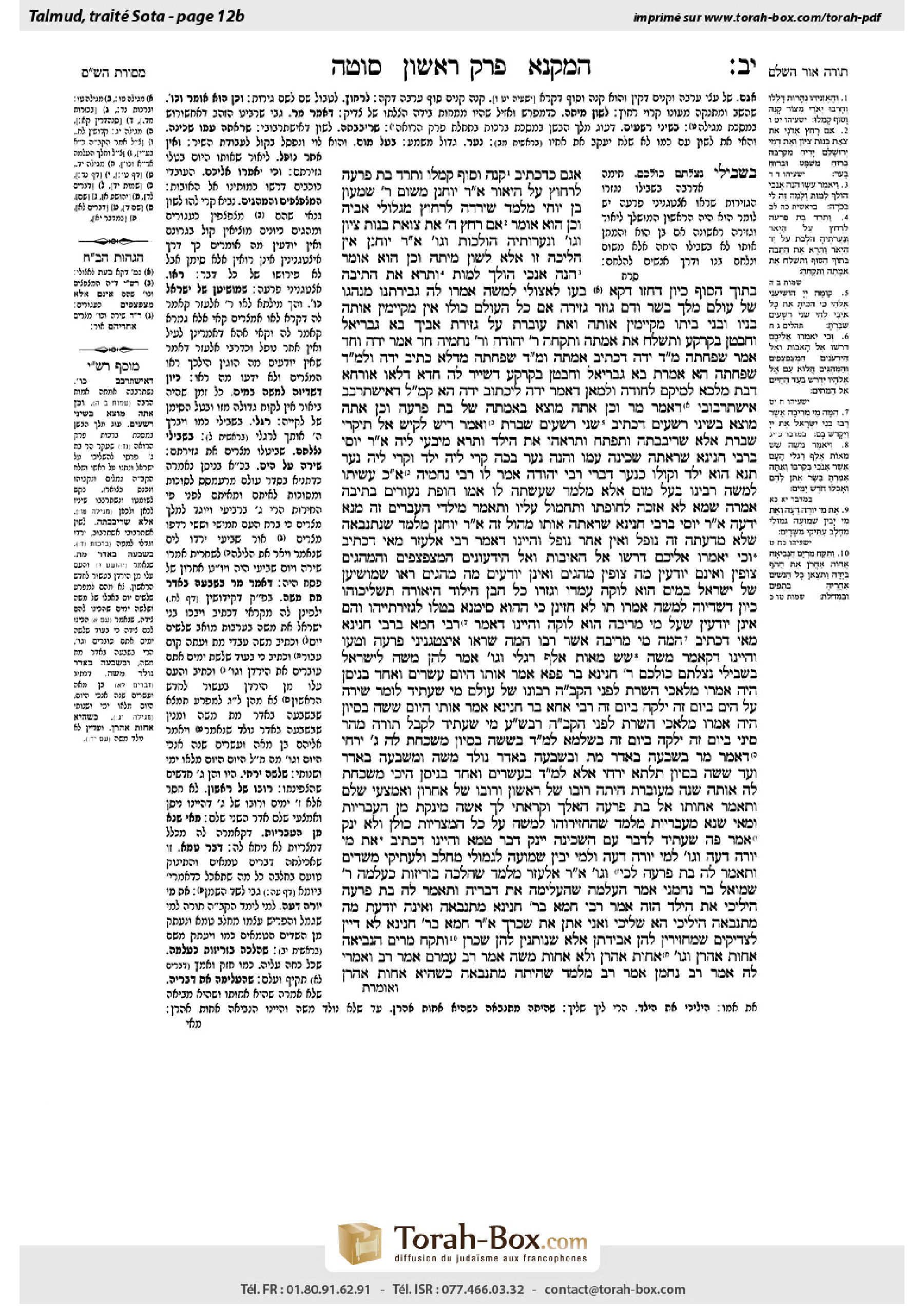
Sotah 12b: Talmud study for Daf Yomi
Daf Yomi is the daily study of one Talmud folio. Explore 37 tractates with scans, Hebrew text, Sefaria English and AI-generated French translations where annotated.
Passage selection and English or AI-generated French translation are available where the scan has annotations. Daf Study is independent of Torah-Box and Sefaria.
Browse Sotah · סוטה · All tractatesSotah 12b text and translations
This page of Sotah includes the Aramaic text, an English translation and an AI-generated French translation, alongside the scan above.
סוטה י״ב ב · Aramaic and Hebrew text
אֲגַם, כְּדִכְתִיב: ״קָנֶה וָסוּף קָמֵלוּ״.
״וַתֵּרֶד בַּת פַּרְעֹה לִרְחוֹץ עַל הַיְאֹר״, אָמַר רַבִּי יוֹחָנָן מִשּׁוּם רַבִּי שִׁמְעוֹן בֶּן יוֹחַי: מְלַמֵּד שֶׁיָּרְדָה לִרְחוֹץ מִגִּלּוּלֵי [בֵּית] אָבִיהָ, וְכֵן הוּא אוֹמֵר: ״אִם רָחַץ ה׳ אֵת צוֹאַת בְּנוֹת צִיּוֹן וְגוֹ׳״.
״וְנַעֲרֹתֶיהָ הוֹלְכוֹת וְגוֹ׳״, אָמַר רַבִּי יוֹחָנָן: אֵין הֲלִיכָה זוֹ אֶלָּא לְשׁוֹן מִיתָה, וְכֵן הוּא אוֹמֵר: ״הִנֵּה אָנֹכִי הוֹלֵךְ לָמוּת״.
״וַתֵּרֶא אֶת הַתֵּיבָה בְּתוֹךְ הַסּוּף״, כֵּיוָן דַּחֲזוֹ דְּקָא בָעוּ לְאַצּוֹלֵי לְמֹשֶׁה, אָמְרוּ לָהּ: גְּבִירְתֵּנוּ, מִנְהָגוֹ שֶׁל עוֹלָם מֶלֶךְ בָּשָׂר וָדָם גּוֹזֵר גְּזֵירָה, אִם כׇּל הָעוֹלָם כּוּלּוֹ אֵין מְקַיְּימִין אוֹתָהּ — בָּנָיו וּבְנֵי בֵיתוֹ מְקַיְּימִין אוֹתָהּ, וְאַתְּ עוֹבֶרֶת עַל גְּזֵירַת אָבִיךְ? בָּא גַּבְרִיאֵל וַחֲבָטָן בַּקַּרְקַע.
״וַתִּשְׁלַח אֶת אֲמָתָהּ וַתִּקָּחֶהָ״. רַבִּי יְהוּדָה וְרַבִּי נְחֶמְיָה, חַד אָמַר: יָדָהּ, וְחַד אָמַר: שִׁפְחָתָהּ. מַאן דְּאָמַר יָדָהּ — דִּכְתִיב ״אַמָּתָהּ״. וּמַאן דְּאָמַר שִׁפְחָתָהּ — מִדְּלָא כְּתִיב ״יָדָהּ״.
וּלְמַאן דְּאָמַר שִׁפְחָתָהּ, הָא אָמְרַתְּ בָּא גַּבְרִיאֵל וַחֲבָטָן בַּקַּרְקַע! דְּשַׁיַּיר לַהּ חֲדָא, דְּלָאו אוֹרְחַהּ דְּבַת מַלְכָּא לְמֵיקַם לְחוֹדַהּ.
וּלְמַאן דְּאָמַר יָדָהּ, לִיכְתּוֹב ״יָדָהּ״! הָא קָא מַשְׁמַע לַן דְּאִישְׁתַּרְבַּב אִישְׁתַּרְבּוֹבֵי. דְּאָמַר מָר: וְכֵן אַתָּה מוֹצֵא בְּאַמָּתָהּ שֶׁל בַּת פַּרְעֹה, וְכֵן אַתָּה מוֹצֵא בְּשִׁינֵּי רְשָׁעִים, דִּכְתִיב: ״שִׁנֵּי רְשָׁעִים שִׁבַּרְתָּ״, וְאָמַר רֵישׁ לָקִישׁ: אַל תִּיקְרֵי ״שִׁבַּרְתָּ״, אֶלָּא ״שֶׁרִיבַּבְתָּה״.
״וַתִּפְתַּח וַתִּרְאֵהוּ אֶת הַיֶּלֶד״. ״וַתֵּרֶא״ מִיבְּעֵי לֵיהּ! אָמַר רַבִּי יוֹסֵי בְּרַבִּי חֲנִינָא: שֶׁרָאֲתָה שְׁכִינָה עִמּוֹ.
״וְהִנֵּה נַעַר בֹּכֶה״. קָרֵי לֵיהּ ״יֶלֶד״, וְקָרֵי לֵיהּ ״נַעַר״. תָּנָא: הוּא יֶלֶד וְקוֹלוֹ כְּנַעַר, דִּבְרֵי רַבִּי יְהוּדָה. אָמַר לוֹ רַבִּי נְחֶמְיָה: אִם כֵּן, עֲשִׂיתוֹ לְמֹשֶׁה רַבֵּינוּ בַּעַל מוּם. אֶלָּא, מְלַמֵּד שֶׁעָשְׂתָה לוֹ אִמּוֹ חוּפַּת נְעוּרִים בַּתֵּיבָה, אָמְרָה: שֶׁמָּא לֹא אֶזְכֶּה לְחוּפָּתוֹ.
״וַתַּחְמֹל עָלָיו וַתֹּאמֶר מִיַּלְדֵי הָעִבְרִים זֶה״. מְנָא יָדְעָה? אָמַר רַבִּי יוֹסֵי בְּרַבִּי חֲנִינָא: שֶׁרָאֲתָה אוֹתוֹ מָהוּל.
״זֶה״. אָמַר רַבִּי יוֹחָנָן: מְלַמֵּד שֶׁנִּתְנַבְּאָה שֶׁלֹּא מִדַּעְתָּהּ — זֶה נוֹפֵל, וְאֵין אַחֵר נוֹפֵל.
וְהַיְינוּ דְּאָמַר רַבִּי אֶלְעָזָר, מַאי דִּכְתִיב: ״וְכִי יֹאמְרוּ אֲלֵיכֶם דִּרְשׁוּ אֶל הָאֹבוֹת וְאֶל הַיִּדְּעֹנִים הַמְצַפְצְפִים וְהַמַּהְגִּים״: צוֹפִין וְאֵינָם יוֹדְעִין מָה צוֹפִין, מְהַגִּים וְאֵינָן יוֹדְעִים מָה מְהַגִּים.
רָאוּ שֶׁמּוֹשִׁיעָן שֶׁל יִשְׂרָאֵל בַּמַּיִם הוּא לוֹקֶה, עָמְדוּ וְגָזְרוּ: ״כׇּל הַבֵּן הַיִּלּוֹד הַיְאֹרָה תַּשְׁלִיכֻהוּ״. כֵּיוָן דְּשַׁדְיוּהּ לְמֹשֶׁה, אָמְרוּ: תּוּ לָא חָזֵינַן כִּי הָהוּא סִימָנָא, בַּטִּלוּ לִגְזֵירְתַּיְיהוּ. וְהֵם אֵינָן יוֹדְעִין שֶׁעַל מֵי מְרִיבָה הוּא לוֹקֶה.
וְהַיְינוּ דְּאָמַר רַבִּי חָמָא בְּרַבִּי חֲנִינָא: מַאי דִּכְתִיב ״הֵמָּה מֵי מְרִיבָה אֲשֶׁר רָבוּ״ — הֵמָּה שֶׁרָאוּ אִיצְטַגְנִינֵי פַּרְעֹה וְטָעוּ. וְהַיְינוּ דְּקָאָמַר מֹשֶׁה: ״שֵׁשׁ מֵאוֹת אֶלֶף רַגְלִי וְגוֹ׳״, אָמַר לָהֶן מֹשֶׁה לְיִשְׂרָאֵל: בִּשְׁבִילִי נִצַּלְתֶּם כּוּלְּכֶם.
רַבִּי חֲנִינָא בַּר פָּפָּא אָמַר: אוֹתוֹ הַיּוֹם עֶשְׂרִים וְאֶחָד בְּנִיסָן הָיָה, אָמְרוּ מַלְאֲכֵי הַשָּׁרֵת לִפְנֵי הַקָּדוֹשׁ בָּרוּךְ הוּא: רִבּוֹנוֹ שֶׁל עוֹלָם, מִי שֶׁעָתִיד לוֹמַר שִׁירָה עַל הַיָּם בְּיוֹם זֶה — יִלְקֶה בְּיוֹם זֶה?
רַבִּי אַחָא בַּר חֲנִינָא אָמַר: אוֹתוֹ הַיּוֹם שִׁשָּׁה בְּסִיוָן הָיָה, אָמְרוּ מַלְאֲכֵי הַשָּׁרֵת לִפְנֵי הַקָּדוֹשׁ בָּרוּךְ הוּא: רִבּוֹנוֹ שֶׁל עוֹלָם, מִי שֶׁעָתִיד לְקַבֵּל תּוֹרָה מֵהַר סִינַי בְּיוֹם זֶה — יִלְקֶה בְּיוֹם זֶה?
בִּשְׁלָמָא לְמַאן דְּאָמַר בְּשִׁשָּׁה בְּסִיוָן, מַשְׁכַּחַתְּ לַהּ תְּלָתָא יַרְחֵי. דְּאָמַר מָר: בְּשִׁבְעָה בַּאֲדָר מֵת, וּבְשִׁבְעָה בַּאֲדָר נוֹלָד מֹשֶׁה, וּמִשִּׁבְעָה בַּאֲדָר וְעַד שִׁשָּׁה בְּסִיוָן תְּלָתָא יַרְחֵי. אֶלָּא לְמַאן דְּאָמַר בְּעֶשְׂרִים וְאֶחָד בְּנִיסָן, הֵיכִי מַשְׁכַּחַתְּ לַהּ?
אוֹתָהּ שָׁנָה מְעוּבֶּרֶת הָיְתָה: רוּבּוֹ שֶׁל רִאשׁוֹן, וְרוּבּוֹ שֶׁל אַחֲרוֹן, וְאֶמְצָעִי שָׁלֵם.
״וַתֹּאמֶר אֲחוֹתוֹ אֶל בַּת פַּרְעֹה הַאֵלֵךְ וְקָרָאתִי לָךְ אִשָּׁה מֵינֶקֶת מִן הָעִבְרִיּוֹת״. וּמַאי שְׁנָא מֵעִבְרִיּוֹת?
מְלַמֵּד שֶׁהֶחְזִירוּהוּ לְמֹשֶׁה עַל כׇּל הַמִּצְרִיּוֹת כּוּלָּן, וְלֹא יָנַק, אָמַר: פֶּה שֶׁעָתִיד לְדַבֵּר עִם הַשְּׁכִינָה יִינַק דָּבָר טָמֵא? וְהַיְינוּ דִּכְתִיב: ״אֶת מִי יוֹרֶה דֵעָה וְגוֹ׳״. לְמִי יוֹרֶה דֵּעָה וּלְמִי יָבִין שְׁמוּעָה — ״לִגְמוּלֵי מֵחָלָב וּלְעַתִּיקֵי מִשָּׁדַיִם״.
״וַתֹּאמֶר לָהּ בַּת פַּרְעֹה לֵכִי וְגוֹ׳״. אָמַר רַבִּי אֶלְעָזָר: מְלַמֵּד שֶׁהָלְכָה בִּזְרִיזוּת כְּעַלְמָה. רַבִּי שְׁמוּאֵל בַּר נַחְמָנִי אָמַר: ״הָעַלְמָה״ — שֶׁהֶעֱלִימָה אֶת דְּבָרֶיהָ.
״וַתֹּאמֶר לָהּ בַּת פַּרְעֹה הֵילִיכִי אֶת הַיֶּלֶד הַזֶּה״. אָמַר רַבִּי חָמָא בְּרַבִּי חֲנִינָא: מִתְנַבְּאָה וְאֵינָהּ יוֹדַעַת מָה מִתְנַבְּאָה, ״הֵילִיכִי״ — הָא שֶׁלִּיכִי. ״וַאֲנִי אֶתֵּן אֶת שְׂכָרֵךְ״. אָמַר רַבִּי חָמָא בְּרַבִּי חֲנִינָא: לֹא דַּיָּין לַצַּדִּיקִים שֶׁמַּחְזִירִין לָהֶן אֲבֵידָתָן, אֶלָּא שֶׁנּוֹתְנִין לָהֶן שְׂכָרָן.
״וַתִּקַּח מִרְיָם הַנְּבִיאָה אֲחוֹת אַהֲרֹן וְגוֹ׳״. אֲחוֹת אַהֲרֹן וְלֹא אֲחוֹת מֹשֶׁה? אָמַר רַב עַמְרָם אָמַר רַב, וְאָמְרִי לַהּ, אָמַר רַב נַחְמָן אָמַר רַב: מְלַמֵּד שֶׁהָיְתָה מִתְנַבְּאָה כְּשֶׁהִיא אֲחוֹת אַהֲרֹן,
Sotah 12b · English translation
She placed him in a marsh, as it is written: “The reeds and willows [suf] shall wither” (Isaiah 19:6).
The verse states: “And the daughter of Pharaoh came down to bathe [lirḥotz] in the river” (Exodus 2:5). Rabbi Yoḥanan says in the name of Rabbi Shimon ben Yoḥai: This teaches that she came down to the river to cleanse herself from the impurity of her father’s idols, as she was immersing herself as part of the conversion process. And similarly it states: “When the Lord shall have washed [raḥatz] away the filth of the daughters of Zion, and shall have purged the blood of Jerusalem from the midst thereof, by the spirit of judgment, and by the spirit of destruction” (Isaiah 4:4). This washing clearly refers to the purging of spiritual sins, rather than bathing for the sake of cleanliness.
The verse continues: “And her maidens walked along [holekhot] by the riverside” (Exodus 2:5). Rabbi Yoḥanan says: This walking is nothing other than the terminology of going toward death, and similarly it states: “Behold, I am going [holekh] to die” (Genesis 25:32).
The verse continues: “And she saw the ark among the willows” (Exodus 2:5). Once her maidens saw that the daughter of Pharaoh was intending to save Moses, they said to her: Our mistress, the custom of the world is that when a king of flesh and blood decrees a decree, even if all the world does not fulfill it, at least his children and members of his household fulfill it, and yet you are violating the decree of your father. After the maidens tried to convince her not to save Moses, the angel Gabriel came and beat them to the ground and they died.
The verse concludes: “And she sent amatah to take it” (Exodus 2:5). Rabbi Yehuda and Rabbi Neḥemya disagree as to the definition of the word “amatah.” One says that it means her arm, and one says that it means her maidservant. The Gemara explains: The one who says that it means her arm explained it in this manner, as it is written “amatah,” which denotes her forearm. And the one who says that it means her maidservant explained it in this manner because it does not explicitly write the more common term: Her hand [yadah]. Therefore, he understands that this is the alternative term for a maidservant, ama.
The Gemara asks: And according to the one who says that it means her maidservant, didn’t you say earlier: Gabriel came and beat them to the ground and the maidservants died, so how could Pharaoh’s daughter send her? The Gemara answers: It must be that Gabriel left her one maidservant, as it is not proper that a princess should stand alone.
The Gemara asks: And according to the one who says that it means her hand, let the Torah write explicitly: Her hand [yadah]. Why use the more unusual term amatah? The Gemara answers: This verse teaches us that her arm extended [ishtarbav] many cubits. As the Master said in another context: And similarly you find with regard to the hand of Pharaoh’s daughter that it extended, and similarly you find with regard to the teeth of evildoers, as it is written: “You have broken [shibbarta] the teeth of the wicked” (Psalms 3:8), and Reish Lakish said: Do not read the word as shibbarta, rather read it as sheribbavta, you have extended.
The next verse states: “And she opened it and saw it [vatirehu], even the child” (Exodus 2:6). The Gemara comments: The verse states: “And she saw it”; it should have stated: And she saw. Rabbi Yosei, son of Rabbi Ḥanina, says: In addition to Moses, she saw the Divine Presence with him. This is indicated by the usage of “saw it.”
The verse states: “And saw it, even the child [yeled]; and behold a lad [na’ar] that wept” (Exodus 2:6). The verse calls him “a child [yeled],” and the same verse calls him “a lad [na’ar].” A Sage teaches: He is the age of a child but his voice is as loud and deep as a lad; this is the statement of Rabbi Yehuda. Rabbi Neḥemya said to him: If that is so, you made Moses our teacher blemished, since his voice was unusually deep. Rather, this teaches that his mother made a canopy of youth, i.e., a small canopy, for him in the ark, as she said: Perhaps I will not merit to see his wedding canopy.
The verse concludes: “And she had compassion on him, and said: This [zeh] is one of the Hebrews’ children” (Exodus 2:6). The Gemara asks: From where did she know that he was a Hebrew child? Rabbi Yosei, son of Rabbi Ḥanina, says: As she saw that he was circumcised.
The Gemara comments: The Pharaoh’s daughter said: “This [zeh] is one of the Hebrews’ children” (Exodus 2:6). Rabbi Yoḥanan says: This teaches that she prophesied unknowingly, as the intention of the word “zeh” was: This one falls, i.e., is cast, into the water, but no other will fall by means of water, for on that day Pharaoh’s decree was canceled.
The Gemara explains: And this is what Rabbi Elazar said: What is the meaning of that which is written: “And when they shall say to you: Seek unto the necromancers and the diviners, that chirp [metzaftzefim] and that mutter [mahggim]” (Isaiah 8:19)? The explanation of their chirping and muttering is: They see [tzofin], but they do not know what they are seeing; they enunciate [mahggim], but they do not know what they are enunciating. Although necromancers and diviners do have some insight into the future, they do not see clearly enough to understand what they are actually seeing.
The Gemara applies this to Pharaoh: Pharaoh’s astrologers saw that the savior of the Jewish people would be stricken by water. Therefore, they arose and decreed: “Every son that is born you shall cast into the river” (Exodus 1:22); they thought that their vision indicated that Moses would be killed in the water. Once Jochebed cast Moses into the water, although he was protected in an ark, the astrologers said: We no longer see in the stars anything like that sign we saw as to the downfall of the leader of the Jews by water, and therefore at that moment they canceled their decree. But they did not know that what they saw foretold that Moses would be stricken on account of the waters of Meribah. They envisioned a downfall for Moses by water but didn’t fully comprehend their vision.
And this is what Rabbi Ḥama, son of Rabbi Ḥanina, says: What is the meaning of that which is written: “These [hemma] are the waters of Meribah, where the children of Israel strove with the Lord, and He was sanctified in them” (Numbers 20:13)? The verse indicates that these are the waters that the astrologers of Pharaoh saw and on account of which they erred. And this is what Moses said: “The people, among whom I am, are six hundred thousand men on foot [ragli]; and yet You have said: I will give them flesh, that they may eat a whole month” (Numbers 11:21). Moses said to the Jewish people: On account of me, which is an alternative meaning of the word ragli, all of you were saved, as the decree to throw all males into the river was canceled on my account.
Rabbi Ḥanina bar Pappa says: That day that Moses was placed in the river was the twenty-first day of the month of Nisan. The ministering angels said before the Holy One, Blessed be He: Master of the Universe, should the one who in the future will say the Song at the Red Sea on this day be stricken on this day? As this was also the date on which the Red Sea would be parted during the salvation of the Exodus.
Rabbi Aḥa bar Ḥanina says: That day was actually the sixth day of the month of Sivan. The ministering angels said before the Holy One, Blessed be He: Master of the Universe, should the one who in the future will receive the Torah on Mount Sinai on this day be stricken on this day? As this was also the date on which the Torah was received.
The Gemara asks: Granted, according to the one who says that Moses was placed in the water on the sixth of Sivan, you find that there can be three months during which Moses was hidden after his birth; as the Master said (Tosefta 11:7): Moses died on the seventh of Adar, and Moses was born on the seventh of Adar. And based on this, from the seventh of Adar until the sixth of Sivan there are three months, which correspond to the three months Moses was hidden before being placed in the water. But according to the one who says that it was on the twenty-first of Nisan, how can you find that he was hidden for three months?
The Gemara answers: That year was a leap year in which there were two months of Adar. Moses was hidden most of the first month of the three, from the seventh day of the first Adar when he was born, and most of the last month of the three, i.e., all of Nisan until the twenty-first, and the entire middle one. All of this together is considered as three months.
The Gemara now discusses the next verse in Exodus: “Then said his sister to Pharaoh’s daughter: Shall I go and call you a nurse of the Hebrew women, that she may nurse the child for you?” (Exodus 2:7). The Gemara asks: And what is different that Pharaoh’s daughter would specifically want a nurse of the Hebrew women?
The Gemara answers: This teaches that prior to this, they took Moses around to all the Egyptian wet nurses and he did not agree to nurse from any of them, as he said: Shall a mouth that in the future will speak with the Divine Presence actually nurse something impure? And this is as it is written: “Whom shall one teach knowledge? And whom shall one make understand the message?” (Isaiah 28:9). The prophet is asking: To whom shall God teach the knowledge of the Torah, and to whom shall God make to understand the message of the Torah? The answer is as the verse continues: “Them that are weaned from the milk, them that are drawn from the breasts” (Isaiah 28:9). The conclusion of the verse indicates that the Torah should be taught to the one who did not want to nurse from the milk of a gentile woman, i.e., Moses.
The next verse states: “And Pharaoh’s daughter said to her: Go. And the maiden [ha’alma] went and called the child’s mother” (Exodus 2:8). Rabbi Elazar says: This teaches that she went quickly like a maiden, i.e., with the strength of one of marriageable age, and not as the young child that she was. Rabbi Shmuel bar Naḥmani says: The word ha’alma is related to the word meaning to hide [le’alem], for she hid her words and didn’t tell Pharaoh’s daughter that she was bringing the baby’s mother.
The next verse states what Pharaoh’s daughter said to Jochebed: “And Pharaoh’s daughter said to her: Take this [heilikhi] child away, and nurse it for me, and I will give you your wages. And the woman took the child, and nursed it” (Exodus 2:9). Rabbi Ḥama, son of Rabbi Ḥanina, says: Pharaoh’s daughter is prophesying and she does not know what she is prophesying, as the word heilikhi means: This is yours [ha shellikhi], i.e., this is your child. The next part of the verse states: “And I will give you your wages.” Rabbi Ḥama, son of Rabbi Ḥanina, says: This teaches that with regard to righteous people, not only is it so that God arranges that their lost items are returned to them, but He also arranges that they get their wages, as the son of Jochebed was returned to her and she also received payment for nursing him.
Elsewhere, the verse states with regard to Miriam: “And Miriam the prophetess, the sister of Aaron, took a timbrel in her hand; and all the women went out after her with timbrels and with dances” (Exodus 15:20). The Gemara asks: Why is Miriam referred to as “the sister of Aaron,” and not the sister of Moses? Rav Amram says that Rav says, and some say that Rav Naḥman says that Rav says: This teaches that Miriam already prophesied when she was still the sister of only Aaron, i.e., before Moses was born.
Sotah 12b · Traduction française (IA)
Elle le plaça dans un marécage, comme il est écrit : « Les roseaux et les joncs [suf] se dessécheront » (Isaïe 19:6).
Le verset dit : « La fille de Pharaon descendit se baigner [lirḥotz] dans le fleuve » (Exode 2:5). Rabbi Yoḥanan dit au nom de Rabbi Shimon ben Yoḥai : Cela enseigne qu’elle descendit au fleuve pour se purifier de l’impureté liée aux idoles de son père, car elle s’immergeait dans le cadre de sa conversion. De même, il est écrit : « Quand le Seigneur aura lavé [raḥatz] la souillure des filles de Sion et purifié Jérusalem du sang qui se trouve en son sein, par l’esprit de jugement et par l’esprit de destruction » (Isaïe 4:4). Ce lavage désigne clairement la purification des fautes spirituelles, et non un bain destiné à se nettoyer.
Le verset poursuit : « Et ses servantes marchaient [holekhot] le long du fleuve » (Exode 2:5). Rabbi Yoḥanan dit : Cette marche n’est autre qu’une expression désignant le fait d’aller vers la mort ; de même, il est écrit : « Voici, je vais [holekh] mourir » (Genèse 25:32).
Le verset poursuit : « Et elle vit la corbeille parmi les roseaux » (Exode 2:5). Lorsque ses servantes virent que la fille de Pharaon avait l’intention de sauver Moïse, elles lui dirent : « Notre maîtresse, l’usage du monde veut que, lorsqu’un roi de chair et de sang édicte un décret, même si le monde entier ne le respecte pas, ses enfants et les membres de sa maison, eux, le respectent au moins ; or, toi, tu enfreins le décret de ton père. » Après que les servantes eurent tenté de la dissuader de sauver Moïse, l’ange Gabriel vint, les frappa à terre et elles moururent.
Le verset se termine ainsi : « Elle envoya amatah pour la prendre » (Exode 2:5). Rabbi Yehouda et Rabbi Neḥemya sont en désaccord sur le sens du mot « amatah ». Selon l’un, il désigne son bras ; selon l’autre, sa servante. La Guemara explique : Celui qui dit qu’il désigne son bras l’explique ainsi, car le texte écrit « amatah », terme qui désigne son avant-bras. Celui qui dit qu’il désigne sa servante l’explique ainsi, car le texte n’emploie pas explicitement le terme plus courant : « sa main » [yadah]. Il comprend donc qu’il s’agit de l’autre terme désignant une servante : ama.
La Guemara demande : Et selon celui qui dit que cela désigne sa servante, n’a-t-on pas dit précédemment que Gabriel était venu, les avait frappées à terre et que les servantes étaient mortes ? Comment la fille de Pharaon aurait-elle donc pu l’envoyer ? La Guemara répond : Il faut que Gabriel lui en ait laissé une, car il ne convient pas qu’une princesse reste seule.
La Guemara demande : Et selon celui qui dit que cela désigne son bras, que la Torah écrive explicitement « sa main » [yadah]. Pourquoi employer le terme moins courant amatah ? La Guemara répond : Ce verset nous enseigne que son bras s’allongea [ishtarbav] sur plusieurs coudées. En effet, le Maître a dit dans un autre contexte : On trouve de même que le bras de la fille de Pharaon s’allongea, et, de même, à propos des dents des méchants, comme il est écrit : « Tu as brisé [shibbarta] les dents des méchants » (Psaumes 3:8). Reish Lakish a dit : Ne lis pas shibbarta, mais plutôt sheribbavta, « tu as allongé ».
Le verset suivant dit : « Elle l’ouvrit et le vit [vatirehu], à savoir l’enfant » (Exode 2:6). La Guemara fait remarquer que le texte dit : « Elle le vit » ; il aurait dû dire : « Elle vit ». Rabbi Yosei, fils de Rabbi Ḥanina, dit : En plus de Moïse, elle vit la Présence divine avec lui. C’est ce qu’indique l’emploi de « le vit ».
Le verset dit : « Elle le vit, à savoir l’enfant [yeled] ; et voici qu’un garçon [na’ar] pleurait » (Exode 2:6). Le verset le qualifie d’« enfant [yeled] », puis, dans le même verset, de « garçon [na’ar] ». Un Sage enseigne : Il avait l’âge d’un enfant, mais sa voix était aussi forte et grave que celle d’un garçon. Telle est la déclaration de Rabbi Yehouda. Rabbi Neḥemya lui dit : « Si c’est ainsi, tu as fait de Moïse notre maître un être difforme, puisque sa voix était anormalement grave. » Cela enseigne plutôt que sa mère lui avait aménagé dans la corbeille un dais de jeunesse, c’est-à-dire un petit dais, car elle se disait : « Peut-être ne mériterai-je pas de voir son dais nuptial. »
Le verset se termine ainsi : « Elle eut pitié de lui et dit : “C’est [zeh] un enfant des Hébreux” » (Exode 2:6). La Guemara demande : Comment sut-elle qu’il s’agissait d’un enfant hébreu ? Rabbi Yosei, fils de Rabbi Ḥanina, dit : Elle vit qu’il était circoncis.
La Guemara fait remarquer que la fille de Pharaon dit : « C’est [zeh] un enfant des Hébreux » (Exode 2:6). Rabbi Yoḥanan dit : Cela enseigne qu’elle prophétisa sans le savoir, car le mot « zeh » signifiait qu’il serait le seul à tomber dans l’eau, c’est-à-dire à y être jeté, et que personne d’autre n’y tomberait, car ce jour-là, le décret de Pharaon fut annulé.
La Guemara explique : C’est ce que Rabbi Elazar a dit : Quel est le sens de ce qui est écrit : « Quand on vous dira : Consultez les nécromanciens et les devins, ceux qui gazouillent [metzaftzefim] et marmonnent [mahggim] » (Isaïe 8:19) ? Leur gazouillement et leur marmonnement s’expliquent ainsi : Ils voient [tzofin], mais ne savent pas ce qu’ils voient ; ils articulent [mahggim], mais ne savent pas ce qu’ils articulent. Bien que les nécromanciens et les devins aient quelque connaissance de l’avenir, ils ne voient pas assez clairement pour comprendre ce qu’ils voient réellement.
La Guemara applique cela à Pharaon : ses astrologues virent que le sauveur du peuple juif serait frappé par l’eau. Ils se levèrent donc et décrétèrent : « Tout fils qui naîtra, vous le jetterez dans le fleuve » (Exode 1:22) ; ils pensaient que leur vision indiquait que Moïse serait tué dans l’eau. Lorsque Yokheved jeta Moïse dans l’eau, bien qu’il fût protégé dans une corbeille, les astrologues dirent : « Nous ne voyons plus dans les astres rien qui ressemble au signe que nous avions vu concernant la chute du chef des Juifs par l’eau. » Ils annulèrent donc leur décret à ce moment-là. Mais ils ne savaient pas que leur vision annonçait que Moïse serait frappé à cause des eaux de Meriba. Ils avaient entrevu la chute de Moïse par l’eau, mais n’avaient pas pleinement compris leur vision.
Et c’est ce que dit Rabbi Ḥama, fils de Rabbi Ḥanina : Quel est le sens de ce qui est écrit : « Ce sont [hemma] les eaux de Meriba, où les enfants d’Israël contestèrent avec le Seigneur, et où Il fut sanctifié parmi eux » (Nombres 20:13) ? Le verset indique que ce sont ces eaux que les astrologues de Pharaon avaient vues et qui les avaient induits en erreur. Et c’est ce que dit Moïse : « Le peuple au milieu duquel je me trouve compte six cent mille hommes à pied [ragli], et pourtant Tu as dit : Je leur donnerai de la viande, afin qu’ils en mangent pendant un mois entier » (Nombres 11:21). Moïse dit au peuple juif : « À cause de moi » — autre sens du mot ragli — vous avez tous été sauvés, car le décret de jeter tous les garçons dans le fleuve fut annulé à cause de moi.
Rabbi Ḥanina bar Pappa dit : Le jour où Moïse fut placé dans le fleuve était le vingt et unième jour du mois de Nisan. Les anges tutélaires dirent devant le Saint, béni soit-Il : « Maître de l’Univers, celui qui dira à l’avenir le Cantique de la mer des Joncs ce jour-là doit-il être frappé ce même jour ? » C’était également la date à laquelle la mer des Joncs devait se fendre lors de la délivrance de l’Exode.
Rabbi Aḥa bar Ḥanina dit : Ce jour-là était en réalité le sixième jour du mois de Sivan. Les anges tutélaires dirent devant le Saint, béni soit-Il : « Maître de l’Univers, celui qui recevra à l’avenir la Torah sur le mont Sinaï ce jour-là doit-il être frappé ce même jour ? » C’était également la date à laquelle la Torah fut reçue.
La Guemara demande : On peut admettre que, selon celui qui dit que Moïse fut placé dans l’eau le six Sivan, il y a bien trois mois durant lesquels Moïse fut caché après sa naissance, car le Maître a dit (Tosefta 11:7) : Moïse mourut le sept Adar et naquit le sept Adar. Sur cette base, du sept Adar au six Sivan, il y a trois mois, qui correspondent aux trois mois pendant lesquels Moïse fut caché avant d’être placé dans l’eau. Mais selon celui qui dit que cela eut lieu le vingt et un Nisan, comment peut-on considérer qu’il fut caché pendant trois mois ?
La Guemara répond : Cette année-là était une année embolismique comptant deux mois d’Adar. Moïse fut caché pendant la majeure partie du premier des trois mois, à partir du sept du premier Adar, jour de sa naissance, pendant la majeure partie du dernier mois des trois, c’est-à-dire tout Nisan jusqu’au vingt et un, ainsi que pendant tout le mois du milieu. Tout cela est considéré comme trois mois.
La Guemara examine maintenant le verset suivant de l’Exode : « Sa sœur dit à la fille de Pharaon : “Dois-je aller te chercher une nourrice parmi les femmes hébreues, afin qu’elle allaite l’enfant pour toi ?” » (Exode 2:7). La Guemara demande : Pourquoi la fille de Pharaon aurait-elle voulu précisément une nourrice parmi les femmes hébreues ?
La Guemara répond : Cela enseigne qu’auparavant, on avait amené Moïse auprès de toutes les nourrices égyptiennes, mais qu’il avait refusé de téter auprès d’aucune d’elles, car il se disait : « La bouche qui parlera à l’avenir avec la Présence divine doit-elle vraiment téter quelque chose d’impur ? » C’est ce qui est écrit : « À qui enseignera-t-on la connaissance ? À qui fera-t-on comprendre le message ? » (Isaïe 28:9). Le prophète demande : À qui Dieu enseignera-t-Il la connaissance de la Torah, et à qui fera-t-Il comprendre le message de la Torah ? La réponse se trouve dans la suite du verset : « À ceux qui sont sevrés du lait, à ceux qu’on a retirés des mamelles » (Isaïe 28:9). La fin du verset indique que la Torah doit être enseignée à celui qui n’a pas voulu téter le lait d’une femme non juive, c’est-à-dire Moïse.
Le verset suivant dit : « La fille de Pharaon lui dit : “Va.” La jeune fille [ha’alma] alla appeler la mère de l’enfant » (Exode 2:8). Rabbi Elazar dit : Cela enseigne qu’elle partit rapidement, comme une jeune fille, c’est-à-dire avec la vigueur d’une personne en âge de se marier, et non comme la jeune enfant qu’elle était. Rabbi Shmuel bar Naḥmani dit : Le mot ha’alma est apparenté au mot signifiant cacher [le’alem], car elle dissimula ses paroles et ne dit pas à la fille de Pharaon qu’elle allait chercher la mère du bébé.
Le verset suivant rapporte les paroles de la fille de Pharaon à Yokheved : « La fille de Pharaon lui dit : “Emmène [heilikhi] cet enfant, allaite-le pour moi, et je te donnerai ton salaire.” La femme prit l’enfant et l’allaita » (Exode 2:9). Rabbi Ḥama, fils de Rabbi Ḥanina, dit : La fille de Pharaon prophétise sans savoir ce qu’elle prophétise, car le mot heilikhi signifie : « Il est à toi » [ha shellikhi], c’est-à-dire : « Cet enfant est le tien. » La suite du verset dit : « Et je te donnerai ton salaire. » Rabbi Ḥama, fils de Rabbi Ḥanina, dit : Cela enseigne qu’en ce qui concerne les justes, Dieu ne se contente pas de faire en sorte que leurs objets perdus leur soient rendus ; Il veille aussi à ce qu’ils reçoivent leur salaire, puisque le fils de Yokheved lui fut rendu et qu’elle reçut également un paiement pour l’avoir allaité.
Ailleurs, le verset dit au sujet de Myriam : « Myriam la prophétesse, sœur d’Aaron, prit un tambourin à la main ; et toutes les femmes sortirent derrière elle avec des tambourins et en dansant » (Exode 15:20). La Guemara demande : Pourquoi Myriam est-elle appelée « sœur d’Aaron », et non sœur de Moïse ? Rav Amram dit au nom de Rav — et certains disent que Rav Naḥman dit au nom de Rav : Cela enseigne que Myriam prophétisait déjà alors qu’elle était encore seulement la sœur d’Aaron, c’est-à-dire avant la naissance de Moïse.
Traduction française générée par IA à partir de l’édition anglaise de Sefaria. Vérifie toujours un passage avec le texte source.
Text from Sefaria: William Davidson Edition - Vocalized Aramaic (CC BY NC); William Davidson Edition - English (CC BY NC).