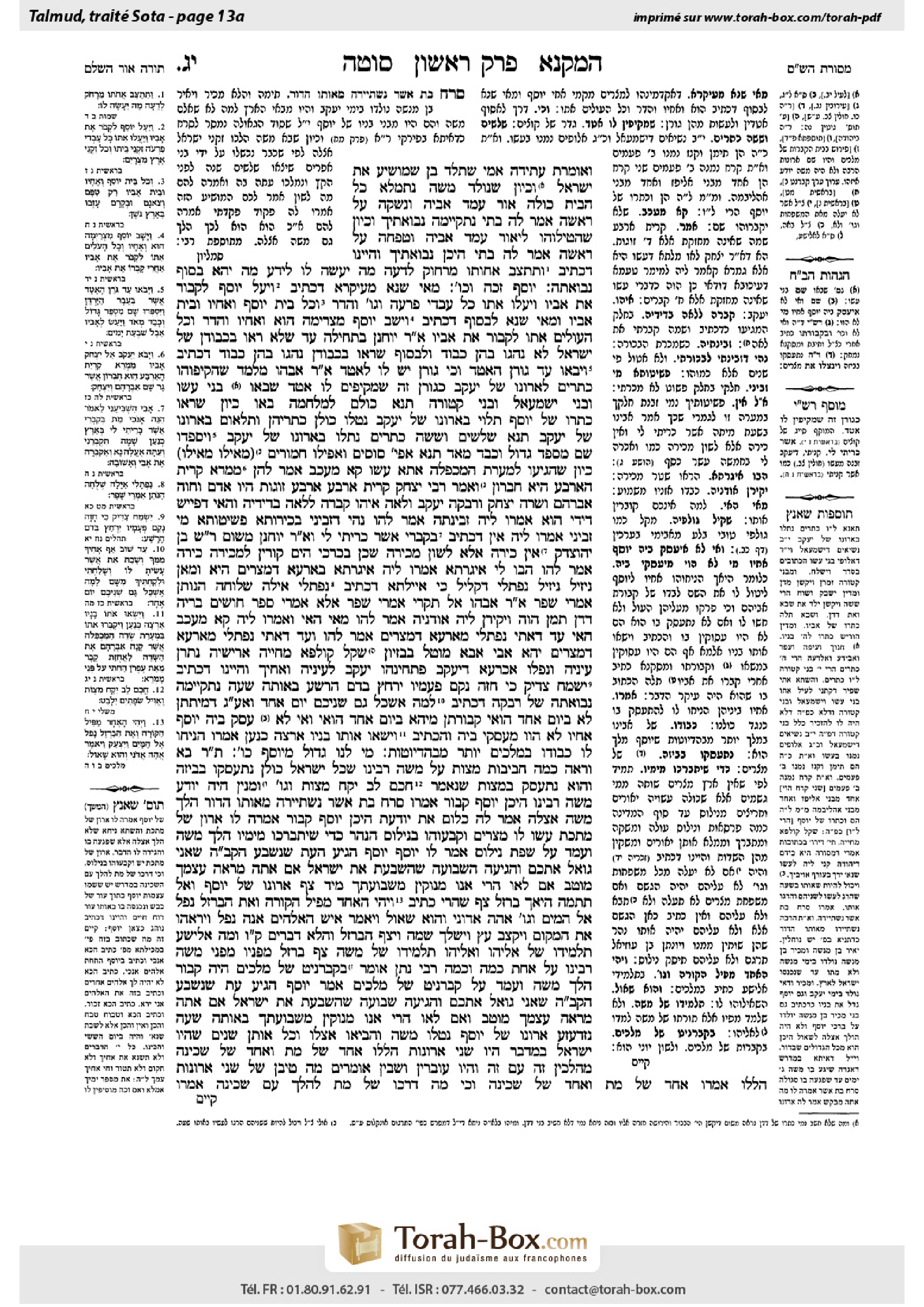
Sotah 13a: Talmud study for Daf Yomi
Daf Yomi is the daily study of one Talmud folio. Explore 37 tractates with scans, Hebrew text, Sefaria English and AI-generated French translations where annotated.
Passage selection and English or AI-generated French translation are available where the scan has annotations. Daf Study is independent of Torah-Box and Sefaria.
Browse Sotah · סוטה · All tractatesSotah 13a text and translations
This page of Sotah includes the Aramaic text, an English translation and an AI-generated French translation, alongside the scan above.
סוטה י״ג א · Aramaic and Hebrew text
וְאוֹמֶרֶת: עֲתִידָה אִמִּי שֶׁתֵּלֵד בֵּן שֶׁמּוֹשִׁיעַ אֶת יִשְׂרָאֵל. וְכֵיוָן שֶׁנּוֹלַד מֹשֶׁה נִתְמַלֵּא כָּל הַבַּיִת כּוּלּוֹ אוֹר. עָמַד אָבִיהָ וּנְשָׁקָהּ עַל רֹאשָׁהּ, אָמַר לָהּ: בִּתִּי, נִתְקַיְּימָה נְבוּאָתִיךְ. וְכֵיוָן שֶׁהִטִּילוּהוּ לַיְאוֹר, עָמַד אָבִיהָ וּטְפָחָהּ עַל רֹאשָׁהּ, אָמַר לָהּ: בִּתִּי הֵיכָן נְבוּאָתִיךְ? וְהַיְינוּ דִּכְתִיב: ״וַתֵּתַצַּב אֲחוֹתוֹ מֵרָחוֹק לְדֵעָה מַה יֵּעָשֶׂה לוֹ״ — לֵידַע מָה יְהֵא בְּסוֹף נְבוּאָתָהּ.
יוֹסֵף זָכָה וְכוּ׳. מַאי שְׁנָא מֵעִיקָּרָא דִּכְתִיב: ״וַיַּעַל יוֹסֵף לִקְבּוֹר אֶת אָבִיו וַיַּעֲלוּ אִתּוֹ כׇּל עַבְדֵי פַּרְעֹה וְגוֹ׳״, וַהֲדַר: ״וְכֹל בֵּית יוֹסֵף וְאֶחָיו וּבֵית אָבִיו״, וּמַאי שְׁנָא לְבַסּוֹף דִּכְתִיב: ״וַיָּשׇׁב יוֹסֵף מִצְרַיְמָה הוּא וְאֶחָיו״, וַהֲדַר: ״וְכׇל הָעוֹלִים אִתּוֹ לִקְבּוֹר אֶת אָבִיו״?
אָמַר רַבִּי יוֹחָנָן: בַּתְּחִילָּה עַד שֶׁלֹּא רָאוּ בִּכְבוֹדָן שֶׁל יִשְׂרָאֵל — לֹא נָהֲגוּ בָּהֶן כָּבוֹד, וּלְבַסּוֹף שֶׁרָאוּ בִּכְבוֹדָן — נָהֲגוּ בָּהֶן כָּבוֹד.
דִּכְתִיב: ״וַיָּבֹאוּ עַד גּוֹרֶן הָאָטָד״, וְכִי גוֹרֶן יֵשׁ לוֹ לָאָטָד? אָמַר רַבִּי אֲבָהוּ: מְלַמֵּד שֶׁהִקִּיפוּהוּ כְּתָרִים לַאֲרוֹנוֹ שֶׁל יַעֲקֹב כְּגוֹרֶן זֶה שֶׁמַּקִּיפִים לוֹ אָטָד, שֶׁבָּאוּ בְּנֵי עֵשָׂו וּבְנֵי יִשְׁמָעֵאל וּבְנֵי קְטוּרָה.
תָּנָא: כּוּלָּם לַמִּלְחָמָה בָּאוּ, כֵּיוָן שֶׁרָאוּ כִּתְרוֹ שֶׁל יוֹסֵף תָּלוּי בַּאֲרוֹנוֹ שֶׁל יַעֲקֹב, נָטְלוּ כּוּלָּן כִּתְרֵיהֶן וּתְלָאוּם בַּאֲרוֹנוֹ שֶׁל יַעֲקֹב. תָּנָא: שְׁלֹשִׁים וְשִׁשָּׁה כְּתָרִים נִתְלוּ בַּאֲרוֹנוֹ שֶׁל יַעֲקֹב.
״וַיִּסְפְּדוּ שָׁם מִסְפֵּד גָּדוֹל וְכָבֵד מְאֹד״. תָּנָא: אֲפִילּוּ סוּסִים וַאֲפִילּוּ חֲמוֹרִים.
(מֵאֵילּוּ מֵאֵילּוּ) כֵּיוָן שֶׁהִגִּיעוּ לִמְעָרַת הַמַּכְפֵּלָה, אֲתָא עֵשָׂו קָא מְעַכֵּב, אָמַר לָהֶן: ״מַמְרֵא קִרְיַת הָאַרְבַּע הִיא חֶבְרוֹן״, וְאָמַר רַבִּי יִצְחָק: קִרְיַת אַרְבַּע — אַרְבַּע זוּגוֹת הָיוּ: אָדָם וְחַוָּה, אַבְרָהָם וְשָׂרָה, יִצְחָק וְרִבְקָה, יַעֲקֹב וְלֵאָה. אִיהוּ קַבְרַהּ לְלֵאָה בְּדִידֵיהּ, וְהַאי דְּפָיֵישׁ — דִּידִי הוּא.
אֲמַרוּ לֵיהּ: זַבֵּינְתֵּהּ. אֲמַר לְהוּ: נְהִי דְּזַבֵּינִי בְּכֵירוּתָא, פְּשִׁיטוּתָא מִי זַבֵּינִי? אֲמַרוּ לֵיהּ: אִין, דִּכְתִיב: ״בְּקִבְרִי אֲשֶׁר כָּרִיתִי לִי״, וְאָמַר רַבִּי יוֹחָנָן מִשּׁוּם רַבִּי שִׁמְעוֹן בֶּן יְהוֹצָדָק: אֵין ״כִּירָה״ אֶלָּא לְשׁוֹן מְכִירָה, שֶׁכֵּן בִּכְרַכֵּי הַיָּם קוֹרִין לִמְכִירָה ״כִּירָה״.
אֲמַר לְהוּ: הַבוּ לִי אִיגַּרְתָּא! אֲמַרוּ לֵיהּ: אִיגַּרְתָּא בְּאַרְעָא דְמִצְרַיִם הִיא. וּמַאן נֵיזִיל — נֵיזִיל נַפְתָּלִי דְּקַלִּיל כִּי אַיָּילְתָּא, דִּכְתִיב: ״נַפְתָּלִי אַיָּלָה שְׁלוּחָה הַנּוֹתֵן אִמְרֵי שָׁפֶר״, אָמַר רַבִּי אֲבָהוּ: אַל תִּקְרֵי ״אִמְרֵי שָׁפֶר״, אֶלָּא ״אִמְרֵי סֵפֶר״.
חוּשִׁים בְּרֵיהּ דְּדָן תַּמָּן הֲוָה, וְיַקִּירָן לֵיהּ אוּדְנֵיהּ. אֲמַר לְהוּ: מַאי הַאי? וְאָמְרוּ לֵיהּ: קָא מְעַכֵּב הַאי עַד דְּאָתֵי נַפְתָּלִי מֵאַרְעָא דְּמִצְרַיִם. אֲמַר לְהוּ: וְעַד דְּאָתֵי נַפְתָּלִי מֵאַרְעָא דְּמִצְרַיִם, יְהֵא אֲבִי אַבָּא מוּטָל בְּבִזָּיוֹן? שְׁקַל קוּלְפָא מַחְיֵיהּ אַרֵישֵׁיהּ, נָתְרָן עֵינֵיהּ וּנְפַלוּ אַכַּרְעָא דְיַעֲקֹב, פַּתְחִינְהוּ יַעֲקֹב לְעֵינֵיהּ וְאַחֵיךְ. וְהַיְינוּ דִּכְתִיב ״יִשְׂמַח צַדִּיק כִּי חָזָה נָקָם פְּעָמָיו יִרְחַץ בְּדַם הָרָשָׁע״.
בְּאוֹתָהּ שָׁעָה נִתְקַיְּימָה נְבוּאָתָהּ שֶׁל רִבְקָה, דִּכְתִיב: ״לָמָּה אֶשְׁכַּל גַּם שְׁנֵיכֶם יוֹם אֶחָד״. וְאַף עַל גַּב דְּמִיתָתָן לֹא בְּיוֹם אֶחָד הֲוַאי — קְבוּרָתָן מִיהָא בְּיוֹם אֶחָד הֲוַאי.
וְאִי לָא [אִי]עֲסַק בֵּיהּ יוֹסֵף, אֶחָיו לָא הֲווֹ מִעַסְּקִי בֵּיהּ? וְהָכְתִיב: ״וַיִּשְׂאוּ אוֹתוֹ בָנָיו אַרְצָה כְּנַעַן״? אָמְרוּ: הַנִּיחוּ לוֹ, כְּבוֹדוֹ בִּמְלָכִים יוֹתֵר מִבְּהֶדְיוֹטוֹת.
מִי לָנוּ גָּדוֹל מִיּוֹסֵף כּוּ׳. תָּנוּ רַבָּנַן: בֹּא וּרְאֵה כַּמָּה חֲבִיבוֹת מִצְוֹת עַל מֹשֶׁה רַבֵּינוּ, שֶׁכׇּל יִשְׂרָאֵל כּוּלָּן נִתְעַסְּקוּ בַּבִּיזָּה, וְהוּא נִתְעַסֵּק בְּמִצְוֹת, שֶׁנֶּאֱמַר: ״חֲכַם לֵב יִקַּח מִצְוֹת וְגוֹ׳״.
וּמִנַּיִן הָיָה יוֹדֵעַ מֹשֶׁה רַבֵּינוּ הֵיכָן יוֹסֵף קָבוּר? אָמְרוּ: סֶרַח בַּת אָשֵׁר נִשְׁתַּיְּירָה מֵאוֹתוֹ הַדּוֹר. הָלַךְ מֹשֶׁה אֶצְלָהּ, אָמַר לָהּ: כְּלוּם אַתְּ יוֹדַעַת הֵיכָן יוֹסֵף קָבוּר? אָמְרָה לוֹ: אָרוֹן שֶׁל מַתֶּכֶת עָשׂוּ לוֹ מִצְרִים וּקְבָעוּהוּ בְּנִילוּס הַנָּהָר, כְּדֵי שֶׁיִּתְבָּרְכוּ מֵימָיו. הָלַךְ מֹשֶׁה וְעָמַד עַל שְׂפַת נִילוּס, אָמַר לוֹ: יוֹסֵף יוֹסֵף! הִגִּיעַ הָעֵת שֶׁנִּשְׁבַּע הַקָּדוֹשׁ בָּרוּךְ הוּא שֶׁאֲנִי גּוֹאֵל אֶתְכֶם, וְהִגִּיעָה הַשְּׁבוּעָה שֶׁהִשְׁבַּעְתָּ אֶת יִשְׂרָאֵל. אִם אַתָּה מַרְאֶה עַצְמְךָ מוּטָב, אִם לָאו — הֲרֵי אָנוּ מְנוּקִּין מִשְּׁבוּעָתֶךָ. מִיָּד צָף אֲרוֹנוֹ שֶׁל יוֹסֵף.
וְאַל תִּתְמַהּ הֵיאַךְ בַּרְזֶל צָף, שֶׁהֲרֵי כְּתִיב: ״וַיְהִי הָאֶחָד מַפִּיל הַקּוֹרָה וְאֶת הַבַּרְזֶל נָפַל אֶל הַמָּיִם וְגוֹ׳ אֲהָהּ אֲדוֹנִי וְהוּא שָׁאוּל. וַיֹּאמֶר אִישׁ הָאֱלֹהִים אָנָה נָפָל וַיַּרְאֵהוּ אֶת הַמָּקוֹם וַיִּקְצׇב עֵץ וַיַּשְׁלֶךְ שָׁמָּה וַיָּצֶף הַבַּרְזֶל״. וַהֲלֹא דְּבָרִים קַל וָחוֹמֶר: וּמָה אֱלִישָׁע תַּלְמִידוֹ שֶׁל אֵלִיָּהוּ, וְאֵלִיָּהוּ תַּלְמִידוֹ שֶׁל מֹשֶׁה — צָף בַּרְזֶל מִפָּנָיו, מִפְּנֵי מֹשֶׁה רַבֵּינוּ — עַל אַחַת כַּמָּה וְכַמָּה.
רַבִּי נָתָן אוֹמֵר: בְּקַבַּרְנִיט שֶׁל מְלָכִים הָיָה קָבוּר. הָלַךְ מֹשֶׁה וְעָמַד עַל קַבַּרְנִיט שֶׁל מְלָכִים, אָמַר: יוֹסֵף, הִגִּיעַ עֵת שֶׁנִּשְׁבַּע הַקָּדוֹשׁ בָּרוּךְ הוּא שֶׁאֲנִי גּוֹאֵל אֶתְכֶם, וְהִגִּיעָה שְׁבוּעָה שֶׁהִשְׁבַּעְתָּ אֶת יִשְׂרָאֵל. אִם אַתָּה מַרְאֶה עַצְמְךָ — מוּטָב, וְאִם לָאו — הֲרֵי אָנוּ מְנוּקִּין מִשְּׁבוּעָתֶךָ. בְּאוֹתָהּ שָׁעָה נִזְדַּעְזַע אֲרוֹנוֹ שֶׁל יוֹסֵף, נְטָלוֹ מֹשֶׁה, וֶהֱבִיאוֹ אֶצְלוֹ.
וְכׇל אוֹתָן שָׁנִים שֶׁהָיוּ יִשְׂרָאֵל בַּמִּדְבָּר, הָיוּ שְׁנֵי אֲרוֹנוֹת הַלָּלוּ, אֶחָד שֶׁל מֵת וְאֶחָד שֶׁל שְׁכִינָה, מְהַלְּכִין זֶה עִם זֶה, וְהָיוּ עוֹבְרִין וְשָׁבִין אוֹמְרִים: מָה טִיבָן שֶׁל שְׁנֵי אֲרוֹנוֹת הַלָּלוּ? אָמְרוּ: אֶחָד שֶׁל מֵת וְאֶחָד שֶׁל שְׁכִינָה. וְכִי מָה דַּרְכּוֹ שֶׁל מֵת לְהַלֵּךְ עִם שְׁכִינָה? אָמְרוּ:
Sotah 13a · English translation
And as a child Miriam would say: In the future, my mother will give birth to a son who will save the Jewish people. And once Moses was born, the entire house was filled with light. Her father arose and kissed her on her head. He said to her: My daughter, your prophecy has been fulfilled. And once they put him into the river, her father arose and hit her on her head. He said to her: My daughter, where is your prophecy? And this is as it is written: “And his sister stood afar off, to know what would be done to him” (Exodus 2:4), i.e., to know what will be the ultimate resolution of her prophecy.
§ The mishna teaches: Joseph merited to bury his father, resulting in a display of great honor to his father. The Gemara begins its discussion of the burial of Jacob by asking: What is different initially that it is written: “And Joseph went up to bury his father; and with him went up all the servants of Pharaoh, the elders of his house, and all the elders of the land of Egypt” (Genesis 50:7), and afterward it says in the following verse: “And all the house of Joseph, and his brethren, and his father’s house; only their little ones, and their flocks, and their herds, they left in the land of Goshen” (Genesis 50:8), indicating that the brothers of Joseph were second in importance to the Egyptians? And what is different at the end that it is written: “And Joseph returned into Egypt, he, and his brethren,” and afterward it states: “And all that went up with him to bury his father, after he had buried his father” (Genesis 50:14), placing the brothers before the Egyptians?
Rabbi Yoḥanan says: Initially, before the Egyptians saw the honor of the Jewish people, as the Gemara will soon explain, they did not treat them with honor, so the brothers were behind the servants of Pharaoh. And in the end, when they saw their honor, they treated the brothers with honor.
The Gemara explains what honor was accorded to the family of Jacob: As it is written: “And they came to the threshing floor of Atad, which is beyond the Jordan, and there they wailed with a very great and sore wailing; and he made a mourning for his father seven days” (Genesis 50:10). The word atad is the name of the boxthorn bush. And does a boxthorn bush have a threshing floor? Thorns are not collected and eaten. Rabbi Abbahu says: This teaches that they surrounded the casket of Jacob with crowns, like this threshing floor that is surrounded with boxthorns, because the children of Esau and the children of Ishmael and the children of Keturah all came to the burial of Jacob.
A Sage taught: Initially, they all came to wage war with the family of Jacob, but once they saw the crown of Joseph, the viceroy of Egypt, hanging on the casket of Jacob, they all took their crowns and hung them on the casket of Jacob. A Sage taught: Thirty-six crowns were hung on the casket of Jacob. This was the great honor accorded to the family of Jacob.
The Gemara continues its discussion of Jacob’s burial. The verse states: “And there they wailed with a very great and sore wailing” (Genesis 50:10). It is taught: Even horses and even donkeys participated in the mourning.
Once they reached the Cave of Machpelah, Esau came and was preventing them from burying Jacob there. He said to them: It says: “And Jacob came unto Isaac his father to Mamre, to Kiryat Arba, the same is Hebron, where Abraham and Isaac sojourned” (Genesis 35:27). And Rabbi Yitzḥak says: It is called Kiryat Arba because there were four couples buried there: Adam and Eve, Abraham and Sarah, Isaac and Rebecca, Jacob and Leah. Esau said: Jacob buried Leah in his spot, and the spot that is remaining is mine.
The children of Jacob said to Esau: You sold your rights to Jacob. Esau said to them: Though I sold the birthright, did I also sell my rights to the burial site as an ordinary brother? The brothers said to him: Yes, you also sold to Jacob those rights, as it is written that Joseph stated: “My father made me swear, saying: Behold, I die; in my grave that I have dug [kariti] for me in the land of Canaan, there shall you bury me” (Genesis 50:5). And Rabbi Yoḥanan says in the name of Rabbi Shimon ben Yehotzadak: The word kira in the verse is nothing other than a term of a sale [mekhira] sharing a similar root, because in the cities overseas they call a sale kira.
Esau said to them: Bring the bill of sale to me, i.e., you can’t prove your claims. They said to him: The bill of sale is in the land of Egypt. They said: And who will go to bring it? Naphtali will go, for he is as fast as a doe, as it is written: “Naphtali is a doe let loose, he gives goodly words” (Genesis 49:21). Rabbi Abbahu says: Do not read it as “goodly words [imrei shafer]”; rather, read it as imrei sefer, i.e., the words of the book, as he returned to Egypt to retrieve the bill of sale.
The Gemara relates: Hushim, the son of Dan, was there and his ears were heavy, i.e., he was hard of hearing. He said to them: What is this that is delaying the burial? And they said to him: This one, Esau, is preventing us from burying Jacob until Naphtali comes back from the land of Egypt with the bill of sale. He said to them: And until Naphtali comes back from the land of Egypt will our father’s father lie in degradation? He took a club [kulepa] and hit Esau on the head, and Esau’s eyes fell out and they fell on the legs of Jacob. Jacob opened his eyes and smiled. And this is that which is written: “The righteous shall rejoice when he sees the vengeance; he shall wash his feet in the blood of the wicked” (Psalms 58:11).
At that moment the prophecy of Rebecca was fulfilled, as it is written that Rebecca said of Jacob and Esau: “Why should I be bereaved of you both in one day?” (Genesis 27:45), as Rebecca foresaw that the future bereavement for both her sons would be on the same day. The Gemara comments: And although their deaths were not on the same day, in any event their burials were on the same day, as Esau was killed and buried on the same day that Jacob was buried.
The Gemara returns to discuss the involvement of Joseph and his brothers in the burial of their father: And if Joseph would not have dealt with the burial of Jacob, would his brothers not have dealt with it? But isn’t it written: “For his sons carried him into the land of Canaan, and buried him in the cave of the field of Machpelah” (Genesis 50:13)? Since it is evident that the brothers were involved in the burial, why did they not deal with Jacob’s burial needs from the outset? The Gemara answers: They said: Allow Joseph to take care of it, because there is more honor for our father to be prepared for burial by royalty than by common people [hedyotot].
§ It states further in the mishna: Who, to us, had a greater burial than Joseph, as it was none other than Moses who involved himself in transporting his coffin. The Sages taught in the Tosefta (4:6–7): Come and see how beloved mitzvot are to Moses our teacher. As, at the time of the Exodus, all the Jewish people were involved in taking the plunder from Egypt, and he was involved in the performance of mitzvot, as it is stated: “The wise in heart will take mitzvot” (Proverbs 10:8).
The Gemara asks: And from where did Moses our teacher know where Joseph was buried? The Sages said: Serah, the daughter of Asher, remained from that generation that initially descended to Egypt with Jacob. Moses went to her and said to her: Do you know anything about where Joseph is buried? She said to him: The Egyptians fashioned a metal casket for him and set it in the Nile [Nilus] River as an augury so that its water would be blessed. Moses went and stood on the bank of the Nile. He said to Joseph: Joseph, Joseph, the time has arrived about which the Holy One, Blessed be He, took an oath saying that I, i.e., God, will redeem you. And the time for fulfillment of the oath that you administered to the Jewish people that they will bury you in Eretz Yisrael has arrived. If you show yourself, it is good, but if not, we are clear from your oath. Immediately, the casket of Joseph floated to the top of the water.
And do not wonder how iron can float, as it is written in the verses describing how Elisha was able to cause iron to float: “But as one was felling a beam, the ax head fell into the water; and he cried, and said: Alas, my master! For it was borrowed. And the man of God said: Where did it fall? And he showed him the place. And he cut down a stick, and cast it in there, and the iron floated up” (II Kings 6:5–6). And are these matters not inferred a fortiori: And just as Elisha, who was a mere student of Elijah, and Elijah was a mere student of Moses, as Elijah studied the Torah of Moses, was able to cause the iron to float before him, all the more so would it float before Moses our teacher himself.
The Gemara now presents a different version of where Joseph was buried. Rabbi Natan says: Joseph was buried in the crypt [kabbarnit] of kings. Moses went and stood by the crypt of kings and said: Joseph, the time has arrived about which the Holy One, Blessed be He, took an oath saying that: I will redeem you. And the time for fulfillment of the oath that you administered to the Jewish people that they will bury you in Eretz Yisrael has arrived. If you show yourself, it is good, but if not, we are clear from your oath. At that moment, the casket of Joseph shook among the caskets. Moses took it and brought it over to himself.
And all those years that the Jewish people were in the wilderness, these two arks, one a casket of a dead man, Joseph, and one the Ark of the Divine Presence, i.e., the Ark of the Covenant, were traveling together, and passersby would say: What is the nature of these two arks? They said to them: One is of a dead person and one is of the Divine Presence. The passersby would ask: And in what way is it the manner of a dead person to travel with the Divine Presence? They said in response:
Sotah 13a · Traduction française (IA)
Enfant, Miriam disait : « Un jour, ma mère donnera naissance à un fils qui sauvera le peuple juif. » Lorsque Moïse naquit, toute la maison fut remplie de lumière. Son père se leva et l’embrassa sur la tête. Il lui dit : « Ma fille, ta prophétie s’est réalisée. » Mais lorsqu’on plaça Moïse dans le fleuve, son père se leva et la frappa sur la tête. Il lui dit : « Ma fille, qu’est-il advenu de ta prophétie ? » C’est ce qui est écrit : « Sa sœur se tint à distance pour savoir ce qu’il adviendrait de lui » (Exode 2, 4), c’est-à-dire pour savoir quelle serait l’issue de sa prophétie.
§ La Michna enseigne que Joseph mérita d’enterrer son père, lui rendant ainsi de grands honneurs. La Guemara commence son analyse de l’enterrement de Jacob par cette question : pourquoi, au début, est-il écrit : « Joseph monta pour enterrer son père ; avec lui montèrent tous les serviteurs de Pharaon, les anciens de sa maison et tous les anciens du pays d’Égypte » (Genèse 50, 7), puis, au verset suivant : « Toute la maison de Joseph, ses frères et la maison de son père ; seuls leurs jeunes enfants, leurs troupeaux de petit et de gros bétail restèrent dans le pays de Goshen » (Genèse 50, 8), ce qui indique que les frères de Joseph venaient après les Égyptiens en importance ? Et pourquoi, à la fin, est-il écrit : « Joseph retourna en Égypte, lui et ses frères », puis : « Tous ceux qui étaient montés avec lui pour enterrer son père, après qu’il eut enterré son père » (Genèse 50, 14), plaçant les frères avant les Égyptiens ?
Rabbi Yoḥanan dit : Au début, avant que les Égyptiens ne voient les honneurs rendus au peuple juif, comme la Guemara l’expliquera bientôt, ils ne traitaient pas ses membres avec honneur ; les frères venaient donc après les serviteurs de Pharaon. À la fin, lorsqu’ils virent les honneurs qui leur étaient rendus, ils traitèrent les frères avec honneur.
La Guemara explique quels honneurs furent rendus à la famille de Jacob. En effet, il est écrit : « Ils arrivèrent à l’aire d’Atad, au-delà du Jourdain, et là ils poussèrent des lamentations très grandes et très douloureuses ; il célébra un deuil de sept jours pour son père » (Genèse 50, 10). Le mot atad désigne le jujubier. Or, un jujubier a-t-il une aire ? Ses épines ne se récoltent pas pour être mangées. Rabbi Abbahu dit : Cela enseigne qu’ils entourèrent le cercueil de Jacob de couronnes, comme une aire entourée de jujubiers, car les enfants d’Ésaü, les enfants d’Ismaël et les enfants de Ketoura vinrent tous aux funérailles de Jacob.
Un Sage enseigna : Au début, ils étaient tous venus faire la guerre à la famille de Jacob. Mais lorsqu’ils virent la couronne de Joseph, vice-roi d’Égypte, suspendue au cercueil de Jacob, ils prirent tous leurs couronnes et les suspendirent au cercueil de Jacob. Un Sage enseigna : Trente-six couronnes furent suspendues au cercueil de Jacob. Tels furent les grands honneurs rendus à la famille de Jacob.
La Guemara poursuit son analyse de l’enterrement de Jacob. Le verset dit : « Ils poussèrent des lamentations très grandes et très douloureuses » (Genèse 50, 10). Il est enseigné que même les chevaux et les ânes prirent part au deuil.
Lorsqu’ils arrivèrent à la grotte de Makhpéla, Ésaü vint les empêcher d’y enterrer Jacob. Il leur dit : « Il est écrit : “Jacob arriva auprès d’Isaac son père, à Mamré, à Kiryat-Arba, qui est Hébron, où Abraham et Isaac avaient séjourné” » (Genèse 35, 27). Rabbi Yitzḥak dit : Elle est appelée Kiryat-Arba parce que quatre couples y furent enterrés : Adam et Ève, Abraham et Sarah, Isaac et Rébecca, Jacob et Léa. Ésaü leur dit : « Jacob a enterré Léa à sa place, et la place qui reste est la mienne. »
Les enfants de Jacob dirent à Ésaü : « Tu as vendu tes droits à Jacob. » Ésaü leur répondit : « Même si j’ai vendu le droit d’aînesse, ai-je aussi vendu mes droits sur le lieu d’inhumation, comme un simple frère ? » Les frères lui dirent : « Oui, tu as aussi vendu ces droits à Jacob, comme il est écrit que Joseph déclara : “Mon père m’a fait jurer en disant : Voici, je meurs ; dans la tombe que j’ai creusée [kariti] pour moi au pays de Canaan, tu m’enterreras” » (Genèse 50, 5). Rabbi Yoḥanan dit au nom de Rabbi Shimon ben Yehotzadak : Dans ce verset, le mot kira désigne une vente [mekhira], terme partageant la même racine, car dans les villes d’outre-mer, on appelle une vente kira.
Ésaü leur dit : « Apportez-moi l’acte de vente », c’est-à-dire qu’ils ne pouvaient pas prouver leurs affirmations. Ils lui répondirent : « L’acte de vente est en Égypte. » Ils demandèrent : « Qui ira le chercher ? » Naftali ira, car il est rapide comme une biche, comme il est écrit : « Naftali est une biche en liberté ; il prononce de belles paroles » (Genèse 49, 21). Rabbi Abbahu dit : Ne lis pas « de belles paroles [imrei shafer] », mais plutôt imrei sefer, c’est-à-dire les paroles du document, car il retourna en Égypte pour rapporter l’acte de vente.
La Guemara rapporte : Houshim, fils de Dan, était là ; il avait l’ouïe dure, c’est-à-dire qu’il était dur d’oreille. Il leur demanda : « Qu’est-ce qui retarde l’enterrement ? » Ils lui répondirent : « Cet homme, Ésaü, nous empêche d’enterrer Jacob jusqu’au retour de Naftali d’Égypte avec l’acte de vente. » Il leur dit : « Notre père, le père de notre père, doit-il donc rester dans l’humiliation jusqu’au retour de Naftali d’Égypte ? » Il prit un gourdin [kulepa] et frappa Ésaü à la tête. Les yeux d’Ésaü sortirent de leurs orbites et tombèrent sur les jambes de Jacob. Jacob ouvrit les yeux et sourit. C’est ce qui est écrit : « Le juste se réjouira en voyant la vengeance ; il baignera ses pieds dans le sang du méchant » (Psaumes 58, 11).
À ce moment-là, la prophétie de Rébecca se réalisa, comme il est écrit qu’elle dit au sujet de Jacob et d’Ésaü : « Pourquoi serais-je privée de vous deux en un seul jour ? » (Genèse 27, 45), car Rébecca avait prévu que la perte de ses deux fils surviendrait le même jour. La Guemara fait remarquer : bien que leurs morts n’aient pas eu lieu le même jour, leurs enterrements, en tout état de cause, eurent lieu le même jour, car Ésaü fut tué et enterré le jour même où Jacob fut enterré.
La Guemara revient sur le rôle de Joseph et de ses frères dans l’enterrement de leur père. Si Joseph ne s’était pas occupé de l’enterrement de Jacob, ses frères ne s’en seraient-ils pas chargés ? Pourtant, n’est-il pas écrit : « Ses fils le transportèrent au pays de Canaan et l’enterrèrent dans la grotte du champ de Makhpéla » (Genèse 50, 13) ? Puisqu’il est évident que les frères participèrent à l’enterrement, pourquoi ne se sont-ils pas occupés dès le début des préparatifs funéraires de Jacob ? La Guemara répond : Ils dirent : « Laissons Joseph s’en charger, car il est plus honorable pour notre père d’être préparé pour l’enterrement par des membres de la famille royale que par des gens ordinaires [hedyotot]. »
§ La Michna ajoute : Qui, parmi nous, eut des funérailles plus honorables que Joseph, puisque nul autre que Moïse ne s’occupa de transporter son cercueil ? Les Sages enseignèrent dans la Tosefta (4, 6–7) : « Venez voir combien les mitsvot étaient chères à Moïse notre maître. Au moment de l’Exode, tout le peuple juif s’affairait à prendre le butin d’Égypte, tandis que lui s’occupait d’accomplir des mitsvot, comme il est dit : “Celui qui a le cœur sage prend des mitsvot” » (Proverbes 10, 8).
La Guemara demande : Comment Moïse notre maître savait-il où Joseph était enterré ? Les Sages dirent : Serah, fille d’Asher, était encore en vie, ayant appartenu à la génération qui était descendue en Égypte avec Jacob. Moïse alla la trouver et lui demanda : « Sais-tu quelque chose sur l’endroit où Joseph est enterré ? » Elle lui répondit : « Les Égyptiens ont fabriqué pour lui un cercueil de métal et l’ont placé dans le Nil [Nilus], en guise de présage, afin que ses eaux soient bénies. » Moïse alla se tenir sur la rive du Nil. Il dit à Joseph : « Joseph, Joseph, le moment est venu où le Saint, béni soit-Il, a juré qu’il arriverait, celui où Moi, c’est-à-dire Dieu, te délivrerai. Le moment est venu d’accomplir le serment que tu as fait prêter au peuple juif, celui de t’enterrer en Eretz Israël. Si tu te montres, tant mieux ; sinon, nous sommes dégagés de ton serment. » Aussitôt, le cercueil de Joseph remonta à la surface de l’eau.
Ne vous étonnez pas qu’un objet de fer puisse flotter, car il est écrit, dans les versets décrivant comment Élisée parvint à faire flotter du fer : « Comme l’un d’eux abattait une poutre, le fer de la hache tomba dans l’eau ; il s’écria : “Hélas, mon maître ! Car il était emprunté.” L’homme de Dieu dit : “Où est-il tombé ?” Il lui montra l’endroit. Alors Élisée coupa un morceau de bois, le jeta à cet endroit, et le fer remonta à la surface » (II Rois 6, 5–6). Et ces faits ne se déduisent-ils pas a fortiori ? Si Élisée, simple disciple d’Élie, et Élie, simple disciple de Moïse — puisqu’Élie étudiait la Torah de Moïse —, ont pu faire flotter le fer devant Élisée, à plus forte raison flotterait-il devant Moïse notre maître lui-même.
La Guemara présente maintenant une autre version de l’endroit où Joseph fut enterré. Rabbi Natan dit : Joseph fut enterré dans le caveau [kabbarnit] des rois. Moïse alla se tenir près du caveau des rois et dit : « Joseph, le moment est venu où le Saint, béni soit-Il, a juré : “Je te délivrerai.” Le moment est venu d’accomplir le serment que tu as fait prêter au peuple juif, celui de t’enterrer en Eretz Israël. Si tu te montres, tant mieux ; sinon, nous sommes dégagés de ton serment. » À cet instant, le cercueil de Joseph trembla parmi les cercueils. Moïse le saisit et l’amena auprès de lui.
Pendant toutes ces années où le peuple juif séjourna dans le désert, deux arches voyagèrent ensemble : l’une était le cercueil d’un mort, Joseph, et l’autre l’Arche de la Présence divine, c’est-à-dire l’Arche de l’Alliance. Les passants demandaient : « Que signifient ces deux arches ? » On leur répondait : « L’une contient un mort et l’autre la Présence divine. » Les passants demandaient : « En quoi est-il dans la nature d’un mort de voyager avec la Présence divine ? » On leur répondit :
Traduction française générée par IA à partir de l’édition anglaise de Sefaria. Vérifie toujours un passage avec le texte source.
Text from Sefaria: William Davidson Edition - Vocalized Aramaic (CC BY NC); William Davidson Edition - English (CC BY NC).