Sotah 14b: Talmud study for Daf Yomi
Daf Yomi is the daily study of one Talmud folio. Explore 37 tractates with scans, Hebrew text, Sefaria English and AI-generated French translations where annotated.
Passage selection and English or AI-generated French translation are available where the scan has annotations. Daf Study is independent of Torah-Box and Sefaria.
Browse Sotah · סוטה · All tractatesSotah 14b text and translations
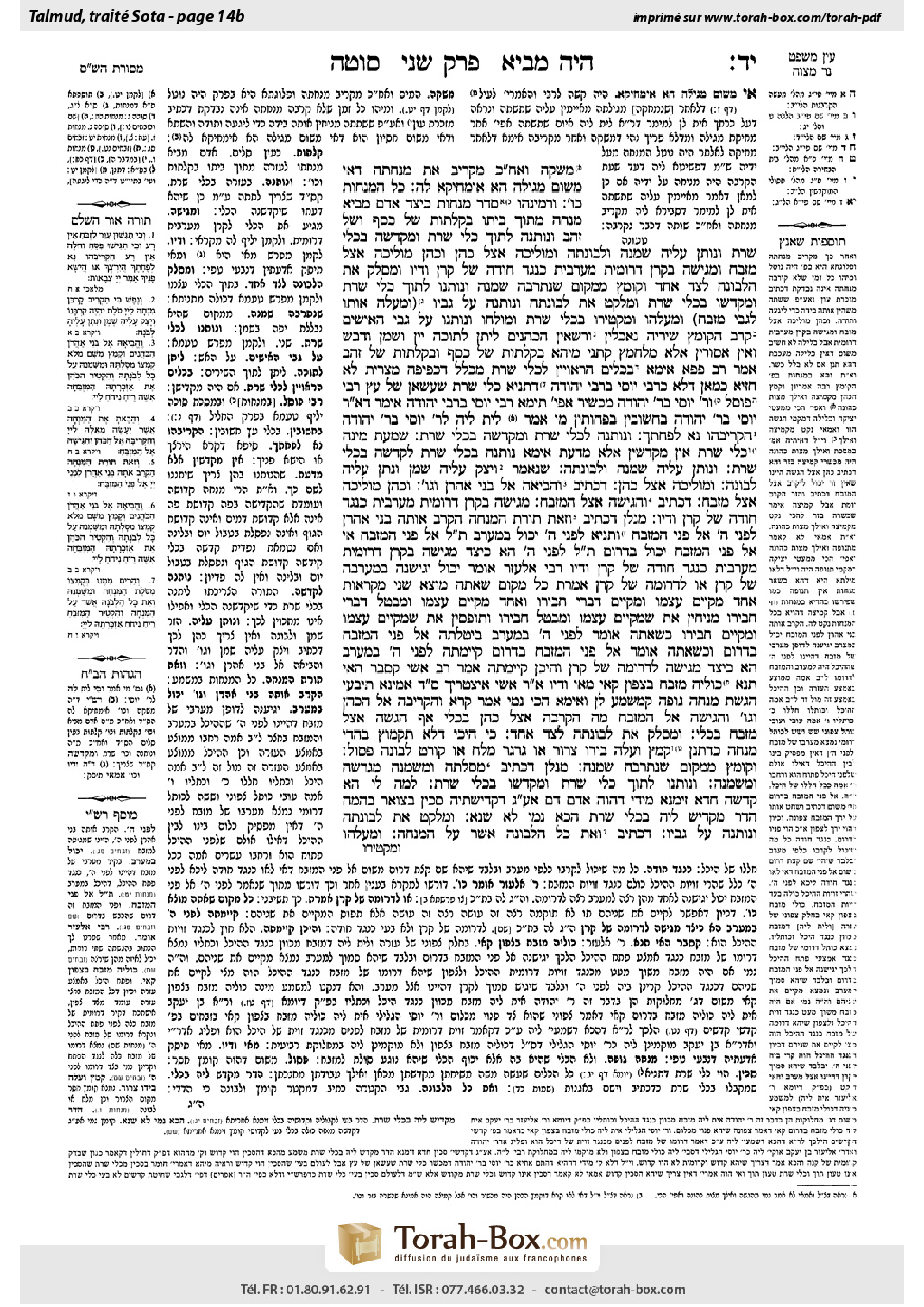
This page of Sotah includes the Aramaic text, an English translation and an AI-generated French translation, alongside the scan above.
סוטה י״ד ב · Aramaic and Hebrew text
מַשְׁקָהּ, וְאַחַר כָּךְ מַקְרִיב אֶת מִנְחָתָהּ. דְּאִי מִשּׁוּם מְגִילָּה הָא אִימְּחִיקָא לַהּ.
כׇּל הַמְּנָחוֹת וְכוּ׳. וּרְמִינְהוּ: סֵדֶר מְנָחוֹת, כֵּיצַד? אָדָם מֵבִיא מִנְחָה מִתּוֹךְ בֵּיתוֹ בִּקְלָתוֹת שֶׁל כֶּסֶף וְשֶׁל זָהָב, וְנוֹתְנָהּ לְתוֹךְ כְּלִי שָׁרֵת, וּמְקַדְּשָׁהּ בִּכְלִי שָׁרֵת, וְנוֹתֵן עָלֶיהָ שַׁמְנָהּ וּלְבוֹנָתָהּ, וּמוֹלִיכָהּ אֵצֶל כֹּהֵן. וְכֹהֵן מוֹלִיכָהּ אֵצֶל מִזְבֵּחַ, וּמַגִּישָׁהּ בְּקֶרֶן דְּרוֹמִית מַעֲרָבִית כְּנֶגֶד חוּדָּהּ שֶׁל קֶרֶן, וְדַיּוֹ.
וּמְסַלֵּק אֶת הַלְּבוֹנָה לְצַד אֶחָד, וְקוֹמֵץ מִמָּקוֹם שֶׁנִּתְרַבָּה שַׁמְנָהּ וְנוֹתְנוֹ לְתוֹךְ כְּלִי שָׁרֵת, וּמְקַדְּשׁוֹ בִּכְלִי שָׁרֵת. וּמְלַקֵּט אֶת לְבוֹנָתָהּ וְנוֹתְנָהּ עַל גַּבָּיו, וּמַעֲלֶה אוֹתוֹ לְגַבֵּי מִזְבֵּחַ, וּמַעֲלֵהוּ וּמַקְטִירוֹ בִּכְלִי שָׁרֵת, וּמוֹלְחוֹ, וְנוֹתְנוֹ עַל גַּבֵּי הָאִישִּׁים.
קָרַב הַקּוֹמֶץ שְׁיָרֶיהָ נֶאֱכָלִין, וְרַשָּׁאִין הַכֹּהֲנִים לִיתֵּן לְתוֹכָהּ יַיִן וְשֶׁמֶן וּדְבַשׁ, וְאֵין אֲסוּרִין אֶלָּא מִלְּחַמֵּץ.
קָתָנֵי מִיהָא בִּקְלָתוֹת שֶׁל כֶּסֶף וּבִקְלָתוֹת שֶׁל זָהָב! אָמַר רַב פָּפָּא: אֵימָא בְּכֵלִים הָרְאוּיִין לִכְלֵי שָׁרֵת.
מִכְּלַל דִּכְפִיפָה מִצְרִית לָא חַזְיָא, כְּמַאן — דְּלָא כְּרַבִּי יוֹסֵי בְּרַבִּי יְהוּדָה, דְּתַנְיָא: כְּלֵי שָׁרֵת שֶׁעֲשָׂאָן שֶׁל עֵץ, רַבִּי פּוֹסֵל וְרַבִּי יוֹסֵי בְּרַבִּי יְהוּדָה מַכְשִׁיר.
אֲפִילּוּ תֵּימָא רַבִּי יוֹסֵי בְּרַבִּי יְהוּדָה, אֵימַר דְּאָמַר רַבִּי יוֹסֵי בְּרַבִּי יְהוּדָה בַּחֲשׁוּבִין, בִּפְחוּתִין מִי אָמַר? לֵית לֵיהּ לְרַבִּי יוֹסֵי בְּרַבִּי יְהוּדָה ״הַקְרִיבֵהוּ נָא לְפֶחָתֶךָ״?!
וְנוֹתְנָהּ לִכְלֵי שָׁרֵת, וּמְקַדְּשָׁהּ בִּכְלִי שָׁרֵת. שָׁמְעַתְּ מִינַּהּ — כְּלִי שָׁרֵת אֵין מְקַדְּשִׁין אֶלָּא מִדַּעַת? אֵימָא: נוֹתְנָהּ בִּכְלִי שָׁרֵת לְקַדְּשָׁהּ בִּכְלִי שָׁרֵת.
וְנוֹתֵן עָלֶיהָ שַׁמְנָהּ וּלְבוֹנָתָהּ, שֶׁנֶּאֱמַר: ״וְיָצַק עָלֶיהָ שֶׁמֶן וְנָתַן עָלֶיהָ לְבֹנָה״.
וּמוֹלִיכָהּ אֵצֶל כֹּהֵן, דִּכְתִיב: ״וֶהֱבִיאָהּ אֶל בְּנֵי אַהֲרֹן וְגוֹ׳״.
וְכֹהֵן מוֹלִיכָהּ אֵצֶל מִזְבֵּחַ, דִּכְתִיב: ״וְהִגִּישָׁהּ אֵצֶל הַמִּזְבֵּחַ״.
מַגִּישָׁהּ בְּקֶרֶן דְּרוֹמִית מַעֲרָבִית כְּנֶגֶד חוּדָּהּ שֶׁל קֶרֶן וְדַיּוֹ. מְנָלַן —
דִּכְתִיב: ״וְזֹאת תּוֹרַת הַמִּנְחָה הַקְרֵב אוֹתָהּ בְּנֵי אַהֲרֹן לִפְנֵי ה׳ אֶל פְּנֵי הַמִּזְבֵּחַ״, וְתַנְיָא: ״לִפְנֵי ה׳״, יָכוֹל בַּמַּעֲרָב — תַּלְמוּד לוֹמַר: ״אֶל פְּנֵי הַמִּזְבֵּחַ״. אִי אֶל פְּנֵי הַמִּזְבֵּחַ, יָכוֹל בַּדָּרוֹם — תַּלְמוּד לוֹמַר: ״לִפְנֵי ה׳״. הָא כֵּיצַד — מַגִּישָׁהּ בְּקֶרֶן דְּרוֹמִית מַעֲרָבִית כְּנֶגֶד חוּדָּהּ שֶׁל קֶרֶן, וְדַיּוֹ.
רַבִּי אֶלְעָזָר אוֹמֵר: יָכוֹל יַגִּישֶׁנָּה בְּמַעֲרָבָהּ שֶׁל קֶרֶן אוֹ לִדְרוֹמָהּ שֶׁל קֶרֶן — אָמַרְתָּ: כׇּל מָקוֹם שֶׁאַתָּה מוֹצֵא שְׁנֵי מִקְרָאוֹת, אֶחָד מְקַיֵּים עַצְמוֹ וּמְקַיֵּים דִּבְרֵי חֲבֵירוֹ, וְאֶחָד מְקַיֵּים עַצְמוֹ וּמְבַטֵּל דִּבְרֵי חֲבֵירוֹ — מַנִּיחִין אֶת שֶׁמְּקַיֵּים עַצְמוֹ וּמְבַטֵּל חֲבֵירוֹ, וְתוֹפְסִין אֶת שֶׁמְּקַיֵּים עַצְמוֹ וּמְקַיֵּים חֲבֵירוֹ. כְּשֶׁאַתָּה אוֹמֵר ״לִפְנֵי ה׳״ בַּמַּעֲרָב — בִּטַּלְתָּה ״אֶל פְּנֵי הַמִּזְבֵּחַ״ בַּדָּרוֹם, וּכְשֶׁאַתָּה אוֹמֵר ״אֶל פְּנֵי הַמִּזְבֵּחַ״ בַּדָּרוֹם, קִיַּימְתָּה ״לִפְנֵי ה׳״ בַּמַּעֲרָב. הָא כֵּיצַד? מַגִּישָׁהּ לִדְרוֹמָהּ שֶׁל קֶרֶן.
וְהֵיכָן קִיַּימְתָּה? אָמַר רַב אָשֵׁי: קָסָבַר הַאי תַּנָּא כּוּלֵּיהּ מִזְבֵּחַ בְּצָפוֹן קָאֵי.
מַאי ״וְדַיּוֹ״? אָמַר רַב אָשֵׁי: אִיצְטְרִיךְ, סָלְקָא דַּעְתָּךְ אָמֵינָא: תִּיבְּעֵי הַגָּשַׁת מִנְחָה גּוּפַהּ, קָמַשְׁמַע לַן.
וְאֵימָא הָכִי נָמֵי? אָמַר קְרָא: ״וְהִקְרִיבָהּ אֶל הַכֹּהֵן וְגוֹ׳ וְהִגִּישָׁהּ אֶל הַמִּזְבֵּחַ״ — מָה הַקְרָבָה אֵצֶל כֹּהֵן בִּכְלִי, אַף הַגָּשָׁה אֵצֶל מִזְבֵּחַ בִּכְלִי.
וּמְסַלֵּק אֶת לְבוֹנָתָהּ לְצַד אֶחָד. כִּי הֵיכִי דְּלָא תִּקְּמוֹץ בַּהֲדֵי מִנְחָה, כְּדִתְנַן: קָמַץ וְעָלָה בְּיָדוֹ צְרוֹר אוֹ גַּרְגֵּר מֶלַח אוֹ קוֹרֶט לְבוֹנָה — פָּסוּל.
וְקוֹמֵץ מִמָּקוֹם שֶׁנִּתְרַבָּה שַׁמְנָהּ. מְנָלַן? דִּכְתִיב ״מִסׇּלְתָּהּ וּמִשַּׁמְנָהּ״, ״מִגִּרְשָׂהּ וּמִשַּׁמְנָהּ״.
וְנוֹתְנוֹ לְתוֹךְ כְּלִי שָׁרֵת וּמְקַדְּשׁוֹ בִּכְלִי שָׁרֵת. לְמָה לִי? הָא קַדְּשַׁהּ חֲדָא זִימְנָא! מִידֵּי דְּהָוֵה אַדָּם; דָּם, אַף עַל גַּב דְּקַדֵּישְׁתֵּיהּ סַכִּין בְּצַוַּאר בְּהֵמָה, הֲדַר מְקַדֵּישׁ לֵיהּ בִּכְלִי שָׁרֵת, הָכָא נָמֵי לָא שְׁנָא.
וּמְלַקֵּט אֶת לְבוֹנָתָהּ וְנוֹתְנָהּ עַל גַּבָּיו — דִּכְתִיב: ״וְאֶת כׇּל הַלְּבוֹנָה אֲשֶׁר עַל הַמִּנְחָה״.
וּמַעֲלֵהוּ
Sotah 14b · English translation
that the priest would first give her the water of the sota to drink, and only afterward would he sacrifice her meal-offering. Therefore, if the concern were due to the scroll, it would no longer be applicable, as it was already erased in the water of the sota before the meal-offering was brought. The efforts to fatigue her by making her hold the meal-offering must indicate that the Torah is protective of her.
It was taught in the mishna: All meal-offerings, from their beginning until their end, are placed in service vessels and remain there. The Gemara raises a contradiction from the Tosefta (Menaḥot 1:16): What is the procedure for meal-offerings? A person brings his meal-offering from his property in baskets [kelatot] of silver and of gold, and when he reaches the Temple he places it in a service vessel and sanctifies it in the service vessel, and he puts its oil and frankincense on it, and he carries it to the priest. And the priest then carries it to the altar and brings it near to the southwest horn of the altar, opposite the corner of the horn of the altar. And this is sufficient.
The baraita continues: And the priest then removes the frankincense to one side, and he removes a handful from the place where its oil has accumulated and mixed with the flour, and he puts the handful into a service vessel and consecrates it in the service vessel. And he then gathers its frankincense and puts it on top of the handful and brings it up onto the altar. And he brings it up and burns it in the service vessel; and he salts it and places it upon the fires.
The baraita continues: After the handful is sacrificed, the remainders of the meal-offering are eaten. And the priests are permitted to put wine and oil and honey in it, even though it is prohibited to offer honey on the altar. And they are prohibited only from allowing the meal-offering to become leavened.
The Gemara asks: In any event, the baraita teaches that the meal-offering is first placed in baskets of silver and baskets of gold brought from one’s home. This seems to contradict the mishna’s statement that all other meal-offerings are initially in service vessels. Rav Pappa said: The mishna means to say that meal-offerings are placed in vessels of silver and gold, as these are suitable to be service vessels if consecrated.
The Gemara notes: Since the mishna distinguishes in this regard between the meal-offering of the sota and all other meal-offerings, one may learn by inference that an Egyptian wicker basket is not suitable to be a service vessel even if it is consecrated. In accordance with whose opinion is this the case? It is not in accordance with the opinion of Rabbi Yosei, son of Rabbi Yehuda, as it is taught in a baraita: With regard to service vessels that were made of wood, Rabbi Yehuda HaNasi deems them unfit, and Rabbi Yosei, son of Rabbi Yehuda, deems them fit.
The Gemara responds: You can even say that the mishna is in accordance with the opinion of Rabbi Yosei, son of Rabbi Yehuda. Say that Rabbi Yosei, son of Rabbi Yehuda, says that wooden vessels are deemed fit with regard to those of superior quality; but does he say likewise with regard to vessels of lesser quality, e.g., a basket made of palm branches? Doesn’t Rabbi Yosei, son of Rabbi Yehuda, hold to the principle articulated in the verse: “And when you offer the blind for a sacrifice, is it not evil! …If you would present it now unto your governor, will he be pleased with you or show you favor?” (Malachi 1:8)? Nothing that is unfit for presentation to a ruler may be brought to the Temple. Therefore, even Rabbi Yosei, son of Rabbi Yehuda, must agree that a basket made of palm branches cannot be a service vessel.
§ The baraita states: He places it in a service vessel and sanctifies it in the service vessel. The Gemara asks: Can one learn from the unnecessary repetition of the term service vessel, that service vessels can sanctify their contents only with intention? Must one place the meal-offering in the service vessel with express intent to sanctify it? The Gemara answers: Say: He simply places it in the service vessel in order to sanctify it in the service vessel. He need not intend to sanctify it.
§ The baraita teaches: The owner of the meal-offering puts its oil and frankincense on it. The Gemara cites the source of this halakha: As it is stated: “And when anyone brings a meal-offering unto the Lord, his offering shall be of fine flour; and he shall pour oil upon it, and put frankincense thereon” (Leviticus 2:1).
The baraita states: And he carries it to the priest. The Gemara cites the source: As it is written: “And he shall bring it to Aaron’s sons, the priests” (Leviticus 2:2).
The baraita states: And the priest then carries it to the altar. The Gemara cites the source: As it is written: “And you shall bring the meal-offering that is made of these things unto the Lord; and it shall be presented unto the priest, and he shall bring it unto the altar” (Leviticus 2:8).
The baraita states: The priest brings it near to the southwest horn of the altar, opposite the corner of the horn. And this is sufficient. The Gemara asks: From where do we derive this?
The Gemara responds: As it is written: “And this is the law of the meal-offering: The sons of Aaron shall offer it before the Lord in front of the altar” (Leviticus 6:7). And it is taught in a baraita: When the verse states: “Before the Lord,” one might have understood this to mean on the western side of the altar, opposite the Holy of Holies. Therefore, the verse states: “In front of the altar.” This must be the south of the altar, where the ramp is located. If the verse had stated only: In front of the altar, one might have understood it to mean specifically on the southern side. Therefore, the verse states: “Before the Lord,” indicating the western side. How can these texts be reconciled? The priest brings it near to the southwest corner of the altar, opposite the corner of the horn. And this is sufficient.
Rabbi Elazar says another interpretation: One might have thought that he offers it up on the western side of the corner or on the southern side of the corner. Say: Anywhere you find two verses, one of which fulfills itself and fulfills the statement of the other, and one of which fulfills itself and nullifies the statement of the other, leave the verse that fulfills itself and nullifies the other, and seize the one that fulfills itself and fulfills the other. The principle is applied as follows: When you say: “Before the Lord,” on the western side, you have nullified the other part of the verse: “In front of the altar,” on the southern side. But when you say: “In front of the altar,” on the southern side, you have also fulfilled: “Before the Lord,” on the western side. How so? He brings it near to the southern side of the corner.
The Gemara asks: But where have you fulfilled the phrase “before the Lord”? Rav Ashi said: This tanna holds that the entire altar stands in the north of the Temple courtyard. Therefore, the entire southern side of the altar stood opposite the Holy of Holies in the west, and it can therefore be called: Before the Lord.
The Gemara asks: What is taught by the phrase: And this is sufficient? Rav Ashi said: This phrase was necessary, as otherwise it might enter your mind to say: Require the priest to bring the meal-offering itself near to the corner of the altar without the use of a vessel. The baraita teaches us that this is not so, and one can bring it to the altar in its service vessel.
The Gemara asks: And why not say that this is indeed so? The Gemara responds: The verse states: “And you shall bring the meal-offering that is made of these things unto the Lord; and it shall be presented unto the priest, and he shall bring it unto the altar” (Leviticus 2:8); just as presentation to the priest is in a vessel, so too bringing it to the altar must be in a vessel.
The baraita states: And he removes its frankincense to one side. The Gemara explains: This is done in order that the frankincense not be removed along with the meal-offering when the priest removes a handful. As we learned in a mishna (Menaḥot 6a): If he removed the handful and a pebble, or a grain of salt, or a crumb [koret] of frankincense came out in his hand, it is invalid. The handful must be entirely fine flour.
The baraita continues: And he removes a handful from the place where its oil has accumulated. The Gemara asks: From where do we derive this? As it is written: “And he shall take from there his handful of the fine flour thereof, and of the oil thereof” (Leviticus 2:2). The Torah also states: “And the priest shall make the memorial part of it smoke, even of the groats thereof, and of the oil thereof” (Leviticus 2:16). The handful should be taken from the area where there is an abundance of oil.
The baraita continues: And he puts the handful into a service vessel and sanctifies it in the service vessel. The Gemara asks: Why do I need this sanctification? He has already sanctified it once, when he initially brought it to the Temple. The Gemara responds: The sanctification here is just as with the blood of the offerings. Although the knife sanctifies blood by contact with the neck of the animal, since the knife itself is a service vessel, the priest sanctifies it again when he collects it in the service vessel. Here too, it is not different; the meal-offering must be sanctified twice.
The baraita continues: And he gathers its frankincense and puts it on top of the handful. The Gemara cites the source: As it is written: “And he shall take up from his handful, of the fine flour of the meal-offering, and of the oil thereof, and all the frankincense which is upon the meal-offering” (Leviticus 6:8).
The baraita continues: And he then brings it up
Sotah 14b · Traduction française (IA)
Le prêtre lui faisait d’abord boire l’eau de la sota, et ce n’est qu’ensuite qu’il sacrifiait son offrande végétale. Par conséquent, si la préoccupation avait été liée au rouleau, elle n’aurait plus été pertinente, puisque celui-ci avait déjà été effacé dans l’eau de la sota avant que l’offrande végétale soit apportée. Les efforts déployés pour la fatiguer en la faisant tenir l’offrande végétale indiquent donc que la Torah la protège.
Il a été enseigné dans la Michna : Toutes les offrandes végétales, depuis le début de leur procédure jusqu’à la fin, sont placées dans des ustensiles de service et y restent. La Guemara soulève une contradiction à partir de la Tosefta (Menaḥot 1:16) : Quelle est la procédure pour les offrandes végétales ? On apporte son offrande végétale de chez soi dans des paniers [kelatot] d’argent et d’or ; arrivé au Temple, on la place dans un ustensile de service et on la sanctifie dans cet ustensile de service, puis on y met son huile et son encens, et on la porte au prêtre. Le prêtre la porte alors à l’autel et l’approche de la corne sud-ouest de l’autel, face à l’angle de la corne. Cela suffit.
La baraïta poursuit : Le prêtre écarte ensuite l’encens, prélève une poignée à l’endroit où l’huile s’est accumulée et s’est mêlée à la farine, puis place cette poignée dans un ustensile de service et la sanctifie dans cet ustensile de service. Il recueille ensuite l’encens, le pose sur la poignée et la porte à l’autel. Il la porte et la brûle dans l’ustensile de service ; il la sale et la place sur les feux.
La baraïta poursuit : Après que la poignée a été sacrifiée, le reste de l’offrande végétale est consommé. Les prêtres ont le droit d’y mettre du vin, de l’huile et du miel, bien qu’il soit interdit d’offrir du miel sur l’autel. Il leur est seulement interdit de laisser l’offrande végétale fermenter.
La Guemara demande : Quoi qu’il en soit, la baraïta enseigne que l’offrande végétale est d’abord placée dans des paniers d’argent et d’or apportés de chez soi. Cela semble contredire l’affirmation de la Michna selon laquelle toutes les autres offrandes végétales sont dès le départ dans des ustensiles de service. Rav Pappa a dit : La Michna veut dire que les offrandes végétales sont placées dans des récipients d’argent et d’or, car ceux-ci peuvent servir d’ustensiles de service s’ils sont consacrés.
La Guemara remarque : Puisque la Michna établit à cet égard une distinction entre l’offrande végétale de la sota et toutes les autres offrandes végétales, on peut en déduire qu’un panier tressé égyptien ne peut pas servir d’ustensile de service, même s’il est consacré. De l’avis de qui est-ce le cas ? Ce n’est pas l’avis de Rabbi Yossei, fils de Rabbi Yehouda, car il est enseigné dans une baraïta : Au sujet des ustensiles de service en bois, Rabbi Yehouda HaNassi les déclare inaptes, tandis que Rabbi Yossei, fils de Rabbi Yehouda, les déclare aptes.
La Guemara répond : On peut même dire que la Michna est conforme à l’avis de Rabbi Yossei, fils de Rabbi Yehouda. Rabbi Yossei, fils de Rabbi Yehouda, dit que les ustensiles en bois sont aptes lorsqu’ils sont de qualité supérieure ; mais dit-il la même chose des ustensiles de qualité inférieure, par exemple un panier fait de branches de palmier ? Rabbi Yossei, fils de Rabbi Yehouda, ne tient-il pas compte du principe formulé dans le verset : « Quand vous offrez un animal aveugle en sacrifice, n’est-ce pas mal ! … Présente-le donc à ton gouverneur : te recevra-t-il favorablement, ou te témoignera-t-il de la bienveillance ? » (Malachie 1:8). Rien de ce qui ne convient pas à être présenté à un gouverneur ne peut être apporté au Temple. Par conséquent, même Rabbi Yossei, fils de Rabbi Yehouda, doit reconnaître qu’un panier fait de branches de palmier ne peut pas être un ustensile de service.
§ La baraïta dit : On le place dans un ustensile de service et on le sanctifie dans cet ustensile de service. La Guemara demande : Peut-on déduire de la répétition superflue du terme « ustensile de service » que les ustensiles de service ne sanctifient leur contenu qu’en présence d’une intention ? Faut-il placer l’offrande végétale dans l’ustensile de service avec l’intention expresse de la sanctifier ? La Guemara répond : Il faut comprendre qu’on la place simplement dans l’ustensile de service afin qu’elle y soit sanctifiée. Il n’est pas nécessaire d’avoir l’intention de la sanctifier.
§ La baraïta enseigne : Le propriétaire de l’offrande végétale y met son huile et son encens. La Guemara cite la source de cette halakha : comme il est dit : « Si quelqu’un présente au Seigneur une offrande végétale, son offrande sera de fleur de farine ; il versera de l’huile dessus et y déposera de l’encens » (Lévitique 2:1).
La baraïta dit : Il la porte au prêtre. La Guemara en cite la source : comme il est écrit : « Il l’apportera aux fils d’Aaron, les prêtres » (Lévitique 2:2).
La baraïta dit : Le prêtre la porte alors à l’autel. La Guemara en cite la source : comme il est écrit : « Tu apporteras au Seigneur l’offrande végétale préparée de ces éléments ; elle sera présentée au prêtre, et celui-ci la portera à l’autel » (Lévitique 2:8).
La baraïta dit : Le prêtre l’approche de la corne sud-ouest de l’autel, face à l’angle de la corne. Cela suffit. La Guemara demande : D’où déduisons-nous cela ?
La Guemara répond : comme il est écrit : « Voici la loi de l’offrande végétale : les fils d’Aaron la présenteront devant le Seigneur, devant l’autel » (Lévitique 6:7). Et il est enseigné dans une baraïta : Lorsque le verset dit « devant le Seigneur », on aurait pu comprendre que cela signifie du côté ouest de l’autel, face au Saint des Saints. Le verset dit donc : « devant l’autel ». Cela doit désigner le sud de l’autel, où se trouve la rampe. Si le verset avait seulement dit « devant l’autel », on aurait pu comprendre que cela signifie précisément du côté sud. Le verset dit donc : « devant le Seigneur », ce qui indique le côté ouest. Comment concilier ces textes ? Le prêtre l’approche de l’angle sud-ouest de l’autel, face à l’angle de la corne. Cela suffit.
Rabbi Elazar donne une autre interprétation : On aurait pu penser qu’il la présente du côté ouest de l’angle ou du côté sud de l’angle. Il faut dire : Chaque fois que tu trouves deux versets, dont l’un satisfait son propre énoncé tout en satisfaisant celui de l’autre, tandis que l’autre satisfait son propre énoncé tout en annulant celui du premier, écarte le verset qui satisfait son propre énoncé et annule celui de l’autre, et retiens celui qui satisfait son propre énoncé ainsi que celui de l’autre. On applique ce principe ainsi : Si tu interprètes « devant le Seigneur » comme désignant le côté ouest, tu annules l’autre partie du verset, « devant l’autel », qui désigne le côté sud. Mais si tu interprètes « devant l’autel » comme désignant le côté sud, tu accomplis aussi l’énoncé « devant le Seigneur », qui désigne le côté ouest. Comment cela ? Il l’approche du côté sud de l’angle.
La Guemara demande : Mais où as-tu satisfait à l’expression « devant le Seigneur » ? Rav Ashi a dit : Ce tanna considère que l’ensemble de l’autel se trouve au nord de la cour du Temple. Par conséquent, tout le côté sud de l’autel faisait face au Saint des Saints, situé à l’ouest, et peut donc être appelé « devant le Seigneur ».
La Guemara demande : Que nous enseigne l’expression « cela suffit » ? Rav Ashi a dit : Cette expression était nécessaire, car autrement on aurait pu penser qu’il faut exiger du prêtre qu’il approche l’offrande végétale elle-même de l’angle de l’autel, sans utiliser d’ustensile. La baraïta nous enseigne qu’il n’en est pas ainsi : on peut l’apporter à l’autel dans son ustensile de service.
La Guemara demande : Et pourquoi ne pas dire qu’il en est effectivement ainsi ? La Guemara répond : Le verset dit : « Tu apporteras au Seigneur l’offrande végétale préparée de ces éléments ; elle sera présentée au prêtre, et celui-ci la portera à l’autel » (Lévitique 2:8). De même que sa présentation au prêtre se fait dans un ustensile, son transport à l’autel doit lui aussi se faire dans un ustensile.
La baraïta dit : Il écarte son encens. La Guemara explique : On fait cela afin que l’encens ne soit pas prélevé avec l’offrande végétale lorsque le prêtre en prélève une poignée. Car nous avons appris dans une Michna (Menaḥot 6a) : S’il a prélevé la poignée et qu’un caillou, un grain de sel ou une miette [koret] d’encens est venu avec elle dans sa main, elle est invalide. La poignée doit être entièrement composée de fleur de farine.
La baraïta poursuit : Il prélève une poignée à l’endroit où son huile s’est accumulée. La Guemara demande : D’où déduisons-nous cela ? Comme il est écrit : « Il en prélèvera une poignée de sa fleur de farine et de son huile » (Lévitique 2:2). La Torah dit aussi : « Le prêtre en fera fumer la partie mémorielle, avec sa semoule et son huile » (Lévitique 2:16). La poignée doit être prélevée dans la zone où l’huile est abondante.
La baraïta poursuit : Il place la poignée dans un ustensile de service et la sanctifie dans cet ustensile de service. La Guemara demande : Pourquoi cette sanctification est-elle nécessaire ? Il l’a déjà sanctifiée une fois, lorsqu’il l’a apportée au Temple au départ. La Guemara répond : Cette sanctification est comme celle du sang des sacrifices. Bien que le couteau sanctifie le sang par contact avec le cou de l’animal, puisque le couteau lui-même est un ustensile de service, le prêtre le sanctifie de nouveau lorsqu’il le recueille dans l’ustensile de service. Ici aussi, il en va de même : l’offrande végétale doit être sanctifiée deux fois.
La baraïta poursuit : Il recueille son encens et le pose sur la poignée. La Guemara en cite la source : comme il est écrit : « Il en prélèvera une poignée de la fleur de farine de l’offrande végétale, de son huile, ainsi que tout l’encens qui se trouve sur l’offrande végétale » (Lévitique 6:8).
La baraïta poursuit : Il la porte ensuite
Traduction française générée par IA à partir de l’édition anglaise de Sefaria. Vérifie toujours un passage avec le texte source.
Text from Sefaria: William Davidson Edition - Vocalized Aramaic (CC BY NC); William Davidson Edition - English (CC BY NC).