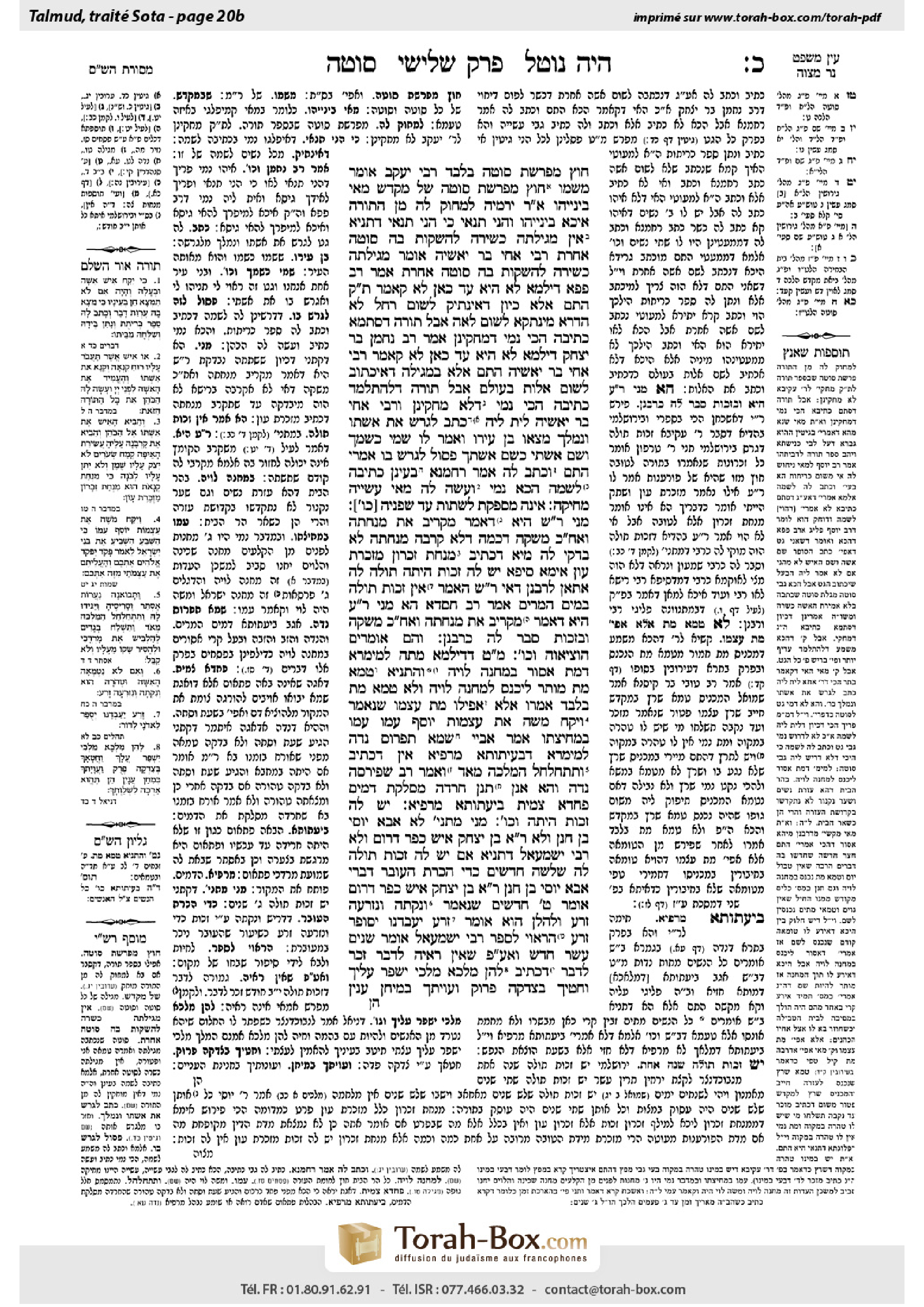
Sotah 20b: Talmud study for Daf Yomi
Daf Yomi is the daily study of one Talmud folio. Explore 37 tractates with scans, Hebrew text, Sefaria English and AI-generated French translations where annotated.
Passage selection and English or AI-generated French translation are available where the scan has annotations. Daf Study is independent of Torah-Box and Sefaria.
Browse Sotah · סוטה · All tractatesSotah 20b text and translations
This page of Sotah includes the Aramaic text, an English translation and an AI-generated French translation, alongside the scan above.
סוטה כ׳ ב · Aramaic and Hebrew text
חוּץ מִפָּרָשַׁת סוֹטָה בִּלְבַד. רַבִּי יַעֲקֹב אוֹמֵר מִשְּׁמוֹ: חוּץ מִפָּרָשַׁת סוֹטָה שֶׁל מִקְדָּשׁ. מַאי בֵּינַיְיהוּ? אָמַר רַבִּי יִרְמְיָה: לִמְחוֹק לָהּ מִן הַתּוֹרָה אִיכָּא בֵּינַיְיהוּ.
וְהָנֵי תַּנָּאֵי כִי הָנֵי תַּנָּאֵי. דְּתַנְיָא: אֵין מְגִילָּתָהּ כְּשֵׁירָה לְהַשְׁקוֹת בָּהּ סוֹטָה אַחֶרֶת. רַבִּי אַחַי בַּר יֹאשִׁיָּה אוֹמֵר: מְגִילָּתָהּ כְּשֵׁירָה לְהַשְׁקוֹת בָּהּ סוֹטָה אַחֶרֶת.
אָמַר רַב פָּפָּא, דִּילְמָא לָא הִיא: עַד כָּאן לָא קָאָמַר תַּנָּא קַמָּא הָתָם, אֶלָּא כֵּיוָן דְּאִינְּתִיק לְשׁוּם רָחֵל — לָא הָדְרָא מִינַּתְקָא לְשׁוּם לֵאָה, אֲבָל תּוֹרָה, דִּסְתָמָא כְּתִיבָה — הָכִי נָמֵי דְּמָחֲקִינַן.
אָמַר רַב נַחְמָן בַּר יִצְחָק: דִּילְמָא לָא הִיא, עַד כָּאן לָא קָאָמַר רַבִּי אַחַי בַּר יֹאשִׁיָּה הָתָם אֶלָּא בִּמְגִילָּה, דְּאִיכְּתוּב לְשׁוּם אָלוֹת בָּעוֹלָם. אֲבָל תּוֹרָה, דִּלְהִתְלַמֵּד כְּתִיבָה, הָכִי נָמֵי דְּלָא מָחֲקִינַן.
וְרַבִּי אַחַי בַּר יֹאשִׁיָּה לֵית לֵיהּ כָּתַב לְגָרֵשׁ אֶת אִשְׁתּוֹ וְנִמְלַךְ, מְצָאוֹ בֶּן עִירוֹ וְאָמַר לוֹ: שְׁמִי כְּשִׁמְךָ, וְשֵׁם אִשְׁתִּי כְּשֵׁם אִשְׁתְּךָ — פָּסוּל לְגָרֵשׁ בּוֹ?
אָמְרִי: הָתָם ״וְכָתַב לָהּ״ אָמַר רַחֲמָנָא, בָּעִינַן כְּתִיבָה לִשְׁמָהּ: הָכָא נָמֵי ״וְעָשָׂה לָהּ״! מַאי עֲשִׂיָּיה — מְחִיקָה.
אֵינָהּ מַסְפֶּקֶת לִשְׁתּוֹת עַד שֶׁפָּנֶיהָ [כּוּ׳]. מַנִּי — רַבִּי שִׁמְעוֹן הִיא, דְּאָמַר: מַקְרִיב אֶת מִנְחָתָהּ וְאַחַר כָּךְ מַשְׁקָהּ. דְּכַמָּה דְּלָא קָרְבָה מִנְחָתַהּ — לָא בָּדְקִי לַהּ מַיָּא, דִּכְתִיב: ״מִנְחַת זִכָּרוֹן מַזְכֶּרֶת עָוֹן״,
אֵימָא סֵיפָא: יֵשׁ לָהּ זְכוּת הָיְתָה תּוֹלָה לָהּ, אֲתָאן לְרַבָּנַן, דְּאִי רַבִּי שִׁמְעוֹן, הָאָמַר: אֵין זְכוּת תּוֹלָה בַּמַּיִם הַמָּרִים!
אָמַר רַב חִסְדָּא: הָא מַנִּי — רַבִּי עֲקִיבָא הִיא, דְּאָמַר: מַקְרִיב אֶת מִנְחָתָהּ וְאַחַר כָּךְ מַשְׁקָהּ, וּבִזְכוּת סָבַר לַהּ כְּרַבָּנַן.
וְהֵם אוֹמְרִים הוֹצִיאוּהָ וְכוּ׳. מַאי טַעְמָא — דְּדִילְמָא מֵתָה. לְמֵימְרָא דְּמֵת אָסוּר בְּמַחֲנֵה לְוִיָּה?
וְהָתַנְיָא: טְמֵא מֵת מוּתָּר לִיכָּנֵס לְמַחֲנֵה לְוִיָּה. וְלֹא טְמֵא מֵת בִּלְבַד אָמְרוּ, אֶלָּא אֲפִילּוּ מֵת עַצְמוֹ, שֶׁנֶּאֱמַר: ״וַיִּקַּח מֹשֶׁה אֶת עַצְמוֹת יוֹסֵף עִמּוֹ״, עִמּוֹ בִּמְחִיצָתוֹ!
אָמַר אַבָּיֵי: שֶׁמָּא תִּפְרוֹס נִדָּה. לְמֵימְרָא דְּבִיעֲתוּתָא מְרַפְּיָא? אִין, דִּכְתִיב: ״וַתִּתְחַלְחַל הַמַּלְכָּה מְאֹד״, וְאָמַר רַב: שֶׁפֵּירְסָה נִדָּה. וְהָא אֲנַן תְּנַן: חֲרָדָה מְסַלֶּקֶת דָּמִים! פַּחְדָּא צָמֵית, בִּיעֲתוּתָא מְרַפְּיָא.
יֵשׁ לָהּ זְכוּת הָיְתָה וְכוּ׳. מַנִּי מַתְנִיתִין? לָא אַבָּא יוֹסֵי בֶּן חָנָן, וְלָא רַבִּי אֶלְעָזָר בֶּן יִצְחָק אִישׁ כְּפַר דָּרוֹם, וְלֹא רַבִּי יִשְׁמָעֵאל.
דְּתַנְיָא: אִם יֵשׁ לָהּ זְכוּת תּוֹלָה לָהּ שְׁלֹשָׁה חֳדָשִׁים, כְּדֵי הַכָּרַת הָעוּבָּר, דִּבְרֵי אַבָּא יוֹסֵי בֶּן חָנָן. רַבִּי אֶלְעָזָר בֶּן יִצְחָק אִישׁ כְּפַר דָּרוֹם אוֹמֵר: תִּשְׁעָה חֳדָשִׁים, שֶׁנֶּאֱמַר: ״וְנִקְּתָה וְנִזְרְעָה זָרַע״, וּלְהַלָּן הוּא אוֹמֵר: ״זֶרַע יַעַבְדֶנּוּ יְסֻפַּר״, זֶרַע הָרָאוּי לְסַפֵּר.
רַבִּי יִשְׁמָעֵאל אוֹמֵר: שְׁנֵים עָשָׂר חֹדֶשׁ. וְאַף עַל פִּי שֶׁאֵין רְאָיָה לַדָּבָר — זֵכֶר לַדָּבָר, דִּכְתִיב: ״לָהֵן מַלְכָּא מִלְכִּי יִשְׁפַּר עֲלָיךְ וַחֲטָיָךְ בְּצִדְקָה פְרֻק וַעֲוָיָתָךְ בְּמִחַן עֲנָיִן
Sotah 20b · English translation
except for the ink used to write the Torah passage about the sota, even when written in a Torah scroll. Rabbi Ya’akov says in the name of Rabbi Meir: It is except for the ink used to write the scroll with the sota passage used in the Temple. The Gemara asks: What is the difference between these two opinions? The Gemara replies: Rabbi Yirmeya says that there is a difference between them with regard to whether it is permitted to erase the passage for the sota from a Torah scroll. According to Rabbi Yehuda, Rabbi Meir holds that this is permitted, and therefore the passage in the Torah scroll must be written with ink that does not contain iron sulfate, so that it can be erased. By contrast, according to Rabbi Ya’akov, Rabbi Meir holds that it is prohibited to erase the passage from a Torah scroll, and therefore the passage may be written with ink containing iron sulfate.
The Gemara assumes that according to Rabbi Ya’akov it is prohibited to erase the passage from a Torah scroll, since he holds that the scroll must be written for the sake of the sota, whereas Rabbi Yehuda, who permits this, holds that the scroll need not be written for the sake of the sota. And therefore, the opinions of these tanna’im are parallel to the opinions of those tanna’im, as it is taught in a baraita: The scroll of one sota is not fit to be used in the preparation of the water to give to another sota to drink, as it was not written for the sake of the other sota. Rabbi Aḥai bar Yoshiya says: Her scroll is fit to be used in the preparation of the water to give to another sota to drink, since it does not need to be written for the sake of the sota.
Rav Pappa said: Perhaps that is not so, and the two disputes are not comparable. It is possible that the first tanna of the baraita states that the scroll may not be used for another sota only there, in the case if a scroll written for a specific woman; since it was originally designated in the name of one woman, e.g., Rachel, it cannot again be designated in the name of another woman, e.g., Leah. However, in the case of a Torah scroll, which is written without specifying anyone, indeed we may erase the passage to prepare the water for a sota even though it was not written for her sake.
Rav Naḥman bar Yitzḥak said that the comparison between the two disputes can be refuted for a different reason: Perhaps that is not so. It is possible that Rabbi Aḥai bar Yoshiya states that the scroll may be used for another sota only there, with regard to the scroll written for a specific sota, as it was written for the purpose of the curses of a sota in general. However, in the case of a Torah scroll, which is written to be learned from, indeed we may not erase it for a sota, as it was not written for the sake of a sota at all.
The Gemara asks: And doesn’t Rabbi Aḥai bar Yoshiya hold in accordance with that which is taught in a mishna (Gittin 24a): With regard to one who wrote a bill of divorce with which to divorce his wife but later reconsidered and did not divorce her, if a resident of his city found him and said to him: My name is the same as your name, and my wife’s name is the same as your wife’s name; give me the bill of divorce, and I will use it to divorce my wife, it is unfit to divorce the other woman with it. The reason for this is that it was written for the sake of another woman. Seemingly, the same principle should apply with regard to the scroll of a sota.
The Sages say in response: There, with regard to a bill of divorce, the Merciful One states: “And he shall write for her a bill of divorce” (Deuteronomy 24:1). This teaches that we require the writing to be performed for the sake of the specific woman. However, no similar requirement is mentioned with regard to a sota. The Gemara asks: Here, too, with regard to the sota, the verse states: “And the priest shall perform with her all of this law” (Numbers 5:30), indicating that the ritual must be performed for the sake of the specific woman. The Gemara answers: What is the performance referred to in the verse? It is referring to the erasure, whereas the writing need not be done for the sake of a specific woman.
§ The mishna states: When a guilty woman drinks she does not manage to finish drinking before her face turns green and her eyes bulge, and her skin becomes full of protruding veins. The Gemara asks: In accordance with whose opinion is this mishna, which indicates that the water evaluates her while she is still drinking? It is in accordance with the opinion of Rabbi Shimon, who says: The priest sacrifices her meal-offering and afterward forces her to drink, because according to the opinion of the Rabbis the meal-offering is sacrificed only after she drinks, and as long as her meal-offering has not been sacrificed the water does not evaluate her, as it is written: “And he shall bring her offering for her…for it is a meal-offering of jealousy, a meal-offering of remembrance, a reminder of iniquity” (Numbers 5:15).
The Gemara asks: Say the latter clause of the mishna: If she has merit, it delays her punishment for her. We arrive at the opinion of the Rabbis, as, if this statement were in accordance with the opinion of Rabbi Shimon, didn’t he say: Merit does not delay punishment in the case of the bitter water of a sota?
Rav Ḥisda said: In accordance with whose opinion is this mishna? It is in accordance with the opinion of Rabbi Akiva, who says: The priest sacrifices her meal-offering and afterward forces her to drink. With regard to the order of the ritual he holds in accordance with Rabbi Shimon, and with regard to the matter of merit delaying punishment, he holds in accordance with the opinion of the Rabbis.
§ The mishna states: And the people standing in the Temple say: Remove her, so that she does not render the Temple courtyard impure. The Gemara explains: What is the reason for this? It is lest she die there immediately and render the women’s courtyard, where she drinks the water, impure. The Gemara asks: Is this to say that a corpse is prohibited from being in the women’s courtyard, which has the same status as the Levite camp in the desert?
But isn’t it taught in a baraita: One who is ritually impure with impurity imparted by a corpse is permitted to enter the Levite camp. And the Sages said this not only with regard to one who is ritually impure with impurity imparted by a corpse; rather, even a corpse itself may be brought into the Levite camp, as it is stated: “And Moses took the bones of Joseph with him” (Exodus 13:19), which is interpreted to mean: With him, in his vicinity, even though Moses was in the Levite camp.
Abaye said: The woman is removed not due to a concern that she will die there but lest the fear of the water cause her to begin to menstruate, and it is prohibited for a menstruating woman to enter the Levite camp. The Gemara asks: Is this to say that fear causes muscular relaxation and menstrual bleeding? The Gemara responds: Yes, as it is written: “And the Queen was exceedingly pained” (Esther 4:4), and Rav says: This means that she began to menstruate. The Gemara asks: But didn’t we learn in a mishna (Nidda 39a) that trepidation eliminates the flow of menstrual blood? Presumably, the sota experiences trepidation. The Gemara answers: Trepidation generated by extended worry contracts the muscles and prevents the blood from flowing, but sudden fear relaxes the muscles and causes the blood to flow.
§ The mishna states: If she has merit, it delays punishment…for one year…for two years…for three years. The Gemara asks: Whose opinion is expressed in the mishna? It is not the opinion of Abba Yosei ben Ḥanan, and not the opinion of Rabbi Elazar ben Yitzḥak of Kefar Darom, and not the opinion of Rabbi Yishmael.
This is as it is taught in a baraita: If she has merit, it delays punishment for her for three months, equivalent to the time necessary to recognize the fetus; this is the statement of Abba Yosei ben Ḥanan. Rabbi Elazar ben Yitzḥak of Kefar Darom says: Merit delays punishment for nine months, as it is stated: “Then she shall be cleared, and shall conceive seed” (Numbers 5:28). It is possible to infer from this that if she has merit she will be cleared temporarily, for the length of time required to conceive a child, and there, in Psalms, it says: “A seed shall serve him; it shall be told of the Lord unto the next generation” (Psalms 22:31). This indicates that the seed must be fit to tell of the Lord once it matures, and a child can live only if it is born after the culmination of nine months in the womb.
Rabbi Yishmael says: Merit delays punishment for twelve months. And although there is no explicit proof for the concept of merit delaying punishment for twelve months, there is an allusion to the concept, as it is written that Daniel said to Nebuchadnezzar after interpreting Nebuchadnezzar’s dream concerning the evil which would befall him: “Therefore, O king, let my counsel be acceptable to you, and redeem your sins with charity, and your iniquities by showing mercy to the poor;
Sotah 20b · Traduction française (IA)
à l’exception de l’encre utilisée pour écrire le passage de la Torah concernant la sota, même lorsqu’il est écrit dans un rouleau de la Torah. Rabbi Ya’akov dit au nom de Rabbi Meïr : à l’exception de l’encre utilisée pour écrire le rouleau contenant le passage de la sota, utilisé dans le Temple. La Guemara demande : Quelle est la différence entre ces deux avis ? La Guemara répond : Rabbi Yirmeya dit qu’ils diffèrent sur la question de savoir s’il est permis d’effacer le passage concernant la sota d’un rouleau de la Torah. Selon Rabbi Yehuda, Rabbi Meïr estime que cela est permis ; le passage du rouleau de la Torah doit donc être écrit avec une encre qui ne contient pas de sulfate de fer, afin de pouvoir être effacé. En revanche, selon Rabbi Ya’akov, Rabbi Meïr estime qu’il est interdit d’effacer le passage d’un rouleau de la Torah ; le passage peut donc être écrit avec une encre contenant du sulfate de fer.
La Guemara suppose que, selon Rabbi Ya’akov, il est interdit d’effacer le passage d’un rouleau de la Torah, puisqu’il estime que le rouleau doit être écrit pour la sota, tandis que Rabbi Yehuda, qui le permet, estime qu’il n’est pas nécessaire que le rouleau soit écrit pour la sota. Les avis de ces tannaïm correspondent donc à ceux des tannaïm suivants, comme l’enseigne une baraïta : Le rouleau d’une sota ne peut pas servir à préparer l’eau que l’on fera boire à une autre sota, car il n’a pas été écrit pour cette autre sota. Rabbi Aḥai bar Yoshiya dit : Son rouleau peut servir à préparer l’eau que l’on fera boire à une autre sota, puisqu’il n’est pas nécessaire qu’il soit écrit pour la sota.
Rav Pappa dit : Peut-être n’en est-il pas ainsi, et les deux controverses ne sont pas comparables. Il est possible que le premier tanna de la baraïta affirme que le rouleau ne peut servir à une autre sota uniquement dans le cas d’un rouleau écrit pour une femme déterminée : puisqu’il a d’abord été désigné au nom d’une femme, par exemple Rachel, il ne peut ensuite être désigné au nom d’une autre femme, par exemple Léa. Cependant, dans le cas d’un rouleau de la Torah, qui est écrit sans désigner personne, il est effectivement permis d’en effacer le passage pour préparer l’eau destinée à une sota, même si le rouleau n’a pas été écrit pour elle.
Rav Naḥman bar Yitzḥak dit que l’on peut réfuter la comparaison entre les deux controverses pour une autre raison : peut-être n’en est-il pas ainsi. Il est possible que Rabbi Aḥai bar Yoshiya affirme que le rouleau peut servir à une autre sota uniquement dans le cas d’un rouleau écrit pour une sota déterminée, puisqu’il a été écrit en vue des malédictions concernant une sota en général. Cependant, dans le cas d’un rouleau de la Torah, qui est écrit pour être étudié, il est effectivement interdit de l’effacer pour une sota, puisqu’il n’a pas du tout été écrit pour une sota.
La Guemara demande : Rabbi Aḥai bar Yoshiya ne se conforme-t-il pas à ce qui est enseigné dans une Michna (Guittin 24a) : Celui qui a écrit un acte de divorce pour divorcer de sa femme, mais a ensuite changé d’avis et ne l’a pas divorcée, si un habitant de sa ville le rencontre et lui dit : « Je porte le même nom que toi, et ma femme porte le même nom que la tienne ; donne-moi l’acte de divorce, et je m’en servirai pour divorcer de ma femme », ne peut pas l’utiliser pour divorcer de l’autre femme. La raison en est qu’il a été écrit pour une autre femme. Apparemment, le même principe devrait s’appliquer au rouleau d’une sota.
Les Sages répondent : Dans le cas de l’acte de divorce, le Miséricordieux dit : « Il lui écrira un acte de divorce » (Deutéronome 24:1). Cela enseigne que l’écriture doit être faite pour la femme concernée. Cependant, aucune exigence semblable n’est mentionnée à propos d’une sota. La Guemara demande : Ici aussi, à propos de la sota, le verset dit : « Le prêtre accomplira à son égard toute cette loi » (Nombres 5:30), ce qui indique que le rituel doit être accompli pour la femme concernée. La Guemara répond : À quoi se rapporte l’accomplissement mentionné dans le verset ? À l’effacement ; en revanche, l’écriture n’a pas besoin d’être faite pour une femme déterminée.
§ La Michna énonce : Lorsqu’une femme coupable boit, elle n’a pas le temps de finir avant que son visage ne devienne verdâtre, que ses yeux ne sortent de leurs orbites et que sa peau ne se couvre de veines saillantes. La Guemara demande : Selon l’avis de qui cette Michna indique-t-elle que l’eau la met à l’épreuve alors qu’elle boit encore ? Elle suit l’avis de Rabbi Shimon, qui dit : Le prêtre offre son offrande de farine, puis la force à boire. En effet, selon les Sages, l’offrande de farine n’est offerte qu’après qu’elle a bu ; tant que son offrande de farine n’a pas été offerte, l’eau ne la met pas à l’épreuve, comme il est écrit : « Il apportera son offrande pour elle… car c’est une offrande de farine de jalousie, une offrande de farine de souvenir, un rappel de faute » (Nombres 5:15).
La Guemara demande : Considérons la dernière partie de la Michna : Si elle a du mérite, celui-ci retarde son châtiment. Nous voici parvenus à l’avis des Sages ; car si cette déclaration suivait l’avis de Rabbi Shimon, n’a-t-il pas dit que le mérite ne retarde pas le châtiment dans le cas de l’eau amère d’une sota ?
Rav Ḥisda dit : Selon l’avis de qui cette Michna a-t-elle été énoncée ? Selon l’avis de Rabbi Akiva, qui dit : Le prêtre offre son offrande de farine, puis la force à boire. Pour l’ordre du rituel, il suit Rabbi Shimon ; quant à la question du mérite qui retarde le châtiment, il suit l’avis des Sages.
§ La Michna énonce : Et les personnes qui se tiennent dans le Temple disent : « Éloignez-la, afin qu’elle ne rende pas impure la cour du Temple. » La Guemara explique : Pour quelle raison ? De peur qu’elle ne meure sur place et ne rende impure la cour des femmes, où elle boit l’eau. La Guemara demande : Faut-il en déduire qu’un cadavre ne peut pas se trouver dans la cour des femmes, qui a le même statut que le camp des Lévites dans le désert ?
Pourtant, une baraïta enseigne : Celui qui est rituellement impur par contact avec un cadavre est autorisé à entrer dans le camp des Lévites. Les Sages ont précisé qu’il ne s’agit pas seulement de celui qui est rituellement impur par contact avec un cadavre ; même un cadavre peut être amené dans le camp des Lévites, comme il est dit : « Moïse prit avec lui les ossements de Joseph » (Exode 13:19), ce qui est interprété ainsi : « avec lui », c’est-à-dire dans son voisinage, bien que Moïse se trouvât dans le camp des Lévites.
Abaye dit : On éloigne la femme non par crainte qu’elle ne meure sur place, mais de peur que la terreur de l’eau ne déclenche ses règles ; or, il est interdit à une femme qui a ses règles d’entrer dans le camp des Lévites. La Guemara demande : Faut-il en déduire que la peur détend les muscles et provoque un saignement menstruel ? La Guemara répond : Oui, comme il est écrit : « La reine fut extrêmement bouleversée » (Esther 4:4), et Rav dit que cela signifie que ses règles commencèrent. La Guemara demande : Pourtant, n’avons-nous pas appris dans une Michna (Nidda 39a) que l’effroi arrête l’écoulement du sang menstruel ? Apparemment, la sota est en proie à l’effroi. La Guemara répond : L’effroi provoqué par une inquiétude prolongée contracte les muscles et empêche le sang de s’écouler, tandis qu’une peur soudaine détend les muscles et fait couler le sang.
§ La Michna énonce : Si elle a du mérite, celui-ci retarde son châtiment… d’un an… de deux ans… de trois ans. La Guemara demande : Quel avis la Michna exprime-t-elle ? Ce n’est ni l’avis d’Abba Yosei ben Ḥanan, ni celui de Rabbi Elazar ben Yitzḥak de Kefar Darom, ni celui de Rabbi Yishmael.
En effet, une baraïta enseigne : Si elle a du mérite, celui-ci retarde son châtiment de trois mois, soit le temps nécessaire pour reconnaître le fœtus ; telle est la déclaration d’Abba Yosei ben Ḥanan. Rabbi Elazar ben Yitzḥak de Kefar Darom dit : Le mérite retarde son châtiment de neuf mois, comme il est dit : « Alors elle sera déclarée quitte et concevra une descendance » (Nombres 5:28). On peut en déduire que, si elle a du mérite, elle sera temporairement déclarée quitte, pendant le temps nécessaire pour concevoir un enfant ; et là, dans les Psaumes, il est dit : « Une descendance le servira ; on parlera du Seigneur à la génération future » (Psaumes 22:31). Cela indique que la descendance doit être en état de parler du Seigneur lorsqu’elle aura grandi, et qu’un enfant ne peut vivre que s’il naît au terme de neuf mois passés dans le ventre de sa mère.
Rabbi Yishmael dit : Le mérite retarde le châtiment de douze mois. Et bien qu’il n’existe pas de preuve explicite que le mérite retarde le châtiment de douze mois, il y en a une allusion, comme il est écrit que Daniel dit à Nabuchodonosor, après avoir interprété le rêve de Nabuchodonosor concernant le malheur qui devait s’abattre sur lui : « C’est pourquoi, ô roi, que mon conseil te soit agréable, et rachète tes péchés par la charité, et tes iniquités par la miséricorde envers les pauvres ;
Traduction française générée par IA à partir de l’édition anglaise de Sefaria. Vérifie toujours un passage avec le texte source.
Text from Sefaria: William Davidson Edition - Vocalized Aramaic (CC BY NC); William Davidson Edition - English (CC BY NC).