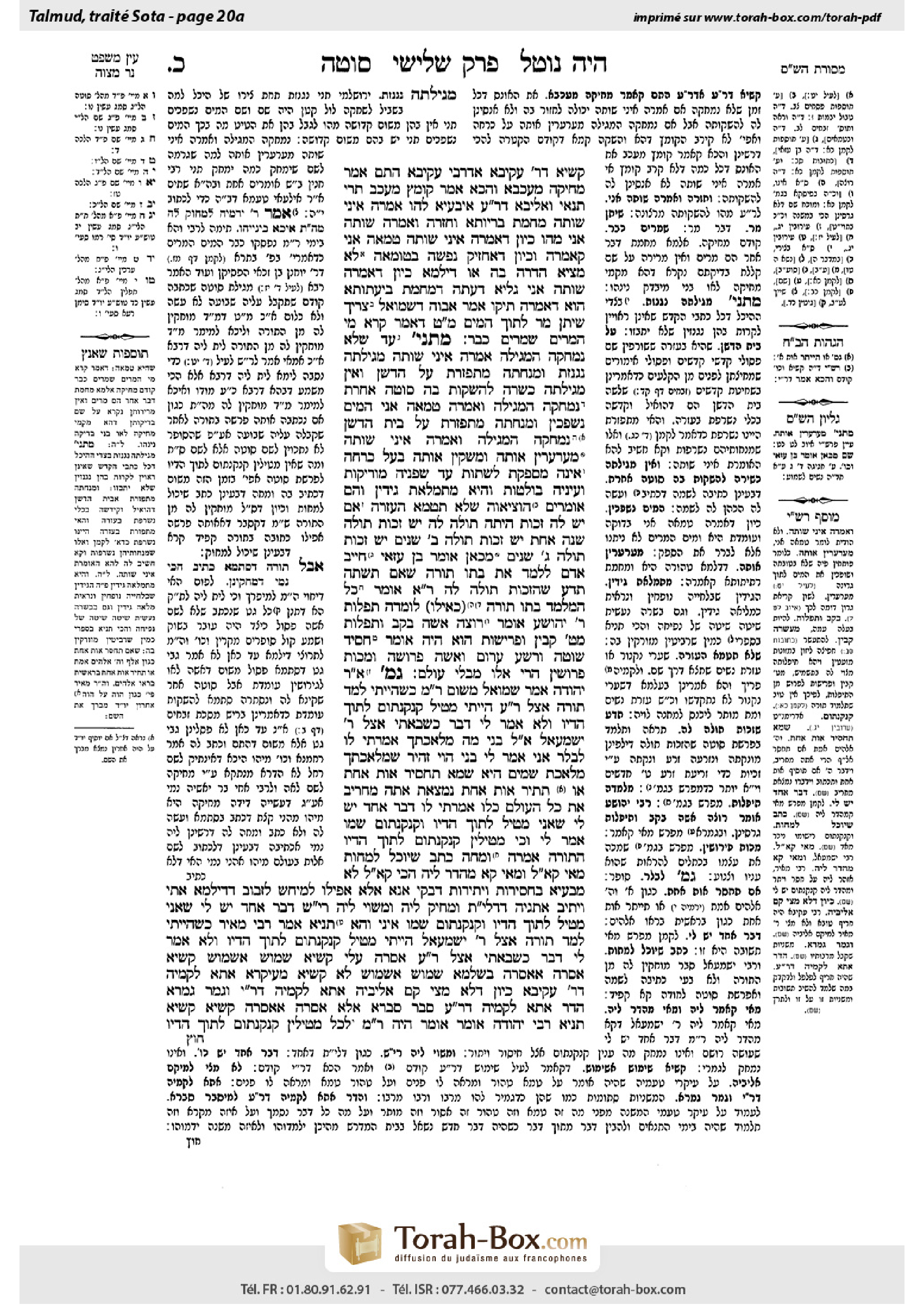
Sotah 20a: Talmud study for Daf Yomi
Daf Yomi is the daily study of one Talmud folio. Explore 37 tractates with scans, Hebrew text, Sefaria English and AI-generated French translations where annotated.
Passage selection and English or AI-generated French translation are available where the scan has annotations. Daf Study is independent of Torah-Box and Sefaria.
Browse Sotah · סוטה · All tractatesSotah 20a text and translations
This page of Sotah includes the Aramaic text, an English translation and an AI-generated French translation, alongside the scan above.
סוטה כ׳ א · Aramaic and Hebrew text
קַשְׁיָא דְּרַבִּי עֲקִיבָא אַדְּרַבִּי עֲקִיבָא: הָתָם אָמַר מְחִיקָה מְעַכְּבָא, וְהָכָא אָמַר קוֹמֶץ מְעַכֵּב!
תְּרֵי תַּנָּאֵי וְאַלִּיבָּא דְּרַבִּי עֲקִיבָא.
אִיבַּעְיָא לְהוּ: אָמְרָה אֵינִי שׁוֹתָה מֵחֲמַת בְּרִיּוּתָא, וְחָזְרָה וְאָמְרָה שׁוֹתָה אֲנִי, מַהוּ? כֵּיוָן דְּאָמְרָה אֵינִי שׁוֹתָה — טְמֵאָה אֲנִי קָאָמְרָה, וְכֵיוָן דְּאַחְזִיק נַפְשַׁהּ בְּטוּמְאָה, לָא מָצְיָא הָדְרָה בַּהּ. אוֹ דִילְמָא כֵּיוָן דְּאָמְרָה שׁוֹתָה אֲנִי — גַּלִּיָא דַּעְתַּהּ דְּמֵחֲמַת בִּיעֲתוּתָא הוּא דְּאָמְרָה. תֵּיקוּ.
אָמַר אֲבוּהּ דִּשְׁמוּאֵל: צָרִיךְ שֶׁיִּתֵּן מַר לְתוֹךְ הַמַּיִם. מַאי טַעְמָא — דְּאָמַר קְרָא: ״מֵי הַמָּרִים״, שֶׁמָּרִים כְּבָר.
מַתְנִי׳ עַד שֶׁלֹּא נִמְחֲקָה הַמְּגִילָּה אָמְרָה ״אֵינִי שׁוֹתָה״ — מְגִילָּתָהּ נִגְנֶזֶת, וּמִנְחָתָהּ מִתְפַּזֶּרֶת עַל הַדֶּשֶׁן, וְאֵין מְגִילָּתָהּ כְּשֵׁרָה לְהַשְׁקוֹת בָּהּ סוֹטָה אַחֶרֶת. נִמְחֲקָה הַמְּגִילָּה וְאָמְרָה ״טְמֵאָה אֲנִי״ — הַמַּיִם נִשְׁפָּכִין, וּמִנְחָתָהּ מִתְפַּזֶּרֶת עַל בֵּית הַדֶּשֶׁן. נִמְחֲקָה הַמְּגִילָּה וְאָמְרָה ״אֵינִי שׁוֹתָה״ — מְעַרְעֲרִין אוֹתָהּ, וּמַשְׁקִין אוֹתָהּ בְּעַל כׇּרְחָהּ.
אֵינָהּ מַסְפֶּקֶת לִשְׁתּוֹת עַד שֶׁפָּנֶיהָ מוֹרִיקוֹת, וְעֵינֶיהָ בּוֹלְטוֹת, וְהִיא מִתְמַלֵּאת גִּידִין. וְהֵם אוֹמְרִים: הוֹצִיאוּהָ [הוֹצִיאוּהָ] שֶׁלֹּא תְּטַמֵּא הָעֲזָרָה.
אִם יֵשׁ לָהּ זְכוּת — הָיְתָה תּוֹלָה לָהּ. יֵשׁ זְכוּת תּוֹלָה שָׁנָה אַחַת, יֵשׁ זְכוּת תּוֹלָה שְׁתֵּי שָׁנִים, יֵשׁ זְכוּת תּוֹלָה שָׁלֹשׁ שָׁנִים. מִכָּאן אוֹמֵר בֶּן עַזַּאי: חַיָּיב אָדָם לְלַמֵּד אֶת בִּתּוֹ תּוֹרָה, שֶׁאִם תִּשְׁתֶּה תֵּדַע שֶׁהַזְּכוּת תּוֹלָה לָהּ. רַבִּי אֱלִיעֶזֶר אוֹמֵר: כׇּל הַמְלַמֵּד בִּתּוֹ תּוֹרָה — (כְּאִילּוּ) לוֹמְּדָהּ תִּפְלוּת.
רַבִּי יְהוֹשֻׁעַ אוֹמֵר: רוֹצָה אִשָּׁה בְּקַב וְתִפְלוּת, מִתִּשְׁעָה קַבִּין וּפְרִישׁוּת. הוּא הָיָה אוֹמֵר: חָסִיד שׁוֹטֶה, וְרָשָׁע עָרוּם, וְאִשָּׁה פְּרוּשָׁה, וּמַכּוֹת פְּרוּשִׁין — הֲרֵי אֵלּוּ מְבַלֵּי עוֹלָם.
גְּמָ׳ אָמַר רַב יְהוּדָה אָמַר שְׁמוּאֵל מִשּׁוּם רַבִּי מֵאִיר: כְּשֶׁהָיִיתִי לָמֵד תּוֹרָה אֵצֶל רַבִּי עֲקִיבָא, הָיִיתִי מֵטִיל קַנְקַנְתּוֹם לְתוֹךְ הַדְּיוֹ, וְלֹא אָמַר לִי דָּבָר. כְּשֶׁבָּאתִי אֵצֶל רַבִּי יִשְׁמָעֵאל, אָמַר לִי: בְּנִי מָה מְלַאכְתֶּךָ? אָמַרְתִּי לוֹ: לַבְלָר אֲנִי. אָמַר לִי: בְּנִי, הֱוֵי זָהִיר, שֶׁמְּלַאכְתְּךָ מְלֶאכֶת שָׁמַיִם הִיא, שֶׁמָּא תַּחְסִיר אוֹת אַחַת אוֹ תֹּתִיר אוֹת אַחַת, נִמְצֵאתָ אַתָּה מַחְרִיב אֶת כָּל הָעוֹלָם כֻּלּוֹ.
אָמַרְתִּי לוֹ: דָּבָר אֶחָד יֵשׁ לִי שֶׁאֲנִי מֵטִיל לְתוֹךְ הַדְּיוֹ, וְקַנְקַנְתּוֹם שְׁמוֹ. אָמַר לִי: וְכִי מְטִילִין קַנְקַנְתּוֹם לְתוֹךְ הַדְּיוֹ? הַתּוֹרָה אָמְרָה ״וּמָחָה״, כְּתָב שֶׁיּוּכַל לִמְחוֹת!
מַאי קָאָמַר לֵיהּ וּמַאי קָא מַהְדַּר לֵיהּ?
הָכִי קָאָמַר לֵיהּ: לָא מִבַּעְיָא בַּחֲסֵירוֹת וִיתֵירוֹת דְּבָקִי אֲנָא, אֶלָּא אֲפִילּוּ לְמֵיחַשׁ לִזְבוּב דְּדִילְמָא אָתֵי וְיָתֵיב אַתָּגֵיהּ דְּדָלֶית וּמָחֵיק לֵיהּ וּמְשַׁוֵּי לֵיהּ רֵישׁ — דָּבָר אֶחָד יֵשׁ לִי שֶׁאֲנִי מֵטִיל לְתוֹךְ הַדְּיוֹ וְקַנְקַנְתּוֹם שְׁמוֹ.
אִינִי? וְהָא תַּנְיָא, אָמַר רַבִּי מֵאִיר: כְּשֶׁהָיִיתִי לָמֵד תּוֹרָה אֵצֶל רַבִּי יִשְׁמָעֵאל הָיִיתִי מֵטִיל קַנְקַנְתּוֹם לְתוֹךְ הַדְּיוֹ, וְלֹא אָמַר לִי דָּבָר. כְּשֶׁבָּאתִי אֵצֶל רַבִּי עֲקִיבָא אֲסָרָהּ עָלַי!
קַשְׁיָא שִׁמּוּשׁ אַשִּׁמּוּשׁ. קַשְׁיָא אֲסָרָהּ אַאֲסָרָהּ!
בִּשְׁלָמָא שִׁמּוּשׁ אַשִּׁמּוּשׁ לָא קַשְׁיָא: מֵעִיקָּרָא אֲתָא לְקַמֵּיהּ דְּרַבִּי עֲקִיבָא. כֵּיוָן דְּלָא מָצֵי (קָם) [לְמֵיקַם] אַלִּיבֵּיהּ, אֲתָא לְקַמֵּיהּ דְּרַבִּי יִשְׁמָעֵאל, וּגְמַר גְּמָרָא. הֲדַר אֲתָא לְקַמֵּיהּ דְּרַבִּי עֲקִיבָא סָבַר סְבָרָא.
אֶלָּא אֲסָרָהּ אַאֲסָרָהּ קַשְׁיָא! קַשְׁיָא.
תַּנְיָא, רַבִּי יְהוּדָה אוֹמֵר, אוֹמֵר הָיָה רַבִּי מֵאִיר: לַכֹּל מְטִילִין קַנְקַנְתּוֹם לְתוֹךְ הַדְּיוֹ,
Sotah 20a · English translation
The Gemara asks: The statement of Rabbi Akiva is difficult, as it is contradicted by another statement of Rabbi Akiva: There, in the first baraita, he said that erasure prevents the authorities from compelling the woman to drink the water if she retracted her decision to drink, and here he says that the sacrifice of the handful prevents the authorities from compelling the woman to drink the water. In other words, according to the first baraita the woman can retract her decision to drink until the scroll is erased, whereas according to the second baraita she can retract her decision until the handful is sacrificed.
The Gemara responds: There is a dispute between two tanna’im, and they disagree with regard to the opinion of Rabbi Akiva. They disagree with regard to what point in time, according to Rabbi Akiva, is the final moment at which a woman can refuse to drink the bitter water without being forced to do so.
A dilemma was raised before the Sages: If she initially said: I will not drink, while in a state of good health, and then she retracted her statement and said: I will drink, what is the halakha? Does one say that when she said: I will not drink, it is as if she confessed and said: I am defiled, and since she established herself as defiled she cannot retract her statement? Or perhaps when she said: I will drink, she revealed her thoughts that it was only due to fear that she said she will not drink? The Gemara concludes that the dilemma shall stand unresolved.
Shmuel’s father says: It is necessary for one to put a bitter substance into the water that the sota drinks. What is the reason for this? It is as the verse states: “And he shall blot them out into the water of bitterness” (Numbers 5:23), indicating that they are already bitter before the scroll is erased.
MISHNA: If before the scroll was erased she said: I will not drink, the scroll that was written for her is sequestered, and her meal-offering is burned and scattered over the place of the ashes, and her scroll is not fit to give to another sota to drink. If the scroll was erased and afterward she said: I am defiled, the water is poured out, and her meal-offering is scattered in the place of the ashes. If the scroll was already erased and she said: I will not drink, she is forced to drink against her will.
When a guilty woman drinks she does not manage to finish drinking before her face turns green and her eyes bulge, and her skin becomes full of protruding veins, and the people standing in the Temple say: Remove her, so that she does not render the Temple courtyard impure by dying there.
The mishna limits the scope of the previous statement: If she has merit, it delays punishment for her and she does not die immediately. There is a merit that delays punishment for one year, there is a larger merit that delays punishment for two years, and there is a merit that delays punishment for three years. From here Ben Azzai states: A person is obligated to teach his daughter Torah, so that if she drinks and does not die immediately, she will know that some merit she has delayed punishment for her. Rabbi Eliezer says: Anyone who teaches his daughter Torah is teaching her promiscuity [tiflut].
Rabbi Yehoshua says: A woman desires to receive the amount of a kav of food and a sexual relationship [tiflut] rather than to receive nine kav of food and abstinence. He would say: A foolish man of piety, and a conniving wicked person, and an abstinent woman [perusha], and those who injure themselves out of false abstinence; all these are people who erode the world.
GEMARA: Rav Yehuda says that Shmuel says in the name of Rabbi Meir: When I was studying Torah before Rabbi Akiva, as his disciple, I used to put iron sulfate into the ink with which I wrote Torah scrolls, and he did not say anything to me in protest. Afterward, when I came to learn Torah before Rabbi Yishmael, he said to me: My son, what is your vocation? I said to him: I am a scribe [lavlar] who writes Torah scrolls. He said to me: My son, be careful in your work, as your work is the work of Heaven, lest you omit a single letter from the Torah scroll or add a single letter, and in this you are found to be destroying the entire world if the mistake alters the meaning of the verse and results in blasphemy.
Rabbi Meir continues: I said to Rabbi Yishmael: I have one substance that I put into the ink, and it is called iron sulfate, which prevents the writing from being erased. He said to me: And may iron sulfate be put into the ink? The Torah clearly said with regard to the scroll of the sota: “And the priest shall write these curses in a scroll, and he shall blot them out into the water of bitterness” (Numbers 5:23). This indicates that the Torah requires writing that can be blotted out.
Since Rabbi Meir’s remark about iron sulfate seems unrelated to Rabbi Yishmael’s previous statement, the Gemara asks: What is Rabbi Yishmael saying to Rabbi Meir, and what is Rabbi Meir replying to Rabbi Yishmael?
The Gemara explains: This is what Rabbi Meir is saying to him: It is not necessary to say that I do not err in omissions and additions, as I am an expert. Rather, there is not even any reason for concern with regard to a fly lest it come and sit on the protrusion of the letter dalet and erase it, thereby rendering it the letter reish, which could be a critical error. There is no concern of this erasure occurring, since I have a certain substance that I put into the ink and that prevents the writing from being erased, and it is called iron sulfate.
The Gemara questions the initial part of Rabbi Meir’s statement: Is that so? But isn’t it taught in a baraita that Rabbi Meir said: When I was studying Torah before Rabbi Yishmael, I used to put iron sulfate into the ink with which I wrote Torah scrolls, and he did not say anything to me. Afterward, when I came to learn Torah with Rabbi Akiva, he prohibited me from doing so.
The Gemara points out that there are two separate contradictions between the two statements: Rav Yehuda’s statement with regard to Rabbi Meir first serving Rabbi Akiva as a disciple is difficult, as it is contradicted by the statement of the baraita with regard to his first serving Rabbi Yishmael. Furthermore, Rav Yehuda’s statement is difficult, since he states that it was Rabbi Yishmael who prohibited the addition of iron sulfate, and this is contradicted by the statement of the baraita that it was Rabbi Akiva who prohibited it.
The Gemara answers: Granted, the apparent contradiction between Rav Yehuda’s statement with regard to Rabbi Meir’s serving Rabbi Akiva first, and the statement of the baraita with regard to serving Rabbi Yishmael first, poses no difficulty. Initially, he came before Rabbi Akiva to study, but since he could not comprehend his extremely complicated method of learning, he came before Rabbi Yishmael and learned the oral tradition from him. Afterward, he returned and came before Rabbi Akiva and studied his method of logical reasoning in order to understand the reasons behind the halakhot he had already learned.
However, the contradiction between Rav Yehuda’s statement that it was Rabbi Yishmael who prohibited the addition of iron sulfate and the statement of the baraita that it was Rabbi Akiva who prohibited it still poses a difficulty. The Gemara concludes: Indeed, the matter is difficult.
It is taught in a baraita: Rabbi Yehuda says that Rabbi Meir would say: Iron sulfate may be put into the ink that is used for all sacred writings, i.e., Torah scrolls, phylacteries, and mezuzot,
Sotah 20a · Traduction française (IA)
La Guemara demande : La déclaration de Rabbi Akiva pose difficulté, car elle est contredite par une autre déclaration de Rabbi Akiva. Là, dans la première baraïta, il a dit que l’effacement empêche les autorités de contraindre la femme à boire l’eau si elle revient sur sa décision de boire ; ici, il dit que le sacrifice de la poignée empêche les autorités de la contraindre à boire l’eau. Autrement dit, selon la première baraïta, la femme peut revenir sur sa décision jusqu’à l’effacement du rouleau, tandis que, selon la seconde baraïta, elle peut revenir sur sa décision jusqu’au sacrifice de la poignée.
La Guemara répond : Il y a une divergence entre deux tannaïm, qui ne sont pas d’accord sur l’opinion de Rabbi Akiva. Ils divergent sur le moment qui, selon Rabbi Akiva, constitue la dernière limite à laquelle une femme peut refuser de boire l’eau amère sans y être contrainte.
Les Sages ont soulevé une question : si, au départ, alors qu’elle était en bonne santé, elle a dit : « Je ne boirai pas », puis est revenue sur ses paroles et a dit : « Je boirai », quelle est la halakha ? Faut-il dire que, lorsqu’elle a dit : « Je ne boirai pas », c’est comme si elle avait avoué et déclaré : « Je suis souillée », et que, s’étant ainsi déclarée souillée, elle ne peut revenir sur ses paroles ? Ou peut-être que, lorsqu’elle a dit : « Je boirai », elle a révélé que c’était uniquement par peur qu’elle avait dit qu’elle ne boirait pas ? La Guemara conclut que la question demeure sans réponse.
Le père de Shmuel dit : Il faut mettre une substance amère dans l’eau que boit la sota. Pour quelle raison ? Comme le dit le verset : « Et il les effacera dans l’eau d’amertume » (Nombres 5,23), ce qui indique que l’eau est déjà amère avant l’effacement du rouleau.
Michna : Si, avant que le rouleau soit effacé, elle dit : « Je ne boirai pas », le rouleau écrit pour elle est mis de côté, son offrande de farine est brûlée et dispersée à l’endroit des cendres, et son rouleau ne peut pas être utilisé pour une autre sota. Si le rouleau a été effacé et qu’ensuite elle dit : « Je suis souillée », l’eau est versée et son offrande de farine est dispersée à l’endroit des cendres. Si le rouleau a déjà été effacé et qu’elle dit : « Je ne boirai pas », elle est contrainte de boire contre son gré.
Lorsqu’une femme coupable boit, elle n’a pas le temps d’achever de boire que son visage devient vert, ses yeux sortent de leurs orbites et sa peau se couvre de veines saillantes. Les personnes présentes dans le Temple disent alors : « Emmenez-la, afin qu’elle ne rende pas impure la cour du Temple en y mourant. »
La Michna limite la portée de la déclaration précédente : si elle a du mérite, celui-ci retarde son châtiment et elle ne meurt pas immédiatement. Un mérite peut retarder son châtiment d’un an, un mérite plus important peut le retarder de deux ans, et un mérite peut le retarder de trois ans. À partir de là, Ben Azzai affirme : Un homme a l’obligation d’enseigner la Torah à sa fille, afin que, si elle boit et ne meurt pas immédiatement, elle sache qu’un mérite qu’elle possède a retardé son châtiment. Rabbi Eliezer dit : Quiconque enseigne la Torah à sa fille lui enseigne la débauche [tiflut].
Rabbi Yehoshua dit : Une femme préfère recevoir un kav de nourriture et des rapports sexuels [tiflut] plutôt que neuf kav de nourriture et l’abstinence. Il disait : Un homme pieux insensé, un méchant rusé, une femme ascète [perusha] et ceux qui se font du mal au nom d’une fausse ascèse : tous ces gens-là érodent le monde.
Guemara : Rav Yehuda dit au nom de Shmuel, au nom de Rabbi Meir : Quand j’étudiais la Torah auprès de Rabbi Akiva, comme son disciple, je mettais du sulfate de fer dans l’encre avec laquelle j’écrivais des rouleaux de Torah, et il ne protestait pas. Plus tard, lorsque je suis venu étudier la Torah auprès de Rabbi Yishmael, il m’a dit : « Mon fils, quel est ton métier ? » Je lui ai répondu : « Je suis scribe [lavlar] et j’écris des rouleaux de Torah. » Il m’a dit : « Mon fils, sois vigilant dans ton travail, car ton travail est une œuvre du Ciel. Prends garde de ne pas omettre une seule lettre du rouleau de Torah ni d’en ajouter une seule, car tu pourrais ainsi détruire le monde entier si l’erreur modifie le sens du verset et aboutit à un blasphème. »
Rabbi Meir poursuit : J’ai dit à Rabbi Yishmael : « J’ai une substance que je mets dans l’encre ; elle s’appelle sulfate de fer et empêche l’écriture de s’effacer. » Il m’a dit : « Peut-on donc mettre du sulfate de fer dans l’encre ? Au sujet du rouleau de la sota, la Torah a clairement dit : “Le prêtre écrira ces malédictions sur un rouleau, puis les effacera dans l’eau d’amertume” (Nombres 5,23). Cela indique que la Torah exige une écriture qui puisse être effacée. »
Comme la remarque de Rabbi Meir sur le sulfate de fer semble sans rapport avec la déclaration précédente de Rabbi Yishmael, la Guemara demande : Que dit Rabbi Yishmael à Rabbi Meir, et que lui répond Rabbi Meir ?
La Guemara explique : Voici ce que Rabbi Meir lui dit : « Il n’est pas nécessaire de dire que je ne commets pas d’erreurs d’omission ou d’ajout, car je suis expert. Il n’y a même pas lieu de craindre qu’une mouche vienne se poser sur la saillie de la lettre dalet et l’efface, la transformant ainsi en lettre reish, ce qui pourrait constituer une erreur grave. Il n’y a pas lieu de craindre un tel effacement, car j’ai une substance que je mets dans l’encre et qui empêche l’écriture de s’effacer ; elle s’appelle sulfate de fer. »
La Guemara remet en question le début de la déclaration de Rabbi Meir : Est-ce bien ainsi ? N’est-il pas enseigné dans une baraïta que Rabbi Meir a dit : « Quand j’étudiais la Torah auprès de Rabbi Yishmael, je mettais du sulfate de fer dans l’encre avec laquelle j’écrivais des rouleaux de Torah, et il ne disait rien. Plus tard, lorsque je suis venu étudier la Torah auprès de Rabbi Akiva, il me l’a interdit. »
La Guemara relève qu’il existe deux contradictions distinctes entre les deux déclarations : la déclaration de Rav Yehuda, selon laquelle Rabbi Meir a d’abord été le disciple de Rabbi Akiva, pose difficulté, car elle est contredite par la baraïta, selon laquelle il a d’abord été le disciple de Rabbi Yishmael. En outre, la déclaration de Rav Yehuda pose difficulté puisqu’il affirme que c’est Rabbi Yishmael qui a interdit l’ajout de sulfate de fer, tandis que la baraïta affirme que c’est Rabbi Akiva qui l’a interdit.
La Guemara répond : Certes, la contradiction apparente entre la déclaration de Rav Yehuda, selon laquelle Rabbi Meir a d’abord étudié auprès de Rabbi Akiva, et la baraïta, selon laquelle il a d’abord étudié auprès de Rabbi Yishmael, ne pose pas de difficulté. Au début, il est venu étudier auprès de Rabbi Akiva, mais, comme il ne parvenait pas à comprendre sa méthode d’étude extrêmement complexe, il est venu auprès de Rabbi Yishmael et a appris de lui la tradition orale. Ensuite, il est revenu auprès de Rabbi Akiva et a étudié sa méthode de raisonnement logique afin de comprendre les raisons des halakhot qu’il avait déjà apprises.
Cependant, la contradiction entre la déclaration de Rav Yehuda, selon laquelle c’est Rabbi Yishmael qui a interdit l’ajout de sulfate de fer, et la baraïta, selon laquelle c’est Rabbi Akiva qui l’a interdit, demeure difficile. La Guemara conclut : En effet, la question est difficile.
Il est enseigné dans une baraïta : Rabbi Yehuda dit que Rabbi Meir disait : On peut mettre du sulfate de fer dans l’encre utilisée pour tous les écrits sacrés, c’est-à-dire les rouleaux de Torah, les téfilines et les mezouzot,
Traduction française générée par IA à partir de l’édition anglaise de Sefaria. Vérifie toujours un passage avec le texte source.
Text from Sefaria: William Davidson Edition - Vocalized Aramaic (CC BY NC); William Davidson Edition - English (CC BY NC).