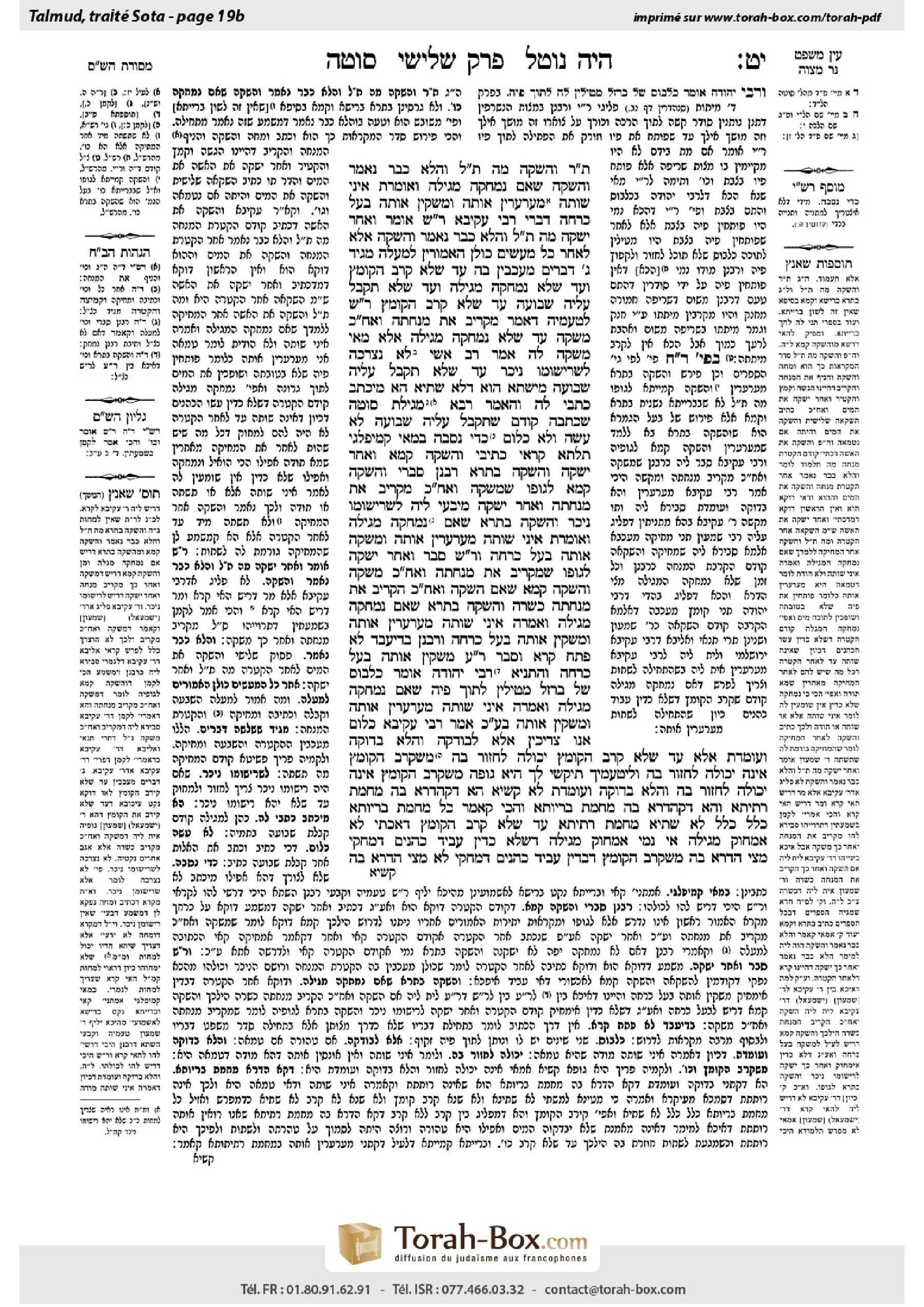
Sotah 19b: Talmud study for Daf Yomi
Daf Yomi is the daily study of one Talmud folio. Explore 37 tractates with scans, Hebrew text, Sefaria English and AI-generated French translations where annotated.
Passage selection and English or AI-generated French translation are available where the scan has annotations. Daf Study is independent of Torah-Box and Sefaria.
Browse Sotah · סוטה · All tractatesSotah 19b text and translations
This page of Sotah includes the Aramaic text, an English translation and an AI-generated French translation, alongside the scan above.
סוטה י״ט ב · Aramaic and Hebrew text
תָּנוּ רַבָּנַן: ״וְהִשְׁקָה״ מָה תַּלְמוּד לוֹמַר? וַהֲלֹא כְּבָר נֶאֱמַר ״וְהִשְׁקָהּ״! שֶׁאִם נִמְחֲקָה מְגִילָּה וְאוֹמֶרֶת ״אֵינִי שׁוֹתָה״ — מְעַרְעֲרִין אוֹתָהּ וּמַשְׁקִין אוֹתָהּ בְּעַל כׇּרְחָהּ, דִּבְרֵי רַבִּי עֲקִיבָא.
רַבִּי שִׁמְעוֹן אוֹמֵר: ״וְאַחַר יַשְׁקֶה״ מָה תַּלְמוּד לוֹמַר? וַהֲלֹא כְּבָר נֶאֱמַר ״וְהִשְׁקָהּ״! אֶלָּא, לְאַחַר כׇּל מַעֲשִׂים כּוּלָּן הָאֲמוּרִין לְמַעְלָה. מַגִּיד שְׁלֹשָׁה דְּבָרִים מְעַכְּבִין בָּהּ: עַד שֶׁלֹּא קָרַב הַקּוֹמֶץ, וְעַד שֶׁלֹּא נִמְחֲקָה מְגִילָּה, וְעַד שֶׁלֹּא תְּקַבֵּל עָלֶיהָ שְׁבוּעָה.
עַד שֶׁלֹּא קָרַב הַקּוֹמֶץ. רַבִּי שִׁמְעוֹן לְטַעְמֵיהּ, דְּאָמַר: מַקְרִיב אֶת מִנְחָתָהּ וְאַחַר כָּךְ מַשְׁקָהּ.
עַד שֶׁלֹּא נִמְחֲקָה מְגִילָּה. אֶלָּא מַאי מַשְׁקֶה לַהּ? אָמַר רַב אָשֵׁי: לֹא נִצְרְכָה לְשֶׁרִישּׁוּמוֹ נִיכָּר.
עַד שֶׁלֹּא תְּקַבֵּל עָלֶיהָ שְׁבוּעָה. מִישְׁתָּא הוּא דְּלָא שָׁתְיָא, הָא מִיכְתָּב כָּתְבִי לַהּ, וְהָאָמַר רָבָא: מְגִילַּת סוֹטָה שֶׁכְּתָבָהּ קוֹדֶם שֶׁתְּקַבֵּל עָלֶיהָ שְׁבוּעָה — לֹא עָשָׂה וְלֹא כְלוּם! כְּדִי נַסְבַהּ.
בְּמַאי קָמִיפַּלְגִי? תְּלָתָא קְרָאֵי כְּתִיבִי: ״וְהִשְׁקָה״ קַמָּא, ״וְאַחַר יַשְׁקֶה״, ״וְהִשְׁקָהּ״ בָּתְרָא.
רַבָּנַן סָבְרִי: ״וְהִשְׁקָה״ קַמָּא — לְגוּפוֹ, שֶׁמַּשְׁקֶה וְאַחַר כָּךְ מַקְרִיב אֶת מִנְחָתָהּ. ״וְאַחַר יַשְׁקֶה״ — מִיבְּעֵי לֵיהּ לְשֶׁרִישּׁוּמוֹ נִיכָּר. ״וְהִשְׁקָהּ״ בָּתְרָא — שֶׁאִם נִמְחֲקָה מְגִילָּה וְאוֹמֶרֶת ״אֵינִי שׁוֹתָה״, מְעַרְעֲרִין אוֹתָהּ וּמַשְׁקֶה אוֹתָהּ בְּעַל כׇּרְחָהּ.
וְרַבִּי שִׁמְעוֹן סָבַר: ״וְאַחַר יַשְׁקֶה״ — לְגוּפוֹ, שֶׁמַּקְרִיב אֶת מִנְחָתָהּ וְאַחַר כָּךְ מַשְׁקָהּ. ״וְהִשְׁקָה״ קַמָּא — שֶׁאִם הִשְׁקָהּ וְאַחַר כָּךְ הִקְרִיב אֶת מִנְחָתָהּ כְּשֵׁרָה. ״וְהִשְׁקָהּ״ בָּתְרָא — שֶׁאִם נִמְחֲקָה מְגִילָּה וְאָמְרָה ״אֵינִי שׁוֹתָה״, מְעַרְעֲרִין אוֹתָהּ וּמַשְׁקִין אוֹתָהּ בְּעַל כׇּרְחָהּ.
וְרַבָּנַן — בְּדִיעֲבַד לָא פָּתַח קְרָא.
וְסָבַר רַבִּי עֲקִיבָא מַשְׁקִין אוֹתָהּ בְּעַל כׇּרְחָהּ? וְהָתַנְיָא, רַבִּי יְהוּדָה אוֹמֵר: כַּלְבּוֹס שֶׁל בַּרְזֶל מְטִילִין לְתוֹךְ פִּיהָ, שֶׁאִם נִמְחֲקָה מְגִילָּה וְאָמְרָה ״אֵינִי שׁוֹתָה״ — מְעַרְעֲרִין אוֹתָהּ וּמַשְׁקִין אוֹתָהּ בְּעַל כׇּרְחָהּ. אָמַר רַבִּי עֲקִיבָא: כְּלוּם אָנוּ צְרִיכִין אֶלָּא לְבוֹדְקָהּ, וַהֲלֹא בְּדוּקָה וְעוֹמֶדֶת! אֶלָּא: עַד שֶׁלֹּא קָרַב הַקּוֹמֶץ — יְכוֹלָה לַחֲזוֹר בָּהּ, מִשֶּׁקָּרַב הַקּוֹמֶץ — אֵינָהּ יְכוֹלָה לַחֲזוֹר בָּהּ.
וְלִיטַעְמָיךְ, תִּיקְשֵׁי לָךְ הִיא גּוּפַהּ: מִשֶּׁקָּרַב הַקּוֹמֶץ אֵינָהּ יְכוֹלָה לַחֲזוֹר בָּהּ? וַהֲלֹא בְּדוּקָה וְעוֹמֶדֶת!
לָא קַשְׁיָא: הָא — דְּקָהָדְרָא בַּהּ מֵחֲמַת רְתִיתָא, וְהָא — דְּקָהָדְרָא בָּהּ מֵחֲמַת בְּרִיּוּתָא.
וְהָכִי קָאָמַר: כׇּל מֵחֲמַת בְּרִיּוּתָא — כְּלָל כְּלָל לָא שָׁתְיָא. מֵחֲמַת רְתִיתָא עַד שֶׁלֹּא קָרַב הַקּוֹמֶץ, דְּאַכַּתִּי לָא אִמְּחוּק מְגִילָּה, אִי נָמֵי אִמְּחוּק מְגִילָּה, דְּשֶׁלֹּא כְּדִין עֲבוּד כֹּהֲנִים דְּמַחֲקִי — מָצְיָ[א] הָדְרָא בָּהּ. מִשֶּׁקָּרַב הַקּוֹמֶץ, דִּבְדִין עֲבוּד כֹּהֲנִים דְּמָחֲקִי — לָא מָצֵי הָדְרָא בָּהּ.
Sotah 19b · English translation
The Sages taught: What is the meaning when the verse states after the sacrifice of the meal-offering: “And he shall make her drink the water” (Numbers 5:27)? But isn’t it already stated: “And he shall make the woman drink the water of bitterness that causes the curse” (Numbers 5:24)? The baraita answers: The repetition teaches that if the scroll was already erased and then the woman says: I will not drink, she is forced [me’arerin] to drink against her will. This is the statement of Rabbi Akiva.
Rabbi Shimon says: What is the meaning when the verse states: “And the priest shall take a handful of the meal-offering, as the memorial part of it, and burn it upon the altar, and afterward he shall make the woman drink the water” (Numbers 5:26)? But isn’t it already stated previously: “And he shall make the woman drink” (Numbers 5:24)? Rather, this verse indicates that the sota is given the bitter water to drink only after all the actions that are stated above are performed, i.e., erasing the scroll, sacrificing the meal-offering, and administering the oath. Therefore, this verse teaches that three matters preclude her from drinking: She does not drink until the handful is sacrificed, and until the scroll is erased, and until she accepts the oath upon herself.
The Gemara elaborates: She does not drink until the handful is sacrificed. Rabbi Shimon conforms to his line of reasoning stated earlier, as he says that the priest sacrifices her meal-offering and afterward forces her to drink.
The Gemara questions the second condition: She does not drink until the scroll is erased. Why does the baraita need to state this? But what could he give her to drink if the scroll was not yet erased into the water? Rav Ashi says: No, this halakha is necessary for an instance where the scroll was erased, but the impression of the ink is still discernible on the parchment. The woman does not drink until the scroll is totally erased.
The Gemara discusses the third condition: She does not drink until she accepts the oath upon herself. One might infer from this statement that it is only that she does not drink before she accepts the oath; however, the scroll is written for her before she accepts the oath. But didn’t Rava say: With regard to a scroll of a sota that was written before she accepted the oath upon herself, whoever wrote it did nothing, and the scroll is rendered invalid. The Gemara responds: This was cited for no reason, as in fact the scroll is not even written before she accepts the oath upon herself, and nothing should be inferred.
The Gemara asks: With regard to what do the Rabbis and Rabbi Shimon disagree in the mishna? The Gemara answers: Three verses are written which pertain to drinking the bitter water: The first occurrence of the term is in the verse: “And he shall make the woman drink” (Numbers 5:24); the second: “And afterward he shall make the woman drink the water” (Numbers 5:26); and the last occurrence of the term is in the verse: “And he shall make her drink” (Numbers 5:27).
The Rabbis hold that the first occurrence of the term: “And he shall make the woman drink,” is written to teach the halakha itself, i.e., that the priest first forces her to drink and afterward sacrifices her meal-offering. The second instance: “And afterward he shall make the woman drink,” is necessary to teach that as long as the impression of the writing is still discernible, the sota is not given the bitter water to drink. The third verse, the last occurrence of the term: “And he shall make her drink,” teaches that if the scroll was erased and then the woman says: I will not drink, she is forced to drink against her will.
And Rabbi Shimon holds that the second verse: “And afterward he shall make the woman drink the water” (Numbers 5:26), is written to teach the halakha itself, i.e., that the priest first sacrifices her meal-offering and afterward forces her to drink. The first occurrence of the term: “And he shall make the woman drink,” teaches that if he forced her to drink and only afterward sacrificed her meal-offering, the offering is nevertheless valid. The last occurrence of the term: “And he shall make her drink,” teaches that if the scroll was erased and then she said: I will not drink, she is forced to drink against her will.
The Gemara explains the Rabbis’ opinion: And the Rabbis would respond to Rabbi Shimon that the verse does not begin the discussion with a halakha that is applicable only after the fact, and therefore the initial mention of the drinking is referring to the proper time for the ritual.
The Gemara asks: But does Rabbi Akiva in fact hold that the woman is forced to drink against her will? But isn’t it taught in a baraita (Tosefta 2:3) that Rabbi Yehuda says: A hook [kelabus] made of iron is forcibly placed into her mouth, so that if the scroll was erased and she said: I will not drink, she is forced to drink against her will. Rabbi Akiva said: It is not necessary to force her to drink. Don’t we need to force her to drink the water only in order to evaluate her fidelity? And isn’t she established as having been evaluated when she refuses to drink, as she is essentially admitting her guilt? Rather, Rabbi Akiva’s statement should be understood as follows: Until the handful is sacrificed she can retract her decision to drink the bitter water; however, once the handful is sacrificed she cannot retract her decision to drink.
The Gemara asks: But according to your reasoning in explanation of Rabbi Akiva’s statement, this explanation itself should pose a difficulty for you. Why can’t she retract her decision once the handful is sacrificed? And isn’t she established as having been evaluated when she refuses to drink?
The Gemara answers: This is not difficult; this case, where she is forced to drink, is referring to a situation where she retracts her decision to drink due to fear, as her refusal is not viewed as an admission of guilt, and it is possible that if she drinks she will be found undefiled. And that case, where she does not drink, is referring to a situation where she retracts her decision in a state of good health. Since she does not appear to be afraid, her refusal is viewed as an admission of guilt.
And this is what Rabbi Akiva is saying: In any case where she retracts her decision to drink in a state of good health, she does not drink at all. With regard to a sota who retracts her decision due to fear, if she retracts her decision before the handful is sacrificed, when the scroll has not yet been erased; or even if the scroll was already erased, since the priests acted incorrectly when they erased it beforehand; she can retract her decision. Once the handful is sacrificed, in which case the priests acted correctly when they erased the scroll, she cannot retract her decision, and she is forced to drink against her will.
Sotah 19b · Traduction française (IA)
Les Sages ont enseigné : Que signifie le verset qui dit, après le sacrifice de l’offrande de farine : « Il lui fera boire l’eau » (Nombres 5,27) ? Mais n’est-il pas déjà écrit : « Il fera boire à la femme l’eau amère qui entraîne la malédiction » (Nombres 5,24) ? La baraïta répond : Cette répétition enseigne que, si le rouleau a déjà été effacé et que la femme dit ensuite : « Je ne boirai pas », on la contraint [me’arerin] à boire contre son gré. Telle est l’opinion de Rabbi Akiva.
Rabbi Shimon dit : Que signifie le verset qui dit : « Le prêtre prélèvera une poignée de l’offrande de farine, comme part commémorative, et la fera fumer sur l’autel, puis il fera boire à la femme l’eau » (Nombres 5,26) ? Mais n’est-il pas déjà écrit auparavant : « Il fera boire à la femme » (Nombres 5,24) ? Ce verset indique plutôt que la sota ne reçoit l’eau amère à boire qu’après l’accomplissement de tous les actes mentionnés plus haut, à savoir l’effacement du rouleau, le sacrifice de l’offrande de farine et l’administration du serment. Ce verset enseigne donc que trois conditions empêchent la femme de boire : elle ne boit pas avant que la poignée soit sacrifiée, avant que le rouleau soit effacé et avant qu’elle accepte le serment.
La Guemara précise : Elle ne boit pas avant que la poignée soit sacrifiée. Rabbi Shimon reste fidèle au raisonnement qu’il a exposé précédemment, puisqu’il affirme que le prêtre sacrifie son offrande de farine, puis la contraint à boire.
La Guemara examine la deuxième condition : elle ne boit pas avant que le rouleau soit effacé. Pourquoi la baraïta doit-elle le préciser ? Que pourrait-on lui donner à boire si le rouleau n’avait pas encore été effacé dans l’eau ? Rav Ashi dit : Non, cette halakha est nécessaire dans le cas où le rouleau a été effacé, mais où la trace de l’encre est encore visible sur le parchemin. La femme ne boit pas tant que le rouleau n’est pas entièrement effacé.
La Guemara examine la troisième condition : elle ne boit pas avant d’accepter le serment. On pourrait déduire de cette affirmation qu’elle ne boit certes pas avant d’avoir accepté le serment, mais que le rouleau est écrit pour elle avant qu’elle ne l’accepte. Mais Rava n’a-t-il pas dit : si le rouleau d’une sota a été écrit avant qu’elle n’accepte le serment, celui qui l’a écrit n’a rien fait et le rouleau est invalide ? La Guemara répond : cette précision a été citée sans raison ; en réalité, le rouleau n’est même pas écrit avant qu’elle n’accepte le serment, et il ne faut donc rien en déduire.
La Guemara demande : Sur quel point les Rabbins et Rabbi Shimon sont-ils en désaccord dans la Michna ? La Guemara répond : Trois versets concernent le fait de faire boire l’eau amère. La première occurrence figure dans le verset : « Il fera boire à la femme » (Nombres 5,24) ; la deuxième, dans le verset : « Puis il fera boire à la femme l’eau » (Nombres 5,26) ; et la dernière, dans le verset : « Il lui fera boire » (Nombres 5,27).
Les Rabbins considèrent que la première occurrence de l’expression « Il fera boire à la femme » enseigne la halakha elle-même, à savoir que le prêtre la contraint d’abord à boire, puis sacrifie son offrande de farine. La deuxième occurrence, « Puis il fera boire à la femme », est nécessaire pour enseigner que, tant que la trace de l’écriture reste visible, la sota ne reçoit pas l’eau amère à boire. Le troisième verset, la dernière occurrence de l’expression « Il lui fera boire », enseigne que, si le rouleau a été effacé et que la femme dit ensuite : « Je ne boirai pas », on la contraint à boire contre son gré.
Rabbi Shimon considère, quant à lui, que le deuxième verset, « Puis il fera boire à la femme l’eau » (Nombres 5,26), enseigne la halakha elle-même, à savoir que le prêtre sacrifie d’abord son offrande de farine, puis la contraint à boire. La première occurrence de l’expression « Il fera boire à la femme » enseigne que, si le prêtre l’a contrainte à boire et n’a sacrifié son offrande de farine qu’ensuite, l’offrande reste néanmoins valide. La dernière occurrence de l’expression « Il lui fera boire » enseigne que, si le rouleau a été effacé et qu’elle dit ensuite : « Je ne boirai pas », on la contraint à boire contre son gré.
La Guemara explique l’opinion des Rabbins : ceux-ci répondraient à Rabbi Shimon que le verset ne commence pas par énoncer une halakha qui ne s’applique qu’a posteriori ; la première mention de l’acte de faire boire renvoie donc au moment approprié pour le rituel.
La Guemara demande : Rabbi Akiva considère-t-il réellement que la femme est contrainte de boire contre son gré ? Mais n’est-il pas enseigné dans une baraïta (Tosefta 2,3) que Rabbi Yehuda dit : « On lui introduit de force dans la bouche un crochet [kelabus] en fer », de sorte que, si le rouleau a été effacé et qu’elle dit : « Je ne boirai pas », on la contraint à boire contre son gré ? Rabbi Akiva dit : « Il n’est pas nécessaire de la contraindre à boire. » N’a-t-on besoin de la contraindre à boire l’eau que pour évaluer sa fidélité ? Or, lorsqu’elle refuse de boire, son cas est déjà considéré comme évalué, puisqu’elle reconnaît en substance sa culpabilité. Il faut plutôt comprendre ainsi les propos de Rabbi Akiva : jusqu’à ce que la poignée soit sacrifiée, elle peut revenir sur sa décision de boire l’eau amère ; mais, une fois la poignée sacrifiée, elle ne peut plus revenir sur sa décision.
La Guemara demande : Mais, selon votre raisonnement pour expliquer les propos de Rabbi Akiva, cette explication elle-même devrait vous poser une difficulté. Pourquoi ne peut-elle pas revenir sur sa décision une fois la poignée sacrifiée ? Son cas n’est-il pas déjà considéré comme évalué lorsqu’elle refuse de boire ?
La Guemara répond : Il n’y a pas de difficulté. Le cas où elle est contrainte de boire concerne une situation où elle revient sur sa décision de boire par peur ; son refus n’est donc pas considéré comme un aveu de culpabilité, et il est possible que, si elle boit, il soit constaté qu’elle n’a pas été souillée. En revanche, le cas où elle ne boit pas concerne une situation où elle revient sur sa décision alors qu’elle est en bonne santé. Comme elle ne semble pas avoir peur, son refus est considéré comme un aveu de culpabilité.
Voici donc ce que dit Rabbi Akiva : dans tous les cas où elle revient sur sa décision de boire alors qu’elle est en bonne santé, elle ne boit pas du tout. Quant à une sota qui revient sur sa décision par peur, si elle le fait avant que la poignée soit sacrifiée, alors que le rouleau n’a pas encore été effacé — ou même si le rouleau a déjà été effacé, puisque les prêtres ont agi incorrectement en l’effaçant prématurément —, elle peut revenir sur sa décision. Mais une fois la poignée sacrifiée, les prêtres ayant alors agi correctement en effaçant le rouleau, elle ne peut plus revenir sur sa décision et on la contraint à boire contre son gré.
Traduction française générée par IA à partir de l’édition anglaise de Sefaria. Vérifie toujours un passage avec le texte source.
Text from Sefaria: William Davidson Edition - Vocalized Aramaic (CC BY NC); William Davidson Edition - English (CC BY NC).