Sotah 19a: Talmud study for Daf Yomi
Daf Yomi is the daily study of one Talmud folio. Explore 37 tractates with scans, Hebrew text, Sefaria English and AI-generated French translations where annotated.
Passage selection and English or AI-generated French translation are available where the scan has annotations. Daf Study is independent of Torah-Box and Sefaria.
Browse Sotah · סוטה · All tractatesSotah 19a text and translations
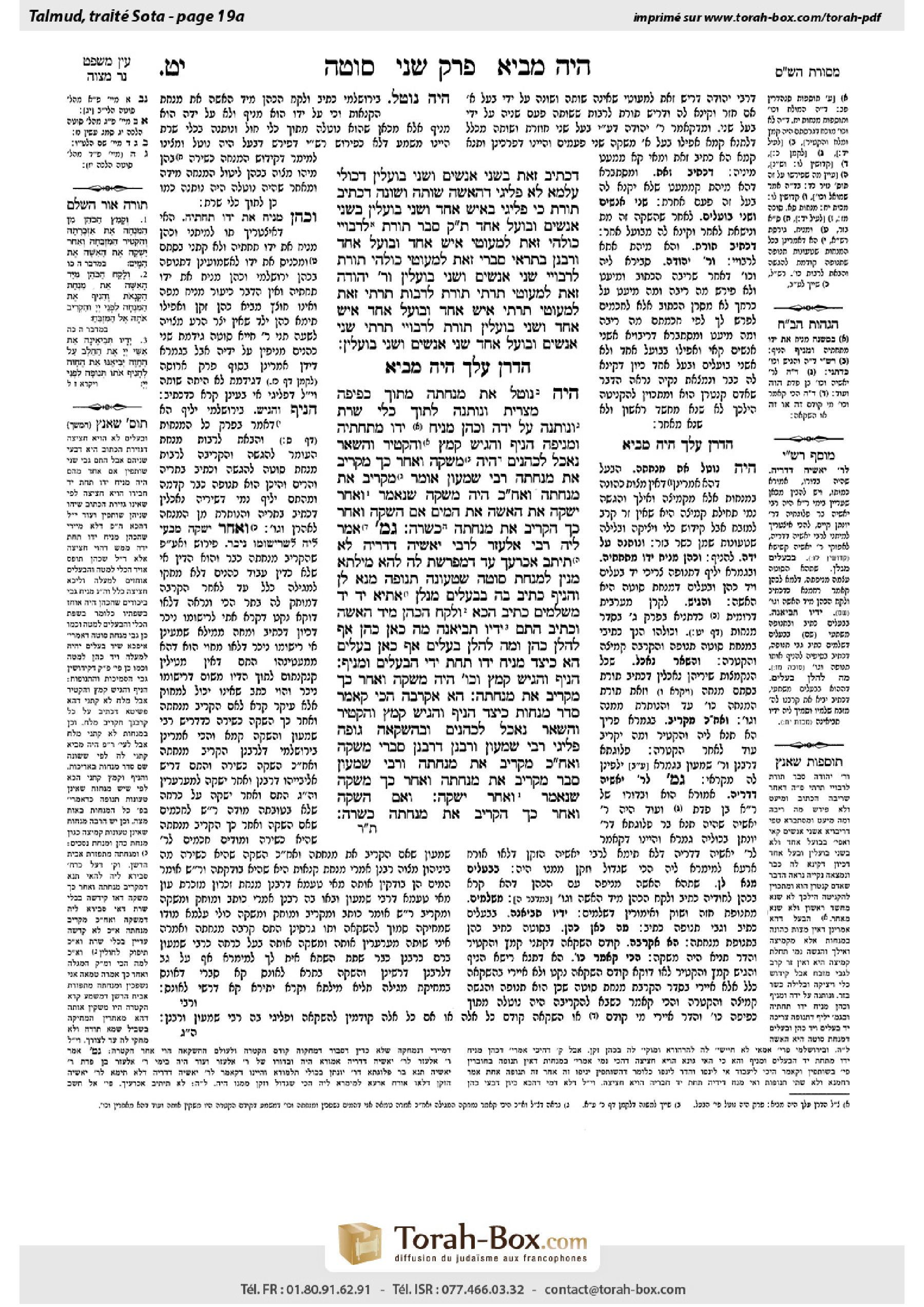
This page of Sotah includes the Aramaic text, an English translation and an AI-generated French translation, alongside the scan above.
סוטה י״ט א · Aramaic and Hebrew text
דִּכְתִיב: ״זֹאת״. בִּשְׁנֵי אֲנָשִׁים וּשְׁנֵי בּוֹעֲלִין — דְּכוּלֵּי עָלְמָא לָא פְּלִיגִי דְּהָאִשָּׁה שׁוֹתָה וְשׁוֹנָה, דִּכְתִיב: ״תּוֹרַת״.
כִּי פְּלִיגִי בְּאִישׁ אֶחָד וּשְׁנֵי בּוֹעֲלִין, בִּשְׁנֵי אֲנָשִׁים וּבוֹעֵל אֶחָד.
תַּנָּא קַמָּא סָבַר: ״תּוֹרַת״ — לְרַבּוֹיֵי כּוּלְּהִי, ״זֹאת״ — לְמַעוֹטֵי אִישׁ אֶחָד וּבוֹעֵל אֶחָד.
וְרַבָּנַן בָּתְרָאֵי סָבְרִי: ״זֹאת״ — לְמַעוֹטֵי כּוּלְּהִי, ״תּוֹרַת״ — לְרַבּוֹיֵי שְׁנֵי אֲנָשִׁים וּשְׁנֵי בּוֹעֲלִין.
וְרַבִּי יְהוּדָה: ״זֹאת״ — לְמַעוֹטֵי תַּרְתֵּי, ״תּוֹרַת״ — לְרַבּוֹת תַּרְתֵּי. ״זֹאת״ לְמַעוֹטֵי תַּרְתֵּי — אִישׁ אֶחָד וּבוֹעֵל אֶחָד, אִישׁ אֶחָד וּשְׁנֵי בּוֹעֲלִין, ״תּוֹרַת״ — לְרַבּוֹיֵי תַּרְתֵּי, שְׁנֵי אֲנָשִׁים וּבוֹעֵל אֶחָד, שְׁנֵי אֲנָשִׁים וּשְׁנֵי בּוֹעֲלִין.
הֲדַרַן עֲלָךְ הָיָה מֵבִיא
הָיָה נוֹטֵל אֶת מִנְחָתָהּ מִתּוֹךְ כְּפִיפָה מִצְרִית, וְנוֹתְנָהּ לְתוֹךְ כְּלִי שָׁרֵת, וְנוֹתְנָהּ עַל יָדָהּ, וְכֹהֵן מַנִּיחַ יָדוֹ מִתַּחְתֶּיהָ וּמְנִיפָהּ. הֵנִיף וְהִגִּישׁ, קָמַץ וְהִקְטִיר, וְהַשְּׁאָר נֶאֱכָל לַכֹּהֲנִים.
הָיָה מַשְׁקָהּ וְאַחַר כָּךְ מַקְרִיב אֶת מִנְחָתָהּ. רַבִּי שִׁמְעוֹן אוֹמֵר: מַקְרִיב אֶת מִנְחָתָהּ וְאַחַר כָּךְ הָיָה מַשְׁקָהּ, שֶׁנֶּאֱמַר: ״וְאַחַר יַשְׁקֶה אֶת הָאִשָּׁה אֶת הַמָּיִם״. אִם הִשְׁקָהּ וְאַחַר כָּךְ הִקְרִיב אֶת מִנְחָתָהּ — כְּשֵׁרָה.
גְּמָ׳ אֲמַר לֵיהּ רַבִּי אֶלְעָזָר לְרַבִּי יֹאשִׁיָּה דְּדָרֵיהּ: לָא תֵּיתֵב אַכַּרְעָךְ עַד דִּמְפָרְשַׁתְּ לָהּ לְהָא מִילְּתָא: מִנַּיִן לְמִנְחַת סוֹטָה שֶׁטְּעוּנָה תְּנוּפָה? מְנָא לַן?! ״וְהֵנִיף״ כְּתִיב בַּהּ! בִּבְעָלִים, מְנָלַן?
אָתְיָא ״יָד״ ״יָד״ מִשְּׁלָמִים. כְּתִיב הָכָא: ״וְלָקַח הַכֹּהֵן מִיַּד הָאִשָּׁה״, וּכְתִיב הָתָם: ״יָדָיו תְּבִיאֶינָה״.
מָה כָּאן כֹּהֵן — אַף לְהַלָּן כֹּהֵן, וּמָה לְהַלָּן בְּעָלִים — אַף כָּאן בְּעָלִים. הָא כֵּיצַד? מַנִּיחַ יָדוֹ תַּחַת יְדֵי הַבְּעָלִים וּמֵנִיף.
הֵנִיף וְהִגִּישׁ קָמַץ וְכוּ׳. הָיָה מַשְׁקָהּ וְאַחַר כָּךְ מַקְרִיב אֶת מִנְחָתָהּ. הָא אַקְרְבַהּ!
הָכִי קָאָמַר: סֵדֶר מְנָחוֹת כֵּיצַד? הֵנִיף וְהִגִּישׁ, קָמַץ וְהִקְטִיר, וְהַשְּׁאָר נֶאֱכָל לַכֹּהֲנִים.
וּבְהַשְׁקָאָה גּוּפַהּ פְּלִיגִי רַבִּי שִׁמְעוֹן וְרַבָּנַן. דְּרַבָּנַן סָבְרִי: מַשְׁקָהּ וְאַחַר כָּךְ מַקְרִיב אֶת מִנְחָתָהּ, וְרַבִּי שִׁמְעוֹן סָבַר: מַקְרִיב אֶת מִנְחָתָהּ וְאַחַר כָּךְ מַשְׁקָהּ, שֶׁנֶּאֱמַר: ״וְאַחַר יַשְׁקֶה״.
וְאִם הִשְׁקָהּ וְאַחַר כָּךְ הִקְרִיב אֶת מִנְחָתָהּ — כְּשֵׁרָה.
Sotah 19a · English translation
as it is written: “This is the law of jealousy.” The word “this” is a restricting term and excludes that possibility. With regard to two different husbands and two different paramours, where her first husband suspected her with regard to one paramour during her first marriage and the second husband suspected her with regard to a different man during the second marriage, everyone agrees that the woman drinks and repeats, as it is written: “This is the law of jealousy,” in all cases of jealousy.
They disagree when there is one husband and two paramours, i.e., where one husband warned her with regard to a second paramour after she survived her first ordeal. They also disagree in a case of two husbands and one paramour, i.e., if her second husband accused her with regard to the same paramour on account of whom she was compelled to drink by her first husband.
The opinions are justified as follows: The first tanna holds that the phrase “the law of jealousy” serves to include all of these cases. In almost all cases the woman drinks and repeats. The word “this” serves to exclude only the case of one husband and one paramour, in which she does not drink and repeat.
And the Rabbis mentioned later in the baraita hold that the word “this” serves to exclude all of these cases. The woman almost never drinks and repeats. The phrase “the law of jealousy” serves to include only the case of two husbands and two paramours, in which she does drink and repeat.
And Rabbi Yehuda holds: The word “this” serves to exclude two of the cases, and the phrase “the law of jealousy” serves to include two. The word “this” serves to exclude the two cases of one husband and one paramour and one husband and two paramours. In neither of these cases does the woman drink and repeat. The phrase “the law of jealousy” serves to include two cases, i.e., two husbands and one paramour, and all the more so two husbands and two paramours. In both of these cases, the woman must drink and repeat.
MISHNA: He would take her meal-offering out of the Egyptian wicker basket made of palm leaves in which it was lying and would put it into a service vessel and then place it on her hand. And the priest would then place his hand underneath hers and wave it together with her. The priest waved it and brought it near to the southwest corner of the altar, removed a handful from it, and burned the handful; and the remainder was eaten by the priests.
The priest would force the woman to drink the bitter water of a sota, and afterward he would sacrifice her meal-offering. Rabbi Shimon says: The priest would sacrifice her meal-offering and afterward he would force her to drink, as it is stated: “And the priest shall take a handful of the meal-offering, as the memorial part of it, and burn it upon the altar, and afterward he shall make the woman drink the water” (Numbers 5:26). But Rabbi Shimon concedes that if the priest first forced her to drink and afterward sacrificed her meal-offering, it is still valid.
GEMARA: Rabbi Elazar said to Rabbi Yoshiya of his generation, i.e., his contemporary: You shall not sit on your feet until you explain this matter to me: From where is it derived that the meal-offering of a sota requires waving? The Gemara expresses surprise at the question: From where do we derive this? It is explicitly written with regard to the meal-offering of a sota: “And the priest shall take the meal-offering of jealousy out of the woman’s hand, and shall wave the meal-offering before the Lord, and bring it unto the altar” (Numbers 5:25). Rather, the question is as follows: From where do we derive that the waving is performed by the owner, i.e., the woman, and not only by the priest?
Rabbi Yoshiya answered: This is derived by means of a verbal analogy between the term “hand” written here and “hand” from the peace-offering: It is written here, with regard to the meal-offering of a sota: “And the priest shall take the meal-offering of jealousy out of the woman’s hand” (Numbers 5:25), and it is written there, with regard to the peace-offering: “He that offers his peace-offerings unto the Lord…His own hands shall bring the offerings…that the breast may be waved before the Lord” (Leviticus 7:29–30).
Just as here, in the case of the sota, the priest waves the offering, so too there, in the case of the peace-offering, the priest waves the offering. And just as there, in the case of the peace-offering, the owner waves the offering, so too here, in the case of the sota, the owner waves the offering. How is this accomplished? The priest places his hand beneath the hands of the owner and then waves the offering with the owner.
§ The mishna states: The priest waved it and brought it near to the southwest corner of the altar, removed a handful from it, and burned the handful. Yet the continuation of the mishna states: The priest would force the woman to drink, and afterward he would sacrifice her meal-offering. The Gemara asks: Didn’t the mishna state in the previous phrase that the offering was already sacrificed?
The Gemara answers: This is what the mishna is saying: What was the sacrificial order of meal-offerings in general? The priest waved the meal-offering and brought it near to the southwest corner of the altar, removed a handful from it, and burned the handful, and the remainder was eaten by the priests.
And as for the correct order for sacrificing the meal-offering of the sota and forcing her to drink, this itself is a matter about which Rabbi Shimon and the Rabbis disagree, as the Rabbis hold that the priest would force the woman to drink and afterward he would sacrifice her meal-offering; and Rabbi Shimon holds that the priest would sacrifice her meal-offering and afterward he would force her to drink, as it is stated: “And the priest shall take a handful of the meal-offering, as the memorial part of it, and burn it upon the altar, and afterward he shall make the woman drink the water” (Numbers 5:26).
§ The mishna states: But Rabbi Shimon concedes that if the priest first forced her to drink and afterward sacrificed her meal-offering, the offering is still valid.
Sotah 19a · Traduction française (IA)
comme il est écrit : « Telle est la loi de la jalousie. » Le mot « telle » est un terme restrictif qui exclut cette possibilité. Dans le cas de deux maris différents et de deux amants différents, où son premier mari l’a soupçonnée au sujet d’un amant pendant leur premier mariage, puis son second mari l’a soupçonnée au sujet d’un autre homme pendant leur second mariage, tous conviennent que la femme boit et recommence, comme il est écrit : « Telle est la loi de la jalousie », dans tous les cas de jalousie.
Ils divergent lorsqu’il y a un seul mari et deux amants, c’est-à-dire lorsqu’un mari l’a mise en garde au sujet d’un second amant après qu’elle a survécu à sa première épreuve. Ils divergent également dans le cas de deux maris et d’un seul amant, c’est-à-dire si son second mari l’a accusée au sujet du même amant que celui au sujet duquel son premier mari l’avait obligée à boire.
Les opinions se justifient ainsi : le premier tanna estime que l’expression « la loi de la jalousie » sert à inclure tous ces cas. Dans presque tous les cas, la femme boit et recommence. Le mot « telle » ne sert qu’à exclure le cas d’un seul mari et d’un seul amant, dans lequel elle ne boit pas et ne recommence pas.
Les Rabbins mentionnés plus loin dans la baraïta estiment que le mot « telle » sert à exclure tous ces cas. La femme ne boit presque jamais et ne recommence pas. L’expression « la loi de la jalousie » sert à inclure uniquement le cas de deux maris et de deux amants, dans lequel elle boit et recommence.
Et Rabbi Yehouda estime que le mot « telle » sert à exclure deux cas, tandis que l’expression « la loi de la jalousie » sert à en inclure deux. Le mot « telle » sert à exclure les cas d’un seul mari et d’un seul amant, et d’un seul mari et de deux amants. Dans aucun de ces cas la femme ne boit et ne recommence. L’expression « la loi de la jalousie » sert à inclure deux cas : celui de deux maris et d’un seul amant, et, à plus forte raison, celui de deux maris et de deux amants. Dans ces deux cas, la femme doit boire et recommencer.
MICHNA : Il retirait son offrande de farine de la corbeille égyptienne en feuilles de palmier où elle reposait, la plaçait dans un ustensile de service, puis la déposait sur sa main. Le prêtre plaçait ensuite sa main sous celle de la femme et faisait le balancement rituel avec elle. Le prêtre la balançait, l’approchait de l’angle sud-ouest de l’autel, en prélevait une poignée et brûlait cette poignée ; le reste était consommé par les prêtres.
Le prêtre obligeait la femme à boire l’eau amère de la sota, puis sacrifiait son offrande de farine. Rabbi Shimon dit : Le prêtre sacrifiait son offrande de farine, puis l’obligeait à boire, comme il est dit : « Le prêtre prendra une poignée de l’offrande de farine, comme mémorial, et la brûlera sur l’autel ; ensuite, il fera boire l’eau à la femme » (Nombres 5,26). Mais Rabbi Shimon reconnaît que si le prêtre l’a d’abord obligée à boire, puis a sacrifié son offrande de farine, celle-ci reste valide.
GUEMARA : Rabbi Elazar dit à Rabbi Yoshiya, son contemporain : Tu ne te relèveras pas avant de m’avoir expliqué cette question : d’où apprend-on que l’offrande de farine d’une sota doit faire l’objet du balancement rituel ? La Guemara s’étonne de cette question : d’où apprend-on cela ? C’est explicitement écrit au sujet de l’offrande de farine d’une sota : « Le prêtre prendra des mains de la femme l’offrande de farine de jalousie, fera le balancement rituel de l’offrande de farine devant l’Éternel, puis l’apportera à l’autel » (Nombres 5,25). La question est plutôt la suivante : d’où apprend-on que la femme, propriétaire de l’offrande, participe au balancement rituel, et que celui-ci n’est pas effectué uniquement par le prêtre ?
Rabbi Yoshiya répondit : Cela s’apprend par une analogie verbale entre le terme « main », écrit ici, et le terme « main » relatif au sacrifice de paix. Ici, au sujet de l’offrande de farine d’une sota, il est écrit : « Le prêtre prendra des mains de la femme l’offrande de farine de jalousie » (Nombres 5,25). Et là, au sujet du sacrifice de paix, il est écrit : « Celui qui offre ses sacrifices de paix à l’Éternel… apportera les offrandes de ses propres mains… afin que la poitrine soit balancée devant l’Éternel » (Lévitique 7,29–30).
De même qu’ici, dans le cas de la sota, le prêtre fait le balancement rituel de l’offrande, de même là, dans le cas du sacrifice de paix, le prêtre fait le balancement rituel de l’offrande. Et de même que là, dans le cas du sacrifice de paix, le propriétaire fait le balancement rituel de l’offrande, de même ici, dans le cas de la sota, la propriétaire fait le balancement rituel de l’offrande. Comment cela se fait-il ? Le prêtre place sa main sous les mains de la propriétaire, puis balance l’offrande avec elle.
§ La Michna dit : Le prêtre la balançait, l’approchait de l’angle sud-ouest de l’autel, en prélevait une poignée et brûlait cette poignée. Pourtant, la suite de la Michna dit : Le prêtre obligeait la femme à boire, puis sacrifiait son offrande de farine. La Guemara demande : La Michna n’a-t-elle pas dit dans la phrase précédente que l’offrande avait déjà été sacrifiée ?
La Guemara répond : Voici ce que dit la Michna : quel était l’ordre général des sacrifices des offrandes de farine ? Le prêtre balançait l’offrande de farine, l’approchait de l’angle sud-ouest de l’autel, en prélevait une poignée et brûlait cette poignée ; le reste était consommé par les prêtres.
Quant à l’ordre à suivre pour sacrifier l’offrande de farine de la sota et la faire boire, c’est précisément un sujet de désaccord entre Rabbi Shimon et les Rabbins : les Rabbins estiment que le prêtre obligeait la femme à boire, puis sacrifiait son offrande de farine ; Rabbi Shimon estime que le prêtre sacrifiait son offrande de farine, puis l’obligeait à boire, comme il est dit : « Le prêtre prendra une poignée de l’offrande de farine, comme mémorial, et la brûlera sur l’autel ; ensuite, il fera boire l’eau à la femme » (Nombres 5,26).
§ La Michna dit : Mais Rabbi Shimon reconnaît que si le prêtre a d’abord obligé la femme à boire, puis a sacrifié son offrande de farine, l’offrande reste valide.
Traduction française générée par IA à partir de l’édition anglaise de Sefaria. Vérifie toujours un passage avec le texte source.
Text from Sefaria: William Davidson Edition - Vocalized Aramaic (CC BY NC); William Davidson Edition - English (CC BY NC).