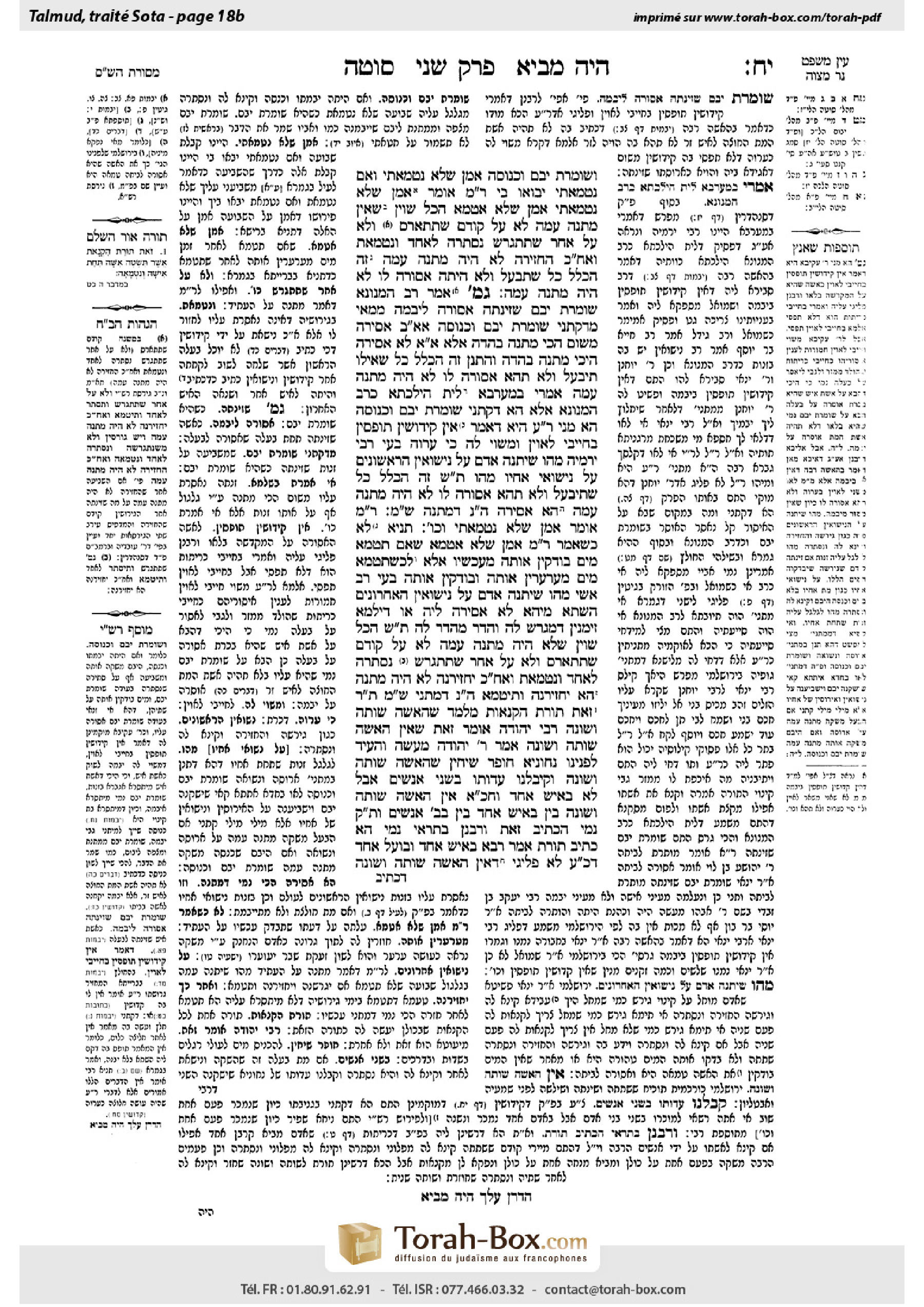
Sotah 18b: Talmud study for Daf Yomi
Daf Yomi is the daily study of one Talmud folio. Explore 37 tractates with scans, Hebrew text, Sefaria English and AI-generated French translations where annotated.
Passage selection and English or AI-generated French translation are available where the scan has annotations. Daf Study is independent of Torah-Box and Sefaria.
Browse Sotah · סוטה · All tractatesSotah 18b text and translations
This page of Sotah includes the Aramaic text, an English translation and an AI-generated French translation, alongside the scan above.
סוטה י״ח ב · Aramaic and Hebrew text
וְשׁוֹמֶרֶת יָבָם, וּכְנוּסָה. אָמֵן שֶׁלֹּא נִטְמֵאתִי, וְאִם נִטְמֵאתִי — יָבוֹאוּ בִּי.
רַבִּי מֵאִיר אוֹמֵר: אָמֵן שֶׁלֹּא נִטְמֵאתִי, אָמֵן שֶׁלֹּא אֶטָּמֵא.
הַכֹּל שָׁוִין שֶׁאֵין מַתְנֶה עִמָּהּ, לֹא עַל קוֹדֶם שֶׁתִּתְאָרֵס וְלֹא עַל אַחַר שֶׁתִּתְגָּרֵשׁ.
נִסְתְּרָה לְאֶחָד וְנִטְמֵאת, וְאַחַר כָּךְ הֶחְזִירָה — לֹא הָיָה מַתְנֶה עִמָּהּ.
זֶה הַכְּלָל: כׇּל שֶׁתִּבָּעֵל וְלֹא הָיְתָה אֲסוּרָה לוֹ — לֹא הָיָה מַתְנֶה עִמָּהּ.
גְּמָ׳ אָמַר רַב הַמְנוּנָא: שׁוֹמֶרֶת יָבָם שֶׁזִּינְּתָה — אֲסוּרָה לִיבָמָהּ. מִמַּאי — מִדְּקָתָנֵי שׁוֹמֶרֶת יָבָם וּכְנוּסָה.
אִי אָמְרַתְּ בִּשְׁלָמָא אֲסִירָה — מִשּׁוּם הָכִי מַתְנֵה בַּהֲדַהּ, אֶלָּא אִי אָמְרַתְּ לָא אֲסִירָה — הֵיכִי מַתְנֵה בַּהֲדַהּ? וְהָתְנַן, זֶה הַכְּלָל: כֹּל שֶׁאִילּוּ תִּיבָּעֵל וְלֹא תְּהֵא אֲסוּרָה לוֹ — לֹא הָיָה מַתְנֶה עִמָּהּ!
אָמְרִי בְּמַעְרְבָא: לֵית הִילְכְתָא כְּרַב הַמְנוּנָא.
אֶלָּא הָא דְּקָתָנֵי ״שׁוֹמֶרֶת יָבָם וּכְנוּסָה״ — הָא מַנִּי רַבִּי עֲקִיבָא הִיא, דְּאָמַר: אֵין קִידּוּשִׁין תּוֹפְסִין בְּחַיָּיבֵי לָאוִין, וּמְשַׁוֵּי לַהּ כִּי עֶרְוָה.
בָּעֵי רַבִּי יִרְמְיָה: מַהוּ שֶׁיַּתְנֶה אָדָם עַל נִישּׂוּאִין הָרִאשׁוֹנִים, עַל נִישּׂוּאֵי אָחִיו, מַהוּ?
תָּא שְׁמַע, זֶה הַכְּלָל: כֹּל שֶׁתִּיבָּעֵל וְלֹא תְּהֵא אֲסוּרָה לוֹ — לֹא הָיָה מַתְנֶה עִמָּהּ. הָא אֲסִירָה — הָכִי נָמֵי דְּמַתְנֶה. שְׁמַע מִינַּהּ.
רַבִּי מֵאִיר אוֹמֵר: אָמֵן שֶׁלֹּא נִטְמֵאתִי וְכוּ׳. תַּנְיָא: לֹא כְּשֶׁאָמַר רַבִּי מֵאִיר אָמֵן שֶׁלֹּא אֶטָּמֵא שֶׁאִם תִּטָּמֵא מַיִם בּוֹדְקִין אוֹתָהּ מֵעַכְשָׁיו, אֶלָּא: לִכְשֶׁתִּטָּמֵא — מַיִם מְעַרְעֲרִין אוֹתָהּ וּבוֹדְקִין אוֹתָהּ.
בָּעֵי רַב אָשֵׁי: מַהוּ שֶׁיַּתְנֶה אָדָם עַל נִישּׂוּאִין הָאַחֲרוֹנִים? הַשְׁתָּא מִיהָא לָא אֲסִירָה לֵיהּ, אוֹ דִילְמָא זִימְנִין דִּמְגָרֵשׁ לַהּ וַהֲדַר מַהְדַּר לַהּ?
תָּא שְׁמַע: הַכֹּל שָׁוִין שֶׁלֹּא הָיָה מַתְנֶה עִמָּהּ לֹא עַל קוֹדֶם שֶׁתִּתְאָרֵס, וְלֹא עַל אַחַר שֶׁתִּתְגָּרֵשׁ. נִסְתְּרָה לְאֶחָד וְנִטְמֵאת, וְאַחַר כָּךְ יַחְזִירֶנָּה — לֹא הָיָה מַתְנֶה. הָא יַחְזִירֶנָּה וְתִיטָּמֵא, הָכִי נָמֵי דְּמַתְנֵי. שְׁמַע מִינַּהּ.
תָּנוּ רַבָּנַן: ״זֹאת תּוֹרַת הַקְּנָאֹת״, מְלַמֵּד שֶׁהָאִשָּׁה שׁוֹתָה וְשׁוֹנָה.
רַבִּי יְהוּדָה אוֹמֵר: ״זֹאת״, שֶׁאֵין הָאִשָּׁה שׁוֹתָה וְשׁוֹנָה. אָמַר רַבִּי יְהוּדָה: מַעֲשֶׂה וְהֵעִיד לְפָנֵינוּ נְחוּנְיָא חוֹפֵר שִׁיחִין שֶׁהָאִשָּׁה שׁוֹתָה וְשׁוֹנָה, וְקִיבַּלְנוּ עֵדוּתוֹ בִּשְׁנֵי אֲנָשִׁים, אֲבָל לֹא בְּאִישׁ אֶחָד.
וַחֲכָמִים אוֹמְרִים: אֵין הָאִשָּׁה שׁוֹתָה וְשׁוֹנָה, בֵּין בְּאִישׁ אֶחָד בֵּין בִּשְׁנֵי אֲנָשִׁים.
וְתַנָּא קַמָּא נָמֵי, הָכְתִיב ״זֹאת״! וְרַבָּנַן בָּתְרָאֵי נָמֵי, הָא כְתִיב ״תּוֹרַת״!
אָמַר רָבָא: בְּאִישׁ אֶחָד וּבוֹעֵל אֶחָד — דְּכוּלֵּי עָלְמָא לָא פְּלִיגִי דְּאֵין הָאִשָּׁה שׁוֹתָה וְשׁוֹנָה,
Sotah 18b · English translation
nor as a widow waiting for my yavam to perform levirate marriage, since a woman at that stage is prohibited from engaging in sexual intercourse with any men, nor when married through levirate marriage to the yavam; amen that I did not become defiled, and if I did become defiled, may all these curses come upon me.
Rabbi Meir says that “amen, amen” means: Amen that I did not become defiled in the past, amen that I will not become defiled in the future.
All agree that he may stipulate with her through this oath neither with regard to what she did before becoming betrothed to him, nor with regard to what she will do after she becomes divorced from him.
Similarly, if a husband divorced his wife, and while divorced she secluded herself with another man and became defiled, and afterward her husband took her back and remarried her, and he then warned her about a specific man, and she secluded herself, and she is now about to drink the water of the sota, he cannot stipulate with her that she take an oath that she did not become defiled during the period in which she was divorced. This is because her husband would become forbidden to her only if she had married another man after being divorced, not if she merely committed an act of promiscuity.
This is the principle: In every case where if she would engage in sexual intercourse with someone else she would not become forbidden to her husband due to this act, he may not stipulate with her that her oath include that act. The oath can include only cases in which she would be rendered forbidden to him.
GEMARA: Rav Hamnuna says: In the case of a widow awaiting her yavam who committed adultery, she becomes forbidden to her yavam. From where is this derived? It is from the fact that the mishna teaches: Nor as a widow waiting for my yavam to perform levirate marriage, nor when married through levirate marriage.
The Gemara explains: Granted, if you say that a woman awaiting levirate marriage who committed adultery is forbidden to the yavam, due to that reason a husband may stipulate with a sota that she take an oath that she did not commit adultery while she was awaiting levirate marriage with him. But if you say that such a woman does not become forbidden, how can a husband stipulate this with her? But didn’t we learn in the mishna that this is the principle: In every case where if she would engage in sexual intercourse with someone else she would not become forbidden to her husband due to this act, he may not stipulate with her that her oath include that act? Clearly she must become forbidden to the yavam if she commits adultery.
They say in the West, Eretz Yisrael: The halakha is not in accordance with the opinion of Rav Hamnuna. A woman awaiting levirate marriage who commits adultery does not become forbidden to the yavam.
The Gemara asks: But with regard to that which is taught in the mishna: Nor as a widow waiting for my yavam to perform levirate marriage, nor when married through levirate marriage, in accordance with whose opinion is this? It is in accordance with the opinion of Rabbi Akiva, who says: Betrothal does not take effect even for those who would be merely liable for violating ordinary prohibitions were they to be married. All agree that betrothal does not take effect for forbidden unions that carry the punishment of karet, e.g., unions between siblings. However, according to Rabbi Akiva, in matters of personal status an ordinary Torah prohibition is equivalent to prohibitions that carry the punishment of karet. And he therefore holds that just as a wife who commits adultery, rendering her liable to receive karet, is forbidden to her husband and must be divorced, so too, a widow awaiting her yavam who commits adultery, violating an ordinary Torah prohibition, is considered to be a woman forbidden to her yavam.
Rabbi Yirmeya raised a dilemma: If a man divorced his wife and then remarried her, and she then secluded herself and came to drink the water of a sota, what is the halakha as to whether a man in that situation may stipulate with her concerning their first marriage? May he compel her to include in her oath that she did not commit adultery then either? Similarly, may a yavam stipulate with his yevama concerning the marriage of his brother, requiring her to attest that she did not commit adultery prior to the brother’s death? What is the halakha?
The Gemara proposes: Come and hear evidence from the conclusion of the mishna: This is the principle: In every case where if she would engage in sexual intercourse with someone else she would not become forbidden to her husband due to this act, he may not stipulate with her that her oath include that act. One may therefore infer that he may indeed stipulate with her concerning any case in which she would become forbidden. In both of the cases in question the woman would have become forbidden to her husband if she had been guilty. Therefore, the Gemara concludes: Indeed, conclude from the mishna that he is entitled to stipulate in these cases.
§ The mishna states: Rabbi Meir says that “amen, amen” means: Amen that I did not become defiled in the past, amen that I will not become defiled in the future. With regard to this it is taught in a baraita (Tosefta 2:2): When Rabbi Meir said: Amen that I will not become defiled in the future, he did not mean to say that if God knows that she will become defiled in the future, the water that she drinks now evaluates whether she will be unfaithful and passes judgment on her from now. Rather, he meant that in the event that she becomes defiled in the future, the water that she drinks now will destabilize her and evaluate then whether she was unfaithful.
Rav Ashi raised a dilemma: What is the halakha as to whether a man may stipulate with his wife concerning a later marriage, in the event that he would divorce her and then remarry her? Do we say: Now, at least, if she remains faithful during this marriage, she is not forbidden to him? Or perhaps this includes a later marriage, as sometimes a man divorces his wife and remarries her, and if she then commits adultery she will become forbidden to him.
The Gemara answers: Come and hear evidence from the mishna: All agree that he may stipulate with her through this oath neither with regard to what she did before becoming betrothed to him, nor with regard to what she will do after she becomes divorced from him. And if while divorced she secluded herself with another man and became defiled, and afterward her husband took her back and remarried her, he may not stipulate with her with regard to the period in which she was divorced, since that act does not render her forbidden to him. The Gemara infers: But if he remarries her and she then becomes defiled, she would be forbidden to him. Therefore, he may indeed stipulate with her in advance with regard to this. The Gemara states: Indeed, conclude from the mishna that this is so.
§ The Sages taught: The verse states: “This is the law of jealousy” (Numbers 5:29), indicating that the same law is to be carried out in all cases of jealousy. This teaches that the woman drinks and repeats, i.e., she must drink a second time if she becomes a sota again.
The baraita continues: Rabbi Yehuda says: The word “this” in the verse is a restricting term, indicating that the woman does not drink and repeat. Rabbi Yehuda said: There was an incident in which Neḥunya the ditch digger testified before us in the name of his teachers that the woman drinks and repeats, and we accepted his testimony with regard to two men, but not with regard to one man. Even if she drinks the water of a sota while married to her first husband, she must drink again after violating a warning by her second husband. However, one husband cannot have his wife drink twice.
The baraita concludes: And the Rabbis say: The woman does not drink and repeat, whether with regard to one man or with regard to two men.
The Gemara asks: But according to the first tanna of the baraita as well, isn’t it written in the verse: “This,” restricting the number of times a woman must drink? And according to the Rabbis mentioned later in the baraita as well, isn’t it written: “The law of jealousy,” amplifying the number of times a woman must drink to include all cases of jealousy?
Rava said: Different halakhot apply to different cases: With regard to one husband who accused his wife twice about one paramour, everyone agrees that the woman does not drink and repeat, having been proven innocent once,
Sotah 18b · Traduction française (IA)
ni comme veuve attendant que son yavam contracte avec elle un mariage léviratique, car une femme dans cette situation n’a le droit d’avoir de relations sexuelles avec aucun homme, ni après avoir contracté un mariage léviratique avec son yavam ; amen, je ne me suis pas souillée, et si je me suis souillée, que toutes ces malédictions s’abattent sur moi.
Rabbi Meir dit que « amen, amen » signifie : Amen, je ne me suis pas souillée par le passé ; amen, je ne me souillerai pas à l’avenir.
Tous conviennent qu’il ne peut pas lui imposer, par ce serment, de jurer ni au sujet de ce qu’elle a fait avant leurs fiançailles, ni au sujet de ce qu’elle fera après leur divorce.
De même, si un mari a divorcé de sa femme et que, pendant qu’elle était divorcée, elle s’est isolée avec un autre homme et s’est souillée, puis que son mari l’a reprise et l’a épousée de nouveau, qu’il l’a ensuite mise en garde contre un homme précis et qu’elle s’est isolée avec lui, et qu’elle est maintenant sur le point de boire l’eau de la sota, il ne peut pas lui imposer de jurer qu’elle ne s’est pas souillée pendant la période où elle était divorcée. En effet, son mari ne lui serait interdit que si, après le divorce, elle avait épousé un autre homme, et non si elle avait simplement commis un acte de débauche.
Voici le principe : chaque fois que, si elle avait eu des relations sexuelles avec quelqu’un d’autre, cet acte ne l’aurait pas rendue interdite à son mari, celui-ci ne peut pas lui imposer d’inclure cet acte dans son serment. Le serment ne peut porter que sur les cas où elle lui serait devenue interdite.
GUEMARA : Rav Hamnouna dit : une veuve attendant son yavam qui commet l’adultère devient interdite à son yavam. D’où cela découle-t-il ? Du fait que la Michna enseigne : « ni comme veuve attendant que son yavam contracte avec elle un mariage léviratique, ni après avoir contracté un mariage léviratique ».
La Guemara explique : Il est logique de dire qu’une femme attendant un mariage léviratique qui commet l’adultère devient interdite à son yavam ; c’est pour cette raison qu’un mari peut stipuler qu’une sota jure qu’elle n’a pas commis l’adultère alors qu’elle attendait de contracter avec lui un mariage léviratique. Mais si l’on dit qu’une telle femme ne devient pas interdite, comment un mari pourrait-il le lui imposer ? N’avons-nous pas appris dans la Michna ce principe : chaque fois que, si elle avait eu des relations sexuelles avec quelqu’un d’autre, cet acte ne l’aurait pas rendue interdite à son mari, celui-ci ne peut pas lui imposer d’inclure cet acte dans son serment ? Il est donc clair qu’elle doit devenir interdite à son yavam si elle commet l’adultère.
En Terre d’Israël, on dit : la halakha ne suit pas l’avis de Rav Hamnouna. Une femme attendant un mariage léviratique qui commet l’adultère ne devient pas interdite à son yavam.
La Guemara demande : Mais, concernant ce qui est enseigné dans la Michna — « ni comme veuve attendant que son yavam contracte avec elle un mariage léviratique, ni après avoir contracté un mariage léviratique » —, de qui est-ce l’avis ? C’est celui de Rabbi Akiva, qui dit que les fiançailles ne prennent pas effet même pour les femmes qui, si elles se mariaient, ne seraient passibles que de la peine prévue pour la transgression d’interdictions ordinaires. Tous conviennent que les fiançailles ne prennent pas effet dans le cas d’unions interdites passibles de karet, par exemple les unions entre frères et sœurs. Toutefois, selon Rabbi Akiva, en matière de statut personnel, une interdiction ordinaire de la Torah équivaut à une interdiction passible de karet. Il estime donc que, de même qu’une épouse qui commet l’adultère, ce qui la rend passible de karet, devient interdite à son mari et doit être répudiée, de même une veuve attendant son yavam qui commet l’adultère, transgressant une interdiction ordinaire de la Torah, est considérée comme une femme interdite à son yavam.
Rabbi Yirmeya souleva une question : si un homme a divorcé de sa femme puis l’a épousée de nouveau, et qu’elle s’est alors isolée et vient boire l’eau de la sota, quelle est la halakha quant à la possibilité pour un homme dans cette situation de lui imposer une stipulation concernant leur premier mariage ? Peut-il la contraindre à inclure dans son serment qu’elle n’a pas non plus commis l’adultère à cette époque ? De même, un yavam peut-il imposer à sa yevama une stipulation concernant le mariage de son frère, en lui demandant d’attester qu’elle n’a pas commis l’adultère avant la mort de celui-ci ? Quelle est la halakha ?
La Guemara propose : Viens et écoute une preuve tirée de la conclusion de la Michna : « Voici le principe : chaque fois que, si elle avait eu des relations sexuelles avec quelqu’un d’autre, cet acte ne l’aurait pas rendue interdite à son mari, celui-ci ne peut pas lui imposer d’inclure cet acte dans son serment. » On peut donc en déduire qu’il peut effectivement lui imposer une stipulation dans tout cas où elle lui serait devenue interdite. Dans les deux cas en question, la femme serait devenue interdite à son mari si elle avait été coupable. La Guemara conclut donc : en effet, déduis de la Michna qu’il a le droit de lui imposer une stipulation dans ces cas.
§ La Michna rapporte : Rabbi Meir dit que « amen, amen » signifie : Amen, je ne me suis pas souillée par le passé ; amen, je ne me souillerai pas à l’avenir. À ce sujet, une baraïta (Tosefta 2:2) enseigne : lorsque Rabbi Meir a dit : « Amen, je ne me souillerai pas à l’avenir », il ne voulait pas dire que, si Dieu sait qu’elle se souillera à l’avenir, l’eau qu’elle boit maintenant détermine si elle sera infidèle et la juge dès à présent. Il voulait plutôt dire que, si elle se souille à l’avenir, l’eau qu’elle boit maintenant la fera chanceler et déterminera alors si elle a été infidèle.
Rav Ashi souleva une question : quelle est la halakha quant à la possibilité pour un homme d’imposer à sa femme une stipulation concernant un mariage ultérieur, dans l’éventualité où il divorcerait d’elle puis l’épouserait de nouveau ? Dit-on : pour l’instant, au moins, si elle reste fidèle pendant ce mariage, elle ne lui est pas interdite ? Ou bien cela inclut-il un mariage ultérieur, car il arrive qu’un homme divorce de sa femme puis l’épouse de nouveau et que, si elle commet alors l’adultère, elle lui devienne interdite ?
La Guemara répond : Viens et écoute une preuve tirée de la Michna : « Tous conviennent qu’il ne peut pas lui imposer, par ce serment, de jurer ni au sujet de ce qu’elle a fait avant leurs fiançailles, ni au sujet de ce qu’elle fera après leur divorce. » Et si, alors qu’elle était divorcée, elle s’est isolée avec un autre homme et s’est souillée, puis que son mari l’a reprise et l’a épousée de nouveau, il ne peut pas lui imposer de stipulation concernant la période où elle était divorcée, puisque cet acte ne la rend pas interdite à lui. La Guemara en déduit : mais s’il l’épouse de nouveau et qu’elle se souille ensuite, elle lui serait interdite. Il peut donc effectivement lui imposer cette stipulation à l’avance. La Guemara affirme : en effet, déduis de la Michna qu’il en est ainsi.
§ Les Sages ont enseigné : Le verset dit : « Telle est la loi de la jalousie » (Nombres 5:29), ce qui indique que la même loi s’applique dans tous les cas de jalousie. Cela enseigne que la femme boit de nouveau, c’est-à-dire qu’elle doit boire une seconde fois si elle redevient une sota.
La baraïta poursuit : Rabbi Yehuda dit : le mot « telle » dans le verset est une expression restrictive, indiquant que la femme ne boit pas de nouveau. Rabbi Yehuda dit : Il est arrivé que Neḥunya le creuseur de puits témoigne devant nous, au nom de ses maîtres, que la femme boit de nouveau ; nous avons accepté son témoignage dans le cas de deux hommes, mais pas dans celui d’un seul homme. Même si elle boit l’eau de la sota alors qu’elle est mariée à son premier mari, elle doit boire de nouveau après avoir transgressé une mise en garde de son second mari. Toutefois, un mari ne peut pas faire boire deux fois sa femme.
La baraïta conclut : Et les Sages disent : la femme ne boit pas de nouveau, qu’il s’agisse d’un seul homme ou de deux hommes.
La Guemara demande : Mais le premier tanna de la baraïta ne trouve-t-il pas lui aussi le mot « telle » dans le verset, qui restreint le nombre de fois qu’une femme doit boire ? Et les Sages mentionnés plus loin dans la baraïta ne trouvent-ils pas eux aussi les mots « la loi de la jalousie », qui élargissent le nombre de fois qu’une femme doit boire afin d’inclure tous les cas de jalousie ?
Rava dit : différentes halakhot s’appliquent selon les cas. Concernant un seul mari qui a accusé deux fois sa femme au sujet d’un même amant, tous conviennent que la femme ne boit pas de nouveau, puisqu’elle a déjà été déclarée innocente une fois,
Traduction française générée par IA à partir de l’édition anglaise de Sefaria. Vérifie toujours un passage avec le texte source.
Text from Sefaria: William Davidson Edition - Vocalized Aramaic (CC BY NC); William Davidson Edition - English (CC BY NC).