Sotah 18a: Talmud study for Daf Yomi
Daf Yomi is the daily study of one Talmud folio. Explore 37 tractates with scans, Hebrew text, Sefaria English and AI-generated French translations where annotated.
Passage selection and English or AI-generated French translation are available where the scan has annotations. Daf Study is independent of Torah-Box and Sefaria.
Browse Sotah · סוטה · All tractatesSotah 18a text and translations
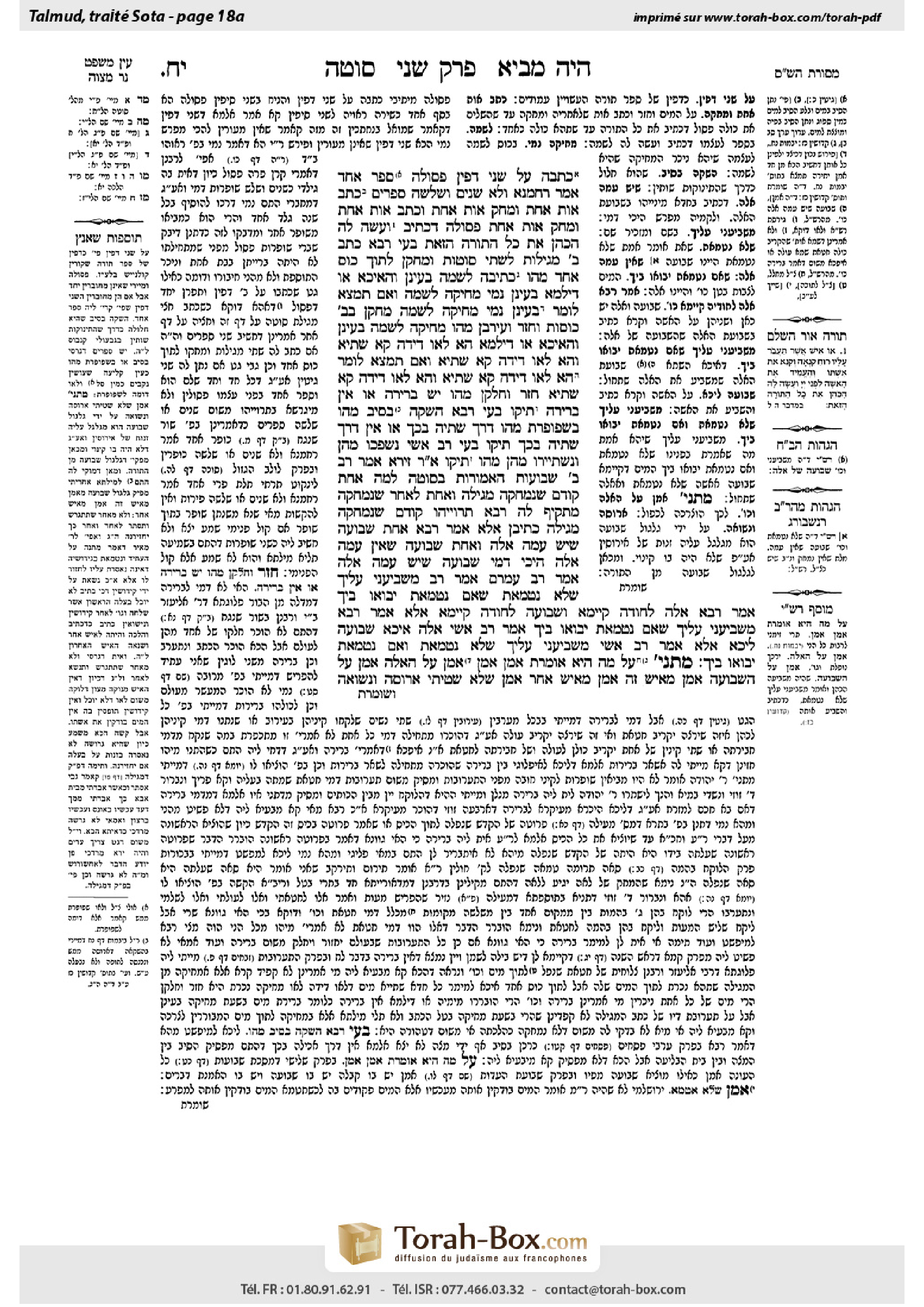
This page of Sotah includes the Aramaic text, an English translation and an AI-generated French translation, alongside the scan above.
סוטה י״ח א · Aramaic and Hebrew text
כְּתָבָהּ עַל שְׁנֵי דַּפִּין — פְּסוּלָה. ״סֵפֶר״ אֶחָד אָמַר רַחֲמָנָא, וְלֹא שְׁנַיִם וּשְׁלֹשָׁה סְפָרִים.
כָּתַב אוֹת אַחַת וּמָחַק אוֹת אַחַת, וְכָתַב אוֹת אַחַת וּמָחַק אוֹת אַחַת — פְּסוּלָה, דִּכְתִיב: ״וְעָשָׂה לָהּ הַכֹּהֵן אֵת כׇּל הַתּוֹרָה הַזֹּאת״.
בָּעֵי רָבָא: כָּתַב שְׁתֵּי מְגִילּוֹת לִשְׁתֵּי סוֹטוֹת, וּמְחָקָן לְתוֹךְ כּוֹס אֶחָד, מַהוּ? כְּתִיבָה לִשְׁמָהּ בָּעֵינַן, וְהָאִיכָּא, אוֹ דִילְמָא בָּעֵינַן נָמֵי מְחִיקָה לִשְׁמָהּ?
וְאִם תִּמְצָא לוֹמַר בָּעֵינַן נָמֵי מְחִיקָה לִשְׁמָהּ, מְחָקָן בִּשְׁתֵּי כוֹסוֹת וְחָזַר וְעֵירְבָן, מַהוּ? מְחִיקָה לִשְׁמָהּ בָּעֵינַן, וְהָאִיכָּא, אוֹ דִילְמָא הָא לָאו דִּידַהּ קָא שָׁתְיָא וְהָא לָאו דִּידַהּ קָא שָׁתְיָא?
וְאִם תִּמְצָא לוֹמַר הָא לָאו דִּידַהּ קָא שָׁתְיָא וְהָא לָאו דִּידַהּ קָא שָׁתְיָא, חָזַר וְחִלְּקָן, מַהוּ? יֵשׁ בְּרֵירָה, אוֹ אֵין בְּרֵירָה? תֵּיקוּ.
בָּעֵי רָבָא: הִשְׁקָהּ בְּסִיב, מַהוּ? בִּשְׁפוֹפֶרֶת, מַהוּ? דֶּרֶךְ שְׁתִיָּה בְּכָךְ, אוֹ אֵין דֶּרֶךְ שְׁתִיָּה בְּכָךְ? תֵּיקוּ.
בָּעֵי רַב אָשֵׁי: נִשְׁפְּכוּ מֵהֶן וְנִשְׁתַּיְּירוּ מֵהֶן, מַהוּ? תֵּיקוּ.
אָמַר רַבִּי זֵירָא אָמַר רַב: שְׁתֵּי שְׁבוּעוֹת הָאֲמוּרוֹת בַּסּוֹטָה. לָמָּה? אַחַת קוֹדֶם שֶׁנִּמְחֲקָה מְגִילָּה, וְאַחַת לְאַחַר שֶׁנִּמְחֲקָה.
מַתְקֵיף לַהּ רָבָא: תַּרְוַיְיהוּ קוֹדֶם שֶׁנִּמְחֲקָה מְגִילָּה כְּתִיבָן? אֶלָּא אָמַר רָבָא: אַחַת שְׁבוּעָה שֶׁיֵּשׁ עִמָּהּ אָלָה, וְאַחַת שְׁבוּעָה שֶׁאֵין עִמָּהּ אָלָה.
הֵיכִי דָּמֵי שְׁבוּעָה שֶׁיֵּשׁ עִמָּהּ אָלָה? אָמַר רַב עַמְרָם אָמַר רַב: ״מַשְׁבִּיעַנִי עָלַיִךְ שֶׁלֹּא נִטְמֵאת, שֶׁאִם נִטְמֵאת יָבוֹאוּ בִּיךְ״.
אָמַר רָבָא: אָלָה לְחוֹדַהּ קָיְימָא וּשְׁבוּעָה לְחוֹדַהּ קָיְימָא! אֶלָּא אָמַר רָבָא: ״מַשְׁבִּיעַנִי עָלַיִךְ שֶׁאִם נִטְמֵאת יָבוֹאוּ בִּיךְ״.
אָמַר רַב אָשֵׁי: אָלָה — אִיכָּא, שְׁבוּעָה — לֵיכָּא! אֶלָּא אָמַר רַב אָשֵׁי: ״מַשְׁבִּיעַנִי עָלַיִךְ שֶׁלֹּא נִטְמֵאת, וְאִם נִטְמֵאת יָבוֹאוּ בִּיךְ״.
מַתְנִי׳ עַל מָה הִיא אוֹמֶרֶת ״אָמֵן״ ״אָמֵן״ — אָמֵן עַל הָאָלָה, אָמֵן עַל הַשְּׁבוּעָה. אָמֵן מֵאִישׁ זֶה, אָמֵן מֵאִישׁ אַחֵר. אָמֵן שֶׁלֹּא שָׂטִיתִי אֲרוּסָה וּנְשׂוּאָה
Sotah 18a · English translation
If one wrote the scroll on two unattached pages, it is unfit, as the Merciful One states in the Torah: “Scroll,” in the singular. It must be written on one scroll and not on two or three scrolls.
If one wrote one letter and erased that one letter in water, and he then wrote one more letter and erased that one letter, it is unfit, as it is written: “And the priest shall execute upon her all this law” (Numbers 5:30). The entire passage must be written completely and only then erased, all at once.
§ Rava raised a dilemma: If one wrote two scrolls for two separate sota women but then erased both of the scrolls in one cup, what is the halakha? Do we require that only the writing be performed for the sake of a specific woman, in which case that is accomplished here? Or perhaps we require that also the erasure be performed for the sake of a specific woman, which is not accomplished here, since both scrolls are erased together?
And if you say that we require that also the erasure be for the sake of each specific woman, then if the priest erased them in two different cups and afterward mixed the water from both together again, what is the halakha? Do we require that only the erasure be for the sake of a specific woman, in which case that is accomplished here? Or perhaps since this sota does not drink from only her own water and that sota does not drink from only her own water, the water is disqualified?
And furthermore, if you say that the water is disqualified because this one does not drink from only her own water and that one does not drink from only her own water, what if after mixing the two cups of water together the priest divided them again into two cups and gave one to each? What is the halakha then? Is there retroactive clarification, in which case one may claim that each woman drank her own water, or is there no retroactive clarification? The Gemara responds: The dilemma shall stand unresolved.
Rava raised a dilemma: If the priest administered the bitter water to the sota to drink through a palm fiber, what is the halakha? Or if he administered it through a tube, what is the halakha? Is this considered a normal manner of drinking, or is it not considered a normal manner of drinking, in which case the act is invalid? The Gemara responds: The dilemma shall stand unresolved.
Rav Ashi raised a dilemma: If some of the water of the sota spilled out and some of it remained in the cup, what is the halakha? Is it sufficient for the woman to drink some of the water in which the scroll has been erased or must she drink all of it? The Gemara responds: The dilemma shall stand unresolved.
§ Rabbi Zeira says that Rav says: With regard to the two oaths that are stated with regard to the sota: “And the priest shall cause her to swear” (Numbers 5:19), and: “Then the priest shall cause the woman to swear with the oath of cursing” (Numbers 5:21), why are they both necessary? One must be administered before the scroll is erased and one must be administered after it is erased.
Rava objects to this: Both of the oaths are written in the Torah before any mention of the scroll being erased. What is the basis to claim that one oath was administered afterward? Rather, Rava said: While both oaths are administered before the sota drinks, the two oaths are different: One is an oath that has a curse with it, and one is an oath that does not have a curse with it.
The Gemara asks: What are the circumstances of an oath that has a curse with it? What is the language of this oath? Rav Amram says that Rav says: The priest says: I administer an oath to you that you are honest in your claim that you were not defiled, as, if you were defiled, all these curses will come upon you.
Rava said: This is insufficient, as the curse stands by itself and the oath stands by itself. They are said in separate statements, and it cannot be considered to be an oath with a curse. Rather, Rava said: The priest says: I administer an oath to you that if you were defiled, all these curses will come upon you.
Rav Ashi said: Even this is insufficient, as there is a curse but there is no oath that she was not defiled. Rather, Rav Ashi said: The priest must say: I administer an oath to you that you were not defiled and that if you were defiled all these curses will come upon you. Here the oath itself includes the curse.
MISHNA: With regard to what does she say: “Amen, amen” (Number 5:22), twice, as recorded in the verse? The mishna explains that it includes of the following: Amen on the curse, as she accepts the curse upon herself if she is guilty, and amen on the oath, as she declares that she is not defiled. She states: Amen if I committed adultery with this man about whom I was warned, amen if I committed adultery with another man. Amen that I did not stray when I was betrothed nor after I was married,
Sotah 18a · Traduction française (IA)
Si l’on a écrit le rouleau sur deux feuillets distincts, il est invalide, car le Miséricordieux dit dans la Torah : « Un rouleau », au singulier. Il doit être écrit sur un seul rouleau, et non sur deux ou trois rouleaux.
Si l’on a écrit une lettre et effacé cette lettre dans l’eau, puis écrit une autre lettre et effacé celle-ci, le rouleau est invalide, car il est écrit : « Le prêtre exécutera contre elle toute cette loi » (Nombres 5,30). Le passage entier doit être écrit intégralement, puis seulement ensuite effacé, en une seule fois.
§ Rava souleva un dilemme : si l’on a écrit deux rouleaux pour deux femmes sota distinctes, puis effacé les deux rouleaux dans une même coupe, quelle est la halakha ? Exige-t-on que seule l’écriture soit faite à l’intention d’une femme déterminée, ce qui est le cas ici ? Ou exige-t-on peut-être également que l’effacement soit fait à l’intention d’une femme déterminée, ce qui n’est pas le cas ici, puisque les deux rouleaux sont effacés ensemble ?
Et si tu dis que l’on exige également que l’effacement soit fait à l’intention de chacune des femmes, alors, si le prêtre les a effacés dans deux coupes différentes, puis a mélangé à nouveau l’eau des deux coupes, quelle est la halakha ? Exige-t-on que seul l’effacement soit fait à l’intention d’une femme déterminée, ce qui est le cas ici ? Ou peut-être l’eau est-elle invalide, puisque cette sota ne boit pas uniquement de sa propre eau, pas plus que l’autre sota ne boit uniquement de la sienne ?
Et de plus, si tu dis que l’eau est invalide parce que chacune ne boit pas uniquement de sa propre eau, que se passe-t-il si, après avoir mélangé l’eau des deux coupes, le prêtre la répartit à nouveau dans deux coupes et en donne une à chacune ? Quelle est alors la halakha ? Y a-t-il une clarification rétroactive, de sorte que l’on puisse soutenir que chaque femme a bu sa propre eau, ou n’y a-t-il pas de clarification rétroactive ? La Guemara répond : Le dilemme reste sans réponse.
Rava souleva un dilemme : si le prêtre a fait boire à la sota l’eau amère au moyen d’une fibre de palmier, quelle est la halakha ? Ou s’il la lui a fait boire au moyen d’un tube, quelle est la halakha ? Est-ce considéré comme une manière normale de boire, ou non, auquel cas l’acte est invalide ? La Guemara répond : Le dilemme reste sans réponse.
Rav Ashi souleva un dilemme : si une partie de l’eau de la sota s’est renversée et qu’une autre partie est restée dans la coupe, quelle est la halakha ? Suffit-il que la femme boive une partie de l’eau dans laquelle le rouleau a été effacé, ou doit-elle tout boire ? La Guemara répond : Le dilemme reste sans réponse.
§ Rabbi Zeira dit au nom de Rav : À propos des deux serments prescrits concernant la sota — « Le prêtre la fera jurer » (Nombres 5,19) et « Alors le prêtre fera jurer la femme par le serment de malédiction » (Nombres 5,21) — pourquoi faut-il les deux ? L’un doit être prononcé avant que le rouleau soit effacé et l’autre après son effacement.
Rava objecte : les deux serments sont écrits dans la Torah avant toute mention de l’effacement du rouleau. Sur quoi se fonde-t-on pour affirmer que l’un des serments est prononcé après ? Rava dit plutôt : bien que les deux serments soient prononcés avant que la sota boive, ils diffèrent : l’un est un serment accompagné d’une malédiction, et l’autre est un serment qui n’est pas accompagné d’une malédiction.
La Guemara demande : Dans quelles circonstances un serment est-il accompagné d’une malédiction ? Quelle est la formule de ce serment ? Rav Amram dit au nom de Rav : Le prêtre dit : « Je te fais prêter serment que tu dis la vérité en affirmant que tu n’as pas été souillée, car, si tu as été souillée, toutes ces malédictions s’abattront sur toi. »
Rava dit : Cela ne suffit pas, car la malédiction est énoncée séparément et le serment est énoncé séparément. Ils sont prononcés dans des déclarations distinctes et ne peuvent donc être considérés comme un serment accompagné d’une malédiction. Rava dit plutôt : Le prêtre dit : « Je te fais prêter serment que, si tu as été souillée, toutes ces malédictions s’abattront sur toi. »
Rav Ashi dit : Cela ne suffit pas non plus, car il y a une malédiction, mais aucun serment portant sur le fait qu’elle n’a pas été souillée. Rav Ashi dit plutôt : Le prêtre doit dire : « Je te fais prêter serment que tu n’as pas été souillée et que, si tu as été souillée, toutes ces malédictions s’abattront sur toi. » Ici, le serment lui-même inclut la malédiction.
MICHNA : À quoi correspondent les deux « Amen, amen » qu’elle prononce, comme le rapporte le verset (Nombres 5,22) ? La Michna explique qu’ils incluent les éléments suivants : « Amen » à la malédiction, car elle accepte la malédiction sur elle-même si elle est coupable, et « amen » au serment, car elle déclare qu’elle n’a pas été souillée. Elle dit : « Amen si j’ai commis l’adultère avec cet homme au sujet duquel j’ai été mise en garde ; amen si j’ai commis l’adultère avec un autre homme. Amen si je ne me suis pas égarée lorsque j’étais fiancée, ni après mon mariage, »
Traduction française générée par IA à partir de l’édition anglaise de Sefaria. Vérifie toujours un passage avec le texte source.
Text from Sefaria: William Davidson Edition - Vocalized Aramaic (CC BY NC); William Davidson Edition - English (CC BY NC).