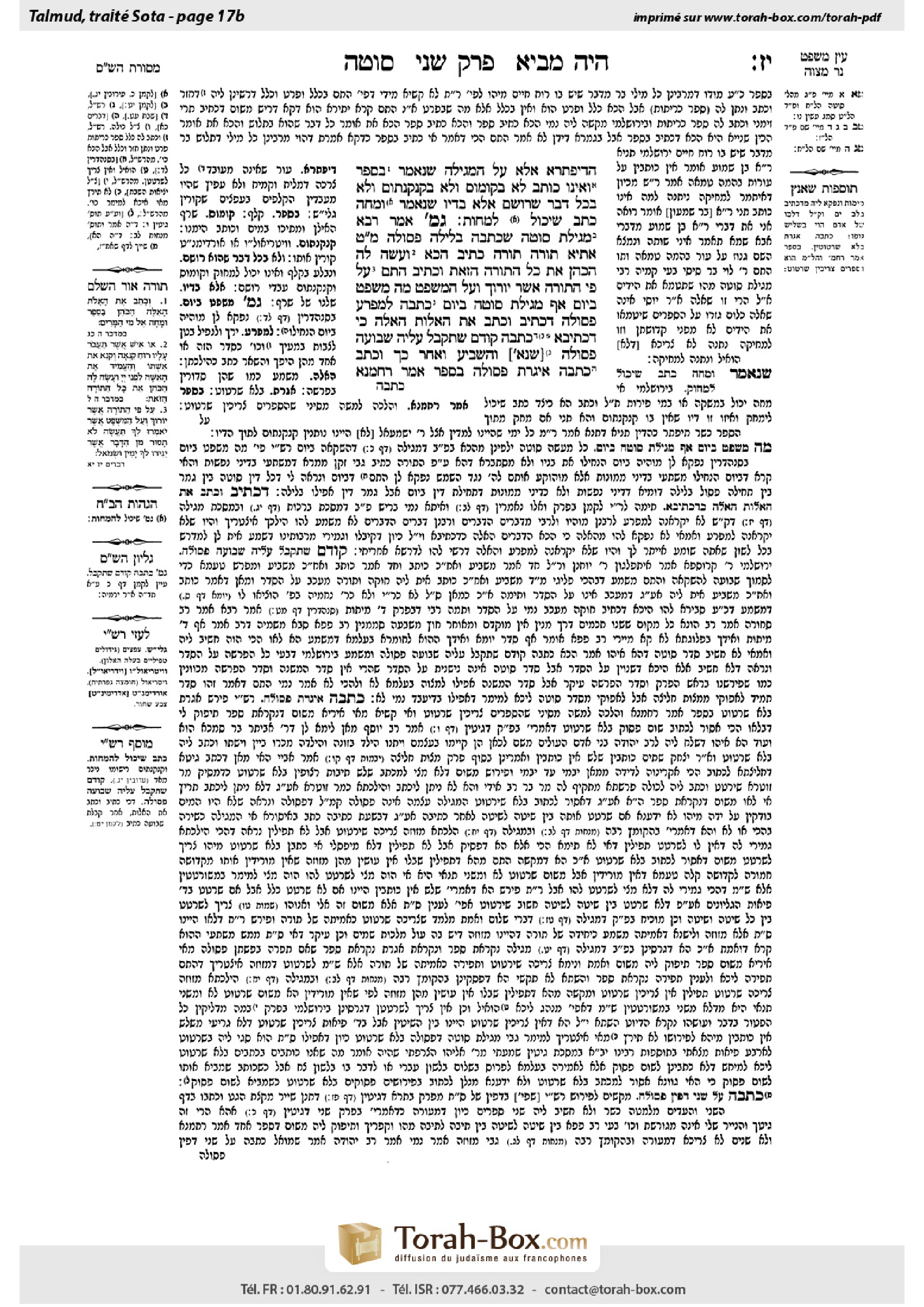
Sotah 17b: Talmud study for Daf Yomi
Daf Yomi is the daily study of one Talmud folio. Explore 37 tractates with scans, Hebrew text, Sefaria English and AI-generated French translations where annotated.
Passage selection and English or AI-generated French translation are available where the scan has annotations. Daf Study is independent of Torah-Box and Sefaria.
Browse Sotah · סוטה · All tractatesSotah 17b text and translations
This page of Sotah includes the Aramaic text, an English translation and an AI-generated French translation, alongside the scan above.
סוטה י״ז ב · Aramaic and Hebrew text
הַדִּיפְתְּרָא, אֶלָּא עַל הַמְּגִילָּה, שֶׁנֶּאֱמַר: ״בַּסֵּפֶר״.
וְאֵינוֹ כּוֹתֵב לֹא בְּקוֹמוֹס וְלֹא בְּקַנְקַנְתּוֹם, וְלֹא בְּכׇל דָּבָר שֶׁרוֹשֵׁם, אֶלָּא בִּדְיוֹ, שֶׁנֶּאֱמַר: ״וּמָחָה״, כְּתָב שֶׁיָּכוֹל לִמָּחוֹת.
גְּמָ׳ אָמַר רָבָא: מְגִילַּת סוֹטָה שֶׁכְּתָבָהּ בַּלַּיְלָה — פְּסוּלָה. מַאי טַעְמָא — אָתְיָא ״תּוֹרָה״ ״תּוֹרָה״. כְּתִיב הָכָא: ״וְעָשָׂה לָהּ הַכֹּהֵן אֵת כׇּל הַתּוֹרָה הַזֹּאת״, וּכְתִיב הָתָם: ״עַל פִּי הַתּוֹרָה אֲשֶׁר יוֹרוּךָ וְעַל הַמִּשְׁפָּט״, מָה מִשְׁפָּט בַּיּוֹם — אַף מְגִילַּת סוֹטָה בַּיּוֹם.
כְּתָבָהּ לְמַפְרֵעַ — פְּסוּלָה, דִּכְתִיב: ״וְכָתַב אֶת הָאָלוֹת הָאֵלֶּה״, כִּי דִּכְתִיבָא.
כְּתָבָהּ קוֹדֶם שֶׁתְּקַבֵּל עָלֶיהָ שְׁבוּעָה — פְּסוּלָה, שֶׁנֶּאֱמַר: ״וְהִשְׁבִּיעַ״, וְאַחַר כָּךְ ״וְכָתַב״.
כְּתָבָהּ אִיגֶּרֶת — פְּסוּלָה. ״בַּסֵּפֶר״ אָמַר רַחֲמָנָא.
Sotah 17b · English translation
diftera, a hide that is only partially processed, as it is salted and treated with flour but not gallnuts; rather, it must be written only on a scroll of parchment, as it is stated: “And the priest shall write these curses in a scroll” (Numbers 5:23).
And the scribe may not write with gum [komos], and not with iron sulfate [kankantom], nor with any substance that makes a mark and cannot be completely erased, but only with ink made from soot, as it is stated in the continuation of the same verse: “And he shall blot them out into the water of bitterness” (Numbers 5:23). This indicates that the scroll must be written with a writing that can be erased in water.
GEMARA: Rava says: A scroll of a sota that one wrote at night is unfit. What is the reason for this? It is derived by verbal analogy between one instance of the word “law” and another instance of the word “law.” It is written here, with regard to a sota: “And the priest shall execute upon her all this law” (Numbers 5:30), and it is written there, with regard to judgment: “According to the law, which they shall teach you, and according to the judgment, which they shall tell you” (Deuteronomy 17:11). Just as judgment may be done only by day, so too the scroll of a sota may be written only by day.
If one wrote the scroll out of sequence, it is unfit, as it is written: “And the priest shall write these curses in a scroll” (Numbers 5:23). They must be written in the scroll just as they are written in the Torah.
If one wrote the scroll before the sota accepted the oath upon herself, the scroll is unfit, as it is stated: “Then the priest shall cause the woman to swear with the oath of cursing” (Numbers 5:21), and afterward it states: “And the priest shall write these curses in a scroll” (Numbers 5:23).
If one wrote the scroll as a letter, i.e., without first scoring the lines onto the parchment, it is unfit, as the Merciful One states in the Torah: “In a scroll,” indicating that it must be written like a Torah scroll, in which the parchment must be scored.
Sotah 17b · Traduction française (IA)
Diftera, une peau qui n’a été que partiellement préparée, puisqu’elle a été salée et traitée à la farine, mais pas aux noix de galle ; elle doit plutôt être écrite uniquement sur un rouleau de parchemin, comme il est dit : « Le prêtre écrira ces malédictions sur un rouleau » (Nombres 5,23).
Le scribe ne peut pas écrire avec de la gomme [komos], ni avec du sulfate de fer [kankantom], ni avec aucune substance qui laisse une marque impossible à effacer complètement ; il doit écrire uniquement avec de l’encre faite de suie, comme il est dit dans la suite du même verset : « Et il les effacera dans les eaux d’amertume » (Nombres 5,23). Cela indique que le rouleau doit être écrit avec une encre qui peut être effacée dans l’eau.
GUEMARA : Rava dit : Un rouleau de sota écrit la nuit est invalide. Pour quelle raison ? On le déduit par analogie verbale entre deux occurrences du mot « loi ». Il est écrit ici, au sujet de la sota : « Le prêtre accomplira à son égard toute cette loi » (Nombres 5,30), et il est écrit là, au sujet du jugement : « Selon la loi qu’ils t’enseigneront et selon le jugement qu’ils te feront connaître » (Deutéronome 17,11). De même que le jugement ne peut être rendu que le jour, le rouleau de la sota ne peut lui aussi être écrit que le jour.
Si l’on a écrit le rouleau dans le désordre, il est invalide, comme il est écrit : « Le prêtre écrira ces malédictions sur un rouleau » (Nombres 5,23). Elles doivent être écrites sur le rouleau dans le même ordre que dans la Torah.
Si l’on a écrit le rouleau avant que la sota ait accepté le serment, il est invalide, comme il est dit : « Alors le prêtre fera prêter à la femme le serment de malédiction » (Nombres 5,21), puis il est dit : « Le prêtre écrira ces malédictions sur un rouleau » (Nombres 5,23).
Si l’on a écrit le rouleau comme une lettre, c’est-à-dire sans tracer au préalable les lignes sur le parchemin, il est invalide, car le Miséricordieux déclare dans la Torah : « Sur un rouleau », ce qui indique qu’il doit être écrit comme un rouleau de Torah, dont le parchemin doit être réglé.
Traduction française générée par IA à partir de l’édition anglaise de Sefaria. Vérifie toujours un passage avec le texte source.
Text from Sefaria: William Davidson Edition - Vocalized Aramaic (CC BY NC); William Davidson Edition - English (CC BY NC).