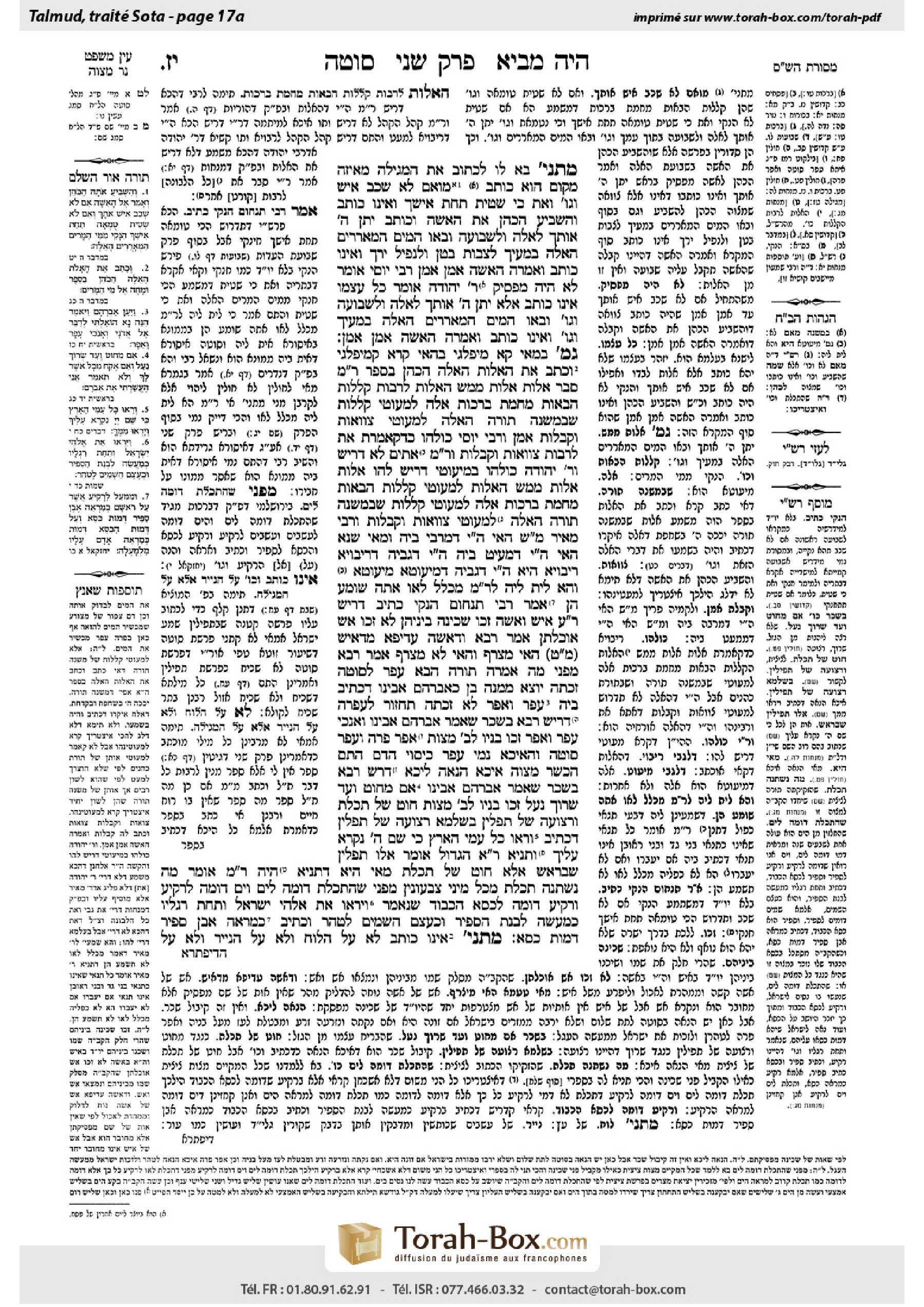
Sotah 17a: Talmud study for Daf Yomi
Daf Yomi is the daily study of one Talmud folio. Explore 37 tractates with scans, Hebrew text, Sefaria English and AI-generated French translations where annotated.
Passage selection and English or AI-generated French translation are available where the scan has annotations. Daf Study is independent of Torah-Box and Sefaria.
Browse Sotah · סוטה · All tractatesSotah 17a text and translations
This page of Sotah includes the Aramaic text, an English translation and an AI-generated French translation, alongside the scan above.
סוטה י״ז א · Aramaic and Hebrew text
מַתְנִי׳ בָּא לוֹ לִכְתּוֹב אֶת הַמְּגִילָּה, מֵאֵיזֶה מָקוֹם הוּא כּוֹתֵב?
מִ״וְאִם לֹא שָׁכַב אִישׁ וְגוֹ׳ וְאַתְּ כִּי שָׂטִית תַּחַת אִישֵׁךְ״,
וְאֵינוֹ כּוֹתֵב ״וְהִשְׁבִּיעַ הַכֹּהֵן אֶת הָאִשָּׁה״. וְכוֹתֵב: ״יִתֵּן ה׳ אוֹתָךְ לְאָלָה וְלִשְׁבֻעָה. וּבָאוּ הַמַּיִם הַמְאָרְרִים הָאֵלֶּה בְּמֵעַיִךְ לַצְבּוֹת בֶּטֶן וְלַנְפִּל יָרֵךְ״. וְאֵינוֹ כּוֹתֵב ״וְאָמְרָה הָאִשָּׁה אָמֵן אָמֵן״.
רַבִּי יוֹסֵי אוֹמֵר: לֹא הָיָה מַפְסִיק.
רַבִּי יְהוּדָה אוֹמֵר: כׇּל עַצְמוֹ אֵינוֹ כּוֹתֵב אֶלָּא ״יִתֵּן ה׳ אוֹתָךְ לְאָלָה וְלִשְׁבֻעָה וְגוֹ׳ וּבָאוּ הַמַּיִם הַמְאָרְרִים הָאֵלֶּה בְּמֵעַיִךְ וְגוֹ׳״. וְאֵינוֹ כּוֹתֵב ״וְאָמְרָה הָאִשָּׁה אָמֵן אָמֵן״.
גְּמָ׳ בְּמַאי קָא מִיפַּלְגִי? בְּהַאי קְרָא קָמִיפַּלְגִי: ״וְכָתַב אֶת הָאָלוֹת הָאֵלֶּה הַכֹּהֵן בַּסֵּפֶר״.
רַבִּי מֵאִיר סָבַר: ״אָלוֹת״ — אָלוֹת מַמָּשׁ. ״הָאָלוֹת״ — לְרַבּוֹת קְלָלוֹת הַבָּאוֹת מֵחֲמַת בְּרָכוֹת. ״אֵלֶּה״ — לְמַעוֹטֵי קְלָלוֹת שֶׁבְּמִשְׁנֵה תוֹרָה. ״הָאֵלֶּה״ — לְמַעוֹטֵי צַוּוֹאוֹת וְקַבָּלוֹת אָמֵן.
וְרַבִּי יוֹסֵי: כּוּלְּהוּ כִּדְקָאָמְרַתְּ, ״אֶת״ — לְרַבּוֹת צַוּוֹאוֹת וְקַבָּלוֹת.
וְרַבִּי מֵאִיר — אֶתִּים לָא דָּרֵישׁ.
וְרַבִּי יְהוּדָה — כּוּלְּהוּ בְּמִיעוּטֵי דָּרֵישׁ לְהוּ. ״אָלוֹת״ — אָלוֹת מַמָּשׁ. ״הָאָלוֹת״ — לְמַעוֹטֵי קְלָלוֹת הַבָּאוֹת מֵחֲמַת בְּרָכוֹת. ״אֵלֶּה״ — לְמַעוֹטֵי קְלָלוֹת שֶׁבְּמִשְׁנֵה תוֹרָה. ״הָאֵלֶּה״ — לְמַעוֹטֵי צַוּוֹאוֹת וְקַבָּלוֹת.
וְרַבִּי מֵאִיר, מַאי שְׁנָא הַאי הֵי דִּמְרַבֵּי בֵּיהּ, וּמַאי שְׁנָא הַאי הֵי דְּמַעֵיט בֵּיהּ?
הֵי דְּגַבֵּי(ה ד)רִיבּוּיָא — רִיבּוּיָא (הִיא), הֵי דְּגַבֵּי(ה ד)מִיעוּטָא — מִיעוּטָא.
וְהָא לֵית לֵיהּ לְרַבִּי מֵאִיר מִכְּלָל לָאו אַתָּה שׁוֹמֵעַ הֵן?
אָמַר רַבִּי תַּנְחוּם: ״הִנָּקִי״ כְּתִיב.
דָּרֵישׁ רַבִּי עֲקִיבָא: אִישׁ וְאִשָּׁה זָכוּ — שְׁכִינָה בֵּינֵיהֶן. לֹא זָכוּ — אֵשׁ אוֹכַלְתָּן.
אָמַר רָבָא: וּדְאִשָּׁה עֲדִיפָא מִדְּאִישׁ, מַאי טַעְמָא — הַאי מְצָרֵף, וְהַאי לָא מְצָרֵף.
אָמַר רָבָא: מִפְּנֵי מָה אָמְרָה תּוֹרָה הָבֵא עָפָר לְסוֹטָה? זָכְתָה — יוֹצֵא מִמֶּנָּה בֵּן כְּאַבְרָהָם אָבִינוּ, דִּכְתִיב בֵּיהּ ״עָפָר וָאֵפֶר״, לֹא זָכְתָה — תַּחְזוֹר לַעֲפָרָהּ.
דְּרֵישׁ רָבָא: בִּשְׂכַר שֶׁאָמַר אַבְרָהָם אָבִינוּ ״וְאָנֹכִי עָפָר וָאֵפֶר״, זָכוּ בָּנָיו לִשְׁתֵּי מִצְוֹת, אֵפֶר פָּרָה וַעֲפַר סוֹטָה.
וְהָאִיכָּא נָמֵי עֲפַר כִּיסּוּי הַדָּם!
הָתָם הֶכְשֵׁר מִצְוָה אִיכָּא, הֲנָאָה לֵיכָּא.
דָּרֵשׁ רָבָא: בִּשְׂכַר שֶׁאָמַר אַבְרָהָם אָבִינוּ ״אִם מִחוּט וְעַד שְׂרוֹךְ נַעַל״, זָכוּ בָּנָיו לִשְׁתֵּי מִצְוֹת: חוּט שֶׁל תְּכֵלֶת וּרְצוּעָה שֶׁל תְּפִלִּין.
בִּשְׁלָמָא רְצוּעָה שֶׁל תְּפִלִּין, דִּכְתִיב: ״וְרָאוּ כׇּל עַמֵּי הָאָרֶץ כִּי שֵׁם ה׳ נִקְרָא עָלֶיךָ״, וְתַנְיָא, רַבִּי אֱלִיעֶזֶר הַגָּדוֹל אוֹמֵר: אֵלּוּ תְּפִלִּין שֶׁבָּרֹאשׁ.
אֶלָּא חוּט שֶׁל תְּכֵלֶת, מַאי הִיא? דְּתַנְיָא, הָיָה רַבִּי מֵאִיר אוֹמֵר: מָה נִשְׁתַּנָּה תְּכֵלֶת מִכׇּל מִינֵי צִבְעוֹנִין?
מִפְּנֵי שֶׁהַתְּכֵלֶת דּוֹמֶה לַיָּם, וְיָם דּוֹמֶה לָרָקִיעַ, וְרָקִיעַ דּוֹמֶה לְכִסֵּא הַכָּבוֹד — שֶׁנֶּאֱמַר: ״וַיִּרְאוּ אֵת אֱלֹהֵי יִשְׂרָאֵל וְתַחַת רַגְלָיו כְּמַעֲשֵׂה לִבְנַת הַסַּפִּיר וּכְעֶצֶם הַשָּׁמַיִם לָטֹהַר״, וּכְתִיב: ״כְּמַרְאֵה אֶבֶן סַפִּיר דְּמוּת כִּסֵּא״.
מַתְנִי׳ אֵינוֹ כּוֹתֵב לֹא עַל הַלּוּחַ, וְלֹא עַל הַנְּיָיר, וְלֹא עַל
Sotah 17a · English translation
MISHNA: When the priest comes to write the scroll of the sota that is to be placed in the water, from what place in the Torah passage concerning the sota (Numbers 5:11–31) does he write?
He starts from the verse: “If no man has lain with you, and if you have not gone astray to defilement while under your husband, you shall be free from this water of bitterness that causes the curse” (Numbers 5:19); and continues: “But if you have gone astray while under your husband, and if you are defiled, and some man has lain with you besides your husband” (Numbers 5:20).
And then he does not write the beginning of the following verse, which states: “Then the priest shall cause the woman to swear with the oath of cursing, and the priest shall say to the woman” (Numbers 5:21), but he does write the oath recorded in the continuation of the verse: “The Lord shall make you a curse and an oath among your people when the Lord will cause your thigh to fall away, and your belly to swell. And this water that causes the curse shall go into your bowels, and cause your belly to swell, and your thigh to fall away” (Numbers 5:21–22); but he does not write the conclusion of the verse: “And the woman shall say: Amen, amen” (Numbers 5:22).
Rabbi Yosei says: He does not interrupt the verses but rather writes the entire passage without any omissions.
Rabbi Yehuda says: He writes nothing other than curses recorded in the final verses cited above: “The Lord shall make you a curse and an oath among your people when the Lord will cause your thigh to fall away, and your belly to swell. And this water that causes the curse shall go into your bowels, and cause your belly to swell, and your thigh to fall away.” And he does not write the conclusion of the verse: “And the woman shall say: Amen, amen.”
GEMARA: With regard to what issue do the Sages in the mishna disagree? What is the source of their disagreement? They disagree concerning the proper interpretation of the verse: “And the priest shall write these [ha’eleh] curses [et ha’alot] in a scroll” (Numbers 5:23).
Rabbi Meir, the first tanna of the mishna, reasons: The word “alot,” curses, is referring to actual curses. The prefix ha, meaning: The, in the word “ha’alot” serves to include curses that come on account of the blessings, i.e., the curses that are inferred from the phrase: “You shall be free from this water of bitterness that causes the curse” (5:19). The word “eleh,” meaning these, is a limiting term that serves to exclude the long list of curses that are recorded in Mishne Torah, the book of Deuteronomy (chapter 28). Although these curses are also referred to as “alot,” the priest does not write them. The addition of the definite article in the word “ha’eleh” serves to exclude the commands recorded in the sota passage and the acceptances by the word “amen” recorded there as well. The priest need not write these sections of the passage.
And Rabbi Yosei interprets it: It would all be as you, Rabbi Meir, said; however, the additional word “et” in the verse amplifies its scope. It serves to include both commands and acceptances, as they must be written in the scroll as well.
And why does Rabbi Meir disagree? As a rule, he does not interpret the additional word et as amplifying a verse’s scope.
And as for Rabbi Yehuda, he interprets all of the terms in the verse as exclusionary: The word “alot” is referring specifically to the actual curses recorded in the verses. The definite article in the word “ha’alot” serves to exclude curses that come on account of blessings. The word “eleh” serves to exclude the curses recorded in the Mishne Torah. And the definite article in the word “ha’eleh” serves to exclude the commands and acceptances recorded in the verses.
The Gemara asks: But according to Rabbi Meir, what is different about this letter heh at the beginning of the word “ha’alot” such that it amplifies the halakha to include curses that come on account of the blessings, and what is different about that letter heh in the word “ha’eleh” such that it excludes the commands and acceptances by the word “amen”? Why should one amplify while the other excludes?
The Gemara answers: The letter heh when written near an amplifier is an amplifier. The word “alot” itself amplifies the halakha, and the definite article extends that amplification; and a heh when written near a restrictor is a restrictor. The word “eleh” itself restricts the halakha, and the definite article before it extends that restriction.
The Gemara asks: But Rabbi Meir does not accept the principle that from a negative statement you can infer a positive statement. What is to be gained by writing the blessings if one cannot infer the curses from them?
Rabbi Tanḥum says: It is written: “If no man has lain with you…you shall be free [hinnaki]” (Numbers 5:19). The word “hinnaki” should be interpreted as if it were in fact ḥinnaki, meaning: You shall choke. When read with the beginning of the next verse, it then forms the sentence: You shall choke… if you have gone astray while under your husband. Therefore, Rabbi Meir understands the blessings themselves to have a dimension of a curse.
§ Rabbi Akiva taught: If a man [ish] and woman [isha] merit reward through a faithful marriage, the Divine Presence rests between them. The words ish and isha are almost identical; the difference between them is the middle letter yod in ish, and the final letter heh in isha. These two letters can be joined to form the name of God spelled yod, heh. But if due to licentiousness they do not merit reward, the Divine Presence departs, leaving in each word only the letters alef and shin, which spell esh, fire. Therefore, fire consumes them.
Rava said: And the fire that consumes the woman is stronger and more immediate than that which consumes the man. What is the reason for this? The letters alef and shin in the word isha are adjacent, joined together, but in the word ish they are not joined, as the letter yod is written between them.
Additionally, Rava says: For what reason did the Torah say: Bring dust for the sota? It is because if she merits to be proven faithful after drinking the water of the sota, a child like our Patriarch Abraham will emerge from her, as it is written with regard to Abraham that he said: “I am but dust and ashes” (Genesis 18:27). But if she does not merit to be proven faithful after drinking the water of the sota, she shall die and return to her dust, the soil from which mankind was formed.
And Rava further taught: As reward for that which our Patriarch Abraham said: “And I am but dust and ashes” (Genesis 18:27), his children merited two mitzvot: The ashes of the red heifer (see Numbers, chapter 19) and the dust of the sota.
The Gemara asks: But there is also another mitzva involving dust: The dust used for covering the blood of a slaughtered undomesticated animal or fowl (see Leviticus 17:13).
The Gemara answers: There, the dust does serve as an accessory to the mitzva of covering the blood, but there is no benefit imparted by it. It occurs after the animal has been slaughtered and does not itself render the meat fit for consumption.
Rava further taught: As reward for that which our Patriarch Abraham said to the king of Sodom: “That I will not take a thread nor a shoe strap nor anything that is yours” (Genesis 14:23), distancing himself from anything not rightfully his, his children merited two mitzvot: The thread of sky-blue wool worn on ritual fringes and the strap of phylacteries.
The Gemara asks: Granted, the strap of the phylacteries impart benefit, as it is written: “And all the peoples of the earth shall see that the name of the Lord is called upon you; and they shall be afraid of you” (Deuteronomy 28:10). And it is taught in a baraita that Rabbi Eliezer the Great says: This is a reference to the phylacteries of the head, upon which the name of God is written. Phylacteries therefore impart the splendor and grandeur of God and are a fit reward.
But what is the benefit imparted by the thread of sky-blue wool? The Gemara answers: As it is taught in a baraita that Rabbi Meir would say: What is different about sky-blue from all other colors such that it was specified for the mitzva of ritual fringes?
It is because sky-blue dye is similar in its color to the sea, and the sea is similar to the sky, and the sky is similar to the Throne of Glory, as it is stated: “And they saw the God of Israel; and there was under His feet the like of a paved work of sapphire stone, and the like of the very heaven for clearness” (Exodus 24:10). This verse shows that the heavens are similar to sapphire, and it is written: “And above the firmament that was over their heads was the likeness of a throne, as the appearance of a sapphire stone” (Ezekiel 1:26). Therefore, the throne is similar to the heavens. The color of sky blue dye acts as an indication of the bond between the Jewish people and the Divine Presence.
MISHNA: The priest does not write the scroll of the sota upon a wooden tablet, and not upon paper made from grass, and not upon
Sotah 17a · Traduction française (IA)
Michna : Lorsque le prêtre vient écrire le rouleau de la sota destiné à être placé dans l’eau, à partir de quel endroit du passage de la Torah concernant la sota (Nombres 5,11-31) l’écrit-il ?
Il commence au verset : « Si aucun homme n’a couché avec toi et si tu ne t’es pas égarée en te souillant alors que tu étais sous l’autorité de ton mari, tu seras quitte de cette eau amère qui provoque la malédiction » (Nombres 5,19) ; puis il poursuit : « Mais si tu t’es égarée alors que tu étais sous l’autorité de ton mari, si tu t’es souillée et qu’un homme a couché avec toi, en dehors de ton mari » (Nombres 5,20).
Ensuite, il n’écrit pas le début du verset suivant, qui dit : « Alors le prêtre fera prêter à la femme le serment de la malédiction, et le prêtre dira à la femme » (Nombres 5,21), mais il écrit le serment rapporté dans la suite du verset : « Que le Seigneur fasse de toi une malédiction et un serment au milieu de ton peuple, lorsque le Seigneur fera dépérir ta cuisse et enfler ton ventre. Et que cette eau qui provoque la malédiction pénètre dans tes entrailles, fasse enfler ton ventre et dépérir ta cuisse » (Nombres 5,21-22) ; mais il n’écrit pas la fin du verset : « Et la femme dira : Amen, amen » (Nombres 5,22).
Rabbi Yossi dit : Il n’interrompt pas les versets, mais écrit tout le passage sans rien omettre.
Rabbi Yehouda dit : Il n’écrit rien d’autre que les malédictions consignées dans les derniers versets cités ci-dessus : « Que le Seigneur fasse de toi une malédiction et un serment au milieu de ton peuple, lorsque le Seigneur fera dépérir ta cuisse et enfler ton ventre. Et que cette eau qui provoque la malédiction pénètre dans tes entrailles, fasse enfler ton ventre et dépérir ta cuisse. » Et il n’écrit pas la fin du verset : « Et la femme dira : Amen, amen. »
Guemara : Sur quelle question les Sages de la Michna sont-ils en désaccord ? Quelle est la source de leur désaccord ? Ils divergent sur l’interprétation correcte du verset : « Et le prêtre écrira ces [ha’eleh] malédictions [et ha’alot] sur un rouleau » (Nombres 5,23).
Rabbi Meïr, le premier tanna de la Michna, raisonne ainsi : Le mot « alot », « malédictions », désigne de véritables malédictions. Le préfixe « ha », qui signifie « les », dans le mot « ha’alot » sert à inclure les malédictions qui découlent des bénédictions, c’est-à-dire celles qu’on déduit de l’expression : « Tu seras quitte de cette eau amère qui provoque la malédiction » (5,19). Le mot « eleh », « ces », est un terme restrictif qui sert à exclure la longue liste de malédictions consignées dans Michné Torah, le livre du Deutéronome (chapitre 28). Bien que ces malédictions soient également appelées « alot », le prêtre ne les écrit pas. L’ajout de l’article défini dans le mot « ha’eleh » sert à exclure les injonctions consignées dans le passage de la sota, ainsi que les acquiescements exprimés par le mot « amen » qui y figurent également. Le prêtre n’a pas besoin d’écrire ces parties du passage.
Rabbi Yossi l’interprète ainsi : Tout serait comme tu l’as dit, Rabbi Meïr ; toutefois, le mot supplémentaire « et » dans le verset élargit sa portée. Il sert à inclure les injonctions et les acquiescements, qui doivent eux aussi être écrits sur le rouleau.
Et pourquoi Rabbi Meïr est-il en désaccord ? En règle générale, il n’interprète pas le mot supplémentaire « et » comme élargissant la portée d’un verset.
Quant à Rabbi Yehouda, il interprète tous les termes du verset comme des expressions restrictives : le mot « alot » désigne spécifiquement les malédictions proprement dites consignées dans les versets. L’article défini dans le mot « ha’alot » sert à exclure les malédictions qui découlent des bénédictions. Le mot « eleh » sert à exclure les malédictions consignées dans Michné Torah. Et l’article défini dans le mot « ha’eleh » sert à exclure les injonctions et les acquiescements consignés dans les versets.
La Guemara demande : Mais, selon Rabbi Meïr, en quoi la lettre hé au début du mot « ha’alot » diffère-t-elle pour élargir la halakha et inclure les malédictions qui découlent des bénédictions, et en quoi la lettre hé dans le mot « ha’eleh » diffère-t-elle pour exclure les injonctions et les acquiescements exprimés par le mot « amen » ? Pourquoi l’une élargit-elle la portée, tandis que l’autre la restreint ?
La Guemara répond : La lettre hé, lorsqu’elle est placée à côté d’un terme amplificateur, a une fonction amplificatrice. Le mot « alot » élargit lui-même la halakha, et l’article défini prolonge cet élargissement ; tandis qu’une lettre hé placée à côté d’un terme restrictif a une fonction restrictive. Le mot « eleh » restreint lui-même la halakha, et l’article défini qui le précède prolonge cette restriction.
La Guemara demande : Mais Rabbi Meïr n’admet pas le principe selon lequel on peut déduire une affirmation positive d’une affirmation négative. Quel intérêt y a-t-il à écrire les bénédictions si l’on ne peut pas en déduire les malédictions ?
Rabbi Tanḥoum dit : Il est écrit : « Si aucun homme n’a couché avec toi… tu seras quitte [hinnaki] » (Nombres 5,19). Le mot « hinnaki » doit être interprété comme s’il s’écrivait en réalité « ḥinnaki », c’est-à-dire : « tu étoufferas ». Lu avec le début du verset suivant, il forme alors la phrase : « Tu étoufferas… si tu t’es égarée alors que tu étais sous l’autorité de ton mari. » Rabbi Meïr comprend donc que les bénédictions elles-mêmes comportent une dimension de malédiction.
§ Rabbi Akiva enseignait : Si un homme [ish] et une femme [isha] méritent une récompense grâce à un mariage fidèle, la Présence divine réside entre eux. Les mots ish et isha sont presque identiques ; ils diffèrent par la lettre médiane yod dans ish et par la lettre finale hé dans isha. Ces deux lettres peuvent être réunies pour former le nom de Dieu, écrit yod, hé. Mais si, en raison de la débauche, ils ne méritent pas cette récompense, la Présence divine les quitte, ne laissant dans chacun des mots que les lettres alef et shin, qui forment esh, « feu ». Le feu les consume donc.
Rava dit : Le feu qui consume la femme est plus intense et agit plus rapidement que celui qui consume l’homme. Pour quelle raison ? Dans le mot isha, les lettres alef et shin sont contiguës, réunies, tandis que dans le mot ish, elles ne le sont pas, car la lettre yod est écrite entre elles.
En outre, Rava dit : Pour quelle raison la Torah a-t-elle prescrit d’apporter de la poussière pour la sota ? Parce que si elle mérite d’être reconnue fidèle après avoir bu l’eau de la sota, un enfant semblable à notre patriarche Abraham naîtra d’elle, car il est écrit au sujet d’Abraham qu’il dit : « Je ne suis que poussière et cendre » (Genèse 18,27). Mais si elle ne mérite pas d’être reconnue fidèle après avoir bu l’eau de la sota, elle mourra et retournera à sa poussière, la terre dont l’humanité a été formée.
Rava enseigna encore : En récompense des paroles de notre patriarche Abraham : « Et je ne suis que poussière et cendre » (Genèse 18,27), ses enfants méritèrent deux mitsvot : les cendres de la vache rousse (voir Nombres, chapitre 19) et la poussière de la sota.
La Guemara demande : Mais il existe aussi une autre mitsva impliquant de la poussière : celle qui consiste à utiliser de la poussière pour recouvrir le sang d’un animal sauvage ou d’un oiseau abattu (voir Lévitique 17,13).
La Guemara répond : Dans ce cas, la poussière sert bien d’accessoire à la mitsva consistant à recouvrir le sang, mais elle ne procure aucun avantage. Cette action a lieu après l’abattage de l’animal et ne rend pas, en elle-même, la viande propre à la consommation.
Rava enseigna encore : En récompense des paroles adressées par notre patriarche Abraham au roi de Sodome : « Je ne prendrai ni fil, ni courroie de sandale, ni rien de ce qui est à toi » (Genèse 14,23), par lesquelles il se tenait à l’écart de tout ce qui ne lui appartenait pas légitimement, ses enfants méritèrent deux mitsvot : le fil de laine bleu ciel porté aux franges rituelles et la lanière des phylactères.
La Guemara demande : Certes, la lanière des phylactères procure un avantage, car il est écrit : « Tous les peuples de la terre verront que le nom du Seigneur est invoqué sur toi, et ils te craindront » (Deutéronome 28,10). Et il est enseigné dans une baraïta que Rabbi Eliezer le Grand dit : Cela fait référence aux phylactères de la tête, sur lesquels le nom de Dieu est écrit. Les phylactères confèrent donc la splendeur et la grandeur de Dieu et constituent une récompense appropriée.
Mais quel avantage procure le fil de laine bleu ciel ? La Guemara répond : Il est enseigné dans une baraïta que Rabbi Meïr disait : En quoi le bleu ciel diffère-t-il de toutes les autres couleurs, pour avoir été spécifiquement choisi pour la mitsva des franges rituelles ?
C’est parce que la teinture bleu ciel ressemble par sa couleur à la mer, la mer ressemble au ciel, et le ciel ressemble au Trône de Gloire, comme il est dit : « Ils virent le Dieu d’Israël ; sous ses pieds se trouvait comme un pavement de saphir, semblable au ciel même dans sa pureté » (Exode 24,10). Ce verset montre que les cieux ressemblent au saphir, et il est écrit : « Au-dessus du firmament qui était au-dessus de leurs têtes se trouvait quelque chose qui ressemblait à un trône, ayant l’aspect d’une pierre de saphir » (Ézéchiel 1,26). Le trône ressemble donc aux cieux. La couleur de la teinture bleu ciel indique le lien entre le peuple juif et la Présence divine.
Michna : Le prêtre n’écrit pas le rouleau de la sota sur une tablette de bois, ni sur du papier fabriqué à partir de plantes, ni sur
Traduction française générée par IA à partir de l’édition anglaise de Sefaria. Vérifie toujours un passage avec le texte source.
Text from Sefaria: William Davidson Edition - Vocalized Aramaic (CC BY NC); William Davidson Edition - English (CC BY NC).