Sotah 16b: Talmud study for Daf Yomi
Daf Yomi is the daily study of one Talmud folio. Explore 37 tractates with scans, Hebrew text, Sefaria English and AI-generated French translations where annotated.
Passage selection and English or AI-generated French translation are available where the scan has annotations. Daf Study is independent of Torah-Box and Sefaria.
Browse Sotah · סוטה · All tractatesSotah 16b text and translations
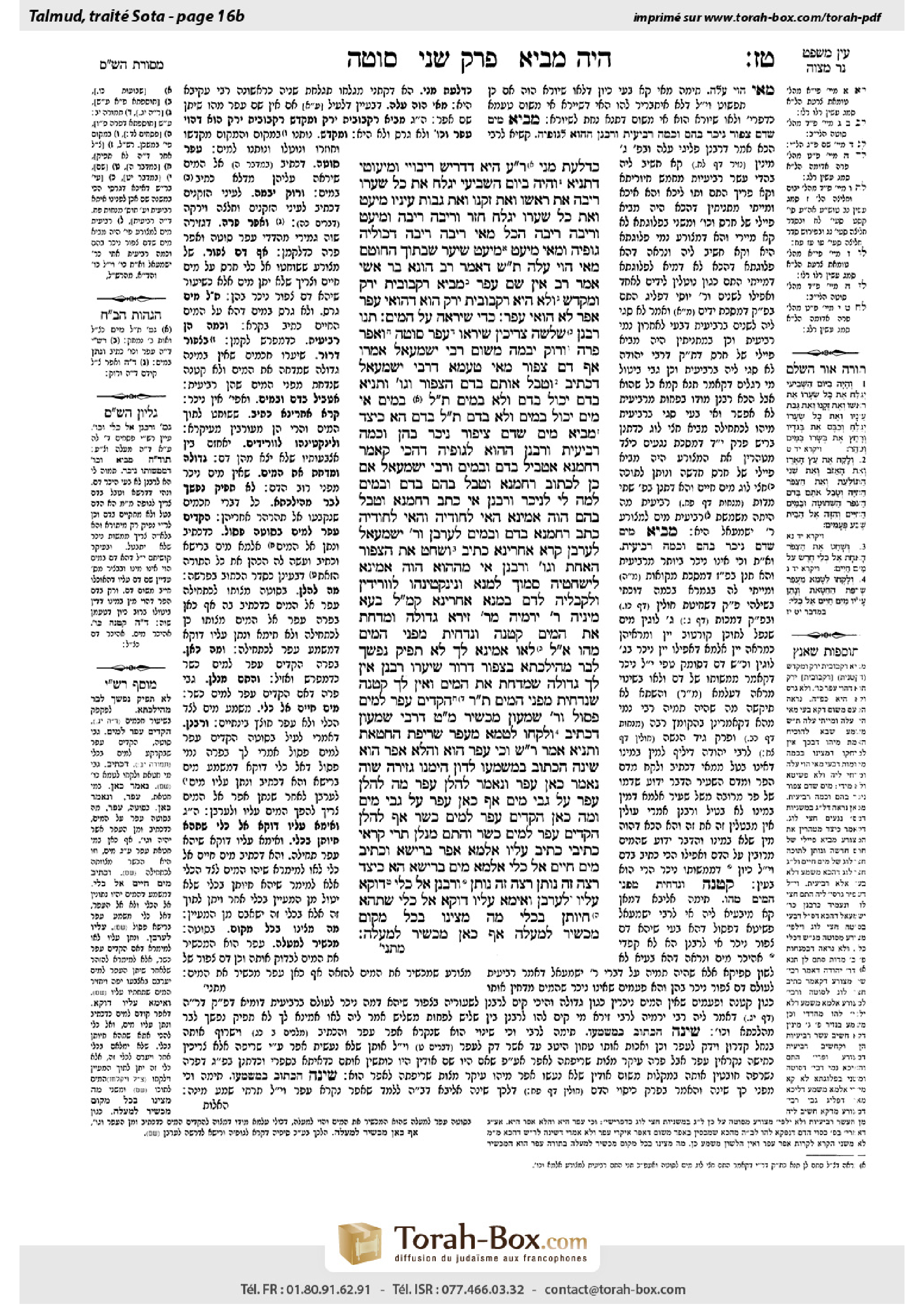
This page of Sotah includes the Aramaic text, an English translation and an AI-generated French translation, alongside the scan above.
סוטה י״ו ב · Aramaic and Hebrew text
כְּדַלַּעַת, מַנִּי — רַבִּי עֲקִיבָא הִיא, דְּדָרֵישׁ רִיבּוּיֵי וּמִיעוּטֵי. דְּתַנְיָא: ״וְהָיָה בַּיּוֹם הַשְּׁבִיעִי יְגַלַּח אֶת כׇּל שְׂעָרוֹ״ — רִיבָּה, ״אֶת רֹאשׁוֹ וְאֶת זְקָנוֹ וְאֵת גַּבֹּת עֵינָיו״ — מִיעֵט, ״וְאֶת כָּל שְׂעָרוֹ יְגַלֵּחַ״ — חָזַר וְרִיבָּה. רִיבָּה וּמִיעֵט וְרִיבָּה — רִיבָּה הַכֹּל.
מַאי רִיבָּה — רִיבָּה דְּכוּלֵּיהּ גּוּפֵיהּ, וּמַאי מִיעֵט — מִיעֵט שֵׂיעָר שֶׁבְּתוֹךְ הַחוֹטֶם.
מַאי הָוֵי עֲלַהּ? תָּא שְׁמַע, דְּאָמַר רַב הוּנָא בַּר אָשֵׁי אָמַר רַב: אֵין שָׁם עָפָר — מֵבִיא רַקְבּוּבִית יָרָק, וּמְקַדֵּשׁ.
וְלָא הִיא: רַקְבּוּבִית יָרָק הוּא דַּהֲוַאי עָפָר, אֵפֶר לָא הֲוַאי עָפָר.
כְּדֵי שֶׁיֵּרָאֶה עַל הַמַּיִם. תָּנוּ רַבָּנַן, שְׁלֹשָׁה צְרִיכִין שֶׁיֵּרָאוּ: עֲפַר סוֹטָה, וְאֵפֶר פָּרָה, וְרוֹק יְבָמָה. מִשּׁוּם רַבִּי יִשְׁמָעֵאל אָמְרוּ: אַף דַּם צִפּוֹר.
מַאי טַעְמָא דְּרַבִּי יִשְׁמָעֵאל, דִּכְתִיב: ״וְטָבַל אוֹתָם בְּדַם הַצִּפֹּר וְגוֹ׳״, וְתַנְיָא: ״בְּדַם״, יָכוֹל בַּדָּם וְלֹא בַּמַּיִם — תַּלְמוּד לוֹמַר: ״בַּמַּיִם״. אִי מַיִם, יָכוֹל בַּמַּיִם וְלֹא בַּדָּם — תַּלְמוּד לוֹמַר: ״בַּדָּם״. הָא כֵּיצַד? מֵבִיא מַיִם שֶׁדַּם צִיפּוֹר נִיכָּר בָּהֶן, וְכַמָּה — רְבִיעִית.
וְרַבָּנַן: הַהוּא לְגוּפֵיהּ, דְּהָכִי קָאָמַר רַחֲמָנָא: אַטְבֵּיל בְּדָם וּבְמַיִם.
וְרַבִּי יִשְׁמָעֵאל: אִם כֵּן, לִכְתּוֹב רַחֲמָנָא: ״וְטָבַל בָּהֶם״, ״בְּדַם וּבַמַּיִם״ לְמָה לִי — לְנִיכָּר.
וְרַבָּנַן: אִי כְּתַב רַחֲמָנָא ״וְטָבַל בָּהֶם״, הֲוָה אָמֵינָא: הַאי לְחוֹדֵיהּ וְהַאי לְחוֹדֵיהּ, כְּתַב רַחֲמָנָא: ״בְּדַם וּבַמַּיִם״ — לְעָרְבָן.
וְרַבִּי יִשְׁמָעֵאל, לְעָרְבָן קְרָא אַחֲרִינָא כְּתִיב: ״וְשָׁחַט אֶת הַצִּפֹּר הָאֶחָת וְגוֹ׳״.
וְרַבָּנַן: אִי מֵהָהוּא הֲוָה אָמֵינָא: לִישְׁחֲטֵיהּ סָמוּךְ לְמָנָא וְנִינְקְטִינְהוּ לִוְורִידִין, וּלְקַבְּלֵיהּ לְדָם בְּמָנָא אַחֲרִינָא, קָא מַשְׁמַע לַן.
בְּעָא מִינֵּיהּ רַבִּי יִרְמְיָה מֵרַבִּי זֵירָא: גְּדוֹלָה וּמַדְחֵת אֶת הַמַּיִם, קְטַנָּה וְנִדְחֵית מִפְּנֵי הַמַּיִם, מַהוּ?
אֲמַר לֵיהּ: לָאו אָמֵינָא לָךְ לָא תַּפֵּיק נַפְשָׁךְ לְבַר מֵהִילְכְתָא, בְּצִפּוֹר דְּרוֹר שִׁיעֲרוּ רַבָּנַן. אֵין לְךָ גְּדוֹלָה שֶׁמַּדְחֵת אֶת הַמַּיִם, וְאֵין לְךָ קְטַנָּה שֶׁנִּדְחֵית מִפְּנֵי הַמַּיִם.
תָּנוּ רַבָּנַן: הִקְדִּים עָפָר לַמַּיִם — פָּסוּל, וְרַבִּי שִׁמְעוֹן מַכְשִׁיר. מַאי טַעְמָא דְּרַבִּי שִׁמְעוֹן —
דִּכְתִיב: ״וְלָקְחוּ לַטָּמֵא מֵעֲפַר שְׂרֵיפַת הַחַטָּאת״, וְתַנְיָא, אָמַר רַבִּי שִׁמְעוֹן: וְכִי עָפָר הוּא? וַהֲלֹא אֵפֶר הוּא! שִׁינָּה הַכָּתוּב בְּמַשְׁמָעוֹ לָדוּן הֵימֶנּוּ גְּזֵירָה שָׁוָה. נֶאֱמַר כָּאן ״עָפָר״, וְנֶאֱמַר לְהַלָּן ״עָפָר״. מָה לְהַלָּן עָפָר עַל גַּבֵּי מַיִם — אַף כָּאן עָפָר עַל גַּבֵּי מַיִם.
וּמָה כָּאן הִקְדִּים עָפָר לַמַּיִם — כָּשֵׁר, אַף לְהַלָּן הִקְדִּים עָפָר לַמַּיִם — כָּשֵׁר.
וְהָתָם מְנָלַן? תְּרֵי קְרָאֵי כְּתִיבִי. כְּתִיב ״עָלָיו״, אַלְמָא אֵפֶר בְּרֵישָׁא, וּכְתִיב ״מַיִם חַיִּים אֶל כֶּלִי״, אַלְמָא מַיִם בְּרֵישָׁא. הָא כֵּיצַד? רָצָה — זֶה נוֹתֵן, רָצָה — זֶה נוֹתֵן.
וְרַבָּנַן: ״אֶל כֶּלִי״ — דַּוְקָא, ״עָלָיו״ — לְעָרְבָן.
וְאֵימָא: ״עָלָיו״ — דַּוְקָא, ״אֶל כֶּלִי״ — שֶׁתְּהֵא חִיּוּתָן בִּכְלִי!
מָה מָצִינוּ בְּכׇל מָקוֹם מַכְשִׁיר לְמַעְלָה, אַף כָּאן מַכְשִׁיר לְמַעְלָה.
Sotah 16b · English translation
By contrast, the mishna states that the leper must be shaven like a gourd. In accordance with whose opinion is this? It is in accordance with the opinion of Rabbi Akiva, who interprets verses by means of the principle of amplifications and restrictions. As it is taught in a baraita: In the verse: “And it shall be on the seventh day, that he shall shave off all his hair,” the phrase “all his hair” is an amplification. The phrase that follows: “His head and his beard and his eyebrows,” is a restriction. In the final phrase: “Even all his hair he shall shave off,” the verse then amplified again. The verse is therefore an instance of amplification and restriction and amplification, which includes everything.
What does it include? It includes the hair of all of the body. What does it nevertheless exclude? It excludes nose hairs, which do not need to be shaved. Since the mishna presents only the opinion of Rabbi Akiva, it poses no challenge to Rabbi Yishmael’s list.
The Gemara asks: What conclusion was reached about it, i.e., whether ashes may be used instead of dust for the water of the sota? Come and hear evidence from that which Rav Huna bar Ashi says that Rav says: If there is no dust available for the sota water, the priest brings decomposed vegetable matter, and he consecrates the water with it. This indicates that it is permitted to substitute other substances for dust.
The Gemara responds: But that is not so. Decomposed vegetable matter is permitted because it will become dust, but ashes will not become dust.
§ The mishna states: He would take loose dust from underneath the tablet and place it into the vessel with the water, so that the dust would be visible upon the water. The Sages taught (Tosefta 1:8): Three items are required to be seen: The dust of the sota must be visible in the water, the ashes of the red heifer must be visible when placed in the waters of purification, and the spittle of a woman whose husband, who has a brother, died childless [yevama] must be visible. The yavam, brother-in-law of the yevama, is bound by Torah law to marry her, and this bond is dissolved through the ritual of ḥalitza, in which she spits before him in the presence of judges. In the name of Rabbi Yishmael they said: Even the blood of the bird used in a leper’s purification ritual is required to be visible in the vessel.
The Gemara asks: What is the reasoning of Rabbi Yishmael? As it is written with regard to the process of the purification of a leper: “And he shall take the cedar wood, and the hyssop, and the scarlet, and the living bird, and dip them in the blood of the slain bird, and in the running water” (Leviticus 14:51). And it is taught in a baraita: Had the verse stated only the phrase “in the blood,” one might have thought that these items must be dipped only in the blood and should not be dipped in the water at all. Therefore, the verse also states: “In the running water.” If the verse had stated only the phrase “in the running water,” one might have thought they should be dipped only in the water and not be dipped in the blood at all. Therefore, the verse also states: “In the blood.” How can these texts be reconciled? One must bring little enough water so that the blood of the bird will still be recognizable within it. And how much water is this? It is a quarter-log.
And the Rabbis, who do not require that the blood of the bird be visible in the water, how do they understand the verse? That verse is necessary for its own sake, as this is what the Merciful One is saying: Dip the objects both in blood and in water together. The blood need not be visible.
And why does Rabbi Yishmael reject this straightforward understanding of the verse? It is because if this understanding were so, then the Merciful One should have written simply: And dip in them, i.e., dip the cedar wood, hyssop, scarlet wool, and live bird in the blood and water, as the blood and water have already been mentioned beforehand. Why do I need the verse to list explicitly: “And dip them in the blood of the slain bird, and in the running water”? This is to teach that the blood must be recognizable in the water.
And what would the Rabbis respond to this? If the Merciful One had written simply: And dip in them, then I would say the items should be dipped in this liquid separately and in that liquid separately. Therefore, the Merciful One writes: “And dip them in the blood of the slain bird, and in the running water,” to teach that one must mix them together.
And from where does Rabbi Yishmael derive that one must mix them together? Another verse is written: “And he shall slaughter one of the birds in an earthen vessel over running water” (Leviticus 14:50). This indicates that the blood of the bird must fall directly into the water below, and the blood and the water will become mixed together.
And why do the Rabbis not learn it from that verse? If one were to learn it from that verse, I would say that one should slaughter the bird adjacent to the vessel holding the water, and one should grasp the opened veins to ensure that no blood escapes immediately and then collect the blood in a different vessel. The blood and water would therefore be in separate vessels. Therefore, this first verse teaches us that the blood and water must be mixed together.
Rabbi Yirmeya raised a dilemma before Rabbi Zeira: If the bird is big and contains such a large amount of blood that it effaces the water, rendering it indistinguishable, or if the bird is small and contains so little blood that its blood is effaced due to the water and indistinguishable, what is the halakha?
Rabbi Zeira said to him: Haven’t I told you not to take yourself out of the bounds of the practical halakha? Do not ask questions about impossible eventualities. The Sages measured the ratio of blood to water specifically with regard to a sparrow. There is no sparrow big enough to efface the water, nor is there one small enough to be effaced due to the water.
§ The Rabbis taught (Tosefta, Para 6:6): If one places the dust in the vessel before the water, the mixture is unfit; but Rabbi Shimon deems it fit. The Gemara asks: What is the reasoning of Rabbi Shimon?
It is as it is written with regard to the red heifer: “And for the unclean they shall take of the dust of the burning of the purification from sin, and running water shall be put thereto in a vessel” (Numbers 19:17). And it is taught in a baraita that Rabbi Shimon said: Is it dust [afar] that is taken? But isn’t it really ashes [efer]? Evidently the Torah altered its usage and referred to ashes as dust in order to derive a verbal analogy from it. Dust is stated in the verse here, and dust is stated there, with regard to the sota. Just as there, with regard to the sota, the verse teaches that the dust must be placed on top of water, so too here, with regard to the red heifer, one learns that the dust, i.e., ashes, must be placed on top of the water.
And likewise, just as here, with regard to the red heifer, if one places the dust in the vessel before the water, it is fit after the fact, so too there, with regard to the sota, if one places the dust in the vessel before the water, it is fit.
The Gemara asks: And there, with regard to the red heifer, from where do we derive that the mixture is fit even if the dust is placed first? Two phrases are written in the verse. It is written that the water must be put: “Thereto.” Therefore, apparently, the ashes should be placed first. And it is written that the running water must be placed: “In a vessel.” Apparently, the water should be placed in the vessel first, while it is still empty. How can these texts be reconciled? If he desires to place the water first he places it, and if he desires to place the ash first he places it.
And how do the Rabbis, who deem the mixture unfit, interpret the verse? The verse states: “In a vessel,” specifically. The water must be placed first. When the verse states: “Thereto,” it teaches only that it is required to mix the ashes with the water.
The Gemara asks: But one could just as easily say the opposite: “Thereto” should be understood specifically, and the ashes must be placed first. The phrase “running water shall be put…in a vessel,” should indicate only that the water must run directly into the vessel and that it may not be brought from the spring by means of another vessel.
The Gemara answers: Just as we find in every instance that the facilitating item goes above the primary item, e.g., in the case of a sota the dust goes on top of the water, so too here, in the case of the red heifer, the facilitating item must go above the primary item. The water must be placed first, and only then the ashes.
Sotah 16b · Traduction française (IA)
À l’inverse, la Michna affirme que le lépreux doit être rasé comme une calebasse. Selon l’opinion de qui ? Selon celle de Rabbi Akiva, qui interprète les versets au moyen du principe d’amplification et de restriction. En effet, il est enseigné dans une baraïta : dans le verset « Le septième jour, il se rasera tous les poils », l’expression « tous les poils » constitue une amplification. L’expression qui suit, « sa tête, sa barbe et ses sourcils », constitue une restriction. Dans la dernière expression, « il se rasera tous les poils », le verset amplifie de nouveau. Le verset relève donc du procédé amplification-restriction-amplification, qui inclut tout.
Qu’inclut-il ? Les poils de tout le corps. Qu’exclut-il néanmoins ? Les poils du nez, qu’il n’est pas nécessaire de raser. Puisque la Michna ne présente que l’opinion de Rabbi Akiva, elle ne contredit pas la liste de Rabbi Yishmael.
La Guemara demande : quelle conclusion a-t-on tirée à ce sujet, c’est-à-dire quant à la possibilité d’utiliser des cendres à la place de la poussière pour l’eau de la sota ? Écoute cette preuve tirée de ce que Rav Huna bar Ashi rapporte au nom de Rav : s’il n’y a pas de poussière disponible pour l’eau de la sota, le prêtre apporte des matières végétales décomposées et les consacre avec l’eau. Cela indique qu’il est permis de remplacer la poussière par d’autres substances.
La Guemara répond : Mais il n’en est rien. Les matières végétales décomposées sont permises parce qu’elles deviendront de la poussière, tandis que les cendres ne deviendront pas de la poussière.
§ La Michna affirme : Il prenait de la poussière meuble sous la tablette et la mettait dans le récipient contenant l’eau, de sorte que la poussière soit visible à la surface de l’eau. Les Sages ont enseigné (Tosefta 1:8) : Trois éléments doivent être visibles : la poussière de la sota doit être visible dans l’eau ; les cendres de la vache rousse doivent être visibles lorsqu’elles sont placées dans les eaux de purification ; et le crachat d’une femme dont le mari, qui avait un frère, est mort sans enfant [yevama] doit être visible. Le yavam, beau-frère de la yevama, est tenu par la Torah de l’épouser ; ce lien est dissous par le rite de la ḥalitza, au cours duquel elle crache devant lui en présence de juges. Au nom de Rabbi Yishmael, ils ont dit : le sang de l’oiseau utilisé dans le rite de purification du lépreux doit lui aussi être visible dans le récipient.
La Guemara demande : quel est le raisonnement de Rabbi Yishmael ? Car il est écrit à propos du processus de purification du lépreux : « Il prendra le bois de cèdre, l’hysope, l’écarlate et l’oiseau vivant, et les trempera dans le sang de l’oiseau égorgé et dans l’eau vive » (Lévitique 14:51). Et il est enseigné dans une baraïta : si le verset avait seulement dit « dans le sang », on aurait pu penser que ces éléments doivent être trempés uniquement dans le sang et non dans l’eau. C’est pourquoi le verset dit aussi : « dans l’eau vive ». Si le verset avait seulement dit « dans l’eau vive », on aurait pu penser qu’ils doivent être trempés uniquement dans l’eau et non dans le sang. C’est pourquoi le verset dit aussi : « dans le sang ». Comment concilier ces textes ? Il faut apporter une quantité d’eau assez faible pour que le sang de l’oiseau reste reconnaissable en son sein. Et quelle est cette quantité d’eau ? Un quart de log.
Et les Sages, qui n’exigent pas que le sang de l’oiseau soit visible dans l’eau, comment comprennent-ils le verset ? Ce verset est nécessaire en lui-même : c’est ce que dit le Miséricordieux, c’est-à-dire la Torah : tremper les objets dans le sang et dans l’eau ensemble. Le sang n’a pas besoin d’être visible.
Et pourquoi Rabbi Yishmael rejette-t-il cette interprétation simple du verset ? Parce que, si tel était le sens, le Miséricordieux aurait dû écrire simplement : « Et les y tremper », c’est-à-dire tremper le bois de cèdre, l’hysope, la laine écarlate et l’oiseau vivant dans le sang et dans l’eau, puisque le sang et l’eau ont déjà été mentionnés auparavant. Pourquoi le verset précise-t-il : « Et les tremper dans le sang de l’oiseau égorgé et dans l’eau vive » ? Pour enseigner que le sang doit être reconnaissable dans l’eau.
Et que répondraient les Sages à cela ? Si le Miséricordieux avait simplement écrit : « Et les y tremper », j’aurais dit que les éléments doivent être trempés séparément dans l’un de ces liquides et séparément dans l’autre. C’est pourquoi le Miséricordieux écrit : « Et les tremper dans le sang de l’oiseau égorgé et dans l’eau vive », pour enseigner qu’il faut les mélanger.
Et de quelle source Rabbi Yishmael déduit-il qu’il faut les mélanger ? Un autre verset est écrit : « Il égorgera l’un des oiseaux dans un récipient de terre cuite, au-dessus d’une eau vive » (Lévitique 14:50). Cela indique que le sang de l’oiseau doit tomber directement dans l’eau située en dessous, de sorte que le sang et l’eau se mélangent.
Et pourquoi les Sages ne le déduisent-ils pas de ce verset ? Si on le déduisait de ce verset, je dirais qu’il faut égorger l’oiseau près du récipient contenant l’eau, saisir les veines ouvertes pour empêcher le sang de s’écouler immédiatement, puis recueillir le sang dans un autre récipient. Le sang et l’eau se trouveraient donc dans des récipients séparés. C’est pourquoi le premier verset nous enseigne que le sang et l’eau doivent être mélangés.
Rabbi Yirmeya souleva une question devant Rabbi Zeira : si l’oiseau est gros et contient une telle quantité de sang qu’il fait disparaître l’eau, la rendant impossible à distinguer, ou si l’oiseau est petit et contient si peu de sang que celui-ci est noyé dans l’eau et devient impossible à distinguer, quelle est la halakha ?
Rabbi Zeira lui dit : Ne t’ai-je pas dit de ne pas sortir du cadre de la halakha pratique ? Ne pose pas de questions sur des éventualités impossibles. Les Sages ont mesuré la proportion de sang par rapport à l’eau précisément à partir d’un moineau. Il n’existe pas de moineau assez gros pour faire disparaître l’eau, ni de moineau assez petit pour que son sang soit noyé dans l’eau.
§ Les Sages ont enseigné (Tosefta, Para 6:6) : si l’on met la poussière dans le récipient avant l’eau, le mélange est invalide ; mais Rabbi Shimon le considère comme valide. La Guemara demande : quel est le raisonnement de Rabbi Shimon ?
C’est ainsi qu’il est écrit à propos de la vache rousse : « Pour l’impur, ils prendront de la poussière provenant de la combustion du sacrifice expiatoire, et l’on y mettra de l’eau vive dans un récipient » (Nombres 19:17). Et il est enseigné dans une baraïta que Rabbi Shimon a dit : Prend-on de la poussière [afar] ? Mais n’est-ce pas en réalité des cendres [efer] ? Il apparaît que la Torah a modifié son usage et appelé les cendres « poussière », afin d’en tirer une analogie verbale. La poussière est mentionnée dans le verset ici, et la poussière est mentionnée là, à propos de la sota. De même que là, à propos de la sota, le verset enseigne que la poussière doit être placée sur l’eau, de même ici, à propos de la vache rousse, on apprend que la poussière, c’est-à-dire les cendres, doit être placée sur l’eau.
Et de même que là, à propos de la vache rousse, si l’on met la poussière dans le récipient avant l’eau, le mélange est valide a posteriori, de même ici, à propos de la sota, si l’on met la poussière dans le récipient avant l’eau, le mélange est valide.
La Guemara demande : et là, à propos de la vache rousse, de quelle source déduit-on que le mélange est valide même si la poussière est mise en premier ? Deux expressions figurent dans le verset. Il est écrit que l’eau doit être mise « là-dessus » ; il semblerait donc que les cendres doivent être placées en premier. Et il est écrit que l’eau vive doit être mise « dans un récipient » ; il semblerait donc que l’eau doit être mise en premier dans le récipient, alors qu’il est encore vide. Comment concilier ces textes ? S’il souhaite mettre l’eau en premier, qu’il la mette en premier ; s’il souhaite mettre les cendres en premier, qu’il les mette en premier.
Et comment les Sages, qui considèrent le mélange comme invalide, interprètent-ils le verset ? Le verset dit précisément : « dans un récipient ». L’eau doit être mise en premier. Quand le verset dit « là-dessus », il enseigne seulement qu’il faut mélanger les cendres à l’eau.
La Guemara demande : mais on pourrait tout aussi bien dire l’inverse : « là-dessus » doit être compris au sens strict, et les cendres doivent être mises en premier. L’expression « l’eau vive sera mise… dans un récipient » devrait indiquer seulement que l’eau doit couler directement dans le récipient et qu’on ne peut pas l’apporter de la source au moyen d’un autre récipient.
La Guemara répond : de même que, dans tous les cas que nous connaissons, l’élément auxiliaire est placé au-dessus de l’élément principal — par exemple, dans le cas de la sota, la poussière est placée sur l’eau —, de même ici, dans le cas de la vache rousse, l’élément auxiliaire doit être placé au-dessus de l’élément principal. L’eau doit être mise en premier, et les cendres seulement ensuite.
Traduction française générée par IA à partir de l’édition anglaise de Sefaria. Vérifie toujours un passage avec le texte source.
Text from Sefaria: William Davidson Edition - Vocalized Aramaic (CC BY NC); William Davidson Edition - English (CC BY NC).