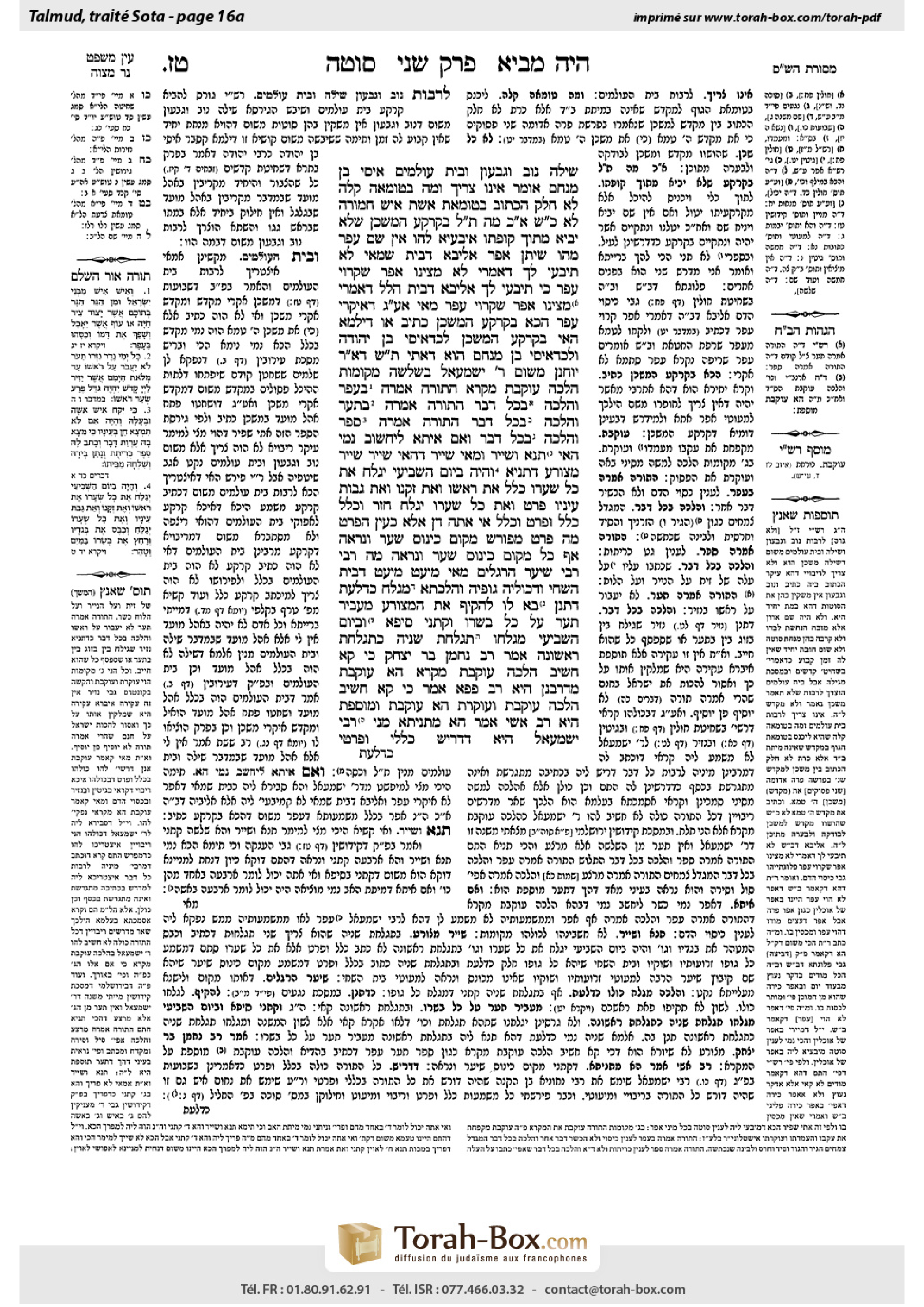
Sotah 16a: Talmud study for Daf Yomi
Daf Yomi is the daily study of one Talmud folio. Explore 37 tractates with scans, Hebrew text, Sefaria English and AI-generated French translations where annotated.
Passage selection and English or AI-generated French translation are available where the scan has annotations. Daf Study is independent of Torah-Box and Sefaria.
Browse Sotah · סוטה · All tractatesSotah 16a text and translations
This page of Sotah includes the Aramaic text, an English translation and an AI-generated French translation, alongside the scan above.
סוטה י״ו א · Aramaic and Hebrew text
שִׁילֹה נוֹב וְגִבְעוֹן וּבֵית עוֹלָמִים.
אִיסִי בֶּן מְנַחֵם אוֹמֵר, אֵינוֹ צָרִיךְ: וּמָה בְּטוּמְאָה קַלָּה לֹא חָלַק הַכָּתוּב — בְּטוּמְאַת אֵשֶׁת אִישׁ חֲמוּרָה, לֹא כׇּל שֶׁכֵּן? אִם כֵּן מָה תַּלְמוּד לוֹמַר ״בְּקַרְקַע הַמִּשְׁכָּן״ — שֶׁלֹּא יָבִיא מִתּוֹךְ קוּפָּתוֹ.
אִיבַּעְיָא לְהוּ: אֵין שָׁם עָפָר, מַהוּ שֶׁיִּתֵּן אֵפֶר? אַלִּיבָּא דְּבֵית שַׁמַּאי לָא תִּיבְּעֵי לָךְ, דְּאָמְרִי: לֹא מָצִינוּ אֵפֶר שֶׁקָּרוּי ״עָפָר״.
כִּי תִּיבְּעֵי לָךְ, אַלִּיבָּא דְּבֵית הִלֵּל דְּאָמְרִי: מָצִינוּ אֵפֶר שֶׁקָּרוּי ״עָפָר״, מַאי? אַף עַל גַּב דְּאִיקְּרִי ״עָפָר״, הָכָא ״בְּקַרְקַע הַמִּשְׁכָּן״ כְּתִיב, אוֹ דִילְמָא הַאי ״בְּקַרְקַע הַמִּשְׁכָּן״ לְכִדְאִיסִי בֶּן יְהוּדָה וּלְכִדְאִיסִי בֶּן מְנַחֵם הוּא דְּאָתֵי?
תָּא שְׁמַע, דְּאָמַר רַבִּי יוֹחָנָן מִשּׁוּם רַבִּי יִשְׁמָעֵאל: בִּשְׁלֹשָׁה מְקוֹמוֹת הֲלָכָה עוֹקֶבֶת מִקְרָא.
הַתּוֹרָה אָמְרָה בְּ״עָפָר״, וַהֲלָכָה בְּכׇל דָּבָר. הַתּוֹרָה אָמְרָה בְּ״תַעַר״, וַהֲלָכָה בְּכׇל דָּבָר. הַתּוֹרָה אָמְרָה ״סֵפֶר״, וַהֲלָכָה בְּכׇל דָּבָר.
וְאִם אִיתָא — לִיחְשׁוֹב נָמֵי הַאי!
תְּנָא וְשַׁיַּיר. וּמַאי שַׁיַּיר דְּהַאי שַׁיַּיר? שַׁיַּיר מְצוֹרָע, דְּתַנְיָא: ״וְהָיָה בַּיּוֹם הַשְּׁבִיעִי יְגַלַּח אֶת כׇּל שְׂעָרוֹ״ — כְּלָל, ״אֶת רֹאשׁוֹ וְאֶת זְקָנוֹ וְאֵת גַּבֹּת עֵינָיו״ — פְּרָט, ״וְאֶת כָּל שְׂעָרוֹ יְגַלֵּחַ״ — חָזַר וְכָלַל. כְּלָל וּפְרָט וּכְלָל — אִי אַתָּה דָן אֶלָּא כְעֵין הַפְּרָט. מָה פְּרָט מְפוֹרָשׁ: מְקוֹם כִּינּוּס שֵׂעָר וְנִרְאֶה — אַף כׇּל מָקוֹם כִּינּוּס שֵׂעָר וְנִרְאֶה.
מָה רַבִּי — רַבִּי שְׂעַר הָרַגְלַיִם. מַאי מִיעֵט — מִיעֵט דְּבֵית הַשֶּׁחִי וּדְכוּלֵּיהּ גּוּפֵיהּ.
וְהִלְכְתָא: מְגַלֵּחַ כְּדַלַּעַת. דִּתְנַן: בָּא לוֹ לְהַקִּיף אֶת הַמְצוֹרָע — מַעֲבִיר תַּעַר עַל כׇּל בְּשָׂרוֹ, וְקָתָנֵי סֵיפָא: וּבַיּוֹם הַשְּׁבִיעִי מְגַלְּחוֹ תִּגְלַחַת שְׁנִיָּה כְּתִגְלַחַת רִאשׁוֹנָה.
אָמַר רַב נַחְמָן בַּר יִצְחָק: כִּי קָא חָשֵׁיב, הֲלָכָה עוֹקֶבֶת מִקְרָא, הָא עוֹקֶבֶת מִדְּרַבָּנַן הִיא.
רַב פָּפָּא אָמַר: כִּי קָא חָשֵׁיב הֲלָכָה עוֹקֶבֶת וְעוֹקֶרֶת, הָא עוֹקֶבֶת וּמוֹסֶפֶת הִיא.
רַב אָשֵׁי אָמַר: הָא מַתְנִיתָא מַנִּי — רַבִּי יִשְׁמָעֵאל הִיא, דְּדָרֵישׁ כְּלָלֵי וּפְרָטֵי.
Sotah 16a · English translation
Shiloh, Nob, and Gibeon, and also the Eternal House, i.e., the Temple in Jerusalem. The dust for the sota is still brought from the ground of the Sanctuary wherever it is located, even after the Jewish people are no longer in the wilderness.
Isi ben Menaḥem says: There is no need to derive this halakha from the verse. It may be learned by an a fortiori inference: With regard to the prohibition against entering the Sanctuary in a state of impurity, a lenient matter for which there is no court-imposed capital punishment, the Torah does not differentiate. It is prohibited for an impure person to enter the Tabernacle no matter where it stands. Therefore, with regard to the impurity of a married woman, which is stringent and carries the penalty of strangulation, all the more so is it not clear that the Torah does not differentiate? The dust must be brought from the Sanctuary no matter where it stands. If so, what is the meaning when the verse states: “And of the dust that is on the floor of the Tabernacle”? It teaches that one should not bring dust from his own basket and place it directly into the water; he must first place it on the floor.
A dilemma was raised before the Sages: If there is no dust there, what is the halakha? May one place ashes in the vessel instead? The Gemara responds: There is no need to raise the dilemma if one holds in accordance with the opinion of Beit Shammai, as they say: We never find ashes referred to as dust in the Torah.
When you raise the dilemma, it is in accordance with the opinion of Beit Hillel, who say: We do find ashes referred to as dust in the context of the red heifer (Numbers 19:17). They likewise hold that ashes may also be used instead of dust to cover the blood of a slaughtered bird or undomesticated animal (see Leviticus 17:13). What is the halakha here, with regard to the water of a sota? May ashes replace dust? Although elsewhere ashes may be referred to as dust, here it is written: “On the floor of the Tabernacle,” indicating that dust in particular is required, since dust comes from the ground. Or perhaps the phrase “on the floor of the Tabernacle” comes only to teach that the halakha is in accordance with the teaching of Isi ben Yehuda or in accordance with the teaching of Isi ben Menaḥem. If so, perhaps ashes are acceptable as well.
Come and hear evidence from that which Rabbi Yoḥanan says in the name of Rabbi Yishmael: In three instances the halakha supersedes the verse, i.e., the tradition alters the straightforward meaning of the verse.
The Torah states: “And whatsoever man…that takes in hunting any beast or fowl that may be eaten, he shall pour out the blood thereof, and cover it in dust” (Leviticus 17:13), but the halakha is that the blood may be covered in anything similar to dust. The Torah states with regard to the nazirite: “All the days of his vow of naziriteship there shall be no razor come upon his head” (Numbers 6:5), but the halakha is that the nazirite may not remove his hair with anything. The Torah states: “That he writes her a bill [sefer] of divorce” (Deuteronomy 24:1). The word sefer denotes a scroll, but the halakha is that the husband may inscribe the bill of divorce on anything that is detached from the ground and suitable to be written upon, not only on a scroll.
And if it is so that ashes may be placed in the water of a sota despite the verse’s stipulation of dust, consider this fourth case as well to be a halakha that supersedes the verse. Since it is omitted from Rabbi Yishmael’s statement, it seems that ashes may not be used.
The Gemara responds: Rabbi Yishmael taught some cases and omitted others; his list is not exhaustive. The Gemara asks: What else did he omit that he omitted this? It is not reasonable that he would provide a list lacking only one item. The Gemara answers: He omitted the leper, as it is taught in a baraita (Tosefta, Nega’im 1:9): In the verse: “And it shall be on the seventh day, that he shall shave off all his hair” (Leviticus 14:9), the phrase “all his hair” is a generalization. The phrase that follows: “His head and his beard and his eyebrows,” is a detail. And with the following phrase: “Even all his hair he shall shave off,” the verse then generalized again. In any case of a generalization, and a detail, and a generalization, you may deduce that the verse is referring only to items similar to the detail. Just as the detail is explicitly referring to areas where there is a collection of hair which is visible, so too all areas on the leper that have a collection of hair which is visible must be shaven.
To what otherwise excluded case does this baraita extend the halakha? It extends the halakha of hair to include pubic hair. What does the baraita exclude? It excludes armpit hair, which is not visible, and body hair that is not collected. This is the straightforward meaning of the verse.
And yet the halakha is: The leper shaves like a gourd, i.e., his entire body must be shaved. As we learned in a mishna (Nega’im 14:2): When the priest comes to shave the leper, he passes a razor over all of his flesh. And in the latter clause, the mishna teaches: On the seventh day he shaves the leper again. The second shaving is just like the first shaving. The verse previously analyzed is referring to the second shaving, and its straightforward meaning is that not all of the leper’s flesh needs to be shaved. However, the mishna states that the leper must shave all of his flesh in the second shaving as well. This is another instance where the halakha supersedes the straightforward meaning of the verse, yet it is omitted from Rabbi Yishmael’s list.
Rabbi Naḥman bar Yitzḥak said: Rabbi Yishmael consciously omitted the halakha of the leper because he counted only instances where the halakha supersedes the straightforward meaning of the verse. This halakha of the leper, however, is an instance where the halakha supersedes only an exegetical interpretation of the Sages.
Rav Pappa said: Rabbi Yishmael counted only cases where the halakha both supersedes and uproots the straightforward meaning of the verse. This, however, is an instance where the halakha supersedes and adds. The halakha does not overrule the verse but rather adds an additional requirement, i.e., that the whole body must be shaved.
Rav Ashi said: This baraita, which teaches that only certain parts of the body must be shaved, is in accordance with whose opinion? It is in accordance with the opinion of Rabbi Yishmael, who interprets verses by means of the principle of generalizations and details. According to this interpretation, only collected areas of hair that are visible must be shaven.
Sotah 16a · Traduction française (IA)
Shilo, Nob et Gabaon, ainsi que la Maison éternelle, c’est-à-dire le Temple de Jérusalem. La poussière destinée à la sota est toujours prélevée sur le sol du Sanctuaire, où qu’il se trouve, même après que le peuple juif a cessé de vivre dans le désert.
Isi ben Menaḥem dit : Il n’est pas nécessaire de déduire cette halakha du verset. On peut l’apprendre par un raisonnement a fortiori : concernant l’interdiction d’entrer dans le Sanctuaire en état d’impureté, une règle clémente qui n’entraîne pas de peine capitale prononcée par un tribunal, la Torah ne fait aucune distinction. Il est interdit à une personne impure d’entrer dans le Tabernacle, où qu’il se trouve. À plus forte raison, concernant l’impureté d’une femme mariée, qui est un cas rigoureux passible de strangulation, n’est-il pas évident que la Torah ne fait aucune distinction ? La poussière doit être prélevée au Sanctuaire, où qu’il se trouve. Dès lors, que signifie la formulation du verset : « De la poussière qui se trouve sur le sol du Tabernacle » ? Elle enseigne qu’on ne doit pas prendre de poussière dans son propre panier pour la verser directement dans l’eau ; il faut d’abord la déposer sur le sol.
Une question fut posée aux Sages : s’il n’y a pas de poussière à cet endroit, quelle est la halakha ? Peut-on mettre des cendres dans le récipient à la place ? La Guemara répond : Il n’est pas nécessaire de poser cette question si l’on suit l’opinion de Beit Shammaï, car ils disent : « Nous ne trouvons jamais dans la Torah que les cendres soient appelées poussière. »
La question se pose si l’on suit l’opinion de Beit Hillel, qui disent : « Nous trouvons que les cendres sont appelées poussière » dans le contexte de la vache rousse (Nombres 19,17). Ils tiennent également que des cendres peuvent servir à la place de la poussière pour recouvrir le sang d’un oiseau ou d’un animal sauvage abattu (voir Lévitique 17,13). Quelle est la halakha ici, concernant l’eau de la sota ? Les cendres peuvent-elles remplacer la poussière ? Bien qu’ailleurs les cendres puissent être désignées comme de la poussière, il est écrit ici : « Sur le sol du Tabernacle », ce qui indique que c’est précisément de la poussière qui est requise, puisque la poussière provient du sol. Ou peut-être l’expression « sur le sol du Tabernacle » vient-elle seulement enseigner que la halakha est conforme à l’enseignement d’Isi ben Yehuda ou à celui d’Isi ben Menaḥem. Si tel est le cas, les cendres sont peut-être également acceptables.
Examinons une preuve tirée de ce que Rabbi Yoḥanan dit au nom de Rabbi Yishmael : dans trois cas, la halakha l’emporte sur le verset, c’est-à-dire que la tradition modifie le sens littéral du verset.
La Torah dit : « Tout homme […] qui prend à la chasse un animal ou un oiseau qu’on peut manger, en répandra le sang et le couvrira de poussière » (Lévitique 17,13), mais la halakha est que le sang peut être couvert de toute matière semblable à la poussière. La Torah dit au sujet du nazir : « Pendant tous les jours de son vœu de naziréat, le rasoir ne passera pas sur sa tête » (Nombres 6,5), mais la halakha est que le nazir ne peut retirer ses cheveux avec aucun moyen. La Torah dit : « Il lui écrit un acte [sefer] de divorce » (Deutéronome 24,1). Le mot sefer désigne un rouleau, mais la halakha est que le mari peut écrire l’acte de divorce sur tout support détaché du sol et apte à recevoir une inscription, et pas seulement sur un rouleau.
Et s’il est vrai que l’on peut mettre des cendres dans l’eau de la sota malgré la prescription du verset concernant la poussière, considérons également ce quatrième cas comme une halakha qui l’emporte sur le verset. Puisqu’il est omis de la déclaration de Rabbi Yishmael, il semble qu’on ne puisse pas utiliser de cendres.
La Guemara répond : Rabbi Yishmael a enseigné certains cas et en a omis d’autres ; sa liste n’est pas exhaustive. La Guemara demande : Qu’a-t-il omis d’autre pour avoir omis celui-ci ? Il n’est pas raisonnable qu’il ait dressé une liste à laquelle il ne manquerait qu’un seul élément. La Guemara répond : Il a omis le lépreux, comme l’enseigne une baraïta (Tosefta, Negaïm 1:9) : dans le verset « Le septième jour, il rasera tous ses cheveux » (Lévitique 14,9), l’expression « tous ses cheveux » est une généralité. L’expression qui suit, « sa tête, sa barbe et ses sourcils », est un détail. Puis, dans l’expression suivante, « il rasera tous ses cheveux », le verset énonce de nouveau une généralité. Or, chaque fois qu’il y a une généralité, puis un détail, puis une généralité, on peut en déduire que le verset ne vise que des éléments semblables au détail. De même que le détail désigne explicitement les endroits où se trouve une pousse de cheveux visible, de même toutes les zones du lépreux où se trouve une pousse de cheveux visible doivent être rasées.
À quel cas autrement exclu cette baraïta étend-elle la halakha ? Elle étend la halakha relative aux cheveux pour y inclure les poils pubiens. Qu’exclut la baraïta ? Elle exclut les poils des aisselles, qui ne sont pas visibles, ainsi que les poils du corps qui ne forment pas une pousse. Voilà le sens littéral du verset.
Pourtant, la halakha est que le lépreux se rase comme une calebasse, c’est-à-dire que tout son corps doit être rasé. Comme nous l’avons appris dans une Michna (Negaïm 14:2) : lorsque le prêtre vient raser le lépreux, il passe un rasoir sur toute sa chair. Dans la suite de la Michna, il est enseigné que, le septième jour, il rase de nouveau le lépreux. Le second rasage est identique au premier. Le verset analysé précédemment fait référence au second rasage, et son sens littéral est que toute la chair du lépreux n’a pas besoin d’être rasée. Cependant, la Michna indique que le lépreux doit également se faire raser toute la chair lors du second rasage. C’est un autre cas où la halakha l’emporte sur le sens littéral du verset, mais qui est omis de la liste de Rabbi Yishmael.
Rabbi Naḥman bar Yitzḥak dit : Rabbi Yishmael a délibérément omis la halakha concernant le lépreux, car il n’a compté que les cas où la halakha l’emporte sur le sens littéral du verset. Or, dans le cas du lépreux, la halakha l’emporte uniquement sur une interprétation exégétique des Sages.
Rav Pappa dit : Rabbi Yishmael n’a compté que les cas où la halakha l’emporte sur le sens littéral du verset et le déracine. Ici, en revanche, la halakha l’emporte sur le verset et y ajoute. Elle ne contredit pas le verset, mais impose une exigence supplémentaire, à savoir que tout le corps doit être rasé.
Rav Ashi dit : De l’opinion de qui relève cette baraïta, qui enseigne que seules certaines parties du corps doivent être rasées ? Elle relève de l’opinion de Rabbi Yishmael, qui interprète les versets au moyen du principe des généralités et des détails. Selon cette interprétation, seules les zones où se trouve une pousse de cheveux visible doivent être rasées.
Traduction française générée par IA à partir de l’édition anglaise de Sefaria. Vérifie toujours un passage avec le texte source.
Text from Sefaria: William Davidson Edition - Vocalized Aramaic (CC BY NC); William Davidson Edition - English (CC BY NC).