Sotah 15b: Talmud study for Daf Yomi
Daf Yomi is the daily study of one Talmud folio. Explore 37 tractates with scans, Hebrew text, Sefaria English and AI-generated French translations where annotated.
Passage selection and English or AI-generated French translation are available where the scan has annotations. Daf Study is independent of Torah-Box and Sefaria.
Browse Sotah · סוטה · All tractatesSotah 15b text and translations
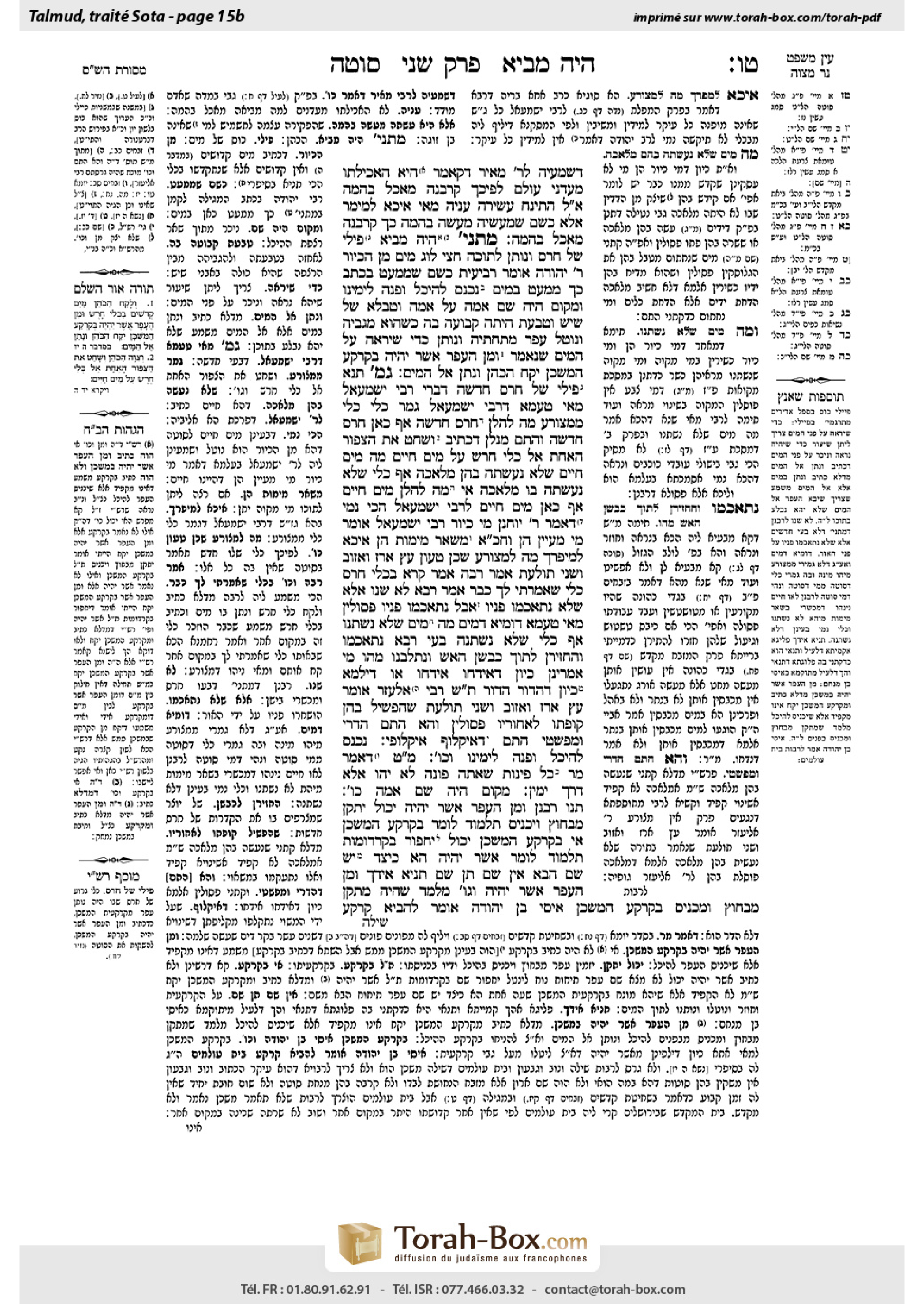
This page of Sotah includes the Aramaic text, an English translation and an AI-generated French translation, alongside the scan above.
סוטה י״ה ב · Aramaic and Hebrew text
דְּשַׁמְעֵיהּ לְרַבִּי מֵאִיר דְּקָאָמַר: הִיא הֶאֱכִילַתּוּ מַעֲדַנֵּי עוֹלָם — לְפִיכָךְ קׇרְבָּנָהּ מַאֲכַל בְּהֵמָה. אָמַר לוֹ: הָתִינַח עֲשִׁירָה, עֲנִיָּה מַאי אִיכָּא לְמֵימַר! אֶלָּא: כְּשֵׁם שֶׁמַּעֲשֶׂיהָ מַעֲשֵׂה בְהֵמָה — כָּךְ קׇרְבָּנָהּ מַאֲכַל בְּהֵמָה.
מַתְנִי׳ הָיָה מֵבִיא פְּיָלִי שֶׁל חֶרֶס וְנוֹתֵן לְתוֹכָהּ חֲצִי לוֹג מַיִם מִן הַכִּיּוֹר. רַבִּי יְהוּדָה אוֹמֵר: רְבִיעִית. כְּשֵׁם שֶׁמְּמַעֵט בַּכְּתָב, כָּךְ מְמַעֵט בַּמַּיִם.
נִכְנַס לַהֵיכָל וּפָנָה לִימִינוֹ, וּמָקוֹם הָיָה שָׁם אַמָּה עַל אַמָּה, וְטַבְלָא שֶׁל שַׁיִשׁ, וְטַבַּעַת הָיְתָה קְבוּעָה בָּהּ כְּשֶׁהוּא מַגְבִּיהַּ, וְנוֹטֵל עָפָר מִתַּחְתֶּיהָ, וְנוֹתֵן כְּדֵי שֶׁיֵּרָאֶה עַל הַמַּיִם, שֶׁנֶּאֱמַר: ״וּמִן הֶעָפָר אֲשֶׁר יִהְיֶה בְּקַרְקַע הַמִּשְׁכָּן יִקַּח הַכֹּהֵן וְנָתַן אֶל הַמָּיִם״.
גְּמָ׳ תָּנָא: פְּיָלִי שֶׁל חֶרֶס חֲדָשָׁה, דִּבְרֵי רַבִּי יִשְׁמָעֵאל. מַאי טַעְמָא דְּרַבִּי יִשְׁמָעֵאל? גָּמַר ״כְּלִי״ ״כְּלִי״ מִמְּצוֹרָע: מָה לְהַלָּן חֶרֶס חֲדָשָׁה — אַף כָּאן חֶרֶס חֲדָשָׁה.
וְהָתָם מְנָלַן? דִּכְתִיב: ״וְשָׁחַט אֶת הַצִּפּוֹר הָאֶחָת אֶל כְּלִי חֶרֶשׂ עַל מַיִם חַיִּים״, מָה ״מַיִם חַיִּים״ — שֶׁלֹּא נֶעֶשְׂתָה בָּהֶן מְלָאכָה, אַף ״כְּלִי״ — שֶׁלֹּא נֶעֶשְׂתָה בּוֹ מְלָאכָה.
אִי: מָה לְהַלָּן מַיִם חַיִּים, אַף כָּאן מַיִם חַיִּים?!
לְרַבִּי יִשְׁמָעֵאל הָכִי נָמֵי. דְּאָמַר רַבִּי יוֹחָנָן: מֵי כִיּוֹר, רַבִּי יִשְׁמָעֵאל אוֹמֵר: מֵי מַעְיָין הֵן, וַחֲכָמִים אוֹמְרִים: מִשְּׁאָר מֵימוֹת הֵן.
אִיכָּא לְמִיפְרַךְ: מָה לִמְצוֹרָע, שֶׁכֵּן טָעוּן עֵץ אֶרֶז וְאֵזוֹב וּשְׁנִי תוֹלָעַת!
אָמַר רַבָּה, אָמַר קְרָא: ״בִּכְלִי חֶרֶס״, כְּלִי שֶׁאָמַרְתִּי לְךָ כְּבָר.
אָמַר רָבָא: לֹא שָׁנוּ אֶלָּא שֶׁלֹּא נִתְאַכְּמוּ פָּנָיו, אֲבָל נִתְאַכְּמוּ פָּנָיו — פְּסוּלִין. מַאי טַעְמָא, דּוּמְיָא דְּמַיִם: מָה ״מַיִם״ — שֶׁלֹּא נִשְׁתַּנּוּ, אַף ״כְּלִי״ — שֶׁלֹּא נִשְׁתַּנָּה.
בָּעֵי רָבָא: נִתְאַכְּמוּ וְהֶחְזִירָן לְתוֹךְ כִּבְשַׁן הָאֵשׁ וְנִתְלַבְּנוּ, מַהוּ? מִי אָמְרִינַן: כֵּיוָן דְּאִידְּחוֹ אִידְּחוֹ, אוֹ דִילְמָא כֵּיוָן דַּהֲדוּר הֲדוּר?
תָּא שְׁמַע, רַבִּי אֶלְעָזָר אוֹמֵר: עֵץ אֶרֶז וְאֵזוֹב וּשְׁנִי תוֹלַעַת שֶׁהִפְשִׁיל בָּהֶן קוּפָּתוֹ לַאֲחוֹרָיו — פְּסוּלִין. וְהָא הָתָם הָדְרִי וּמִפַּשְׁטִי!
הָתָם דְּאִיקְּלוּף אִיקְּלוֹפֵי.
נִכְנַס לַהֵיכָל וּפָנָה לִימִינוֹ וְכוּ׳. מַאי טַעְמָא? דְּאָמַר מָר: כׇּל פִּינּוֹת שֶׁאַתָּה פּוֹנֶה לֹא יְהוּ אֶלָּא דֶּרֶךְ יָמִין.
מָקוֹם הָיָה שָׁם אַמָּה כּוּ׳. תָּנוּ רַבָּנַן: ״וּמִן הֶעָפָר אֲשֶׁר יִהְיֶה״, יָכוֹל יְתַקֵּן מִבַּחוּץ וְיַכְנִיס.
תַּלְמוּד לוֹמַר: ״בְּקַרְקַע הַמִּשְׁכָּן״. אִי ״בְּקַרְקַע הַמִּשְׁכָּן״, יָכוֹל יַחְפּוֹר בְּקַרְדּוּמּוֹת — תַּלְמוּד לוֹמַר: ״אֲשֶׁר יִהְיֶה״. הָא כֵּיצַד? יֵשׁ שָׁם — הָבֵא, אֵין שָׁם — תֵּן שָׁם.
תַּנְיָא אִידַּךְ: ״וּמִן הֶעָפָר אֲשֶׁר יִהְיֶה וְגוֹ׳״ — מְלַמֵּד שֶׁהָיָה מְתַקֵּן מִבַּחוּץ וּמַכְנִיס. ״בְּקַרְקַע הַמִּשְׁכָּן״, אִיסִי בֶּן יְהוּדָה אוֹמֵר: לְהָבִיא קַרְקַע
Sotah 15b · English translation
And why did Rabban Gamliel speak up? It was because he heard Rabbi Meir saying an alternative explanation: She fed him, i.e., her paramour, delicacies from around the world; therefore, her offering is animal food. Rabban Gamliel said to him: Your explanation works out well in the case of a rich sota, but with regard to a poor sota, who cannot afford such delicacies, what is there to say? Rather, the reason she brings an offering of animal food is: Just as her actions were the actions of an animal, so too her offering is animal food.
MISHNA: The priest would bring an earthenware drinking vessel [peyalei] and he would pour into it half a log of water from the basin in the Temple. Rabbi Yehuda says: The priest would pour only a quarter-log of water. Just as Rabbi Yehuda minimizes the writing, as he requires that less be written on the scroll of the sota than do the Rabbis, so too he minimizes the amount of water to be taken from the basin for the erasing of the text.
The priest would enter the Sanctuary and turn to his right. And there was a place there, on the Sanctuary floor, with an area of a cubit by a cubit, and a marble tablet [tavla] was there, and a ring was fastened to the tablet to assist the priest when he would raise it. And the priest would take loose dust from underneath it and place the dust into the vessel with the water, so that the dust would be visible upon the water, as it is stated: “And the priest shall take holy water in an earthen vessel; and of the dust that is on the floor of the Tabernacle the priest shall take, and put it into the water” (Numbers 5:17).
GEMARA: The Sages taught: It must be a new earthenware vessel; this is the statement of Rabbi Yishmael. The Gemara asks: What is the reasoning of Rabbi Yishmael? The Gemara answers: Rabbi Yishmael derives this by means of a verbal analogy between “vessel” in the case of the sota (Numbers 5:17) and “vessel” from the case of a leper (Leviticus 14:5). Just as there, with regard to the leper, a new earthenware vessel is required, so too here, a new earthenware vessel is required.
And there, with regard to the leper, from where do we derive that a new vessel is required? The Gemara answers: As it is written: “And he shall slaughter one of the birds in an earthen vessel over running water” (Leviticus 14:5). Just as running water has not been used beforehand for work, i.e., once used it is no longer considered to be running, so too the vessel must not have been used for work.
The Gemara asks: If this verbal analogy is extended, then just as there, running water from a flowing spring is required, so too here, with regard the sota, running water from a spring should be required for the water of a sota.
The Gemara answers: According to Rabbi Yishmael it is indeed so, as Rabbi Yoḥanan says: With regard to the water of the basin in the Temple Rabbi Yishmael says: It is collected from spring water. And the Rabbis say: It may also be from any other type of water and need not be collected from spring water.
The Gemara asks: The verbal analogy can be refuted: One cannot apply halakhot stated with regard to a leper to a sota, as what is unique about a leper is that he requires cedar wood, and the hyssop, and the scarlet wool for the performance of his purification ritual, and these are not required of the sota. Why, then, should a new vessel be required by the sota?
Rabba said: The verse cited in the mishna states: “And the priest shall take holy water in an earthen vessel” (Numbers 5:17). The Torah makes no prior mention of the need for the priest to bring with him an earthenware vessel. Therefore, the verse must mean that the water should be placed in the vessel that I have already told you about, i.e., the vessel used for the leper.
Rava says: Even according to the opinion that a new vessel is not required, they taught that the earthenware vessel is taken only when its exterior was not blackened from usage. But if its exterior was blackened, then it is unfit for use by the sota. What is the reason for this? Its requirements are similar to those of water: Just as the water must be clear and unchanged in appearance, so too the vessel must be unchanged in appearance.
Rava raised a dilemma: If the vessel’s exterior was blackened, and it was returned to the furnace and became white again, what is the halakha? Do we say that once it has been disqualified, it is disqualified forever and can never be rendered fit for use? Or perhaps since it has returned to a white appearance it has returned to a state of fitness.
Come and hear evidence from that which Rabbi Elazar says: If the leper tied the cedar wood, and the hyssop, and the scarlet wool for his purification to his basket behind him, so as to carry it on his back, they are disqualified, since their form has changed. But there, after those items have been tied, they can be smoothed out again as if they had never been used, and still they are unfit. Evidently, after being disqualified an item cannot become fit again.
The Gemara answers: There, the items are permanently unfit because they are peeled due to tying and can never truly return to their original appearance. That case does not provide proof.
The mishna states: The priest would enter the Sanctuary and turn to his right. The Gemara asks: What is the reason that he should do so? The Gemara responds: As the Master said: All turns that you turn should be only to the right.
The mishna continues: There was a place there, on the Sanctuary floor, with an area of a cubit by a cubit, and a marble tablet was there and a ring was fastened to the tablet so that it could be raised. When the priest would raise the tablet, he would take loose dust from underneath it and place the dust into the vessel with the water, so that the dust would be visible upon the water, as it is stated: “And the priest shall take holy water in an earthen vessel; and of the dust that is on the floor of the Tabernacle the priest shall take, and put it into the water” (Numbers 5:17). The Sages taught in a baraita: If the verse had stated only: “And of the dust that is on the floor,” one might have thought that the priest could prepare the concoction from dust from outside the Sanctuary and bring it in afterward.
Therefore, the verse states: “The dust that is on the floor of the Tabernacle,” indicating that the dust must be from inside the Sanctuary. If the verse had stated only: “On the floor of the Tabernacle,” one might have thought that the priest may dig with axes to loosen the dust there. Therefore, the verse states: “And of the dust that is on the floor of the Tabernacle,” indicating that the dust must be lying there loosely. How so? If there is already loose earth there on the Sanctuary floor, bring it; if there is none there, then place loose dust there from elsewhere, and then pick it up and use it.
It is taught in another baraita: The verse states: “And of the dust that is on the floor of the Tabernacle”; the fact that the verse does not explicitly state to take the dust from the floor of the Tabernacle teaches that the priest would prepare dust from outside and bring it into the Sanctuary. When the verse states: “The dust that is on the floor of the Tabernacle,” Isi ben Yehuda says that this phrase serves to include the floor of the Tabernacle when it stood in
Sotah 15b · Traduction française (IA)
Et pourquoi Rabban Gamliel prit-il la parole ? Parce qu’il avait entendu Rabbi Meïr proposer une autre explication : elle lui avait servi, à lui, son amant, des mets délicats venus du monde entier ; c’est pourquoi son offrande est de la nourriture pour les animaux. Rabban Gamliel lui dit : Ton explication convient bien dans le cas d’une sota riche, mais que dire d’une sota pauvre, qui n’a pas les moyens de se procurer de tels mets délicats ? La raison pour laquelle elle apporte une offrande qui est de la nourriture pour les animaux est plutôt la suivante : de même que ses actes étaient ceux d’un animal, de même son offrande est de la nourriture pour les animaux.
MICHNA : Le prêtre apportait un récipient de terre cuite [peyalei] et y versait un demi-log d’eau provenant du bassin du Temple. Rabbi Yehouda dit : Le prêtre ne versait qu’un quart de log d’eau. De même que Rabbi Yehouda réduit la quantité à écrire, puisqu’il exige qu’on écrive moins sur le rouleau de la sota que ne l’exigent les Rabbins, de même réduit-il la quantité d’eau à prendre dans le bassin pour effacer le texte.
Le prêtre entrait dans le Sanctuaire et se tournait vers sa droite. Il y avait là, sur le sol du Sanctuaire, un espace d’une coudée sur une coudée ; une dalle de marbre [tavla] s’y trouvait, et un anneau était fixé à la dalle pour aider le prêtre à la soulever. Le prêtre prenait de la poussière meuble sous la dalle et la plaçait dans le récipient contenant l’eau, afin que la poussière soit visible à la surface de l’eau, comme il est dit : « Le prêtre prendra de l’eau sainte dans un récipient de terre cuite ; puis le prêtre prendra de la poussière qui se trouve sur le sol du Tabernacle et la mettra dans l’eau » (Nombres 5,17).
GUEMARA : Les Sages ont enseigné dans une baraïta : Il faut un récipient neuf en terre cuite ; telle est l’opinion de Rabbi Yichmaël. La Guemara demande : Quel est le raisonnement de Rabbi Yichmaël ? La Guemara répond : Rabbi Yichmaël déduit cela par une analogie verbale entre le terme « récipient » dans le cas de la sota (Nombres 5,17) et le terme « récipient » dans le cas du lépreux (Lévitique 14,5). De même que là, dans le cas du lépreux, un récipient neuf en terre cuite est requis, de même ici, un récipient neuf en terre cuite est requis.
Et là, dans le cas du lépreux, d’où déduisons-nous qu’un récipient neuf est requis ? La Guemara répond : Car il est écrit : « Il égorgera l’un des oiseaux dans un récipient de terre cuite, au-dessus d’eaux vives » (Lévitique 14,5). De même que les eaux vives n’ont pas été utilisées auparavant pour un travail — car, dès qu’elles sont utilisées, elles ne sont plus considérées comme vives —, de même le récipient ne doit pas avoir été utilisé pour un travail.
La Guemara demande : Si l’on étend cette analogie verbale, alors, de même que là, de l’eau vive provenant d’une source est requise, de même ici, dans le cas de la sota, l’eau devrait provenir d’une source vive.
La Guemara répond : Selon Rabbi Yichmaël, c’est effectivement le cas, car Rabbi Yoḥanan dit : Au sujet de l’eau du bassin du Temple, Rabbi Yichmaël dit qu’elle est prélevée à une source. Les Rabbins disent qu’elle peut aussi provenir de toute autre sorte d’eau et qu’il n’est pas nécessaire qu’elle soit prélevée à une source.
La Guemara demande : On peut réfuter l’analogie verbale : on ne peut pas appliquer à la sota les halakhot énoncées au sujet du lépreux, car celui-ci se distingue par le fait que le bois de cèdre, l’hysope et la laine écarlate sont nécessaires à l’accomplissement de son rite de purification, alors qu’ils ne sont pas requis pour la sota. Pourquoi, dès lors, un récipient neuf serait-il requis pour la sota ?
Rabba dit : Le verset cité dans la Michna énonce : « Le prêtre prendra de l’eau sainte dans un récipient de terre cuite » (Nombres 5,17). La Torah n’a pas mentionné auparavant que le prêtre devait apporter avec lui un récipient de terre cuite. Le verset doit donc signifier que l’eau doit être placée dans le récipient dont je vous ai déjà parlé, c’est-à-dire le récipient utilisé pour le lépreux.
Rava dit : Même selon l’opinion qui ne requiert pas un récipient neuf, les Sages ont enseigné que le récipient de terre cuite ne peut être utilisé que si son extérieur n’a pas noirci à l’usage. Mais si son extérieur a noirci, il est impropre à l’usage pour la sota. Pour quelle raison ? Les exigences le concernant sont semblables à celles qui concernent l’eau : de même que l’eau doit être claire et ne pas avoir changé d’aspect, de même le récipient ne doit pas avoir changé d’aspect.
Rava souleva un dilemme : si l’extérieur du récipient a noirci, puis qu’on l’a remis dans le four et qu’il est redevenu blanc, quelle est la halakha ? Disons-nous qu’une fois disqualifié, il l’est définitivement et ne peut plus jamais redevenir apte à l’usage ? Ou peut-être que, puisqu’il a retrouvé son aspect blanc, il a retrouvé son état d’aptitude.
Venez entendre un élément de preuve tiré de ce que dit Rabbi Elazar : si le lépreux a attaché à son panier, derrière lui, le bois de cèdre, l’hysope et la laine écarlate destinés à sa purification, afin de les porter sur son dos, ils sont disqualifiés, car leur forme a changé. Or, dans ce cas, après avoir été attachés, ces objets peuvent être lissés de nouveau comme s’ils n’avaient jamais été utilisés, et pourtant ils sont impropres. Il ressort donc qu’un objet disqualifié ne peut pas redevenir apte.
La Guemara répond : Dans ce cas, les objets sont définitivement impropres parce qu’ils sont écorcés du fait qu’ils ont été attachés et qu’ils ne peuvent jamais véritablement retrouver leur aspect d’origine. Ce cas ne constitue donc pas une preuve.
La Michna dit : Le prêtre entrait dans le Sanctuaire et se tournait vers sa droite. La Guemara demande : Pourquoi devait-il agir ainsi ? La Guemara répond : Comme le Maître l’a dit : tous les mouvements que vous effectuez doivent se faire uniquement vers la droite.
La Michna poursuit : Il y avait là, sur le sol du Sanctuaire, un espace d’une coudée sur une coudée ; une dalle de marbre s’y trouvait et un anneau était fixé à la dalle afin de pouvoir la soulever. Lorsque le prêtre soulevait la dalle, il prenait de la poussière meuble sous celle-ci et la plaçait dans le récipient contenant l’eau, afin que la poussière soit visible à la surface de l’eau, comme il est dit : « Le prêtre prendra de l’eau sainte dans un récipient de terre cuite ; puis le prêtre prendra de la poussière qui se trouve sur le sol du Tabernacle et la mettra dans l’eau » (Nombres 5,17). Les Sages ont enseigné dans une baraïta : si le verset avait seulement dit : « de la poussière qui se trouve sur le sol », on aurait pu penser que le prêtre pouvait préparer le mélange avec de la poussière provenant de l’extérieur du Sanctuaire et l’y apporter ensuite.
C’est pourquoi le verset dit : « la poussière qui se trouve sur le sol du Tabernacle », ce qui indique que la poussière doit provenir de l’intérieur du Sanctuaire. Si le verset avait seulement dit : « sur le sol du Tabernacle », on aurait pu penser que le prêtre pouvait creuser avec des haches pour ameublir la poussière à cet endroit. C’est pourquoi le verset dit : « de la poussière qui se trouve sur le sol du Tabernacle », ce qui indique que la poussière doit s’y trouver à l’état meuble. Comment procéder ? S’il y a déjà de la terre meuble sur le sol du Sanctuaire, prenez-la ; s’il n’y en a pas, déposez-y de la poussière meuble provenant d’ailleurs, puis prenez-la et utilisez-la.
Il est enseigné dans une autre baraïta : le verset dit : « de la poussière qui se trouve sur le sol du Tabernacle » ; le fait que le verset ne dise pas explicitement de prendre la poussière sur le sol du Tabernacle enseigne que le prêtre préparait de la poussière à l’extérieur et l’apportait dans le Sanctuaire. Lorsque le verset dit : « la poussière qui se trouve sur le sol du Tabernacle », Isi ben Yehouda dit que cette expression sert à inclure le sol du Tabernacle lorsqu’il se trouvait à
Traduction française générée par IA à partir de l’édition anglaise de Sefaria. Vérifie toujours un passage avec le texte source.
Text from Sefaria: William Davidson Edition - Vocalized Aramaic (CC BY NC); William Davidson Edition - English (CC BY NC).