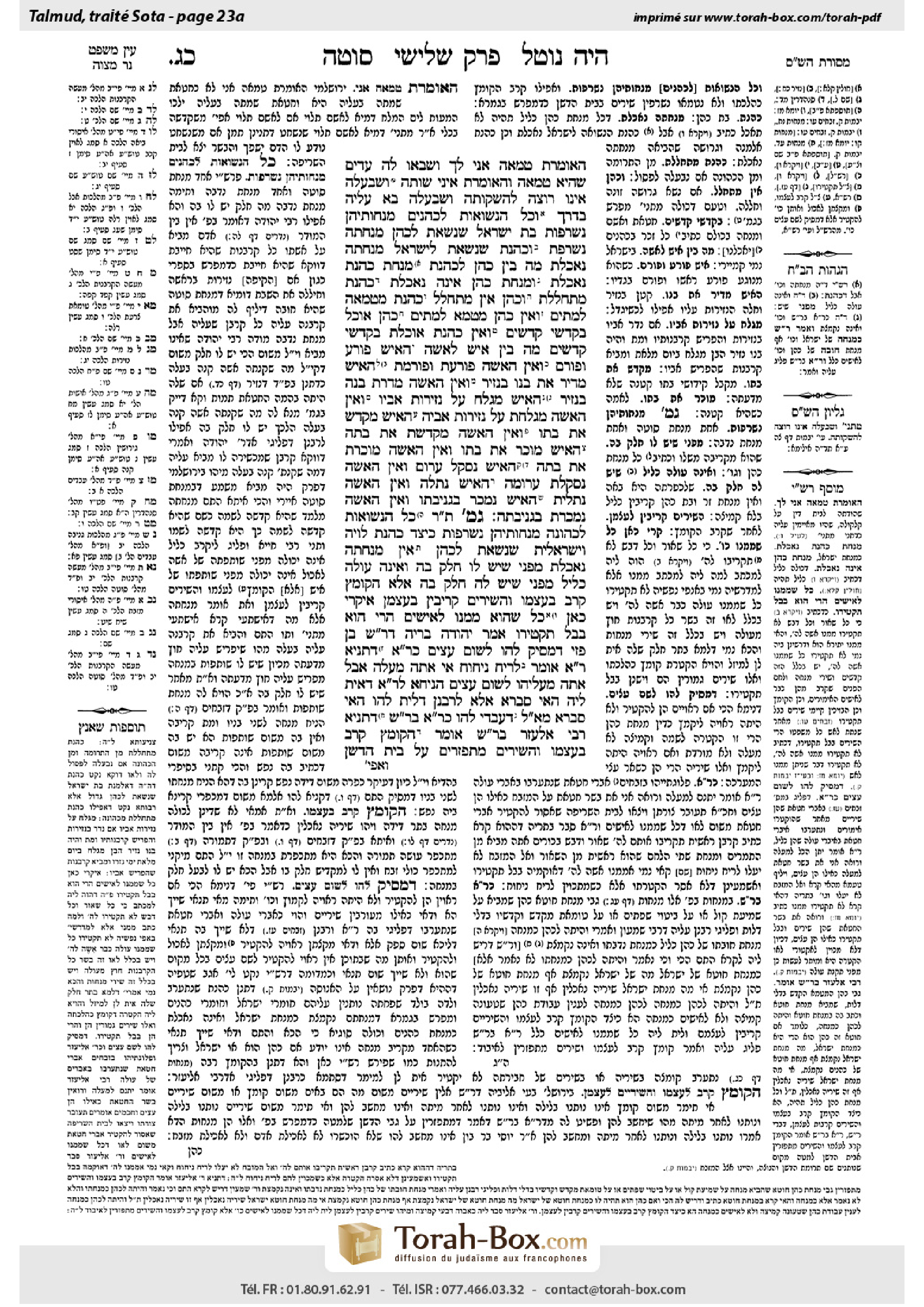
Sotah 23a: Talmud study for Daf Yomi
Daf Yomi is the daily study of one Talmud folio. Explore 37 tractates with scans, Hebrew text, Sefaria English and AI-generated French translations where annotated.
Passage selection and English or AI-generated French translation are available where the scan has annotations. Daf Study is independent of Torah-Box and Sefaria.
Browse Sotah · סוטה · All tractatesSotah 23a text and translations
This page of Sotah includes the Aramaic text, an English translation and an AI-generated French translation, alongside the scan above.
סוטה כ״ג א · Aramaic and Hebrew text
הָאוֹמֶרֶת ״טְמֵאָה אֲנִי לָךְ״, וְשֶׁבָּאוּ לָהּ עֵדִים שֶׁהִיא טְמֵאָה, וְהָאוֹמֶרֶת ״אֵינִי שׁוֹתָה״, וְשֶׁבַּעְלָהּ אֵינוֹ רוֹצֶה לְהַשְׁקוֹתָהּ, וְשֶׁבַּעְלָהּ בָּא עָלֶיהָ בַּדֶּרֶךְ,
וְכׇל הַנְּשׂוּאוֹת לְכֹהֲנִים — מִנְחוֹתֵיהֶן נִשְׂרָפוֹת. בַּת יִשְׂרָאֵל שֶׁנִּשֵּׂאת לְכֹהֵן — מִנְחָתָהּ נִשְׂרֶפֶת, וְכֹהֶנֶת שֶׁנִּשֵּׂאת לְיִשְׂרָאֵל — מִנְחָתָהּ נֶאֱכֶלֶת.
מָה בֵּין כֹּהֵן לְכֹהֶנֶת? מִנְחַת כֹּהֶנֶת נֶאֱכֶלֶת, וּמִנְחַת כֹּהֵן אֵינָהּ נֶאֱכֶלֶת. כֹּהֶנֶת מִתְחַלֶּלֶת, וְכֹהֵן אֵין מִתְחַלֵּל.
כֹּהֶנֶת מִטַּמְּאָה לְמֵתִים, וְאֵין כֹּהֵן מִטַּמֵּא לְמֵתִים. כֹּהֵן אוֹכֵל בְּקׇדְשֵׁי קָדָשִׁים, וְאֵין כֹּהֶנֶת אוֹכֶלֶת בְּקׇדְשֵׁי קֳדָשִׁים.
מָה בֵּין אִישׁ לְאִשָּׁה: הָאִישׁ פּוֹרֵעַ וּפוֹרֵם, וְאֵין הָאִשָּׁה פּוֹרַעַת וּפוֹרֶמֶת. הָאִישׁ מַדִּיר אֶת בְּנוֹ בְּנָזִיר, וְאֵין הָאִשָּׁה מַדֶּרֶת בְּנָהּ בְּנָזִיר. הָאִישׁ מְגַלֵּחַ עַל נְזִירוּת אָבִיו, וְאֵין הָאִשָּׁה מְגַלַּחַת עַל נְזִירוּת אָבִיהָ.
הָאִישׁ מְקַדֵּשׁ אֶת בִּתּוֹ, וְאֵין הָאִשָּׁה מְקַדֶּשֶׁת אֶת בִּתָּהּ. הָאִישׁ מוֹכֵר אֶת בִּתּוֹ, וְאֵין הָאִשָּׁה מוֹכֶרֶת אֶת בִּתָּהּ. הָאִישׁ נִסְקָל עָרוֹם, וְאֵין הָאִשָּׁה נִסְקֶלֶת עֲרוּמָּה. הָאִישׁ נִתְלֶה, וְאֵין הָאִשָּׁה נִתְלֵית. הָאִישׁ נִמְכָּר בִּגְנֵיבָתוֹ, וְאֵין הָאִשָּׁה נִמְכֶּרֶת בִּגְנֵיבָתָהּ.
גְּמָ׳ תָּנוּ רַבָּנַן: כׇּל הַנְּשׂוּאוֹת לַכְּהוּנָּה מִנְחוֹתֵיהֶן נִשְׂרָפוֹת. כֵּיצַד? כֹּהֶנֶת לְוִיָּה וְיִשְׂרְאֵלִית שֶׁנִּשֵּׂאת לְכֹהֵן — אֵין מִנְחָתָהּ נֶאֱכֶלֶת, מִפְּנֵי שֶׁיֵּשׁ לוֹ חֵלֶק בָּהּ. וְאֵינָהּ עוֹלָה כָּלִיל — מִפְּנֵי שֶׁיֵּשׁ לָהּ חֵלֶק בָּהּ. אֶלָּא — הַקּוֹמֶץ קָרֵב בְּעַצְמוֹ, וְהַשִּׁירַיִם קְרֵיבִין בְּעַצְמָן.
אִיקְּרִי כָּאן: כֹּל שֶׁהוּא מִמֶּנּוּ לָאִישִּׁים — הֲרֵי הוּא בְּ״בַל תַּקְטִירוּ״! אָמַר יְהוּדָה בְּרֵיהּ דְּרַבִּי שִׁמְעוֹן בֶּן פַּזִּי: דְּמַסֵּיק לְהוּ לְשׁוּם עֵצִים, כְּרַבִּי אֱלִיעֶזֶר. דְּתַנְיָא, רַבִּי אֱלִיעֶזֶר אוֹמֵר: לְרֵיחַ נִיחוֹחַ אִי אַתָּה מַעֲלֶה, אֲבָל אַתָּה מַעֲלֵיהוּ לְשׁוּם עֵצִים.
הָנִיחָא לְרַבִּי אֱלִיעֶזֶר דְּאִית לֵיהּ הַאי סְבָרָא, אֶלָּא לְרַבָּנַן דְּלֵית לְהוּ הַאי סְבָרָא, מַאי אִיכָּא לְמֵימַר? דְּעָבְדִי לְהוּ כְּרַבִּי אֶלְעָזָר בְּרַבִּי שִׁמְעוֹן. דְּתַנְיָא, רַבִּי אֶלְעָזָר בְּרַבִּי שִׁמְעוֹן אוֹמֵר: הַקּוֹמֶץ קָרֵב בְּעַצְמוֹ, וְהַשִּׁירַיִם מִתְפַּזְּרִים עַל בֵּית הַדֶּשֶׁן.
Sotah 23a · English translation
A woman who confesses and says: I am defiled, and therefore prohibited to you; and a woman with regard to whom witnesses came and testified that she is defiled; and a woman who says: I will not drink the bitter water of a sota, even if she does not confess her guilt; and a woman whose husband changed his mind and does not want to force her to drink; and a woman whose husband engaged in sexual intercourse with her on the way to the Temple.
And all the women who are married to priests, their meal-offerings are always burned, as the verse states: “And every meal-offering of a priest shall be completely burned; it shall not be eaten” (Leviticus 6:16). An Israelite woman who is married to a priest, her meal-offering is burned; and the daughter of a priest who is married to an Israelite, her meal-offering is eaten.
The mishna asks a general question: What are the differences between a priest and the daughter of a priest? The meal-offering of the daughter of a priest is eaten by the priests, but the meal-offering of a priest is not eaten. The daughter of a priest can become disqualified from marrying a priest and from partaking of teruma by engaging in sexual intercourse with someone forbidden to her, but a priest does not become desacralized by engaging in sexual intercourse with a woman forbidden to him.
The daughter of a priest may become impure with impurity imparted by a corpse, but a priest may not become impure with impurity imparted by a corpse except for the burial of his seven closest relatives. A priest may eat from offerings of the most sacred order, but the daughter of a priest may not eat from offerings of the most sacred order.
What are the halakhic differences between a man and a woman? A man lets his hair grow and rends his garments when he is a leper, but a woman does not let her hair grow or rend her garments when she is a leper. A man can vow that his minor son shall be a nazirite, obligating the son to remain a nazirite even during his adulthood, but a woman cannot vow that her son shall be a nazirite. A man can shave at the culmination of his naziriteship by using offerings originally designated for his father’s naziriteship, i.e., if one’s father was also a nazirite and he died having already designated offerings for the culmination of his naziriteship; but a woman cannot shave at the culmination of her naziriteship by using offerings designated for her father’s naziriteship.
A man can betroth his daughter to another man while she is a minor, but a woman cannot betroth her daughter even while she is a minor. A man can sell his daughter as a maidservant while she is a minor, but a woman cannot sell her daughter as a maidservant even while she is a minor. A man is stoned naked, but a woman is not stoned naked. A man is hanged after he is stoned for certain transgressions, but a woman is not hanged. A man is sold for his committing an act of theft in order to pay his debt, but a woman is not sold for her committing an act of theft.
GEMARA: The Sages taught (Tosefta 2:6): All the women who are married into the priesthood, their meal-offerings are burned. How so? With regard to the daughter of a priest, or the daughter of a Levite or an Israelite woman who is married to a priest, her meal-offering is not eaten due to the fact that her father or husband, respectively, has a share in the meal-offering, and it is therefore treated as the meal-offering of a priest, which is not eaten. But it is not completely burned without removing a handful from it, as the Torah states with regard to the meal-offering of a priest, due to the fact that she also has a share in it. Rather, the handful is sacrificed by itself, and the remainder of the meal-offering is sacrificed by itself.
The Gemara asks: One should apply here the principle that in the case of any offering that is meant to be partly burned on the flames of the altar, one who burns the remainder of the offering is subject to the prohibition: Do not burn. This prohibition is derived from the verse: “You shall not burn of it as an offering made by fire unto the Lord” (Leviticus 2:11). Yehuda, son of Rabbi Shimon ben Pazi, said that the priest burns the remainder not as an offering but for the purpose of firewood. This is permitted, in accordance with the opinion of Rabbi Eliezer, as it is taught in a baraita that Rabbi Eliezer says: With regard to those parts of an offering which may not be burned, for a pleasing aroma you may not burn them; however, you may burn them on the altar for the purpose of firewood.
The Gemara continues: This works out well according to the opinion of Rabbi Eliezer, who holds in accordance with this reasoning and permits burning the remainder of an offering as firewood; however, according to the Rabbis, who do not hold in accordance with this reasoning, what can be said? How is the remainder burned on the altar? The Gemara answers: With regard to the remainder, they act in accordance with the opinion of Rabbi Elazar, son of Rabbi Shimon, as it is taught in a baraita: Rabbi Elazar, son of Rabbi Shimon, says with regard to the meal-offering of a sinner who is a priest: The handful is removed from the meal-offering and sacrificed by itself, and the remainder is neither eaten nor burned on the altar; rather, it is scattered on the place of the ashes.
Sotah 23a · Traduction française (IA)
Une femme qui avoue et dit : « Je suis impure, et je suis donc interdite à vous » ; une femme à l'égard de laquelle des témoins sont venus et ont témoigné qu'elle est impure ; une femme qui dit : « Je ne boirai pas l'eau amère de la sota », même si elle n'avoue pas sa culpabilité ; une femme dont le mari a changé d'avis et ne veut pas la contraindre à boire ; et une femme dont le mari a eu des rapports sexuels avec elle en chemin vers le Temple.
Et toutes les femmes mariées à des prêtres, leurs offrandes de farine sont toujours brûlées, comme l'écrit le verset : « Et toute offrande de farine d'un prêtre sera entièrement brûlée ; elle ne sera pas mangée » (Lévitique 6:16). Une femme israélite mariée à un prêtre, son offrande de farine est brûlée ; et la fille d'un prêtre mariée à un Israélite, son offrande de farine est mangée.
La Michna pose une question générale : Quelles sont les différences entre un prêtre et la fille d'un prêtre ? L'offrande de farine de la fille d'un prêtre est mangée par les prêtres, mais l'offrande de farine d'un prêtre n'est pas mangée. La fille d'un prêtre peut être disqualifiée pour épouser un prêtre et pour consommer la terouma en ayant des rapports sexuels avec une personne qui lui est interdite, mais un prêtre ne perd pas son statut sacré en ayant des rapports sexuels avec une femme qui lui est interdite.
La fille d'un Cohen peut contracter l'impureté transmise par un cadavre, mais un Cohen ne peut contracter l'impureté transmise par un cadavre que pour l'enterrement de ses sept plus proches parents. Un Cohen peut manger des offrandes de l'ordre le plus sacré, mais la fille d'un Cohen ne peut pas manger des offrandes de l'ordre le plus sacré.
Quelles sont les différences halakhiques entre un homme et une femme ? Un homme laisse pousser ses cheveux et déchire ses vêtements lorsqu'il est lépreux, mais une femme ne laisse pas pousser ses cheveux ni ne déchire ses vêtements lorsqu'elle est lépreuse. Un homme peut faire vœu que son fils mineur soit nazaré, obligeant le fils à rester nazaré même pendant son âge adulte, mais une femme ne peut pas faire vœu que son fils soit nazaré. Un homme peut se raser à la fin de son nazaréat en utilisant des offrandes initialement désignées pour le nazaréat de son père, c'est-à-dire si son père était également nazaré et qu'il est mort en ayant déjà désigné des offrandes pour la fin de son nazaréat ; mais une femme ne peut pas se raser à la fin de son nazaréat en utilisant des offrandes désignées pour le nazaréat de son père.
Un homme peut fiancer sa fille à un autre homme alors qu'elle est mineure, mais une femme ne peut pas fiancer sa fille même alors qu'elle est mineure. Un homme peut vendre sa fille comme servante alors qu'elle est mineure, mais une femme ne peut pas vendre sa fille comme servante même alors qu'elle est mineure. Un homme est lapidé nu, mais une femme n'est pas lapidée nue. Un homme est pendu après avoir été lapidé pour certaines transgressions, mais une femme n'est pas pendue. Un homme est vendu pour avoir commis un acte de vol afin de payer sa dette, mais une femme n'est pas vendue pour avoir commis un acte de vol.
Guemara : Les Sages ont enseigné (Tosefta 2:6) : Toutes les femmes qui sont mariées dans le sacerdoce, leurs offrandes de farine sont brûlées. Comment cela se passe-t-il ? S'agissant de la fille d'un prêtre, ou de la fille d'un Lévite ou d'une femme israélite mariée à un prêtre, son offrande de farine n'est pas mangée en raison du fait que son père ou son mari, respectivement, a une part dans l'offrande de farine, et elle est donc traitée comme l'offrande de farine d'un prêtre, qui n'est pas mangée. Mais elle n'est pas entièrement brûlée sans en retirer une poignée, comme l'écrit la Torah à propos de l'offrande de farine d'un prêtre, en raison du fait qu'elle a également une part dans celle-ci. Plutôt, la poignée est sacrifiée par elle-même, et le reste de l'offrande de farine est sacrifié par lui-même.
La Guemara demande : On devrait appliquer ici le principe que dans le cas de toute offrande qui est destinée à être partiellement brûlée sur les flammes de l'autel, celui qui brûle le reste de l'offrande est soumis à l'interdiction : Ne brûle pas. Cette interdiction est dérivée du verset : « Tu ne brûleras pas de cela comme offrande consumée par le feu pour l'Éternel » (Lévitique 2:11). Yehuda, fils de Rabbi Shimon ben Pazi, a dit que le prêtre brûle le reste non pas comme offrande, mais dans le but de bois de chauffage. Cela est permis, conformément à l'opinion de Rabbi Eliezer, comme il est enseigné dans une baraïta que Rabbi Eliezer dit : S'agissant de ces parties d'une offrande qui ne peuvent pas être brûlées, pour un agréable parfum vous ne pouvez pas les brûler ; cependant, vous pouvez les brûler sur l'autel dans le but de bois de chauffage.
La Guemara poursuit : Cela se concilie bien avec l'opinion de Rabbi Eliezer, qui adopte ce raisonnement et autorise à brûler le reste d'une offrande comme bois de chauffage ; mais, selon les Rabbins, qui n'adoptent pas ce raisonnement, que peut-on dire ? Comment le reste est-il brûlé sur l'autel ? La Guemara répond : S'agissant du reste, ils suivent l'opinion de Rabbi Elazar, fils de Rabbi Shimon, comme l'enseigne une baraïta : Rabbi Elazar, fils de Rabbi Shimon, dit au sujet de l'offrande de farine d'un pécheur qui est prêtre : La poignée est retirée de l'offrande de farine et sacrifiée à part, et le reste n'est ni mangé ni brûlé sur l'autel ; il est plutôt dispersé sur le lieu des cendres.
Traduction française générée par IA à partir de l’édition anglaise de Sefaria. Vérifie toujours un passage avec le texte source.
Text from Sefaria: William Davidson Edition - Vocalized Aramaic (CC BY NC); William Davidson Edition - English (CC BY NC).