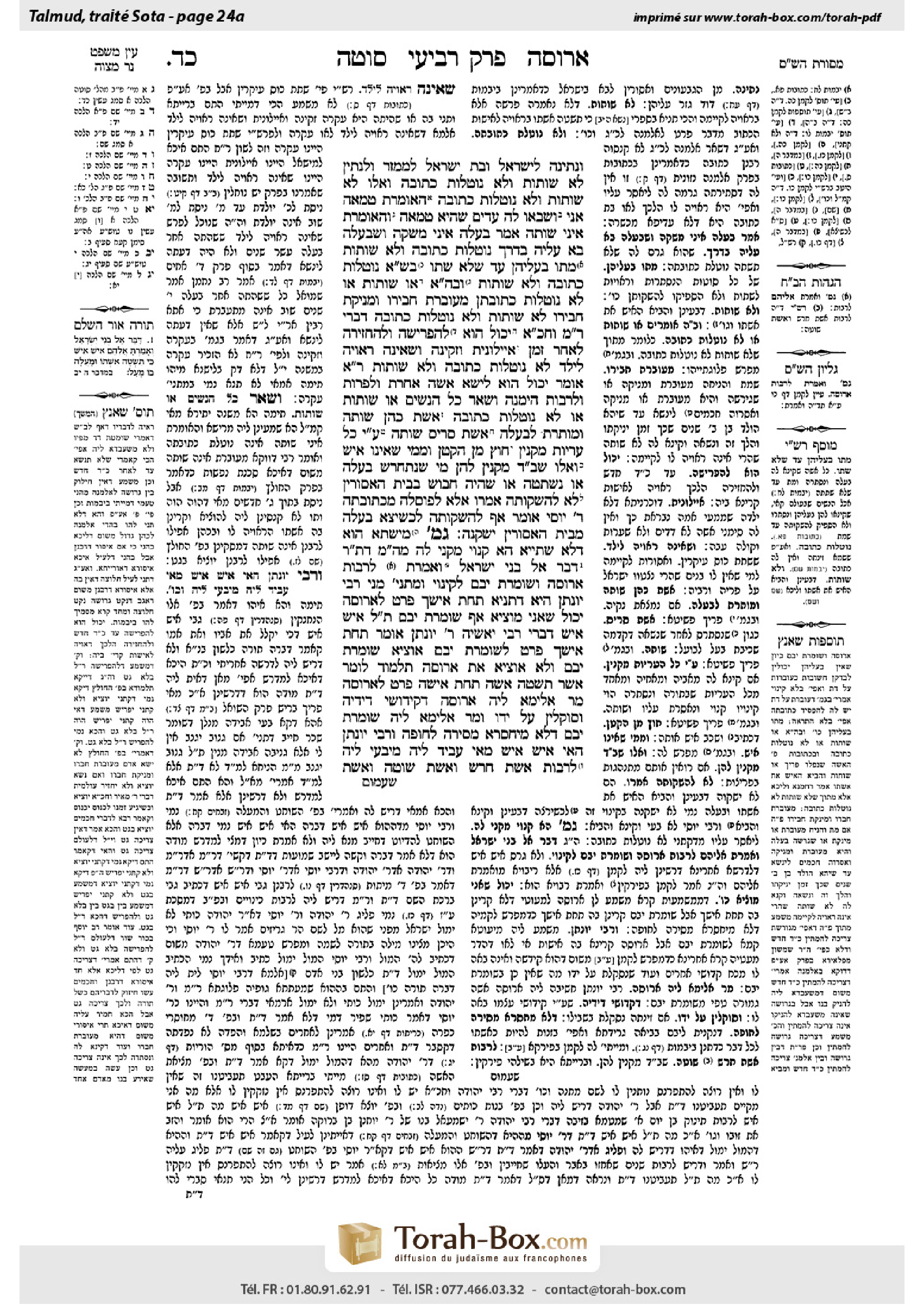
Sotah 24a: Talmud study for Daf Yomi
Daf Yomi is the daily study of one Talmud folio. Explore 37 tractates with scans, Hebrew text, Sefaria English and AI-generated French translations where annotated.
Passage selection and English or AI-generated French translation are available where the scan has annotations. Daf Study is independent of Torah-Box and Sefaria.
Browse Sotah · סוטה · All tractatesSotah 24a text and translations
This page of Sotah includes the Aramaic text, an English translation and an AI-generated French translation, alongside the scan above.
סוטה כ״ד א · Aramaic and Hebrew text
וּנְתִינָה לְיִשְׂרָאֵל, וּבַת יִשְׂרָאֵל לְמַמְזֵר וּלְנָתִין — לֹא שׁוֹתוֹת וְלֹא נוֹטְלוֹת כְּתוּבָה.
וְאֵלּוּ לֹא שׁוֹתוֹת וְלֹא נוֹטְלוֹת כְּתוּבָה: הָאוֹמֶרֶת ״טְמֵאָה אֲנִי״, וְשֶׁבָּאוּ לָהּ עֵדִים שֶׁהִיא טְמֵאָה, וְהָאוֹמֶרֶת ״אֵינִי שׁוֹתָה״.
אָמַר בַּעְלָהּ ״אֵינִי מַשְׁקָהּ״, וְשֶׁבַּעְלָהּ בָּא עָלֶיהָ בַּדֶּרֶךְ — נוֹטְלוֹת כְּתוּבָּה וְלֹא שׁוֹתוֹת.
מֵתוּ בַּעְלֵיהֶן עַד שֶׁלֹּא שָׁתוּ, בֵּית שַׁמַּאי אוֹמְרִים: נוֹטְלוֹת כְּתוּבָּה וְלֹא שׁוֹתוֹת, וּבֵית הִלֵּל אוֹמְרִים: אוֹ שׁוֹתוֹת אוֹ לֹא נוֹטְלוֹת כְּתוּבָּתָן.
מְעוּבֶּרֶת חֲבֵירוֹ וּמְנִיקַת חֲבֵירוֹ — לֹא שׁוֹתוֹת וְלֹא נוֹטְלוֹת כְּתוּבָּה, דִּבְרֵי רַבִּי מֵאִיר. וַחֲכָמִים אוֹמְרִים: יָכוֹל הוּא לְהַפְרִישָׁהּ וּלְהַחְזִירָהּ לְאַחַר זְמַן.
אַיְילוֹנִית וּזְקֵינָה, וְשֶׁאֵינָהּ רְאוּיָה לֵילֵד — לֹא נוֹטְלוֹת כְּתוּבָּה וְלֹא שׁוֹתוֹת. רַבִּי אֶלְעָזָר אוֹמֵר: יָכוֹל הוּא לִישָּׂא אִשָּׁה אַחֶרֶת וְלִפְרוֹת וְלִרְבּוֹת הֵימֶנָּה.
וּשְׁאָר כׇּל הַנָּשִׁים — אוֹ שׁוֹתוֹת אוֹ לֹא נוֹטְלוֹת כְּתוּבָּה. אֵשֶׁת כֹּהֵן שׁוֹתָה — וּמוּתֶּרֶת לְבַעְלָהּ. אֵשֶׁת סָרִיס שׁוֹתָה.
עַל יְדֵי כׇּל עֲרָיוֹת מְקַנִּין, חוּץ מִן הַקָּטָן וּמִמִּי שֶׁאֵינוֹ אִישׁ.
וְאֵלּוּ שֶׁבֵּית דִּין מְקַנִּין לָהֶן: מִי שֶׁנִּתְחָרֵשׁ בַּעְלָהּ, אוֹ נִשְׁתַּטָּה, אוֹ שֶׁהָיָה חָבוּשׁ בְּבֵית הָאֲסוּרִין. לֹא לְהַשְׁקוֹתָהּ אָמְרוּ, אֶלָּא לְפוֹסְלָהּ מִכְּתוּבָּתָהּ. רַבִּי יוֹסֵי אוֹמֵר: אַף לְהַשְׁקוֹתָהּ. לִכְשֶׁיֵּצֵא בַּעְלָהּ מִבֵּית הָאֲסוּרִין יַשְׁקֶנָּה.
גְּמָ׳ מִישְׁתָּא הוּא דְּלָא שָׁתְיָיא, הָא קַנּוֹיֵ[י] מְקַנֵּי לַהּ: מְנָא הָנֵי מִילֵּי? דְּתָנוּ רַבָּנַן: ״דַּבֵּר אֶל בְּנֵי יִשְׂרָאֵל וְאָמַרְתָּ״ — לְרַבּוֹת אֲרוּסָה וְשׁוֹמֶרֶת יָבָם לְקִינּוּי.
וּמַתְנִיתִין מַנִּי — רַבִּי יוֹנָתָן הִיא. דְּתַנְיָא: ״תַּחַת אִישֵׁךְ״, פְּרָט לַאֲרוּסָה. יָכוֹל שֶׁאֲנִי מוֹצִיא אַף שׁוֹמֶרֶת יָבָם, תַּלְמוּד לוֹמַר: ״אִישׁ אִישׁ״, דִּבְרֵי רַבִּי יֹאשִׁיָּה.
רַבִּי יוֹנָתָן אוֹמֵר: ״תַּחַת אִישֵׁךְ״ — פְּרָט לְשׁוֹמֶרֶת יָבָם. אוֹצִיא שׁוֹמֶרֶת יָבָם וְלֹא אוֹצִיא אֶת אֲרוּסָה, תַּלְמוּד לוֹמַר: ״אֲשֶׁר תִּשְׂטֶה אִשָּׁה תַּחַת אִישָׁהּ״ — פְּרָט לַאֲרוּסָה.
מָר אַלִּימָא לֵיהּ אֲרוּסָה, דְּקִידּוּשֵׁי דִּידֵיהּ, וְסוֹקְלִין עַל יָדוֹ.
וּמָר אַלִּימָא לֵיהּ שׁוֹמֶרֶת יָבָם, דְּלָא מְיחַסְּרָא מְסִירָה לְחוּפָּה.
וְרַבִּי יוֹנָתָן, הַאי ״אִישׁ אִישׁ״ מַאי עָבֵיד לֵיהּ? מִיבְּעֵי לֵיהּ לְרַבּוֹת אֵשֶׁת חֵרֵשׁ, וְאֵשֶׁת שׁוֹטֶה, וְאֵשֶׁת
Sotah 24a · English translation
or Gibeonite woman who was married to a Jew of unflawed lineage, or a Jewish woman of unflawed lineage who was married to a mamzer or a Gibeonite, all of these women neither drink the bitter water nor collect payment of their marriage contracts, as the sota ritual applies only to permitted marriages.
And the following women neither drink the bitter water nor collect payment of their marriage contracts: A woman who confesses and says: I am defiled, and a woman with regard to whom witnesses came and testified that she is defiled, and a woman who says: I will not drink the bitter water, even if she does not confess her guilt.
However, a woman whose husband said: I will not have her drink, and a woman whose husband engaged in sexual intercourse with her on the way to the Temple, collect payment of their marriage contracts even though they do not drink the bitter water, as it is due to the husbands that they do not drink.
If the husbands of sota women died before their wives drank the bitter water, Beit Shammai say: They collect payment of their marriage contracts and they do not drink the bitter water. And Beit Hillel say: They either drink the bitter water or they do not collect payment of their marriage contracts.
A woman who was pregnant with the child of another man at the time of her marriage and a woman who was nursing the child of another man at the time of her marriage neither drink the bitter water nor collect payment of their marriage contracts. This is because by rabbinic law they may not marry for twenty-four months after the baby’s birth, and therefore these also constitute prohibited marriages. This is the statement of Rabbi Meir. And the Rabbis say: He can separate from her, and remarry her after the time of twenty-four months has elapsed, and therefore these are considered permitted marriages, and the women can drink the bitter water.
A sexually underdeveloped woman who is incapable of bearing children [ailonit], and an elderly woman, and a woman who is incapable of giving birth for other reasons, neither collect payment of their marriage contracts nor drink the bitter water, as marrying a woman who cannot give birth constitutes a violation of the mitzva to be fruitful and multiply. Rabbi Elazar says: He can marry another woman and procreate through her; therefore, these are considered permitted marriages, and women in these categories can drink the bitter water.
And all other women either drink the bitter water or do not collect payment of their marriage contracts. The wife of a priest drinks, and if she is found to be innocent of adultery, she is permitted to her husband. The wife of a eunuch also drinks.
A husband can issue a warning to his wife forbidding her to seclude herself with any man, even with regard to all those men with whom relations are forbidden, e.g., her father or brother, with the exception of a minor and of one who is not a man, i.e., in a situation where a man suspects his wife of bestiality.
And these are the women to whom the court issues a warning in place of their husbands: One whose husband became a deaf-mute or became an imbecile, or was incarcerated in prison. The Sages said that the court warns her not in order to have her drink the bitter water if she disobeys the warning, but in order to disqualify her from receiving payment of her marriage contract. Rabbi Yosei says: The court’s warning also serves to have her drink, and when her husband is released from prison he has her drink.
GEMARA: The mishna states that a betrothed woman and a widow awaiting her yavam do not drink the bitter water. The Gemara infers: She does not drink, but the husband or yavam can warn her against secluding herself with another man, and if she violates his warning, she is forbidden to him. The Gemara asks: From where are these matters derived? The Gemara answers: This is derived as the Sages taught with regard to the verse: “Speak to the children of Israel and say unto them: If the wife of any man goes astray, and acts unfaithfully against him” (Numbers 5:12). The superfluous phrase “and say unto them” is an amplification, and serves to include a betrothed woman and a widow awaiting her yavam in the halakhot of warning.
And whose opinion is expressed in the mishna? It is the opinion of Rabbi Yonatan, as it is taught in a baraita with regard to the verse: “And the priest shall cause her to swear, and shall say to the woman: If no man has lain with you, and if you have not gone aside to defilement while under your husband” (Numbers 5:19). This excludes a betrothed woman, who does not yet live with her betrothed, from the ritual of the bitter water. One might have thought that I exclude even a widow awaiting her yavam; therefore, the verse states: “If the wife of any man goes astray” (Numbers 5:12). The term “any man” serves to include a widow awaiting her yavam in the ritual of the bitter water. This is the statement of Rabbi Yoshiya.
Rabbi Yonatan says: The phrase “while under your husband” excludes a widow awaiting her yavam from drinking the bitter water. Lest one would say that I will exclude a widow awaiting her yavam but I will not exclude a betrothed woman, the verse therefore states: “This is the law of jealousy, when a wife, while under her husband, goes astray, and is defiled” (Numbers 5:29). The term “while under her husband” excludes a betrothed woman from drinking the bitter water.
The Gemara explains the dispute: One Sage, Rabbi Yonatan, holds that the bond with the betrothed woman is stronger, as it is his own betrothal, whereas in the case of a widow awaiting her yavam, the bond stems from his brother’s betrothal. And furthermore, if the betrothed woman commits adultery, she is stoned due to her bond with him, whereas a widow awaiting her yavam who engages in sexual intercourse with another man is liable only to receive lashes. Since the bond with the betrothed woman is stronger, Rabbi Yonatan derives from the phrase “while under your husband” that a widow awaiting her yavam is excluded with respect to the bitter water, whereas a betrothed woman is excluded only because of the phrase “and say unto them.”
And one Sage, Rabbi Yoshiya, holds that the bond with the widow awaiting her yavam is stronger, as she is not lacking entry into the wedding canopy, as her marriage to the yavam is completed through sexual intercourse alone. Rabbi Yoshiya therefore excludes only a betrothed woman from drinking the bitter water.
The Gemara asks: And Rabbi Yonatan, who excludes both a betrothed woman and a widow awaiting her yavam from drinking the bitter water, what does he do with this term “any man”? What does it serve to include? The Gemara answers: Rabbi Yonatan requires it in order to include the wife of a deaf-mute and the wife of an imbecile, and the wife of
Sotah 24a · Traduction française (IA)
ou une femme guibonite mariée à un Juif de filiation irréprochable, ou une femme juive de filiation irréprochable mariée à un mamzer ou à un Guibonite : toutes ces femmes ne boivent pas les eaux amères et ne perçoivent pas le montant de leur contrat de mariage, car le rituel de la sota ne s’applique qu’aux unions autorisées.
Et les femmes suivantes ne boivent pas les eaux amères et ne perçoivent pas le montant de leur contrat de mariage : une femme qui avoue et dit : « Je suis souillée » ; une femme au sujet de laquelle des témoins sont venus attester qu’elle est souillée ; et une femme qui dit : « Je ne boirai pas les eaux amères », même si elle n’avoue pas sa faute.
Cependant, une femme dont le mari a dit : « Je ne la ferai pas boire », et une femme avec laquelle son mari a eu des rapports sexuels en chemin vers le Temple perçoivent le montant de leur contrat de mariage, bien qu’elles ne boivent pas les eaux amères, car c’est à cause de leurs maris qu’elles ne boivent pas.
Si les maris de femmes sota meurent avant que leurs épouses ne boivent les eaux amères, Beit Chammaï disent : elles perçoivent le montant de leur contrat de mariage et ne boivent pas les eaux amères. Beit Hillel disent : elles boivent les eaux amères ou ne perçoivent pas le montant de leur contrat de mariage.
Une femme qui était enceinte de l’enfant d’un autre homme au moment de son mariage et une femme qui allaitait l’enfant d’un autre homme au moment de son mariage ne boivent pas les eaux amères et ne perçoivent pas le montant de leur contrat de mariage. En effet, selon la loi rabbinique, elles ne peuvent pas se marier pendant les vingt-quatre mois suivant la naissance du bébé ; ces unions sont donc également interdites. Telle est l’opinion de Rabbi Meïr. Les Sages disent : il peut se séparer d’elle puis l’épouser de nouveau après l’écoulement de la période de vingt-quatre mois ; ces unions sont donc considérées comme autorisées, et ces femmes peuvent boire les eaux amères.
Une femme sexuellement sous-développée, incapable d’avoir des enfants [ailonit], une femme âgée et une femme incapable d’accoucher pour d’autres raisons ne perçoivent pas le montant de leur contrat de mariage et ne boivent pas les eaux amères, car épouser une femme qui ne peut pas avoir d’enfants constitue une transgression de la mitsva de procréer et de se multiplier. Rabbi Elazar dit : il peut épouser une autre femme et procréer par son intermédiaire ; ces unions sont donc considérées comme autorisées, et les femmes de ces catégories peuvent boire les eaux amères.
Et toutes les autres femmes boivent les eaux amères ou ne perçoivent pas le montant de leur contrat de mariage. L’épouse d’un prêtre boit et, s’il est établi qu’elle est innocente d’adultère, elle peut rester avec son mari. L’épouse d’un eunuque boit également.
Un mari peut avertir son épouse de ne pas s’isoler avec un homme, y compris avec ceux avec lesquels les relations sont interdites, par exemple son père ou son frère, à l’exception d’un mineur et d’un être qui n’est pas un homme, c’est-à-dire dans le cas où un homme soupçonne son épouse de bestialité.
Et voici les femmes auxquelles le tribunal adresse un avertissement à la place de leurs maris : celle dont le mari est devenu sourd-muet ou a perdu la raison, ou a été incarcéré. Les Sages disent que le tribunal l’avertit non pas afin qu’elle boive les eaux amères si elle enfreint l’avertissement, mais afin de la priver du montant de son contrat de mariage. Rabbi Yossé dit : l’avertissement du tribunal sert aussi à la faire boire et, lorsque son mari est libéré de prison, il la fait boire.
GUEMARA : La Michna dit qu’une femme fiancée et une veuve attendant son yavam ne boivent pas les eaux amères. La Guemara en déduit qu’elles ne boivent pas, mais que le mari ou le yavam peut les avertir de ne pas s’isoler avec un autre homme et que, si elles enfreignent cet avertissement, elles lui sont interdites. La Guemara demande : De quoi ces règles sont-elles déduites ? La Guemara répond : elles sont déduites de ce que les Sages ont enseigné au sujet du verset : « Parle aux enfants d’Israël et dis-leur : Si la femme de quelqu’un s’égare et lui devient infidèle » (Nombres 5:12). L’expression superflue « et dis-leur » constitue une amplification et sert à inclure une femme fiancée et une veuve attendant son yavam dans les halakhot de l’avertissement.
Et quelle opinion la Michna exprime-t-elle ? Celle de Rabbi Yonatan, comme il est enseigné dans une baraïta au sujet du verset : « Le prêtre la fera jurer et dira à la femme : Si aucun homme n’a couché avec toi et si tu ne t’es pas détournée vers la souillure alors que tu étais sous ton mari » (Nombres 5:19). Cela exclut du rituel des eaux amères une femme fiancée, qui ne vit pas encore avec son fiancé. On aurait pu penser que j’exclus également une veuve attendant son yavam ; le verset dit donc : « Si la femme de quelqu’un s’égare » (Nombres 5:12). L’expression « quelqu’un » sert à inclure une veuve attendant son yavam dans le rituel des eaux amères. Telle est l’opinion de Rabbi Yoshiya.
Rabbi Yonatan dit : l’expression « alors que tu étais sous ton mari » exclut une veuve attendant son yavam du droit de boire les eaux amères. Pour éviter de dire que j’exclus une veuve attendant son yavam, mais pas une femme fiancée, le verset dit : « Telle est la loi de la jalousie, lorsqu’une femme, alors qu’elle est sous son mari, s’égare et est souillée » (Nombres 5:29). L’expression « alors qu’elle est sous son mari » exclut une femme fiancée du droit de boire les eaux amères.
La Guemara explique le désaccord : un Sage, Rabbi Yonatan, considère que le lien avec la femme fiancée est plus fort, puisqu’il s’agit de ses propres fiançailles, tandis que, dans le cas d’une veuve attendant son yavam, le lien découle des fiançailles de son frère. En outre, si la femme fiancée commet un adultère, elle est lapidée en raison de son lien avec lui, tandis qu’une veuve attendant son yavam qui a des rapports sexuels avec un autre homme n’est passible que de flagellation. Puisque le lien avec la femme fiancée est plus fort, Rabbi Yonatan déduit de l’expression « alors que tu étais sous ton mari » que la veuve attendant son yavam est exclue du rituel des eaux amères, tandis que la femme fiancée n’en est exclue qu’en vertu de l’expression « et dis-leur ».
Et un Sage, Rabbi Yoshiya, considère que le lien avec la veuve attendant son yavam est plus fort, car il ne lui manque pas l’entrée sous le dais nuptial : son mariage avec le yavam est achevé par le seul rapport sexuel. Rabbi Yoshiya n’exclut donc du droit de boire les eaux amères que la femme fiancée.
La Guemara demande : Et Rabbi Yonatan, qui exclut du droit de boire les eaux amères aussi bien une femme fiancée qu’une veuve attendant son yavam, que fait-il de l’expression « quelqu’un » ? Qu’inclut-elle ? La Guemara répond : Rabbi Yonatan en a besoin pour inclure l’épouse d’un sourd-muet, l’épouse d’un homme qui a perdu la raison, et l’épouse de
Traduction française générée par IA à partir de l’édition anglaise de Sefaria. Vérifie toujours un passage avec le texte source.
Text from Sefaria: William Davidson Edition - Vocalized Aramaic (CC BY NC); William Davidson Edition - English (CC BY NC).