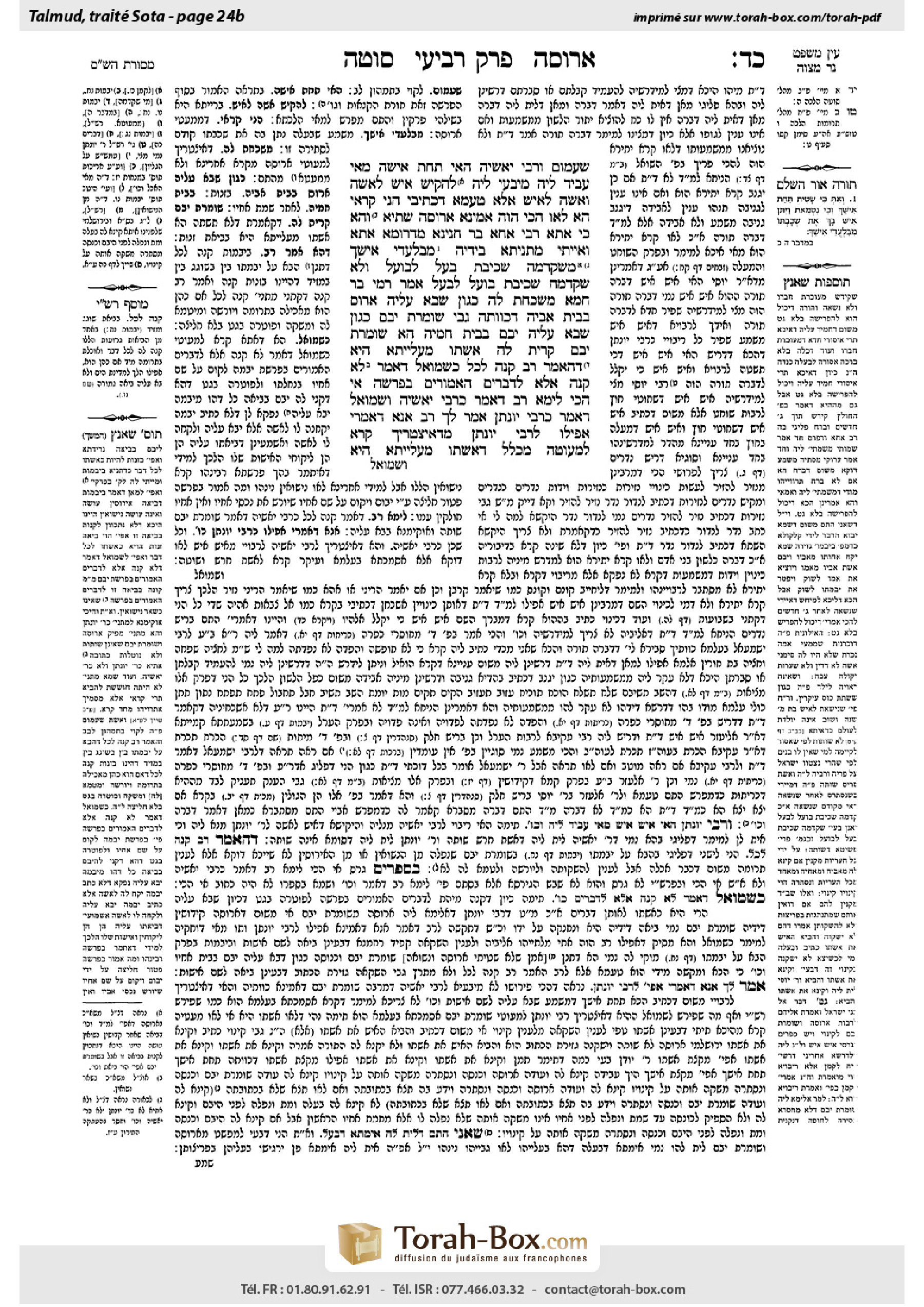
Sotah 24b: Talmud study for Daf Yomi
Daf Yomi is the daily study of one Talmud folio. Explore 37 tractates with scans, Hebrew text, Sefaria English and AI-generated French translations where annotated.
Passage selection and English or AI-generated French translation are available where the scan has annotations. Daf Study is independent of Torah-Box and Sefaria.
Browse Sotah · סוטה · All tractatesSotah 24b text and translations
This page of Sotah includes the Aramaic text, an English translation and an AI-generated French translation, alongside the scan above.
סוטה כ״ד ב · Aramaic and Hebrew text
שַׁעֲמוּם. וְרַבִּי יֹאשִׁיָּה, הַאי ״תַּחַת אִישָׁהּ״ מַאי עָבֵיד לֵיהּ? מִיבְּעֵי לֵיהּ לְהַקִּישׁ אִישׁ לְאִשָּׁה וְאִשָּׁה לְאִישׁ.
אֶלָּא, טַעְמָא דִּכְתִיבִי הָנֵי קְרָאֵי, הָא לָאו הָכִי, הֲוָה אָמֵינָא אֲרוּסָה שָׁתְיָא? וְהָא כִּי אֲתָא רַבִּי אַחָא בַּר חֲנִינָא מִדָּרוֹמָא, אֲתָא וְאַיְיתִי מַתְנִיתָא בִּידֵיהּ: ״מִבַּלְעֲדֵי אִישֵׁךְ״, מִשֶּׁקָּדְמָה שְׁכִיבַת בַּעַל לַבּוֹעֵל, וְלֹא שֶׁקָּדְמָה שְׁכִיבַת בּוֹעֵל לַבַּעַל.
אָמַר רָמֵי בַּר חָמָא: מַשְׁכַּחַתְּ לַהּ — כְּגוֹן שֶׁבָּא עָלֶיהָ אָרוּס בְּבֵית אָבִיהָ.
דִּכְווֹתַהּ גַּבֵּי שׁוֹמֶרֶת יָבָם — כְּגוֹן שֶׁבָּא עָלֶיהָ יָבָם בְּבֵית חָמִיהָ. הָא שׁוֹמֶרֶת יָבָם קָרֵית לַהּ? אִשְׁתּוֹ מְעַלַּיְיתָא הִיא, דְּהָאָמַר רַב: קָנָה לַכֹּל!
כִּשְׁמוּאֵל, דְּאָמַר: לֹא קָנָה אֶלָּא לִדְבָרִים הָאֲמוּרִים בַּפָּרָשָׁה.
אִי הָכִי, לֵימָא רַב דְּאָמַר כְּרַבִּי יֹאשִׁיָּה וּשְׁמוּאֵל דְּאָמַר כְּרַבִּי יוֹנָתָן? אָמַר לָךְ רַב: אֲנָא דַּאֲמַרִי — אֲפִילּוּ לְרַבִּי יוֹנָתָן. מִדְּאִיצְטְרִיךְ קְרָא לְמַעוֹטַהּ — מִכְּלַל דְּאִשְׁתּוֹ מְעַלַּיְיתָא הִיא.
Sotah 24b · English translation
a mentally ill person [shiamum], whom the court warns on behalf of the husband. The Gemara asks: And according to Rabbi Yoshiya, what does he do with this term “while under her husband”? The Gemara answers: Rabbi Yoshiya requires it in order to compare a man to a woman and a woman to a man, as explained later (27a).
The Gemara asks: But according to both opinions, the reason for the exclusion of a betrothed woman is that these verses are written; if it were not so, I would say that a betrothed woman drinks. But when Rabbi Aḥa bar Ḥanina came from the South, he came and brought the following baraita with him: The verse states: “But if you have gone astray while under your husband, and if you are defiled, and some man has lain with you besides your husband” (Numbers 5:20). This indicates that the halakhot of a sota apply only when sexual intercourse with the husband preceded sexual intercourse with the paramour, and not in a case when sexual intercourse with the paramour preceded intercourse with the husband. In the case of a betrothed woman who committed adultery, intercourse with the paramour preceded intercourse with the betrothed, and this verse excludes her from drinking the bitter water of the sota.
Rami bar Ḥama said: You find the necessity for an additional exclusion in a case where her betrothed engaged in sexual intercourse with her in her father’s house, i.e., before they were married, and before the sexual intercourse with the paramour.
The Gemara questions this explanation: In the corresponding situation with regard to a widow awaiting her yavam, whom Rabbi Yonatan excludes from the sota ritual due to the exclusion from the phrase “while under your husband,” is the necessity for this exclusion due to a case where the yavam engaged in sexual intercourse with her in her father-in-law’s house before the levirate marriage took place? But do you call that woman a widow awaiting her yavam? She is his full-fledged wife, as didn’t Rav say: If a widow awaiting her yavam engaged in sexual intercourse with her yavam, even without the intention of implementing a levirate marriage, he has acquired her as his wife with respect to all aspects of marriage, including the halakhot of a sota.
The Gemara answers: Rabbi Yonatan’s opinion is in accordance with the opinion of Shmuel, as Shmuel says: A yavam who engages in sexual intercourse with his yevama without intending to consummate the levirate marriage does not acquire her as his wife except with regard to those matters that are stated in the passage in the Torah that deals with levirate marriage, i.e., that he inherits his brother’s estate, and he can free the widow with a bill of divorce without ḥalitza (see Yevamot 56a). He is not considered fully married to the woman, and, according to Rabbi Yonatan, the halakhot of a sota do not apply to her.
The Gemara asks: If so, let us say that Rav stated his opinion in accordance with the opinion of Rabbi Yoshiya, and Shmuel stated his opinion in accordance with the opinion of Rabbi Yonatan. The Gemara rejects this interpretation: Rav could have said to you: I state my opinion even according to the opinion of Rabbi Yonatan. Since it was necessary for the verse to exclude a yevama who engaged in sexual intercourse with her yavam from the sota ritual, by inference one may derive that she is his full-fledged wife with regard to all other matters.
Sotah 24b · Traduction française (IA)
une personne atteinte de troubles mentaux [shiamum], que le tribunal met en garde au nom du mari. La Guemara demande : Et, selon Rabbi Yoshiya, que fait-il de l’expression « alors qu’elle est sous l’autorité de son mari » ? La Guemara répond : Rabbi Yoshiya en a besoin pour établir une comparaison entre l’homme et la femme, et entre la femme et l’homme, comme cela sera expliqué plus loin (27a).
La Guemara demande : Mais, selon les deux opinions, la femme fiancée n’est exclue que parce que ces versets sont écrits ; sinon, j’aurais dit qu’une femme fiancée boit. Or, lorsque Rabbi Aḥa bar Ḥanina revint du Sud, il rapporta avec lui la baraïta suivante : Le verset dit : « Mais si tu t’es égarée alors que tu étais sous l’autorité de ton mari, si tu t’es souillée et si un homme a couché avec toi, en dehors de ton mari » (Nombres 5:20). Cela indique que les halakhot de la sota ne s’appliquent que lorsque les relations sexuelles avec le mari ont précédé celles avec l’amant, et non lorsque les relations sexuelles avec l’amant ont précédé celles avec le mari. Dans le cas d’une femme fiancée qui a commis l’adultère, les relations sexuelles avec l’amant ont précédé celles avec son fiancé ; ce verset l’exclut donc de la consommation de l’eau amère de la sota.
Rami bar Ḥama dit : La nécessité d’une exclusion supplémentaire apparaît dans le cas où son fiancé a eu des relations sexuelles avec elle dans la maison de son père, c’est-à-dire avant leur mariage et avant qu’elle ait eu des relations sexuelles avec l’amant.
La Guemara conteste cette explication : Dans le cas correspondant d’une veuve en attente de yiboum, que Rabbi Yonatan exclut du rituel de la sota en s’appuyant sur l’exclusion tirée de l’expression « alors que tu es sous l’autorité de ton mari », cette exclusion est-elle nécessaire dans le cas où le yavam a eu des relations sexuelles avec elle dans la maison de son beau-père, avant le mariage léviratique ? Mais appelle-t-on cette femme une veuve en attente de yiboum ? Elle est son épouse à part entière, car Rav n’a-t-il pas dit : si une veuve en attente de yiboum a des relations sexuelles avec son yavam, même sans avoir l’intention de conclure le mariage léviratique, celui-ci l’a acquise comme épouse à tous égards, y compris au regard des halakhot de la sota ?
La Guemara répond : L’opinion de Rabbi Yonatan est conforme à celle de Shmuel, car Shmuel dit : Un yavam qui a des relations sexuelles avec sa yevama sans avoir l’intention de conclure le mariage léviratique ne l’acquiert comme épouse que pour les aspects mentionnés dans le passage de la Torah consacré au mariage léviratique : il hérite des biens de son frère et peut libérer la veuve au moyen d’un acte de divorce, sans ḥalitsa (voir Yevamot 56a). Il n’est pas considéré comme pleinement marié à cette femme et, selon Rabbi Yonatan, les halakhot de la sota ne s’appliquent pas à elle.
La Guemara demande : Si tel est le cas, disons que Rav a formulé son opinion conformément à celle de Rabbi Yoshiya et que Shmuel a formulé la sienne conformément à celle de Rabbi Yonatan. La Guemara rejette cette interprétation : Rav aurait pu te répondre : « Je formule mon opinion même selon Rabbi Yonatan. » Puisqu’il était nécessaire que le verset exclue du rituel de la sota une yevama qui a eu des relations sexuelles avec son yavam, on peut en déduire qu’elle est son épouse à part entière à tous les autres égards.
Traduction française générée par IA à partir de l’édition anglaise de Sefaria. Vérifie toujours un passage avec le texte source.
Text from Sefaria: William Davidson Edition - Vocalized Aramaic (CC BY NC); William Davidson Edition - English (CC BY NC).