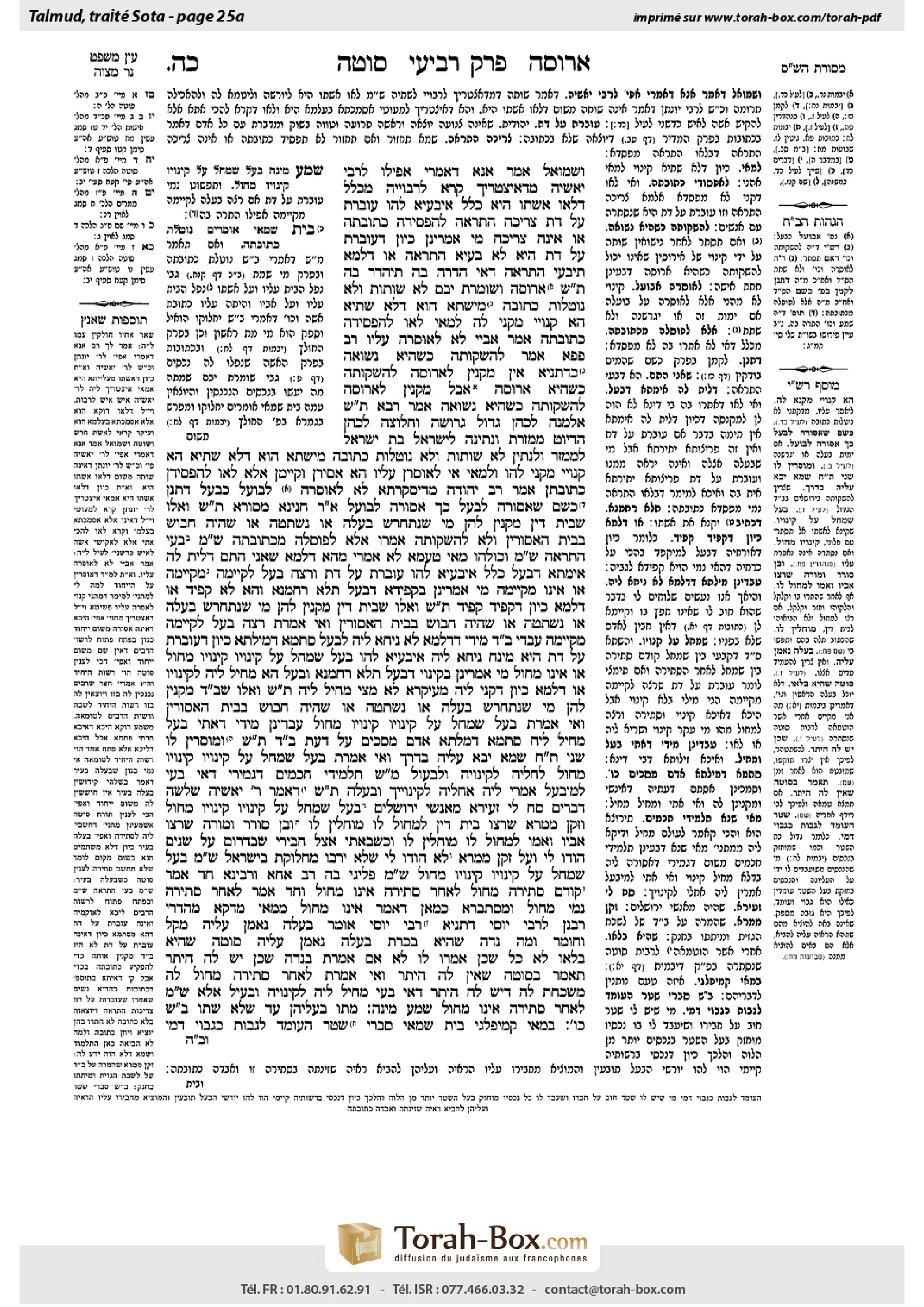
Sotah 25a: Talmud study for Daf Yomi
Daf Yomi is the daily study of one Talmud folio. Explore 37 tractates with scans, Hebrew text, Sefaria English and AI-generated French translations where annotated.
Passage selection and English or AI-generated French translation are available where the scan has annotations. Daf Study is independent of Torah-Box and Sefaria.
Browse Sotah · סוטה · All tractatesSotah 25a text and translations
This page of Sotah includes the Aramaic text, an English translation and an AI-generated French translation, alongside the scan above.
סוטה כ״ה א · Aramaic and Hebrew text
וּשְׁמוּאֵל אָמַר: אֲנָא דַּאֲמַרִי — אֲפִילּוּ לְרַבִּי יֹאשִׁיָּה. מִדְּאִיצְטְרִיךְ קְרָא לְרַבּוֹיַהּ — מִכְּלָל דְּלָאו אִשְׁתּוֹ הִיא כְּלָל.
אִיבַּעְיָא לְהוּ: עוֹבֶרֶת עַל דָּת צְרִיכָה הַתְרָאָה לְהַפְסִידָהּ כְּתוּבָּתָהּ, אוֹ אֵינָהּ צְרִיכָה? מִי אָמְרִינַן: כֵּיוָן דְּעוֹבֶרֶת עַל דָּת הִיא — לָא בָּעֲיָא הַתְרָאָה, אוֹ דִלְמָא תִּיבְעֵי הַתְרָאָה, דְּאִי הָדְרָה בַּהּ תִּיהְדַּר בַּהּ?
תָּא שְׁמַע: אֲרוּסָה וְשׁוֹמֶרֶת יָבָם לֹא שׁוֹתוֹת וְלֹא נוֹטְלוֹת כְּתוּבָה. מִישְׁתָּא הוּא דְּלָא שָׁתְיָא, הָא קַנּוֹיֵי מְקַנֵּי לַהּ. לְמַאי? לָאו לְהַפְסִידָהּ כְּתוּבָּתָהּ?
אָמַר אַבָּיֵי: לָא, לְאוֹסְרָהּ עָלָיו. רַב פָּפָּא אָמַר: לְהַשְׁקוֹתָהּ כְּשֶׁהִיא נְשׂוּאָה. כִּדְתַנְיָא: אֵין מְקַנִּין לַאֲרוּסָה לְהַשְׁקוֹתָהּ כְּשֶׁהִיא אֲרוּסָה, אֲבָל מְקַנִּין לַאֲרוּסָה לְהַשְׁקוֹתָהּ כְּשֶׁהִיא נְשׂוּאָה.
אָמַר רָבָא, תָּא שְׁמַע: אַלְמָנָה לְכֹהֵן גָּדוֹל, גְּרוּשָׁה וַחֲלוּצָה לְכֹהֵן הֶדְיוֹט, מַמְזֶרֶת וּנְתִינָה לְיִשְׂרָאֵל, בַּת יִשְׂרָאֵל לְמַמְזֵר וּלְנָתִין — לֹא שׁוֹתוֹת וְלֹא נוֹטְלוֹת כְּתוּבָה.
מִישְׁתָּא הוּא דְּלָא שָׁתְיָא, הָא קַנּוֹיֵי מְקַנֵּי לְהוּ. וּלְמַאי? אִי לְאוֹסְרָן עָלָיו — הָא אֲסִירָן וְקָיְימָן, אֶלָּא לָאו: לְהַפְסִידָן כְּתוּבָּתָן?
אָמַר רַב יְהוּדָה מִדִּיסְקַרְתָּא: לָא, לְאוֹסְרָהּ לַבּוֹעֵל כַּבַּעַל. דִּתְנַן: כְּשֵׁם שֶׁאֲסוּרָה לַבַּעַל — כָּךְ אֲסוּרָה לַבּוֹעֵל.
אָמַר רַב חֲנִינָא מִסּוּרָא: תָּא שְׁמַע, וְאֵלּוּ שֶׁבֵּית דִּין מְקַנִּין לָהֶן: מִי שֶׁנִּתְחָרֵשׁ בַּעְלָהּ, אוֹ נִשְׁתַּטָּה, אוֹ שֶׁהָיָה חָבוּשׁ בְּבֵית הָאֲסוּרִין. וְלֹא לְהַשְׁקוֹתָהּ אָמְרוּ, אֶלָּא לְפוֹסְלָהּ מִכְּתוּבָּתָהּ. שְׁמַע מִינַּהּ בָּעֵי הַתְרָאָה. שְׁמַע מִינַּהּ.
וְכוּלְּהוּ, מַאי טַעְמָא לָא אָמְרִי מֵהָא! דִּלְמָא שָׁאנֵי הָתָם, דְּלֵית לַהּ אֵימְתָא דְבַעַל כְּלָל.
אִיבַּעְיָא לְהוּ: עוֹבֶרֶת עַל דָּת וְרָצָה בַּעַל לְקַיְּימָהּ, מְקַיְּימָהּ אוֹ אֵינוֹ מְקַיְּימָהּ? מִי אָמְרִינַן בִּקְפִידָה דְבַעַל תְּלָא רַחֲמָנָא, וְהָא לָא קָפֵיד. אוֹ דִלְמָא כֵּיוָן דְּקָפֵיד — קָפֵיד?
תָּא שְׁמַע, וְאֵלּוּ שֶׁבֵּית דִּין מְקַנִּין לָהֶן: מִי שֶׁנִּתְחָרֵשׁ בַּעְלָהּ, אוֹ נִשְׁתַּטָּה, אוֹ שֶׁהָיָה חָבוּשׁ בְּבֵית הָאֲסוּרִין. וְאִי אָמְרַתְּ רָצָה בַּעַל לְקַיְּימָהּ מְקַיְּימָהּ, עָבְדִי בֵּית דִּין מִידֵּי דְּדִלְמָא לָא נִיחָא לֵיהּ לְבַעַל? סְתָמָא דְמִילְּתָא: כֵּיוָן דְּעוֹבֶרֶת עַל דָּת הִיא — מֵינָח נִיחָא לֵיהּ.
אִיבַּעְיָא לְהוּ: בַּעַל שֶׁמָּחַל עַל קִינּוּיוֹ — קִינּוּיוֹ מָחוּל, אוֹ אֵינוֹ מָחוּל? מִי אָמְרִינַן בְּקִינּוּי דְּבַעַל תְּלָא רַחֲמָנָא, וּבַעַל הָא מָחֵיל לֵיהּ לְקִינּוּיוֹ, אוֹ דִלְמָא: כֵּיוָן דְּקַנִּי לַיהּ מֵעִיקָּרָא — לָא מָצֵי מָחֵיל לֵיהּ?
תָּא שְׁמַע, וְאֵלּוּ שֶׁבֵּית דִּין מְקַנִּין לָהֶן: מִי שֶׁנִּתְחָרֵשׁ בַּעְלָהּ, אוֹ נִשְׁתַּטָּה, אוֹ שֶׁהָיָה חָבוּשׁ בְּבֵית הָאֲסוּרִין. וְאִי אָמְרַתְּ בַּעַל שֶׁמָּחַל עַל קִינּוּיוֹ — קִינּוּיוֹ מָחוּל, עָבְדִינַן מִידֵּי דְּאָתֵי בַּעַל מָחֵיל לֵיהּ? סְתָמָא דְמִלְּתָא, אָדָם מַסְכִּים עַל דַּעַת בֵּית דִּין.
תָּא שְׁמַע: וּמוֹסְרִין לוֹ שְׁנֵי תַּלְמִידֵי חֲכָמִים, שֶׁמָּא יָבֹא עָלֶיהָ בַּדֶּרֶךְ. וְאִי אָמְרַתְּ בַּעַל שֶׁמָּחַל עַל קִינּוּיוֹ — קִינּוּיוֹ מָחוּל, לַחְלֵיהּ לְקִינּוּיֵהּ וְלִבְעוֹל!
מַאי שְׁנָא תַּלְמִידֵי חֲכָמִים — דִּגְמִירִי, דְּאִי בָּעֵי לְמִיבְעַל, אָמְרִי לֵיהּ: אַחֲלֵיהּ לְקִינּוּיָיךְ וּבַעְלַהּ.
תָּא שְׁמַע, דְּאָמַר רַבִּי יֹאשִׁיָּה: שְׁלֹשָׁה דְּבָרִים סָח לִי זְעֵירָא מֵאַנְשֵׁי יְרוּשָׁלַיִם: בַּעַל שֶׁמָּחַל עַל קִינּוּיוֹ — קִינּוּיוֹ מָחוּל, וְזָקֵן מַמְרֵא שֶׁרָצוּ בֵּית דִּין לִמְחוֹל לוֹ — מוֹחֲלִין לוֹ, וּבֵן סוֹרֵר וּמוֹרֶה שֶׁרָצוּ אָבִיו וְאִמּוֹ לִמְחוֹל לוֹ — מוֹחֲלִין לוֹ.
וּכְשֶׁבָּאתִי אֵצֶל חֲבֵירַי שֶׁבַּדָּרוֹם, עַל שְׁנַיִם הוֹדוּ לִי, וְעַל זָקֵן מַמְרֵא לֹא הוֹדוּ לִי — שֶׁלֹּא יִרְבּוּ מַחֲלוֹקֹת בְּיִשְׂרָאֵל. שְׁמַע מִינַּהּ: בַּעַל שֶׁמָּחַל עַל קִינּוּיוֹ — קִינּוּיוֹ מָחוּל. שְׁמַע מִינַּהּ.
פְּלִיגִי בַּהּ רַב אַחָא וְרָבִינָא. חַד אָמַר: קוֹדֶם סְתִירָה — מָחוּל, לְאַחַר סְתִירָה — אֵינוֹ מָחוּל. וְחַד אָמַר: לְאַחַר סְתִירָה, נָמֵי מָחוּל. וּמִסְתַּבְּרָא כְּמַאן דְּאָמַר אֵינוֹ מָחוּל,
מִמַּאי — מִדְּקָא מְהַדְּרִי רַבָּנַן לְרַבִּי יוֹסֵי. דְּתַנְיָא, רַבִּי יוֹסֵי אוֹמֵר: בַּעְלָהּ נֶאֱמָן עָלֶיהָ, מִקַּל וָחוֹמֶר: וּמָה נִדָּה שֶׁהִיא בְּכָרֵת — בַּעְלָהּ נֶאֱמָן עָלֶיהָ, סוֹטָה שֶׁהִיא בְּלָאו, לֹא — כׇּל שֶׁכֵּן?
אָמְרוּ לוֹ: לֹא, אִם אָמַרְתָּ בְּנִדָּה — שֶׁכֵּן יֵשׁ לָהּ הֶיתֵּר, תֹּאמַר בְּסוֹטָה — שֶׁאֵין לָהּ הֶיתֵּר.
וְאִי אָמְרַתְּ לְאַחַר סְתִירָה מָחוּל לָהּ, מַשְׁכַּחַתְּ לַהּ דְּיֵשׁ לָהּ הֶיתֵּר, דְּאִי בָּעֵי מָחֵיל לֵיהּ לְקִינּוּיֵהּ וּבָעֵיל. אֶלָּא שְׁמַע מִינַּהּ: לְאַחַר סְתִירָה אֵינוֹ מָחוּל. שְׁמַע מִינַּהּ.
מֵתוּ בַּעְלֵיהֶן עַד שֶׁלֹּא שָׁתוּ, בֵּית שַׁמַּאי כּוּ׳. בְּמַאי קָמִיפַּלְגִי? בֵּית שַׁמַּאי סָבְרִי: שְׁטָר הָעוֹמֵד לִגְבּוֹת — כְּגָבוּי דָּמֵי.
Sotah 25a · English translation
And Shmuel could have said: I state my opinion even according to the opinion of Rabbi Yoshiya. Since it was necessary for the verse to specifically include in the sota ritual a yevama who engaged in sexual intercourse with her yavam, by inference one may conclude that she is not his wife at all with regard to any matters other than those explicit in the verse.
§ A dilemma was raised before the Sages: With regard to a woman who violates the precepts of halakha or Jewish custom with regard to modesty, who may be divorced without payment of her marriage contract, is forewarning from her husband required in order to cause her to forfeit her right to collect payment of her marriage contract or is forewarning not required? Do we say that since she is a woman who violates the precepts, forewarning is not required, as she is aware that her actions are prohibited? Or perhaps forewarning is required, so that if she desires to repent, she will be reminded to repent?
The Gemara suggests: Come and hear a proof from the mishna: A betrothed woman and a widow awaiting her yavam neither drink the bitter water nor collect payment of their marriage contracts. It is possible to infer that she does not drink, but the husband or yavam can warn her against secluding herself with another man. For what halakha is his warning relevant? Is it not relevant to cause her to forfeit her right to collect payment of her marriage contract? Accordingly, a woman forfeits payment of her marriage contract due to immodest behavior only if she is warned.
Abaye said: No, the relevance of the warning of the husband or yavam is to render her forbidden to him in the event that she secludes herself with another man. Rav Pappa said: The relevance of the warning is to have her drink if she secludes herself with another man when she is married, as it is taught in a baraita: One does not issue a warning to a betrothed woman in order to have her drink while she is betrothed. However, one can issue a warning to a betrothed woman in order to have her drink when she is married.
Rava said: Come and hear a proof from the continuation of the mishna: A widow who was married to a High Priest, or a ḥalutza who was married to a common priest, or a mamzeret or Gibeonite woman who was married to a Jew of unflawed lineage, or a Jewish woman of unflawed lineage who was married to a mamzer or a Gibeonite; all of these women neither drink the bitter water nor collect payment of their marriage contracts.
The Gemara infers: She does not drink, but the husband or yavam can warn her against secluding herself with another man. But for what halakha is his warning relevant? If it is in order to prohibit these women to him, aren’t they currently prohibited to him? Rather, is it not relevant to cause them to forfeit their rights to collect payment of their marriage contracts? This indicates that only when a woman is warned in advance does her immodest behavior cause her to forfeit her right to collect payment of her marriage contract.
Rav Yehuda of Diskarta said: No, the relevance of the warning is to render her permanently forbidden to her paramour, should she seclude herself with him, just as she would become forbidden to her husband, as we learned in a mishna (27b): Just as she is forbidden to her husband, so is she forbidden to her paramour.
Rav Ḥanina of Sura said: Come and hear a proof from the continuation of the mishna: And these are the women to whom the court issues a warning in place of their husbands: One whose husband became a deaf-mute or became an imbecile, or was incarcerated in prison. And the Sages said that the court warns her not in order to have her drink the bitter water if she disobeys the warning; rather in order to disqualify her from receiving payment of her marriage contract. Since the sole purpose of the warning issued by the court is to disqualify her from receiving payment of her marriage contract in the event she secludes herself with the man, one can learn from the mishna that similarly, a woman who violates the precepts requires forewarning. The Gemara concludes: Indeed, one can learn from the mishna that a warning is required.
The Gemara asks: With regard to all of the other Sages, who proposed inconclusive proofs from other clauses of the mishna, what is the reason they did not say that proof can be adduced from this explicit statement? The Gemara answers: They reasoned that perhaps it is different there, as the wife has no fear of her husband at all, since he is either incapacitated or incarcerated, and therefore she must be warned first. In other cases, an explicit warning is unnecessary.
A dilemma was raised before the Sages: If a woman violates the precepts and her husband desires to maintain her as his wife, may he maintain her as his wife or may he not maintain her as his wife? Do we say that the Merciful One made the requirement to divorce her dependent on the husband’s objection to her behavior, and as this husband does not raise an objection he may maintain her as his wife? Or perhaps, since the Torah objects to this behavior, it is considered as though he objected, as the requirement to divorce her is due to the Torah’s objection to this behavior, irrespective of the husband’s wishes.
The Gemara cites proof: Come and hear the mishna: And these are the women to whom the court issues a warning in place of their husbands: One whose husband became a deaf-mute or became an imbecile, or was incarcerated in prison. And if you say that should the husband desire to maintain her as his wife he may maintain her as his wife, perhaps he may not want the court to warn her. Would the court perform a matter that is perhaps not amenable to the husband? The Gemara replies: The ordinary situation is that since she is violating the precepts, it is amenable to the husband to divorce her, and the court acts under this assumption.
§ A dilemma was raised before the Sages: With regard to a husband who issued a warning to his wife and later retracted his warning, as he did not wish his wife to acquire the status of a sota, is his warning retracted, or is it not retracted? Do we say that the Merciful One made acquiring the status of a sota dependent on the husband’s warning, and the husband retracted his warning? Or perhaps, since he warned her at the outset, he can no longer retract his warning?
The Gemara cites proof that the husband cannot retract his warning: Come and hear the mishna: And these are the women to whom the court issues a warning in place of their husbands: One whose husband became a deaf-mute or became an imbecile, or was incarcerated in prison. And if you say that in the case of a husband who retracted his warning, his warning is retracted, would we, i.e., the court, do something that the husband can come and retract? This would cause a diminution of the esteem of the court. The Gemara replies: The ordinary situation is that a person concurs with the opinion of the court and would not retract a warning issued by the court, so this is not a concern. Therefore, no proof can be brought from the mishna.
The Gemara cites proof: Come and hear another mishna (7a): When the husband takes the sota to the Temple, he first takes her to the local court, and the court provides him with two Torah scholars who accompany them, lest he engage in sexual intercourse with her on the way to the Temple, which is prohibited due to her status as a sota. And if you say that with regard to a husband who retracted his warning, his warning is retracted, let him retract his warning and engage in sexual intercourse with her.
The Gemara replies that perhaps the husband can retract his warning: What is different about Torah scholars that they are chosen to accompany the husband? They differ from other people as they are learned, and if they see that the husband desires to engage in sexual intercourse with his wife, they say to him: Retract your warning and then you may engage in sexual intercourse with her in a permitted manner.
The Gemara cites proof: Come and hear that which Rabbi Yoshiya says: Ze’eira, who was one of the men of Jerusalem, told me three matters: A husband who retracted his warning, his warning is retracted; and in the case of a rebellious Elder whom the court wishes to forgive, the court may forgive him; and in the case of a stubborn and rebellious son whose father and mother wish to forgive him for his sins, they may forgive him.
And when I came to my colleagues in the South and told them these rulings, they agreed with me with regard to two of them, but with regard to forgiving a rebellious Elder they did not agree with me. They held that a rebellious Elder cannot be forgiven, in order that discord not proliferate among the Jewish people. The Gemara comments: One can conclude from Rabbi Yoshiya’s statement that with regard to a husband who retracted his warning, his warning is retracted. The Gemara concludes: Indeed, one can conclude from Rabbi Yoshiya’s statement that the husband can retract his warning.
Rav Aḥa and Ravina disagree with regard to the limits of this halakha permitting a husband to retract his warning. One says that if he retracts his warning before her seclusion with another man, his warning is retracted, but if he retracts his warning after her seclusion with another man, it is not retracted. And one says that if he retracts his warning after her seclusion with another man, it is also retracted. And it is reasonable to hold according to the one who says that the husband’s warning is not retracted after her seclusion with another man.
The Gemara asks: From where can one derive that after the wife’s seclusion with another man, the warning cannot be retracted? It can be derived from the answer that the Rabbis gave in reply to Rabbi Yosei, as it is taught in a baraita: Rabbi Yosei says: It is unnecessary to provide an escort to accompany the sota and her husband, as the husband of a sota is trusted not to engage in sexual intercourse with her, on the basis of an a fortiori inference: And just as in the case of a menstruating woman, who is prohibited from engaging in sexual intercourse with her husband by penalty of karet, her husband is nevertheless trusted with regard to her, as he is permitted to seclude himself with her, so too, with regard to a sota, who is prohibited from engaging in sexual intercourse with her husband only by an ordinary prohibition, is it not all the more so that he should be trusted?
The Rabbis said to Rabbi Yosei: No, if you say that he is trusted with regard to a menstruating woman, the reason is not due to the severity of the prohibition. Rather, he is trusted because she has the ability to become permitted to her husband after her menstrual flow has ceased and she has immersed in a ritual bath. Shall you also say that he is trusted with regard to a sota, who potentially does not have the ability to become permitted to her husband, due to her suspected adultery?
The Gemara explains the proof: And if you say that after her seclusion with another man the warning can be retracted for her, you therefore find an instance in which the sota has the ability to become permitted to her husband, as, if the husband desires he can retract his warning and engage in sexual intercourse with her. Rather, conclude from the Rabbis’ statement that if he retracts his warning after her seclusion with another man, the warning is not retracted. The Gemara concludes: Indeed, one can conclude from the Rabbis’ statement that the warning cannot be retracted.
§ The mishna states: If the husbands of the sota women died before their wives drank the bitter water, Beit Shammai say: They collect payment of their marriage contracts and they do not drink the bitter water. And Beit Hillel say: They either drink the bitter water or they do not collect payment of their marriage contracts. The Gemara asks: With regard to what do Beit Shammai and Beit Hillel disagree? The Gemara answers: Beit Shammai hold that a promissory note that stands to be collected is considered to be as though it was already collected, and since the woman possesses the marriage contract, the payment of the marriage contract is considered as though it is already in her possession. Since the burden of proof rests upon the claimant, she does not lose her rights to the money unless the inheritors prove that she committed adultery.
Sotah 25a · Traduction française (IA)
Et Shmuel aurait pu dire : « J’énonce mon opinion même selon Rabbi Yoshiya. » Puisqu’il a fallu que le verset inclue expressément dans le rituel de la sota une yevama qui a eu des relations sexuelles avec son yavam, on peut en déduire qu’elle n’est pas du tout son épouse pour tout ce qui n’est pas explicitement mentionné dans le verset.
§ Les Sages soulevèrent une question : une femme qui transgresse les préceptes de la halakha ou les usages juifs en matière de pudeur peut être répudiée sans recevoir le paiement de sa ketouba. L’avertissement de son mari est-il nécessaire pour qu’elle perde son droit au paiement de sa ketouba, ou ne l’est-il pas ? Dirons-nous que, puisqu’elle transgresse les préceptes, aucun avertissement n’est nécessaire, car elle sait que ses actes sont interdits ? Ou peut-être un avertissement est-il nécessaire afin que, si elle souhaite se repentir, on le lui rappelle ?
La Guemara propose : « Venez et écoutez » une preuve tirée de la Michna : une femme fiancée et une veuve en attente de son yavam ne boivent pas l’eau amère et ne perçoivent pas le paiement de leur ketouba. On peut en déduire qu’elle ne boit pas, mais que son mari ou son yavam peut l’avertir de ne pas s’isoler avec un autre homme. À quelle halakha cet avertissement est-il pertinent ? N’est-ce pas pour lui faire perdre son droit au paiement de sa ketouba ? Ainsi, une femme ne perd le paiement de sa ketouba en raison d’un comportement impudique que si elle a été avertie.
Abaye dit : « Non, l’avertissement du mari ou du yavam sert à la lui interdire si elle s’isole avec un autre homme. » Rav Pappa dit : « Cet avertissement sert à ce qu’elle boive si elle s’isole avec un autre homme alors qu’elle est mariée, comme cela est enseigné dans une baraïta : On n’avertit pas une femme fiancée afin qu’elle boive tant qu’elle est fiancée. Toutefois, on peut avertir une femme fiancée afin qu’elle boive une fois mariée. »
Rava dit : « Venez et écoutez » une preuve tirée de la suite de la Michna : une veuve qui a épousé un grand prêtre, une haloutsa qui a épousé un prêtre ordinaire, une mamzeret ou une femme guivonite qui a épousé un juif de lignée irréprochable, ou une femme juive de lignée irréprochable qui a épousé un mamzer ou un guivonite : toutes ces femmes ne boivent pas l’eau amère et ne perçoivent pas le paiement de leur ketouba.
La Guemara déduit : elle ne boit pas, mais son mari ou son yavam peut l’avertir de ne pas s’isoler avec un autre homme. Mais à quelle halakha cet avertissement est-il pertinent ? S’il sert à rendre ces femmes interdites à leur époux, ne lui sont-elles pas déjà interdites ? Il faut plutôt dire qu’il sert à les priver du droit au paiement de leur ketouba. Cela indique qu’une femme ne perd le droit au paiement de sa ketouba en raison de son comportement impudique que si elle a été avertie au préalable.
Rav Yehuda de Diskarta dit : « Non, l’avertissement sert à la rendre définitivement interdite à son amant si elle s’isole avec lui, tout comme elle deviendrait interdite à son mari, ainsi que nous l’avons appris dans une Michna (27b) : “De même qu’elle est interdite à son mari, elle est interdite à son amant.” »
Rav Ḥanina de Sura dit : « Venez et écoutez » une preuve tirée de la suite de la Michna : « Et voici les femmes que le tribunal avertit à la place de leur mari : celle dont le mari est devenu sourd-muet ou imbécile, ou a été incarcéré. » Les Sages ont dit que le tribunal l’avertit non pas pour qu’elle boive l’eau amère si elle désobéit à l’avertissement, mais afin de la priver du paiement de sa ketouba. Puisque le seul but de l’avertissement donné par le tribunal est de la priver du paiement de sa ketouba au cas où elle s’isolerait avec cet homme, on peut déduire de la Michna que, de même, une femme qui transgresse les préceptes doit être avertie au préalable. La Guemara conclut : en effet, on peut déduire de la Michna qu’un avertissement est nécessaire.
La Guemara demande : pourquoi les autres Sages, qui ont proposé des preuves non concluantes tirées d’autres passages de la Michna, n’ont-ils pas dit qu’on pouvait apporter une preuve de cette déclaration explicite ? La Guemara répond : ils estimaient que ce cas est peut-être différent, car l’épouse ne craint pas du tout son mari, puisqu’il est soit incapable, soit incarcéré ; il faut donc l’avertir au préalable. Dans les autres cas, un avertissement explicite n’est pas nécessaire.
Les Sages soulevèrent une question : si une femme transgresse les préceptes et que son mari souhaite la garder comme épouse, peut-il le faire ou non ? Dirons-nous que le Miséricordieux a fait dépendre l’obligation de la répudier de l’opposition du mari à son comportement et que, puisque ce mari ne s’y oppose pas, il peut la garder ? Ou peut-être, puisque la Torah s’oppose à ce comportement, est-ce considéré comme si le mari s’y opposait lui-même, l’obligation de la répudier découlant de l’opposition de la Torah à ce comportement, indépendamment de la volonté du mari ?
La Guemara apporte une preuve : « Venez et écoutez » la Michna : « Et voici les femmes que le tribunal avertit à la place de leur mari : celle dont le mari est devenu sourd-muet ou imbécile, ou a été incarcéré. » Or, si vous dites que le mari peut garder sa femme s’il le souhaite, peut-être ne voudra-t-il pas que le tribunal l’avertisse. Le tribunal agirait-il dans une affaire qui pourrait ne pas convenir au mari ? La Guemara répond : en général, puisque la femme transgresse les préceptes, il convient au mari de la répudier, et le tribunal agit en partant de cette hypothèse.
§ Les Sages soulevèrent une question : un mari a averti sa femme, puis a retiré son avertissement parce qu’il ne voulait pas que sa femme acquière le statut de sota. Son avertissement est-il annulé ou ne l’est-il pas ? Dirons-nous que le Miséricordieux a fait dépendre l’acquisition du statut de sota de l’avertissement du mari, et que celui-ci a retiré son avertissement ? Ou peut-être, puisqu’il l’a avertie au départ, ne peut-il plus retirer son avertissement ?
La Guemara apporte une preuve que le mari ne peut pas retirer son avertissement : « Venez et écoutez » la Michna : « Et voici les femmes que le tribunal avertit à la place de leur mari : celle dont le mari est devenu sourd-muet ou imbécile, ou a été incarcéré. » Or, si vous dites que l’avertissement d’un mari qui le retire est annulé, le tribunal entreprendrait-il une démarche que le mari pourrait ensuite annuler ? Cela diminuerait le prestige du tribunal. La Guemara répond : en général, une personne se rallie à l’avis du tribunal et ne retirerait pas un avertissement émis par celui-ci ; il n’y a donc pas lieu de s’en inquiéter. On ne peut donc tirer aucune preuve de la Michna.
La Guemara apporte une preuve : « Venez et écoutez » une autre Michna (7a) : lorsque le mari emmène la sota au Temple, il la conduit d’abord devant le tribunal local, qui lui fournit deux sages de la Torah pour les accompagner, de peur qu’il n’ait des relations sexuelles avec elle en chemin vers le Temple, ce qui lui est interdit en raison du statut de sota de sa femme. Or, si vous dites qu’un mari qui retire son avertissement l’annule, qu’il le retire et ait des relations sexuelles avec elle !
La Guemara répond que le mari peut peut-être retirer son avertissement : pourquoi choisit-on des sages de la Torah pour accompagner le mari ? Parce qu’ils sont instruits, contrairement aux autres personnes, et que, s’ils voient que le mari souhaite avoir des relations sexuelles avec sa femme, ils lui disent : « Retire ton avertissement, et tu pourras ensuite avoir des relations sexuelles avec elle de manière permise. »
La Guemara apporte une preuve : « Venez et écoutez » ce que dit Rabbi Yoshiya : « Ze’eira, qui était l’un des hommes de Jérusalem, m’a rapporté trois choses : l’avertissement d’un mari qui le retire est annulé ; le tribunal peut pardonner à un Ancien rebelle qu’il souhaite absoudre ; et, si le père et la mère d’un fils rebelle et indocile souhaitent lui pardonner ses fautes, ils le peuvent. »
« Lorsque je suis allé auprès de mes collègues du Sud et que je leur ai rapporté ces décisions, ils m’ont approuvé pour deux d’entre elles, mais pas au sujet du pardon de l’Ancien rebelle. Ils estimaient qu’on ne peut pas pardonner à un Ancien rebelle, afin que la discorde ne se répande pas au sein du peuple juif. » La Guemara commente : on peut conclure de la déclaration de Rabbi Yoshiya que l’avertissement d’un mari qui le retire est annulé. La Guemara conclut : en effet, on peut conclure de la déclaration de Rabbi Yoshiya que le mari peut retirer son avertissement.
Rav Aḥa et Ravina sont en désaccord quant aux limites de cette halakha qui permet au mari de retirer son avertissement. L’un dit que, s’il le retire avant qu’elle ne s’isole avec un autre homme, son avertissement est annulé, mais que, s’il le retire après qu’elle s’est isolée avec un autre homme, il n’est pas annulé. L’autre dit que, même s’il le retire après qu’elle s’est isolée avec un autre homme, il est annulé. Il est raisonnable de retenir l’avis de celui qui dit que l’avertissement du mari n’est pas annulé après qu’elle s’est isolée avec un autre homme.
La Guemara demande : d’où peut-on déduire qu’après que l’épouse s’est isolée avec un autre homme, l’avertissement ne peut plus être retiré ? On peut le déduire de la réponse que les Rabbins ont faite à Rabbi Yosei, comme cela est enseigné dans une baraïta : Rabbi Yosei dit : « Il n’est pas nécessaire de fournir un accompagnateur à la sota et à son mari, car on peut se fier au mari d’une sota pour qu’il n’ait pas de relations sexuelles avec elle », sur la base d’un raisonnement a fortiori : de même que, dans le cas d’une femme menstruée, avec laquelle son mari a l’interdiction d’avoir des relations sexuelles sous peine de karet, son mari est néanmoins digne de confiance, puisqu’il lui est permis de s’isoler avec elle, à plus forte raison doit-on pouvoir se fier à lui dans le cas d’une sota, avec laquelle il n’a l’interdiction d’avoir des relations sexuelles qu’en vertu d’une prohibition ordinaire.
Les Rabbins dirent à Rabbi Yosei : « Non, si l’on dit qu’on peut se fier à lui dans le cas d’une femme menstruée, ce n’est pas en raison de la sévérité de l’interdiction. On peut plutôt se fier à lui parce qu’elle peut redevenir permise à son mari après la fin de son écoulement menstruel et son immersion dans un bain rituel. Dirais-tu également qu’on peut se fier à lui dans le cas d’une sota, qui pourrait ne pas avoir la possibilité de redevenir permise à son mari en raison de l’adultère dont elle est soupçonnée ? »
La Guemara explique la preuve : si vous dites qu’après qu’elle s’est isolée avec un autre homme, l’avertissement peut encore être retiré, vous trouvez alors un cas où la sota peut redevenir permise à son mari, car celui-ci peut, s’il le souhaite, retirer son avertissement et avoir des relations sexuelles avec elle. Il faut plutôt conclure, d’après la déclaration des Rabbins, que si le mari retire son avertissement après qu’elle s’est isolée avec un autre homme, l’avertissement n’est pas annulé. La Guemara conclut : en effet, on peut conclure de la déclaration des Rabbins que l’avertissement ne peut pas être retiré.
§ La Michna enseigne : si les maris des femmes sota meurent avant que leurs épouses ne boivent l’eau amère, Beit Shammaï disent : « Elles perçoivent le paiement de leur ketouba et ne boivent pas l’eau amère. » Et Beit Hillel disent : « Elles boivent l’eau amère ou ne perçoivent pas le paiement de leur ketouba. » La Guemara demande : sur quoi Beit Shammaï et Beit Hillel sont-ils en désaccord ? La Guemara répond : Beit Shammaï estiment qu’une reconnaissance de dette destinée à être recouvrée est considérée comme si elle avait déjà été recouvrée ; puisque la femme détient la ketouba, son paiement est considéré comme étant déjà en sa possession. Puisque la charge de la preuve incombe au demandeur, elle ne perd pas son droit à cet argent, à moins que les héritiers ne prouvent qu’elle a commis l’adultère.
Traduction française générée par IA à partir de l’édition anglaise de Sefaria. Vérifie toujours un passage avec le texte source.
Text from Sefaria: William Davidson Edition - Vocalized Aramaic (CC BY NC); William Davidson Edition - English (CC BY NC).