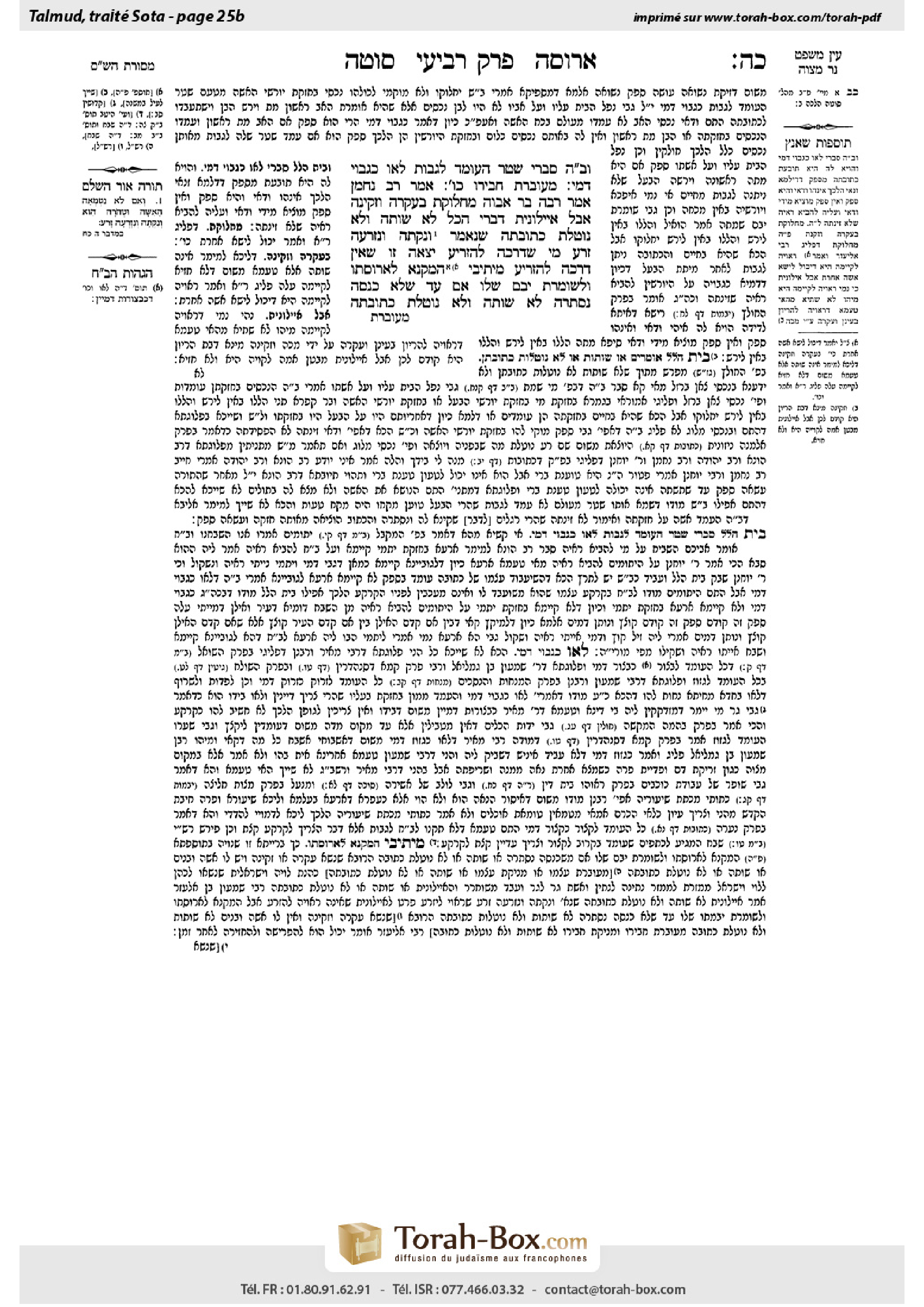
Sotah 25b: Talmud study for Daf Yomi
Daf Yomi is the daily study of one Talmud folio. Explore 37 tractates with scans, Hebrew text, Sefaria English and AI-generated French translations where annotated.
Passage selection and English or AI-generated French translation are available where the scan has annotations. Daf Study is independent of Torah-Box and Sefaria.
Browse Sotah · סוטה · All tractatesSotah 25b text and translations
This page of Sotah includes the Aramaic text, an English translation and an AI-generated French translation, alongside the scan above.
סוטה כ״ה ב · Aramaic and Hebrew text
וּבֵית הִלֵּל סָבְרִי: שְׁטָר הָעוֹמֵד לִגְבּוֹת — לָאו כְּגָבוּי דָּמֵי.
מְעוּבֶּרֶת חֲבֵירוֹ כּוּ׳. אָמַר רַב נַחְמָן אָמַר רַבָּה בַּר אֲבוּהּ: מַחְלוֹקֶת בַּעֲקָרָה וּזְקֵינָה.
אֲבָל אַיְילוֹנִית — דִּבְרֵי הַכֹּל לֹא שׁוֹתָה וְלֹא נוֹטֶלֶת כְּתוּבָּתָהּ, שֶׁנֶּאֱמַר: ״וְנִקְּתָה וְנִזְרְעָה זָרַע״, מִי שֶׁדַּרְכָּהּ לְהַזְרִיעַ, יָצְאָה זוֹ שֶׁאֵין דַּרְכָּהּ לְהַזְרִיעַ.
מֵיתִיבִי: הַמְקַנֵּא לַאֲרוּסָתוֹ וּלְשׁוֹמֶרֶת יָבָם שֶׁלּוֹ, אִם עַד שֶׁלֹּא כְּנָסָהּ נִסְתְּרָה — לֹא שׁוֹתָה וְלֹא נוֹטֶלֶת כְּתוּבָּתָהּ.
Sotah 25b · English translation
And Beit Hillel hold that a promissory note that stands to be collected is not considered as though it was already collected. Therefore, the payment of the marriage contract is not considered to be in the wife’s possession, and as this means that she is the claimant, she is not entitled to the money unless she proves that she did not commit adultery.
§ The mishna states (24a): A woman who was pregnant with the child of another man at the time of her marriage…A sexually underdeveloped woman, who is incapable of bearing children [ailonit], and an elderly woman, and a woman who is incapable of giving birth for other reasons, neither collect payment of their marriage contracts nor drink the bitter water. Rabbi Elazar says: He can marry another woman and procreate through her; therefore these are considered permitted marriages, and the women can drink the bitter water. Rav Naḥman says that Rabba bar Avuh says: The dispute between the first tanna and Rabbi Elazar is only in the case of a barren woman and an elderly woman.
However, with regard to a sexually underdeveloped woman, all agree that she neither drinks the bitter water nor collects payment of her marriage contract. This is as it is stated with regard to a sota who is found to be innocent of adultery: “And she shall be cleared, and shall conceive seed” (Numbers 5:28), indicating that the sota ritual pertains only to one whose way is to bear seed and give birth, excluding this sexually underdeveloped woman, whose way is not to bear seed.
The Gemara raises an objection to Rav Naḥman’s statement from a baraita in the Tosefta (5:4): With regard to one who issues a warning to his betrothed, or to his yevama while she is a widow awaiting her yavam, if she secluded herself with the other man before her husband consummated the marriage, she neither drinks the bitter water nor collects payment of her marriage contract.
Sotah 25b · Traduction française (IA)
Et Beit Hillel considère qu’une reconnaissance de dette qui reste à recouvrer n’est pas considérée comme déjà recouvrée. Par conséquent, le paiement de la kétouba n’est pas considéré comme étant en possession de la femme. Puisque c’est elle qui réclame l’argent, elle n’y a droit que si elle prouve qu’elle n’a pas commis d’adultère.
§ La Michna enseigne (24a) : Une femme qui était enceinte de l’enfant d’un autre homme au moment de son mariage… Une femme sexuellement sous-développée, incapable d’avoir des enfants [ailonit], une femme âgée et une femme incapable d’accoucher pour d’autres raisons ne perçoivent pas le montant de leur kétouba et ne boivent pas l’eau amère. Rabbi Elazar dit : Il peut épouser une autre femme et procréer avec elle ; ces unions sont donc considérées comme permises, et les femmes peuvent boire l’eau amère. Rav Naḥman dit au nom de Rabba bar Avuh : Le différend entre le premier tanna et Rabbi Elazar ne concerne que le cas d’une femme stérile et d’une femme âgée.
Toutefois, en ce qui concerne une femme sexuellement sous-développée, tous conviennent qu’elle ne boit pas l’eau amère et ne perçoit pas le montant de sa kétouba. En effet, il est écrit à propos d’une sota reconnue innocente d’adultère : « Elle sera innocentée et concevra une descendance » (Nombres 5:28), ce qui indique que le rituel de la sota ne concerne que celle qui a vocation à concevoir et à donner naissance, à l’exclusion de cette femme sexuellement sous-développée, qui n’a pas vocation à concevoir.
La Guemara soulève une objection à la déclaration de Rav Naḥman à partir d’une baraïta de la Tosefta (5:4) : Celui qui met en garde sa fiancée, ou sa yevama alors qu’elle est veuve et attend son yavam, et qui se retrouve seule avec un autre homme avant que son mari n’ait consommé le mariage, ne boit pas l’eau amère et ne perçoit pas le montant de sa kétouba.
Traduction française générée par IA à partir de l’édition anglaise de Sefaria. Vérifie toujours un passage avec le texte source.
Text from Sefaria: William Davidson Edition - Vocalized Aramaic (CC BY NC); William Davidson Edition - English (CC BY NC).