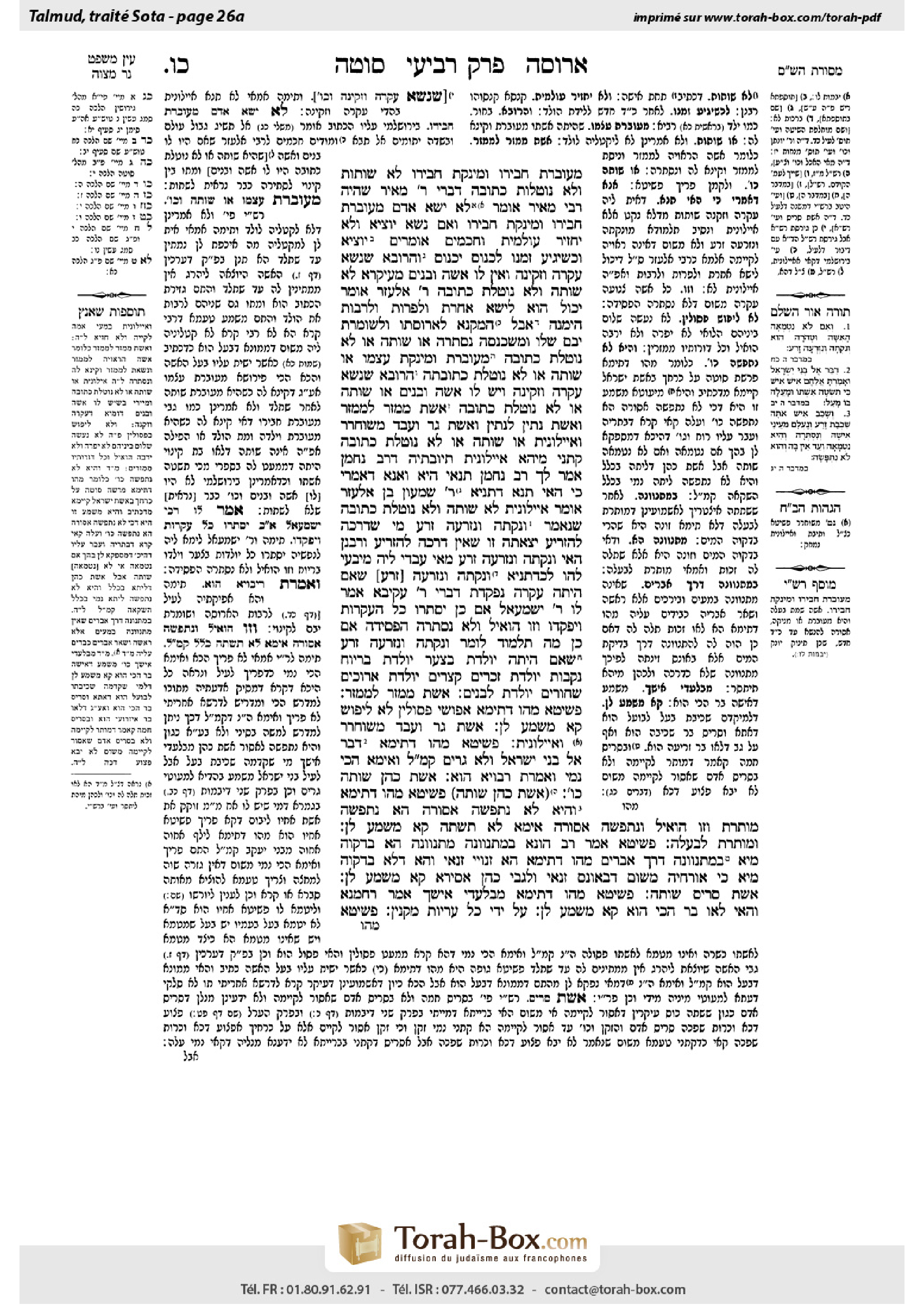
Sotah 26a: Talmud study for Daf Yomi
Daf Yomi is the daily study of one Talmud folio. Explore 37 tractates with scans, Hebrew text, Sefaria English and AI-generated French translations where annotated.
Passage selection and English or AI-generated French translation are available where the scan has annotations. Daf Study is independent of Torah-Box and Sefaria.
Browse Sotah · סוטה · All tractatesSotah 26a text and translations
This page of Sotah includes the Aramaic text, an English translation and an AI-generated French translation, alongside the scan above.
סוטה כ״ו א · Aramaic and Hebrew text
מְעוּבֶּרֶת חֲבֵירוֹ וּמֵינֶקֶת חֲבֵירוֹ — לֹא שׁוֹתוֹת וְלֹא נוֹטְלוֹת כְּתוּבָה, דִּבְרֵי רַבִּי מֵאִיר.
שֶׁהָיָה רַבִּי מֵאִיר אוֹמֵר: לֹא יִשָּׂא אָדָם מְעוּבֶּרֶת חֲבֵירוֹ וּמֵינֶקֶת חֲבֵירוֹ, וְאִם נָשָׂא — יוֹצִיא וְלֹא יַחְזִיר עוֹלָמִית. וַחֲכָמִים אוֹמְרִים: יוֹצִיא, וּכְשֶׁיַּגִּיעַ זְמַנּוֹ לִכְנוֹס — יִכְנוֹס.
וְהָרוֹבֶא שֶׁנָּשָׂא עֲקָרָה וּזְקֵינָה, וְאֵין לוֹ אִשָּׁה וּבָנִים מֵעִיקָּרָא — לֹא שׁוֹתָה וְלֹא נוֹטֶלֶת כְּתוּבָּה. רַבִּי אֶלְעָזָר אוֹמֵר: יָכוֹל הוּא לִישָּׂא אַחֶרֶת וְלִפְרוֹת וְלִרְבּוֹת הֵימֶנָּה.
אֲבָל הַמְקַנֵּא לַאֲרוּסָתוֹ וּלְשׁוֹמֶרֶת יָבָם שֶׁלּוֹ, וּמִשֶּׁכְּנָסָהּ נִסְתְּרָה — אוֹ שׁוֹתָה, אוֹ לֹא נוֹטֶלֶת כְּתוּבָּה. מְעוּבֶּרֶת וּמֵינֶקֶת עַצְמוֹ — אוֹ שׁוֹתָה, אוֹ לֹא נוֹטֶלֶת כְּתוּבָּתָהּ. הָרוֹבֶא שֶׁנָּשָׂא עֲקָרָה וּזְקֵינָה, וְיֵשׁ לוֹ אִשָּׁה וּבָנִים — אוֹ שׁוֹתָה, אוֹ לֹא נוֹטֶלֶת כְּתוּבָּה.
אֵשֶׁת מַמְזֵר לְמַמְזֵר, וְאֵשֶׁת נָתִין לְנָתִין, וְאֵשֶׁת גֵּר וְעֶבֶד מְשׁוּחְרָר, וְאַיְילוֹנִית — אוֹ שׁוֹתָה, אוֹ לֹא נוֹטֶלֶת כְּתוּבָּה. קָתָנֵי מִיהָא אַיְילוֹנִית, תְּיוּבְתֵּיהּ דְּרַב נַחְמָן!
אָמַר לְךָ רַב נַחְמָן: תַּנָּאֵי הִיא, וַאֲנָא דַּאֲמַרִי כִּי הַאי תַּנָּא, דְּתַנְיָא, רַבִּי שִׁמְעוֹן בֶּן אֶלְעָזָר אוֹמֵר: אַיְילוֹנִית — לֹא שׁוֹתָה וְלֹא נוֹטֶלֶת כְּתוּבָּה, שֶׁנֶּאֱמַר: ״וְנִקְּתָה וְנִזְרְעָה זָרַע״ — מִי שֶׁדַּרְכָּהּ לְהַזְרִיעַ. יָצָאתָה זוֹ — שֶׁאֵין דַּרְכָּהּ לְהַזְרִיעַ.
וְרַבָּנַן, הַאי ״וְנִקְּתָה וְנִזְרְעָה זָרַע״ מַאי עָבְדִי לֵיהּ? מִיבְּעֵי לְהוּ לְכִדְתַנְיָא: ״וְנִקְּתָה וְנִזְרְעָה [זָרַע]״, שֶׁאִם הָיְתָה עֲקָרָה נִפְקֶדֶת, דִּבְרֵי רַבִּי עֲקִיבָא. אָמַר לוֹ רַבִּי יִשְׁמָעֵאל: אִם כֵּן, יִסָּתְרוּ כׇּל הָעֲקָרוֹת וְיִפָּקְדוּ, וְזוֹ, הוֹאִיל וְלֹא נִסְתְּרָה הִפְסִידָה?!
אִם כֵּן, מָה תַּלְמוּד לוֹמַר: ״וְנִקְּתָה וְנִזְרְעָה זָרַע״, שֶׁאִם הָיְתָה יוֹלֶדֶת בְּצַעַר — יוֹלֶדֶת בְּרֶיוַח, נְקֵבוֹת — יוֹלֶדֶת זְכָרִים, קְצָרִים — יוֹלֶדֶת אֲרוּכִּים, שְׁחוֹרִים — יוֹלֶדֶת לְבָנִים.
אֵשֶׁת מַמְזֵר לְמַמְזֵר. פְּשִׁיטָא! מַהוּ דְּתֵימָא: אַפּוֹשֵׁי פְּסוּלִין לָא לַיפֵּשׁ, קָא מַשְׁמַע לַן.
אֵשֶׁת גֵּר וְעֶבֶד מְשׁוּחְרָר וְאַיְילוֹנִית. פְּשִׁיטָא?
מַהוּ דְּתֵימָא: ״דַּבֵּר אֶל בְּנֵי יִשְׂרָאֵל״, וְלֹא גֵּרִים, קָא מַשְׁמַע לַן. וְאֵימָא הָכִי נָמֵי! ״וְאָמַרְתָּ״ — רִבּוּיָא הוּא.
אֵשֶׁת כֹּהֵן שׁוֹתָה כּוּ׳. אֵשֶׁת כֹּהֵן שׁוֹתָה — פְּשִׁיטָא! מַהוּ דְּתֵימָא: ״וְהִיא לֹא נִתְפָּשָׂה״ — אֲסוּרָה, הָא נִתְפָּשָׂה — מוּתֶּרֶת. וְזוֹ, הוֹאִיל וְנִתְפָּשָׂה אֲסוּרָה — אֵימָא לָא תִּשְׁתֵּה, קָא מַשְׁמַע לַן.
וּמוּתֶּרֶת לְבַעְלָהּ. פְּשִׁיטָא! אָמַר רַב הוּנָא: בְּמִתְנַוְּונָה. מִתְנַוְּונָה — הָא בַּדְקוּהָ מַיָּא!
בְּמִתְנַוְּונָה דֶּרֶךְ אֵבָרִים. מַהוּ דְּתֵימָא: הָא זַנּוֹיֵי זַנַּאי, וְהָא דְּלָא בַּדְקוּהָ מַיָּא כִּי אוֹרְחַיְה[וּ] — מִשּׁוּם דִּבְאוֹנֶס זַנַּאי, וּלְגַבֵּי כֹּהֵן אֲסִירָא, קָא מַשְׁמַע לַן.
אֵשֶׁת סָרִיס שׁוֹתָה. פְּשִׁיטָא! מַהוּ דְּתֵימָא: ״מִבַּלְעֲדֵי אִישֵׁךְ״ אָמַר רַחֲמָנָא, וְהַאי לָאו בַּר הָכִי הוּא, קָא מַשְׁמַע לַן.
עַל יְדֵי כׇּל עֲרָיוֹת מְקַנִּין. פְּשִׁיטָא!
Sotah 26a · English translation
The baraita continues: A woman who was pregnant with the child of another man at the time of her marriage and a woman who was nursing the child of another man at the time of her marriage neither drink the bitter water nor collect payment of their marriage contracts, as their marriages were prohibited by rabbinic law. This is the statement of Rabbi Meir.
The baraita continues: The reason for this is as Rabbi Meir would say: A man may not marry a woman who is pregnant with the child of another man or a woman who is nursing the child of another man, until twenty-four months pass after the baby’s birth, so as to ensure that the woman will not become pregnant while the child needs to nurse. And if he married her, he must divorce her and may never remarry her, as the Sages penalized him for transgressing the prohibition. And the Rabbis say: He must divorce her, and when his time to marry her arrives, i.e., twenty-four months after the baby’s birth, he can marry her again.
The baraita continues: In the case of a young man who married a barren woman or an elderly woman, and he did not have a wife and children beforehand, the woman neither drinks nor collects payment of her marriage contract, as it is prohibited for him to marry a woman with whom he cannot procreate. Rabbi Elazar says: This marriage is not forbidden, as he can marry another woman and procreate through her, and therefore she can drink the bitter water.
The baraita continues: However, in the case of one who issued a warning to his betrothed, or to his yevama while she was a widow awaiting her yavam, and she secluded herself with the other man after he consummated the marriage, she either drinks the bitter water or does not collect payment of her marriage contract. If his own pregnant or nursing wife becomes a sota, then despite the concern that the bitter water may harm the fetus, she either drinks the bitter water or does not collect payment of her marriage contract. In the case of a young man who married a barren woman or an elderly woman, and he already had a wife and children and was therefore permitted to marry his barren or elderly wife, the woman either drinks the bitter water or does not collect payment of her marriage contract.
The baraita concludes: With regard to the wife of a mamzer who is married to a mamzer in a permitted marriage, and the wife of a Gibeonite who is married to a Gibeonite in a permitted marriage, and the wife of a convert or an emancipated slave, and a sexually underdeveloped woman, if any of these women becomes a sota she either drinks the bitter water or does not collect payment of her marriage contract, as the marriage is permitted. After citing the entire baraita, the Gemara explains the difficulty: In any event, the baraita teaches that a sexually underdeveloped woman can drink the bitter water if the marriage is permitted, and this is a conclusive refutation of the opinion of Rav Naḥman.
The Gemara answers: Rav Naḥman could have said to you: There is a dispute between tanna’im with regard to this matter, and I state my opinion in accordance with the opinion of this tanna, as it is taught in a baraita: Rabbi Shimon Ben Elazar says: A sexually underdeveloped woman neither drinks nor collects payment of her marriage contract, as it is stated: “And she shall be cleared, and shall conceive seed” (Numbers 5:28), indicating that the sota ritual pertains only to one whose way is to bear seed and give birth, excluding this sexually underdeveloped woman, whose way is not to bear seed.
The Gemara asks: And as for the Rabbis, what do they do with this verse: “And she shall be cleared, and shall conceive seed”? Since they hold that a sexually underdeveloped woman drinks the bitter water, what do they derive from the verse? The Gemara answers: They require it for that which is taught in a baraita: The verse: “And she shall be cleared, and shall conceive seed” (Numbers 5:28), indicates that if she was barren, she will be remembered and conceive a child; this is the statement of Rabbi Akiva. Rabbi Yishmael said to him: If so, all the barren women will seclude themselves with other men, and they will be remembered and conceive after drinking the bitter water and being found innocent; but that virtuous barren woman, who does not transgress the prohibition of seclusion, since she does not seclude herself with other men, she loses the opportunity to receive this blessing.
Rabbi Yishmael continues: If so, what is the meaning when the verse states: “And she shall be cleared, and shall conceive seed” (Numbers 5:28)? This means that if in the past she would give birth in pain, from then on she will give birth with ease; if she gave birth to females, she will now give birth to males; if her children were short, she will now give birth to tall children; if her children were black, she will give birth to white children.
§ The baraita in the Tosefta cited above states: The wife of a mamzer who is married to a mamzer in a permitted marriage… either drinks the bitter water or does not collect payment of her marriage contract. The Gemara asks: Isn’t that obvious? Since their marriage is permitted, why should the sota ritual not apply? The Gemara answers: It is necessary lest you say that she should not drink, since if she drinks and is found to be innocent of adultery, she is permitted to her husband. This is undesirable since their offspring are also mamzerim, and we do not cause the number of individuals of flawed lineage to proliferate. The baraita in the Tosefta therefore teaches us that this is not a concern, and the wife of a mamzer is permitted to drink.
The aforementioned baraita in the Tosefta states: The wife of a convert or an emancipated slave, and a sexually underdeveloped woman can drink the bitter water. The Gemara asks with regard to the wife of a convert or an emancipated slave, who also has the status of a convert: Isn’t that obvious? Since their marriage is permitted, why should the sota ritual not apply?
The Gemara answers: It is necessary lest you say that she does not drink, as the verse states: “Speak to the children of Israel, and say unto them: If the wife of any man goes astray, and acts unfaithfully against him” (Numbers 5:12). One might have inferred from this verse that the sota ritual applies only to those born as Jews and not to converts; the baraita in the Tosefta therefore teaches us that this is not so. The Gemara asks: Why not say that indeed the verse excludes converts? The Gemara answers: The subsequent term: “And say unto them” (Numbers 5:12) is an amplification, which serves to include converts.
§ The mishna states: The wife of a priest drinks the bitter water, and if she is found to be innocent of adultery she is permitted to her husband. The Gemara asks: Why does the mishna state: The wife of a priest drinks? Isn’t that obvious? The Gemara answers: It is necessary lest you say that she does not drink, as the verse states: “And a man lay with her…neither was she seized” (Numbers 5:13). This indicates that if the sota was not seized she is forbidden; however, if she was seized, i.e., raped, she is permitted to her husband. And with regard to this woman, the wife of a priest, since even if she was seized she is forbidden to her husband, as a priest may not remain married to his wife if she was raped while they were married, one might say that the sota ritual does not apply to her, and she does not drink. Therefore, the mishna teaches us that she does drink.
§ The mishna states: The wife of a priest drinks, and if she is found to be innocent of adultery, she is permitted to her husband. The Gemara asks: Isn’t that obvious? Rav Huna says: The mishna is referring to a case where the woman’s health deteriorates after she drinks the bitter water, and one might have thought that she is defiled. The Gemara asks: In the case of a woman whose health deteriorates, hasn’t the bitter water already evaluated that she was unfaithful? The fact that her health deteriorates indicates that she is defiled and forbidden to her husband, and her death is delayed due to her merit in other matters.
The Gemara answers: The mishna is referring to a case where her health deteriorates, but not in the manner of a sota, who is afflicted in her belly and thighs (see Numbers 5:27). Rather, she is afflicted by way of other limbs. Lest you say: This woman engaged in licentious intercourse, and the fact that the bitter water did not evaluate her in the usual manner is because she engaged in licentious intercourse under duress, and with regard to a priest, even rape renders her forbidden to her husband, the mishna therefore teaches us that the woman’s deteriorating health does not indicate anything.
§ The mishna states: The wife of a eunuch drinks. The Gemara asks: Isn’t that obvious? Since their marriage is permitted, why should the sota ritual not apply? The Gemara replies: It is necessary lest you say that she does not drink, since the Merciful One states with regard to the sota: “But if you have gone astray while under your husband, and if you are defiled, and some man has lain with you besides your husband” (Numbers 5:20). This indicates that her husband had lain with her, and this husband, the eunuch, is not capable of that. The mishna therefore teaches us that the wife of a eunuch does drink the bitter water.
§ The mishna states: A husband can issue a warning to his wife with regard to all those with whom relations are forbidden, e.g., her father or brother. The Gemara asks: Isn’t that obvious?
Sotah 26a · Traduction française (IA)
La baraïta poursuit : Une femme qui était enceinte de l’enfant d’un autre homme au moment de son mariage et une femme qui allaitait l’enfant d’un autre homme au moment de son mariage ne boivent pas les eaux amères et ne perçoivent pas le montant de leur contrat de mariage, car leur mariage était interdit par décret rabbinique. Telle est la déclaration de Rabbi Meïr.
La baraïta poursuit : La raison en est que Rabbi Meïr disait : Un homme ne peut épouser une femme enceinte de l’enfant d’un autre homme ni une femme qui allaite l’enfant d’un autre homme avant que vingt-quatre mois ne se soient écoulés depuis la naissance du bébé, afin d’éviter qu’elle ne tombe enceinte pendant que l’enfant a encore besoin de téter. S’il l’a épousée, il doit divorcer d’elle et ne pourra jamais l’épouser de nouveau, car les Sages l’ont pénalisé pour avoir transgressé l’interdit. Les Rabbins, eux, disent : Il doit divorcer d’elle, puis, lorsque le moment où il pourra l’épouser sera venu, c’est-à-dire vingt-quatre mois après la naissance du bébé, il pourra l’épouser de nouveau.
La baraïta poursuit : Dans le cas d’un jeune homme qui a épousé une femme stérile ou une femme âgée, alors qu’il n’avait auparavant ni femme ni enfants, cette femme ne boit pas et ne perçoit pas le montant de son contrat de mariage, car il lui est interdit d’épouser une femme avec laquelle il ne peut pas procréer. Rabbi Elazar dit : Ce mariage n’est pas interdit, car il peut épouser une autre femme et procréer avec elle ; cette femme peut donc boire les eaux amères.
La baraïta poursuit : Toutefois, si un homme a adressé un avertissement à sa fiancée, ou à sa yévama alors qu’elle était veuve dans l’attente de son yavam, et qu’elle s’est isolée avec l’autre homme après que le mariage a été consommé, elle boit les eaux amères ou ne perçoit pas le montant de son contrat de mariage. Si sa propre épouse, enceinte ou allaitante, devient une sota, elle boit les eaux amères ou ne perçoit pas le montant de son contrat de mariage, malgré la crainte que les eaux amères ne nuisent au fœtus. Dans le cas d’un jeune homme qui a épousé une femme stérile ou une femme âgée alors qu’il avait déjà une épouse et des enfants, et qu’il était donc autorisé à épouser cette femme stérile ou âgée, cette femme boit les eaux amères ou ne perçoit pas le montant de son contrat de mariage.
La baraïta conclut : Si l’une de ces femmes devient une sota — l’épouse d’un mamzer mariée à un mamzer dans le cadre d’un mariage permis, l’épouse d’un Guibéonite mariée à un Guibéonite dans le cadre d’un mariage permis, l’épouse d’un converti ou d’un esclave affranchi, ou une femme sexuellement sous-développée — elle boit les eaux amères ou ne perçoit pas le montant de son contrat de mariage, car son mariage est permis. Après avoir cité la baraïta dans son intégralité, la Guemara expose la difficulté : Quoi qu’il en soit, la baraïta enseigne qu’une femme sexuellement sous-développée peut boire les eaux amères si son mariage est permis ; cela réfute de manière décisive l’opinion de Rav Naḥman.
La Guemara répond : Rav Naḥman aurait pu te dire : Il existe une controverse entre les tannaïm sur cette question, et mon opinion suit celle de ce tanna, comme il est enseigné dans une baraïta : Rabbi Shimon ben Elazar dit : Une femme sexuellement sous-développée ne boit pas et ne perçoit pas le montant de son contrat de mariage, car il est dit : « Elle sera déclarée quitte et concevra une descendance » (Nombres 5,28), ce qui indique que le rituel de la sota ne concerne que celle qui a vocation à porter une descendance et à enfanter, à l’exclusion de cette femme sexuellement sous-développée, qui n’a pas vocation à porter une descendance.
La Guemara demande : Et les Rabbins, que font-ils de ce verset : « Elle sera déclarée quitte et concevra une descendance » ? Puisqu’ils soutiennent qu’une femme sexuellement sous-développée boit les eaux amères, que déduisent-ils du verset ? La Guemara répond : Ils en ont besoin pour ce qui est enseigné dans une baraïta : Le verset « Elle sera déclarée quitte et concevra une descendance » (Nombres 5,28) indique que si elle était stérile, elle sera bénie et concevra un enfant. Telle est la déclaration de Rabbi Akiva. Rabbi Yishmael lui dit : Dans ce cas, toutes les femmes stériles s’isoleront avec d’autres hommes, et, après avoir bu les eaux amères et avoir été déclarées innocentes, elles seront bénies et concevront ; mais cette femme stérile vertueuse, qui ne transgresse pas l’interdit de s’isoler puisqu’elle ne s’isole pas avec d’autres hommes, perdra l’occasion de recevoir cette bénédiction.
Rabbi Yishmael poursuit : Dans ce cas, que signifie le verset : « Elle sera déclarée quitte et concevra une descendance » (Nombres 5,28) ? Cela signifie que si, auparavant, elle accouchait dans la douleur, désormais elle accouchera facilement ; si elle mettait au monde des filles, elle mettra désormais au monde des garçons ; si ses enfants étaient petits, elle mettra désormais au monde des enfants grands ; si ses enfants étaient noirs, elle mettra désormais au monde des enfants blancs.
§ La baraïta de la Tosefta citée plus haut enseigne : L’épouse d’un mamzer mariée à un mamzer dans le cadre d’un mariage permis… boit les eaux amères ou ne perçoit pas le montant de son contrat de mariage. La Guemara demande : N’est-ce pas évident ? Puisque leur mariage est permis, pourquoi le rituel de la sota ne s’appliquerait-il pas ? La Guemara répond : Cette précision est nécessaire, de peur que tu ne dises qu’elle ne doit pas boire, car si elle boit et est déclarée innocente d’adultère, elle est autorisée à vivre avec son mari. Cela serait indésirable, puisque leur descendance serait elle aussi composée de mamzerim et que nous ne favorisons pas la prolifération des personnes de lignée entachée. La baraïta de la Tosefta nous enseigne donc qu’il n’y a pas lieu de s’en inquiéter et que l’épouse d’un mamzer est autorisée à boire.
La baraïta de la Tosefta susmentionnée enseigne : L’épouse d’un converti ou d’un esclave affranchi, qui a elle aussi le statut de convertie, ainsi qu’une femme sexuellement sous-développée, peuvent boire les eaux amères. La Guemara demande au sujet de l’épouse d’un converti ou d’un esclave affranchi : N’est-ce pas évident ? Puisque leur mariage est permis, pourquoi le rituel de la sota ne s’appliquerait-il pas ?
La Guemara répond : Cette précision est nécessaire, de peur que tu ne dises qu’elle ne boit pas, car il est dit : « Parle aux enfants d’Israël et dis-leur : Si la femme de quelqu’un s’égare et lui devient infidèle » (Nombres 5,12). On aurait pu déduire de ce verset que le rituel de la sota ne s’applique qu’aux personnes nées juives et non aux convertis ; la baraïta de la Tosefta nous enseigne donc qu’il n’en est pas ainsi. La Guemara demande : Pourquoi ne pas dire que le verset exclut effectivement les convertis ? La Guemara répond : L’expression qui suit, « et dis-leur » (Nombres 5,12), est une amplification qui sert à inclure les convertis.
§ La Michna énonce : L’épouse d’un prêtre boit les eaux amères et, si elle est déclarée innocente d’adultère, elle est autorisée à vivre avec son mari. La Guemara demande : Pourquoi la Michna précise-t-elle que l’épouse d’un prêtre boit ? N’est-ce pas évident ? La Guemara répond : Cette précision est nécessaire, de peur que tu ne dises qu’elle ne boit pas, car il est dit : « Un homme a couché avec elle… et elle n’a pas été saisie » (Nombres 5,13). Cela indique que si la sota n’a pas été saisie, elle est interdite à son mari ; en revanche, si elle a été saisie, c’est-à-dire violée, elle est autorisée à vivre avec lui. Or, dans le cas de cette femme, l’épouse d’un prêtre, puisqu’elle est interdite à son mari même si elle a été saisie — un prêtre ne pouvant rester marié à son épouse si elle a été violée alors qu’ils étaient mariés —, on aurait pu dire que le rituel de la sota ne s’applique pas à elle et qu’elle ne boit pas. La Michna nous enseigne donc qu’elle boit.
§ La Michna énonce : L’épouse d’un prêtre boit et, si elle est déclarée innocente d’adultère, elle est autorisée à vivre avec son mari. La Guemara demande : N’est-ce pas évident ? Rav Houna dit : La Michna parle du cas où la santé de la femme se dégrade après qu’elle a bu les eaux amères, et l’on aurait pu penser qu’elle est souillée. La Guemara demande : Dans le cas d’une femme dont la santé se dégrade, les eaux amères n’ont-elles pas déjà révélé qu’elle a été infidèle ? La dégradation de sa santé indique qu’elle est souillée et interdite à son mari, et sa mort est retardée en raison de son mérite dans d’autres domaines.
La Guemara répond : La Michna parle du cas où sa santé se dégrade, mais pas de la manière dont une sota est frappée, au ventre et aux cuisses (voir Nombres 5,27). Elle est plutôt atteinte dans d’autres parties du corps. De peur que tu ne dises : Cette femme a eu des relations illicites, et si les eaux amères ne l’ont pas éprouvée de la manière habituelle, c’est parce qu’elle a eu des relations illicites sous la contrainte ; or, dans le cas de l’épouse d’un prêtre, même un viol la rend interdite à son mari. La Michna nous enseigne donc que la dégradation de la santé de cette femme n’indique rien.
§ La Michna énonce : L’épouse d’un eunuque boit. La Guemara demande : N’est-ce pas évident ? Puisque leur mariage est permis, pourquoi le rituel de la sota ne s’appliquerait-il pas ? La Guemara répond : Cette précision est nécessaire, de peur que tu ne dises qu’elle ne boit pas, car le Miséricordieux dit au sujet de la sota : « Mais si tu t’es égarée alors que tu étais sous ton mari, et si tu es souillée, et qu’un homme a couché avec toi en dehors de ton mari » (Nombres 5,20). Cela indique que son mari a couché avec elle, ce dont cet époux, l’eunuque, est incapable. La Michna nous enseigne donc que l’épouse d’un eunuque boit les eaux amères.
§ La Michna énonce : Un mari peut adresser un avertissement à sa femme au sujet de toute personne avec laquelle les relations sont interdites, par exemple son père ou son frère. La Guemara demande : N’est-ce pas évident ?
Traduction française générée par IA à partir de l’édition anglaise de Sefaria. Vérifie toujours un passage avec le texte source.
Text from Sefaria: William Davidson Edition - Vocalized Aramaic (CC BY NC); William Davidson Edition - English (CC BY NC).