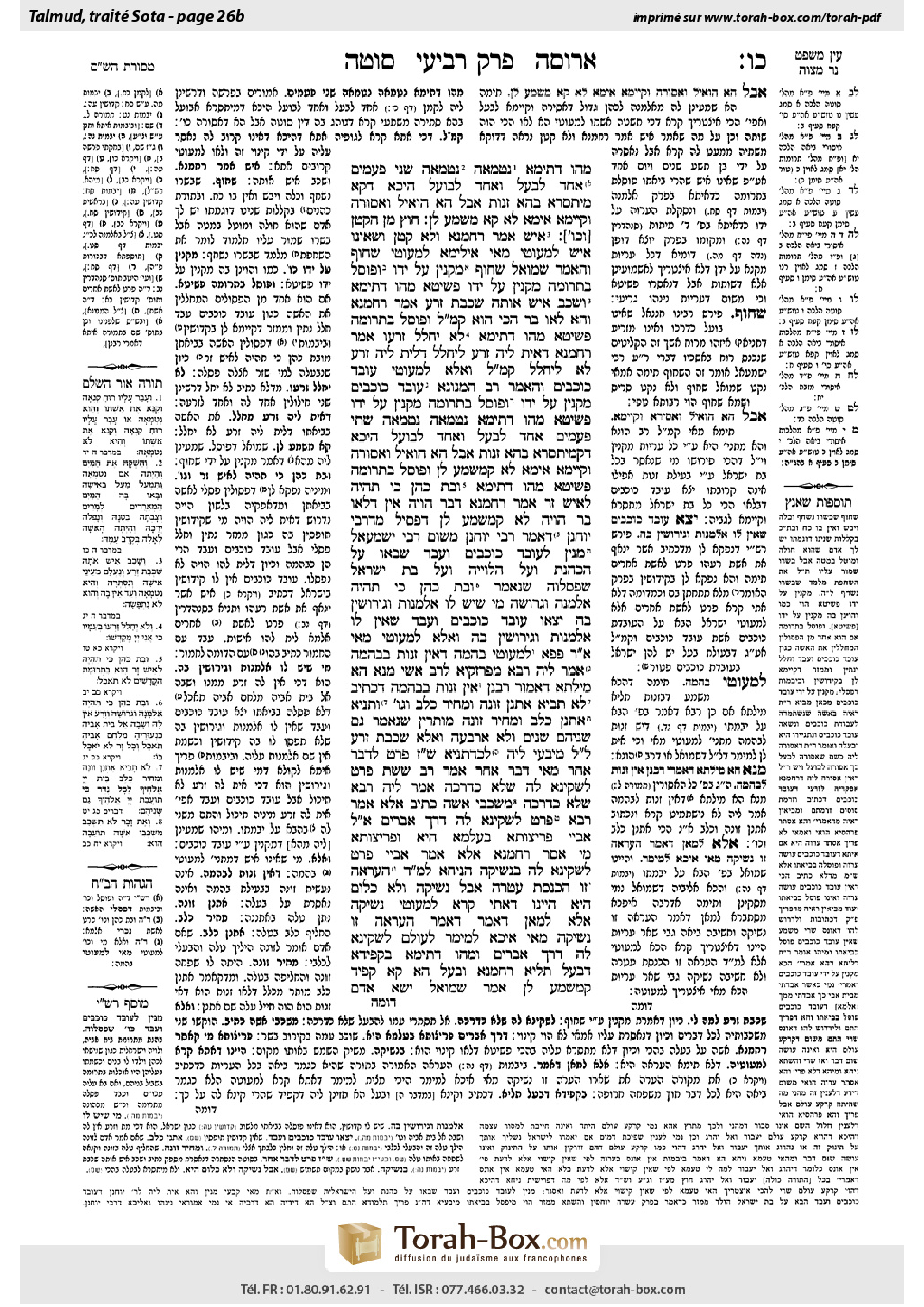
Sotah 26b: Talmud study for Daf Yomi
Daf Yomi is the daily study of one Talmud folio. Explore 37 tractates with scans, Hebrew text, Sefaria English and AI-generated French translations where annotated.
Passage selection and English or AI-generated French translation are available where the scan has annotations. Daf Study is independent of Torah-Box and Sefaria.
Browse Sotah · סוטה · All tractatesSotah 26b text and translations
This page of Sotah includes the Aramaic text, an English translation and an AI-generated French translation, alongside the scan above.
סוטה כ״ו ב · Aramaic and Hebrew text
מַהוּ דְּתֵימָא: ״נִטְמָאָה״ ״נִטְמָאָה״ שְׁנֵי פְּעָמִים: אֶחָד לַבַּעַל וְאֶחָד לַבּוֹעֵל. הֵיכָא דְּקָא מִיתַּסְרָא בְּהָא זְנוּת, אֲבָל הָא הוֹאִיל וַאֲסוּרָה וְקָיְימָא, אֵימָא לָא, קָא מַשְׁמַע לַן.
חוּץ מִן הַקָּטָן וְכוּ׳. ״אִישׁ״ אָמַר רַחֲמָנָא, וְלֹא קָטָן וְשֶׁאֵינוֹ אִישׁ. לְמַעוֹטֵי מַאי? אִילֵּימָא לְמַעוֹטֵי שָׁחוּף, וְהָאָמַר שְׁמוּאֵל: שָׁחוּף מְקַנִּין עַל יָדוֹ, וּפוֹסֵל בִּתְרוּמָה!
מְקַנִּין עַל יָדוֹ, פְּשִׁיטָא! מַהוּ דְּתֵימָא: ״וְשָׁכַב אִישׁ אֹתָהּ שִׁכְבַת זֶרַע״ אָמַר רַחֲמָנָא, וְהָא לָאו בַּר הָכִי הוּא, קָא מַשְׁמַע לַן.
וּפוֹסֵל בִּתְרוּמָה. פְּשִׁיטָא! מַהוּ דְּתֵימָא: ״לֹא יְחַלֵּל זַרְעוֹ״ אָמַר רַחֲמָנָא: דְּאִית לֵיהּ זֶרַע — לִיחַלֵּל, דְּלֵית לֵיהּ זֶרַע — לָא לִיחַלֵּל, קָא מַשְׁמַע לַן.
וְאֶלָּא לְמַעוֹטֵי נׇכְרִי? וְהָאָמַר רַב הַמְנוּנָא: נׇכְרִי מְקַנִּין עַל יָדוֹ וּפוֹסֵל בִּתְרוּמָה.
מְקַנִּין עַל יָדוֹ — פְּשִׁיטָא! מַהוּ דְּתֵימָא ״נִטְמָאָה״ ״נִטְמָאָה״ שְׁתֵּי פְּעָמִים: אֶחָד לַבַּעַל וְאֶחָד לַבּוֹעֵל, הֵיכָא דְּקָמִיתַּסְרָא בְּהָא זְנוּת, אֲבָל הָא הוֹאִיל וַאֲסִירָא וְקָיְימָא, אֵימָא לָא, קָמַשְׁמַע לַן.
וּפוֹסֵל בִּתְרוּמָה — פְּשִׁיטָא! מַהוּ דְּתֵימָא: ״וּבַת כֹּהֵן כִּי תִהְיֶה לְאִישׁ זָר״ אָמַר רַחֲמָנָא: דְּבַר הֲוָיָה — אִין, דְּלָאו בַּר הֲוָיָה — לָא, קָמַשְׁמַע לַן דְּפָסֵיל מִדְּרַבִּי יוֹחָנָן,
דְּאָמַר רַבִּי יוֹחָנָן מִשּׁוּם רַבִּי יִשְׁמָעֵאל: מִנַּיִן לְנׇכְרִי וְעֶבֶד שֶׁבָּאוּ עַל הַכֹּהֶנֶת וְעַל הַלְּוִיָּיה וְעַל בַּת יִשְׂרָאֵל, שֶׁפְּסָלוּהָ — שֶׁנֶּאֱמַר: ״וּבַת כֹּהֵן כִּי תִהְיֶה אַלְמָנָה וּגְרוּשָׁה״. מִי שֶׁיֵּשׁ לוֹ אַלְמְנוּת וְגֵירוּשִׁין בָּהּ, יָצְאוּ נׇכְרִי וְעֶבֶד, שֶׁאֵין לוֹ אַלְמְנוּת וְגֵירוּשִׁין בָּהּ.
וְאֶלָּא לְמַעוֹטֵי מַאי? אָמַר רַב פָּפָּא: לְמַעוֹטֵי בְּהֵמָה, דְּאֵין זְנוּת בִּבְהֵמָה.
אֲמַר לֵיהּ רָבָא מִפַּרְזִקְיָא לְרַב אָשֵׁי: מְנַָא הָא מִילְּתָא דַּאֲמוּר רַבָּנַן אֵין זְנוּת בִּבְהֵמָה, דִּכְתִיב: ״לֹא תָבִיא אֶתְנַן זוֹנָה וּמְחִיר כֶּלֶב וְגוֹ׳״.
וְתַנְיָא: אֶתְנַן כֶּלֶב וּמְחִיר זוֹנָה — מוּתָּרִין, שֶׁנֶּאֱמַר: ״גַּם שְׁנֵיהֶם״, שְׁנַיִם וְלֹא אַרְבָּעָה.
וְאֶלָּא ״שִׁכְבַת זֶרַע״, לְמָה לִי? מִיבְּעֵי לֵיהּ לְכִדְתַנְיָא: ״שִׁכְבַת זֶרַע״ — פְּרָט לְדָבָר אַחֵר.
מַאי ״דָּבָר אַחֵר״? אָמַר רַב שֵׁשֶׁת: פְּרָט לְשֶׁקִּינֵּא לָהּ שֶׁלֹּא כְּדַרְכָּהּ. אֲמַר לֵיהּ רָבָא: שֶׁלֹּא כְּדַרְכָּהּ, ״מִשְׁכְּבֵי אִשָּׁה״ כְּתִיב!
אֶלָּא אָמַר רָבָא: פְּרָט לְשֶׁקִּינֵּא לָהּ דֶּרֶךְ אֵבָרִים. אֲמַר לֵיהּ אַבָּיֵי: פְּרִיצוּתָא בְּעָלְמָא הִיא, וּפְרִיצוּתָא מִי אָסַר רַחֲמָנָא.
אֶלָּא אָמַר אַבָּיֵי: פְּרָט לְשֶׁקִּינֵּא לָהּ בִּנְשִׁיקָה. הָנִיחָא לְמַאן דְּאָמַר הַעֲרָאָה זוֹ הַכְנָסַת עֲטָרָה, אֲבָל נְשִׁיקָה — וְלֹא כְּלוּם הִיא, הַיְינוּ דְּאָתֵי קְרָא לְמַעוֹטֵי נְשִׁיקָה. אֶלָּא לְמַאן דְּאָמַר הַעֲרָאָה זוֹ נְשִׁיקָה, מַאי אִיכָּא לְמֵימַר?
לְעוֹלָם — לְשֶׁקִּינֵּא לָהּ דֶּרֶךְ אֵבָרִים. וּמַהוּ דְּתֵימָא בִּקְפִידָא דְבַעַל תַּלְיָא רַחֲמָנָא, וּבַעַל הָא קָא קָפֵיד, קָמַשְׁמַע לַן.
אָמַר שְׁמוּאֵל: יִשָּׂא אָדָם
Sotah 26b · English translation
The Gemara answers: It is necessary, lest you say that the sota ritual does not apply with regard to forbidden relatives, as the Torah states: “And she was defiled” (Numbers 5:13), “And she was defiled” (Numbers 5:14), two times. One verse teaches that she is defiled and forbidden to her husband, and one verse teaches that she is forbidden to her paramour. One might understand that the sota ritual applies only where she is forbidden to the paramour due to this licentious intercourse; however, with regard to that woman, who secluded herself with a forbidden relative, since the woman already stands prohibited to him due to the prohibition of incest, one might say that the sota ritual does not apply. The mishna therefore teaches us that one can issue a warning even with regard to forbidden relatives.
§ The mishna states: A husband can issue a warning to his wife with regard to all those with whom relations are forbidden, with the exception of a minor and of one who is not a man. The Gemara cites the source for this halakha: The Merciful One states in the Torah: “And a man lay with her” (Numbers 5:13), indicating that one can warn his wife with regard to a man but not with regard to a minor. The Gemara asks: The phrase: And of one who is not a man, serves to exclude what? If we say that it serves to exclude a sick man who lacks the ability to complete intercourse [shaḥuf], but didn’t Shmuel say: One can issue a warning with regard to a shaḥuf, and if a shaḥuf engages in sexual intercourse with the daughter of a priest, he disqualifies her from partaking of teruma.
With regard to Shmuel’s statement that one can issue a warning with regard to a shaḥuf, the Gemara asks: Isn’t that obvious? The Gemara answers: It is necessary, lest you say that one cannot issue a warning with regard to a shaḥuf, as the Merciful One states in the Torah: “And a man lay with her carnally [shikhvat zera]” (Numbers 5:13), literally, a lying of seed, and this man is not capable of that, as he cannot ejaculate. Shmuel therefore teaches us that one can issue a warning with regard to a shaḥuf.
The Gemara asks with regard to Shmuel’s statement that a shaḥuf who engages in sexual intercourse with the daughter of a priest disqualifies her from partaking of teruma: Isn’t that obvious? The Gemara answers: It is necessary lest you say that a shaḥuf does not disqualify the daughter of a priest from partaking of teruma, as the Merciful One states in the Torah with regard to a priest: “And he shall not disqualify his offspring among his people” (Leviticus 21:15). One might infer from this verse that one who can have offspring disqualifies a woman from partaking of teruma, through forbidden sexual intercourse, and that one who cannot have offspring does not disqualify a woman from partaking of teruma. Shmuel therefore teaches us that this is not so. In any event, Shmuel states that one can issue a warning on account of a shaḥuf, unlike the initial interpretation of the mishna.
Since Shmuel’s statement contradicts the suggestion that the mishna excludes a shaḥuf, the Gemara suggests another explanation: Rather, the mishna serves to exclude a gentile, and teaches that one cannot issue a warning with regard to him. The Gemara asks: But didn’t Rav Hamnuna say: One can issue a warning with regard to a gentile, and if a gentile engages in sexual intercourse with the daughter of a priest, he disqualifies her from partaking of teruma.
The Gemara asks with regard to Rav Hamnuna’s statement that one can issue a warning with regard to a gentile: Isn’t that obvious? The Gemara answers: It is necessary lest you say that one cannot issue a warning in this case, as the verse states: “And she was defiled” (Numbers 5:13), “And she was defiled” (Numbers 5:14), twice. One verse teaches that she is defiled and forbidden to her husband, and one verse teaches that she is forbidden to her paramour. One might understand that the sota ritual applies only where she is forbidden to the paramour due to this licentious intercourse; however, with regard to that woman, who engaged in sexual intercourse with a gentile, since she already stands prohibited to him, one might say that the sota ritual does not apply. Rav Hamnuna therefore teaches us that one can issue a warning even with regard to a gentile.
The Gemara asks with regard to Rav Hamnuna’s statement that a gentile who engages in sexual intercourse with the daughter of a priest disqualifies her from partaking of teruma: Isn’t that obvious? The Gemara answers: It is necessary lest you say that he does not disqualify her, as the Merciful One states in the Torah: “And if a priest’s daughter should be unto a strange man, she shall not eat of that which is set apart from the holy things” (Leviticus 22:12), indicating that if a woman engages in sexual intercourse with one who is unfit for her, he disqualifies her from partaking of teruma. Since the term “should be unto” denotes marriage, one might say that one who is eligible for betrothal, yes, he disqualifies the woman; but a gentile, who is not eligible for betrothal, does not disqualify her. Rav Hamnuna therefore teaches us that a gentile disqualifies the woman from partaking of teruma, as one can learn from the ruling of Rabbi Yoḥanan.
This is as Rabbi Yoḥanan says in the name of Rabbi Yishmael: From where is it derived that a gentile or a slave who engaged in sexual intercourse with the daughter of a priest or with the daughter of a Levite or with the daughter of an Israelite, disqualified her from marrying a priest and from partaking of teruma? This is derived as it is stated: “But if a priest’s daughter should be a widow or a divorcée…she returns to her father’s house…she may eat of her father’s bread” (Leviticus 22:13). This indicates that the daughter of a priest returns to eat of her father’s bread, i.e., teruma, if she engaged in sexual intercourse with one whose marriage to her has the potential to end in widowhood or divorce, i.e., a Jew whom she is permitted to marry. This excludes a gentile and a slave, whose marriage to her does not have the potential to end in widowhood or divorce, as their betrothal is invalid.
Since Rav Hamnuna’s statement contradicts the suggestion that the mishna excludes a gentile, the Gemara asks: Rather, what does the term: And of one who is not a man, serve to exclude? Rav Pappa says: This serves to exclude an animal, as the concept of licentiousness does not apply with regard to an animal. Therefore, the halakhot of a sota do not apply in this case.
Rava of Parzakya said to Rav Ashi: From where is this matter that the Sages stated derived, that licentiousness does not apply with regard to an animal? Rav Ashi replied that it is as it is written: “You shall not bring the hire of a harlot, or the price of a dog, into the house of the Lord your God for any vow; for both of them are an abomination to the Lord your God” (Deuteronomy 23:19). This verse prohibits one from sacrificing an animal that served as payment to a prostitute or as payment for the purchase of a dog.
And it is taught in a mishna (Temura 30a): In the converse cases, the hire of a dog, i.e., a kosher animal that was given to the owner of a dog as payment for engaging in intercourse with it, and the price of a prostitute, i.e., a kosher animal which served as payment in the purchase of a maidservant acquired for prostitution, are permitted to be sacrificed, as it is stated in the aforementioned verse: For both of them. This term indicates that only those two animals may not be sacrificed, i.e., those which served as the hire of a harlot and as the price of a dog; and not four animals, as the reverse cases are excluded from this halakha. This indicates that the concept of licentiousness does not apply with regard to animals, as the payment for intercourse with a dog is not considered payment for prostitution.
The Gemara asks: Shmuel states that one can issue a warning with regard to a shaḥuf even though he is unable to discharge semen. But rather, why do I need the verse to state: “And a man lay with her carnally [shikhvat zera]” (Numbers 5:13)? The Gemara answers: It is necessary for that which is taught in a baraita: The term “shikhvat zera” excludes something else.
The Gemara asks: What is meant by the term: Something else? Rav Sheshet said: This excludes a case where the husband issued a warning to his wife not to engage in sexual intercourse in an atypical manner, i.e., anal intercourse, with another man, and teaches that this is not considered a valid warning. Rava said to Rav Sheshet: Intercourse in an atypical manner is considered sexual intercourse, as it is written: “The cohabitations of a woman” (Leviticus 18:22), indicating that there are two forms of sexual intercourse with a woman, vaginal and anal, and there is no halakhic differentiation between them.
Rather, Rava said: It excludes a case where the husband issued a warning to his wife not to engage in intimate contact with another man by way of other limbs, as this is not considered sexual intercourse. Abaye said to Rava: That is merely licentious behavior, and does the Merciful One render a woman forbidden to her husband on account of merely licentious behavior, without sexual intercourse? Since this does not render her forbidden to her husband, it is obvious that if the husband issues a warning in this manner, violating the warning does not cause her to become a sota. The verse is therefore not required to exclude this case.
Rather, Abaye said: The verse excludes a case where the husband issued a warning to his wife with regard to engaging in genital contact without actual penetration. The Gemara asks: This works out well according to the one who says that the definition of the initial stage of intercourse is the insertion of the corona but that genital contact is nothing; this is the reason that the verse came to exclude genital contact. However, according to the one who says that the definition of the initial stage of intercourse is genital contact, what is there to say? Why should this case be excluded from the halakhot of a sota?
The Gemara answers: Actually, the verse serves to exclude a case where the husband issued a warning to his wife not to engage in intimate contact with another man by way of other limbs. And the verse explicitly excludes this case from the halakhot of a sota, lest you say that the woman is rendered a sota due to this warning, as the Merciful One made this halakha dependent on the husband’s objection, and the husband objects to contact of this nature. The verse therefore teaches us that this is not considered a warning, as it does not involve sexual intercourse.
§ Shmuel says: It is better that a man marry
Sotah 26b · Traduction française (IA)
La Guemara répond : Il est nécessaire [de préciser cela], de peur que vous ne disiez que le rituel de la sota ne s'applique pas en ce qui concerne les parents interdits, car la Torah déclare : « Et elle s'est souillée » (Nombres 5:13), « Et elle s'est souillée » (Nombres 5:14), deux fois. Un verset enseigne qu'elle est souillée et interdite à son mari, et un verset enseigne qu'elle est interdite à son amant. On pourrait comprendre que le rituel de la sota ne s'applique que là où elle est interdite à l'amant en raison de cette relation licencieuse ; cependant, en ce qui concerne cette femme qui s'est isolée avec un parent interdit, puisque la femme est déjà interdite à lui en raison de l'interdit de l'inceste, on pourrait dire que le rituel de la sota ne s'applique pas. La Michna nous enseigne donc qu'on peut émettre un avertissement même en ce qui concerne les parents interdits.
§ La Michna énonce : Un mari peut émettre un avertissement à sa femme en ce qui concerne tous ceux avec qui les relations sont interdites, à l'exception d'un mineur et de celui qui n'est pas un homme. La Guemara cite la source de cette halakha : Le Tout-Puissant déclare dans la Torah : « Et un homme a couché avec elle » (Nombres 5:13), indiquant qu'on peut avertir sa femme en ce qui concerne un homme, mais pas en ce qui concerne un mineur. La Guemara demande : L'expression : « et de celui qui n'est pas un homme », sert à exclure quoi ? Si nous disons que cela sert à exclure un homme malade qui n'a pas la capacité d'accomplir la relation [shaḥuf], mais Shmuel n'a-t-il pas dit : On peut émettre un avertissement en ce qui concerne un shaḥuf, et si un shaḥuf a des relations sexuelles avec la fille d'un prêtre, il la rend inapte à consommer la terouma.
Concernant l'affirmation de Shmuel selon laquelle on peut émettre un avertissement à l'égard d'un shaḥuf, la Guemara demande : N'est-ce pas évident ? La Guemara répond : Il est nécessaire [de le préciser], de peur que vous ne disiez qu'on ne peut pas émettre un avertissement à l'égard d'un shaḥuf, car le Tout-Puissant déclare dans la Torah : « Et un homme a couché avec elle charnellement [shikhvat zera] » (Nombres 5:13), littéralement, un dépôt de semence, et cet homme n'est pas capable de cela, car il ne peut pas éjaculer. Shmuel nous enseigne donc qu'on peut émettre un avertissement à l'égard d'un shaḥuf.
La Guemara demande, concernant l'affirmation de Shmuel selon laquelle un shaḥuf qui a des relations sexuelles avec la fille d'un prêtre la rend inapte à consommer la terouma : N'est-ce pas évident ? La Guemara répond : Il est nécessaire [de le préciser], de peur que vous ne disiez qu'un shaḥuf ne rend pas inapte la fille d'un prêtre à consommer la terouma, car le Tout-Puissant déclare dans la Torah, à propos d'un prêtre : « Et il ne rendra pas inaptes ses descendants parmi son peuple » (Lévitique 21:15). On pourrait inférer de ce verset que celui qui peut avoir des descendants rend une femme inapte à consommer la terouma, par des relations sexuelles interdites, et que celui qui ne peut pas avoir de descendants ne rend pas une femme inapte à consommer la terouma. Shmuel nous enseigne donc que ce n'est pas le cas. En tout état de cause, Shmuel affirme qu'on peut émettre un avertissement à cause d'un shaḥuf, contrairement à l'interprétation initiale de la Michna.
Puisque l'affirmation de Shmuel contredit la suggestion que la Michna exclut un shaḥuf, la Guemara propose une autre explication : Plutôt, la Michna sert à exclure un non-Juif, et enseigne qu'on ne peut pas émettre un avertissement à son égard. La Guemara demande : Mais Rav Hamnuna n'a-t-il pas dit : On peut émettre un avertissement à l'égard d'un non-Juif, et si un non-Juif a des relations sexuelles avec la fille d'un prêtre, il la rend inapte à consommer la terouma.
La Guemara demande, au sujet de l'affirmation de Rav Hamnuna selon laquelle on peut émettre un avertissement à l'égard d'un non-Juif : n'est-ce pas évident ? La Guemara répond : Il est nécessaire [de le préciser], de peur que vous ne disiez qu'on ne peut pas émettre d'avertissement dans ce cas, car le verset déclare : « Et elle s'est souillée » (Nombres 5:13), « Et elle s'est souillée » (Nombres 5:14), deux fois. Un verset enseigne qu'elle est souillée et interdite à son mari, et un verset enseigne qu'elle est interdite à son amant. On pourrait comprendre que le rituel de la sota ne s'applique que lorsque l'interdiction à l'égard de l'amant découle de cette relation licencieuse ; cependant, en ce qui concerne cette femme qui a eu des relations sexuelles avec un non-Juif, puisqu'elle est déjà interdite à lui, on pourrait dire que le rituel de la sota ne s'applique pas. Rav Hamnuna nous enseigne donc qu'on peut émettre un avertissement même à l'égard d'un non-Juif.
La Guemara demande, au sujet de l'affirmation de Rav Hamnuna selon laquelle un non-Juif qui a des relations sexuelles avec la fille d'un prêtre la rend inapte à consommer la terouma : n'est-ce pas évident ? La Guemara répond : Il est nécessaire [de le préciser], de peur que vous ne disiez qu'il ne la rend pas inapte, car le Tout-Puissant déclare dans la Torah : « Et si la fille d'un prêtre est donnée en mariage à un étranger, elle ne mangera pas de ce qui est mis à part des choses saintes » (Lévitique 22:12), indiquant que si une femme a des relations sexuelles avec celui qui n'est pas apte pour elle, il la rend inapte à consommer la terouma. Puisque le terme « est donnée en mariage » désigne le mariage, on pourrait dire que celui qui est éligible aux fiançailles, oui, il rend la femme inapte ; mais un non-Juif, qui n'est pas éligible aux fiançailles, ne la rend pas inapte. Rav Hamnuna nous enseigne donc qu'un non-Juif rend la femme inapte à consommer la terouma, comme on peut l'apprendre de la décision de Rabbi Yoḥanan.
C'est ainsi que Rabbi Yoḥanan dit au nom de Rabbi Yishmael : D'où est-il déduit qu'un non-Juif ou un esclave qui a eu des relations sexuelles avec la fille d'un Cohen, ou avec la fille d'un Lévite, ou avec la fille d'un Israélite, la rend inapte à épouser un Cohen et à consommer la terouma ? Cela est déduit de ce qui est écrit : « Mais si la fille d'un Cohen est veuve ou divorcée… elle retourne à la maison de son père… elle peut manger du pain de son père » (Lévitique 22:13). Cela indique que la fille d'un Cohen retourne pour manger du pain de son père, c'est-à-dire la terouma, si elle a eu des relations sexuelles avec un homme dont le mariage avec elle a le potentiel de se terminer par le veuvage ou le divorce, c'est-à-dire un Juif qu'elle est autorisée à épouser. Cela exclut un non-Juif et un esclave, dont le mariage avec elle n'a pas le potentiel de se terminer par le veuvage ou le divorce, car leurs fiançailles sont invalides.
Étant donné que la déclaration de Rav Hamnuna contredit la suggestion selon laquelle la Michna exclut un non-Juif, la Guemara demande : Plutôt, à quoi sert le terme : « Et d'un homme qui n'est pas un homme » ? Rav Pappa dit : Cela sert à exclure un animal, car le concept de débauche ne s'applique pas à un animal. Par conséquent, les halakhot de la sota ne s'appliquent pas dans ce cas.
Rava de Parzakya dit à Rav Ashi : D'où est dérivée cette règle que les Sages ont énoncée, selon laquelle la débauche ne s'applique pas à un animal ? Rav Ashi répondit que c'est comme il est écrit : « Tu ne porteras pas le salaire d'une prostituée, ni le prix d'un chien, dans la maison de l'Éternel, ton Dieu, pour quelque vœu que ce soit ; car l'un et l'autre sont une abomination pour l'Éternel, ton Dieu » (Deutéronome 23:19). Ce verset interdit de sacrifier un animal qui a servi de paiement à une prostituée ou de paiement pour l'achat d'un chien.
Et il est enseigné dans une Michna (Temoura 30a) : Dans les cas inverses, le salaire d'un chien, c'est-à-dire un animal casher qui a été donné au propriétaire d'un chien en paiement pour avoir eu des rapports sexuels avec lui, et le prix d'une prostituée, c'est-à-dire un animal casher qui a servi de paiement pour l'achat d'une servante acquise pour la prostitution, sont permis à être sacrifiés, car il est dit dans le verset susmentionné : « Car l'un et l'autre ». Ce terme indique que seuls ces deux animaux ne peuvent pas être sacrifiés, c'est-à-dire ceux qui ont servi de salaire à une prostituée et de prix pour un chien ; et non quatre animaux, car les cas inverses sont exclus de cette halakha. Cela indique que le concept de débauche ne s'applique pas aux animaux, car le paiement pour des rapports sexuels avec un chien n'est pas considéré comme un paiement pour la prostitution.
La Guemara demande : Chmouël déclare qu'on peut émettre un avertissement à l'égard d'un shaḥuf, bien qu'il soit incapable d'émettre de la semence. Mais plutôt, pourquoi ai-je besoin du verset pour dire : « Et un homme coucha avec elle charnellement [shikhvat zera] » (Nombres 5:13) ? La Guemara répond : C'est nécessaire pour ce qui est enseigné dans une baraïta : Le terme « shikhvat zera » exclut autre chose.
La Guemara demande : Que signifie le terme : Autre chose ? Rav Chéchet dit : Cela exclut un cas où le mari a émis un avertissement à sa femme de ne pas avoir de rapports sexuels d'une manière atypique, c'est-à-dire des rapports anaux, avec un autre homme, et enseigne que ce n'est pas considéré comme un avertissement valide. Rava dit à Rav Chéchet : Les rapports d'une manière atypique sont considérés comme des rapports sexuels, car il est écrit : « Les cohabitations d'une femme » (Lévitique 18:22), indiquant qu'il y a deux formes de rapports sexuels avec une femme, vaginale et anale, et qu'il n'y a pas de différenciation halakhique entre elles.
Au contraire, Rava a dit : Cela exclut le cas où le mari a averti sa femme de ne pas avoir de relations intimes avec un autre homme par le biais d'autres parties du corps, car cela n'est pas considéré comme des rapports sexuels. Abaye a dit à Rava : Il s'agit là seulement d'actes de débauche ; le Saint, béni soit-Il, rend-il une femme interdite à son mari à cause de simples actes de débauche, sans rapports sexuels ? Puisque cela ne la rend pas interdite à son mari, il est évident que si le mari émet un avertissement de cette manière, la violation de cet avertissement ne fait pas d'elle une sota. Le verset n'est donc pas nécessaire pour exclure ce cas.
Au contraire, Abaye a dit : Le verset exclut le cas où le mari a averti sa femme à propos de contacts génitaux sans pénétration réelle. La Guemara demande : Cela se concilie bien avec l'opinion de celui qui dit que la définition de la première étape des rapports sexuels est l'insertion de la couronne, mais que le contact génital ne compte pour rien ; c'est la raison pour laquelle le verset est venu exclure le contact génital. Cependant, selon l'opinion de celui qui dit que la définition de la première étape des rapports sexuels est le contact génital, que peut-on dire ? Pourquoi ce cas devrait-il être exclu des halakhot de la sota ?
La Guemara répond : En réalité, le verset sert à exclure le cas où le mari a averti sa femme de ne pas avoir de relations intimes avec un autre homme par le biais d'autres parties du corps. Et le verset exclut explicitement ce cas des halakhot de la sota, de peur que vous ne disiez que la femme est rendue sota en raison de cet avertissement, car le Saint, béni soit-Il, a rendu cette halakha dépendante de l'objection du mari, et le mari objecte à un contact de cette nature. Le verset nous enseigne donc que ce n'est pas considéré comme un avertissement, car il ne implique pas de rapports sexuels.
§ Chmouël dit : Il est préférable qu'un homme épouse
Traduction française générée par IA à partir de l’édition anglaise de Sefaria. Vérifie toujours un passage avec le texte source.
Text from Sefaria: William Davidson Edition - Vocalized Aramaic (CC BY NC); William Davidson Edition - English (CC BY NC).