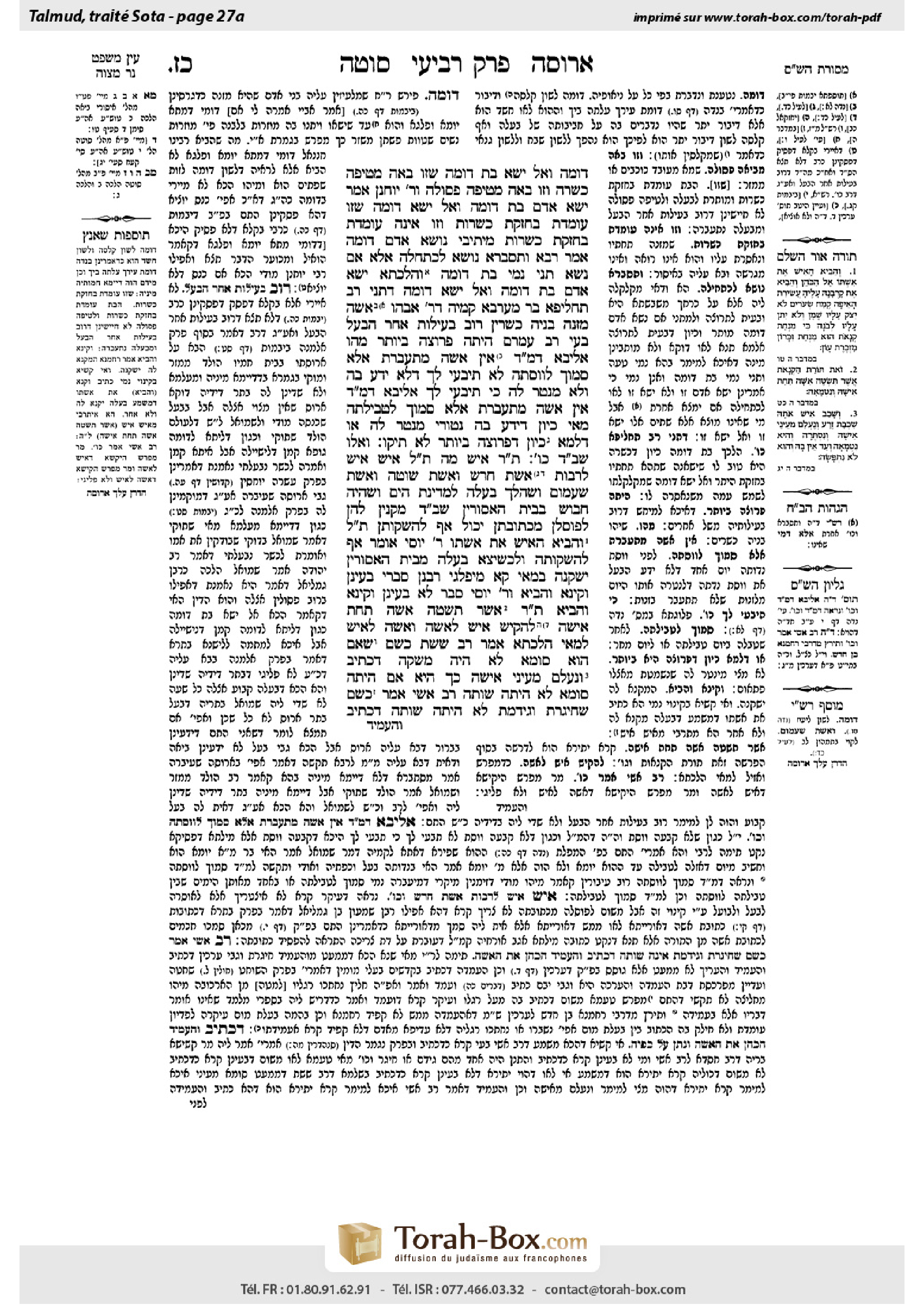
Sotah 27a: Talmud study for Daf Yomi
Daf Yomi is the daily study of one Talmud folio. Explore 37 tractates with scans, Hebrew text, Sefaria English and AI-generated French translations where annotated.
Passage selection and English or AI-generated French translation are available where the scan has annotations. Daf Study is independent of Torah-Box and Sefaria.
Browse Sotah · סוטה · All tractatesSotah 27a text and translations
This page of Sotah includes the Aramaic text, an English translation and an AI-generated French translation, alongside the scan above.
סוטה כ״ז א · Aramaic and Hebrew text
דּוּמָה, וְאַל יִשָּׂא בַּת דּוּמָה. שֶׁזּוֹ בָּאָה מִטִּיפָּה כְּשֵׁרָה, וְזוֹ בָּאָה מִטִּיפָּה פְּסוּלָה.
וְרַבִּי יוֹחָנָן אָמַר: יִשָּׂא אָדָם בַּת דּוּמָה, וְאַל יִשָּׂא דּוּמָה. שֶׁזּוֹ עוֹמֶדֶת בְּחֶזְקַת כַּשְׁרוּת, וְזוֹ אֵינָהּ עוֹמֶדֶת בְּחֶזְקַת כַּשְׁרוּת.
מֵיתִיבִי: נוֹשֵׂא אָדָם דּוּמָה! אָמַר רָבָא: וְתִסְבְּרָא נוֹשֵׂא לְכַתְּחִלָּה?! אֶלָּא: אִם נָשָׂא, תְּנִי נָמֵי: ״בַּת דּוּמָה״.
וְהִלְכְתָא: יִשָּׂא אָדָם בַּת דּוּמָה, וְאַל יִשָּׂא דּוּמָה. דְּתָנֵי רַב תַּחְלִיפָא בַּר מַעְרְבָא קַמֵּיהּ דְּרַבִּי אֲבָהוּ: אִשָּׁה מְזַנָּה — בָּנֶיהָ כְּשֵׁרִין, רוֹב בְּעִילוֹת אַחַר הַבַּעַל.
בָּעֵי רַב עַמְרָם: הָיְתָה פְּרוּצָה בְּיוֹתֵר, מַהוּ? אַלִּיבָּא דְּמַאן דְּאָמַר אֵין אִשָּׁה מִתְעַבֶּרֶת אֶלָּא סָמוּךְ לְוִוסְתָּהּ — לָא תִּיבְּעֵי לָךְ, דְּלָא יָדַע בַּהּ וְלָא מְנַטַּר לַהּ.
כִּי תִּיבְּעֵי לָךְ, אַלִּיבָּא דְּמַאן דְּאָמַר אֵין אִשָּׁה מִתְעַבֶּרֶת אֶלָּא סָמוּךְ לִטְבִילָתָהּ, מַאי? כֵּיוָן דְּיָדַע בָּהּ, נַטּוֹרֵי מְנַטַּר לָהּ, אוֹ דִלְמָא כֵּיוָן דִּפְרוּצָה בְּיוֹתֵר — לָא? תֵּיקוּ.
וְאֵלּוּ שֶׁבֵּית דִּין כּוּ׳. תָּנוּ רַבָּנַן: ״אִישׁ״, מָה תַּלְמוּד לוֹמַר ״אִישׁ אִישׁ״ — לְרַבּוֹת אֵשֶׁת חֵרֵשׁ, וְאֵשֶׁת שׁוֹטֶה, וְאֵשֶׁת שַׁעֲמוּם, וְשֶׁהָלַךְ בַּעְלָהּ לִמְדִינַת הַיָּם, וְשֶׁהָיָה חָבוּשׁ בְּבֵית הָאֲסוּרִין — שֶׁבֵּית דִּין מְקַנִּין לָהֶן לְפוֹסְלָן מִכְּתוּבָּתָן.
יָכוֹל אַף לְהַשְׁקוֹתָן — תַּלְמוּד לוֹמַר: ״וְהֵבִיא הָאִישׁ אֶת אִשְׁתּוֹ״. רַבִּי יוֹסֵי אוֹמֵר: אַף לְהַשְׁקוֹתָהּ, וְלִכְשֶׁיֵּצֵא בַּעְלָהּ מִבֵּית הָאֲסוּרִין יַשְׁקֶנָּה.
בְּמַאי קָא מִיפַּלְגִי, רַבָּנַן סָבְרִי: בָּעֵינַן ״וְקִנֵּא ... וְהֵבִיא״, וְרַבִּי יוֹסֵי סָבַר: לָא בָּעֵינַן ״וְקִנֵּא ... וְהֵבִיא״.
תָּנוּ רַבָּנַן: ״אֲשֶׁר תִּשְׂטֶה אִשָּׁה תַּחַת אִישָׁהּ״, לְהַקִּישׁ אִישׁ לְאִשָּׁה וְאִשָּׁה לְאִישׁ. לְמַאי הִלְכְתָא? אָמַר רַב שֵׁשֶׁת: כְּשֵׁם שֶׁאִם הוּא סוֹמֵא לֹא הָיָה מַשְׁקָהּ, דִּכְתִיב: ״וְנֶעְלַם מֵעֵינֵי אִישָׁהּ״, כָּךְ הִיא, אִם הָיְתָה סוֹמָא — לֹא הָיְתָה שׁוֹתָה. רַב אָשֵׁי אָמַר: כְּשֵׁם שֶׁחִיגֶּרֶת וְגִידֶּמֶת לֹא הָיְתָה שׁוֹתָה, דִּכְתִיב:
Sotah 27a · English translation
a woman whose suspected promiscuity is publicly spoken of [duma], and not marry the daughter of a woman suspected of promiscuity, as this woman, who is herself suspected of promiscuity, comes from seed of unflawed lineage; but that woman, the daughter of a woman suspected of promiscuity, comes from seed of flawed lineage, as she might be a mamzeret.
And Rabbi Yoḥanan says: It is better that a man marry the daughter of a woman suspected of promiscuity, and not marry a woman suspected of promiscuity, as this daughter maintains the presumptive status of virtuousness, but that woman suspected of promiscuity does not maintain the presumptive status of virtuousness.
The Gemara raises an objection to Rabbi Yoḥanan’s statement from a baraita: A man may marry a woman suspected of promiscuity. Rava said in response: And how can you understand the baraita at face value? The baraita states that a man may marry her ab initio, yet clearly it is undesirable to do so. Rather, the wording of the baraita is imprecise, and one must render it: If one married a woman suspected of promiscuity, she is permitted to him. Since the baraita is imprecise, one should also correct it and teach: The daughter of a woman suspected of promiscuity.
The Gemara concludes: And the halakha is that it is better that a man marry the daughter of a woman suspected of promiscuity, and not marry a woman suspected of promiscuity. This is as Rav Taḥalifa, from the West, i.e., Eretz Yisrael, taught before Rabbi Abbahu: If a married woman engages in adulterous sexual intercourse, her children are considered of unflawed lineage, as most instances of sexual intercourse are attributed to the husband, and consequently it is presumed that the children were conceived by the husband and not by the paramour. Therefore, the daughter of a woman suspected of promiscuity is not suspected of being a mamzeret.
Rav Amram raises a dilemma: What is the halakha if the woman was extremely promiscuous and one cannot reasonably attribute most instances of intercourse to the husband? Are her children considered of unflawed lineage, or is their lineage uncertain? According to the opinion of the one who says that a woman becomes pregnant only close to the time of the onset of her menstruation, you do not need to raise this dilemma, as the husband does not know the time of this, i.e., the time of her menstruation, in advance, and he does not watch her actions in order to prevent her from conceiving from another man. Her children are therefore of uncertain lineage.
When do you need to raise this dilemma? It is necessary according to the opinion of the one who says that a woman becomes pregnant only close to the time of her immersion. What is the halakha? Can it be assumed that since he knows the time of this, i.e., of her immersion, he watches her actions on that day in order to prevent her from conceiving from another man; or perhaps, since she is extremely promiscuous, her husband cannot adequately watch her and her children are considered of uncertain lineage? The Gemara concludes: The dilemma shall stand unresolved.
§ The mishna states (24a): And these are the women to whom the court issues a warning in place of their husbands: One whose husband became a deaf-mute or became an imbecile, or if he were incarcerated in prison. The Sages taught: The verse states: “If the wife of any man goes astray” (Numbers 5:12). As the verse could have said: The wife of a man, what is the meaning when the verse states: “The wife of any man”? It serves to include the wife of a deaf-mute, and the wife of an imbecile, and the wife of an insane person, and one whose husband went overseas, and one whose husband was incarcerated in prison; and it teaches that the court issues a warning to these women in order to disqualify them from receiving payment of their marriage contract.
One might have thought that the court’s warning is effective even to have the women drink the bitter water; therefore, the verse states: “Then the man shall bring his wife to the priest” (Numbers 5:15), indicating that only the warning issued by the husband causes his wife to drink. Rabbi Yosei says: The court’s warning is effective even to have her drink, and when her husband is released from prison he has her drink.
The Gemara asks: With regard to what do they disagree? The Gemara answers: The Rabbis hold that we require the same person who issues the warning to bring the woman to the Temple, as the verse states: “And he warned his wife…then the man shall bring his wife to the priest” (Numbers 5:14–15). And Rabbi Yosei holds that we do not require that the actions stated in the verse, i.e., “And he warned…then the man shall bring,” be performed by the same person; and although only the husband may bring the woman to the priest to drink the bitter water, the warning may be issued by the court.
§ The Sages taught that the verse: “This is the law of jealousy, when a wife, while under her husband, goes astray and is defiled” (Numbers 5:29), is superfluous, and serves to compare a man to a woman and a woman to a man. The Gemara asks: With regard to what halakha is this comparison necessary? Rav Sheshet says: This teaches that just as if the husband was blind he would not have her drink, as it is written: “And it was hidden from the eyes of her husband” (Numbers 5:13), indicating that the sota ritual applies only if the husband was capable of seeing her infidelity but did not do so; so too, with regard to the woman, if she were blind, she would not drink. Rav Ashi also says: Just as a lame woman and a woman without hands would not drink, as it is written:
Sotah 27a · Traduction française (IA)
une femme dont la conduite sexuelle présumée est publiquement mise en cause [duma], et ne pas épouser la fille d’une femme soupçonnée d’inconduite sexuelle. En effet, cette femme, elle-même soupçonnée d’inconduite sexuelle, est issue d’une lignée sans défaut, tandis que cette autre femme, la fille d’une femme soupçonnée d’inconduite sexuelle, est issue d’une lignée entachée, car elle pourrait être une mamzeret.
Et Rabbi Yoḥanan dit : Il vaut mieux qu’un homme épouse la fille d’une femme soupçonnée d’inconduite sexuelle plutôt qu’une femme elle-même soupçonnée d’inconduite sexuelle, car cette fille conserve une présomption de vertu, tandis que la femme soupçonnée d’inconduite sexuelle ne bénéficie pas d’une telle présomption.
La Guemara soulève une objection à l’affirmation de Rabbi Yoḥanan à partir d’une baraïta : Un homme peut épouser une femme soupçonnée d’inconduite sexuelle. Rava répondit : Comment comprendre la baraïta au pied de la lettre ? Elle affirme qu’un homme peut l’épouser d’emblée, alors qu’il est clair qu’il n’est pas souhaitable de le faire. La formulation de la baraïta est plutôt imprécise, et il faut la comprendre ainsi : si quelqu’un a épousé une femme soupçonnée d’inconduite sexuelle, elle lui est permise. Puisque la baraïta est imprécise, il faut également la corriger et enseigner : la fille d’une femme soupçonnée d’inconduite sexuelle.
La Guemara conclut : La halakha est qu’il vaut mieux qu’un homme épouse la fille d’une femme soupçonnée d’inconduite sexuelle plutôt qu’une femme elle-même soupçonnée d’inconduite sexuelle. C’est ce qu’enseigna Rav Taḥalifa, de l’Ouest, c’est-à-dire d’Erets Israël, devant Rabbi Abbahu : si une femme mariée a des relations adultères, ses enfants sont considérés comme issus d’une lignée sans défaut, car la plupart des rapports sexuels sont attribués au mari. On présume donc que les enfants ont été conçus par le mari et non par l’amant. Par conséquent, la fille d’une femme soupçonnée d’inconduite sexuelle n’est pas soupçonnée d’être une mamzeret.
Rav Amram soulève un dilemme : quelle est la halakha si la femme était extrêmement débauchée et que l’on ne peut raisonnablement attribuer la plupart de ses rapports à son mari ? Ses enfants sont-ils considérés comme issus d’une lignée sans défaut, ou leur statut généalogique est-il incertain ? Selon l’opinion de celui qui dit qu’une femme ne peut concevoir qu’à proximité du début de ses règles, il n’est pas nécessaire de soulever ce dilemme, car le mari ne connaît pas à l’avance le moment en question, c’est-à-dire celui de ses règles, et ne surveille pas son comportement pour l’empêcher de concevoir d’un autre homme. Le statut généalogique de ses enfants est donc incertain.
Quand faut-il soulever ce dilemme ? Cela est nécessaire selon l’opinion de celui qui dit qu’une femme ne peut concevoir qu’à proximité du moment de son immersion. Quelle est la halakha ? Peut-on supposer que, puisqu’il connaît le moment de son immersion, il surveille son comportement ce jour-là afin de l’empêcher de concevoir d’un autre homme ? Ou peut-être, puisqu’elle est extrêmement débauchée, son mari ne peut-il pas la surveiller convenablement, de sorte que le statut généalogique de ses enfants est incertain ? La Guemara conclut : le dilemme demeure sans réponse.
§ La Michna enseigne (24a) : Et voici les femmes auxquelles le tribunal adresse un avertissement à la place de leur mari : celle dont le mari est devenu sourd-muet ou est devenu déficient mental, ou dont le mari est incarcéré. Les Sages ont enseigné : Le verset dit : « Si la femme de quelque homme s’égare » (Nombres 5:12). Le verset aurait pu dire : « la femme d’un homme » ; que signifie alors l’expression « la femme de quelque homme » ? Elle inclut la femme d’un sourd-muet, la femme d’un déficient mental, la femme d’un homme atteint de folie, celle dont le mari est parti outre-mer et celle dont le mari est incarcéré. Cela enseigne que le tribunal adresse un avertissement à ces femmes afin de les priver du paiement de leur contrat de mariage.
On aurait pu penser que l’avertissement du tribunal est également efficace pour faire boire aux femmes l’eau amère. C’est pourquoi le verset dit : « Alors l’homme conduira sa femme chez le prêtre » (Nombres 5:15), ce qui indique que seul l’avertissement adressé par le mari conduit sa femme à boire. Rabbi Yosei dit : L’avertissement du tribunal est également efficace pour la faire boire, et lorsque son mari est libéré de prison, il la fait boire.
La Guemara demande : Sur quoi porte leur désaccord ? La Guemara répond : Les Rabbins considèrent que la même personne doit adresser l’avertissement et conduire la femme au Temple, comme le dit le verset : « Il avertit sa femme… alors l’homme conduira sa femme chez le prêtre » (Nombres 5:14–15). Rabbi Yosei considère qu’il n’est pas nécessaire que les actes énoncés dans le verset, c’est-à-dire « Il avertit… alors l’homme conduira », soient accomplis par la même personne. Ainsi, bien que seul le mari puisse conduire la femme chez le prêtre pour qu’elle boive l’eau amère, le tribunal peut adresser l’avertissement.
§ Les Sages ont enseigné que le verset « Telle est la loi de la jalousie, lorsqu’une femme, sous l’autorité de son mari, s’égare et se souille » (Nombres 5:29) est superflu et sert à comparer l’homme à la femme et la femme à l’homme. La Guemara demande : Pour quelle halakha cette comparaison est-elle nécessaire ? Rav Sheshet dit : Cela enseigne que, de même que si le mari était aveugle, il ne la ferait pas boire, comme il est écrit : « Et cela fut caché aux yeux de son mari » (Nombres 5:13), ce qui indique que le rituel de la sota ne s’applique que si le mari était capable de voir son infidélité mais ne l’a pas fait, de même, si la femme était aveugle, elle ne boirait pas. Rav Ashi dit également : De même qu’une femme boiteuse et une femme sans mains ne boiraient pas, comme il est écrit :
Traduction française générée par IA à partir de l’édition anglaise de Sefaria. Vérifie toujours un passage avec le texte source.
Text from Sefaria: William Davidson Edition - Vocalized Aramaic (CC BY NC); William Davidson Edition - English (CC BY NC).