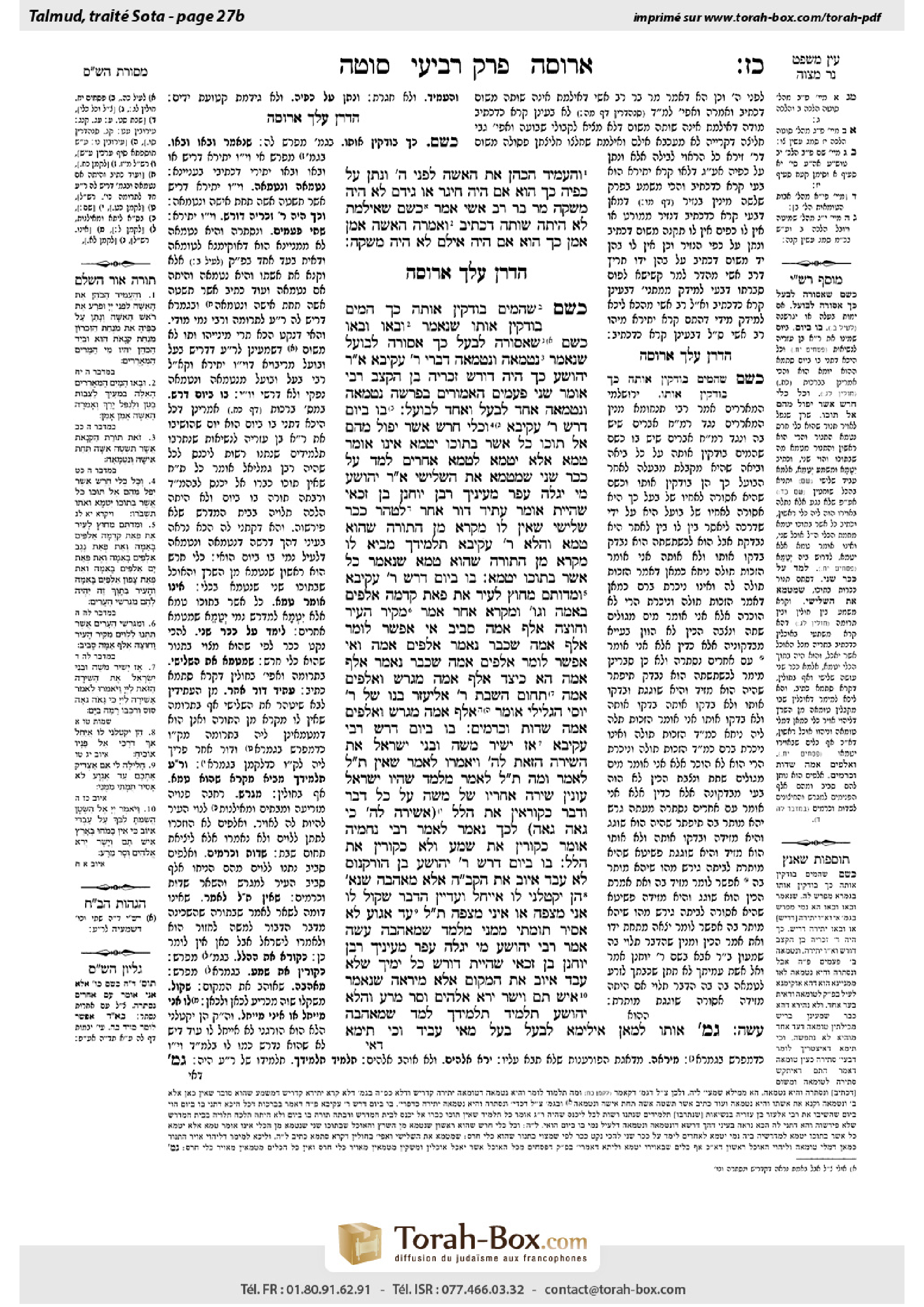
Sotah 27b: Talmud study for Daf Yomi
Daf Yomi is the daily study of one Talmud folio. Explore 37 tractates with scans, Hebrew text, Sefaria English and AI-generated French translations where annotated.
Passage selection and English or AI-generated French translation are available where the scan has annotations. Daf Study is independent of Torah-Box and Sefaria.
Browse Sotah · סוטה · All tractatesSotah 27b text and translations
This page of Sotah includes the Aramaic text, an English translation and an AI-generated French translation, alongside the scan above.
סוטה כ״ז ב · Aramaic and Hebrew text
״וְהֶעֱמִיד הַכֹּהֵן אֶת הָאִשָּׁה לִפְנֵי ה׳ ... וְנָתַן עַל כַּפֶּיהָ״ — כָּךְ הוּא — אִם הָיָה חִיגֵּר אוֹ גִידֵּם, לֹא הָיָה מַשְׁקָהּ. מָר בַּר רַב אָשֵׁי אָמַר: כְּשֵׁם שֶׁאִילֶּמֶת לֹא הָיְתָה שׁוֹתָה, דִּכְתִיב: ״וְאָמְרָה הָאִשָּׁה אָמֵן אָמֵן״, כָּךְ הוּא — אִם הָיָה אִילֵּם, לֹא הָיָה מַשְׁקָהּ.
הֲדַרַן עֲלָךְ אֲרוּסָה
כְּשֵׁם שֶׁהַמַּיִם בּוֹדְקִין אוֹתָהּ, כָּךְ הַמַּיִם בּוֹדְקִין אוֹתוֹ, שֶׁנֶּאֱמַר: ״וּבָאוּ״ ״וּבָאוּ״.
כְּשֵׁם שֶׁאֲסוּרָה לַבַּעַל — כָּךְ אֲסוּרָה לַבּוֹעֵל, שֶׁנֶּאֱמַר: ״נִטְמָאָה״ ״וְנִטְמָאָה״, דִּבְרֵי רַבִּי עֲקִיבָא.
אָמַר רַבִּי יְהוֹשֻׁעַ: כָּךְ הָיָה דּוֹרֵשׁ זְכַרְיָה בֶּן הַקַּצָּב, רַבִּי אוֹמֵר: שְׁנֵי פְּעָמִים הָאֲמוּרִים בַּפָּרָשָׁה ״נִטְמָאָה״ ״וְנִטְמָאָה״ — אֶחָד לַבַּעַל וְאֶחָד לַבּוֹעֵל.
בּוֹ בַּיּוֹם דָּרַשׁ רַבִּי עֲקִיבָא: ״וּכְלִי חֶרֶשׂ אֲשֶׁר יִפֹּל מֵהֶם אֶל תּוֹכוֹ כֹּל אֲשֶׁר בְּתוֹכוֹ יִטְמָא״, אֵינוֹ אוֹמֵר ״טָמֵא״ אֶלָּא ״יִטְמָא״, לְטַמֵּא אֲחֵרִים. לִמֵּד עַל כִּכָּר שֵׁנִי שֶׁמְּטַמֵּא אֶת הַשְּׁלִישִׁי.
אָמַר רַבִּי יְהוֹשֻׁעַ: מִי יְגַלֶּה עָפָר מֵעֵינֶיךָ רַבָּן יוֹחָנָן בֶּן זַכַּאי, שֶׁהָיִיתָ אוֹמֵר: עָתִיד דּוֹר אַחֵר לְטַהֵר כִּכָּר שְׁלִישִׁי, שֶׁאֵין לוֹ מִקְרָא מִן הַתּוֹרָה שֶׁהוּא טָמֵא, וַהֲלֹא רַבִּי עֲקִיבָא תַּלְמִידְךָ מֵבִיא לוֹ מִקְרָא מִן הַתּוֹרָה שֶׁהוּא טָמֵא, שֶׁנֶּאֱמַר: ״כׇּל אֲשֶׁר בְּתוֹכוֹ יִטְמָא״.
בּוֹ בַּיּוֹם דָּרַשׁ רַבִּי עֲקִיבָא: ״וּמַדֹּתֶם מִחוּץ לָעִיר אֶת פְּאַת קֵדְמָה אַלְפַּיִם בָּאַמָּה וְגוֹ׳״, וּמִקְרָא אַחֵר אֹמֵר: ״מִקִּיר הָעִיר וָחוּצָה אֶלֶף אַמָּה סָבִיב״.
אִי אֶפְשָׁר לוֹמַר אֶלֶף אַמָּה, שֶׁכְּבָר נֶאֱמַר אַלְפַּיִם אַמָּה. וְאִי אֶפְשָׁר לוֹמַר אַלְפַּיִם אַמָּה, שֶׁכְּבָר נֶאֱמַר אֶלֶף אַמָּה. הָא כֵּיצַד? אֶלֶף אַמָּה מִגְרָשׁ, וְאַלְפַּיִם אַמָּה תְּחוּם הַשַּׁבָּת.
רַבִּי אֱלִיעֶזֶר בְּנוֹ שֶׁל רַבִּי יוֹסֵי הַגְּלִילִי אוֹמֵר: אֶלֶף אַמָּה מִגְרָשׁ, וְאַלְפַּיִם אַמָּה שָׂדוֹת וּכְרָמִים.
בּוֹ בַּיּוֹם דָּרַשׁ רַבִּי עֲקִיבָא: ״אָז יָשִׁיר מֹשֶׁה וּבְנֵי יִשְׂרָאֵל אֶת הַשִּׁירָה הַזֹּאת לַה׳ וַיֹּאמְרוּ לֵאמֹר״, שֶׁאֵין תַּלְמוּד לוֹמַר ״לֵאמֹר״, וּמָה תַּלְמוּד לוֹמַר ״לֵאמֹר״? מְלַמֵּד שֶׁהָיוּ יִשְׂרָאֵל עוֹנִין שִׁירָה אַחֲרָיו שֶׁל מֹשֶׁה עַל כׇּל דָּבָר וְדָבָר כְּקוֹרְאִין אֶת [הַ]הַלֵּל: (״אָשִׁירָה לַה׳ כִּי גָאֹה גָּאָה״.) לְכָךְ נֶאֱמַר ״לֵאמֹר״.
רַבִּי נְחֶמְיָה אוֹמֵר: כְּקוֹרִין אֶת שְׁמַע, וְלֹא כְּקוֹרִין אֶת [הַ]הַלֵּל.
בּוֹ בַּיּוֹם דָּרַשׁ רַבִּי יְהוֹשֻׁעַ בֶּן הוּרְקָנוֹס: לֹא עָבַד אִיּוֹב אֶת הַקָּדוֹשׁ בָּרוּךְ הוּא אֶלָּא מֵאַהֲבָה, שֶׁנֶּאֱמַר: ״הֵן יִקְטְלֵנִי לוֹ אֲיַחֵל״. וַעֲדַיִין הַדָּבָר שָׁקוּל: לוֹ אֲנִי מְצַפֶּה, אוֹ אֵינִי מְצַפֶּה — תַּלְמוּד לוֹמַר: ״עַד אֶגְוָע לֹא אָסִיר תֻּמָּתִי מִמֶּנִּי״, מְלַמֵּד שֶׁמֵּאַהֲבָה עָשָׂה.
אָמַר רַבִּי יְהוֹשֻׁעַ: מִי יְגַלֶּה עָפָר מֵעֵינֶיךָ רַבָּן יוֹחָנָן בֶּן זַכַּאי, שֶׁהָיִיתָ דּוֹרֵשׁ כׇּל יָמֶיךָ שֶׁלֹּא עָבַד אִיּוֹב אֶת הַמָּקוֹם אֶלָּא מִיִּרְאָה, שֶׁנֶּאֱמַר: ״אִישׁ תָּם וְיָשָׁר יְרֵא אֱלֹהִים וְסָר מֵרָע״, וַהֲלֹא יְהוֹשֻׁעַ תַּלְמִיד תַּלְמִידְךָ לִמֵּד שֶׁמֵּאַהֲבָה עָשָׂה.
גְּמָ׳ ״אוֹתוֹ״ לְמַאן? אִילֵימָא לְבַעַל — בַּעַל מַאי עָבֵיד? וְכִי תֵּימָא
Sotah 27b · English translation
“And the priest shall stand the woman before the Lord…and place the meal-offering of memorial in her hands” (Numbers 5:18), indicating that if she is unable to stand up straight or if she does not have hands with which to accept the offering, then she does not drink; so too, if the husband were lame or without hands, he would not cause his wife to drink. Mar Bar Rav Ashi says: Just as a mute woman would not drink, as it is written: “And the woman shall say: Amen, Amen” (Numbers 5:22), indicating that she must be able to speak; so too, if the husband were mute, he would not cause his wife to drink.
MISHNA: Just as the water evaluates her fidelity, so too, the water evaluates his, i.e., her alleged paramour’s, involvement in the sin, as it is stated: “And the water that causes the curse shall enter into her” (Numbers 5:24), and it is stated again: “And the water that causes the curse shall enter into her and become bitter” (Numbers 5:27). It is derived from the double mention of the phrase “and…shall enter” that both the woman and her paramour are evaluated by the water.
Furthermore, prior to her drinking the water, just as she is forbidden to her husband, so too is she forbidden to her paramour, because in contrast to the verse stating: “Is defiled [nitma’a]” (Numbers 5:14), a superfluous conjoining prefix vav is added to a later verse, rendering the phrase: “And is defiled [venitma’a]” (Numbers 5:29). The addition indicates another prohibition, that of the woman to her paramour. This is the statement of Rabbi Akiva.
Rabbi Yehoshua said: That was how Zekharya ben HaKatzav would interpret it, i.e., he also derived from the superfluous vav that the woman is forbidden to her paramour. Rabbi Yehuda HaNasi says an alternate source: The two times that the defilement of the wife is stated in the passage, namely: “And he warns his wife, and she is defiled” (Numbers 5:14), and the later verse: “When a wife, being under her husband, goes astray and is defiled” (Numbers 5:29), indicate that her defilement results in two prohibitions. One is that she is forbidden to her husband and one is that she is forbidden to her paramour.
§ On that same day that Rabbi Elazar ben Azarya was appointed head of the Sanhedrin, Rabbi Akiva interpreted the verse: “And every earthen vessel into which any of them falls, whatever is in it shall be impure [yitma], and you shall break it” (Leviticus 11:33), as follows: The verse does not state: Is impure [tamei], but rather: “Shall be impure,” in order to indicate that not only does the vessel itself become ritually impure, but it can now render other items ritually impure. This teaches with regard to a loaf that has second-degree ritual impurity status due to its being placed inside an earthenware vessel that had first-degree impurity, that it can render other food with which it comes into contact impure with third-degree impurity status.
After hearing Rabbi Akiva’s statement, Rabbi Yehoshua said: Who will remove the dirt from your eyes, Rabban Yoḥanan ben Zakkai, so that you could live and see this? As you would say: In the future, another generation is destined to deem pure a loaf that contracted third-degree impurity, as there is no explicit verse from the Torah stating that it is impure. But now Rabbi Akiva, your disciple, brings a verse from the Torah indicating that it is impure, as it is stated: “Whatever is in it shall be impure.”
Furthermore, on that same day Rabbi Akiva interpreted the verses with regard to the Levite cities as follows: One verse states: “And you shall measure outside the city for the east side two thousand cubits…this shall be for them the open land outside the cities” (Numbers 35:5), and another verse states: “And the open land around the cities, which you shall give to the Levites, shall be from the wall of the city and outward one thousand cubits round about” (Numbers 35:4).
It is impossible to say that the area around the cities given to the Levites was only one thousand cubits, as it is already stated: “Two thousand cubits.” And it is impossible to say that two thousand cubits were left for them, as it is already stated: “One thousand cubits.” How can these texts be reconciled? One thousand cubits are to be set aside as a tract of open land surrounding the city, and the two thousand cubits are mentioned not in order to be given to the Levites, but to indicate the boundary of the Shabbat limit, beyond which it is forbidden to travel on Shabbat. This verse thereby serves as the source for the two-thousand-cubit Shabbat limit.
Rabbi Eliezer, son of Rabbi Yosei HaGelili, says otherwise: One thousand cubits were given to the Levites as an open tract of land, that could not be planted or built upon, and two thousand cubits of additional land were given to the Levites for planting fields and vineyards.
Additionally, on that same day Rabbi Akiva interpreted the verse: “Then Moses and the children of Israel sang this song to the Lord, and said, saying” (Exodus 15:1), as follows: As there is no need for the verse to state the word “saying,” because it states the word “said” immediately prior to it, why must the verse state the word “saying”? It teaches that the Jewish people would repeat in song after Moses every single statement he said, as is done when reciting hallel. After Moses would recite a verse, they would say as a refrain: “I will sing to the Lord, for He is highly exalted” (Exodus 15:1). It is for this reason that the word “saying” is stated, in addition to the word “said.”
Rabbi Neḥemya says: The people sang the song together with Moses as is done when reciting Shema, which is recited in unison after the prayer leader begins, and not as is done when reciting hallel.
On that same day Rabbi Yehoshua ben Hyrcanus taught: Job served the Holy One, Blessed be He, only out of love, as it is stated: “Though He will slay me, still I will trust in Him” (Job 13:15). And still, the matter is even, i.e., the verse is ambiguous, as there are two possible interpretations of the verse. Was Job saying: I will await Him, expressing his yearning for God; or should the verse be interpreted as saying I will not await Him. As the word “lo” can mean either “to him” or “not,” it is unclear which meaning is intended here. This dilemma is resolved elsewhere, where the verse states a clearer indication of Job’s intent: “Till I die I will not put away my integrity from me” (Job 27:5). This teaches that he acted out of love.
Rabbi Yehoshua said: Who will remove the dirt from your eyes, Rabban Yoḥanan ben Zakkai, so that you could live and see this? As you taught all your life that Job worshipped the Omnipresent only out of fear, as it is stated: “And that man was wholehearted and upright, and God-fearing, and shunned evil” (Job 1:1); but now Yehoshua ben Hyrcanus, the disciple of your disciple, has taught that Job acted out of love.
GEMARA: It is stated in the mishna that just as the water evaluates whether the woman was unfaithful, so too, the water evaluates whether he committed this sin. The Gemara asks: To whom does this refer? If we say that it is referring to the husband, what did the husband do that he should be evaluated? And if you would say
Sotah 27b · Traduction française (IA)
« Le prêtre fera tenir la femme devant le Seigneur… et placera dans ses mains l’offrande de farine destinée à commémorer » (Nombres 5:18). Cela indique que si elle est incapable de se tenir droite ou si elle n’a pas de mains pour recevoir l’offrande, elle ne boit pas. De même, si le mari était boiteux ou n’avait pas de mains, il ne ferait pas boire sa femme. Mar bar Rav Ashi dit : de même qu’une femme muette ne boirait pas, comme il est écrit : « Et la femme dira : Amen, amen » (Nombres 5:22), ce qui indique qu’elle doit être capable de parler, de même, si le mari était muet, il ne ferait pas boire sa femme.
MICHNA : De même que l’eau vérifie sa fidélité, elle vérifie aussi l’implication de son amant présumé dans le péché, comme il est dit : « Et l’eau qui provoque la malédiction entrera en elle » (Nombres 5:24), puis de nouveau : « Et l’eau qui provoque la malédiction entrera en elle et deviendra amère » (Nombres 5:27). La double mention de l’expression « entrera en elle » permet de déduire que l’eau vérifie aussi bien la femme que son amant.
En outre, avant qu’elle ne boive l’eau, de même qu’elle est interdite à son mari, elle est également interdite à son amant. En effet, par rapport au terme « souillée [nitma’a] » du verset (Nombres 5:14), le préfixe conjonctif vav, superflu, est ajouté dans un verset ultérieur, qui donne l’expression : « et souillée [venitma’a] » (Nombres 5:29). Cet ajout indique une autre interdiction : celle de la femme à son amant. Telle est l’opinion de Rabbi Akiva.
Rabbi Yehoshua dit : C’est ainsi que Zekharya ben HaKatzav l’interprétait, c’est-à-dire qu’il déduisait lui aussi du vav superflu que la femme est interdite à son amant. Rabbi Yehuda HaNasi propose une autre source : les deux occurrences de la souillure de l’épouse dans le passage — « Il avertit sa femme, et elle se souille » (Nombres 5:14), puis, plus loin, « Lorsqu’une femme, sous l’autorité de son mari, s’égare et se souille » (Nombres 5:29) — indiquent que sa souillure entraîne deux interdictions : elle est interdite à son mari et à son amant.
§ Ce même jour où Rabbi Elazar ben Azarya fut nommé à la tête du Sanhédrin, Rabbi Akiva interpréta ainsi le verset : « Tout récipient de terre dans lequel tombera l’un d’eux, tout ce qui s’y trouve sera impur [yitma], et vous le briserez » (Lévitique 11:33) : le verset ne dit pas « est impur [tamei] », mais « sera impur », pour indiquer que le récipient lui-même devient rituellement impur et qu’il peut désormais rendre d’autres objets rituellement impurs. Cela enseigne qu’un pain ayant le statut d’impureté rituelle de deuxième degré, parce qu’il a été placé dans un récipient de terre qui avait une impureté de premier degré, peut rendre impur, avec un statut d’impureté de troisième degré, un autre aliment avec lequel il entre en contact.
Après avoir entendu la déclaration de Rabbi Akiva, Rabbi Yehoshua dit : Qui ôtera la poussière de tes yeux, Rabban Yoḥanan ben Zakkai, pour que tu puisses vivre et voir cela ? Car tu disais : « À l’avenir, une autre génération est destinée à déclarer pur un pain qui a contracté une impureté de troisième degré, puisqu’aucun verset explicite de la Torah n’indique qu’il est impur. » Mais maintenant, Rabbi Akiva, ton disciple, apporte un verset de la Torah qui indique qu’il est impur, comme il est dit : « Tout ce qui s’y trouve sera impur. »
En outre, ce même jour, Rabbi Akiva interpréta ainsi les versets relatifs aux villes des Lévites : un verset dit : « Vous mesurerez à l’extérieur de la ville, du côté est, deux mille coudées… cela sera pour eux l’espace libre à l’extérieur des villes » (Nombres 35:5), et un autre verset dit : « L’espace libre autour des villes que vous donnerez aux Lévites s’étendra depuis le mur de la ville vers l’extérieur, sur mille coudées tout autour » (Nombres 35:4).
Il est impossible de dire que l’espace autour des villes donné aux Lévites ne faisait que mille coudées, puisqu’il est déjà dit : « deux mille coudées ». Et il est impossible de dire que deux mille coudées leur étaient réservées, puisqu’il est déjà dit : « mille coudées ». Comment concilier ces textes ? Mille coudées doivent être réservées comme espace libre autour de la ville ; les deux mille coudées ne sont pas mentionnées pour être données aux Lévites, mais pour indiquer la limite du Chabbat, au-delà de laquelle il est interdit de se déplacer le Chabbat. Ce verset constitue ainsi la source de la limite de deux mille coudées pour le Chabbat.
Rabbi Eliezer, fils de Rabbi Yosei HaGelili, dit une autre interprétation : mille coudées furent données aux Lévites comme espace libre, où il était interdit de planter ou de construire, et deux mille coudées de terrain supplémentaires leur furent données pour y cultiver des champs et des vignobles.
En outre, ce même jour, Rabbi Akiva interpréta ainsi le verset : « Alors Moïse et les enfants d’Israël chantèrent ce cantique au Seigneur, et dirent, en disant » (Exode 15:1) : le verset n’a pas besoin d’employer le mot « en disant », puisqu’il emploie juste avant le mot « dirent ». Pourquoi donc le verset dit-il « en disant » ? Cela enseigne que le peuple juif répétait en chantant chacune des paroles prononcées par Moïse, comme lorsqu’on récite le Hallel. Après que Moïse avait récité un verset, ils reprenaient en refrain : « Je chanterai au Seigneur, car Il s’est élevé avec majesté » (Exode 15:1). C’est pour cette raison que le mot « en disant » est écrit en plus du mot « dirent ».
Rabbi Neḥemya dit : Le peuple chanta le cantique avec Moïse comme on récite le Chéma, qui est récité à l’unisson après que l’officiant a commencé, et non comme on récite le Hallel.
Ce même jour, Rabbi Yehoshua ben Hyrcanus enseigna : Job ne servit le Saint, béni soit-Il, que par amour, comme il est dit : « Même s’Il me tue, je mettrai pourtant ma confiance en Lui » (Job 13:15). Pourtant, la question reste indécise, c’est-à-dire que le verset est ambigu, car il admet deux interprétations. Job disait-il : « Je m’en remettrai à Lui », exprimant ainsi son aspiration vers Dieu, ou faut-il comprendre le verset comme disant : « Je ne m’en remettrai pas à Lui » ? Puisque le mot « lo » peut signifier aussi bien « à Lui » que « non », il est impossible de savoir ici quel sens est voulu. Ce dilemme est résolu ailleurs, où le verset donne une indication plus claire de l’intention de Job : « Jusqu’à ma mort, je ne renoncerai pas à mon intégrité » (Job 27:5). Cela enseigne qu’il agissait par amour.
Rabbi Yehoshua dit : Qui ôtera la poussière de tes yeux, Rabban Yoḥanan ben Zakkai, pour que tu puisses vivre et voir cela ? Car tu as enseigné toute ta vie que Job ne servait le Lieu qu’avec crainte, comme il est dit : « Cet homme était intègre et droit, il craignait Dieu et s’écartait du mal » (Job 1:1). Mais maintenant, Yehoshua ben Hyrcanus, le disciple de ton disciple, a enseigné que Job agissait par amour.
GUEMARA : Il est dit dans la Michna que, de même que l’eau vérifie si la femme a été infidèle, elle vérifie aussi si l’homme a commis ce péché. La Guemara demande : De qui s’agit-il ? Si nous disons qu’il s’agit du mari, qu’a fait le mari pour devoir être soumis à cette épreuve ? Et si tu dis…
Traduction française générée par IA à partir de l’édition anglaise de Sefaria. Vérifie toujours un passage avec le texte source.
Text from Sefaria: William Davidson Edition - Vocalized Aramaic (CC BY NC); William Davidson Edition - English (CC BY NC).