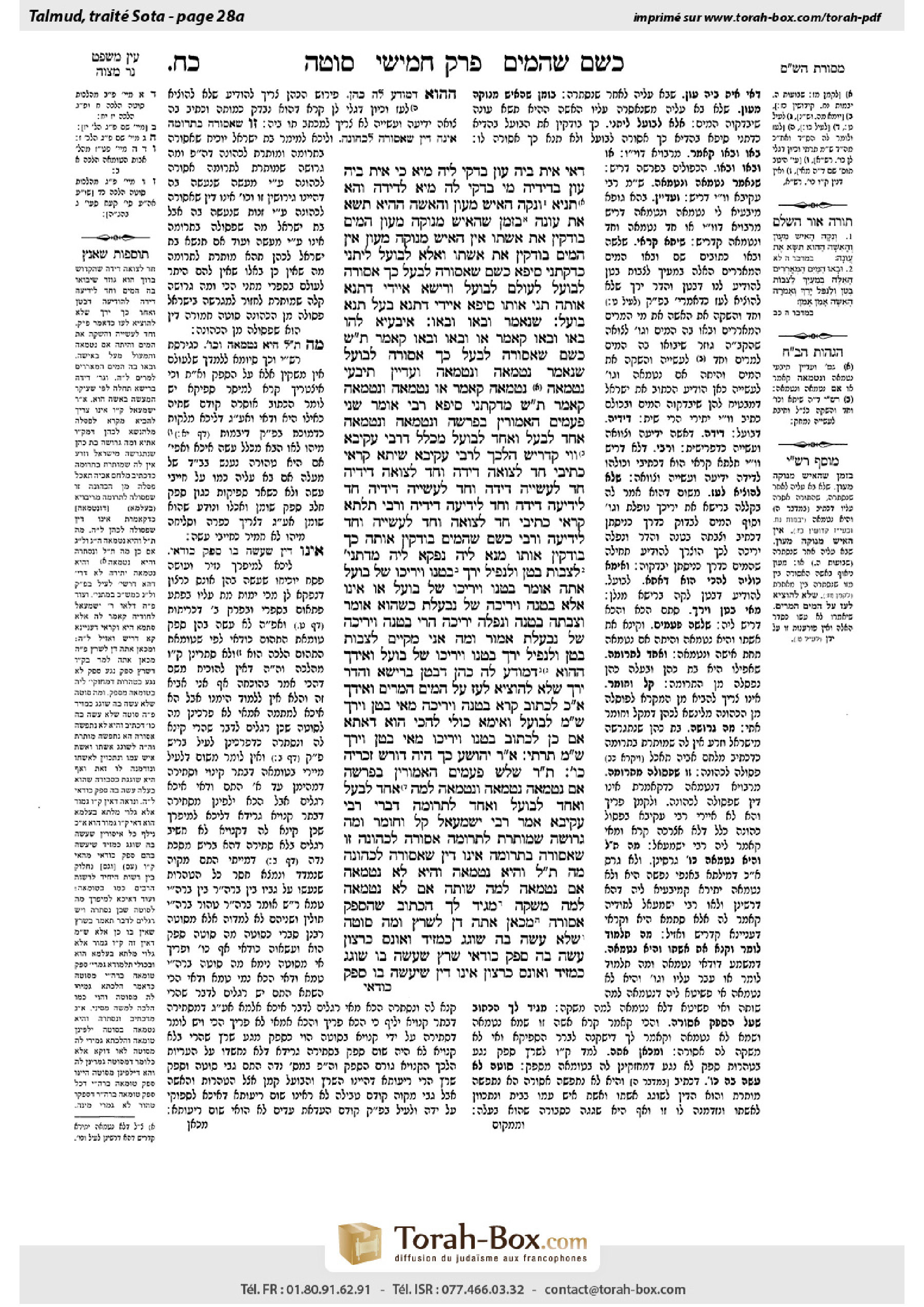
Sotah 28a: Talmud study for Daf Yomi
Daf Yomi is the daily study of one Talmud folio. Explore 37 tractates with scans, Hebrew text, Sefaria English and AI-generated French translations where annotated.
Passage selection and English or AI-generated French translation are available where the scan has annotations. Daf Study is independent of Torah-Box and Sefaria.
Browse Sotah · סוטה · All tractatesSotah 28a text and translations
This page of Sotah includes the Aramaic text, an English translation and an AI-generated French translation, alongside the scan above.
סוטה כ״ח א · Aramaic and Hebrew text
דְּאִי אִית בֵּיהּ עָוֹן בָּדְקִי לֵיהּ מַיָּא, כִּי אִית בֵּיהּ עָוֹן בְּדִידֵיהּ מִי בָּדְקִי לַהּ מַיָּא לְדִידַהּ? וְהָא תַּנְיָא: ״וְנִקָּה הָאִישׁ מֵעָוֹן וְהָאִשָּׁה הַהִיא תִּשָּׂא אֶת עֲוֹנָהּ״. בִּזְמַן שֶׁהָאִישׁ מְנוּקֶּה מֵעָוֹן — הַמַּיִם בּוֹדְקִין אֶת אִשְׁתּוֹ, אֵין הָאִישׁ מְנוּקֶּה מֵעָוֹן — אֵין הַמַּיִם בּוֹדְקִין אֶת אִשְׁתּוֹ!
וְאֶלָּא לְבוֹעֵל, לִיתְנֵי כִּדְקָתָנֵי סֵיפָא: כְּשֵׁם שֶׁאֲסוּרָה לַבַּעַל כָּךְ אֲסוּרָה לַבּוֹעֵל!
לְעוֹלָם לַבּוֹעֵל, וְרֵישָׁא — אַיְּידֵי דִּתְנָא ״אוֹתָהּ״, תָּנֵי ״אוֹתוֹ״. סֵיפָא — אַיְּידֵי דִּתְנָא ״בַּעַל״, תְּנָא ״בּוֹעֵל״.
שֶׁנֶּאֱמַר: ״וּבָאוּ״ ״וּבָאוּ״. אִיבַּעְיָא לְהוּ: ״בָּאוּ״ ״וּבָאוּ״ קָאָמַר, אוֹ ״וּבָאוּ״ ״וּבָאוּ״ קָאָמַר?
תָּא שְׁמַע: כְּשֵׁם שֶׁאֲסוּרָה לַבַּעַל כָּךְ אֲסוּרָה לַבּוֹעֵל, שֶׁנֶּאֱמַר: ״נִטְמָאָה״ ״וְנִטְמָאָה״.
וַעֲדַיִין תִּיבְּעֵי: ״נִטְמָאָה״ ״נִטְמָאָה״ קָאָמַר, אוֹ ״נִטְמָאָה״ ״וְנִטְמָאָה״ קָאָמַר?
תָּא שְׁמַע מִדְּקָתָנֵי סֵיפָא, רַבִּי אוֹמֵר: שְׁנֵי פְּעָמִים הָאֲמוּרִין בַּפָּרָשָׁה ״וְנִטְמָאָה״ ״וְנִטְמָאָה״ — אֶחָד לַבַּעַל וְאֶחָד לַבּוֹעֵל. מִכְּלָל דְּרַבִּי עֲקִיבָא וָוֵי קָדָרֵישׁ.
הִלְכָּךְ לְרַבִּי עֲקִיבָא שִׁיתָּא קְרָאֵי כְּתִיבִי:
חַד לְצַוָּאָה דִּידַהּ, וְחַד לְצַוָּאָה דִּידֵיהּ.
חַד לַעֲשִׂיָּיה דִּידַהּ, וְחַד לַעֲשִׂיָּיה דִּידֵיהּ.
חַד לִידִיעָה דִּידַהּ, וְחַד לִידִיעָה דִּידֵיהּ.
וְרַבִּי, תְּלָתָא קְרָאֵי כְּתִיבִי: חַד — לְצַוָּאָה, וְחַד — לַעֲשִׂיָּיה, וְחַד — לִידִיעָה.
וְרַבִּי, כְּשֵׁם שֶׁהַמַּיִם בּוֹדְקִין אוֹתָהּ כָּךְ בּוֹדְקִין אוֹתוֹ, מְנָא לֵיהּ?
נָפְקָא לֵיהּ מִדְּתַנְיָא: ״לַצְבּוֹת בֶּטֶן וְלַנְפִּל יָרֵךְ״, בִּטְנוֹ וִירֵיכוֹ שֶׁל בּוֹעֵל. אַתָּה אוֹמֵר בִּטְנוֹ וִירֵיכוֹ שֶׁל בּוֹעֵל, אוֹ אֵינוֹ אֶלָּא בִּטְנָהּ וִירֵיכָהּ שֶׁל נִבְעֶלֶת? כְּשֶׁהוּא אוֹמֵר ״וְצָבְתָה בִטְנָהּ וְנָפְלָה יְרֵכָהּ״, הֲרֵי בִּטְנָהּ וִירֵיכָהּ שֶׁל נִבְעֶלֶת אָמוּר, וּמָה אֲנִי מְקַיֵּים ״לַצְבּוֹת בֶּטֶן וְלַנְפִּל יָרֵךְ״ — בִּטְנוֹ וִירֵיכוֹ שֶׁל בּוֹעֵל.
וְאִידַּךְ, הַהוּא דְּמוֹדַע לַהּ כֹּהֵן דְּבֶטֶן בְּרֵישָׁא וַהֲדַר יָרֵךְ, שֶׁלֹּא לְהוֹצִיא לַעַז עַל הַמַּיִם הַמָּרִים.
וְאִידַּךְ: אִם כֵּן, לִכְתּוֹב קְרָא ״בִּטְנָהּ וִירֵכָהּ״, מַאי ״בֶּטֶן״ וְ״יָרֵךְ״? שְׁמַע מִינַּהּ לְבוֹעֵל.
וְאֵימָא (כולי) [כּוּלֵּיהּ] לְהָכִי הוּא דַּאֲתָא? אִם כֵּן, לִכְתּוֹב ״בִּטְנוֹ״ וִ״ירֵכוֹ״. מַאי ״בֶּטֶן״ וְ״יָרֵךְ״? שְׁמַע מִינַּהּ תַּרְתֵּי.
אָמַר רַבִּי יְהוֹשֻׁעַ: כָּךְ הָיָה דּוֹרֵשׁ זְכַרְיָה כּוּ׳.
תָּנוּ רַבָּנַן: שָׁלֹשׁ פְּעָמִים הָאֲמוּרִין בַּפָּרָשָׁה ״אִם נִטְמְאָה״, ״נִטְמָאָה״, ״וְנִטְמָאָה״, לָמָּה? אֶחָד לַבַּעַל, וְאֶחָד לַבּוֹעֵל, וְאֶחָד לִתְרוּמָה, דִּבְרֵי רַבִּי עֲקִיבָא.
אָמַר רַבִּי יִשְׁמָעֵאל, קַל וָחוֹמֶר: וּמָה גְּרוּשָׁה שֶׁמּוּתֶּרֶת לִתְרוּמָה — אֲסוּרָה לִכְהוּנָּה, זוֹ שֶׁאֲסוּרָה בִּתְרוּמָה — אֵינוֹ דִּין שֶׁאֲסוּרָה לִכְהוּנָּה?
מָה תַּלְמוּד לוֹמַר ״וְהִיא נִטְמָאָה״, ״וְהִיא לֹא נִטְמָאָה״ — אִם נִטְמְאָה לָמָּה שׁוֹתָה? אִם לֹא נִטְמְאָה לָמָּה מַשְׁקָהּ? מַגִּיד לְךָ הַכָּתוּב שֶׁהַסָּפֵק אֲסוּרָה.
מִכָּאן אַתָּה דָּן לְשֶׁרֶץ: וּמָה סוֹטָה, שֶׁלֹּא עָשָׂה בָּהּ שׁוֹגֵג כְּמֵזִיד וְאוֹנֶס כְּרָצוֹן — עָשָׂה בָּהּ סָפֵק כְּוַדַּאי, שֶׁרֶץ, שֶׁעָשָׂה בּוֹ שׁוֹגֵג כְּמֵזִיד וְאוֹנֶס כְּרָצוֹן — אֵינוֹ דִּין שֶׁיַּעֲשֶׂה בּוֹ סָפֵק
Sotah 28a · English translation
that if he has committed a similar iniquity the water evaluates his actions, this is difficult, as in a case where he has committed a similar iniquity does the water even evaluate her fidelity? But isn’t it taught in a baraita that the verse: “And the man shall be clear from iniquity, and that woman shall bear her iniquity” (Numbers 5:31), indicates that only when the man is clear of iniquity does the water evaluate the fidelity of his wife, but if the man is not clear of iniquity the water does not evaluate the fidelity of his wife?
And if the mishna is rather referring to the alleged paramour, who is also evaluated by the water that the woman drinks, then let the mishna teach as is taught in its latter clause: Just as she is forbidden to her husband, so too is she forbidden to her paramour. Just as there the paramour is mentioned explicitly, so too here, the mishna should have stated: Just as the water evaluates whether she was unfaithful, so too, it evaluates whether the paramour committed this iniquity.
The Gemara answers: The entire mishna actually does refer to the paramour, and the reason he is not mentioned explicitly in the first clause of the mishna is because since it teaches that the water evaluates whether the wife was unfaithful by using the direct object her, it also teaches that the water evaluates whether the paramour committed the act by using the direct object him, without mentioning the paramour explicitly. In the latter clause of the mishna, on the other hand, since it teaches explicitly that the woman is forbidden to her husband, it also teaches explicitly that she is forbidden to her paramour.
§ In the mishna Rabbi Akiva proves that the water evaluates the paramour as well, as it is stated: “And the water that causes the curse shall enter into her” (Numbers 5:24), and: “And the water that causes the curse shall enter into her and become bitter” (Numbers 5:27). A dilemma was raised before the Sages concerning the precise wording of the mishna: Does the mishna state: “Shall enter [ba’u],” “and shall enter [uva’u]”? According to this version of the mishna, it is derived from the superfluous conjoining prefix vav that the paramour is also evaluated by the water. Or, alternatively, does the mishna state: “And shall enter,” “and shall enter,” indicating that this halakha is derived from the repetition of the phrase in two separate verses?
Come and hear a proof from Rabbi Akiva’s second statement in the mishna, where he says: Just as she is forbidden to her husband, so too is she forbidden to her paramour, as it is stated: “Is defiled [nitma’a],” “And is defiled [venitma’a]” (Numbers 5:29). Here it seems that Rabbi Akiva derives his interpretation from the superfluous prefix vav rather than from the repetition of the phrase. Therefore, the first derivation should be understood in the same manner.
The Gemara asks: But still, let the dilemma be raised with regard to this halakha too: Does Rabbi Akiva state that the source for the halakha is the mention of the phrase “is defiled,” “is defiled,” in two different verses (Numbers 5:14, 29), or does he state that the halakha is derived from the superfluous vav in the phrase “is defiled,” rendering it “and is defiled” (Numbers 5:29)?
Come and hear a proof from the fact that the mishna teaches in the latter clause that Rabbi Yehuda HaNasi says: The two times that the wife’s defilement is stated in the passage, namely: “And he warns his wife, and she is defiled” (Numbers 5:14), and the later verse: “When a wife, being under her husband, goes astray and is defiled” (Numbers 5:29), indicate that there are two prohibitions due to her defilement. One is to forbid her to her husband and one is to forbid her to her paramour. By inference from the fact that the dissenting derivation of Rabbi Yehuda HaNasi is from the repetition of the entire phrase, evidently Rabbi Akiva derives this halakha from the superfluous vav.
Therefore, according to the opinion of Rabbi Akiva, since the phrase “and the water…shall enter” is mentioned three times in the passage, and the prefix vav, written each time, is expounded as though the phrase were mentioned twice, the phrase is treated as though it were written in six verses, as follows.
One of the mentions (Numbers 5:24) is interpreted for the command concerning her, the woman, meaning that God empowered the waters to punish the woman; and one, the prefix vav in that same verse, is expounded for the command concerning him, the paramour, i.e., that he too shall be punished by the water if he is guilty.
One mention of the phrase, in the description of the drinking of the bitter water of a sota (Numbers 5:27), is interpreted for the execution of her punishment, as the punishment will go into effect so long as the process was performed properly; and one, the prefix vav in that verse, is expounded for the execution of his punishment.
One mention (Numbers 5:22) is for her knowledge, i.e., the priest informs her that this punishment will be the result; and one, the prefix vav, is for his knowledge.
But Rabbi Yehuda HaNasi maintains that only three verses worthy of exposition are written with regard to the water entering the woman; he does not derive anything additional from the prefix vav that introduces the various mentions of this matter. He therefore interprets one for the command, and one for the execution, and one for the knowledge, all with regard to the woman herself.
The Gemara asks: And from where does Rabbi Yehuda HaNasi derive the principle in the mishna that just as the water evaluates whether she was unfaithful, so too, it evaluates whether he committed the sin?
The Gemara answers: He derives it from that which is taught in a baraita, that the verse: “And cause the belly to swell and the thigh to fall away” (Numbers 5:22), is referring to the belly and thigh of the paramour. Do you say that the intention is the belly and the thigh of the paramour, or is it only the belly and the thigh of the adulteress? When it says later: “And her belly shall swell, and her thigh shall fall away” (Numbers 5:27), the belly and thigh of the adulteress are explicitly stated. And therefore, how do I realize the meaning of the former verse: “And cause the belly to swell, and the thigh to fall away”? Clearly, it is referring to the belly and thigh of the paramour.
And how does the other tanna, Rabbi Akiva, interpret the repetition of verses? The former verse indicates that the priest informs her that her belly will be afflicted first and then her thigh, so as not to cast aspersions on the bitter water of a sota, i.e., to prevent people from claiming that the guilty woman’s death was not due to the bitter water but rather to some other cause. The reason people might claim this is that the priest says to the woman: “The Lord will make you a curse and an oath among your people, when the Lord makes your thigh fall away, and your belly swell” (Numbers 5:21). This seems to imply that her thigh is supposed to be afflicted before her belly. Therefore, when her belly swells first, people might conclude that it is not due to the water. It is for this reason that the priest needs to inform her that her belly will swell first.
And why does the other tanna, Rabbi Yehuda HaNasi, disagree with Rabbi Akiva? The Gemara answers: If it is so that the verse: “And cause the belly to swell, and the thigh to fall away” (Numbers 5:22), is referring to the woman, the verse should have written: Her belly…and her thigh. What is meant by the phraseology of “the belly…and the thigh”? Conclude from it that it is referring to the belly and thigh of the paramour.
The Gemara asks: And say that the entire verse comes for this, to indicate that the water evaluates the paramour as well, and does not teach the order of the punishment? The Gemara answers: If so, the Torah should have written: His belly…and his thigh. What is the meaning of the general wording: “The belly…and the thigh”? Conclude from it two conclusions: That the paramour is punished and that the priest informs the woman with regard to the order of the punishment.
§ It is stated in the mishna that Rabbi Yehoshua said: That was how Zekharya ben HaKatzav would interpret it. Rabbi Yehuda HaNasi says: The two times that the defilement of the wife is stated in the passage indicate that there are two prohibitions due to her defilement; one is to forbid her to her husband and one is to forbid her to her paramour.
The Sages taught in a baraita: With regard to the three times that the defilement of the wife is stated in the passage, namely: “If she is defiled” (Numbers 5:27), “and he warns his wife, and she is defiled” (Numbers 5:14), and “when a wife being under her husband goes astray and is defiled” (Numbers 5:29), why are all three necessary? One is to prohibit her to her husband, and one is to prohibit her to her paramour, and one is to prohibit her from partaking of teruma, even if she is the wife or daughter of a priest. This is the statement of Rabbi Akiva.
Rabbi Yishmael said: It is unnecessary to derive from a verse that it would also be prohibited for this woman to marry a priest, as it can be derived a fortiori: If a divorced daughter of a priest, who is permitted to partake of teruma, is nevertheless forbidden to marry into the priesthood, then with regard to this sota, who is forbidden to partake of teruma, is it not logical that it is also prohibited for her to marry into the priesthood?
The baraita continues by citing additional expositions involving the verse: “And she is defiled” (Numbers 5:14): What is the meaning when the verse states with regard to the cases in which a husband can compel his wife to drink the bitter water of a sota: “And he warns his wife, and she is defiled; or if the spirit of jealousy comes upon him, and he warns his wife, and she is not defiled” (Numbers 5:14)? If she is defiled, why does she need to drink? And if she is not defiled, why does he make her drink? The baraita answers: The verse tells you that it is discussing a case when there is uncertainty as to whether the woman was faithful to her husband, yet it is prohibited for her to engage in sexual intercourse with her husband until the matter is clarified.
From here you can derive the halakha in a case of uncertainty with regard to whether the carcass of a creeping animal has imparted ritual impurity: Just as in the case of a sota, where the Torah does not consider unwitting adultery like intentional adultery, and rape is not treated like a willing transgression, because if a married woman committed adultery unwittingly or was raped she is not punished, yet still the Torah considers an uncertain case of adultery like a certain violation inasmuch as the woman is forbidden to her husband until the truth is clarified; so too, with regard to a creeping animal or other agents of ritual impurity, where the Torah does consider unwitting contact with impure items like intentional contact, as one contracts impurity whether or not his contact was intentional and an accident is treated like willing contact, is it not logical that the Torah must also consider an uncertain case of transmission of ritual impurity
Sotah 28a · Traduction française (IA)
Si, en effet, il a commis une faute semblable, l’eau évalue ses actes. Cela pose une difficulté : dans un cas où il a commis une faute semblable, l’eau évalue-t-elle même la fidélité de la femme ? Pourtant, il est enseigné dans une baraïta que le verset « L’homme sera quitte de faute, et cette femme portera sa faute » (Nombres 5,31) indique que l’eau n’évalue la fidélité de sa femme que si l’homme est quitte de faute ; mais si l’homme n’en est pas quitte, l’eau n’évalue pas la fidélité de sa femme.
Et si la Michna fait plutôt référence à l’amant présumé, que l’eau évalue également, comme elle évalue la femme qui la boit, qu’elle enseigne alors comme dans sa dernière partie : « De même qu’elle est interdite à son mari, elle est également interdite à son amant présumé. » De même que l’amant présumé y est explicitement mentionné, la Michna aurait dû dire ici aussi : « De même que l’eau évalue si elle a été infidèle, elle évalue également si l’amant présumé a commis cette faute. »
La Guemara répond : En réalité, toute la Michna fait référence à l’amant présumé. S’il n’est pas explicitement mentionné dans la première partie de la Michna, c’est parce que, puisqu’elle enseigne que l’eau évalue si la femme a été infidèle en employant le complément d’objet direct « elle », elle enseigne également que l’eau évalue s’il a commis l’acte en employant le complément d’objet direct « lui », sans mentionner explicitement l’amant présumé. Dans la dernière partie de la Michna, en revanche, puisqu’elle enseigne explicitement que la femme est interdite à son mari, elle enseigne aussi explicitement qu’elle est interdite à son amant présumé.
§ Dans la Michna, Rabbi Akiva prouve que l’eau évalue également l’amant présumé, comme il est dit : « Et l’eau qui provoque la malédiction entrera en elle » (Nombres 5,24), ainsi que : « Et l’eau qui provoque la malédiction entrera en elle et deviendra amère » (Nombres 5,27). Les Sages soulèvent une question au sujet de la formulation exacte de la Michna : dit-elle « entrera [ba’u] », puis « et entrera [uva’u] » ? Selon cette version de la Michna, on déduit du vav superflu qui relie les termes que l’eau évalue également l’amant présumé. Ou bien la Michna dit-elle « et entrera », puis « et entrera », ce qui indique que cette halakha se déduit de la répétition de l’expression dans deux versets distincts ?
Viens et entends une preuve tirée de la seconde déclaration de Rabbi Akiva dans la Michna, où il dit : « De même qu’elle est interdite à son mari, elle est également interdite à son amant présumé », comme il est dit : « est souillée [nitma’a] », « et est souillée [venitma’a] » (Nombres 5,29). Ici, il semble que Rabbi Akiva fonde son interprétation sur le vav superflu plutôt que sur la répétition de l’expression. Il faut donc comprendre la première déduction de la même manière.
La Guemara demande : Mais il faut encore soulever cette question à propos de cette halakha également : Rabbi Akiva dit-il que la source de la halakha est la mention de l’expression « est souillée », « est souillée » dans deux versets différents (Nombres 5,14 et 29), ou dit-il que la halakha se déduit du vav superflu dans l’expression « est souillée », qui devient « et est souillée » (Nombres 5,29) ?
Viens et entends une preuve tirée de ce que la Michna enseigne dans sa dernière partie : Rabbi Yehouda HaNassi dit que les deux mentions de la souillure de la femme dans le passage, à savoir « il avertit sa femme, et elle est souillée » (Nombres 5,14), et le verset ultérieur « lorsqu’une femme, vivant avec son mari, s’égare et est souillée » (Nombres 5,29), indiquent qu’il existe deux interdictions résultant de sa souillure : l’une l’interdit à son mari, l’autre à son amant présumé. On peut déduire du fait que l’interprétation divergente de Rabbi Yehouda HaNassi se fonde sur la répétition de l’expression entière que Rabbi Akiva, manifestement, déduit cette halakha du vav superflu.
Par conséquent, selon l’opinion de Rabbi Akiva, puisque l’expression « et l’eau… entrera » est mentionnée trois fois dans le passage, et que le vav qui la précède chaque fois est interprété comme si l’expression était mentionnée deux fois, celle-ci est considérée comme figurant dans six versets, comme suit.
L’une des mentions (Nombres 5,24) est interprétée comme l’ordre la concernant, elle, la femme : Dieu a donné aux eaux le pouvoir de punir la femme. L’autre, le vav qui précède l’expression dans ce même verset, est interprétée comme l’ordre le concernant, lui, l’amant présumé, c’est-à-dire que l’eau le punira également s’il est coupable.
L’une des mentions de l’expression, dans la description de la consommation de l’eau amère par une sota (Nombres 5,27), est interprétée comme l’exécution de sa punition, laquelle sera mise à effet dès lors que la procédure aura été correctement menée. L’autre, le vav qui précède l’expression dans ce verset, est interprétée comme l’exécution de sa punition à lui.
L’une des mentions (Nombres 5,22) concerne le fait qu’elle en soit informée, c’est-à-dire que le prêtre l’informe que cette punition en sera le résultat ; l’autre, le vav, concerne le fait qu’il en soit informé, lui.
Mais Rabbi Yehouda HaNassi estime que seuls trois versets susceptibles d’être interprétés sont écrits au sujet de l’eau qui entre dans la femme ; il ne tire aucun enseignement supplémentaire du vav qui introduit les différentes mentions de cette affaire. Il en interprète donc un comme concernant l’ordre, un l’exécution et un la connaissance, tous au sujet de la femme elle-même.
La Guemara demande : Et d’où Rabbi Yehouda HaNassi déduit-il le principe énoncé dans la Michna selon lequel, de même que l’eau évalue si elle a été infidèle, elle évalue aussi si lui a commis la faute ?
La Guemara répond : Il le déduit de ce qui est enseigné dans une baraïta : le verset « et faire gonfler le ventre et tomber la cuisse » (Nombres 5,22) fait référence au ventre et à la cuisse de l’amant présumé. Peut-on dire qu’il s’agit du ventre et de la cuisse de l’amant présumé, ou bien seulement du ventre et de la cuisse de la femme adultère ? Lorsque le verset dit plus loin : « Son ventre gonflera et sa cuisse tombera » (Nombres 5,27), le ventre et la cuisse de la femme adultère sont explicitement mentionnés. Comment faut-il donc comprendre le premier verset : « et faire gonfler le ventre et tomber la cuisse » ? De toute évidence, il fait référence au ventre et à la cuisse de l’amant présumé.
Et comment l’autre tanna, Rabbi Akiva, interprète-t-il la répétition des versets ? Le premier verset indique que le prêtre l’informe que son ventre sera atteint d’abord, puis sa cuisse, afin d’éviter de jeter le discrédit sur l’eau amère de la sota, c’est-à-dire d’empêcher que l’on prétende que la mort de la femme coupable n’est pas due à l’eau amère, mais à une autre cause. On pourrait le prétendre parce que le prêtre dit à la femme : « Le Seigneur fera de toi une malédiction et un serment au sein de ton peuple, lorsque le Seigneur fera tomber ta cuisse et gonfler ton ventre » (Nombres 5,21). Cela semble indiquer que sa cuisse doit être atteinte avant son ventre. Par conséquent, si son ventre gonfle en premier, les gens pourraient en conclure que ce n’est pas dû à l’eau. C’est pourquoi le prêtre doit l’informer que son ventre gonflera d’abord.
Et pourquoi l’autre tanna, Rabbi Yehouda HaNassi, n’est-il pas d’accord avec Rabbi Akiva ? La Guemara répond : Si le verset « et faire gonfler le ventre et tomber la cuisse » (Nombres 5,22) faisait référence à la femme, il aurait dû dire : « son ventre… et sa cuisse ». Que signifie donc la formulation « le ventre… et la cuisse » ? Déduis-en qu’il s’agit du ventre et de la cuisse de l’amant présumé.
La Guemara demande : Et ne peut-on pas dire que tout le verset a pour objet d’indiquer que l’eau évalue aussi l’amant présumé, sans enseigner l’ordre de la punition ? La Guemara répond : Dans ce cas, la Torah aurait dû écrire : « son ventre… et sa cuisse ». Que signifie la formulation générale « le ventre… et la cuisse » ? Déduis-en deux conclusions : l’amant présumé est puni et le prêtre informe la femme de l’ordre de la punition.
§ Il est dit dans la Michna que Rabbi Yehoshoua a déclaré : « C’est ainsi que Zekharya ben HaKatzav l’interprétait. » Rabbi Yehouda HaNassi dit que les deux mentions de la souillure de la femme dans le passage indiquent qu’il existe deux interdictions résultant de sa souillure : l’une l’interdit à son mari, l’autre à son amant présumé.
Les Sages ont enseigné dans une baraïta : Pourquoi les trois mentions de la souillure de la femme dans le passage sont-elles toutes nécessaires, à savoir « si elle est souillée » (Nombres 5,27), « il avertit sa femme, et elle est souillée » (Nombres 5,14), et « lorsqu’une femme, vivant avec son mari, s’égare et est souillée » (Nombres 5,29) ? L’une sert à l’interdire à son mari, une autre à l’interdire à son amant présumé, et la troisième à lui interdire de consommer la terouma, même si elle est l’épouse ou la fille d’un prêtre. Telle est la déclaration de Rabbi Akiva.
Rabbi Yishmael a dit : Il n’est pas nécessaire de déduire d’un verset qu’il est également interdit à cette femme d’épouser un prêtre, car on peut le déduire a fortiori : si une fille de prêtre divorcée, qui a le droit de consommer la terouma, n’a néanmoins pas le droit d’épouser un prêtre, à plus forte raison cette sota, qui n’a pas le droit de consommer la terouma, ne peut-elle pas épouser un prêtre.
La baraïta poursuit en citant d’autres interprétations du verset « et elle est souillée » (Nombres 5,14) : quel est le sens des paroles du verset au sujet des cas où un mari peut obliger sa femme à boire l’eau amère de la sota : « Il avertit sa femme, et elle est souillée ; ou bien l’esprit de jalousie s’empare de lui, il avertit sa femme, et elle n’est pas souillée » (Nombres 5,14) ? Si elle est souillée, pourquoi doit-elle boire ? Et si elle n’est pas souillée, pourquoi la fait-il boire ? La baraïta répond : le verset t’apprend qu’il s’agit d’un cas où l’on ne sait pas avec certitude si la femme a été fidèle à son mari, mais où il lui est néanmoins interdit d’avoir des rapports sexuels avec lui jusqu’à ce que l’affaire soit éclaircie.
On peut en déduire la halakha dans un cas où l’on doute qu’une carcasse d’animal rampant ait transmis l’impureté rituelle : de même que, dans le cas d’une sota, la Torah ne considère pas l’adultère involontaire comme un adultère intentionnel, et ne traite pas le viol comme une transgression volontaire — car si une femme mariée commet involontairement un adultère ou est violée, elle n’est pas punie —, la Torah considère néanmoins un cas d’adultère incertain comme une transgression certaine, en ce sens que la femme est interdite à son mari jusqu’à ce que la vérité soit établie ; de même, à propos d’un animal rampant ou d’autres agents d’impureté rituelle, puisque la Torah considère bien le contact involontaire avec des objets impurs comme un contact intentionnel — car on contracte l’impureté, que le contact ait été intentionnel ou non, et qu’un accident soit traité comme un contact volontaire —, n’est-il pas logique que la Torah considère également un cas incertain de transmission de l’impureté rituelle comme établi ?
Traduction française générée par IA à partir de l’édition anglaise de Sefaria. Vérifie toujours un passage avec le texte source.
Text from Sefaria: William Davidson Edition - Vocalized Aramaic (CC BY NC); William Davidson Edition - English (CC BY NC).