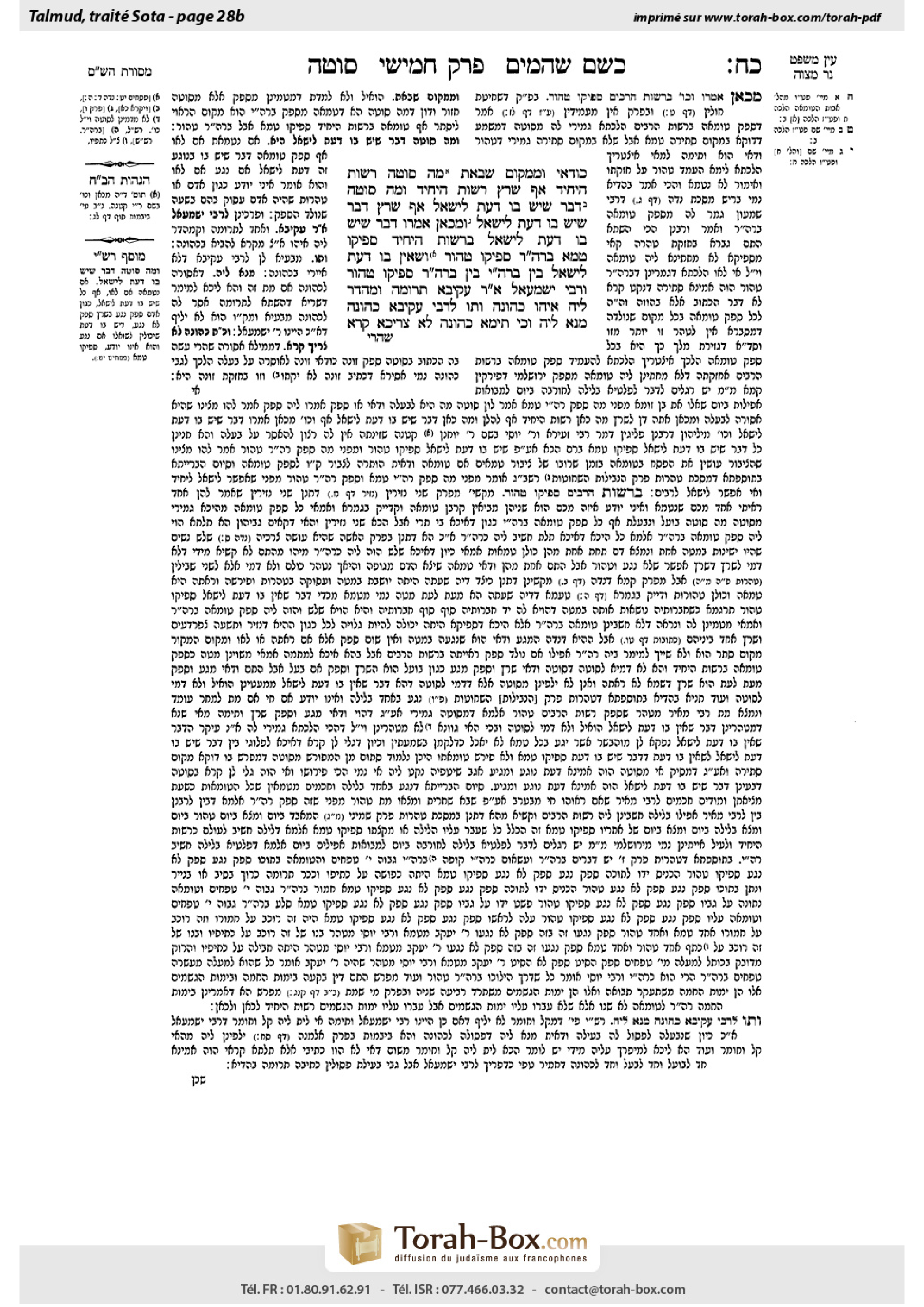
Sotah 28b: Talmud study for Daf Yomi
Daf Yomi is the daily study of one Talmud folio. Explore 37 tractates with scans, Hebrew text, Sefaria English and AI-generated French translations where annotated.
Passage selection and English or AI-generated French translation are available where the scan has annotations. Daf Study is independent of Torah-Box and Sefaria.
Browse Sotah · סוטה · All tractatesSotah 28b text and translations
This page of Sotah includes the Aramaic text, an English translation and an AI-generated French translation, alongside the scan above.
סוטה כ״ח ב · Aramaic and Hebrew text
כְּוַדַּאי.
וּמִמָּקוֹם שֶׁבָּאתָ: מָה סוֹטָה רְשׁוּת הַיָּחִיד — אַף שֶׁרֶץ רְשׁוּת הַיָּחִיד.
וּמָה סוֹטָה דָּבָר שֶׁיֵּשׁ בּוֹ דַּעַת לִישָּׁאֵל — אַף שֶׁרֶץ דָּבָר שֶׁיֵּשׁ בּוֹ דַּעַת לִישָּׁאֵל.
וּמִכָּאן אָמְרוּ: דָּבָר שֶׁיֵּשׁ בּוֹ דַּעַת לִישָּׁאֵל, בִּרְשׁוּת הַיָּחִיד — סְפֵיקוֹ טָמֵא, בִּרְשׁוּת הָרַבִּים — סְפֵיקוֹ טָהוֹר. וְשֶׁאֵין בּוֹ דַּעַת לִישָּׁאֵל, בֵּין בִּרְשׁוּת הַיָּחִיד בֵּין בִּרְשׁוּת הָרַבִּים — סְפֵיקוֹ טָהוֹר.
וְרַבִּי יִשְׁמָעֵאל: אָמַר רַבִּי עֲקִיבָא תְּרוּמָה, וּמַהְדַּר לֵיהּ אִיהוּ כְּהוּנָּה?
וְתוּ: לְרַבִּי עֲקִיבָא, כְּהוּנָּה מְנָא לֵיהּ? וְכִי תֵּימָא כְּהוּנָּה לָא צְרִיכָא קְרָא,
Sotah 28b · English translation
like a case of certain contact with an impure item? Accordingly, any cases of uncertain ritual impurity should be treated like certain impurity.
The baraita continues: And since the case of sota is the source for the halakha with regard to uncertain ritual impurity, the details of the halakha are also derived from the case of sota. Therefore, from the place that you came from, i.e., from the source, it is derived that just as the prohibition with regard to a sota applies only when the uncertainty arises in the private domain, i.e., when she has secluded herself with the alleged paramour, so too, uncertain contact with the carcass of a creeping animal renders an item impure only if the contact was in the private domain.
And furthermore, just as a sota is an entity that has awareness in order for her to be asked whether she actually committed adultery, so too, contact with a creeping animal renders an item impure only if it is an entity that has awareness in order for it to be asked, i.e., a person, or an item that may have contracted impurity in a place where a person was present and could have known.
The baraita concludes: And from here the Sages stated that if an entity that has awareness in order for it to be asked may have contracted impurity in the private domain, its uncertain impurity renders it impure; but if it may have contracted impurity in the public domain, its uncertain impurity leaves it pure. And with regard to an entity that lacks awareness in order for it to be asked, whether the uncertainty arose in the private domain or in the public domain, its uncertain impurity is deemed pure, as it is not similar to a sota.
The Gemara begins its discussion of the baraita by inquiring about the exchange between Rabbi Yishmael and Rabbi Akiva: And what was the intention of Rabbi Yishmael? Apparently, he commented on a statement of Rabbi Akiva, who said that it is prohibited for a sota to partake of teruma, and he answered him concerning the matter of the woman’s being prohibited to marry into the priesthood, which was not mentioned by Rabbi Akiva at all.
And furthermore, from where does Rabbi Akiva derive that it is prohibited for a sota to marry into the priesthood? And if you would say that with regard to her prohibition against marrying into the priesthood a verse is not necessary,
Sotah 28b · Traduction française (IA)
comme dans le cas d’un contact certain avec un objet impur ? Par conséquent, tout cas d’impureté rituelle incertaine doit être traité comme un cas d’impureté certaine.
La baraïta poursuit : Et puisque le cas de la sota est la source de la halakha relative à l’impureté rituelle incertaine, les détails de cette halakha sont eux aussi déduits du cas de la sota. On déduit donc de la source elle-même que, tout comme l’interdiction concernant une sota ne s’applique que lorsque l’incertitude survient dans le domaine privé, c’est-à-dire lorsqu’elle s’est isolée avec l’homme soupçonné d’être son amant, de même, un contact incertain avec la carcasse d’un animal rampant ne rend un objet impur que si le contact a eu lieu dans le domaine privé.
Et de plus, tout comme une sota est un être doué de conscience, de sorte qu’on peut lui demander si elle a réellement commis l’adultère, de même, un contact avec un animal rampant ne rend un objet impur que s’il s’agit d’un être doué de conscience, de sorte qu’on puisse l’interroger — c’est-à-dire une personne — ou d’un objet qui a pu contracter l’impureté dans un lieu où une personne était présente et aurait pu le savoir.
La baraïta conclut : Et c’est de là que les Sages ont déduit que si un être susceptible d’être interrogé a pu contracter l’impureté dans le domaine privé, son impureté incertaine le rend impur ; mais s’il a pu contracter l’impureté dans le domaine public, son impureté incertaine le laisse pur. Quant à un être qui ne peut pas être interrogé, que l’incertitude soit survenue dans le domaine privé ou dans le domaine public, son impureté incertaine est considérée comme pure, car il ne ressemble pas à une sota.
La Guemara commence son examen de la baraïta en s’interrogeant sur l’échange entre Rabbi Yishmael et Rabbi Akiva : quelle était l’intention de Rabbi Yishmael ? Apparemment, il commentait une déclaration de Rabbi Akiva, qui avait dit qu’il est interdit à une sota de consommer de la terouma, et il lui répondit au sujet de l’interdiction faite à la femme d’épouser un membre de la famille sacerdotale, question que Rabbi Akiva n’avait nullement évoquée.
Et de plus, d’où Rabbi Akiva déduit-il qu’il est interdit à une sota d’épouser un membre de la famille sacerdotale ? Et si tu dis qu’aucun verset n’est nécessaire pour établir l’interdiction qui lui est faite d’épouser un membre de la famille sacerdotale,
Traduction française générée par IA à partir de l’édition anglaise de Sefaria. Vérifie toujours un passage avec le texte source.
Text from Sefaria: William Davidson Edition - Vocalized Aramaic (CC BY NC); William Davidson Edition - English (CC BY NC).