Sotah 29a: Talmud study for Daf Yomi
Daf Yomi is the daily study of one Talmud folio. Explore 37 tractates with scans, Hebrew text, Sefaria English and AI-generated French translations where annotated.
Passage selection and English or AI-generated French translation are available where the scan has annotations. Daf Study is independent of Torah-Box and Sefaria.
Browse Sotah · סוטה · All tractatesSotah 29a text and translations
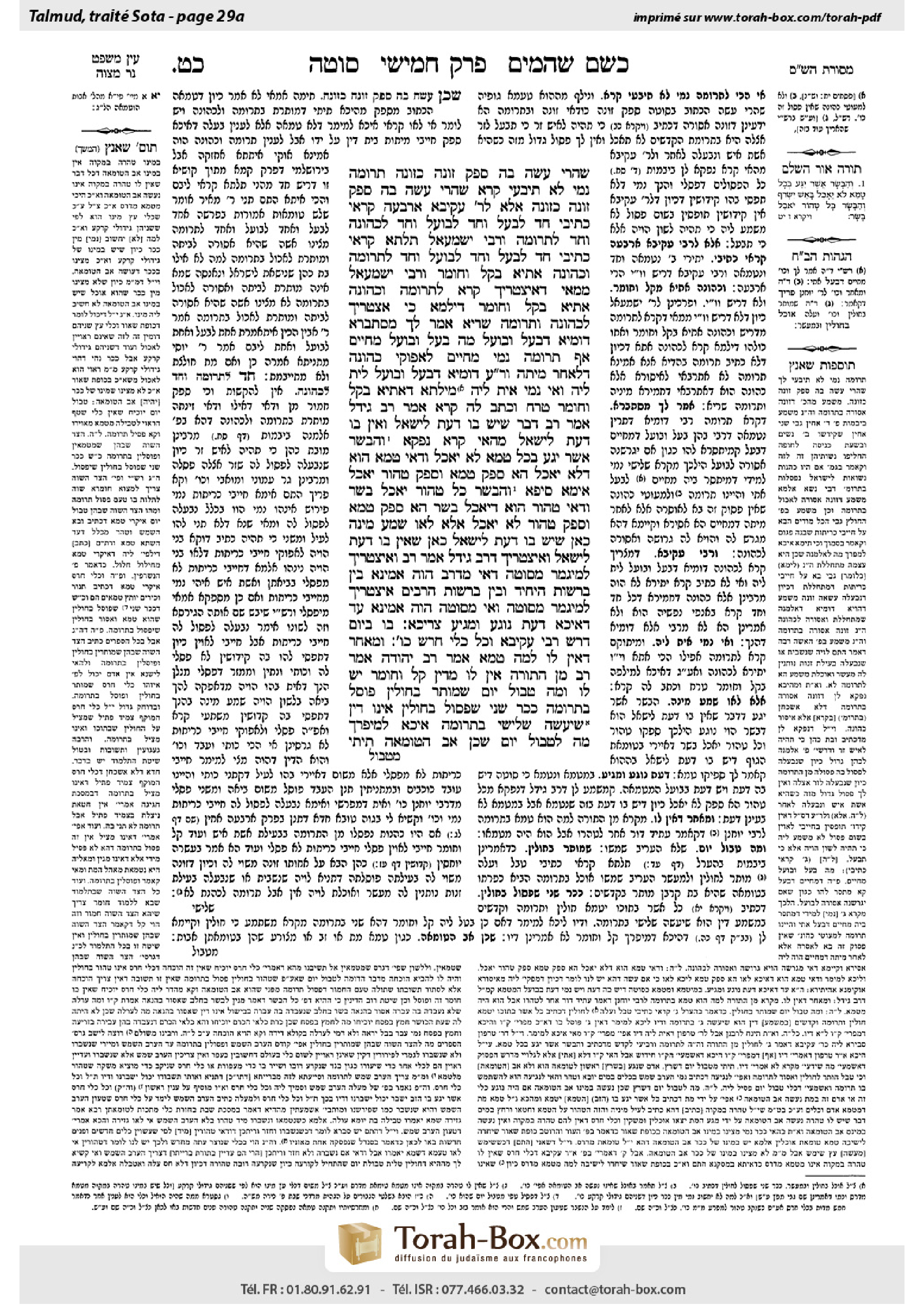
This page of Sotah includes the Aramaic text, an English translation and an AI-generated French translation, alongside the scan above.
סוטה כ״ט א · Aramaic and Hebrew text
שֶׁהֲרֵי עָשָׂה בָּהּ סְפֵק זוֹנָה כְּזוֹנָה. תְּרוּמָה נָמֵי לָא תִּיבְּעֵי קְרָא, שֶׁהֲרֵי עָשָׂה בָּהּ סְפֵק זוֹנָה כְּזוֹנָה!
אֶלָּא לְרַבִּי עֲקִיבָא אַרְבְּעָה קְרָאֵי כְּתִיבִי: חַד לְבַעַל, וְחַד לְבוֹעֵל, וְחַד לִכְהוּנָּה, וְחַד לִתְרוּמָה.
וְרַבִּי יִשְׁמָעֵאל תְּלָתָא קְרָאֵי כְּתִיבִי: חַד לְבַעַל, וְחַד לְבוֹעֵל, וְחַד לִתְרוּמָה, וּכְהוּנָּה אָתְיָא בְּקַל וָחוֹמֶר.
וְרַבִּי יִשְׁמָעֵאל, מִמַּאי דְּאִיצְטְרִיךְ קְרָא לִתְרוּמָה, וּכְהוּנָּה אָתְיָא בְּקַל וָחוֹמֶר? דִּילְמָא כִּי אִצְטְרִיךְ לִכְהוּנָּה, וּתְרוּמָה שַׁרְיָא!
אָמַר לָךְ: מִסְתַּבְּרָא דּוּמְיָא דְּבַעַל וּבוֹעֵל. מָה בַּעַל וּבוֹעֵל מֵחַיִּים — אַף תְּרוּמָה נָמֵי מֵחַיִּים, לְאַפּוֹקֵי כְּהוּנָּה דִּלְאַחַר מִיתָה.
וְרַבִּי עֲקִיבָא, דּוּמְיָא דְּבַעַל וּבוֹעֵל לֵית לֵיהּ.
וְאִי נָמֵי אִית לֵיהּ, מִילְּתָא דְּאָתְיָא בְּקַל וְחוֹמֶר טָרַח וְכָתֵב לַהּ קְרָא.
אָמַר רַב גִּידֵּל אָמַר רַב: דָּבָר שֶׁיֵּשׁ בּוֹ דַּעַת לִישָּׁאֵל וְאֵין בּוֹ דַּעַת לִישָּׁאֵל מֵהַאי קְרָא נָפְקָא: ״וְהַבָּשָׂר אֲשֶׁר יִגַּע בְּכׇל טָמֵא לֹא יֵאָכֵל״; וַדַּאי טָמֵא הוּא דְּלֹא יֵאָכֵל, הָא סָפֵק טָמֵא וְסָפֵק טָהוֹר — יֵאָכֵל.
אֵימָא סֵיפָא: ״וְהַבָּשָׂר כׇּל טָהוֹר יֹאכַל בָּשָׂר״; וַדַּאי טָהוֹר הוּא דְּיֹאכַל בָּשָׂר, הָא סָפֵק טָמֵא וְסָפֵק טָהוֹר — לֹא יֹאכַל.
אֶלָּא לָאו שְׁמַע מִינַּהּ: כָּאן שֶׁיֵּשׁ בּוֹ דַּעַת לִישָּׁאֵל, כָּאן שֶׁאֵין בּוֹ דַּעַת לִישָּׁאֵל.
וְאִיצְטְרִיךְ דְּרַב גִּידֵּל אָמַר רַב, וְאִיצְטְרִיךְ לְמִיגְמַר מִסּוֹטָה. דְּאִי מִדְּרַב, הֲוָה אָמֵינָא — בֵּין בִּרְשׁוּת הַיָּחִיד וּבֵין בִּרְשׁוּת הָרַבִּים, אִיצְטְרִיךְ לְמִיגְמַר מִסּוֹטָה.
וְאִי מִסּוֹטָה, הֲוָה אָמֵינָא — עַד דְּאִיכָּא דַּעַת נוֹגֵעַ וּמַגִּיעַ, צְרִיכָא.
בּוֹ בַּיּוֹם דָּרַשׁ רַבִּי עֲקִיבָא וְכׇל כְּלִי חֶרֶשׂ כּוּ׳.
וּמֵאַחַר דְּאֵין לוֹ, לָמָּה טָמֵא?
אָמַר רַב יְהוּדָה אָמַר רַב: מִן הַתּוֹרָה אֵין לוֹ, מִדִּין קַל וָחוֹמֶר יֵשׁ לוֹ. וּמָה טְבוּל יוֹם שֶׁמּוּתָּר בְּחוּלִּין — פּוֹסֵל בִּתְרוּמָה, כִּכָּר שֵׁנִי שֶׁפָּסוּל בְּחוּלִּין — אֵינוֹ דִּין שֶׁיַּעֲשֶׂה שְׁלִישִׁי בִּתְרוּמָה?
אִיכָּא לְמִיפְרַךְ: מָה לִטְבוּל יוֹם שֶׁכֵּן אַב הַטּוּמְאָה!
תֵּיתֵי
Sotah 29a · English translation
as the Torah has already rendered an uncertain case of a woman who has engaged in sexual intercourse with a man forbidden to her by the Torah [zona] as though she is certainly a zona, since a sota is forbidden to her husband after seclusion even though there are no witnesses that she committed adultery, and therefore it should be prohibited for her to marry a priest just like any zona, then with regard to her prohibition against partaking of teruma a verse should also not be necessary, as it is prohibited for a zona to partake of teruma. Therefore, the Torah renders an uncertain zona like a certain zona.
Rather, it must be explained that according to Rabbi Akiva, the equivalent of four verses worthy of exposition are written with regard to the defilement of a sota, as he maintains that an additional halakha should be derived from the superfluous prefix vav in the verse: “And is defiled [venitma’a]” (Numbers 5:29). Therefore, one verse is written to forbid her to her husband, and one is to forbid her to her paramour, and one is to forbid her to marry into the priesthood, and one is to forbid her to partake of teruma.
And Rabbi Yishmael disagrees with Rabbi Akiva, as he does not expound on the superfluous vav, and therefore maintains that only three verses are written: One is to forbid her to her husband, and one is to forbid her to her paramour, and one is to forbid her to partake of teruma. And her being prohibited to marry into the priesthood is derived through an a fortiori inference, as described in the baraita.
The Gemara asks: And from where does Rabbi Yishmael derive that the verse was necessary to teach the prohibition of a sota to partake of teruma, and her prohibition against marrying into the priesthood is derived through an a fortiori inference? Perhaps the verse was necessary in order to teach that it is prohibited for the woman to marry into the priesthood, but teruma is permitted for her?
The Gemara answers: Rabbi Yishmael could have said to you: It is reasonable to derive from this verse a prohibition that is similar to the prohibitions derived from the other verses, i.e., that she is forbidden to her husband and her paramour. Just as she is forbidden to her husband and her paramour even during the lifetime of her husband, so too, the prohibition against partaking of teruma applies also during the lifetime of her husband, to the exclusion of her prohibition against marrying into the priesthood, which is relevant only after the death of her husband. The reason is that if her husband would divorce her it would be prohibited for her to marry a priest anyway.
And how would Rabbi Akiva respond? The Gemara answers: He is not of the opinion that it is more reasonable to derive a prohibition from the phrase “and is defiled” that is similar to the prohibitions involving her husband and her paramour, and therefore he requires two separate derivations; one for teruma and one for the priesthood.
Or alternatively, perhaps he accepts the opinion that the halakha derived from “and is defiled” should be similar to the prohibitions involving the husband and paramour, but nevertheless, in certain instances with regard to a matter that can be derived through an a fortiori inference, the verse nevertheless takes the trouble and writes explicitly. Therefore, although unnecessary, two verses are stated, one for teruma and one for the priesthood.
The Gemara continues discussing the baraita. Rav Giddel said that Rav said: The halakha with regard to an entity that has awareness in order for it to be asked and an entity that lacks awareness in order for it to be asked in cases of uncertain ritual impurity is derived from this verse: “And the flesh that touches any impure thing shall not be eaten” (Leviticus 7:19). This would seem to indicate that specifically food that is impure for certain is that which shall not be eaten, but food for which it is uncertain whether it is impure and uncertain whether it is pure can be eaten.
However, say the latter clause of the verse: “And as for the flesh, every one that is pure may eat the flesh” (Leviticus 7:19), which would seem to indicate that specifically one who is pure for certain is one who shall eat meat, but one for whom it is uncertain whether he is impure and uncertain whether he is pure shall not eat. The two clauses in the verse seem to contradict one another with regard to the status of uncertain purity.
Rather, must one not conclude from it that the Torah differentiates between two different types of uncertainty? Here, the latter clause, which discusses “every one that is pure,” is referring to an entity that has awareness in order for it to be asked, e.g., a person, who is considered impure if he is uncertain whether he contracted ritual impurity. There, the former clause which discusses impure meat presents the principle of an entity that lacks awareness in order for it to be asked, where an uncertain case of ritual impurity is deemed pure.
The Gemara explains the need for two separate derivations concerning uncertain contractions of ritual impurity: And the derivation that Rav Giddel said that Rav said was necessary, and it was also necessary to derive the principle of uncertain ritual impurity from sota; since if it were derived only through the derivation of Rav, I would say that it makes no difference whether the uncertain contraction of impurity occurred in the private domain or whether it occurred in the public domain. Therefore, it was necessary to derive from sota that uncertain impurity is considered impure only in the private domain.
And if it is derived only from sota, I would say that similar to sota, where both the woman and the paramour possess awareness in order to be asked if they committed the act, so too, items with uncertain impurity should not be deemed impure unless there is awareness on the part of both the one who touches the impure item and the one who causes him to touch, i.e., the agent of impurity and the recipient of impurity are both competent people. Therefore, the derivation of Rav was necessary, as it teaches that in an uncertain case of impurity in the private domain, one is deemed impure even if only the contractor of impurity possesses the awareness to be asked.
§ It is stated in the mishna: On that same day Rabbi Akiva interpreted the phrase “shall be impure” in the verse: “And every earthen vessel into which any of them falls, whatever is in it shall be impure [yitma], and you shall break it” (Leviticus 11:33), as indicating that a loaf that has second-degree ritual impurity can render other food with which it comes into contact impure with third-degree impurity. Rabbi Yehoshua related that Rabban Yoḥanan ben Zakkai had predicted that a future generation would purify a loaf that contracted third-degree impurity, as there is no explicit verse in the Torah stating that this degree of impurity exists.
The Gemara asks: But since the loaf does not have an explicit verse stating that it is impure, why did Rabban Yoḥanan ben Zakkai himself maintain that it is impure?
Rav Yehuda says that Rav says: Rabban Yoḥanan ben Zakkai maintained that although it has no explicit basis from a verse in the Torah, it has proof for its impurity through an a fortiori inference: If even one who immersed in a ritual bath that day and will become completely purified after nightfall, who is therefore permitted to touch non-sacred articles, i.e., he does not transmit impurity to them, disqualifies teruma that he touches, then with regard to a loaf that has second-degree impurity as result of contact with an impure item of the first degree, which is disqualified, i.e., it is rendered impure, even if it is non-sacred, isn’t it logical that it should impart third-degree impurity upon teruma?
The Gemara challenges: This a fortiori inference can be refuted. What is unique about one who was ritually impure who immersed that day and is waiting for nightfall for the purification process to be completed is that prior to his immersion, he was a primary source of impurity. He therefore retains his stringent status even after immersion with regard to his capability of disqualifying teruma. The loaf, by contrast, has second-degree impurity from the outset, and should therefore be treated more lightly.
The Gemara answers: Derive this halakha
Sotah 29a · Traduction française (IA)
Puisque la Torah a déjà traité le cas incertain d’une femme ayant eu des relations sexuelles avec un homme qui lui est interdit par la Torah [zona] comme si elle était certainement une zona — car une sota est interdite à son mari après s’être isolée avec un homme, même s’aucun témoin n’atteste qu’elle a commis l’adultère —, elle devrait donc également être interdite d’épouser un prêtre, comme toute zona. Dès lors, aucun verset ne devrait non plus être nécessaire pour lui interdire de consommer la terouma, puisque la zona n’a pas le droit d’en consommer. Par conséquent, la Torah traite une zona incertaine comme une zona certaine.
Il faut plutôt expliquer que, selon Rabbi Akiva, quatre versets susceptibles d’être interprétés sont écrits au sujet de l’impureté d’une sota, car il estime qu’il faut déduire une halakha supplémentaire du vav superflu dans le verset : « Et elle est souillée [venitma’a] » (Nombres 5:29). Un verset est donc écrit pour l’interdire à son mari, un autre pour l’interdire à son amant, un autre pour lui interdire d’épouser un membre de la prêtrise, et un autre pour lui interdire de consommer la terouma.
Rabbi Yishmael est en désaccord avec Rabbi Akiva, car il ne donne pas d’interprétation au vav superflu ; il estime donc que seuls trois versets sont écrits : l’un pour l’interdire à son mari, l’un pour l’interdire à son amant et l’un pour lui interdire de consommer la terouma. Quant à l’interdiction d’épouser un membre de la prêtrise, elle se déduit par raisonnement a fortiori, comme l’explique la baraïta.
La Guemara demande : d’où Rabbi Yishmael déduit-il que le verset était nécessaire pour enseigner l’interdiction faite à une sota de consommer la terouma, tandis que l’interdiction d’épouser un membre de la prêtrise se déduit par raisonnement a fortiori ? Peut-être le verset était-il nécessaire pour enseigner qu’il lui est interdit d’épouser un membre de la prêtrise, tandis que la terouma lui serait permise ?
La Guemara répond : Rabbi Yishmael aurait pu te dire qu’il est raisonnable de déduire de ce verset une interdiction semblable à celles déduites des autres versets, à savoir qu’elle est interdite à son mari et à son amant. De même qu’elle leur est interdite du vivant de son mari, l’interdiction de consommer la terouma s’applique elle aussi du vivant de son mari. Cela exclut l’interdiction d’épouser un membre de la prêtrise, qui ne s’applique qu’après la mort de son mari. En effet, si son mari divorçait d’elle, il lui serait de toute façon interdit d’épouser un prêtre.
Et que répondrait Rabbi Akiva ? La Guemara répond : il ne considère pas qu’il soit plus raisonnable de déduire de l’expression « et elle est souillée » une interdiction semblable à celles qui concernent son mari et son amant ; il faut donc deux déductions distinctes, l’une pour la terouma et l’autre pour la prêtrise.
Ou bien, peut-être accepte-t-il l’idée que la halakha déduite de « et elle est souillée » doive être semblable aux interdictions concernant le mari et l’amant ; néanmoins, dans certains cas, même lorsqu’une règle peut être déduite par raisonnement a fortiori, le verset prend tout de même la peine de l’énoncer explicitement. Ainsi, bien que ce soit superflu, deux versets sont énoncés, l’un pour la terouma et l’autre pour la prêtrise.
La Guemara poursuit son examen de la baraïta. Rav Giddel a dit au nom de Rav : la halakha concernant une entité dotée de conscience, de sorte qu’on peut l’interroger, et une entité qui n’en est pas dotée, dans les cas d’incertitude relative à l’impureté rituelle, se déduit de ce verset : « La chair qui touche toute chose impure ne sera pas mangée » (Lévitique 7:19). Cela semblerait indiquer que seule la nourriture certainement impure ne doit pas être mangée, tandis que la nourriture dont on ne sait pas si elle est impure ou pure peut être consommée.
Cependant, considérons la suite du verset : « Quant à la chair, toute personne pure pourra manger de la chair » (Lévitique 7:19). Cela semblerait indiquer que seule une personne certainement pure peut manger de la viande, tandis qu’une personne dont on ne sait pas si elle est impure ou pure ne doit pas en manger. Les deux parties du verset semblent donc se contredire quant au statut d’une pureté incertaine.
Ne faut-il pas plutôt en conclure que la Torah distingue deux types d’incertitude ? Ici, la suite du verset, qui parle de « toute personne pure », concerne une entité dotée de conscience, de sorte qu’on peut l’interroger, par exemple une personne, considérée comme impure si elle ne sait pas si elle a contracté une impureté rituelle. Là, la première partie du verset, qui parle de viande impure, énonce le principe concernant une entité qui n’est pas dotée de conscience, de sorte qu’on ne peut pas l’interroger : dans ce cas, une incertitude relative à l’impureté rituelle est considérée comme pure.
La Guemara explique pourquoi deux déductions distinctes sont nécessaires au sujet des cas incertains de contraction d’impureté rituelle : la déduction rapportée par Rav Giddel au nom de Rav était nécessaire, et il fallait également déduire de la sota le principe relatif à l’impureté rituelle incertaine. En effet, si l’on ne se fondait que sur la déduction de Rav, je dirais que cela ne fait aucune différence que la contraction incertaine d’impureté ait eu lieu dans un domaine privé ou dans un domaine public. Il fallait donc déduire de la sota que l’impureté incertaine n’est considérée comme impure que dans un domaine privé.
Et si l’on ne se fondait que sur la sota, je dirais que, tout comme dans le cas de la sota, la femme et l’amant sont tous deux dotés de conscience, de sorte qu’on peut leur demander s’ils ont commis l’acte, de même, une impureté incertaine ne devrait être considérée comme impure que si les deux parties sont dotées de conscience : tant celui qui touche l’objet impur que celui qui le met en contact avec lui, c’est-à-dire que la source de l’impureté et celui qui la reçoit doivent tous deux être des personnes capables de répondre. La déduction de Rav était donc nécessaire, car elle enseigne que, dans un cas d’impureté incertaine en domaine privé, une personne est considérée comme impure même si seul celui qui contracte l’impureté est doté de conscience, de sorte qu’on peut l’interroger.
§ La Michna enseigne : ce même jour, Rabbi Akiva interpréta l’expression « sera impur » dans le verset : « Tout récipient de terre dans lequel tombe l’un d’eux, tout ce qui s’y trouve sera impur [yitma], et vous le briserez » (Lévitique 11:33), comme indiquant qu’un pain frappé d’une impureté rituelle de deuxième degré peut rendre impure au troisième degré toute nourriture avec laquelle il entre en contact. Rabbi Yehoshua rapporta que Rabban Yoḥanan ben Zakkaï avait prédit qu’une génération future déclarerait pur un pain ayant contracté une impureté de troisième degré, puisqu’aucun verset explicite de la Torah n’indique l’existence de ce degré d’impureté.
La Guemara demande : mais puisque aucun verset explicite ne déclare le pain impur, pourquoi Rabban Yoḥanan ben Zakkaï lui-même estimait-il qu’il était impur ?
Rav Yehuda dit au nom de Rav : Rabban Yoḥanan ben Zakkaï estimait que, bien que cette règle ne repose sur aucun verset explicite de la Torah, son impureté est prouvée par un raisonnement a fortiori : si même une personne rituellement impure qui s’est immergée dans un mikvé ce jour-là et attend la nuit pour être complètement purifiée — et qui est donc autorisée à toucher des objets profanes, c’est-à-dire qu’elle ne leur transmet pas l’impureté — disqualifie la terouma qu’elle touche, qu’en est-il d’un pain frappé d’une impureté de deuxième degré parce qu’il a touché un objet impur du premier degré ? Puisqu’il disqualifie même un aliment profane, c’est-à-dire qu’il le rend impur, n’est-il pas logique qu’il transmette une impureté de troisième degré à la terouma ?
La Guemara objecte : ce raisonnement a fortiori peut être réfuté. Ce qui distingue une personne rituellement impure qui s’est immergée ce jour-là et attend la nuit pour achever le processus de purification, c’est qu’avant son immersion, elle était une source primaire d’impureté. Elle conserve donc, même après l’immersion, son statut rigoureux quant à sa capacité à disqualifier la terouma. Le pain, en revanche, est frappé d’une impureté de deuxième degré dès le départ ; il devrait donc être traité avec moins de rigueur.
La Guemara répond : déduis cette halakha.
Traduction française générée par IA à partir de l’édition anglaise de Sefaria. Vérifie toujours un passage avec le texte source.
Text from Sefaria: William Davidson Edition - Vocalized Aramaic (CC BY NC); William Davidson Edition - English (CC BY NC).