Sotah 29b: Talmud study for Daf Yomi
Daf Yomi is the daily study of one Talmud folio. Explore 37 tractates with scans, Hebrew text, Sefaria English and AI-generated French translations where annotated.
Passage selection and English or AI-generated French translation are available where the scan has annotations. Daf Study is independent of Torah-Box and Sefaria.
Browse Sotah · סוטה · All tractatesSotah 29b text and translations
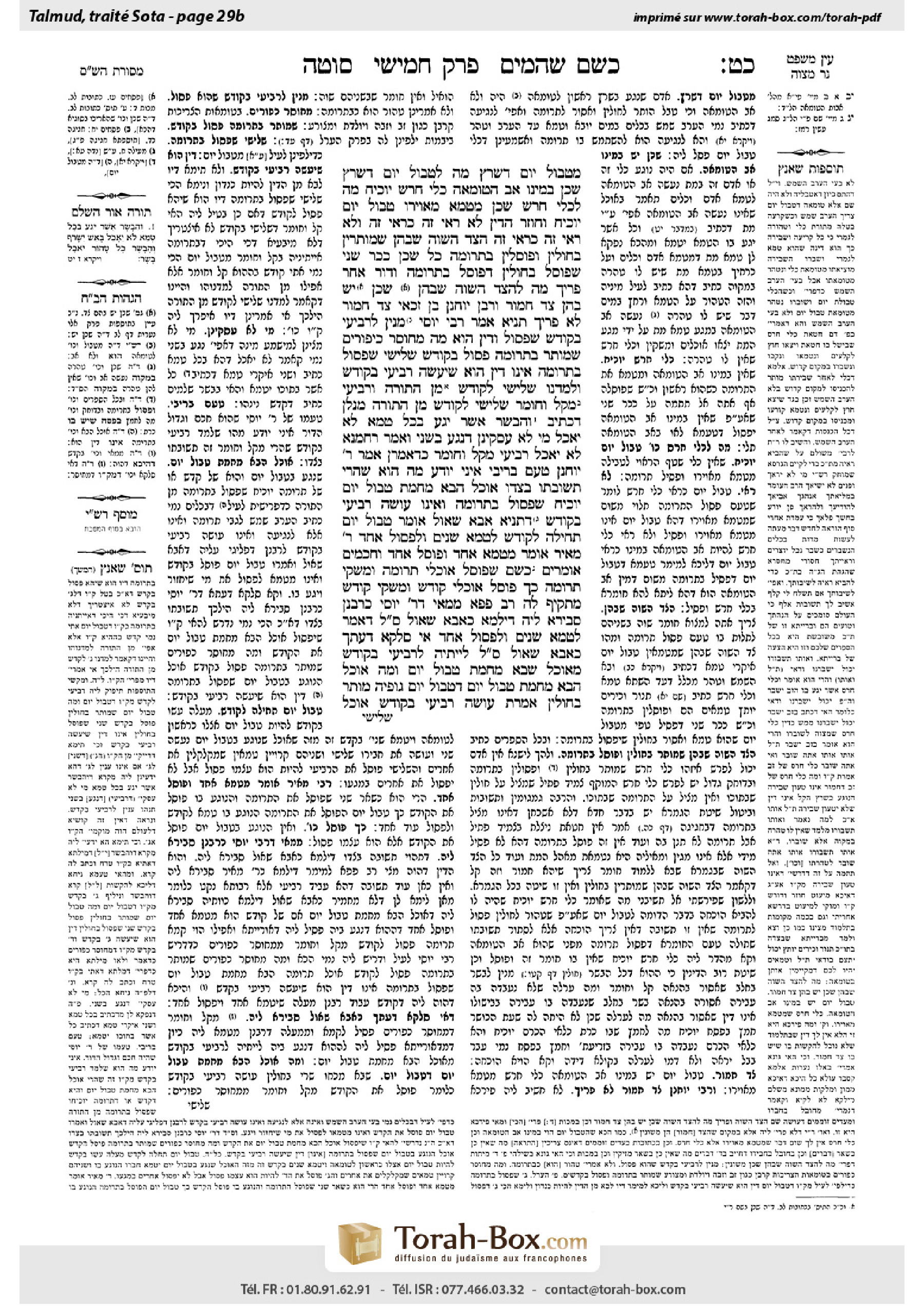
This page of Sotah includes the Aramaic text, an English translation and an AI-generated French translation, alongside the scan above.
סוטה כ״ט ב · Aramaic and Hebrew text
מִטְּבוּל יוֹם דְּשֶׁרֶץ!
מָה לִטְבוּל יוֹם דְּשֶׁרֶץ שֶׁכֵּן בְּמִינוֹ אַב הַטּוּמְאָה!
כְּלִי חֶרֶשׂ יוֹכִיחַ.
מָה לִכְלִי חֶרֶשׂ — שֶׁכֵּן מְטַמֵּא מֵאֲוִירוֹ!
טְבוּל יוֹם יוֹכִיחַ.
וְחוֹזֵר הַדִּין. לֹא רְאִי זֶה כִּרְאִי זֶה, וְלֹא רְאִי זֶה כִּרְאִי זֶה. הַצַּד הַשָּׁוֶה שֶׁבָּהֶן שֶׁמּוּתָּרִין בְּחוּלִּין, וּפוֹסְלִין בִּתְרוּמָה: כׇּל שֶׁכֵּן כִּכָּר שֵׁנִי שֶׁפּוֹסֵל בְּחוּלִּין — דְּפוֹסֵל בִּתְרוּמָה.
וְדוֹר אַחֵר פָּרֵיךְ: מָה לְהַצַּד הַשָּׁוֶה שֶׁבָּהֶן — שֶׁכֵּן יֵשׁ בָּהֶן צַד חָמוּר.
וְרַבָּן יוֹחָנָן בֶּן זַכַּאי, צַד חָמוּר לָא פָּרֵיךְ.
תַּנְיָא, אָמַר רַבִּי יוֹסֵי: מִנַּיִן לִרְבִיעִי בַּקּוֹדֶשׁ שֶׁפָּסוּל?
וְדִין הוּא: מָה מְחוּסַּר כִּיפּוּרִים, שֶׁמּוּתָּר בַּתְּרוּמָה — פָּסוּל בַּקּוֹדֶשׁ. שְׁלִישִׁי, שֶׁפָּסוּל בַּתְּרוּמָה — אֵינוֹ דִּין הוּא שֶׁיַּעֲשֶׂה רְבִיעִי בַּקּוֹדֶשׁ?
וְלָמַדְנוּ שְׁלִישִׁי לַקּוֹדֶשׁ מִן הַתּוֹרָה, וּרְבִיעִי מִקַּל וָחוֹמֶר.
שְׁלִישִׁי לַקּוֹדֶשׁ מִן הַתּוֹרָה מְנָלַן — דִּכְתִיב: ״וְהַבָּשָׂר אֲשֶׁר יִגַּע בְּכׇל טָמֵא לֹא יֵאָכֵל״. מִי לָא עָסְקִינַן דִּנְגַע בְּשֵׁנִי — וְאָמַר רַחֲמָנָא ״לֹא יֵאָכֵל״. רְבִיעִי מִקַּל וָחוֹמֶר — כְּדַאֲמַרַן.
אָמַר רַבִּי יוֹחָנָן: טַעַם בְּרִיבִּי אֵינִי יוֹדֵעַ מָה הוּא, שֶׁהֲרֵי תְּשׁוּבָתוֹ בְּצִדּוֹ: אוֹכֶל הַבָּא מֵחֲמַת טְבוּל יוֹם יוֹכִיחַ, שֶׁפָּסוּל בִּתְרוּמָה וְאֵינוֹ עוֹשֶׂה רְבִיעִי בַּקּוֹדֶשׁ.
דְּתַנְיָא, אַבָּא שָׁאוּל אוֹמֵר: טְבוּל יוֹם תְּחִילָּה לַקּוֹדֶשׁ, לְטַמֵּא שְׁנַיִם, וְלִפְסוֹל אֶחָד.
רַבִּי מֵאִיר אוֹמֵר: מְטַמֵּא אֶחָד, וּפוֹסֵל אֶחָד. וַחֲכָמִים אוֹמְרִים: כְּשֵׁם שֶׁפּוֹסֵל אוֹכְלֵי תְרוּמָה וּמַשְׁקֵי תְרוּמָה — כָּךְ פּוֹסֵל אוֹכְלֵי קוֹדֶשׁ וּמַשְׁקֵי קוֹדֶשׁ!
מַתְקֵיף לַהּ רַב פָּפָּא: מִמַּאי דְּרַבִּי יוֹסֵי כְּרַבָּנַן סְבִירָא לֵיהּ? דִּילְמָא כְּאַבָּא שָׁאוּל סְבִירָא לֵיהּ, דְּאָמַר לְטַמֵּא שְׁנַיִם וְלִפְסוֹל אֶחָד!
אִי סָלְקָא דַעְתָּךְ כְּאַבָּא שָׁאוּל סְבִירָא לֵיהּ, לַיְיתֵיהּ לִרְבִיעִי בַּקּוֹדֶשׁ מֵאוֹכֶל שֶׁבָּא מֵחֲמַת טְבוּל יוֹם.
וּמָה אוֹכֶל הַבָּא מֵחֲמַת טְבוּל יוֹם, דִּטְבוּל יוֹם גּוּפֵיהּ מוּתָּר בְּחוּלִּין — אָמְרַתְּ עוֹשֶׂה רְבִיעִי בַּקּוֹדֶשׁ, אוֹכֶל
Sotah 29b · English translation
from one who immersed that day who was never a primary source of impurity, as he was rendered impure only through contact with a creeping animal, and nevertheless he disqualifies teruma upon contact.
The Gemara continues to challenge the inference: What is unique about the impurity of one who immersed that day who was rendered impure through contact with a creeping animal is that this impurity can apply to either a person or a utensil, as people and utensils are capable of achieving purity through immersion, and within its type there can be a primary source of impurity. A loaf, however, is food, which can never be a primary source of impurity. It can only be rendered impure as a secondary source of impurity.
The Gemara answers: The halakhot of an earthenware vessel can prove that the fact that there are primary sources of impurity within its type is not a relevant factor. An earthenware vessel can never become a primary source of impurity, and nevertheless, if it is impure it disqualifies teruma upon contact.
The Gemara challenges: What is unique about an earthenware vessel is that unlike a loaf, it can render items impure or it can itself become impure from its airspace. An earthenware vessel is the only vessel that does not require direct contact with another item in order to contract or transfer impurity, but can effect or contract impurity through its airspace.
The Gemara answers: One who immersed that day can prove that being able to render items impure through airspace is not a relevant factor. Such an item disqualifies teruma, but imparts impurity only through direct contact and not through its airspace.
And the derivation has reverted to its starting point. The aspect of this case is not like the aspect of that case and the aspect of that case is not like the aspect of this case, as each case has its own unique stringencies. However, their common denominator is that non-sacred food they come into contact with is permitted, i.e., is not rendered impure, but they disqualify teruma. Therefore, Rabban Yoḥanan ben Zakkai infers a fortiori that all the more so, a loaf that contracted second-degree impurity, which is disqualified, i.e., rendered impure, even if it is non-sacred, should also disqualify teruma with which it comes into contact. This was Rabban Yoḥanan ben Zakkai’s logical a fortiori inference that led him to rule that a loaf of second-degree impurity status disqualifies teruma.
And another generation, i.e., the later generation that Rabban Yoḥanan ben Zakkai predicted would deem teruma that came into contact with second-degree impurity pure, would refute this inference as follows: What is unique about their common denominator is that both cases have a stringent aspect that does not exist in other impure items.
And Rabban Yoḥanan ben Zakkai maintained that teruma that came into contact with second-degree impurity is pure, as he would not refute an inference that is based on two sources due to the fact that both sources have a stringent aspect, since each source’s stringency is not shared by the other.
§ It is taught in a baraita (Tosefta, Ḥagiga 3:18) that Rabbi Yosei said: From where is it derived with regard to sacrificial food with fourth-degree ritual impurity that it is disqualified although it is not capable of imparting impurity to other items?
It is derived through logical inference: Just as one who is lacking atonement, e.g., a zav or leper who immersed at the conclusion of his period of impurity but has not yet brought an offering for his atonement, who is permitted to partake of teruma, nevertheless disqualifies sacrificial food if he comes into contact with it, so too, with regard to an item of third-degree impurity status, which disqualifies teruma and is therefore more severe than one who is lacking atonement, is it not logical that it should render sacrificial food with which it comes into contact as having fourth-degree impurity?
The baraita concludes: And we have therefore derived that third-degree impurity applies to sacrificial food from an explicit verse in the Torah, and we have derived that fourth-degree impurity applies to sacrificial food by means of the above a fortiori inference.
The Gemara asks: From where in the Torah do we derive that third-degree impurity applies to sacrificial food? The Gemara answers: As it is written: “And the flesh that touches any impure thing shall not be eaten” (Leviticus 7:19). Are we not dealing in the verse with meat that touches even an item of second-degree impurity? And the Merciful One states that it “shall not be eaten,” indicating that it assumes third-degree impurity. Therefore, fourth-degree impurity can be derived by means of the a fortiori inference of Rabbi Yosei, as we stated above.
Rabbi Yoḥanan says: With regard to the reasoning behind the Distinguished Rabbi Yosei’s a fortiori inference, I do not know what it is, as the response to his inference is right by its side: Food whose impurity came from contact with one who immersed that day can prove that a degree of impurity that disqualifies teruma does not necessarily impart fourth-degree impurity to sacrificial food, as this food disqualifies teruma upon contact, but it does not impart fourth-degree impurity upon sacrificial food.
As it is taught in a baraita (Tosefta, Teharot 1:4) that Abba Shaul says: With regard to one who immersed that day, until sunset he is treated as one who is impure with first-degree impurity vis-à-vis sacrificial food, in that he is able to render two items of sacrificial food impure and to disqualify one additional item. In other words, the first item of sacrificial food that he touches assumes the status of a second-degree impurity. A second item that comes into contact with the first one assumes third-degree impurity. A third item that comes into contact with the second assumes fourth-degree impurity and is therefore disqualified from being eaten, though it cannot impart impurity to other items.
Rabbi Meir says: One who immersed that day is considered impure with second-degree impurity, even vis-à-vis sacrificial food, and as such renders only one item impure and disqualifies one additional item. And the Rabbis say: Just as he merely disqualifies teruma foods and teruma liquids, without transferring to them impurity that can then be transferred further, so too, he merely disqualifies sacrificial foods and sacrificial liquids. In other words, the impurity imparted by one who immersed that day can reach only third-degree impurity and not fourth-degree impurity, contrary to the opinion of Rabbi Yosei.
Rav Pappa objects to Rabbi Yoḥanan’s argument: From where is the presumption derived that Rabbi Yosei holds in accordance with the opinion of the Rabbis? Perhaps he holds in accordance with the opinion of Abba Shaul, who says that one who immersed that day is able to render two items of sacrificial food impure, and to disqualify one additional item.
The Gemara answers: If it enters your mind that Rabbi Yosei holds in accordance with the opinion of Abba Shaul, he should have brought proof for the existence of a fourth degree of ritual impurity with regard to sacrificial food from the case of food whose impurity came from one who immersed that day, as follows:
Just as with regard to food whose impurity came from one who immersed that day, while the one who immersed that day is himself permitted to consume non-sacred food, nevertheless you say that the food imparts fourth-degree impurity status upon sacrificial food, then with regard to food
Sotah 29b · Traduction française (IA)
à partir du cas d’une personne qui s’est immergée ce jour-là et qui n’a jamais été une source première d’impureté, puisqu’elle n’a été rendue impure que par contact avec un animal rampant, et qui, pourtant, disqualifie la terouma par contact.
La Guemara poursuit la réfutation de cette déduction : qu’y a-t-il de particulier dans l’impureté d’une personne qui s’est immergée ce jour-là après avoir été rendue impure par contact avec un animal rampant ? Cette impureté peut concerner aussi bien une personne qu’un ustensile, car les personnes et les ustensiles peuvent être purifiés par immersion ; de plus, dans cette catégorie, il peut y avoir une source première d’impureté. Une miche, en revanche, est un aliment, qui ne peut jamais être une source première d’impureté. Elle ne peut être rendue impure qu’au degré secondaire.
La Guemara répond : Les halakhot d’un récipient en terre cuite prouvent que la présence de sources premières d’impureté dans cette catégorie n’est pas un facteur pertinent. Un récipient en terre cuite ne peut jamais devenir une source première d’impureté et, pourtant, s’il est impur, il disqualifie la terouma par contact.
La Guemara objecte : qu’y a-t-il de particulier dans le cas d’un récipient en terre cuite ? Contrairement à une miche, il peut rendre des objets impurs ou être lui-même rendu impur par son espace intérieur. Un récipient en terre cuite est le seul récipient qui n’exige pas de contact direct avec un autre objet pour contracter ou transmettre l’impureté : il peut transmettre l’impureté par son espace intérieur ou la contracter de cette manière.
La Guemara répond : Le cas d’une personne qui s’est immergée ce jour-là prouve que la capacité de rendre des objets impurs par l’espace intérieur n’est pas un facteur pertinent. Un tel élément disqualifie la terouma, mais ne transmet l’impureté que par contact direct, et non par son espace intérieur.
La déduction revient donc à son point de départ. Le caractère de ce cas n’est pas semblable à celui de l’autre, et celui de l’autre n’est pas semblable à celui-ci, car chacun comporte des rigueurs qui lui sont propres. Toutefois, leur dénominateur commun est que les aliments non consacrés qu’ils touchent restent permis, c’est-à-dire qu’ils ne sont pas rendus impurs, tandis qu’eux-mêmes disqualifient la terouma. Rabban Yoḥanan ben Zakkaï en déduit donc a fortiori qu’à plus forte raison, une miche qui a contracté une impureté du deuxième degré, et qui est disqualifiée, c’est-à-dire rendue impure, même si elle est non consacrée, devrait également disqualifier la terouma qu’elle touche. Telle était la déduction a fortiori de Rabban Yoḥanan ben Zakkaï, qui l’a conduit à statuer qu’une miche ayant le statut d’impureté du deuxième degré disqualifie la terouma.
Et une autre génération, c’est-à-dire la génération ultérieure dont Rabban Yoḥanan ben Zakkaï avait prédit qu’elle déclarerait pure la terouma ayant été en contact avec une impureté du deuxième degré, réfuterait cette déduction de la manière suivante : ce qui caractérise leur dénominateur commun, c’est que chacun des deux cas comporte un aspect rigoureux qui n’existe pas dans les autres objets impurs.
Rabban Yoḥanan ben Zakkaï estimait que la terouma ayant été en contact avec une impureté du deuxième degré est pure, car il ne réfuterait pas une déduction fondée sur deux sources au motif que toutes deux comportent un aspect rigoureux, puisque la rigueur propre à chacune n’est pas partagée par l’autre.
§ Il est enseigné dans une baraïta (Tosefta, Ḥagiga 3:18) que Rabbi Yosei a dit : D’où déduit-on, au sujet d’un aliment consacré ayant une impureté rituelle du quatrième degré, qu’il est disqualifié bien qu’il ne puisse pas transmettre l’impureté à d’autres objets ?
On le déduit par raisonnement : de même qu’une personne dont l’expiation est incomplète — par exemple un zav ou un lépreux qui s’est immergé à la fin de sa période d’impureté, mais n’a pas encore apporté d’offrande pour son expiation —, bien qu’autorisée à consommer de la terouma, disqualifie néanmoins l’aliment consacré qu’elle touche, de même, au sujet d’un objet ayant le statut d’impureté du troisième degré, qui disqualifie la terouma et est donc plus sévère qu’une personne dont l’expiation est incomplète, n’est-il pas logique qu’il confère une impureté du quatrième degré à l’aliment consacré qu’il touche ?
La baraïta conclut : Nous avons donc déduit qu’une impureté du troisième degré s’applique aux aliments consacrés à partir d’un verset explicite de la Torah, et qu’une impureté du quatrième degré s’applique aux aliments consacrés au moyen de la déduction a fortiori ci-dessus.
La Guemara demande : D’où déduit-on dans la Torah qu’une impureté du troisième degré s’applique aux aliments consacrés ? La Guemara répond : Car il est écrit : « Et la chair qui touche quelque chose d’impur ne sera pas mangée » (Lévitique 7:19). Le verset ne traite-t-il pas d’une viande qui touche même un objet ayant une impureté du deuxième degré ? Or le Miséricordieux dit qu’elle « ne sera pas mangée », ce qui indique qu’elle acquiert le statut d’impureté du troisième degré. On peut donc déduire l’impureté du quatrième degré au moyen du raisonnement a fortiori de Rabbi Yosei, comme nous l’avons indiqué plus haut.
Rabbi Yoḥanan dit : Quant au raisonnement qui sous-tend la déduction a fortiori de l’éminent Rabbi Yosei, je l’ignore, car la réfutation de sa déduction se trouve juste à côté : un aliment dont l’impureté provient du contact avec une personne qui s’est immergée ce jour-là prouve qu’un degré d’impureté qui disqualifie la terouma ne transmet pas nécessairement une impureté du quatrième degré aux aliments consacrés. En effet, cet aliment disqualifie la terouma par contact, mais ne transmet pas une impureté du quatrième degré aux aliments consacrés.
Car il est enseigné dans une baraïta (Tosefta, Teharot 1:4) qu’Abba Shaoul dit : Jusqu’au coucher du soleil, une personne qui s’est immergée ce jour-là est considérée, à l’égard des aliments consacrés, comme ayant une impureté du premier degré, en ce qu’elle peut rendre impurs deux aliments consacrés et en disqualifier un troisième. Autrement dit, le premier aliment consacré qu’elle touche acquiert le statut d’impureté du deuxième degré. Un deuxième aliment qui entre en contact avec le premier acquiert le statut du troisième degré. Un troisième aliment qui entre en contact avec le deuxième acquiert le statut du quatrième degré et est donc disqualifié pour la consommation, bien qu’il ne puisse pas transmettre l’impureté à d’autres objets.
Rabbi Meïr dit : Une personne qui s’est immergée ce jour-là est considérée comme ayant une impureté du deuxième degré, même à l’égard des aliments consacrés ; elle ne rend donc impur qu’un seul aliment et en disqualifie un autre. Et les Sages disent : De même qu’elle ne fait que disqualifier les aliments et les liquides de terouma, sans leur transmettre une impureté qui pourrait ensuite être transmise plus loin, de même elle ne fait que disqualifier les aliments et les liquides consacrés. Autrement dit, l’impureté transmise par une personne qui s’est immergée ce jour-là ne peut atteindre que le troisième degré, et non le quatrième, contrairement à l’opinion de Rabbi Yosei.
Rav Pappa objecte à l’argument de Rabbi Yoḥanan : d’où vient l’hypothèse que Rabbi Yosei suit l’opinion des Sages ? Peut-être suit-il l’opinion d’Abba Shaoul, qui dit qu’une personne qui s’est immergée ce jour-là peut rendre impurs deux aliments consacrés et en disqualifier un troisième.
La Guemara répond : Si l’on devait penser que Rabbi Yosei suit l’opinion d’Abba Shaoul, il aurait dû apporter une preuve de l’existence d’un quatrième degré d’impureté rituelle pour les aliments consacrés à partir du cas d’un aliment dont l’impureté provient d’une personne qui s’est immergée ce jour-là, de la manière suivante :
De même que, dans le cas d’un aliment dont l’impureté provient d’une personne qui s’est immergée ce jour-là, alors que cette personne est elle-même autorisée à consommer des aliments non consacrés, tu dis néanmoins que l’aliment confère le statut d’impureté du quatrième degré à un aliment consacré, de même, au sujet d’un aliment
Traduction française générée par IA à partir de l’édition anglaise de Sefaria. Vérifie toujours un passage avec le texte source.
Text from Sefaria: William Davidson Edition - Vocalized Aramaic (CC BY NC); William Davidson Edition - English (CC BY NC).